Project Management on
Pre-lacteal Feeding
Prepared and Submitted by: Basanta Chalise(01)
MHP&E
IOM
Analysis of Situation
Step 1- Identifying and Understanding the Problem
Step 2- Determining Potential Audiences
Step 3- Identifying Potential Communication Resources
Step 4- Assessing the Environment
Step 5- SWOT analysis
Identifying and Understanding the Problem
Background
• Exclusive breastfeeding (EBF) for first six months of
life is beneficial to child and mother [1,2].
• EBF protects a child from under nutrition and
gastro-enteristis. In the long run, EBF is protective
against a number of chronic disease such as
leukaemia, type 2 diabetes, and obesity [3,4].
• Breastfeeding also has proven benefits for the
neuro-cognitive development of the child,
protection from childhood respiratory illness and
protection for the mother from breast cancer.
• EBF also saves the cost associated with illnesses
that arise out of the above mentioned illnesses [5].
Background
• For these reasons, the World Health Organization
(WHO), United Nations Children’s Fund (UNICEF)
and Ministry of Health and Population Nepal
recommend and promote exclusive breastfeeding
for first six months of life and continuation of
breastfeeding thereafter [6-8].
• Any food provided to a newborn before the
initiation of mother’s breastfeeding is considered to
be a prelacteal feed. The type of prelacteal feeds
depends on the culture. It may include ghee (refined
butter), honey, sugar, sugar juice, unboiled cow/goat
milk etc [9].
Background
• The practice of prelacteal feeding is a major cultural
practice still prevalent in many places throughout
South Asia regions [9].
• All prelacteal feeds are provided for non nutritional
reasons such as clearing the throat/bowel; or
thinking that mother’s milk is insufficient or the
colostrum is too heavy for the newborn to digest [9].
• Prelacteal feeds have lesser nutrient and
immunological value; and are often likely to
introduce contaminants [9].
Background
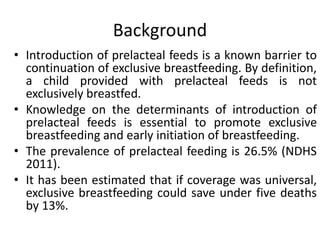
• Introduction of prelacteal feeds is a known barrier to
continuation of exclusive breastfeeding. By definition,
a child provided with prelacteal feeds is not
exclusively breastfed.
• Knowledge on the determinants of introduction of
prelacteal feeds is essential to promote exclusive
breastfeeding and early initiation of breastfeeding.
• The prevalence of prelacteal feeding is 26.5% (NDHS
2011).
• It has been estimated that if coverage was universal,
exclusive breastfeeding could save under five deaths
by 13%.
Vision
There will be no practice of pre-lacteal feeding in
newborn.
Desired behaviors
• Avoid pre-lacteal feeding and practice
exclusive Breastfeeding
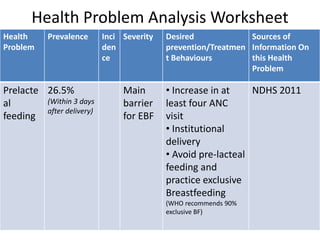
Health Problem Analysis Worksheet
Health
Problem
Prevalence Inci
den
ce
Severity Desired
prevention/Treatmen
t Behaviours
Sources of
Information On
this Health
Problem
Prelacte
al
feeding
26.5%
(Within 3 days
after delivery)
Main
barrier
for EBF
• Increase in at
least four ANC
visit
• Institutional
delivery
• Avoid pre-lacteal
feeding and
practice exclusive
Breastfeeding
(WHO recommends 90%
exclusive BF)
NDHS 2011
Determining Potential Audiences
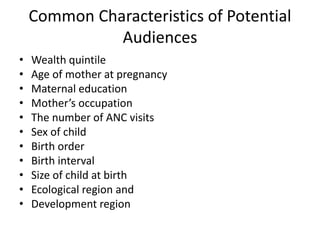
Common Characteristics of Potential
Audiences
• Wealth quintile
• Age of mother at pregnancy
• Maternal education
• Mother’s occupation
• The number of ANC visits
• Sex of child
• Birth order
• Birth interval
• Size of child at birth
• Ecological region and
• Development region
Identify known barrier to behavior change
• Availability – One of the study done in Bhaktapur
district in 2012 showed that 72.3% women didn’t had
information about Breastfeeding during ANC visit.[10]
• Accessibility – Due to geographical difficulties,
unavailability of HWs, traditional home delivery
practices etc (Fifty-eight percent of mothers received antenatal care from a skilled
provider (a doctor, nurse, or midwife) for their most recent birth in the five years preceding
the survey). (NDHS 2011)
• Affordability – ANC services are provided free of cost
in government institutions. In addition they can get
incentive after institutional delivery.
• Acceptability – in most of the society of Nepal there is
practice of pre lacteal feeding before colostrum
feeding.
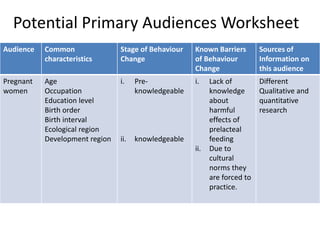
Potential Primary Audiences Worksheet
Audience Common
characteristics
Stage of Behaviour
Change
Known Barriers
of Behaviour
Change
Sources of
Information on
this audience
Pregnant
women
Age
Occupation
Education level
Birth order
Birth interval
Ecological region
Development region
i. Pre-
knowledgeable
ii. knowledgeable
i. Lack of
knowledge
about
harmful
effects of
prelacteal
feeding
ii. Due to
cultural
norms they
are forced to
practice.
Different
Qualitative and
quantitative
research
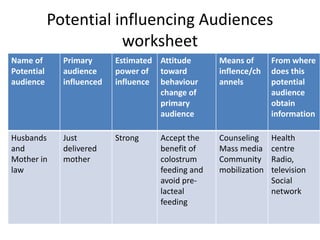
Potential influencing Audiences
worksheet
Name of
Potential
audience
Primary
audience
influenced
Estimated
power of
influence
Attitude
toward
behaviour
change of
primary
audience
Means of
inflence/ch
annels
From where
does this
potential
audience
obtain
information
Husbands
and
Mother in
law
Just
delivered
mother
Strong Accept the
benefit of
colostrum
feeding and
avoid pre-
lacteal
feeding
Counseling
Mass media
Community
mobilization
Health
centre
Radio,
television
Social
network
Identifying Potential Communication resources
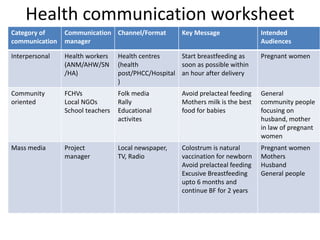
Health communication worksheet
Category of
communication
Communication
manager
Channel/Format Key Message Intended
Audiences
Interpersonal Health workers
(ANM/AHW/SN
/HA)
Health centres
(health
post/PHCC/Hospital
)
Start breastfeeding as
soon as possible within
an hour after delivery
Pregnant women
Community
oriented
FCHVs
Local NGOs
School teachers
Folk media
Rally
Educational
activites
Avoid prelacteal feeding
Mothers milk is the best
food for babies
General
community people
focusing on
husband, mother
in law of pregnant
women
Mass media Project
manager
Local newspaper,
TV, Radio
Colostrum is natural
vaccination for newborn
Avoid prelacteal feeding
Excusive Breastfeeding
upto 6 months and
continue BF for 2 years
Pregnant women
Mothers
Husband
General people
Assessing the Environment
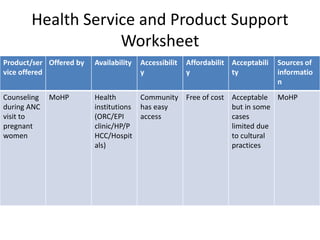
Health Service and Product Support
Worksheet
Product/ser
vice offered
Offered by Availability Accessibilit
y
Affordabilit
y
Acceptabili
ty
Sources of
informatio
n
Counseling
during ANC
visit to
pregnant
women
MoHP Health
institutions
(ORC/EPI
clinic/HP/P
HCC/Hospit
als)
Community
has easy
access
Free of cost Acceptable
but in some
cases
limited due
to cultural
practices
MoHP
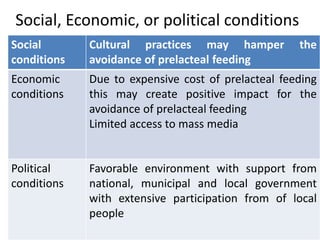
Social, Economic, or political conditions
Social
conditions
Cultural practices may hamper the
avoidance of prelacteal feeding
Economic
conditions
Due to expensive cost of prelacteal feeding
this may create positive impact for the
avoidance of prelacteal feeding
Limited access to mass media
Political
conditions
Favorable environment with support from
national, municipal and local government
with extensive participation from of local
people
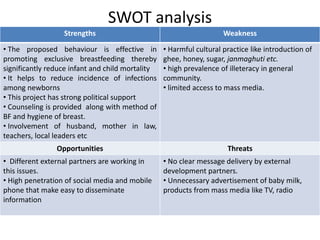
SWOT analysis
Strengths Weakness
• The proposed behaviour is effective in
promoting exclusive breastfeeding thereby
significantly reduce infant and child mortality
• It helps to reduce incidence of infections
among newborns
• This project has strong political support
• Counseling is provided along with method of
BF and hygiene of breast.
• Involvement of husband, mother in law,
teachers, local leaders etc
• Harmful cultural practice like introduction of
ghee, honey, sugar, janmaghuti etc.
• high prevalence of illeteracy in general
community.
• limited access to mass media.
Opportunities Threats
• Different external partners are working in
this issues.
• High penetration of social media and mobile
phone that make easy to disseminate
information
• No clear message delivery by external
development partners.
• Unnecessary advertisement of baby milk,
products from mass media like TV, radio
References
1. Ip S, Chung M, Raman G, Trikalinos TA, Lau J: A summary of the agency for healthcare research
and quality's evidence report on breastfeeding in developed countries. Breastfeed Med 2009,
4(Suppl 1):S17–S30.
2. World Health Organization: Infant and young child feeding: model chapter for textbooks for
medical students and allied health professionals. Geneva: World Health Organization; 2009.
3. Jones ME, Swerdlow AJ, Gill LE, Goldacre MJ: Pre-natal and early life risk factors for childhood
onset diabetes mellitus: a record linkage study. Int J Epidemiol 1998, 27:444–449.
4. Pettitt DJ, Forman MR, Hanson RL, Knowler WC, Bennett PH: Breastfeeding and incidence of non-
insulin-dependent diabetes mellitus in Pima Indians. Lancet 1997, 350:166–168.
5. Kramer MS: "Breast is best": the evidence. Early Hum Dev 2010, 86:729–732.
6. The World Health Organization: Indicators for assessing infant and young child feeding practices.
Geneva: The World Health Organization; 2008.
7. Baby friendly hospital initiative (BFHI): http://www.unicef.org/nutrition/index_24806.html.
8. Ministry of Health and Population: Annual report. Kathmandu: Department of Health Services.
2010/2011.
9. Laroia N, Sharma D: The religious and cultural bases for breastfeeding practices among the
Hindus. Breastfeed Med 2006, 1:94–98.
10. Ulak M, Chandyo RK, Mellander L, Shrestha PS, Strand TA. Infant feeding practices in Bhaktapur,
Nepal: across-sectional, health facility based survey. International Breastfeeding Journal 2012,
7:1
A field Guide to Designing A Health Communication Strategy, Population Communication
Services, JHU
Thank You

Situation Analysis of Project Planning

  • 1.
    Project Management on Pre-lactealFeeding Prepared and Submitted by: Basanta Chalise(01) MHP&E IOM
  • 2.
    Analysis of Situation Step1- Identifying and Understanding the Problem Step 2- Determining Potential Audiences Step 3- Identifying Potential Communication Resources Step 4- Assessing the Environment Step 5- SWOT analysis
  • 3.
  • 4.
    Background • Exclusive breastfeeding(EBF) for first six months of life is beneficial to child and mother [1,2]. • EBF protects a child from under nutrition and gastro-enteristis. In the long run, EBF is protective against a number of chronic disease such as leukaemia, type 2 diabetes, and obesity [3,4]. • Breastfeeding also has proven benefits for the neuro-cognitive development of the child, protection from childhood respiratory illness and protection for the mother from breast cancer. • EBF also saves the cost associated with illnesses that arise out of the above mentioned illnesses [5].
  • 5.
    Background • For thesereasons, the World Health Organization (WHO), United Nations Children’s Fund (UNICEF) and Ministry of Health and Population Nepal recommend and promote exclusive breastfeeding for first six months of life and continuation of breastfeeding thereafter [6-8]. • Any food provided to a newborn before the initiation of mother’s breastfeeding is considered to be a prelacteal feed. The type of prelacteal feeds depends on the culture. It may include ghee (refined butter), honey, sugar, sugar juice, unboiled cow/goat milk etc [9].
  • 6.
    Background • The practiceof prelacteal feeding is a major cultural practice still prevalent in many places throughout South Asia regions [9]. • All prelacteal feeds are provided for non nutritional reasons such as clearing the throat/bowel; or thinking that mother’s milk is insufficient or the colostrum is too heavy for the newborn to digest [9]. • Prelacteal feeds have lesser nutrient and immunological value; and are often likely to introduce contaminants [9].
  • 7.
    Background • Introduction ofprelacteal feeds is a known barrier to continuation of exclusive breastfeeding. By definition, a child provided with prelacteal feeds is not exclusively breastfed. • Knowledge on the determinants of introduction of prelacteal feeds is essential to promote exclusive breastfeeding and early initiation of breastfeeding. • The prevalence of prelacteal feeding is 26.5% (NDHS 2011). • It has been estimated that if coverage was universal, exclusive breastfeeding could save under five deaths by 13%.
  • 8.
    Vision There will beno practice of pre-lacteal feeding in newborn.
  • 9.
    Desired behaviors • Avoidpre-lacteal feeding and practice exclusive Breastfeeding
  • 10.
    Health Problem AnalysisWorksheet Health Problem Prevalence Inci den ce Severity Desired prevention/Treatmen t Behaviours Sources of Information On this Health Problem Prelacte al feeding 26.5% (Within 3 days after delivery) Main barrier for EBF • Increase in at least four ANC visit • Institutional delivery • Avoid pre-lacteal feeding and practice exclusive Breastfeeding (WHO recommends 90% exclusive BF) NDHS 2011
  • 11.
  • 12.
    Common Characteristics ofPotential Audiences • Wealth quintile • Age of mother at pregnancy • Maternal education • Mother’s occupation • The number of ANC visits • Sex of child • Birth order • Birth interval • Size of child at birth • Ecological region and • Development region
  • 13.
    Identify known barrierto behavior change • Availability – One of the study done in Bhaktapur district in 2012 showed that 72.3% women didn’t had information about Breastfeeding during ANC visit.[10] • Accessibility – Due to geographical difficulties, unavailability of HWs, traditional home delivery practices etc (Fifty-eight percent of mothers received antenatal care from a skilled provider (a doctor, nurse, or midwife) for their most recent birth in the five years preceding the survey). (NDHS 2011) • Affordability – ANC services are provided free of cost in government institutions. In addition they can get incentive after institutional delivery. • Acceptability – in most of the society of Nepal there is practice of pre lacteal feeding before colostrum feeding.
  • 14.
    Potential Primary AudiencesWorksheet Audience Common characteristics Stage of Behaviour Change Known Barriers of Behaviour Change Sources of Information on this audience Pregnant women Age Occupation Education level Birth order Birth interval Ecological region Development region i. Pre- knowledgeable ii. knowledgeable i. Lack of knowledge about harmful effects of prelacteal feeding ii. Due to cultural norms they are forced to practice. Different Qualitative and quantitative research
  • 15.
    Potential influencing Audiences worksheet Nameof Potential audience Primary audience influenced Estimated power of influence Attitude toward behaviour change of primary audience Means of inflence/ch annels From where does this potential audience obtain information Husbands and Mother in law Just delivered mother Strong Accept the benefit of colostrum feeding and avoid pre- lacteal feeding Counseling Mass media Community mobilization Health centre Radio, television Social network
  • 16.
  • 17.
    Health communication worksheet Categoryof communication Communication manager Channel/Format Key Message Intended Audiences Interpersonal Health workers (ANM/AHW/SN /HA) Health centres (health post/PHCC/Hospital ) Start breastfeeding as soon as possible within an hour after delivery Pregnant women Community oriented FCHVs Local NGOs School teachers Folk media Rally Educational activites Avoid prelacteal feeding Mothers milk is the best food for babies General community people focusing on husband, mother in law of pregnant women Mass media Project manager Local newspaper, TV, Radio Colostrum is natural vaccination for newborn Avoid prelacteal feeding Excusive Breastfeeding upto 6 months and continue BF for 2 years Pregnant women Mothers Husband General people
  • 18.
  • 19.
    Health Service andProduct Support Worksheet Product/ser vice offered Offered by Availability Accessibilit y Affordabilit y Acceptabili ty Sources of informatio n Counseling during ANC visit to pregnant women MoHP Health institutions (ORC/EPI clinic/HP/P HCC/Hospit als) Community has easy access Free of cost Acceptable but in some cases limited due to cultural practices MoHP
  • 20.
    Social, Economic, orpolitical conditions Social conditions Cultural practices may hamper the avoidance of prelacteal feeding Economic conditions Due to expensive cost of prelacteal feeding this may create positive impact for the avoidance of prelacteal feeding Limited access to mass media Political conditions Favorable environment with support from national, municipal and local government with extensive participation from of local people
  • 21.
    SWOT analysis Strengths Weakness •The proposed behaviour is effective in promoting exclusive breastfeeding thereby significantly reduce infant and child mortality • It helps to reduce incidence of infections among newborns • This project has strong political support • Counseling is provided along with method of BF and hygiene of breast. • Involvement of husband, mother in law, teachers, local leaders etc • Harmful cultural practice like introduction of ghee, honey, sugar, janmaghuti etc. • high prevalence of illeteracy in general community. • limited access to mass media. Opportunities Threats • Different external partners are working in this issues. • High penetration of social media and mobile phone that make easy to disseminate information • No clear message delivery by external development partners. • Unnecessary advertisement of baby milk, products from mass media like TV, radio
  • 22.
    References 1. Ip S,Chung M, Raman G, Trikalinos TA, Lau J: A summary of the agency for healthcare research and quality's evidence report on breastfeeding in developed countries. Breastfeed Med 2009, 4(Suppl 1):S17–S30. 2. World Health Organization: Infant and young child feeding: model chapter for textbooks for medical students and allied health professionals. Geneva: World Health Organization; 2009. 3. Jones ME, Swerdlow AJ, Gill LE, Goldacre MJ: Pre-natal and early life risk factors for childhood onset diabetes mellitus: a record linkage study. Int J Epidemiol 1998, 27:444–449. 4. Pettitt DJ, Forman MR, Hanson RL, Knowler WC, Bennett PH: Breastfeeding and incidence of non- insulin-dependent diabetes mellitus in Pima Indians. Lancet 1997, 350:166–168. 5. Kramer MS: "Breast is best": the evidence. Early Hum Dev 2010, 86:729–732. 6. The World Health Organization: Indicators for assessing infant and young child feeding practices. Geneva: The World Health Organization; 2008. 7. Baby friendly hospital initiative (BFHI): http://www.unicef.org/nutrition/index_24806.html. 8. Ministry of Health and Population: Annual report. Kathmandu: Department of Health Services. 2010/2011. 9. Laroia N, Sharma D: The religious and cultural bases for breastfeeding practices among the Hindus. Breastfeed Med 2006, 1:94–98. 10. Ulak M, Chandyo RK, Mellander L, Shrestha PS, Strand TA. Infant feeding practices in Bhaktapur, Nepal: across-sectional, health facility based survey. International Breastfeeding Journal 2012, 7:1 A field Guide to Designing A Health Communication Strategy, Population Communication Services, JHU
  • 23.