2
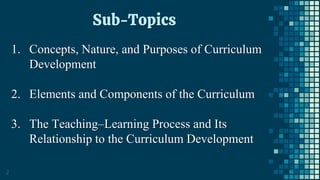
Sub-Topics
1. Concepts, Nature,and Purposes of Curriculum
Development
2. Elements and Components of the Curriculum
3. The Teaching–Learning Process and Its
Relationship to the Curriculum Development
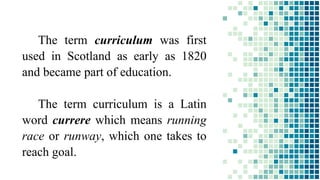
The term curriculumwas first
used in Scotland as early as 1820
and became part of education.
The term curriculum is a Latin
word currere which means running
race or runway, which one takes to
reach goal.
5.
Traditional Points ofView of Curriculum
5
▪ Curriculum is a body of subjects or subject matter prepared by the
teachers for the students to learn.
▪ It is synonymous to course of the study or syllabus (written
documents or a plan of action in accomplishing goals)
▪ Curriculum is permanent studies where the rules of grammar,
reading, rhetoric and logic, and mathematics for basic education
are emphasized. (Robin M. Hutchins)
▪ The mission of the schools should be intellectual training; hence
curriculum should focus on the fundamental intellectual disciplines
of grammar, literature, and writing, and also mathematics, science,
history, and foreign language. (Arthur Bestor)
▪ Discipline is the sole source of curriculum. Curriculum is divided
into chunks of knowledge – subject areas. (Joseph Schwab)
6.
Progressive Points ofView of Curriculum
6
▪ A listing of school subjects, syllabi, course of study, and list of
courses or specific disciplines do not make a curriculum. (These can
only be called curriculum if the written materials are actualized by
the learner.)
▪ Curriculum is the total learning experiences of the individual.
(anchored on John Dewey’s definition of experience and education)
▪ All experiences of children have under the guidance of teachers.
(Caswell and Campbell)
▪ Curriculum is all the experiences in the classroom which are planned
and enacted by the teacher, and also learned by the students. (Marsh
and Willis)
▪ Curriculum is a sequence of potential experiences set up in schools
for the purpose of disciplining children and youth in group ways of
thinking and acting. (Smith, Stanley, and Shores)
7.
Curriculum Development
7
Curriculum isa dynamic process. Development connotes changes
which are systematic. A change for the better means any alteration,
modification, or improvement of existing condition. To produce
positive changes, development should be purposeful, planned, and
progressive. This is how curriculum evolves.
Curriculum development is the process of selecting, organizing,
executing, and evaluating learning experiences on the basis of the
needs, abilities, and interests of the learners and the nature of the society
or community.
8.
8
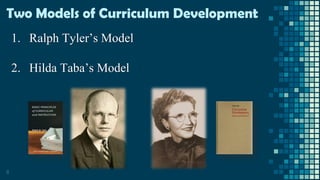
Two Models ofCurriculum Development
1. Ralph Tyler’s Model
2. Hilda Taba’s Model
9.
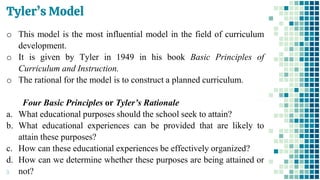
Tyler’s Model
9
o Thismodel is the most influential model in the field of curriculum
development.
o It is given by Tyler in 1949 in his book Basic Principles of
Curriculum and Instruction.
o The rational for the model is to construct a planned curriculum.
Four Basic Principles or Tyler’s Rationale
a. What educational purposes should the school seek to attain?
b. What educational experiences can be provided that are likely to
attain these purposes?
c. How can these educational experiences be effectively organized?
d. How can we determine whether these purposes are being attained or
not?
10.
Taba’s Model
10
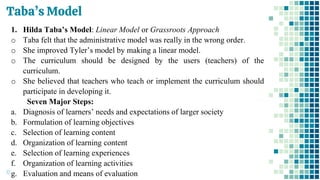
1. HildaTaba’s Model: Linear Model or Grassroots Approach
o Taba felt that the administrative model was really in the wrong order.
o She improved Tyler’s model by making a linear model.
o The curriculum should be designed by the users (teachers) of the
curriculum.
o She believed that teachers who teach or implement the curriculum should
participate in developing it.
Seven Major Steps:
a. Diagnosis of learners’ needs and expectations of larger society
b. Formulation of learning objectives
c. Selection of learning content
d. Organization of learning content
e. Selection of learning experiences
f. Organization of learning activities
g. Evaluation and means of evaluation
Types of CurriculumOperating in Schools
12
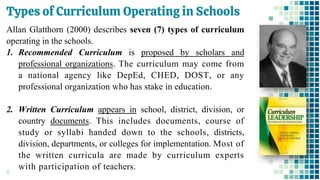
Allan Glatthorn (2000) describes seven (7) types of curriculum
operating in the schools.
1. Recommended Curriculum is proposed by scholars and
professional organizations. The curriculum may come from
a national agency like DepEd, CHED, DOST, or any
professional organization who has stake in education.
2. Written Curriculum appears in school, district, division, or
country documents. This includes documents, course of
study or syllabi handed down to the schools, districts,
division, departments, or colleges for implementation. Most of
the written curricula are made by curriculum experts
with participation of teachers.
13.
Types of CurriculumOperating in Schools
13
3. Taught Curriculum is what teachers implement or deliver in the
classrooms and schools. The different planned activities which
are put into action in the classroom compose the taught
curriculum. These are varied activities that are
implemented in order to arrive at the objectives or purposes.
4. Supported Curriculum In order to have a successful
teaching, other than the teacher, there must be materials
which should support or help in the implementation of a written
curriculum. These refer to the support curriculum that
includes material resources such as textbooks, computers,
computers, audio visual materials, laboratory equipment, zoos,
and other facilities.
14.
Types of CurriculumOperating in Schools
14
5. Assessed curriculum is that which is tested and evaluated.
This refers to a tested or evaluated curriculum. At the
duration and end of the teaching episodes, series of
evaluations are being done by the teachers to determine
the extent of teaching or to tell if the students are
progressing.
6. Learned Curriculum is what the students actually learn and
what is measured. This refers to the learning outcomes
achieved by the students. Learning outcomes are indicated
by the results of the tests and changes in behavior which
can either be cognitive, affective, or psychomotor.
15.
Types of CurriculumOperating in Schools
15
7. Hidden Curriculum is the unintended curriculum which is
not deliberately planned but may modify behavior or
influence learning outcomes. Peer influence, school
environment, physical condition, teacher-learner
interaction, mood of the teachers, etc.
8. Concomitant Curriculum comprises things that are taught at
home, those experiences that are part of a family’s
experiences, or related experiences sanctioned by the family.
This type of curriculum may be received at church, in the
context of religious expression, lessons on values, ethics or
morals, molded behaviors, or social experiences based on a
family’s experiences.
16.
Types of CurriculumOperating in Schools
16
9. Phantom Curriculum consists of the messages prevalent in
and through exposure to media.
10. Null is what is not taught. Not teaching some particular idea or
sets of ideas may be due to mandates from higher authorities,
to a teacher’s lack of knowledge, or to deeply ingrained
assumptions and biases.
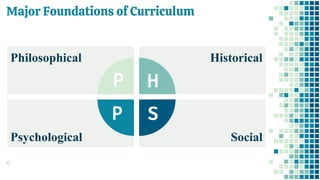
Philosophical Foundation ofCurriculum
18
• Philosophy provides educators, teachers, and curriculum makers
with framework for planning, implementing, and evaluating
curriculum in schools.
• Philosophy helps in answering what schools are for, what subjects
are important, how students should learn, and what materials and
methods should be used.
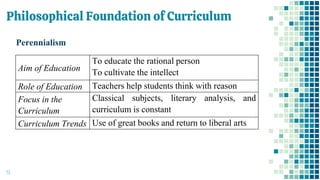
19.
Philosophical Foundation ofCurriculum
19
Aim of Education
To educate the rational person
To cultivate the intellect
Role of Education Teachers help students think with reason
Focus in the
Curriculum
Classical subjects, literary analysis, and
curriculum is constant
Curriculum Trends Use of great books and return to liberal arts
Perennialism
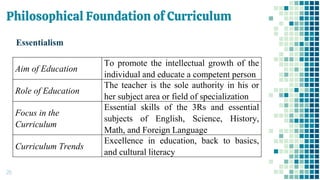
20.
Philosophical Foundation ofCurriculum
20
Essentialism
Aim of Education
To promote the intellectual growth of the
individual and educate a competent person
Role of Education
The teacher is the sole authority in his or
her subject area or field of specialization
Focus in the
Curriculum
Essential skills of the 3Rs and essential
subjects of English, Science, History,
Math, and Foreign Language
Curriculum Trends
Excellence in education, back to basics,
and cultural literacy
21.
Philosophical Foundation ofCurriculum
21
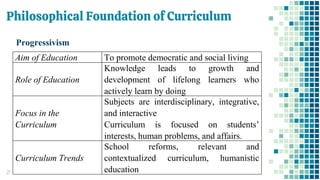
Progressivism
Aim of Education To promote democratic and social living
Role of Education
Knowledge leads to growth and
development of lifelong learners who
actively learn by doing
Focus in the
Curriculum
Subjects are interdisciplinary, integrative,
and interactive
Curriculum is focused on students’
interests, human problems, and affairs.
Curriculum Trends
School reforms, relevant and
contextualized curriculum, humanistic
education
22.
Philosophical Foundation ofCurriculum
22
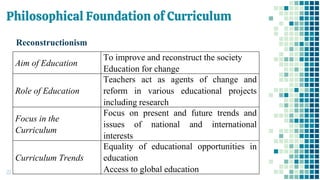
Reconstructionism
Aim of Education
To improve and reconstruct the society
Education for change
Role of Education
Teachers act as agents of change and
reform in various educational projects
including research
Focus in the
Curriculum
Focus on present and future trends and
issues of national and international
interests
Curriculum Trends
Equality of educational opportunities in
education
Access to global education
23.
Historical Foundation ofCurriculum
23
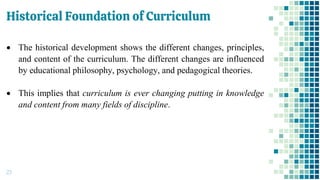
• The historical development shows the different changes, principles,
and content of the curriculum. The different changes are influenced
by educational philosophy, psychology, and pedagogical theories.
• This implies that curriculum is ever changing putting in knowledge
and content from many fields of discipline.
24.
Historical Foundation ofCurriculum
24
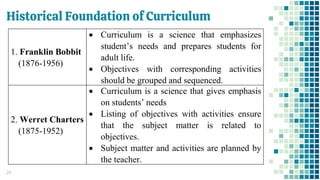
1. Franklin Bobbit
(1876-1956)
• Curriculum is a science that emphasizes
student’s needs and prepares students for
adult life.
• Objectives with corresponding activities
should be grouped and sequenced.
2. Werret Charters
(1875-1952)
• Curriculum is a science that gives emphasis
on students’ needs
• Listing of objectives with activities ensure
that the subject matter is related to
objectives.
• Subject matter and activities are planned by
the teacher.
25.
Historical Foundation ofCurriculum
25
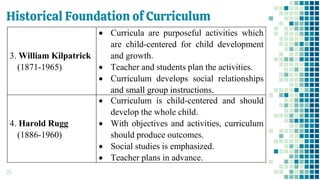
3. William Kilpatrick
(1871-1965)
• Curricula are purposeful activities which
are child-centered for child development
and growth.
• Teacher and students plan the activities.
• Curriculum develops social relationships
and small group instructions.
4. Harold Rugg
(1886-1960)
• Curriculum is child-centered and should
develop the whole child.
• With objectives and activities, curriculum
should produce outcomes.
• Social studies is emphasized.
• Teacher plans in advance.
26.
Historical Foundation ofCurriculum
26
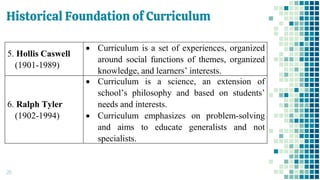
5. Hollis Caswell
(1901-1989)
• Curriculum is a set of experiences, organized
around social functions of themes, organized
knowledge, and learners’ interests.
6. Ralph Tyler
(1902-1994)
• Curriculum is a science, an extension of
school’s philosophy and based on students’
needs and interests.
• Curriculum emphasizes on problem-solving
and aims to educate generalists and not
specialists.
27.
Psychological Foundation ofCurriculum
27
• Psychology provides a basis for the teaching and learning process.
• It unifies the elements of the learning process and some of the
questions which can be addressed by psychological foundations of
education, such as “How should curriculum be organized to
enhance learning?” and “What is the optimum level of students’
participation in learning various contents of the curriculum?”
28.
Psychological Foundation ofCurriculum
28
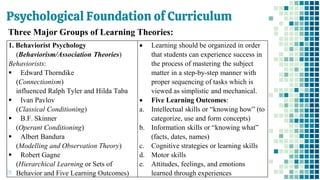
1. Behaviorist Psychology
(Behaviorism/Association Theories)
Behaviorists:
▪ Edward Thorndike
(Connectionism)
influenced Ralph Tyler and Hilda Taba
▪ Ivan Pavlov
(Classical Conditioning)
▪ B.F. Skinner
(Operant Conditioning)
▪ Albert Bandura
(Modelling and Observation Theory)
▪ Robert Gagne
(Hierarchical Learning or Sets of
Behavior and Five Learning Outcomes)
• Learning should be organized in order
that students can experience success in
the process of mastering the subject
matter in a step-by-step manner with
proper sequencing of tasks which is
viewed as simplistic and mechanical.
• Five Learning Outcomes:
a. Intellectual skills or “knowing how” (to
categorize, use and form concepts)
b. Information skills or “knowing what”
(facts, dates, names)
c. Cognitive strategies or learning skills
d. Motor skills
e. Attitudes, feelings, and emotions
learned through experiences
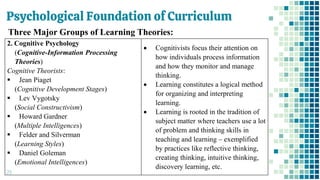
Three Major Groups of Learning Theories:
29.
Psychological Foundation ofCurriculum
29
Three Major Groups of Learning Theories:
2. Cognitive Psychology
(Cognitive-Information Processing
Theories)
Cognitive Theorists:
▪ Jean Piaget
(Cognitive Development Stages)
▪ Lev Vygotsky
(Social Constructivism)
▪ Howard Gardner
(Multiple Intelligences)
▪ Felder and Silverman
(Learning Styles)
▪ Daniel Goleman
(Emotional Intelligences)
• Cognitivists focus their attention on
how individuals process information
and how they monitor and manage
thinking.
• Learning constitutes a logical method
for organizing and interpreting
learning.
• Learning is rooted in the tradition of
subject matter where teachers use a lot
of problem and thinking skills in
teaching and learning – exemplified
by practices like reflective thinking,
creating thinking, intuitive thinking,
discovery learning, etc.
30.
Psychological Foundation ofCurriculum
30
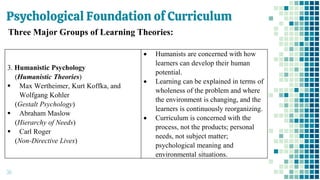
Three Major Groups of Learning Theories:
3. Humanistic Psychology
(Humanistic Theories)
▪ Max Wertheimer, Kurt Koffka, and
Wolfgang Kohler
(Gestalt Psychology)
▪ Abraham Maslow
(Hierarchy of Needs)
▪ Carl Roger
(Non-Directive Lives)
• Humanists are concerned with how
learners can develop their human
potential.
• Learning can be explained in terms of
wholeness of the problem and where
the environment is changing, and the
learners is continuously reorganizing.
• Curriculum is concerned with the
process, not the products; personal
needs, not subject matter;
psychological meaning and
environmental situations.
31.
Social Foundation ofCurriculum
31
• Societal culture affects and shapes schools and their curricula.
• Society as ever dynamic is a source of a very fast changes which
are difficult to cope with and to adjust to. Thus, schools are made
to help to understand these changes. In order for schools to be
relevant, school curriculum should address diversity, explosion of
knowledge, school reforms, and education for all.
• The relationship of curriculum and society is mutual and
encompassing. Hence, to be relevant, the curriculum should reflect
and preserve the culture of society and its aspirations. At the same
time, society should also imbibe the changes brought about by the
formal institutions called schools.
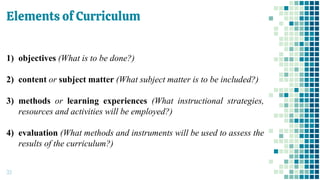
Elements of Curriculum
33
1)objectives (What is to be done?)
2) content or subject matter (What subject matter is to be included?)
3) methods or learning experiences (What instructional strategies,
resources and activities will be employed?)
4) evaluation (What methods and instruments will be used to assess the
results of the curriculum?)
34.
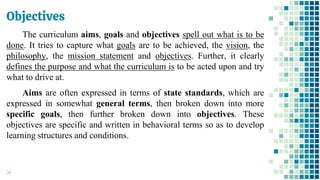
Objectives
34
The curriculum aims,goals and objectives spell out what is to be
done. It tries to capture what goals are to be achieved, the vision, the
philosophy, the mission statement and objectives. Further, it clearly
defines the purpose and what the curriculum is to be acted upon and try
what to drive at.
Aims are often expressed in terms of state standards, which are
expressed in somewhat general terms, then broken down into more
specific goals, then further broken down into objectives. These
objectives are specific and written in behavioral terms so as to develop
learning structures and conditions.
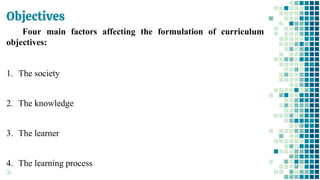
35.
Objectives
35
Four main factorsaffecting the formulation of curriculum
objectives:
1. The society
2. The knowledge
3. The learner
4. The learning process
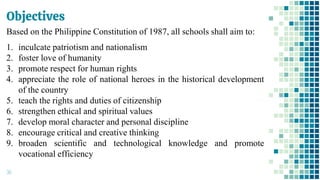
36.
Objectives
36
Based on thePhilippine Constitution of 1987, all schools shall aim to:
1. inculcate patriotism and nationalism
2. foster love of humanity
3. promote respect for human rights
4. appreciate the role of national heroes in the historical development
of the country
5. teach the rights and duties of citizenship
6. strengthen ethical and spiritual values
7. develop moral character and personal discipline
8. encourage critical and creative thinking
9. broaden scientific and technological knowledge and promote
vocational efficiency
37.
Objectives
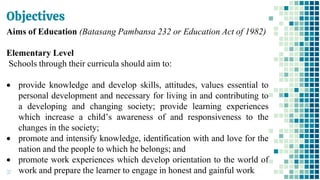
37
Aims of Education(Batasang Pambansa 232 or Education Act of 1982)
Elementary Level
Schools through their curricula should aim to:
• provide knowledge and develop skills, attitudes, values essential to
personal development and necessary for living in and contributing to
a developing and changing society; provide learning experiences
which increase a child’s awareness of and responsiveness to the
changes in the society;
• promote and intensify knowledge, identification with and love for the
nation and the people to which he belongs; and
• promote work experiences which develop orientation to the world of
work and prepare the learner to engage in honest and gainful work
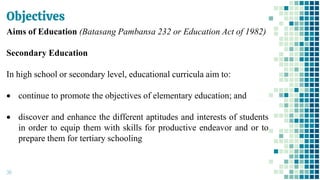
38.
Objectives
38
Aims of Education(Batasang Pambansa 232 or Education Act of 1982)
Secondary Education
In high school or secondary level, educational curricula aim to:
• continue to promote the objectives of elementary education; and
• discover and enhance the different aptitudes and interests of students
in order to equip them with skills for productive endeavor and or to
prepare them for tertiary schooling
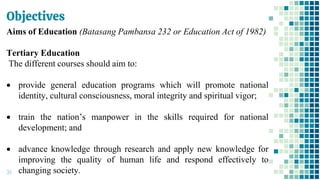
39.
Objectives
39
Aims of Education(Batasang Pambansa 232 or Education Act of 1982)
Tertiary Education
The different courses should aim to:
• provide general education programs which will promote national
identity, cultural consciousness, moral integrity and spiritual vigor;
• train the nation’s manpower in the skills required for national
development; and
• advance knowledge through research and apply new knowledge for
improving the quality of human life and respond effectively to
changing society.
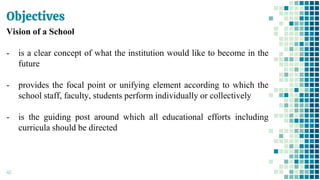
40.
Objectives
40
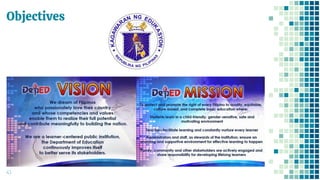
Vision of aSchool
- is a clear concept of what the institution would like to become in the
future
- provides the focal point or unifying element according to which the
school staff, faculty, students perform individually or collectively
- is the guiding post around which all educational efforts including
curricula should be directed
41.
Objectives
41
Vision of aSchool
- is a clear concept of what the institution would like to become in the
future
- provides the focal point or unifying element according to which the
school staff, faculty, students perform individually or collectively
- is the guiding post around which all educational efforts including
curricula should be directed
42.
Objectives
42
Mission Statement ofa School
- spells out how it intends to carry out its Vision
- the mission targets to produce the kind of persons the students will
become after having been educated over a certain period of time
Objectives
44
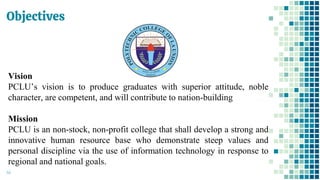
Vision
PCLU’s vision isto produce graduates with superior attitude, noble
character, are competent, and will contribute to nation-building
Mission
PCLU is an non-stock, non-profit college that shall develop a strong and
innovative human resource base who demonstrate steep values and
personal discipline via the use of information technology in response to
regional and national goals.
45.
Objectives
45
The school’s visionand mission are further translated into goals which
are broad statements or intents to be accomplished. Data for the sources
of school goals may include the learners, the society and the fund of
knowledge.
The school’s mission statement spells out how it intends to carry out its
Vision. The mission targets to produce the kind of persons the students
will become after having been educated over a certain period of time.
46.
Objectives
46
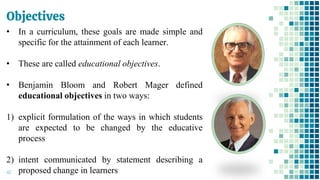
• In acurriculum, these goals are made simple and
specific for the attainment of each learner.
• These are called educational objectives.
• Benjamin Bloom and Robert Mager defined
educational objectives in two ways:
1) explicit formulation of the ways in which students
are expected to be changed by the educative
process
2) intent communicated by statement describing a
proposed change in learners
47.
Objectives
47
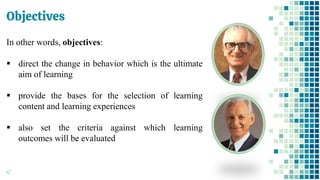
In other words,objectives:
▪ direct the change in behavior which is the ultimate
aim of learning
▪ provide the bases for the selection of learning
content and learning experiences
▪ also set the criteria against which learning
outcomes will be evaluated
48.
Objectives
48
Bloom and hisassociates classified three big domains of objectives.
These are:
1. Cognitive (Bloom, et al, 1956) is the domain of thought process.
a. Knowledge – recall, remembering of prior learned materials, in
terms of facts, concepts, theories and principles. It is the lowest
cognitive level.
b. Comprehension – ability to grasp the meaning of material. It
indicates the lowest form of understanding.
c. Application – the ability to use learned material in new and
concrete situation
d. Analysis – ability to break down material into component parts so
that its organizational structure may be understood
e. Synthesis – ability to put parts together to form a new whole
f. Evaluation – ability to pass judgment based on given criteria
49.
Objectives
49
2. Affective (Krathwohl,1964) is the domain of valuing, attitude and
appreciation.
a. Receiving – students’ willingness to pay attention to particular
event, stimuli, classroom activities
b. Responding – active participation on the part of the students
c. Valuing – concerned with the worth or value a student attaches to a
particular phenomena, object or behavior
d. Organization – concerned with bringing together different values
and building a value system
e. Characterization by a value or value complex – developing a
lifestyle from a value system
50.
Objectives
50
1. Psychomotor (Simpson,1972) is the domain of the use of psychomotor
attributes.
a. Perception – use of sense organs to guide motor activities
b. Set – refers to the readiness to take a particular type of action
c. Guided response – concerned with the early stages in learning complex
skills. Imitation and trial and error are some of the ways of doing
d. Mechanism – responses have become habitual. Performance skills are
with ease and confidence
e. Complex overt responses – skillful performance and with complex
movement patterns
f. Adaptation – skill well developed that the ability to modify is very easy
g. Origination – refers to creating new movement patterns to fit the
situation. Creativity is evident.
51.
Content or SubjectMatter
51
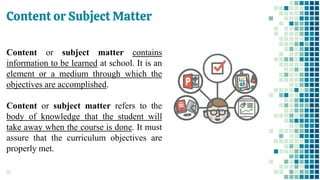
Content or subject matter contains
information to be learned at school. It is an
element or a medium through which the
objectives are accomplished.
Content or subject matter refers to the
body of knowledge that the student will
take away when the course is done. It must
assure that the curriculum objectives are
properly met.
52.
Content or SubjectMatter
52
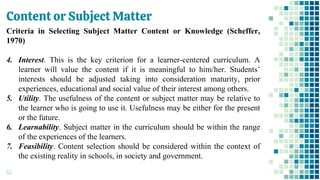
Criteria in Selecting Subject Matter Content or Knowledge (Scheffer,
1970)
1. Self-sufficiency. The prime guiding principle for content selection is
helping the learner attain self-sufficiency in learning in the most
economical manner (Scheffler, 1970). Economy means less teaching effort
and educational resources, less learners’ effort but more results and
effective learning outcomes.
2. Significance. Content or subject matter is significant if it will contribute to
basic ideas, concepts, principles, and generalizations to achieve the overall
aim of the curriculum; it will develop the cognitive, affective, and
psychomotor skills of the learners if the cultural aspects will be considered.
3. Validity. It is the authenticity of the subject matter. Subject matter should
be checked or verified at regular intervals to determine if the content that
was originally valid continues to be.
53.
Content or SubjectMatter
53
Criteria in Selecting Subject Matter Content or Knowledge (Scheffer,
1970)
4. Interest. This is the key criterion for a learner-centered curriculum. A
learner will value the content if it is meaningful to him/her. Students’
interests should be adjusted taking into consideration maturity, prior
experiences, educational and social value of their interest among others.
5. Utility. The usefulness of the content or subject matter may be relative to
the learner who is going to use it. Usefulness may be either for the present
or the future.
6. Learnability. Subject matter in the curriculum should be within the range
of the experiences of the learners.
7. Feasibility. Content selection should be considered within the context of
the existing reality in schools, in society and government.
54.
Content or SubjectMatter
54
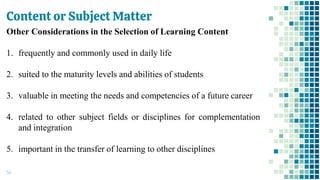
Other Considerations in the Selection of Learning Content
1. frequently and commonly used in daily life
2. suited to the maturity levels and abilities of students
3. valuable in meeting the needs and competencies of a future career
4. related to other subject fields or disciplines for complementation
and integration
5. important in the transfer of learning to other disciplines
55.
Content or SubjectMatter
55
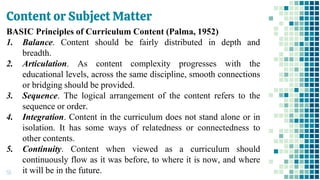
BASIC Principles of Curriculum Content (Palma, 1952)
1. Balance. Content should be fairly distributed in depth and
breadth.
2. Articulation. As content complexity progresses with the
educational levels, across the same discipline, smooth connections
or bridging should be provided.
3. Sequence. The logical arrangement of the content refers to the
sequence or order.
4. Integration. Content in the curriculum does not stand alone or in
isolation. It has some ways of relatedness or connectedness to
other contents.
5. Continuity. Content when viewed as a curriculum should
continuously flow as it was before, to where it is now, and where
it will be in the future.
56.
Learning Experiences
56
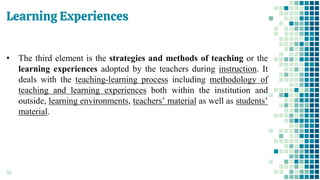
• Thethird element is the strategies and methods of teaching or the
learning experiences adopted by the teachers during instruction. It
deals with the teaching-learning process including methodology of
teaching and learning experiences both within the institution and
outside, learning environments, teachers’ material as well as students’
material.
57.
Learning Experiences
57
• Inhis classic text on curriculum, Tyler defined the term learning
experiences as follows:
The term “learning experience” is not the same as the content with
which a course deals nor the activities performed by the teacher. The
term “learning experience” refers to the interaction between the learner
and the external conditions in the environment to which he or she can
react. Learning takes place through the active behavior of the student.
• Tyler argues that the teacher’s problem is to select learning
experiences that will foster active involvement in the learning process
in order to accomplish the expected learning outcomes.
58.
Learning Experiences
58
General Principlesin Selecting Learning Experiences (Tyler, 1949)
1.The learning experience must give students the opportunity to
practice the desired behavior.
2.The learning experience must give the students satisfaction;
unsatisfying experiences hinder their learning.
3.The learning experience must “fit” the students’ needs and abilities.
4.Multiple learning experiences can achieve the same objective.
Hence, a wide range of experiences is more effective for learning
than a limited range.
5.The learning experience should accomplish several learning
outcomes and satisfy more than one objective.
59.
Learning Experiences
59
• Differentinstructional strategies provide the experiences. The
instructional strategies and methods will put into action the goals and
the use of contents in order to produce an outcome.
• Teaching strategies convert the written curriculum into action. Both
the teacher and the learner take actions to facilitate learning.
• The actions are based on planned objectives, the subject matter to be
taken and the support materials to be used.
• This will include a multitude of teaching methods and educational
activities which will enhance learning.
60.
Learning Experiences
60
Guides inthe Selection and Use of Teaching Methods
1. Curriculum process in the form of teaching methods or strategies are
means to achieve the end.
2. There is no single best teaching process or method.
3. Teaching method should stimulate the learner’s desire to develop the
cognitive, psychomotor, social, and spiritual domain of the
individual.
61.
Learning Experiences
61
Guides inthe Selection and Use of Teaching Methods
4. In the choice of the teaching methods, learning styles of the students
should be considered.
5. Every method should lead to the development of the learning
outcomes in the three domains: cognitive, affective, and
psychomotor.
62.
Curriculum Evaluation
62
Curriculum evaluationrefers to the process of placing value on a
curriculum. Evaluation may focus on a curriculum’s design, including
content and process; its implementation; or outcomes. It identifies the
quality, effectiveness of the program, process, and product of the
curriculum.
Curriculum evaluation is important in a sense that one could assess
whether the aims and objectives have been met or not. It also shows the
effectiveness of strategy of teaching and other components. The
interpretation of evaluation provides the feedback to the curriculum
and its components. With the help of evaluation phase experts can
modify the curriculum by bringing about desirable changes.
63.
Curriculum Evaluation
63
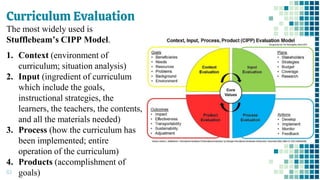
The mostwidely used is
Stufflebeam’s CIPP Model.
1. Context (environment of
curriculum; situation analysis)
2. Input (ingredient of curriculum
which include the goals,
instructional strategies, the
learners, the teachers, the contents,
and all the materials needed)
3. Process (how the curriculum has
been implemented; entire
operation of the curriculum)
4. Products (accomplishment of
goals)
64.
Curriculum Evaluation
64
Suggested Planof Action for Curriculum Evaluation
1. Focus on one particular component of the curriculum. Will it be
subject are, the grade level, the course, or the degree program?
Specify objectives of evaluation.
2. Collect or gather the information. Information is made up of data
needed regarding the object of evaluation.
3. Organize the information. This step will require coding, organizing,
storing and retrieving data for interpretation.
65.
Curriculum Evaluation
65
Suggested Planof Action for Curriculum Evaluation
4. Analyze information. An appropriate way of analyzing will be
utilized.
5. Report the information. The report of evaluation should be reported
to specific audiences. It can be done formally in conferences with
stakeholders, or informally through round table discussion and
conversations.
6. Recycle the information for continuous feedback, modifications and
adjustments to be made.
The Teaching-Learning Process
67
Curriculumis the total learning experience.
Teaching and learning are the actions necessary to accomplish a goal of
education.
Teaching as a Process in Curriculum
• Effective teaching brings about the intended learning outcome.
• Teaching is an organization of meaningful learning.
• Teaching is creating a situation or selecting life-like situations to
enhance learning.
68.
The Teaching-Learning Process
68
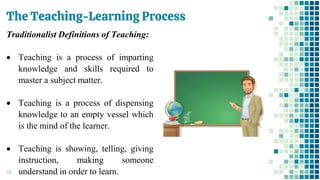
TraditionalistDefinitions of Teaching:
• Teaching is a process of imparting
knowledge and skills required to
master a subject matter.
• Teaching is a process of dispensing
knowledge to an empty vessel which
is the mind of the learner.
• Teaching is showing, telling, giving
instruction, making someone
understand in order to learn.
69.
The Teaching-Learning Process
69
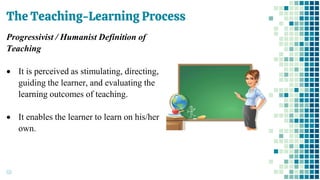
Progressivist/ Humanist Definition of
Teaching
• It is perceived as stimulating, directing,
guiding the learner, and evaluating the
learning outcomes of teaching.
• It enables the learner to learn on his/her
own.
70.
The Teaching-Learning Process
70
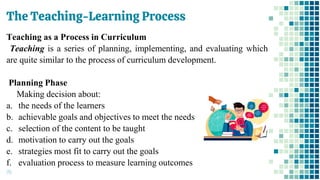
Teachingas a Process in Curriculum
Teaching is a series of planning, implementing, and evaluating which
are quite similar to the process of curriculum development.
Planning Phase
Making decision about:
a. the needs of the learners
b. achievable goals and objectives to meet the needs
c. selection of the content to be taught
d. motivation to carry out the goals
e. strategies most fit to carry out the goals
f. evaluation process to measure learning outcomes
71.
The Teaching-Learning Process
71
Teachingas a Process in Curriculum
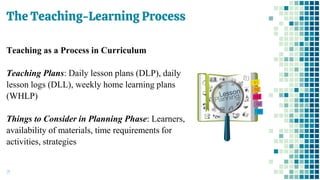
Teaching Plans: Daily lesson plans (DLP), daily
lesson logs (DLL), weekly home learning plans
(WHLP)
Things to Consider in Planning Phase: Learners,
availability of materials, time requirements for
activities, strategies
72.
The Teaching-Learning Process
72
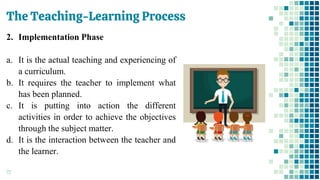
2.Implementation Phase
a. It is the actual teaching and experiencing of
a curriculum.
b. It requires the teacher to implement what
has been planned.
c. It is putting into action the different
activities in order to achieve the objectives
through the subject matter.
d. It is the interaction between the teacher and
the learner.
73.
The Teaching-Learning Process
73
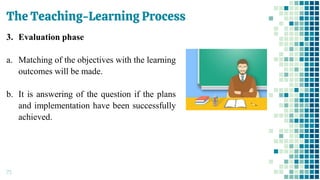
3.Evaluation phase
a. Matching of the objectives with the learning
outcomes will be made.
b. It is answering of the question if the plans
and implementation have been successfully
achieved.
74.
The Teaching-Learning Process
74
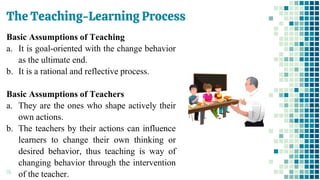
BasicAssumptions of Teaching
a. It is goal-oriented with the change behavior
as the ultimate end.
b. It is a rational and reflective process.
Basic Assumptions of Teachers
a. They are the ones who shape actively their
own actions.
b. The teachers by their actions can influence
learners to change their own thinking or
desired behavior, thus teaching is way of
changing behavior through the intervention
of the teacher.
75.
The Teaching-Learning Process
75
GuideIndicators of Good Teaching
✓ It is well planned and where activities are interrelated to each other.
✓ It provides learning experiences or situations that will ensure
understanding, application, and critical thinking.
✓ It is based on the theories of learning.
✓ It is the one where the learner is stimulated to think and reason.
✓ It utilizes prior learning and its application to new situations.
✓ It is governed by democratic principles.
✓ It embeds a sound evaluation process.
76.
The Teaching-Learning Process
76
Learningas a Process in Curriculum
Learning is a change in an individual’s behavior caused by experiences
or self-activity.
Intentional learning occurs when activities are purposefully arranged
for the students to participate and experience.
Unintentional learning occurs when activities are not purposefully
arranged for the students to participate and experience.
77.
The Teaching-Learning Process
77
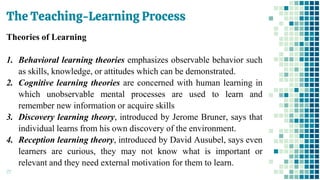
Theoriesof Learning
1. Behavioral learning theories emphasizes observable behavior such
as skills, knowledge, or attitudes which can be demonstrated.
2. Cognitive learning theories are concerned with human learning in
which unobservable mental processes are used to learn and
remember new information or acquire skills
3. Discovery learning theory, introduced by Jerome Bruner, says that
individual learns from his own discovery of the environment.
4. Reception learning theory, introduced by David Ausubel, says even
learners are curious, they may not know what is important or
relevant and they need external motivation for them to learn.
78.
The Teaching-Learning Process
78
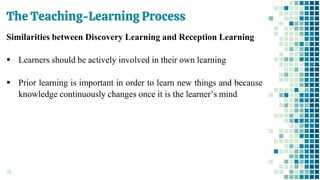
Similaritiesbetween Discovery Learning and Reception Learning
▪ Learners should be actively involved in their own learning
▪ Prior learning is important in order to learn new things and because
knowledge continuously changes once it is the learner’s mind
79.
The Teaching-Learning Process
79
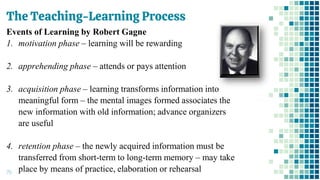
Eventsof Learning by Robert Gagne
1. motivation phase – learning will be rewarding
2. apprehending phase – attends or pays attention
3. acquisition phase – learning transforms information into
meaningful form – the mental images formed associates the
new information with old information; advance organizers
are useful
4. retention phase – the newly acquired information must be
transferred from short-term to long-term memory – may take
place by means of practice, elaboration or rehearsal
80.
The Teaching-Learning Process
80
Eventsof Learning by Robert Gagne
5. recall phase- recall previous learned information
6. generalization phase – transfer of information to new situation
allows application of the learned information in the context in which
it was learned
7. feedback phase – students must receive feedback on their
performance
81.
The Teaching-Learning Process
81
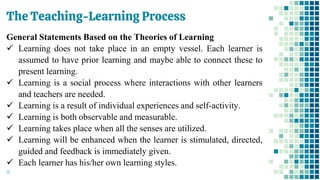
GeneralStatements Based on the Theories of Learning
✓ Learning does not take place in an empty vessel. Each learner is
assumed to have prior learning and maybe able to connect these to
present learning.
✓ Learning is a social process where interactions with other learners
and teachers are needed.
✓ Learning is a result of individual experiences and self-activity.
✓ Learning is both observable and measurable.
✓ Learning takes place when all the senses are utilized.
✓ Learning will be enhanced when the learner is stimulated, directed,
guided and feedback is immediately given.
✓ Each learner has his/her own learning styles.
82.
The Teaching-Learning Process
82
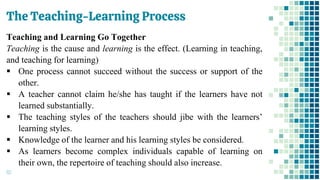
Teachingand Learning Go Together
Teaching is the cause and learning is the effect. (Learning in teaching,
and teaching for learning)
▪ One process cannot succeed without the success or support of the
other.
▪ A teacher cannot claim he/she has taught if the learners have not
learned substantially.
▪ The teaching styles of the teachers should jibe with the learners’
learning styles.
▪ Knowledge of the learner and his learning styles be considered.
▪ As learners become complex individuals capable of learning on
their own, the repertoire of teaching should also increase.
83.
The Teaching-Learning Process
83
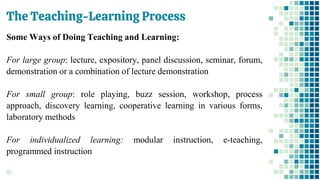
SomeWays of Doing Teaching and Learning:
For large group: lecture, expository, panel discussion, seminar, forum,
demonstration or a combination of lecture demonstration
For small group: role playing, buzz session, workshop, process
approach, discovery learning, cooperative learning in various forms,
laboratory methods
For individualized learning: modular instruction, e-teaching,
programmed instruction
84.
The Teaching-Learning Process
84
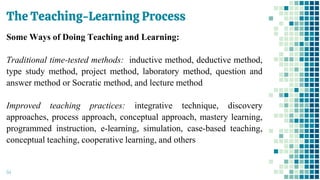
SomeWays of Doing Teaching and Learning:
Traditional time-tested methods: inductive method, deductive method,
type study method, project method, laboratory method, question and
answer method or Socratic method, and lecture method
Improved teaching practices: integrative technique, discovery
approaches, process approach, conceptual approach, mastery learning,
programmed instruction, e-learning, simulation, case-based teaching,
conceptual teaching, cooperative learning, and others
85.
The Teaching-Learning Process
85
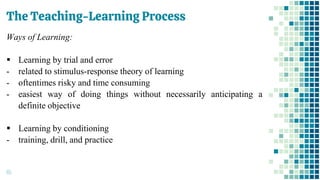
Waysof Learning:
▪ Learning by trial and error
- related to stimulus-response theory of learning
- oftentimes risky and time consuming
- easiest way of doing things without necessarily anticipating a
definite objective
▪ Learning by conditioning
- training, drill, and practice
86.
The Teaching-Learning Process
86
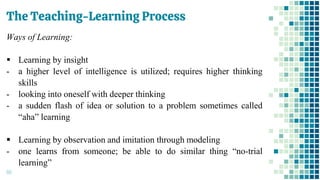
Waysof Learning:
▪ Learning by insight
- a higher level of intelligence is utilized; requires higher thinking
skills
- looking into oneself with deeper thinking
- a sudden flash of idea or solution to a problem sometimes called
“aha” learning
▪ Learning by observation and imitation through modeling
- one learns from someone; be able to do similar thing “no-trial
learning”
References:
• Al-Rajhi, L.T.(2015, January 30). Concepts, Nature and Purposes of
Curriculum [PowerPoint slides]. Slideshare.
https://www.slideshare.net/lollimallow/curriculum-development-lesson-
1-concepts-nature-and-purposes-of-curriculum-purita-b-bilbao
• Banares, P.M. (2015, July 16). Teaching-Learning Process and
Curriculum Development [Prezi slideshow presentation]. Prezi.
https://prezi.com/s994cmneud_m/teaching-learning-process-and-
curriculum-development/
• Constanino, R.C. and Espolong, J.M. (2014, February 6). Elements or
Components of Curriculum [PowerPoint slides]. Scribd.
https://www.scribd.com/doc/205149120/Elements-Components-of-
Curriculum-xxx
• Estroga, I.J. (2013, July 17). Curriculum Development [PowerPoint
slides]. Slideshare.
https://www.slideshare.net/josephestroga/curriculum-development-
24328693
89.
• Gaper, K.(n.d.) Module 1. Curriculum: Concepts, Nature and
Purposes Lesson 1 Concepts, Nature and Purposes of Curriculum,
Academia. October 7, 2022.
https://www.academia.edu/33820685/Module_1_Curriculum_Conce
pts_Nature_and_Purposes_Lesson_1_Concepts_Nature_and_Purpos
es_of_Curriculum
• Gulzar, A.A. (2021, May 24). Elements of Curriculum. Educare.
https://educarepk.com/elements-of-curriculum.html
• Montero, G. (214, July 23). Concepts, Nature and Purposes of
Curriculum [PowerPoint slides]. Slideshare.
https://www.slideshare.net/GailMontero/m1-lesson-1-concepts-
nature-purposes-of-curriculum#
• SFYC. (2011, November 11). Definition of Curriculum [PowerPoint
slides]. Slideshare. https://www.slideshare.net/lourise/definition-of-
curr

![References:
• Al-Rajhi, L.T. (2015, January 30). Concepts, Nature and Purposes of
Curriculum [PowerPoint slides]. Slideshare.
https://www.slideshare.net/lollimallow/curriculum-development-lesson-
1-concepts-nature-and-purposes-of-curriculum-purita-b-bilbao
• Banares, P.M. (2015, July 16). Teaching-Learning Process and
Curriculum Development [Prezi slideshow presentation]. Prezi.
https://prezi.com/s994cmneud_m/teaching-learning-process-and-
curriculum-development/
• Constanino, R.C. and Espolong, J.M. (2014, February 6). Elements or
Components of Curriculum [PowerPoint slides]. Scribd.
https://www.scribd.com/doc/205149120/Elements-Components-of-
Curriculum-xxx
• Estroga, I.J. (2013, July 17). Curriculum Development [PowerPoint
slides]. Slideshare.
https://www.slideshare.net/josephestroga/curriculum-development-
24328693](https://image.slidesharecdn.com/curriculumdevelopment-250221093353-e06a1726/85/Curriculum-Development-Three-Sub-Topics-88-320.jpg)
![• Gaper, K. (n.d.) Module 1. Curriculum: Concepts, Nature and
Purposes Lesson 1 Concepts, Nature and Purposes of Curriculum,
Academia. October 7, 2022.
https://www.academia.edu/33820685/Module_1_Curriculum_Conce
pts_Nature_and_Purposes_Lesson_1_Concepts_Nature_and_Purpos
es_of_Curriculum
• Gulzar, A.A. (2021, May 24). Elements of Curriculum. Educare.
https://educarepk.com/elements-of-curriculum.html
• Montero, G. (214, July 23). Concepts, Nature and Purposes of
Curriculum [PowerPoint slides]. Slideshare.
https://www.slideshare.net/GailMontero/m1-lesson-1-concepts-
nature-purposes-of-curriculum#
• SFYC. (2011, November 11). Definition of Curriculum [PowerPoint
slides]. Slideshare. https://www.slideshare.net/lourise/definition-of-
curr](https://image.slidesharecdn.com/curriculumdevelopment-250221093353-e06a1726/85/Curriculum-Development-Three-Sub-Topics-89-320.jpg)


