Introduction To Statistics,
Statistics And Probability
1
Dr. Shabbir Ahmad
Assistant Professor,
Department of Mathematics,
COMSATS University
Islamabad, Wah Campus
Dr. Shabbir Ahmad
Assistant Professor, Department of Mathematics, COMSATS University Islamabad, Wah Campus
Cell # 0323-5332733, 0332-5332733. Date: 12/6/2021 8:59:34 AM
Lecture No.
Introduction To Probability
Basic Concepts
2
Dr. Shabbir Ahmad
Assistant Professor, Department of Mathematics, COMSATS University Islamabad, Wah Campus
Cell # 0323-5332733, 0332-5332733. Date: 12/6/2021 8:59:36 AM
In this lecture
• Set Theory and Algebra of Sets
• Basics of Probability
• Random and Non-random Experiment
• Event and Sample Space
• Simple and Compound Events
• Mutually Exclusive Events
• Exhaustive Events, Equally Likely Events
• Rules of Counting
Dr. Shabbir Ahmad
Assistant Professor, Department of Mathematics, COMSATS University Islamabad, Wah Campus
Cell # 0323-5332733, 0332-5332733. Date: 12/6/2021 8:59:36 AM
Set Theory:
❑ A set is any well-defined collection or list of distinct objects, e.g. a group of
students, the books in a library, the integers between 1 to 100, all human beings
on earth, etc.
❑ The term well-defined here means that any object must be classified as either
belonging or not belonging to the set under study.
❑ The objects that are in a set, are called members or elements of the set.
❑ Sets are usually denoted by capital letters such as: 𝐴, 𝐵, 𝐸, 𝑌, etc.
❑ The elements of the sets are represented by small letters, such as: 𝑎, 𝑏, 𝑐, 𝑒, 𝑦, etc.
❑ Elements are enclosed by braces to represent a set, e.g. 𝐴 is the set of vowels, i.e.,
𝐴 = 𝑎, 𝑒, 𝑖, 𝑜, 𝑢
4
Dr. Shabbir Ahmad
Assistant Professor, Department of Mathematics, COMSATS University Islamabad, Wah Campus
Cell # 0323-5332733, 0332-5332733. Date: 12/6/2021 8:59:36 AM
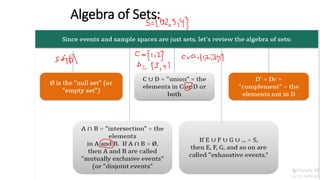
Algebra of Sets:
5
6
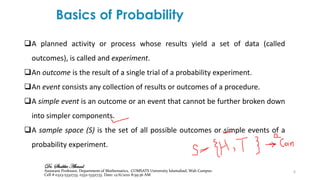
❑A planned activity or process whose results yield a set of data (called
outcomes), is called and experiment.
❑An outcome is the result of a single trial of a probability experiment.
❑An event consists any collection of results or outcomes of a procedure.
❑A simple event is an outcome or an event that cannot be further broken down
into simpler components.

❑A sample space (S) is the set of all possible outcomes or simple events of a
probability experiment.
Dr. Shabbir Ahmad
Assistant Professor, Department of Mathematics, COMSATS University Islamabad, Wah Campus
Cell # 0323-5332733, 0332-5332733. Date: 12/6/2021 8:59:36 AM
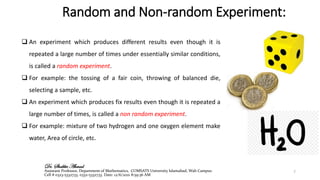
Random and Non-random Experiment:
❑ An experiment which produces different results even though it is
repeated a large number of times under essentially similar conditions,
is called a random experiment.
❑ For example: the tossing of a fair coin, throwing of balanced die,
selecting a sample, etc.
❑ An experiment which produces fix results even though it is repeated a
large number of times, is called a non random experiment.
❑ For example: mixture of two hydrogen and one oxygen element make
water, Area of circle, etc.
7
Dr. Shabbir Ahmad
Assistant Professor, Department of Mathematics, COMSATS University Islamabad, Wah Campus
Cell # 0323-5332733, 0332-5332733. Date: 12/6/2021 8:59:36 AM
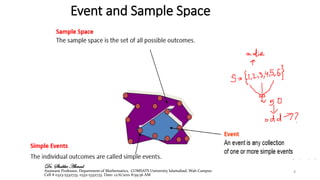
Event and Sample Space
8
Dr. Shabbir Ahmad
Assistant Professor, Department of Mathematics, COMSATS University Islamabad, Wah Campus
Cell # 0323-5332733, 0332-5332733. Date: 12/6/2021 8:59:36 AM
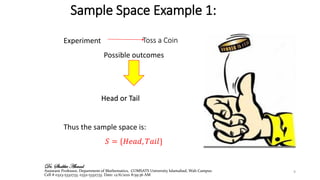
Sample Space Example 1:
Experiment
Possible outcomes
Head or Tail
Thus the sample space is:
𝑆 = {𝐻𝑒𝑎𝑑, 𝑇𝑎𝑖𝑙}
Toss a Coin
9
Dr. Shabbir Ahmad
Assistant Professor, Department of Mathematics, COMSATS University Islamabad, Wah Campus
Cell # 0323-5332733, 0332-5332733. Date: 12/6/2021 8:59:36 AM
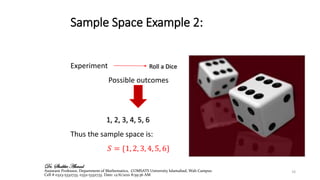
Sample Space Example 2:
Experiment
Possible outcomes
1, 2, 3, 4, 5, 6
Thus the sample space is:
𝑆 = {1, 2, 3, 4, 5, 6}
Roll a Dice
10
Dr. Shabbir Ahmad
Assistant Professor, Department of Mathematics, COMSATS University Islamabad, Wah Campus
Cell # 0323-5332733, 0332-5332733. Date: 12/6/2021 8:59:36 AM
Events
❑ An event is an individual outcome or any number of outcomes (sample points)
of a random experiment or a trial
❑ The events are classified as:
• Simple Events
• Compound Events
• Mutually Exclusive Events
• Exhaustive Events
• Equally Likely Events
In set terminology, any subset of a sample space S of the experiment, is called
an event.
11
Simple and Compound Events:
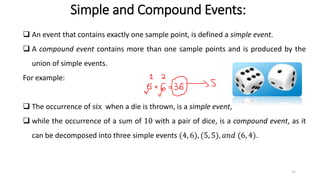
❑ An event that contains exactly one sample point, is defined a simple event.
❑ A compound event contains more than one sample points and is produced by the
union of simple events.
For example:
❑ The occurrence of six when a die is thrown, is a simple event,
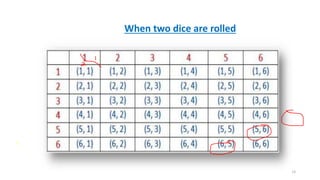
❑ while the occurrence of a sum of 10 with a pair of dice, is a compound event, as it
can be decomposed into three simple events (4, 6), (5, 5), 𝑎𝑛𝑑 (6, 4).
12
13
When two dice are rolled
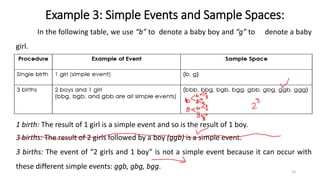
Example 3: Simple Events and Sample Spaces:
In the following table, we use “b” to denote a baby boy and “g” to denote a baby
girl.
1 birth: The result of 1 girl is a simple event and so is the result of 1 boy.
3 births: The result of 2 girls followed by a boy (ggb) is a simple event.
3 births: The event of “2 girls and 1 boy” is not a simple event because it can occur with
these different simple events: ggb, gbg, bgg.
14
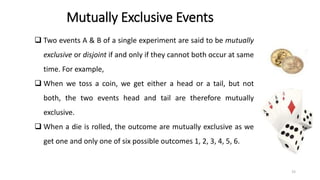
Mutually Exclusive Events
❑ Two events A & B of a single experiment are said to be mutually
exclusive or disjoint if and only if they cannot both occur at same
time. For example,
❑ When we toss a coin, we get either a head or a tail, but not
both, the two events head and tail are therefore mutually
exclusive.
❑ When a die is rolled, the outcome are mutually exclusive as we
get one and only one of six possible outcomes 1, 2, 3, 4, 5, 6.
15
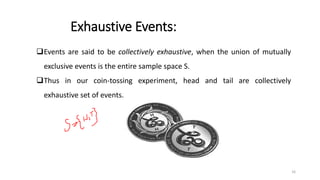
Exhaustive Events:
❑Events are said to be collectively exhaustive, when the union of mutually
exclusive events is the entire sample space S.
❑Thus in our coin-tossing experiment, head and tail are collectively
exhaustive set of events.
16
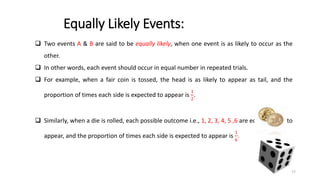
Equally Likely Events:
❑ Two events A & B are said to be equally likely, when one event is as likely to occur as the
other.
❑ In other words, each event should occur in equal number in repeated trials.
❑ For example, when a fair coin is tossed, the head is as likely to appear as tail, and the
proportion of times each side is expected to appear is
1
2
.
❑ Similarly, when a die is rolled, each possible outcome i.e., 1, 2, 3, 4, 5 ,6 are equal chance to
appear, and the proportion of times each side is expected to appear is
1
6
.
17
Counting Sample Points:
• The sample space S, is the set of all possible outcomes of a statistical experiment.
• Each outcome in a sample space is called a sample point. It is also called an element or a member of the
sample space.
Fundamental Principle of Counting:
• When the number of sample points in a sample space S is very large, it becomes very difficult to list
them all and to count the sample points.
• In such cases, a probability problem may be solved by counting sample points in S, without actually
listing each element.
18
Counting Sample Points:
The basic rules or method which helps us to count the number of sample points without
actually listing them all are:
1. Rule of Multiplication
2. Rule of Permutation
3. Rule of Combination
19
1. Rule of Multiplication:
• If a compound experiment consists of two experiment such that, the first has exactly 𝑛1 distinct
outcomes and corresponding to each outcome of the first there can be 𝑛2 distinct outcomes of the
second experiment, then the compound experiment has exactly 𝑛1 × 𝑛2 outcomes.
• In general if there are k experiments, then total sample points of compound experiment are:
𝑛1 × 𝑛2 × 𝑛3 × ⋯ × 𝑛𝑘
20
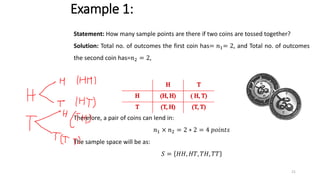
Example 1:
Statement: How many sample points are there if two coins are tossed together?
Solution: Total no. of outcomes the first coin has= 𝑛1= 2, and Total no. of outcomes
the second coin has=𝑛2 = 2,
Therefore, a pair of coins can lend in:
𝑛1 × 𝑛2 = 2 ∗ 2 = 4 𝑝𝑜𝑖𝑛𝑡𝑠
The sample space will be as:
𝑆 = 𝐻𝐻, 𝐻𝑇, 𝑇𝐻, 𝑇𝑇
21
Example 2:
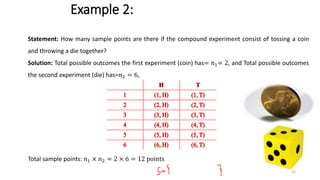
Statement: How many sample points are there if the compound experiment consist of tossing a coin
and throwing a die together?
Solution: Total possible outcomes the first experiment (coin) has= 𝑛1= 2, and Total possible outcomes
the second experiment (die) has=𝑛2 = 6,
Total sample points: 𝑛1 × 𝑛2 = 2 × 6 = 12 points
22
Example 3:
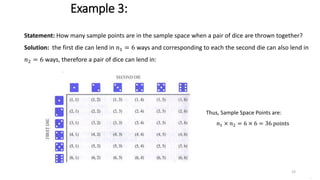
Statement: How many sample points are in the sample space when a pair of dice are thrown together?
Solution: the first die can lend in 𝑛1 = 6 ways and corresponding to each the second die can also lend in
𝑛2 = 6 ways, therefore a pair of dice can lend in:
Thus, Sample Space Points are:
𝑛1 × 𝑛2 = 6 × 6 = 36 points
23
Example 4:
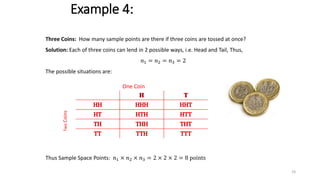
Three Coins: How many sample points are there if three coins are tossed at once?
Solution: Each of three coins can lend in 2 possible ways, i.e. Head and Tail, Thus,
𝑛1 = 𝑛2 = 𝑛3 = 2
The possible situations are:
Thus Sample Space Points: 𝑛1 × 𝑛2 × 𝑛3 = 2 × 2 × 2 = 8 points
One Coin
Two
Coins
24
Example 4 (Cont.,)
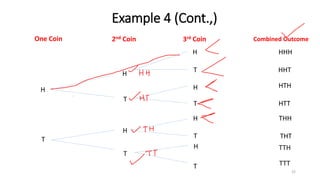
25
One Coin 2nd Coin 3rd Coin Combined Outcome
H
T
H
T
H
T
H
T
H
T
H
T
H
T
HHH
HHT
HTH
HTT
THH
THT
TTH
TTT
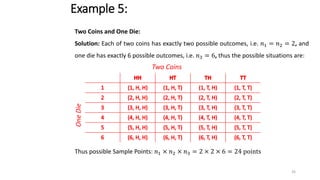
Example 5:
Two Coins and One Die:
Solution: Each of two coins has exactly two possible outcomes, i.e. 𝑛1 = 𝑛2 = 2, and
one die has exactly 6 possible outcomes, i.e. 𝑛3 = 6, thus the possible situations are:
Thus possible Sample Points: 𝑛1 × 𝑛2 × 𝑛3 = 2 × 2 × 6 = 24 points
Two Coins
One
Die
26
Practice Questions:
1. How many sample points are in the sample space, when a pair of dice and one
coin are thrown together?
2. How many sample points are in the sample space when three dice are thrown
together?
3. How many sample points are in the sample space when four coins are thrown
together?
4. If an experiment consists of throwing a die and then drawing a letter at random
from the English alphabet, how many points are there in the sample space?
27
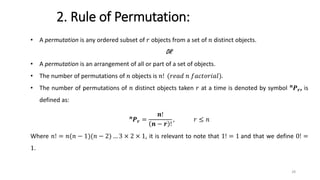
2. Rule of Permutation:
• A permutation is any ordered subset of 𝑟 objects from a set of 𝑛 distinct objects.
OR
• A permutation is an arrangement of all or part of a set of objects.
• The number of permutations of 𝑛 objects is 𝑛! (𝑟𝑒𝑎𝑑 𝑛 𝑓𝑎𝑐𝑡𝑜𝑟𝑖𝑎𝑙).
• The number of permutations of 𝑛 distinct objects taken 𝑟 at a time is denoted by symbol 𝒏
𝑷𝒓, is
defined as:
𝒏
𝑷𝒓 =
𝒏!
𝒏 − 𝒓 !
, 𝑟 ≤ 𝑛
Where 𝑛! = 𝑛(𝑛 − 1)(𝑛 − 2) … 3 × 2 × 1, it is relevant to note that 1! = 1 and that we define 0! =
1.
28
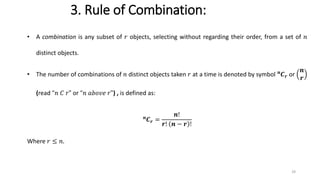
3. Rule of Combination:
• A combination is any subset of 𝑟 objects, selecting without regarding their order, from a set of 𝑛
distinct objects.
• The number of combinations of 𝑛 distinct objects taken 𝑟 at a time is denoted by symbol 𝒏
𝑪𝒓 or
𝒏
𝒓
(read “𝑛 𝐶 𝑟” or “𝑛 𝑎𝑏𝑜𝑣𝑒 𝑟") , is defined as:
𝒏
𝑪𝒓 =
𝒏!
𝒓! 𝒏 − 𝒓 !
Where 𝑟 ≤ 𝑛.
29
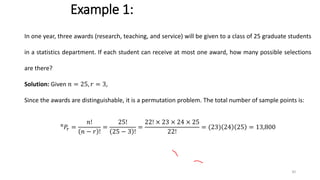
Example 1:
In one year, three awards (research, teaching, and service) will be given to a class of 25 graduate students
in a statistics department. If each student can receive at most one award, how many possible selections
are there?
Solution: Given 𝑛 = 25, 𝑟 = 3,
Since the awards are distinguishable, it is a permutation problem. The total number of sample points is:
𝑛
𝑃𝑟 =
𝑛!
𝑛 − 𝑟 !
=
25!
25 − 3 !
=
22! × 23 × 24 × 25
22!
= (23) 24 25 = 13,800
30
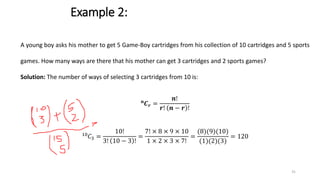
Example 2:
A young boy asks his mother to get 5 Game-Boy cartridges from his collection of 10 cartridges and 5 sports
games. How many ways are there that his mother can get 3 cartridges and 2 sports games?
Solution: The number of ways of selecting 3 cartridges from 10 is:
𝒏
𝑪𝒓 =
𝒏!
𝒓! 𝒏 − 𝒓 !
10
𝐶3 =
10!
3! 10 − 3 !
=
7! × 8 × 9 × 10
1 × 2 × 3 × 7!
=
(8)(9)(10)
(1)(2)(3)
= 120
31
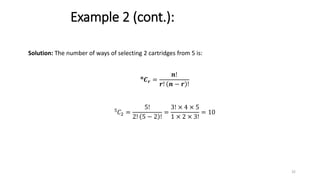
Example 2 (cont.):
Solution: The number of ways of selecting 2 cartridges from 5 is:
𝒏
𝑪𝒓 =
𝒏!
𝒓! 𝒏 − 𝒓 !
5
𝐶2 =
5!
2! 5 − 2 !
=
3! × 4 × 5
1 × 2 × 3!
= 10
32
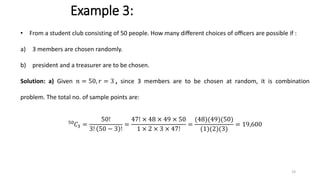
Example 3:
• From a student club consisting of 50 people. How many different choices of officers are possible if :
a) 3 members are chosen randomly.
b) president and a treasurer are to be chosen.
Solution: a) Given 𝑛 = 50, 𝑟 = 3 , since 3 members are to be chosen at random, it is combination
problem. The total no. of sample points are:
50
𝐶3 =
50!
3! 50 − 3 !
=
47! × 48 × 49 × 50
1 × 2 × 3 × 47!
=
(48)(49)(50)
(1)(2)(3)
= 19,600
33
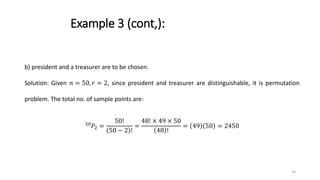
Example 3 (cont,):
b) president and a treasurer are to be chosen.
Solution: Given 𝑛 = 50, 𝑟 = 2, since president and treasurer are distinguishable, it is permutation
problem. The total no. of sample points are:
50
𝑃2 =
50!
50 − 2 !
=
48! × 49 × 50
48 !
= 49 50 = 2450
34
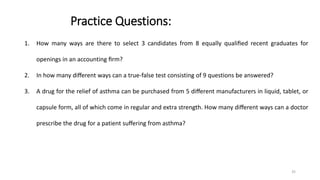
Practice Questions:
1. How many ways are there to select 3 candidates from 8 equally qualified recent graduates for
openings in an accounting firm?
2. In how many different ways can a true-false test consisting of 9 questions be answered?
3. A drug for the relief of asthma can be purchased from 5 different manufacturers in liquid, tablet, or
capsule form, all of which come in regular and extra strength. How many different ways can a doctor
prescribe the drug for a patient suffering from asthma?
35
36
ANY QUESTION

Lecture (Introduction To Probability).pdf

  • 1.
    Introduction To Statistics, StatisticsAnd Probability 1 Dr. Shabbir Ahmad Assistant Professor, Department of Mathematics, COMSATS University Islamabad, Wah Campus Dr. Shabbir Ahmad Assistant Professor, Department of Mathematics, COMSATS University Islamabad, Wah Campus Cell # 0323-5332733, 0332-5332733. Date: 12/6/2021 8:59:34 AM Lecture No.
  • 2.
    Introduction To Probability BasicConcepts 2 Dr. Shabbir Ahmad Assistant Professor, Department of Mathematics, COMSATS University Islamabad, Wah Campus Cell # 0323-5332733, 0332-5332733. Date: 12/6/2021 8:59:36 AM
  • 3.
    In this lecture •Set Theory and Algebra of Sets • Basics of Probability • Random and Non-random Experiment • Event and Sample Space • Simple and Compound Events • Mutually Exclusive Events • Exhaustive Events, Equally Likely Events • Rules of Counting Dr. Shabbir Ahmad Assistant Professor, Department of Mathematics, COMSATS University Islamabad, Wah Campus Cell # 0323-5332733, 0332-5332733. Date: 12/6/2021 8:59:36 AM
  • 4.
    Set Theory: ❑ Aset is any well-defined collection or list of distinct objects, e.g. a group of students, the books in a library, the integers between 1 to 100, all human beings on earth, etc. ❑ The term well-defined here means that any object must be classified as either belonging or not belonging to the set under study. ❑ The objects that are in a set, are called members or elements of the set. ❑ Sets are usually denoted by capital letters such as: 𝐴, 𝐵, 𝐸, 𝑌, etc. ❑ The elements of the sets are represented by small letters, such as: 𝑎, 𝑏, 𝑐, 𝑒, 𝑦, etc. ❑ Elements are enclosed by braces to represent a set, e.g. 𝐴 is the set of vowels, i.e., 𝐴 = 𝑎, 𝑒, 𝑖, 𝑜, 𝑢 4 Dr. Shabbir Ahmad Assistant Professor, Department of Mathematics, COMSATS University Islamabad, Wah Campus Cell # 0323-5332733, 0332-5332733. Date: 12/6/2021 8:59:36 AM
  • 5.
  • 6.
    6 ❑A planned activityor process whose results yield a set of data (called outcomes), is called and experiment. ❑An outcome is the result of a single trial of a probability experiment. ❑An event consists any collection of results or outcomes of a procedure. ❑A simple event is an outcome or an event that cannot be further broken down into simpler components. ❑A sample space (S) is the set of all possible outcomes or simple events of a probability experiment. Dr. Shabbir Ahmad Assistant Professor, Department of Mathematics, COMSATS University Islamabad, Wah Campus Cell # 0323-5332733, 0332-5332733. Date: 12/6/2021 8:59:36 AM
  • 7.
    Random and Non-randomExperiment: ❑ An experiment which produces different results even though it is repeated a large number of times under essentially similar conditions, is called a random experiment. ❑ For example: the tossing of a fair coin, throwing of balanced die, selecting a sample, etc. ❑ An experiment which produces fix results even though it is repeated a large number of times, is called a non random experiment. ❑ For example: mixture of two hydrogen and one oxygen element make water, Area of circle, etc. 7 Dr. Shabbir Ahmad Assistant Professor, Department of Mathematics, COMSATS University Islamabad, Wah Campus Cell # 0323-5332733, 0332-5332733. Date: 12/6/2021 8:59:36 AM
  • 8.
    Event and SampleSpace 8 Dr. Shabbir Ahmad Assistant Professor, Department of Mathematics, COMSATS University Islamabad, Wah Campus Cell # 0323-5332733, 0332-5332733. Date: 12/6/2021 8:59:36 AM
  • 9.
    Sample Space Example1: Experiment Possible outcomes Head or Tail Thus the sample space is: 𝑆 = {𝐻𝑒𝑎𝑑, 𝑇𝑎𝑖𝑙} Toss a Coin 9 Dr. Shabbir Ahmad Assistant Professor, Department of Mathematics, COMSATS University Islamabad, Wah Campus Cell # 0323-5332733, 0332-5332733. Date: 12/6/2021 8:59:36 AM
  • 10.
    Sample Space Example2: Experiment Possible outcomes 1, 2, 3, 4, 5, 6 Thus the sample space is: 𝑆 = {1, 2, 3, 4, 5, 6} Roll a Dice 10 Dr. Shabbir Ahmad Assistant Professor, Department of Mathematics, COMSATS University Islamabad, Wah Campus Cell # 0323-5332733, 0332-5332733. Date: 12/6/2021 8:59:36 AM
  • 11.
    Events ❑ An eventis an individual outcome or any number of outcomes (sample points) of a random experiment or a trial ❑ The events are classified as: • Simple Events • Compound Events • Mutually Exclusive Events • Exhaustive Events • Equally Likely Events In set terminology, any subset of a sample space S of the experiment, is called an event. 11
  • 12.
    Simple and CompoundEvents: ❑ An event that contains exactly one sample point, is defined a simple event. ❑ A compound event contains more than one sample points and is produced by the union of simple events. For example: ❑ The occurrence of six when a die is thrown, is a simple event, ❑ while the occurrence of a sum of 10 with a pair of dice, is a compound event, as it can be decomposed into three simple events (4, 6), (5, 5), 𝑎𝑛𝑑 (6, 4). 12
  • 13.
    13 When two diceare rolled
  • 14.
    Example 3: SimpleEvents and Sample Spaces: In the following table, we use “b” to denote a baby boy and “g” to denote a baby girl. 1 birth: The result of 1 girl is a simple event and so is the result of 1 boy. 3 births: The result of 2 girls followed by a boy (ggb) is a simple event. 3 births: The event of “2 girls and 1 boy” is not a simple event because it can occur with these different simple events: ggb, gbg, bgg. 14
  • 15.
    Mutually Exclusive Events ❑Two events A & B of a single experiment are said to be mutually exclusive or disjoint if and only if they cannot both occur at same time. For example, ❑ When we toss a coin, we get either a head or a tail, but not both, the two events head and tail are therefore mutually exclusive. ❑ When a die is rolled, the outcome are mutually exclusive as we get one and only one of six possible outcomes 1, 2, 3, 4, 5, 6. 15
  • 16.
    Exhaustive Events: ❑Events aresaid to be collectively exhaustive, when the union of mutually exclusive events is the entire sample space S. ❑Thus in our coin-tossing experiment, head and tail are collectively exhaustive set of events. 16
  • 17.
    Equally Likely Events: ❑Two events A & B are said to be equally likely, when one event is as likely to occur as the other. ❑ In other words, each event should occur in equal number in repeated trials. ❑ For example, when a fair coin is tossed, the head is as likely to appear as tail, and the proportion of times each side is expected to appear is 1 2 . ❑ Similarly, when a die is rolled, each possible outcome i.e., 1, 2, 3, 4, 5 ,6 are equal chance to appear, and the proportion of times each side is expected to appear is 1 6 . 17
  • 18.
    Counting Sample Points: •The sample space S, is the set of all possible outcomes of a statistical experiment. • Each outcome in a sample space is called a sample point. It is also called an element or a member of the sample space. Fundamental Principle of Counting: • When the number of sample points in a sample space S is very large, it becomes very difficult to list them all and to count the sample points. • In such cases, a probability problem may be solved by counting sample points in S, without actually listing each element. 18
  • 19.
    Counting Sample Points: Thebasic rules or method which helps us to count the number of sample points without actually listing them all are: 1. Rule of Multiplication 2. Rule of Permutation 3. Rule of Combination 19
  • 20.
    1. Rule ofMultiplication: • If a compound experiment consists of two experiment such that, the first has exactly 𝑛1 distinct outcomes and corresponding to each outcome of the first there can be 𝑛2 distinct outcomes of the second experiment, then the compound experiment has exactly 𝑛1 × 𝑛2 outcomes. • In general if there are k experiments, then total sample points of compound experiment are: 𝑛1 × 𝑛2 × 𝑛3 × ⋯ × 𝑛𝑘 20
  • 21.
    Example 1: Statement: Howmany sample points are there if two coins are tossed together? Solution: Total no. of outcomes the first coin has= 𝑛1= 2, and Total no. of outcomes the second coin has=𝑛2 = 2, Therefore, a pair of coins can lend in: 𝑛1 × 𝑛2 = 2 ∗ 2 = 4 𝑝𝑜𝑖𝑛𝑡𝑠 The sample space will be as: 𝑆 = 𝐻𝐻, 𝐻𝑇, 𝑇𝐻, 𝑇𝑇 21
  • 22.
    Example 2: Statement: Howmany sample points are there if the compound experiment consist of tossing a coin and throwing a die together? Solution: Total possible outcomes the first experiment (coin) has= 𝑛1= 2, and Total possible outcomes the second experiment (die) has=𝑛2 = 6, Total sample points: 𝑛1 × 𝑛2 = 2 × 6 = 12 points 22
  • 23.
    Example 3: Statement: Howmany sample points are in the sample space when a pair of dice are thrown together? Solution: the first die can lend in 𝑛1 = 6 ways and corresponding to each the second die can also lend in 𝑛2 = 6 ways, therefore a pair of dice can lend in: Thus, Sample Space Points are: 𝑛1 × 𝑛2 = 6 × 6 = 36 points 23
  • 24.
    Example 4: Three Coins:How many sample points are there if three coins are tossed at once? Solution: Each of three coins can lend in 2 possible ways, i.e. Head and Tail, Thus, 𝑛1 = 𝑛2 = 𝑛3 = 2 The possible situations are: Thus Sample Space Points: 𝑛1 × 𝑛2 × 𝑛3 = 2 × 2 × 2 = 8 points One Coin Two Coins 24
  • 25.
    Example 4 (Cont.,) 25 OneCoin 2nd Coin 3rd Coin Combined Outcome H T H T H T H T H T H T H T HHH HHT HTH HTT THH THT TTH TTT
  • 26.
    Example 5: Two Coinsand One Die: Solution: Each of two coins has exactly two possible outcomes, i.e. 𝑛1 = 𝑛2 = 2, and one die has exactly 6 possible outcomes, i.e. 𝑛3 = 6, thus the possible situations are: Thus possible Sample Points: 𝑛1 × 𝑛2 × 𝑛3 = 2 × 2 × 6 = 24 points Two Coins One Die 26
  • 27.
    Practice Questions: 1. Howmany sample points are in the sample space, when a pair of dice and one coin are thrown together? 2. How many sample points are in the sample space when three dice are thrown together? 3. How many sample points are in the sample space when four coins are thrown together? 4. If an experiment consists of throwing a die and then drawing a letter at random from the English alphabet, how many points are there in the sample space? 27
  • 28.
    2. Rule ofPermutation: • A permutation is any ordered subset of 𝑟 objects from a set of 𝑛 distinct objects. OR • A permutation is an arrangement of all or part of a set of objects. • The number of permutations of 𝑛 objects is 𝑛! (𝑟𝑒𝑎𝑑 𝑛 𝑓𝑎𝑐𝑡𝑜𝑟𝑖𝑎𝑙). • The number of permutations of 𝑛 distinct objects taken 𝑟 at a time is denoted by symbol 𝒏 𝑷𝒓, is defined as: 𝒏 𝑷𝒓 = 𝒏! 𝒏 − 𝒓 ! , 𝑟 ≤ 𝑛 Where 𝑛! = 𝑛(𝑛 − 1)(𝑛 − 2) … 3 × 2 × 1, it is relevant to note that 1! = 1 and that we define 0! = 1. 28
  • 29.
    3. Rule ofCombination: • A combination is any subset of 𝑟 objects, selecting without regarding their order, from a set of 𝑛 distinct objects. • The number of combinations of 𝑛 distinct objects taken 𝑟 at a time is denoted by symbol 𝒏 𝑪𝒓 or 𝒏 𝒓 (read “𝑛 𝐶 𝑟” or “𝑛 𝑎𝑏𝑜𝑣𝑒 𝑟") , is defined as: 𝒏 𝑪𝒓 = 𝒏! 𝒓! 𝒏 − 𝒓 ! Where 𝑟 ≤ 𝑛. 29
  • 30.
    Example 1: In oneyear, three awards (research, teaching, and service) will be given to a class of 25 graduate students in a statistics department. If each student can receive at most one award, how many possible selections are there? Solution: Given 𝑛 = 25, 𝑟 = 3, Since the awards are distinguishable, it is a permutation problem. The total number of sample points is: 𝑛 𝑃𝑟 = 𝑛! 𝑛 − 𝑟 ! = 25! 25 − 3 ! = 22! × 23 × 24 × 25 22! = (23) 24 25 = 13,800 30
  • 31.
    Example 2: A youngboy asks his mother to get 5 Game-Boy cartridges from his collection of 10 cartridges and 5 sports games. How many ways are there that his mother can get 3 cartridges and 2 sports games? Solution: The number of ways of selecting 3 cartridges from 10 is: 𝒏 𝑪𝒓 = 𝒏! 𝒓! 𝒏 − 𝒓 ! 10 𝐶3 = 10! 3! 10 − 3 ! = 7! × 8 × 9 × 10 1 × 2 × 3 × 7! = (8)(9)(10) (1)(2)(3) = 120 31
  • 32.
    Example 2 (cont.): Solution:The number of ways of selecting 2 cartridges from 5 is: 𝒏 𝑪𝒓 = 𝒏! 𝒓! 𝒏 − 𝒓 ! 5 𝐶2 = 5! 2! 5 − 2 ! = 3! × 4 × 5 1 × 2 × 3! = 10 32
  • 33.
    Example 3: • Froma student club consisting of 50 people. How many different choices of officers are possible if : a) 3 members are chosen randomly. b) president and a treasurer are to be chosen. Solution: a) Given 𝑛 = 50, 𝑟 = 3 , since 3 members are to be chosen at random, it is combination problem. The total no. of sample points are: 50 𝐶3 = 50! 3! 50 − 3 ! = 47! × 48 × 49 × 50 1 × 2 × 3 × 47! = (48)(49)(50) (1)(2)(3) = 19,600 33
  • 34.
    Example 3 (cont,): b)president and a treasurer are to be chosen. Solution: Given 𝑛 = 50, 𝑟 = 2, since president and treasurer are distinguishable, it is permutation problem. The total no. of sample points are: 50 𝑃2 = 50! 50 − 2 ! = 48! × 49 × 50 48 ! = 49 50 = 2450 34
  • 35.
    Practice Questions: 1. Howmany ways are there to select 3 candidates from 8 equally qualified recent graduates for openings in an accounting firm? 2. In how many different ways can a true-false test consisting of 9 questions be answered? 3. A drug for the relief of asthma can be purchased from 5 different manufacturers in liquid, tablet, or capsule form, all of which come in regular and extra strength. How many different ways can a doctor prescribe the drug for a patient suffering from asthma? 35
  • 36.