INCORPORATING
PROBABILISTIC
RETRIEVAL
KNOWLEDGE INTO
TFIDF-BASED SEARCH
ENGINE
Alex Lin
Senior Architect
Intelligent Mining
alin at IntelligentMinining.com
Overview of Retrieval Models
  Boolean Retrieval
  Vector Space Model

  Probabilistic Model

  Language Model
Boolean Retrieval
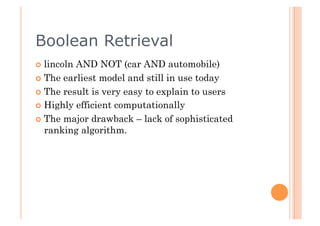
  lincolnAND NOT (car AND automobile)
  The earliest model and still in use today

  The result is very easy to explain to users

  Highly efficient computationally

  The major drawback – lack of sophisticated
   ranking algorithm.
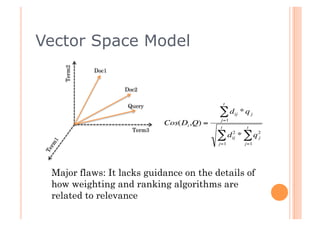
Vector Space Model
    Term2   Doc1


                   Doc2

                                                t
                   Query
                                            ∑d       ij   *qj
                                            j=1
                             Cos(Di ,Q) =
                                            t              t
                     Term3
                                            ∑ d * ∑q2
                                                    ij
                                                                 2
                                                                 j
                                            j=1            j=1


 Major flaws: It lacks guidance on the details of
                   €
 how weighting and ranking algorithms are
 related to relevance
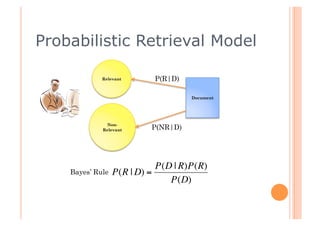
Probabilistic Retrieval Model

             Relevant       P(R|D)

                                     Document


              Non-
             Relevant      P(NR|D)


                             P(D | R)P(R)
    Bayes’ Rule   P(R | D) =
                                P(D)


    €
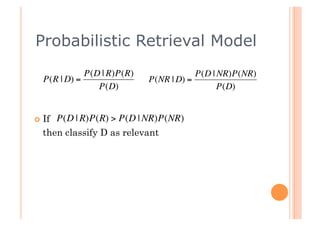
Probabilistic Retrieval Model
                       P(D | R)P(R)               P(D | NR)P(NR)
          P(R | D) =                  P(NR | D) =
                          P(D)                          P(D)


          IfP(D | R)P(R) > P(D | NR)P(NR)
€                         €
          then classify D as relevant

    €
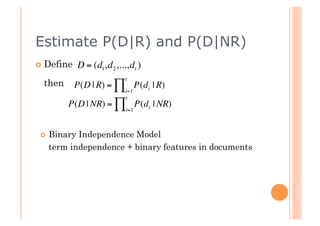
Estimate P(D|R) and P(D|NR)
  Define        D = (d1,d2 ,...,dt )
                                t
        then    P(D | R) = ∏ P(di | R)
                                i=1
                                t

    €          P(D | NR) = ∏ P(di | NR)
                                i=1


€
        Binary Independence Model
€        term independence + binary features in documents
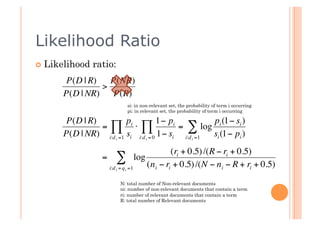
Likelihood Ratio
      Likelihood   ratio:
           P(D | R)   P(NR)
                    >
          P(D | NR)    P(R)
                                si: in non-relevant set, the probability of term i occurring
                                pi: in relevant set, the probability of term i occurring

           P(D | R)          pi          1− pi           pi (1− si )
                    =∏ ⋅ ∏                     = ∑ log
€         P(D | NR) i:d i =1 si i:d i = 0 1− si i:d i =1 si (1− pi )
                                               (ri + 0.5) /(R − ri + 0.5)
                      = ∑ log
                       i:d i = q i =1 (n i − ri + 0.5) /(N − n i − R + ri + 0.5)
€
                             N: total number of Non-relevant documents
                             ni: number of non-relevant documents that contain a term
                             ri: number of relevant documents that contain a term
                             R: total number of Relevant documents
          €
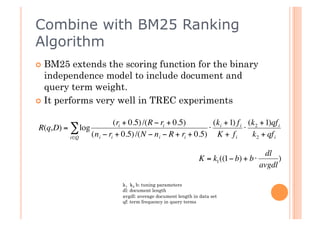
Combine with BM25 Ranking
    Algorithm
      BM25   extends the scoring function for the binary
       independence model to include document and
       query term weight.
      It performs very well in TREC experiments


                              (ri + 0.5) /(R − ri + 0.5)        (k + 1) f i (k 2 + 1)qf i
    R(q,D) = ∑ log                                             ⋅ i         ⋅
            i∈Q
                     (n i − ri + 0.5) /(N − n i − R + ri + 0.5) K + f i      k 2 + qf i

                                                                                         dl
                                                                 K = k1 ((1− b) + b ⋅         )
                                                                                        avgdl
€
                                k1 k2 b: tuning parameters
                                dl: document length
                                avgdl: average document length in data set
                                                  €
                                qf: term frequency in query terms
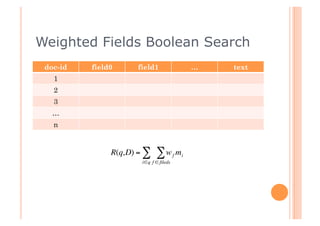
Weighted Fields Boolean Search
 doc-id       field0     field1                     …   text
   1
   2
   3
   …
   n


                   R(q,D) = ∑    ∑w        f   mi
                          i∈q f ∈ fileds


          €
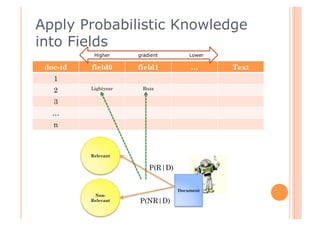
Apply Probabilistic Knowledge
into Fields
           Higher     gradient         Lower

 doc-id   field0      field1           …       Text
   1
          Lightyear    Buzz
   2
   3
   …
   n


          Relevant


                          P(R|D)


                                   Document
           Non-
          Relevant    P(NR|D)
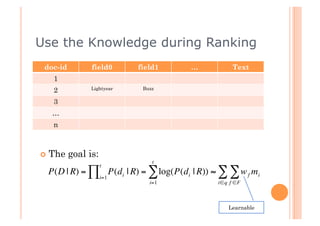
Use the Knowledge during Ranking
     doc-id         field0      field1    …           Text
       1
                    Lightyear    Buzz
       2
       3
       …
       n


      The    goal is:
                                    t
                         t
      P(D | R) = ∏ P(di | R) = ∑ log(P(di | R)) ≈ ∑ ∑ w f mi
                         i=1
                                   i=1           i∈q f ∈F


                                                    Learnable

€
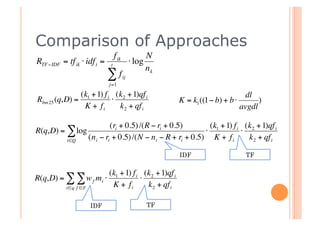
Comparison of Approaches
                                      f ik              N
    RTF −IDF = tf ik ⋅ idf i =    t
                                                  ⋅ log
                                                        nk
                                 ∑f          ij
                                 j=1

                   (k1 + 1) f i (k2 + 1)qf i                                          dl
    Rbm 25 (q,D) =             ⋅                              K = k1 ((1− b) + b ⋅         )
                    K + fi       k 2 + qf i                                          avgdl
€                                  (ri + 0.5) /(R − ri + 0.5)        (k + 1) f i (k 2 + 1)qf i
    R(q,D) = ∑ log                                                  ⋅ 1         ⋅
               i∈Q
                          (n i − ri + 0.5) /(N − n i − R + ri + 0.5) K + f i      k 2 + qf i
€                                               €
                                                              IDF                      TF


€                                (k1 + 1) f i (k 2 + 1)qf i
    R(q,D) = ∑ ∑ w f mi ⋅                    ⋅
               i∈q f ∈F           K + fi       k 2 + qf i

                          IDF                           TF

€
Other Considerations
  Thisis not a formal model
  Require user relevance feedback (search log)

  Harder to handle real-time search queries

  How to Prevent Love/Hate attacks
Thank you

Probabilistic Retrieval

  • 1.
    INCORPORATING PROBABILISTIC RETRIEVAL KNOWLEDGE INTO TFIDF-BASED SEARCH ENGINE AlexLin Senior Architect Intelligent Mining alin at IntelligentMinining.com
  • 2.
    Overview of RetrievalModels   Boolean Retrieval   Vector Space Model   Probabilistic Model   Language Model
  • 3.
    Boolean Retrieval   lincolnANDNOT (car AND automobile)   The earliest model and still in use today   The result is very easy to explain to users   Highly efficient computationally   The major drawback – lack of sophisticated ranking algorithm.
  • 4.
    Vector Space Model Term2 Doc1 Doc2 t Query ∑d ij *qj j=1 Cos(Di ,Q) = t t Term3 ∑ d * ∑q2 ij 2 j j=1 j=1 Major flaws: It lacks guidance on the details of € how weighting and ranking algorithms are related to relevance
  • 5.
    Probabilistic Retrieval Model Relevant P(R|D) Document Non- Relevant P(NR|D) P(D | R)P(R) Bayes’ Rule P(R | D) = P(D) €
  • 6.
    Probabilistic Retrieval Model P(D | R)P(R) P(D | NR)P(NR) P(R | D) = P(NR | D) = P(D) P(D)   IfP(D | R)P(R) > P(D | NR)P(NR) € € then classify D as relevant €
  • 7.
    Estimate P(D|R) andP(D|NR)   Define D = (d1,d2 ,...,dt ) t then P(D | R) = ∏ P(di | R) i=1 t € P(D | NR) = ∏ P(di | NR) i=1 €   Binary Independence Model € term independence + binary features in documents
  • 8.
    Likelihood Ratio   Likelihood ratio: P(D | R) P(NR) > P(D | NR) P(R) si: in non-relevant set, the probability of term i occurring pi: in relevant set, the probability of term i occurring P(D | R) pi 1− pi pi (1− si ) =∏ ⋅ ∏ = ∑ log € P(D | NR) i:d i =1 si i:d i = 0 1− si i:d i =1 si (1− pi ) (ri + 0.5) /(R − ri + 0.5) = ∑ log i:d i = q i =1 (n i − ri + 0.5) /(N − n i − R + ri + 0.5) € N: total number of Non-relevant documents ni: number of non-relevant documents that contain a term ri: number of relevant documents that contain a term R: total number of Relevant documents €
  • 9.
    Combine with BM25Ranking Algorithm   BM25 extends the scoring function for the binary independence model to include document and query term weight.   It performs very well in TREC experiments (ri + 0.5) /(R − ri + 0.5) (k + 1) f i (k 2 + 1)qf i R(q,D) = ∑ log ⋅ i ⋅ i∈Q (n i − ri + 0.5) /(N − n i − R + ri + 0.5) K + f i k 2 + qf i dl K = k1 ((1− b) + b ⋅ ) avgdl € k1 k2 b: tuning parameters dl: document length avgdl: average document length in data set € qf: term frequency in query terms
  • 10.
    Weighted Fields BooleanSearch doc-id field0 field1 … text 1 2 3 … n R(q,D) = ∑ ∑w f mi i∈q f ∈ fileds €
  • 11.
    Apply Probabilistic Knowledge intoFields Higher gradient Lower doc-id field0 field1 … Text 1 Lightyear Buzz 2 3 … n Relevant P(R|D) Document Non- Relevant P(NR|D)
  • 12.
    Use the Knowledgeduring Ranking doc-id field0 field1 … Text 1 Lightyear Buzz 2 3 … n   The goal is: t t P(D | R) = ∏ P(di | R) = ∑ log(P(di | R)) ≈ ∑ ∑ w f mi i=1 i=1 i∈q f ∈F Learnable €
  • 13.
    Comparison of Approaches f ik N RTF −IDF = tf ik ⋅ idf i = t ⋅ log nk ∑f ij j=1 (k1 + 1) f i (k2 + 1)qf i dl Rbm 25 (q,D) = ⋅ K = k1 ((1− b) + b ⋅ ) K + fi k 2 + qf i avgdl € (ri + 0.5) /(R − ri + 0.5) (k + 1) f i (k 2 + 1)qf i R(q,D) = ∑ log ⋅ 1 ⋅ i∈Q (n i − ri + 0.5) /(N − n i − R + ri + 0.5) K + f i k 2 + qf i € € IDF TF € (k1 + 1) f i (k 2 + 1)qf i R(q,D) = ∑ ∑ w f mi ⋅ ⋅ i∈q f ∈F K + fi k 2 + qf i IDF TF €
  • 14.
    Other Considerations   Thisisnot a formal model   Require user relevance feedback (search log)   Harder to handle real-time search queries   How to Prevent Love/Hate attacks
  • 15.

Editor's Notes

  • #9 Si: in non-relevant set, the probability of term i occurringPi: inrelevant set, the probability of term i occurringN: total number of Non-relevant documentsni: number of non-relevant documents that contain a termri: number of relevant documents that contain a term R: total number of Relevant documents