GEK1544 The Mathematics of Games
                                               Tutorial 7

We consider Q. 2 first.


2.    Let p and q be positive numbers , p + q = 1 . Consider the binomial expansion

         1 = (p + q)n = pn + C(n, 1)pn−1 q + · · · + C(n, r) pn−r q r + · · · + q n
                                                                 r                             n
                         n             q                      q                 q
                      = p 1 + C(n, 1) + · · · + C(n, r)            +···+                           .
                                       p                      p                 p

Using the Stirling formula
                                                        k
                                    √    k
                               k ! ≈ 2πk                     for k    1,
                                         e

estimate the value of r (in terms of n when it is large) so that the expression
                                               r                           r
                                           q               n!         q
                              C(n, r)              =                                                   (2.1)
                                           p         r ! (n − r) !    p

is at maximum. (Suggestion. Express (2.1) using the Stirling formula, and treat it as
a function of r. Then differentiate the expression with respect to r , and let n → ∞ . )
Compare in the roulette example when we use the normal distribution, we let
                                                              1
                                           r − nq +           2
                                        Z=    √                   .
                                               np q


Suggested solution.      To locate the maximum, we may ignore the term n !, as it is
independent on r . Let a = q/p and consider
                       1                                       ar
                               ar ≈ √ √                 r     √ √                    n−r
                                                                                           .
                 r ! (n − r) !       2π r           r
                                                            ·  2π n − r        n−r
                                                    e                           e


Here we apply the Stirling formula. Similarly, we ignore the terms involving 2π and e .
Set
                                      ar
                f (r) =         1                       1
                       [rr+ 2 ] [(n − r)(n−r)+ 2 ]
                                       1                      1
      =⇒ ln [f (r)] = r ln a − r +         ln r − (n − r) +      ln (n − r)
                                       2                      2
                                             1     1                          1       1
     =⇒ (ln [f (r)]) = ln a − ln r − r +          · + ln (n − r) + (n − r) +     ·
                                             2     r                          2      n−r
               f (r)                                        1               1
        =⇒           = [ln a − ln r + ln (n − r)] − 1 +         + 1+               .
               f (r)                                       2r           2(n − r)
At maximum,
                                                        1               1
     f (r) = 0 =⇒             [ln a − ln r + ln (n − r)] = 1 +
                                                             − 1+
                                                        2r           2(n − r)
                                 a(n − r)   1     1        (n − r) − r     n − 2r
                    =⇒        ln          =   −         =              =
                                    r       2r 2(n − r)     2r(n − r)    2r (n − r)
When n → ∞, r → c n, where 0 < c < 1 is a fixed number to be determined. Hence
                    n − 2r        n − 2cn        1 − 2c
                              =              =             →0           as n → ∞ .
                   2r (n − r)   4cn (n − cn)   4cn (1 − c)
It follows that
                     a(n − r)                 a(n − r)
              ln              → 0 =⇒                   → 1 =⇒ an → r(1 + a) .
                        r                        r
That is,
                                 q
                        an    ×n   q×n
               r→          = p q =                  =⇒ r = nq            (p + q = 1) .
                       1+a   1+ p  p+q


1.    A person decides to bet $ 1 on the (fixed) number 8 in Las Vegas roulette, and
continue to do so for a total of 500 times. The pay-off on betting on a number is 35 : 1 .
Using the normal distribution table, estimate the person’s probability on winning $ 40 or
more.

Suggested solution.           If the number 8 comes up x times in 500 spins, the profit is

                              35 · x + (500 − x) · (−1) = 36 · x − 500

Solve for x so that

                      36 · x − 500 ≥ 40 ⇐⇒ 36 · x ≥ 540 =⇒ x ≥ 15 .

That is, one needs to win 15 times or more in order to profit $ 40 or more. The chance
                  1
of winning is p = 38 , whereas
                                               37
                                   q =1−p=        .
                                               38
Consider the binomial expansion

1 = (p + q)500
  = p500 + C(500, 1) p499 q + · · · + C(n, s) p500−s q s + · · · + C(500, 485) p15 q 485 + · · · + q n .

It follows that the probability on winning $ 40 or more is

                   C(500, 0) p500 + C(500, 1) p499 q + · · · + C(500, 485) p15 q 485 .

In the above, p500 is the probability of winning 500 times number 8, etc. There are a lot
of terms to sum, all the way from 0 to r = 485 . Instead, we apply the normal distribution
to approximate the number.
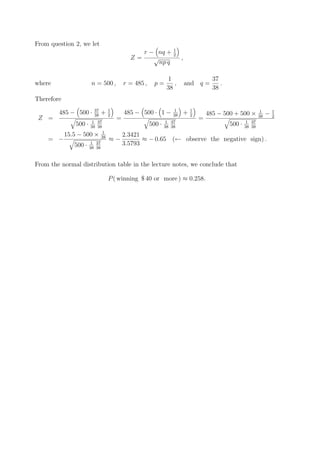
From question 2, we let
                                                                     1
                                                  r − nq +           2
                                               Z=    √                    ,
                                                      np q

                                                                  1                      37
where                    n = 500 ,           r = 485 ,     p=        ,        and q =       .
                                                                  38                     38
Therefore
                          37         1                               1         1
        485 − 500 ·       38
                                +    2
                                             485 − 500 · 1 −         38
                                                                          +    2       485 − 500 + 500 ×        1
                                                                                                                     −   1
                                                                                                                38       2
 Z =                                     =                                         =
                        1 37                                     1 37                                   1 37
                500 ·   38 38
                                                         500 ·   38 38
                                                                                                500 ·   38 38
                                1
            15.5 − 500 ×        38           2.3421
    = −                              ≈−             ≈ − 0.65 (← observe the negative sign) .
               500 ·    1 37                 3.5793
                        38 38


From the normal distribution table in the lecture notes, we conclude that

                                     P ( winning $ 40 or more ) ≈ 0.258.

S 7

  • 1.
    GEK1544 The Mathematicsof Games Tutorial 7 We consider Q. 2 first. 2. Let p and q be positive numbers , p + q = 1 . Consider the binomial expansion 1 = (p + q)n = pn + C(n, 1)pn−1 q + · · · + C(n, r) pn−r q r + · · · + q n r n n q q q = p 1 + C(n, 1) + · · · + C(n, r) +···+ . p p p Using the Stirling formula k √ k k ! ≈ 2πk for k 1, e estimate the value of r (in terms of n when it is large) so that the expression r r q n! q C(n, r) = (2.1) p r ! (n − r) ! p is at maximum. (Suggestion. Express (2.1) using the Stirling formula, and treat it as a function of r. Then differentiate the expression with respect to r , and let n → ∞ . ) Compare in the roulette example when we use the normal distribution, we let 1 r − nq + 2 Z= √ . np q Suggested solution. To locate the maximum, we may ignore the term n !, as it is independent on r . Let a = q/p and consider 1 ar ar ≈ √ √ r √ √ n−r . r ! (n − r) ! 2π r r · 2π n − r n−r e e Here we apply the Stirling formula. Similarly, we ignore the terms involving 2π and e . Set ar f (r) = 1 1 [rr+ 2 ] [(n − r)(n−r)+ 2 ] 1 1 =⇒ ln [f (r)] = r ln a − r + ln r − (n − r) + ln (n − r) 2 2 1 1 1 1 =⇒ (ln [f (r)]) = ln a − ln r − r + · + ln (n − r) + (n − r) + · 2 r 2 n−r f (r) 1 1 =⇒ = [ln a − ln r + ln (n − r)] − 1 + + 1+ . f (r) 2r 2(n − r)
  • 2.
    At maximum, 1 1 f (r) = 0 =⇒ [ln a − ln r + ln (n − r)] = 1 + − 1+ 2r 2(n − r) a(n − r) 1 1 (n − r) − r n − 2r =⇒ ln = − = = r 2r 2(n − r) 2r(n − r) 2r (n − r) When n → ∞, r → c n, where 0 < c < 1 is a fixed number to be determined. Hence n − 2r n − 2cn 1 − 2c = = →0 as n → ∞ . 2r (n − r) 4cn (n − cn) 4cn (1 − c) It follows that a(n − r) a(n − r) ln → 0 =⇒ → 1 =⇒ an → r(1 + a) . r r That is, q an ×n q×n r→ = p q = =⇒ r = nq (p + q = 1) . 1+a 1+ p p+q 1. A person decides to bet $ 1 on the (fixed) number 8 in Las Vegas roulette, and continue to do so for a total of 500 times. The pay-off on betting on a number is 35 : 1 . Using the normal distribution table, estimate the person’s probability on winning $ 40 or more. Suggested solution. If the number 8 comes up x times in 500 spins, the profit is 35 · x + (500 − x) · (−1) = 36 · x − 500 Solve for x so that 36 · x − 500 ≥ 40 ⇐⇒ 36 · x ≥ 540 =⇒ x ≥ 15 . That is, one needs to win 15 times or more in order to profit $ 40 or more. The chance 1 of winning is p = 38 , whereas 37 q =1−p= . 38 Consider the binomial expansion 1 = (p + q)500 = p500 + C(500, 1) p499 q + · · · + C(n, s) p500−s q s + · · · + C(500, 485) p15 q 485 + · · · + q n . It follows that the probability on winning $ 40 or more is C(500, 0) p500 + C(500, 1) p499 q + · · · + C(500, 485) p15 q 485 . In the above, p500 is the probability of winning 500 times number 8, etc. There are a lot of terms to sum, all the way from 0 to r = 485 . Instead, we apply the normal distribution to approximate the number.
  • 3.
    From question 2,we let 1 r − nq + 2 Z= √ , np q 1 37 where n = 500 , r = 485 , p= , and q = . 38 38 Therefore 37 1 1 1 485 − 500 · 38 + 2 485 − 500 · 1 − 38 + 2 485 − 500 + 500 × 1 − 1 38 2 Z = = = 1 37 1 37 1 37 500 · 38 38 500 · 38 38 500 · 38 38 1 15.5 − 500 × 38 2.3421 = − ≈− ≈ − 0.65 (← observe the negative sign) . 500 · 1 37 3.5793 38 38 From the normal distribution table in the lecture notes, we conclude that P ( winning $ 40 or more ) ≈ 0.258.