Thank you
19 min searching
300 million viewers
5 billion hours wasted per year
at least once a week
19 min searching
300 million viewers
5 billion hours wasted per year
at least once a week
Recommendation Engine
Information filtering systems
Deal with choice overload
Focused on user’s:
Preferences
Interest
Observed Behavior
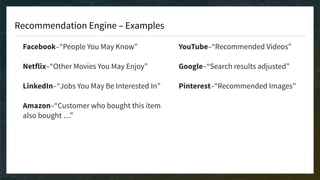
Recommendation Engine – Examples
Facebook–“People You May Know”
Netflix–“Other Movies You May Enjoy”
LinkedIn–“Jobs You May Be Interested In”
Amazon–“Customer who bought this item
also bought …”
YouTube–“Recommended Videos”
Google–“Search results adjusted”
Pinterest–“Recommended Images”
Plan for Today
1. Collaborative Filtering 

- User-User

- Item-Item

- User-Item
2. Content-Based
3. Hybrid Model
4. In Production
Collaborative Filtering
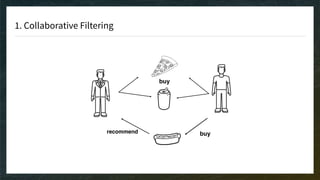
1. Collaborative Filtering
recommend
buy
buy
1. Collaborative Filtering – Rating Matrix
D( , ) = 4 ∈ {∅,1,2,3,4,5}
r. , = 4 − 3 = 1 ∈ {∅, -2,-1,0,1,2}
Rating data:
Re-centered rating data:
1. Collaborative Filtering – Similarity Function
Real function that quantify the similarity between two objects.
1 − ||a − b||2 = 1 −
n
∑
i=1
(ai − bi)2
1 − ||a − b||1 = 1 −
n
∑
i=1
|ai − bi |
1 − ||a − b||p = 1 −
(
n
∑
i=1
|ai − bi |p
)
1/p
a⊤
b
||a||2 ||b||2
=
∑
n
i=1
aibi
∑
n
i=1
a2
i ∑
n
i=1
b2
i
sim(a, b) = …
1. Collaborative Filtering – Similarity Function
Real function that quantify the similarity between two objects.
1 − ||a − b||2 = 1 −
n
∑
i=1
(ai − bi)2
1 − ||a − b||1 = 1 −
n
∑
i=1
|ai − bi |
1 − ||a − b||p = 1 −
(
n
∑
i=1
|ai − bi |p
)
1/p
a⊤
b
||a||2 ||b||2
=
∑
n
i=1
aibi
∑
n
i=1
a2
i ∑
n
i=1
b2
i
sim(a, b) = …
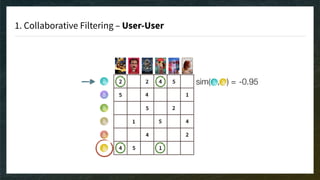
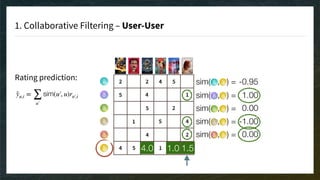
1. Collaborative Filtering – User-User
sim( , ) = -0.95
sim( , ) =
sim( , ) =
sim( , ) =
sim( , ) =
sim( , ) =
1. Collaborative Filtering – User-User
-0.95
1.00
0.00
-1.00
0.00
1. Collaborative Filtering – User-User
sim( , ) =
sim( , ) =
sim( , ) =
sim( , ) =
sim( , ) = -0.95
1.00
0.00
-1.00
0.00
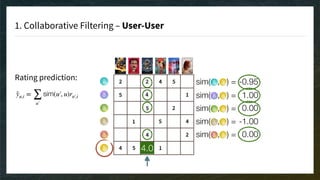
1. Collaborative Filtering – User-User
̂yu,i =
∑
u′
sim(u′, u)ru′,i
Rating prediction:
4.0
sim( , ) =
sim( , ) =
sim( , ) =
sim( , ) =
sim( , ) = -0.95
1.00
0.00
-1.00
0.00
1. Collaborative Filtering – User-User
̂yu,i =
∑
u′
sim(u′, u)ru′,i
Rating prediction:
4.0 1.0 1.5
sim( , ) =
sim( , ) =
sim( , ) =
sim( , ) =
sim( , ) = -0.95
1.00
0.00
-1.00
0.00
1. Collaborative Filtering – User-User
̂yu,i =
∑
u′
sim(u′, u)ru′,i
Rating prediction:
Recommendation:
argmax
i
̂yu,i
1.0 1.54.0
sim( , ) =
sim( , ) =
sim( , ) =
sim( , ) =
sim( , ) = -0.95
1.00
0.00
-1.00
0.00
1. Collaborative Filtering – User-User Benefits
- “People who bought that also bought that”

- Good when #items >> #users

1. Collaborative Filtering – User-User Challenges
- Sparsity

- Don’t scale – Nearest Neighbors requires computation that grows with
the number of users and items 

- Model Too Simplistic – Accuracy of recommendation may be poor
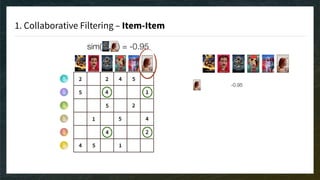
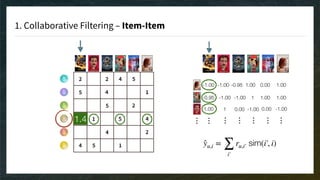
1. Collaborative Filtering – Item-Item
sim( , ) = -0.95
-0.95
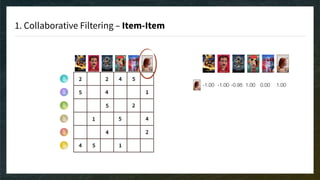
1. Collaborative Filtering – Item-Item
-1.00 -1.00 -0.95 1.00 0.00 1.00
1. Collaborative Filtering – Item-Item
-0.95 -1.00 1.001.00-1.00 1
-1.00 -1.00 -0.95 1.00 0.00 1.00
1. Collaborative Filtering – Item-Item
1.00 0.00 -1.00 0.00 -1.001
-0.95 -1.00 1.001.00-1.00 1
-1.00 -1.00 -0.95 1.00 0.00 1.00
⋮ ⋮ ⋮ ⋮ ⋮ ⋮ ⋮
1. Collaborative Filtering – Item-Item
1.00 0.00 -1.00 0.00 -1.001
-0.95 -1.00 1.001.00-1.00 1
-1.00 -1.00 -0.95 1.00 0.00 1.00
⋮ ⋮ ⋮ ⋮ ⋮ ⋮ ⋮
1. Collaborative Filtering – Item-Item
̂yu,i =
∑
i′
ru,i′ sim(i′, i)
1.00 0.00 -1.00 0.00 -1.001
-0.95 -1.00 1.001.00-1.00 1
-1.00 -1.00 -0.95 1.00 0.00 1.00
1.4 ⋮ ⋮ ⋮ ⋮ ⋮ ⋮ ⋮
1. Collaborative Filtering – Item-Item
1.5 5.0
1.00 0.00 -1.00 0.00 -1.001
-0.95 -1.00 1.001.00-1.00 1
-1.00 -1.00 -0.95 1.00 0.00 1.00
1.4 ⋮ ⋮ ⋮ ⋮ ⋮ ⋮ ⋮
̂yu,i =
∑
i′
ru,i′ sim(i′, i)
1. Collaborative Filtering – Item-Item
5.0
1.00 0.00 -1.00 0.00 -1.001
-0.95 -1.00 1.001.00-1.00 1
-1.00 -1.00 -0.95 1.00 0.00 1.00
5.01.4 1.5
̂yu,i =
∑
i′
ru,i′ sim(i′, i)
⋮ ⋮ ⋮ ⋮ ⋮ ⋮ ⋮
1. Collaborative Filtering – Item-Item Benefits
- “If you like this you might also like that”

- Good when #users >> #items

- Very fast after the item-item table has been pre-computed
1. Collaborative Filtering – Item-Item Challenges
- Bottleneck – similarity computation

- Space complexity – dense item-item similarity matrix

- Model Too Simplistic – Accuracy of recommendation may be poor
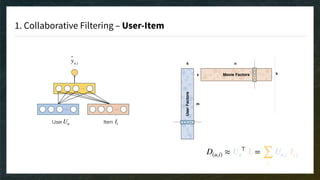
1. Collaborative Filtering – User-Item
D(u,i) ≈ Uu
⊤
Ii =
∑
z
Uu,z Ii,z
D ≈ U⊤
I
1. Collaborative Filtering – User-Item
…
… …
User Item
y!
u,i
D(u,i) ≈ Uu
⊤
Ii =
∑
z
Uu,z Ii,z
…
…
Uu Ii
1. Collaborative Filtering – User-Item
…
… …
y!
u,i
(U, I) = argmin
∑ (U⊤
u Ii − D(u,i))
2
D(u,i) ≈ Uu
⊤
Ii =
∑
z
Uu,z Ii,z
User ItemUu Ii
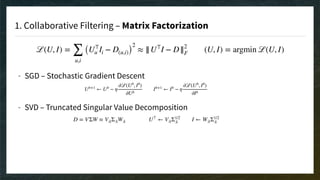
1. Collaborative Filtering – Matrix Factorization
ℒ(U, I) =
∑
u,i
(U⊤
u Ii − D(u,i))
2
≈ ||U⊤
I − D||2
F (U, I) = argmin ℒ(U, I)
- SGD – Stochastic Gradient Descent


Ub+1
← Ub
− η
∂ℒ(Ub
, Ib
)
∂Ub
Ib+1
← Ib
− η
∂ℒ(Ub
, Ib
)
∂Ib
1. Collaborative Filtering – Matrix Factorization
ℒ(U, I) =
∑
u,i
(U⊤
u Ii − D(u,i))
2
≈ ||U⊤
I − D||2
F (U, I) = argmin ℒ(U, I)
- SGD – Stochastic Gradient Descent


- SVD – Truncated Singular Value Decomposition


Ub+1
← Ub
− η
∂ℒ(Ub
, Ib
)
∂Ub
Ib+1
← Ib
− η
∂ℒ(Ub
, Ib
)
∂Ib
D = VΣW ≈ V:kΣ:kW:k U⊤
← V:kΣ1/2
:k I ← W:kΣ1/2
:k
1. Collaborative Filtering – Matrix Factorization
ℒ(U, I) =
∑
u,i
(U⊤
u Ii − D(u,i))
2
≈ ||U⊤
I − D||2
F (U, I) = argmin ℒ(U, I)
- SGD – Stochastic Gradient Descent


- SVD – Truncated Singular Value Decomposition


- ALS – Alternating Least Square


Ub+1
← Ub
− η
∂ℒ(Ub
, Ib
)
∂Ub
Ib+1
← Ib
− η
∂ℒ(Ub
, Ib
)
∂Ib
D = VΣW ≈ V:kΣ:kW:k U⊤
← V:kΣ1/2
:k I ← W:kΣ1/2
:k
Ub+1
← DIb
(Ib⊤
Ib
)−1
Ib+1
← DUb
(Ub⊤
Ub
)−1
1. Collaborative Filtering – User-Item Benefits
similar
- Fast after U and I are pre-computed
- Can learn more about users with U

- Can learn more about items with I
1. Collaborative Filtering – User-Item Challenges
- Sparsity

- Need to re-learn everything every time a new user or new item or new
rating enter the game

- Only linear prediction
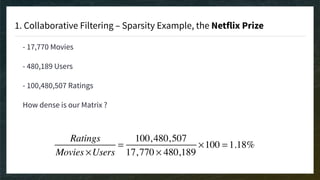
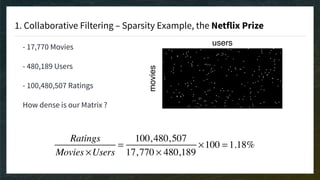
1. Collaborative Filtering – Sparsity Example, the Netflix Prize
- 17,770 Movies
- 480,189 Users
- 100,480,507 Ratings
How dense is our Matrix ?
Ratings
Movies ×Users
=
100,480,507
17,770 × 480,189
×100 = 1.18%
1. Collaborative Filtering – Sparsity Example, the Netflix Prize
- 17,770 Movies
- 480,189 Users
- 100,480,507 Ratings
How dense is our Matrix ?
Ratings
Movies ×Users
=
100,480,507
17,770 × 480,189
×100 = 1.18%
users
movies
1. Collaborative Filtering – Deep Learning
- Non-linear interactions
- Enable transfer learning on multiple dataset
- Enable to use meta-data (keywords, tags)
- Enable to use graph-based data (those who like movies with this actor also 

like movies with this other actor)
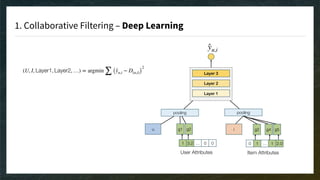
1. Collaborative Filtering – Deep Learning
…
… …
Layer 3
Layer 2
Layer 1
pooling pooling
u g1 g2
1 3.2 … 0 0
User Attributes
g2 g4 g5i
0 1 … 1 2.0
Item Attributes
̂yu,i
̂yu,i
1. Collaborative Filtering – Deep Learning
(U, I, Layer1, Layer2, …) = argmin
∑ ( ̂yu,i − D(u,i))
2
Layer 3
Layer 2
Layer 1
pooling pooling
u g1 g2 g2 g4 g5i
̂yu,i
1 3.2 … 0 0
User Attributes
0 1 … 1 2.0
Item Attributes
1. Collaborative Filtering – Deep Learning
(U, I, Layer1, Layer2, …) = argmin
∑ ( ̂yu,i − D(u,i))
2
- “Mini”-Batch Stochastic Gradient Descent
- Acceleration Heuristics (AdaGrad, Nesterov, RMSprop, Adam, NAdam, ...)
- DropOut / BatchNorm
- Watch-out for Sparse Data and Momentum! vs
- Hyper-parameters Optimization
ru,i = 0 ru,i = ∅
Content Extraction
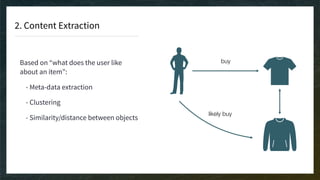
2. Content Extraction
Based on “what does the user like
about an item”:
- Meta-data extraction
- Clustering
- Similarity/distance between objects
likely buy
buy
2. Content Extraction – Item-Item Similarity
- Allow to compute similarities between items
- Does not require rating dataset
- The previous item-item recommendation algorithm still works
- No item cold start
- User attributes mitigate user cold start
2. Content Extraction – Deep
Every single item is not just about
the available meta-data.


Encode information from:
- Images (CNN)
- Text Information (NLP)
- Audio (LSTM)
Input
A documentary which
examines the creation and
co-production of the
popular children’s
television program in three
developing countries:
Bangladesh, Kosovo, and
South Africa.
Prediction
Comedy,
Adventure,
Family,
Animation
In his spectacular film
debut, young Babar, King
of the Elephants must
save his homeland from
certain destruction by
Rataxes and his band of
invading rhinos.
Documentary,
History
Comedy,
Adventure,
Family,
Animation
Adventure, War,
Documentary,
Music
Hybrid Model
3. Hybrid Model
Layer 3
Layer 2
Layer 1
pooling
u g1 g2
1 1 … 0 0
User Attributes
g2 g4 g5i
0 1 … 1 1
Item Attributes
g100 g… g… g… g200 g… g…
A documentary which examines
the creation and co-production of
the popular children’s television
program in three developing
countries: Bangladesh, Kosovo,
and South Africa.
g…
pooling
g… g…
̂yu,i
3. Hybrid Model
Layer 3
Layer 2
Layer 1
pooling
u g1 g2
1 1 … 0 0
User Attributes
g2 g4 g5i
0 1 … 1 1
Item Attributes
g100 g… g… g… g200 g… g…
A documentary which examines
the creation and co-production of
the popular children’s television
program in three developing
countries: Bangladesh, Kosovo,
and South Africa.
g…
pooling
g… g…
̂yu,i
pre-computed as input
fully trained in SGD
3. Hybrid Model
- The previous deep learning recommendation algorithm still works
- Improve recommendations of items without many ratings
- Mitigate item cold start
- Mitigate user cold start
- Improve transfer learning
In Production
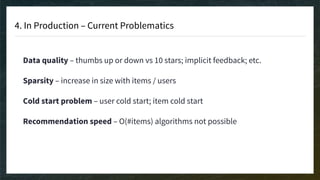
4. In Production – Current Problematics
Data quality – thumbs up or down vs 10 stars; implicit feedback; etc.
Sparsity – increase in size with items / users
Cold start problem – user cold start; item cold start
Recommendation speed – O(#items) algorithms not possible
4. In Production – Solutions
Data quality

Unbiased consumer app where the users enter their tastes
Sparsity 

User interaction: Ask each user to rate the most informative items
Cold start problem

Hybrid models with deep content extraction to recommend new items without ratings
Recommendation speed

Use item-item rec-sys with pre-computed item similarities to compute a (large) set of
candidates; compute feedforward neural network on candidates only
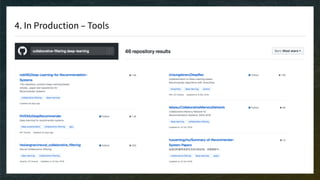
4. In Production – Tools
LightFM
🙂 open source: https://github.com/lyst/lightfm

🙂 hybrid: matrix factorization + context

😐 linear
Deep Learning?
😐 way less tools than Computer Vision or NLP

😐 no pre-trained model available – you need large dataset and GPUs

😐 TensorFlow and PyTorch support for sparse data is limited
4. In Production – Tools
4. In Production – Cloud Based


Do you want to hear more?


Let's get in touch with us at Crossing Minds!

We are building an API to offer state-of-the-art recommendations on the cloud
Thank you

Recommendation System Explained

  • 1.
  • 2.
    19 min searching 300million viewers 5 billion hours wasted per year at least once a week
  • 3.
    19 min searching 300million viewers 5 billion hours wasted per year at least once a week
  • 5.
    Recommendation Engine Information filteringsystems Deal with choice overload Focused on user’s: Preferences Interest Observed Behavior
  • 6.
    Recommendation Engine –Examples Facebook–“People You May Know” Netflix–“Other Movies You May Enjoy” LinkedIn–“Jobs You May Be Interested In” Amazon–“Customer who bought this item also bought …” YouTube–“Recommended Videos” Google–“Search results adjusted” Pinterest–“Recommended Images”
  • 7.
    Plan for Today 1.Collaborative Filtering 
 - User-User
 - Item-Item
 - User-Item 2. Content-Based 3. Hybrid Model 4. In Production
  • 8.
  • 9.
  • 10.
    1. Collaborative Filtering– Rating Matrix D( , ) = 4 ∈ {∅,1,2,3,4,5} r. , = 4 − 3 = 1 ∈ {∅, -2,-1,0,1,2} Rating data: Re-centered rating data:
  • 11.
    1. Collaborative Filtering– Similarity Function Real function that quantify the similarity between two objects. 1 − ||a − b||2 = 1 − n ∑ i=1 (ai − bi)2 1 − ||a − b||1 = 1 − n ∑ i=1 |ai − bi | 1 − ||a − b||p = 1 − ( n ∑ i=1 |ai − bi |p ) 1/p a⊤ b ||a||2 ||b||2 = ∑ n i=1 aibi ∑ n i=1 a2 i ∑ n i=1 b2 i sim(a, b) = …
  • 12.
    1. Collaborative Filtering– Similarity Function Real function that quantify the similarity between two objects. 1 − ||a − b||2 = 1 − n ∑ i=1 (ai − bi)2 1 − ||a − b||1 = 1 − n ∑ i=1 |ai − bi | 1 − ||a − b||p = 1 − ( n ∑ i=1 |ai − bi |p ) 1/p a⊤ b ||a||2 ||b||2 = ∑ n i=1 aibi ∑ n i=1 a2 i ∑ n i=1 b2 i sim(a, b) = …
  • 13.
  • 14.
    1. Collaborative Filtering– User-User sim( , ) = -0.95
  • 15.
    sim( , )= sim( , ) = sim( , ) = sim( , ) = sim( , ) = 1. Collaborative Filtering – User-User -0.95 1.00 0.00 -1.00 0.00
  • 16.
    1. Collaborative Filtering– User-User sim( , ) = sim( , ) = sim( , ) = sim( , ) = sim( , ) = -0.95 1.00 0.00 -1.00 0.00
  • 17.
    1. Collaborative Filtering– User-User ̂yu,i = ∑ u′ sim(u′, u)ru′,i Rating prediction: 4.0 sim( , ) = sim( , ) = sim( , ) = sim( , ) = sim( , ) = -0.95 1.00 0.00 -1.00 0.00
  • 18.
    1. Collaborative Filtering– User-User ̂yu,i = ∑ u′ sim(u′, u)ru′,i Rating prediction: 4.0 1.0 1.5 sim( , ) = sim( , ) = sim( , ) = sim( , ) = sim( , ) = -0.95 1.00 0.00 -1.00 0.00
  • 19.
    1. Collaborative Filtering– User-User ̂yu,i = ∑ u′ sim(u′, u)ru′,i Rating prediction: Recommendation: argmax i ̂yu,i 1.0 1.54.0 sim( , ) = sim( , ) = sim( , ) = sim( , ) = sim( , ) = -0.95 1.00 0.00 -1.00 0.00
  • 20.
    1. Collaborative Filtering– User-User Benefits - “People who bought that also bought that”
 - Good when #items >> #users

  • 21.
    1. Collaborative Filtering– User-User Challenges - Sparsity
 - Don’t scale – Nearest Neighbors requires computation that grows with the number of users and items 
 - Model Too Simplistic – Accuracy of recommendation may be poor
  • 22.
  • 23.
    1. Collaborative Filtering– Item-Item sim( , ) = -0.95 -0.95
  • 24.
    1. Collaborative Filtering– Item-Item -1.00 -1.00 -0.95 1.00 0.00 1.00
  • 25.
    1. Collaborative Filtering– Item-Item -0.95 -1.00 1.001.00-1.00 1 -1.00 -1.00 -0.95 1.00 0.00 1.00
  • 26.
    1. Collaborative Filtering– Item-Item 1.00 0.00 -1.00 0.00 -1.001 -0.95 -1.00 1.001.00-1.00 1 -1.00 -1.00 -0.95 1.00 0.00 1.00 ⋮ ⋮ ⋮ ⋮ ⋮ ⋮ ⋮
  • 27.
    1. Collaborative Filtering– Item-Item 1.00 0.00 -1.00 0.00 -1.001 -0.95 -1.00 1.001.00-1.00 1 -1.00 -1.00 -0.95 1.00 0.00 1.00 ⋮ ⋮ ⋮ ⋮ ⋮ ⋮ ⋮
  • 28.
    1. Collaborative Filtering– Item-Item ̂yu,i = ∑ i′ ru,i′ sim(i′, i) 1.00 0.00 -1.00 0.00 -1.001 -0.95 -1.00 1.001.00-1.00 1 -1.00 -1.00 -0.95 1.00 0.00 1.00 1.4 ⋮ ⋮ ⋮ ⋮ ⋮ ⋮ ⋮
  • 29.
    1. Collaborative Filtering– Item-Item 1.5 5.0 1.00 0.00 -1.00 0.00 -1.001 -0.95 -1.00 1.001.00-1.00 1 -1.00 -1.00 -0.95 1.00 0.00 1.00 1.4 ⋮ ⋮ ⋮ ⋮ ⋮ ⋮ ⋮ ̂yu,i = ∑ i′ ru,i′ sim(i′, i)
  • 30.
    1. Collaborative Filtering– Item-Item 5.0 1.00 0.00 -1.00 0.00 -1.001 -0.95 -1.00 1.001.00-1.00 1 -1.00 -1.00 -0.95 1.00 0.00 1.00 5.01.4 1.5 ̂yu,i = ∑ i′ ru,i′ sim(i′, i) ⋮ ⋮ ⋮ ⋮ ⋮ ⋮ ⋮
  • 31.
    1. Collaborative Filtering– Item-Item Benefits - “If you like this you might also like that”
 - Good when #users >> #items
 - Very fast after the item-item table has been pre-computed
  • 32.
    1. Collaborative Filtering– Item-Item Challenges - Bottleneck – similarity computation
 - Space complexity – dense item-item similarity matrix
 - Model Too Simplistic – Accuracy of recommendation may be poor
  • 33.
  • 34.
  • 35.
    1. Collaborative Filtering– User-Item D(u,i) ≈ Uu ⊤ Ii = ∑ z Uu,z Ii,z D ≈ U⊤ I
  • 36.
    1. Collaborative Filtering– User-Item … … … User Item y! u,i D(u,i) ≈ Uu ⊤ Ii = ∑ z Uu,z Ii,z … … Uu Ii
  • 37.
    1. Collaborative Filtering– User-Item … … … y! u,i (U, I) = argmin ∑ (U⊤ u Ii − D(u,i)) 2 D(u,i) ≈ Uu ⊤ Ii = ∑ z Uu,z Ii,z User ItemUu Ii
  • 38.
    1. Collaborative Filtering– Matrix Factorization ℒ(U, I) = ∑ u,i (U⊤ u Ii − D(u,i)) 2 ≈ ||U⊤ I − D||2 F (U, I) = argmin ℒ(U, I) - SGD – Stochastic Gradient Descent


 Ub+1 ← Ub − η ∂ℒ(Ub , Ib ) ∂Ub Ib+1 ← Ib − η ∂ℒ(Ub , Ib ) ∂Ib
  • 39.
    1. Collaborative Filtering– Matrix Factorization ℒ(U, I) = ∑ u,i (U⊤ u Ii − D(u,i)) 2 ≈ ||U⊤ I − D||2 F (U, I) = argmin ℒ(U, I) - SGD – Stochastic Gradient Descent
 
 - SVD – Truncated Singular Value Decomposition


 Ub+1 ← Ub − η ∂ℒ(Ub , Ib ) ∂Ub Ib+1 ← Ib − η ∂ℒ(Ub , Ib ) ∂Ib D = VΣW ≈ V:kΣ:kW:k U⊤ ← V:kΣ1/2 :k I ← W:kΣ1/2 :k
  • 40.
    1. Collaborative Filtering– Matrix Factorization ℒ(U, I) = ∑ u,i (U⊤ u Ii − D(u,i)) 2 ≈ ||U⊤ I − D||2 F (U, I) = argmin ℒ(U, I) - SGD – Stochastic Gradient Descent
 
 - SVD – Truncated Singular Value Decomposition
 
 - ALS – Alternating Least Square
 
 
 Ub+1 ← Ub − η ∂ℒ(Ub , Ib ) ∂Ub Ib+1 ← Ib − η ∂ℒ(Ub , Ib ) ∂Ib D = VΣW ≈ V:kΣ:kW:k U⊤ ← V:kΣ1/2 :k I ← W:kΣ1/2 :k Ub+1 ← DIb (Ib⊤ Ib )−1 Ib+1 ← DUb (Ub⊤ Ub )−1
  • 41.
    1. Collaborative Filtering– User-Item Benefits similar - Fast after U and I are pre-computed - Can learn more about users with U
 - Can learn more about items with I
  • 42.
    1. Collaborative Filtering– User-Item Challenges - Sparsity
 - Need to re-learn everything every time a new user or new item or new rating enter the game
 - Only linear prediction
  • 43.
    1. Collaborative Filtering– Sparsity Example, the Netflix Prize - 17,770 Movies - 480,189 Users - 100,480,507 Ratings How dense is our Matrix ? Ratings Movies ×Users = 100,480,507 17,770 × 480,189 ×100 = 1.18%
  • 44.
    1. Collaborative Filtering– Sparsity Example, the Netflix Prize - 17,770 Movies - 480,189 Users - 100,480,507 Ratings How dense is our Matrix ? Ratings Movies ×Users = 100,480,507 17,770 × 480,189 ×100 = 1.18% users movies
  • 45.
    1. Collaborative Filtering– Deep Learning - Non-linear interactions - Enable transfer learning on multiple dataset - Enable to use meta-data (keywords, tags) - Enable to use graph-based data (those who like movies with this actor also 
 like movies with this other actor)
  • 46.
    1. Collaborative Filtering– Deep Learning … … … Layer 3 Layer 2 Layer 1 pooling pooling u g1 g2 1 3.2 … 0 0 User Attributes g2 g4 g5i 0 1 … 1 2.0 Item Attributes ̂yu,i ̂yu,i
  • 47.
    1. Collaborative Filtering– Deep Learning (U, I, Layer1, Layer2, …) = argmin ∑ ( ̂yu,i − D(u,i)) 2 Layer 3 Layer 2 Layer 1 pooling pooling u g1 g2 g2 g4 g5i ̂yu,i 1 3.2 … 0 0 User Attributes 0 1 … 1 2.0 Item Attributes
  • 48.
    1. Collaborative Filtering– Deep Learning (U, I, Layer1, Layer2, …) = argmin ∑ ( ̂yu,i − D(u,i)) 2 - “Mini”-Batch Stochastic Gradient Descent - Acceleration Heuristics (AdaGrad, Nesterov, RMSprop, Adam, NAdam, ...) - DropOut / BatchNorm - Watch-out for Sparse Data and Momentum! vs - Hyper-parameters Optimization ru,i = 0 ru,i = ∅
  • 49.
  • 50.
    2. Content Extraction Basedon “what does the user like about an item”: - Meta-data extraction - Clustering - Similarity/distance between objects likely buy buy
  • 51.
    2. Content Extraction– Item-Item Similarity - Allow to compute similarities between items - Does not require rating dataset - The previous item-item recommendation algorithm still works - No item cold start - User attributes mitigate user cold start
  • 52.
    2. Content Extraction– Deep Every single item is not just about the available meta-data.
 
 Encode information from: - Images (CNN) - Text Information (NLP) - Audio (LSTM) Input A documentary which examines the creation and co-production of the popular children’s television program in three developing countries: Bangladesh, Kosovo, and South Africa. Prediction Comedy, Adventure, Family, Animation In his spectacular film debut, young Babar, King of the Elephants must save his homeland from certain destruction by Rataxes and his band of invading rhinos. Documentary, History Comedy, Adventure, Family, Animation Adventure, War, Documentary, Music
  • 53.
  • 54.
    3. Hybrid Model Layer3 Layer 2 Layer 1 pooling u g1 g2 1 1 … 0 0 User Attributes g2 g4 g5i 0 1 … 1 1 Item Attributes g100 g… g… g… g200 g… g… A documentary which examines the creation and co-production of the popular children’s television program in three developing countries: Bangladesh, Kosovo, and South Africa. g… pooling g… g… ̂yu,i
  • 55.
    3. Hybrid Model Layer3 Layer 2 Layer 1 pooling u g1 g2 1 1 … 0 0 User Attributes g2 g4 g5i 0 1 … 1 1 Item Attributes g100 g… g… g… g200 g… g… A documentary which examines the creation and co-production of the popular children’s television program in three developing countries: Bangladesh, Kosovo, and South Africa. g… pooling g… g… ̂yu,i pre-computed as input fully trained in SGD
  • 56.
    3. Hybrid Model -The previous deep learning recommendation algorithm still works - Improve recommendations of items without many ratings - Mitigate item cold start - Mitigate user cold start - Improve transfer learning
  • 57.
  • 58.
    4. In Production– Current Problematics Data quality – thumbs up or down vs 10 stars; implicit feedback; etc. Sparsity – increase in size with items / users Cold start problem – user cold start; item cold start Recommendation speed – O(#items) algorithms not possible
  • 59.
    4. In Production– Solutions Data quality
 Unbiased consumer app where the users enter their tastes Sparsity 
 User interaction: Ask each user to rate the most informative items Cold start problem
 Hybrid models with deep content extraction to recommend new items without ratings Recommendation speed
 Use item-item rec-sys with pre-computed item similarities to compute a (large) set of candidates; compute feedforward neural network on candidates only
  • 60.
    4. In Production– Tools LightFM 🙂 open source: https://github.com/lyst/lightfm
 🙂 hybrid: matrix factorization + context
 😐 linear Deep Learning? 😐 way less tools than Computer Vision or NLP
 😐 no pre-trained model available – you need large dataset and GPUs
 😐 TensorFlow and PyTorch support for sparse data is limited
  • 61.
  • 62.
  • 63.
    4. In Production– Cloud Based 
 Do you want to hear more?
 
 Let's get in touch with us at Crossing Minds!
 We are building an API to offer state-of-the-art recommendations on the cloud
  • 64.