Distributed Database
Management Systems
Distributed DBMS
Outline
 Introduction
 Distributed DBMS Architecture
 Distributed Database Design
 Distributed Query Processing
 Distributed Concurrency Control
 Distributed Reliability Protocols
Distributed DBMS
Outline
 Introduction
 What is a distributed DBMS
 Problems
 Current state-of-affairs
 Distributed DBMS Architecture
 Distributed Database Design
 Distributed Query Processing
 Distributed Concurrency Control
 Distributed Reliability Protocols
Distributed DBMS
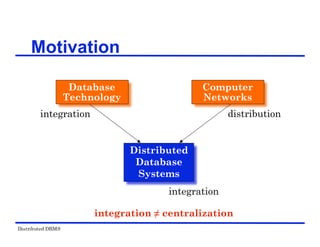
Motivation
Database
Technology
Computer
Networks
integration distribution
integration
integration ≠ centralization
Distributed
Database
Systems
Distributed DBMS
What is a Distributed Database
System?
A distributed database (DDB) is a collection of multiple,
logically interrelated databases distributed over a
computer network.
A distributed database management system (D–DBMS) is
the software that manages the DDB and provides an
access mechanism that makes this distribution
transparent to the users.
Distributed database system (DDBS) = DDB + D–DBMS
Distributed DBMS
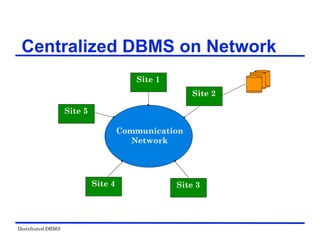
Centralized DBMS on Network
Communication
Network
Site 5
Site 1
Site 2
Site 3
Site 4
Distributed DBMS
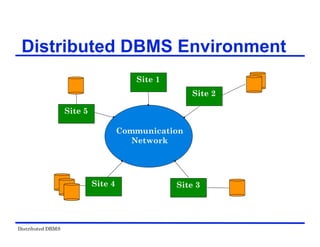
Distributed DBMS Environment
Communication
Network
Site 5
Site 1
Site 2
Site 3
Site 4
Distributed DBMS
Implicit Assumptions
 Data stored at a number of sites  each site
logically consists of a single processor.
 Processors at different sites are interconnected
by a computer network  no multiprocessors
 parallel database systems
 Distributed database is a database, not a
collection of files  data logically related as
exhibited in the users’ access patterns
 relational data model
 D-DBMS is a full-fledged DBMS
 not remote file system, not a TP system
Distributed DBMS
Distributed DBMS Promises
 Transparent management of distributed,
fragmented, and replicated data
 Improved reliability/availability through
distributed transactions
 Improved performance
 Easier and more economical system expansion
Distributed DBMS
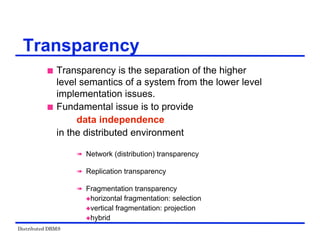
Transparency
 Transparency is the separation of the higher
level semantics of a system from the lower level
implementation issues.
 Fundamental issue is to provide
data independence
in the distributed environment
 Network (distribution) transparency
 Replication transparency
 Fragmentation transparency
horizontal fragmentation: selection
vertical fragmentation: projection
hybrid
Distributed DBMS
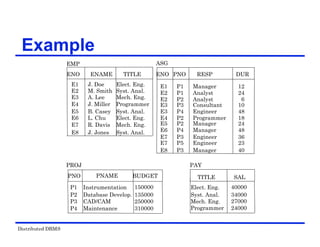
Example
TITLE SAL
PAY
Elect. Eng. 40000
Syst. Anal. 34000
Mech. Eng. 27000
Programmer 24000
PROJ
PNO PNAME BUDGET
ENO ENAME TITLE
E1 J. Doe Elect. Eng.
E2 M. Smith Syst. Anal.
E3 A. Lee Mech. Eng.
E4 J. Miller Programmer
E5 B. Casey Syst. Anal.
E6 L. Chu Elect. Eng.
E7 R. Davis Mech. Eng.
E8 J. Jones Syst. Anal.
EMP
ENO PNO RESP
E1 P1 Manager 12
DUR
E2 P1 Analyst 24
E2 P2 Analyst 6
E3 P3 Consultant 10
E3 P4 Engineer 48
E4 P2 Programmer 18
E5 P2 Manager 24
E6 P4 Manager 48
E7 P3 Engineer 36
E8 P3 Manager 40
ASG
P1 Instrumentation 150000
P3 CAD/CAM 250000
P2 Database Develop. 135000
P4 Maintenance 310000
E7 P5 Engineer 23
Distributed DBMS
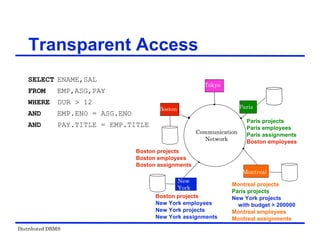
Transparent Access
SELECT ENAME,SAL
FROM EMP,ASG,PAY
WHERE DUR > 12
AND EMP.ENO = ASG.ENO
AND PAY.TITLE = EMP.TITLE
Paris projects
Paris employees
Paris assignments
Boston employees
Montreal projects
Paris projects
New York projects
with budget > 200000
Montreal employees
Montreal assignments
Boston
Communication
Network
Montreal
Paris
New
York
Boston projects
Boston employees
Boston assignments
Boston projects
New York employees
New York projects
New York assignments
Tokyo
Distributed DBMS
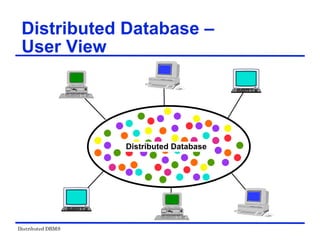
Distributed Database
Distributed Database –
User View
Distributed DBMS
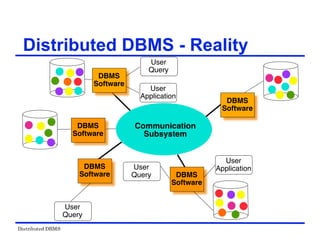
Distributed DBMS - Reality
Communication
Subsystem
User
Query
DBMS
Software
DBMS
Software
User
Application
DBMS
Software
User
Application
User
Query
DBMS
Software
User
Query
DBMS
Software
Distributed DBMS
Potentially Improved
Performance
 Proximity of data to its points of use
 Requires some support for fragmentation and replication
 Parallelism in execution
 Inter-query parallelism
 Intra-query parallelism
Distributed DBMS
Parallelism Requirements
 Have as much of the data required by each
application at the site where the application
executes
 Full replication
 How about updates?
 Updates to replicated data requires implementation of
distributed concurrency control and commit protocols
Distributed DBMS
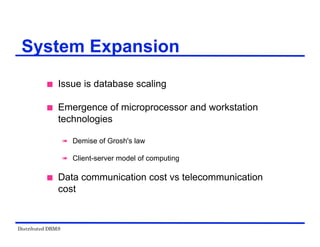
System Expansion
 Issue is database scaling
 Emergence of microprocessor and workstation
technologies
 Demise of Grosh's law
 Client-server model of computing
 Data communication cost vs telecommunication
cost
Distributed DBMS
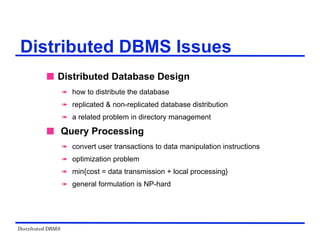
Distributed DBMS Issues
 Distributed Database Design
 how to distribute the database
 replicated & non-replicated database distribution
 a related problem in directory management
 Query Processing
 convert user transactions to data manipulation instructions
 optimization problem
 min{cost = data transmission + local processing}
 general formulation is NP-hard
Distributed DBMS
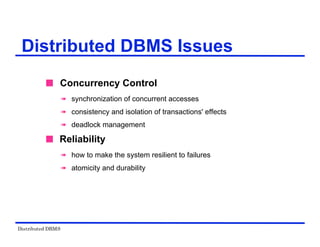
Distributed DBMS Issues
 Concurrency Control
 synchronization of concurrent accesses
 consistency and isolation of transactions' effects
 deadlock management
 Reliability
 how to make the system resilient to failures
 atomicity and durability
Distributed DBMS
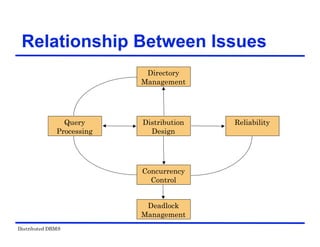
Directory
Management
Relationship Between Issues
Reliability
Deadlock
Management
Query
Processing
Concurrency
Control
Distribution
Design
Distributed DBMS
Outline
 Introduction
 Distributed DBMS Architecture
 Implementation Alternatives
 Component Architecture
 Distributed Database Design
 Distributed Query Processing
 Distributed Concurrency Control
 Distributed Reliability Protocols
Distributed DBMS
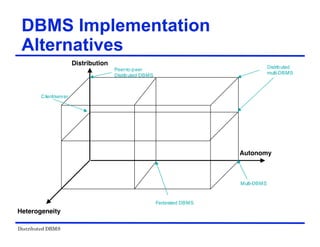
DBMS Implementation
Alternatives
Distribution
Heterogeneity
Autonomy
Client/server
Peer-to-peer
Distributed DBMS
Federated DBMS
Distributed
multi-DBMS
Multi-DBMS
Distributed DBMS
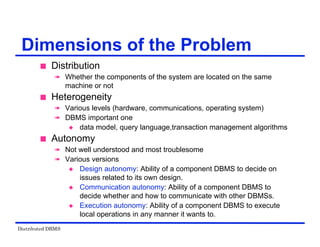
Dimensions of the Problem
 Distribution
 Whether the components of the system are located on the same
machine or not
 Heterogeneity
 Various levels (hardware, communications, operating system)
 DBMS important one
 data model, query language,transaction management algorithms
 Autonomy
 Not well understood and most troublesome
 Various versions
 Design autonomy: Ability of a component DBMS to decide on
issues related to its own design.
 Communication autonomy: Ability of a component DBMS to
decide whether and how to communicate with other DBMSs.
 Execution autonomy: Ability of a component DBMS to execute
local operations in any manner it wants to.
Distributed DBMS
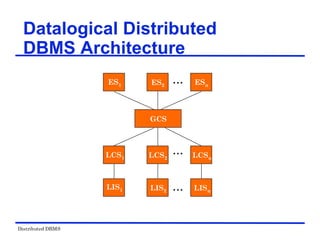
Datalogical Distributed
DBMS Architecture
...
...
...
ES1 ES2 ESn
GCS
LCS1 LCS2 LCSn
LIS1 LIS2 LISn
Distributed DBMS
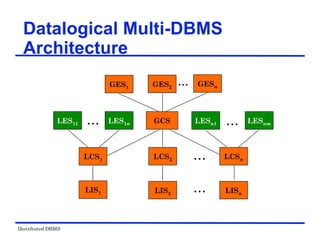
Datalogical Multi-DBMS
Architecture
...
GCS
… …
GES1
LCS2 LCSn
…
…
LIS2 LISn
LES11 LES1n LESn1 LESnm
GES2 GESn
LIS1
LCS1
Distributed DBMS
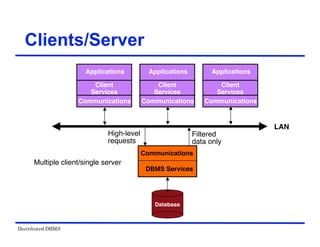
Clients/Server
Communications
Client
Services
Applications
Communications
DBMS Services
LAN
High-level
requests
Filtered
data only
Communications
Client
Services
Applications
Communications
Client
Services
Applications
Database
Multiple client/single server
Distributed DBMS
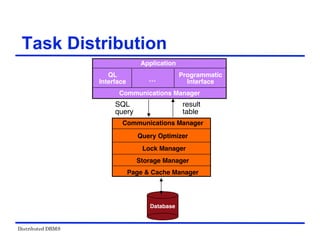
Task Distribution
Application
Communications Manager
Lock Manager
Storage Manager
Page & Cache Manager
Query Optimizer
QL
Interface
Programmatic
Interface
…
SQL
query
result
table
Database
Distributed DBMS
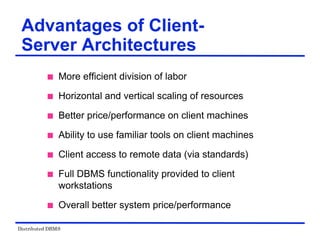
Advantages of Client-
Server Architectures
 More efficient division of labor
 Horizontal and vertical scaling of resources
 Better price/performance on client machines
 Ability to use familiar tools on client machines
 Client access to remote data (via standards)
 Full DBMS functionality provided to client
workstations
 Overall better system price/performance
Distributed DBMS
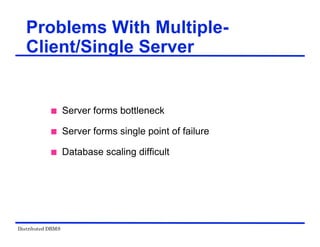
Problems With Multiple-
Client/Single Server
 Server forms bottleneck
 Server forms single point of failure
 Database scaling difficult
Distributed DBMS
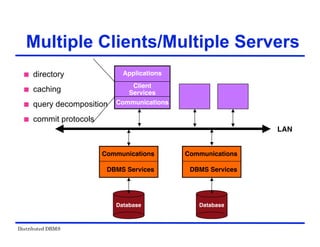
Multiple Clients/Multiple Servers
Communications
Client
Services
Applications
LAN
 directory
 caching
 query decomposition
 commit protocols
Communications
DBMS Services
Database
Communications
DBMS Services
Database
Distributed DBMS
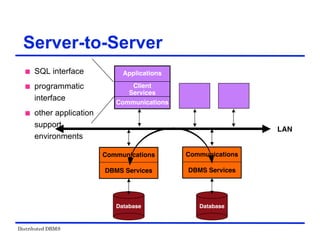
Server-to-Server
Communications
DBMS Services
LAN
Communications
DBMS Services
 SQL interface
 programmatic
interface
 other application
support
environments
Communications
Client
Services
Applications
Database Database
Distributed DBMS
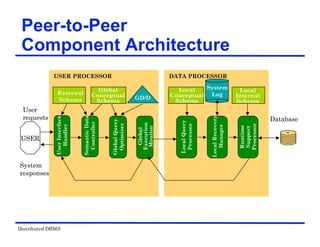
Peer-to-Peer
Component Architecture
Database
DATA PROCESSOR
USER PROCESSOR
USER
User
requests
System
responses
External
Schema
User
Interface
Handler
Global
Conceptual
Schema
Semantic
Data
Controller
Global
Execution
Monitor
System
Log
Local
Recovery
Manager
Local
Internal
Schema
Runtime
Support
Processor
Local
Query
Processor
Local
Conceptual
Schema
Global
Query
Optimizer
GD/D
Distributed DBMS
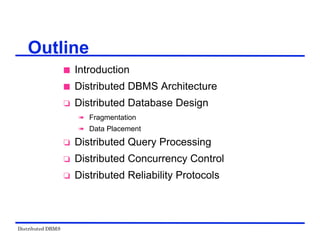
Outline
 Introduction
 Distributed DBMS Architecture
 Distributed Database Design
 Fragmentation
 Data Placement
 Distributed Query Processing
 Distributed Concurrency Control
 Distributed Reliability Protocols
Distributed DBMS
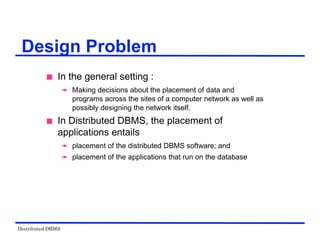
Design Problem
 In the general setting :
 Making decisions about the placement of data and
programs across the sites of a computer network as well as
possibly designing the network itself.
 In Distributed DBMS, the placement of
applications entails
 placement of the distributed DBMS software; and
 placement of the applications that run on the database
Distributed DBMS
Distribution Design
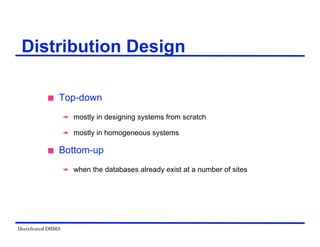
 Top-down
 mostly in designing systems from scratch
 mostly in homogeneous systems
 Bottom-up
 when the databases already exist at a number of sites
Distributed DBMS
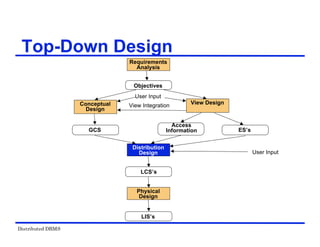
Top-Down Design
User Input
View Integration
User Input
Requirements
Analysis
Objectives
Conceptual
Design
View Design
Access
Information ES’s
GCS
Distribution
Design
Physical
Design
LCS’s
LIS’s
Distributed DBMS
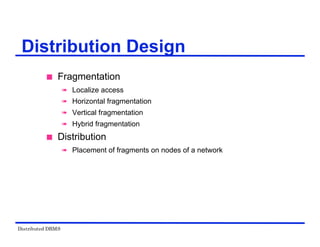
Distribution Design
 Fragmentation
 Localize access
 Horizontal fragmentation
 Vertical fragmentation
 Hybrid fragmentation
 Distribution
 Placement of fragments on nodes of a network
Distributed DBMS
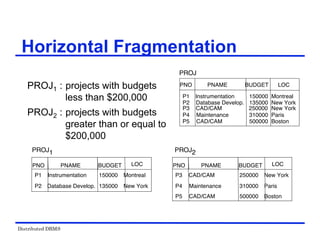
PROJ1 : projects with budgets
less than $200,000
PROJ2 : projects with budgets
greater than or equal to
$200,000
PROJ1
PNO PNAME BUDGET LOC
P3 CAD/CAM 250000 New York
P4 Maintenance 310000 Paris
P5 CAD/CAM 500000 Boston
PNO PNAME LOC
P1 Instrumentation 150000 Montreal
P2 Database Develop. 135000 New York
BUDGET
PROJ2
Horizontal Fragmentation
New York
New York
PROJ
PNO PNAME BUDGET LOC
P1 Instrumentation 150000 Montreal
P3 CAD/CAM 250000
P2 Database Develop. 135000
P4 Maintenance 310000 Paris
P5 CAD/CAM 500000 Boston
New York
New York
Distributed DBMS
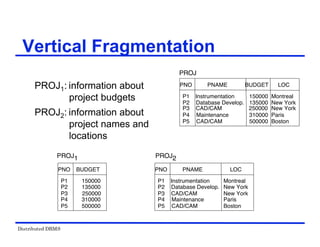
Vertical Fragmentation
PROJ1: information about
project budgets
PROJ2: information about
project names and
locations
PNO BUDGET
P1 150000
P3 250000
P2 135000
P4 310000
P5 500000
PNO PNAME LOC
P1 Instrumentation Montreal
P3 CAD/CAM New York
P2 Database Develop. New York
P4 Maintenance Paris
P5 CAD/CAM Boston
PROJ1 PROJ2
New York
New York
PROJ
PNO PNAME BUDGET LOC
P1 Instrumentation 150000 Montreal
P3 CAD/CAM 250000
P2 Database Develop. 135000
P4 Maintenance 310000 Paris
P5 CAD/CAM 500000 Boston
New York
New York
Distributed DBMS
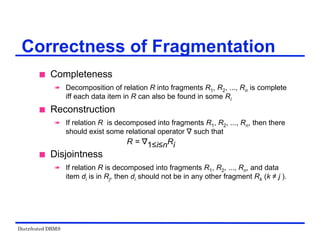
 Completeness
 Decomposition of relation R into fragments R1, R2, ..., Rn is complete
iff each data item in R can also be found in some Ri
 Reconstruction
 If relation R is decomposed into fragments R1, R2, ..., Rn, then there
should exist some relational operator ∇ such that
R = ∇1≤i≤nRi
 Disjointness
 If relation R is decomposed into fragments R1, R2, ..., Rn, and data
item di is in Rj, then di should not be in any other fragment Rk (k ≠ j ).
Correctness of Fragmentation
Distributed DBMS
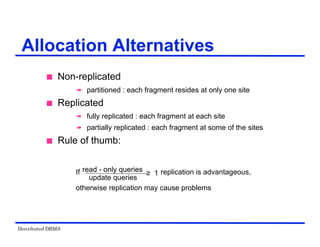
Allocation Alternatives
 Non-replicated
 partitioned : each fragment resides at only one site
 Replicated
 fully replicated : each fragment at each site
 partially replicated : each fragment at some of the sites
 Rule of thumb:
If replication is advantageous,
otherwise replication may cause problems
read - only queries
update queries
≥ 1
Distributed DBMS
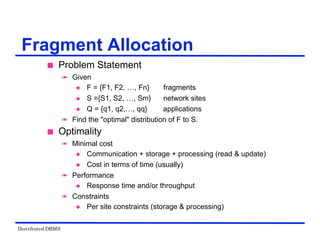
Fragment Allocation
 Problem Statement
 Given
 F = {F1, F2, …, Fn} fragments
 S ={S1, S2, …, Sm} network sites
 Q = {q1, q2,…, qq} applications
 Find the "optimal" distribution of F to S.
 Optimality
 Minimal cost
 Communication + storage + processing (read & update)
 Cost in terms of time (usually)
 Performance
 Response time and/or throughput
 Constraints
 Per site constraints (storage & processing)
Distributed DBMS
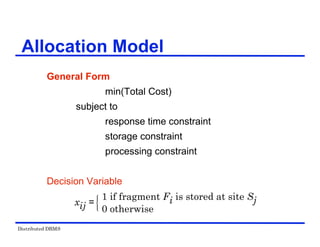
General Form
min(Total Cost)
subject to
response time constraint
storage constraint
processing constraint
Decision Variable
Allocation Model
xij =
1 if fragment Fi is stored at site Sj
0 otherwise
⎧
⎨
⎩
Distributed DBMS
Outline
 Introduction
 Distributed DBMS Architecture
 Distributed Database Design
 Distributed Query Processing
 Query Processing Methodology
 Distributed Query Optimization
 Distributed Concurrency Control
 Distributed Reliability Protocols
Distributed DBMS
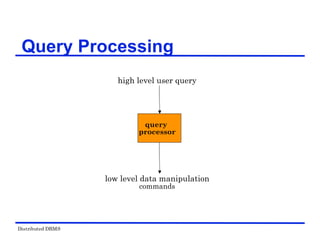
Query Processing
high level user query
query
processor
low level data manipulation
commands
Distributed DBMS
Query Processing Components
 Query language that is used
 SQL: “intergalactic dataspeak”
 Query execution methodology
 The steps that one goes through in executing high-level
(declarative) user queries.
 Query optimization
 How do we determine the “best” execution plan?
Distributed DBMS
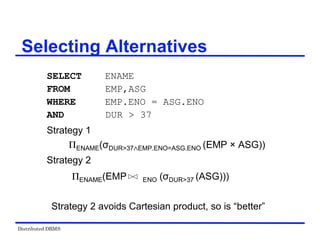
SELECT ENAME
FROM EMP,ASG
WHERE EMP.ENO = ASG.ENO
AND DUR > 37
Strategy 1
ΠENAME(σDUR>37 EMP.ENO=ASG.ENO (EMP × ASG))
Strategy 2
ΠENAME(EMP ENO (σDUR>37 (ASG)))
Selecting Alternatives
Strategy 2 avoids Cartesian product, so is “better”
Distributed DBMS
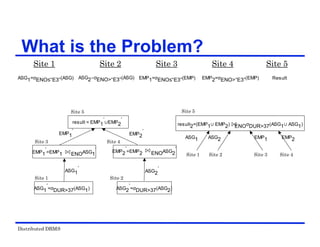
What is the Problem?
Site 1 Site 2 Site 3 Site 4 Site 5
EMP1=σENO≤“E3”(EMP) EMP2=σENO>“E3”(EMP)
ASG2=σENO>“E3”(ASG)
ASG1=σENO≤“E3”(ASG) Result
Site 5
Site 1 Site 2 Site 3 Site 4
ASG1 EMP1 EMP2
ASG2
result2=(EMP1 EMP2) ENOσDUR>37(ASG1 ASG1)
Site 4
result = EMP1
’ EMP2
’
Site 3
Site 1 Site 2
EMP2
’=EMP2 ENOASG2
’
EMP1
’=EMP1 ENOASG1
’
ASG1
’=σDUR>37(ASG1) ASG2
’=σDUR>37(ASG2)
Site 5
ASG2
’
ASG1
’
EMP1
’
EMP2
’
Distributed DBMS
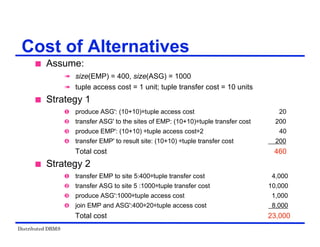
 Assume:
 size(EMP) = 400, size(ASG) = 1000
 tuple access cost = 1 unit; tuple transfer cost = 10 units
 Strategy 1
 produce ASG': (10+10)ѽtuple access cost 20
 transfer ASG' to the sites of EMP: (10+10)ѽtuple transfer cost 200
 produce EMP': (10+10) ѽtuple access costѽ2 40
 transfer EMP' to result site: (10+10) ѽtuple transfer cost 200
Total cost 460
 Strategy 2
 transfer EMP to site 5:400ѽtuple transfer cost 4,000
 transfer ASG to site 5 :1000ѽtuple transfer cost 10,000
 produce ASG':1000ѽtuple access cost 1,000
 join EMP and ASG':400ѽ20ѽtuple access cost 8,000
Total cost 23,000
Cost of Alternatives
Distributed DBMS
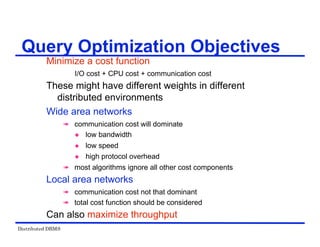
Minimize a cost function
I/O cost + CPU cost + communication cost
These might have different weights in different
distributed environments
Wide area networks
 communication cost will dominate
 low bandwidth
 low speed
 high protocol overhead
 most algorithms ignore all other cost components
Local area networks
 communication cost not that dominant
 total cost function should be considered
Can also maximize throughput
Query Optimization Objectives
Distributed DBMS
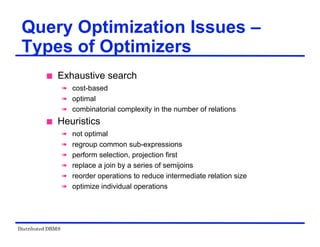
Query Optimization Issues –
Types of Optimizers
 Exhaustive search
 cost-based
 optimal
 combinatorial complexity in the number of relations
 Heuristics
 not optimal
 regroup common sub-expressions
 perform selection, projection first
 replace a join by a series of semijoins
 reorder operations to reduce intermediate relation size
 optimize individual operations
Distributed DBMS
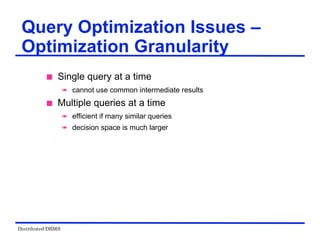
Query Optimization Issues –
Optimization Granularity
 Single query at a time
 cannot use common intermediate results
 Multiple queries at a time
 efficient if many similar queries
 decision space is much larger
Distributed DBMS
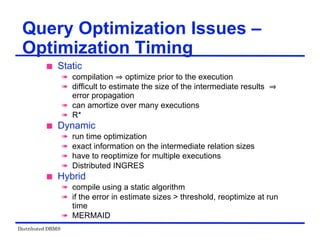
Query Optimization Issues –
Optimization Timing
 Static
 compilation optimize prior to the execution
 difficult to estimate the size of the intermediate results
error propagation
 can amortize over many executions
 R*
 Dynamic
 run time optimization
 exact information on the intermediate relation sizes
 have to reoptimize for multiple executions
 Distributed INGRES
 Hybrid
 compile using a static algorithm
 if the error in estimate sizes > threshold, reoptimize at run
time
 MERMAID
Distributed DBMS
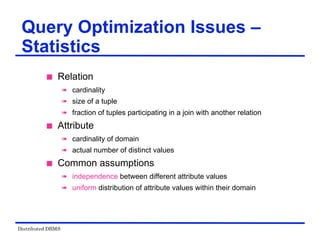
Query Optimization Issues –
Statistics
 Relation
 cardinality
 size of a tuple
 fraction of tuples participating in a join with another relation
 Attribute
 cardinality of domain
 actual number of distinct values
 Common assumptions
 independence between different attribute values
 uniform distribution of attribute values within their domain
Distributed DBMS
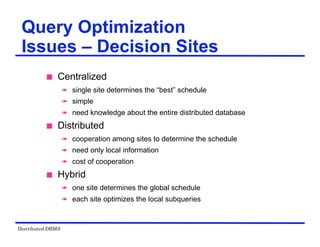
Query Optimization
Issues – Decision Sites
 Centralized
 single site determines the “best” schedule
 simple
 need knowledge about the entire distributed database
 Distributed
 cooperation among sites to determine the schedule
 need only local information
 cost of cooperation
 Hybrid
 one site determines the global schedule
 each site optimizes the local subqueries
Distributed DBMS
Query Optimization Issues –
Network Topology
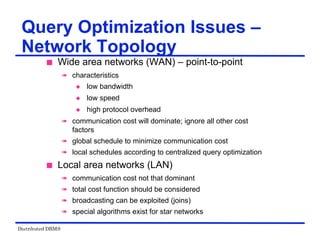
 Wide area networks (WAN) – point-to-point
 characteristics
 low bandwidth
 low speed
 high protocol overhead
 communication cost will dominate; ignore all other cost
factors
 global schedule to minimize communication cost
 local schedules according to centralized query optimization
 Local area networks (LAN)
 communication cost not that dominant
 total cost function should be considered
 broadcasting can be exploited (joins)
 special algorithms exist for star networks
Distributed DBMS
Distributed Query Processing
Methodology
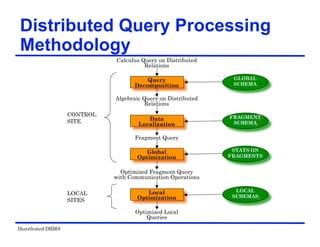
Calculus Query on Distributed
Relations
CONTROL
SITE
LOCAL
SITES
Query
Decomposition
Data
Localization
Algebraic Query on Distributed
Relations
Global
Optimization
Fragment Query
Local
Optimization
Optimized Fragment Query
with Communication Operations
Optimized Local
Queries
GLOBAL
SCHEMA
FRAGMENT
SCHEMA
STATS ON
FRAGMENTS
LOCAL
SCHEMAS
Distributed DBMS
Step 1 – Query Decomposition
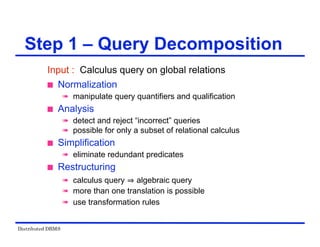
Input : Calculus query on global relations
 Normalization
 manipulate query quantifiers and qualification
 Analysis
 detect and reject “incorrect” queries
 possible for only a subset of relational calculus
 Simplification
 eliminate redundant predicates
 Restructuring
 calculus query algebraic query
 more than one translation is possible
 use transformation rules
Distributed DBMS
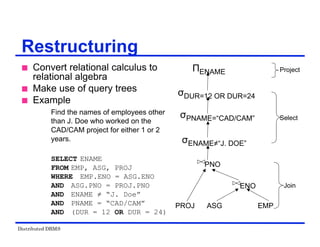
 Convert relational calculus to
relational algebra
 Make use of query trees
 Example
Find the names of employees other
than J. Doe who worked on the
CAD/CAM project for either 1 or 2
years.
SELECT ENAME
FROM EMP, ASG, PROJ
WHERE EMP.ENO = ASG.ENO
AND ASG.PNO = PROJ.PNO
AND ENAME ≠ “J. Doe”
AND PNAME = “CAD/CAM”
AND (DUR = 12 OR DUR = 24)
Restructuring
ΠENAME
σDUR=12 OR DUR=24
σPNAME=“CAD/CAM”
σENAME≠“J. DOE”
PROJ ASG EMP
Project
Select
Join
PNO
ENO
Distributed DBMS
 Commutativity of binary operations
 R × S S × R
 R S S R
 R S S R
 Associativity of binary operations
 ( R × S ) × T R × (S × T)
 ( R S ) T R (S T )
 Idempotence of unary operations
 ΠA’(ΠA’(R)) ΠA’(R)
 σp1(A1)(σp2(A2)(R)) = σp1(A1) p2(A2)(R)
where R[A] and A' A, A" A and A' A"
 Commuting selection with projection
Restructuring –Transformation
Rules (Examples)
Distributed DBMS
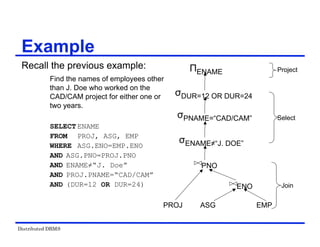
Example
Recall the previous example:
Find the names of employees other
than J. Doe who worked on the
CAD/CAM project for either one or
two years.
SELECT ENAME
FROM PROJ, ASG, EMP
WHERE ASG.ENO=EMP.ENO
AND ASG.PNO=PROJ.PNO
AND ENAME≠“J. Doe”
AND PROJ.PNAME=“CAD/CAM”
AND (DUR=12 OR DUR=24)
ΠENAME
σDUR=12 OR DUR=24
σPNAME=“CAD/CAM”
σENAME≠“J. DOE”
PROJ ASG EMP
Project
Select
Join
PNO
ENO
Distributed DBMS
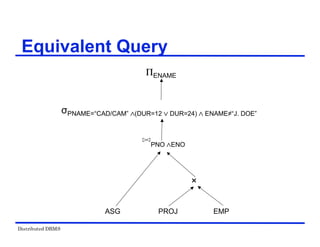
Equivalent Query
ΠENAME
σPNAME=“CAD/CAM” (DUR=12 DUR=24) ENAME≠“J. DOE”
×
PROJ
ASG EMP
PNO ENO
Distributed DBMS
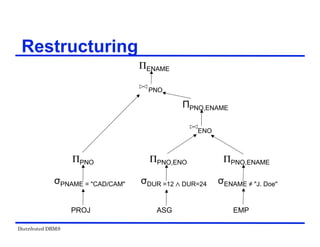
EMP
ΠENAME
σENAME ≠ "J. Doe"
ASG
PROJ
ΠPNO,ENAME
σPNAME = "CAD/CAM"
ΠPNO
σDUR =12 DUR=24
ΠPNO,ENO
ΠPNO,ENAME
Restructuring
PNO
ENO
Distributed DBMS
Step 2 – Data Localization
Input: Algebraic query on distributed relations
 Determine which fragments are involved
 Localization program
 substitute for each global query its materialization program
 optimize
Distributed DBMS
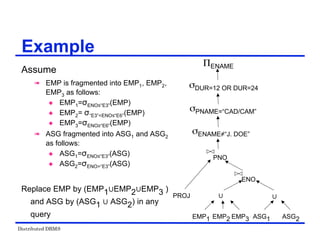
Example
Assume
 EMP is fragmented into EMP1, EMP2,
EMP3 as follows:
 EMP1=σENO≤“E3”(EMP)
 EMP2= σ“E3”<ENO≤“E6”(EMP)
 EMP3=σENO≥“E6”(EMP)
 ASG fragmented into ASG1 and ASG2
as follows:
 ASG1=σENO≤“E3”(ASG)
 ASG2=σENO>“E3”(ASG)
Replace EMP by (EMP1 EMP2 EMP3 )
and ASG by (ASG1 ASG2) in any
query
ΠENAME
σDUR=12 OR DUR=24
σENAME≠“J. DOE”
PROJ
EMP1 EMP2 EMP3 ASG1 ASG2
PNO
ENO
σPNAME=“CAD/CAM”
Distributed DBMS
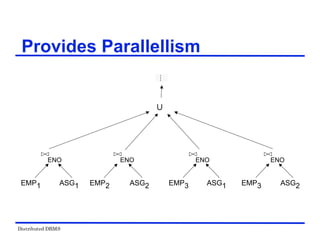
Provides Parallellism
EMP3 ASG1
EMP2 ASG2
EMP1 ASG1 EMP3 ASG2
ENO ENO ENO ENO
Distributed DBMS
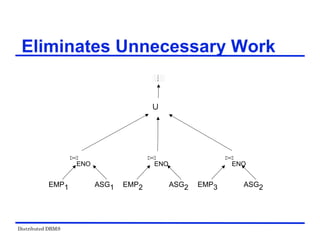
Eliminates Unnecessary Work
EMP2 ASG2
EMP1 ASG1 EMP3 ASG2
ENO ENO ENO
Distributed DBMS
Step 3 – Global Query
Optimization
Input: Fragment query
 Find the best (not necessarily optimal) global
schedule
 Minimize a cost function
 Distributed join processing
 Bushy vs. linear trees
 Which relation to ship where?
 Ship-whole vs ship-as-needed
 Decide on the use of semijoins
 Semijoin saves on communication at the expense of
more local processing.
 Join methods
 nested loop vs ordered joins (merge join or hash join)
Distributed DBMS
Cost-Based Optimization
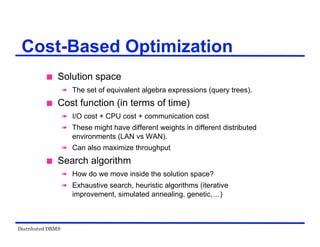
 Solution space
 The set of equivalent algebra expressions (query trees).
 Cost function (in terms of time)
 I/O cost + CPU cost + communication cost
 These might have different weights in different distributed
environments (LAN vs WAN).
 Can also maximize throughput
 Search algorithm
 How do we move inside the solution space?
 Exhaustive search, heuristic algorithms (iterative
improvement, simulated annealing, genetic,…)
Distributed DBMS
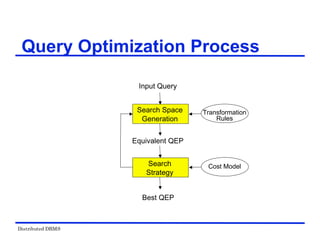
Query Optimization Process
Search Space
Generation
Search
Strategy
Equivalent QEP
Input Query
Transformation
Rules
Cost Model
Best QEP
Distributed DBMS
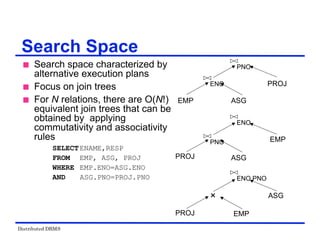
Search Space
 Search space characterized by
alternative execution plans
 Focus on join trees
 For N relations, there are O(N!)
equivalent join trees that can be
obtained by applying
commutativity and associativity
rules
SELECTENAME,RESP
FROM EMP, ASG, PROJ
WHERE EMP.ENO=ASG.ENO
AND ASG.PNO=PROJ.PNO
PROJ
ASG
EMP
PROJ ASG
EMP
PROJ
ASG
EMP
×
ENO
ENO
PNO
PNO
ENO,PNO
Distributed DBMS
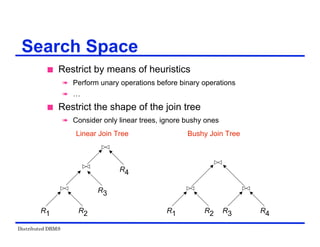
Search Space
 Restrict by means of heuristics
 Perform unary operations before binary operations
 …
 Restrict the shape of the join tree
 Consider only linear trees, ignore bushy ones
R2
R1
R3
R4
Linear Join Tree
R2
R1 R4
R3
Bushy Join Tree
Distributed DBMS
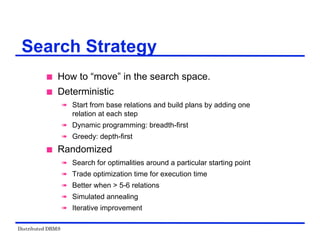
Search Strategy
 How to “move” in the search space.
 Deterministic
 Start from base relations and build plans by adding one
relation at each step
 Dynamic programming: breadth-first
 Greedy: depth-first
 Randomized
 Search for optimalities around a particular starting point
 Trade optimization time for execution time
 Better when > 5-6 relations
 Simulated annealing
 Iterative improvement
Distributed DBMS
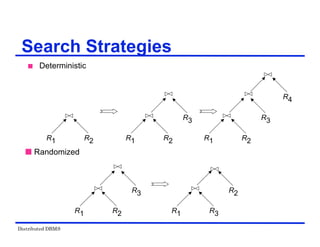
Search Strategies
 Deterministic
 Randomized
R2
R1
R3
R4
R2
R1 R2
R1
R3
R2
R1
R3
R3
R1
R2
Distributed DBMS
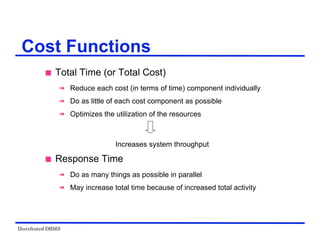
 Total Time (or Total Cost)
 Reduce each cost (in terms of time) component individually
 Do as little of each cost component as possible
 Optimizes the utilization of the resources
Increases system throughput
 Response Time
 Do as many things as possible in parallel
 May increase total time because of increased total activity
Cost Functions
Distributed DBMS
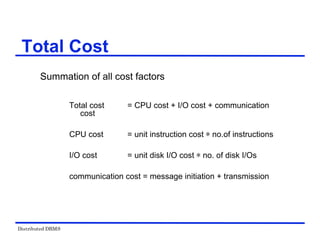
Summation of all cost factors
Total cost = CPU cost + I/O cost + communication
cost
CPU cost = unit instruction cost ѽ no.of instructions
I/O cost = unit disk I/O cost ѽ no. of disk I/Os
communication cost = message initiation + transmission
Total Cost
Distributed DBMS
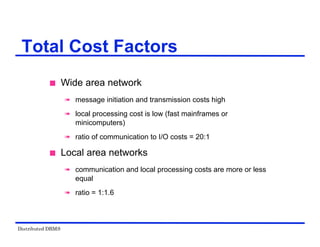
 Wide area network
 message initiation and transmission costs high
 local processing cost is low (fast mainframes or
minicomputers)
 ratio of communication to I/O costs = 20:1
 Local area networks
 communication and local processing costs are more or less
equal
 ratio = 1:1.6
Total Cost Factors
Distributed DBMS
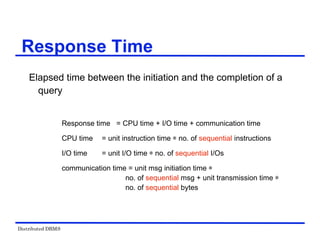
Elapsed time between the initiation and the completion of a
query
Response time = CPU time + I/O time + communication time
CPU time = unit instruction time ѽ no. of sequential instructions
I/O time = unit I/O time ѽ no. of sequential I/Os
communication time = unit msg initiation time ѽ
no. of sequential msg + unit transmission time ѽ
no. of sequential bytes
Response Time
Distributed DBMS
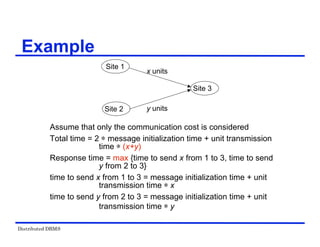
Assume that only the communication cost is considered
Total time = 2 ѽ message initialization time + unit transmission
time ѽ (x+y)
Response time = max {time to send x from 1 to 3, time to send
y from 2 to 3}
time to send x from 1 to 3 = message initialization time + unit
transmission time ѽ x
time to send y from 2 to 3 = message initialization time + unit
transmission time ѽ y
Example
Site 1
Site 2
x units
y units
Site 3
Distributed DBMS
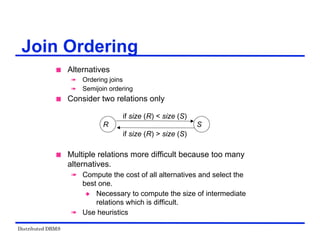
 Alternatives
 Ordering joins
 Semijoin ordering
 Consider two relations only
 Multiple relations more difficult because too many
alternatives.
 Compute the cost of all alternatives and select the
best one.
 Necessary to compute the size of intermediate
relations which is difficult.
 Use heuristics
Join Ordering
R
if size (R) < size (S)
if size (R) > size (S)
S
Distributed DBMS
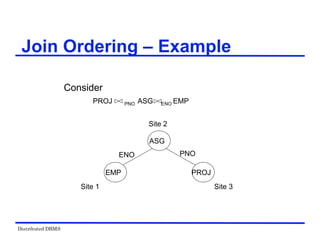
Consider
PROJ PNO ASG ENO EMP
Join Ordering – Example
Site 2
Site 3
Site 1
PNO
ENO
PROJ
ASG
EMP
Distributed DBMS
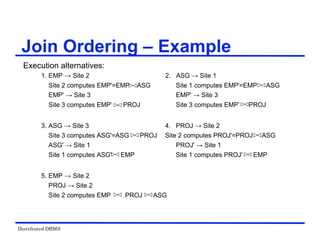
Execution alternatives:
1. EMP → Site 2 2. ASG → Site 1
Site 2 computes EMP'=EMP ASG Site 1 computes EMP'=EMP ASG
EMP' → Site 3 EMP' → Site 3
Site 3 computes EMP’ PROJ Site 3 computes EMP’ PROJ
3. ASG → Site 3 4. PROJ → Site 2
Site 3 computes ASG'=ASG PROJ Site 2 computes PROJ'=PROJ ASG
ASG' → Site 1 PROJ' → Site 1
Site 1 computes ASG' EMP Site 1 computes PROJ' EMP
5. EMP → Site 2
PROJ → Site 2
Site 2 computes EMP PROJ ASG
Join Ordering – Example
Distributed DBMS
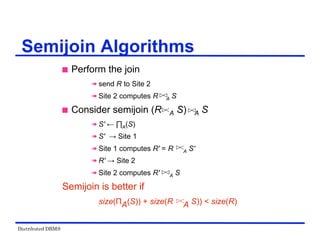
 Consider the join of two relations:
 R[A] (located at site 1)
 S[A] (located at site 2)
 Alternatives:
1 Do the join R A S
2 Perform one of the semijoin equivalents
R A S (R A S) A S
R A (S A R)
(R A S) A (S A R)
Semijoin Algorithms
Distributed DBMS
 Perform the join
 send R to Site 2
 Site 2 computes R A S
 Consider semijoin (R A S) A S
 S' ← ∏A(S)
 S' → Site 1
 Site 1 computes R' = R A S'
 R' → Site 2
 Site 2 computes R' A S
Semijoin is better if
size(ΠA(S)) + size(R A S)) < size(R)
Semijoin Algorithms
Distributed DBMS
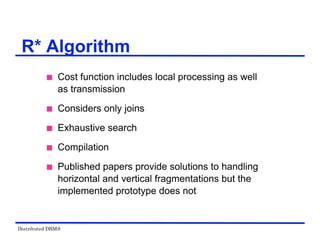
 Cost function includes local processing as well
as transmission
 Considers only joins
 Exhaustive search
 Compilation
 Published papers provide solutions to handling
horizontal and vertical fragmentations but the
implemented prototype does not
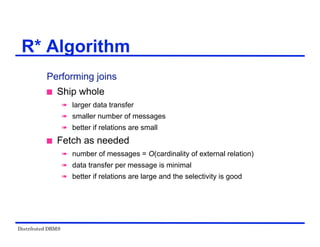
R* Algorithm
Distributed DBMS
Performing joins
 Ship whole
 larger data transfer
 smaller number of messages
 better if relations are small
 Fetch as needed
 number of messages = O(cardinality of external relation)
 data transfer per message is minimal
 better if relations are large and the selectivity is good
R* Algorithm
Distributed DBMS
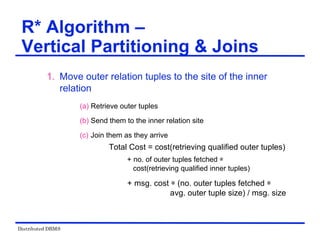
1. Move outer relation tuples to the site of the inner
relation
(a) Retrieve outer tuples
(b) Send them to the inner relation site
(c) Join them as they arrive
Total Cost = cost(retrieving qualified outer tuples)
+ no. of outer tuples fetched ѽ
cost(retrieving qualified inner tuples)
+ msg. cost ѽ (no. outer tuples fetched ѽ
avg. outer tuple size) / msg. size
R* Algorithm –
Vertical Partitioning & Joins
Distributed DBMS
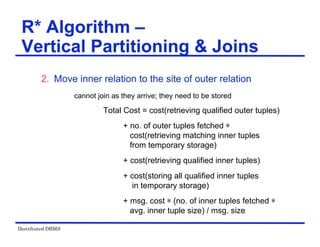
2. Move inner relation to the site of outer relation
cannot join as they arrive; they need to be stored
Total Cost = cost(retrieving qualified outer tuples)
+ no. of outer tuples fetched ѽ
cost(retrieving matching inner tuples
from temporary storage)
+ cost(retrieving qualified inner tuples)
+ cost(storing all qualified inner tuples
in temporary storage)
+ msg. cost ѽ (no. of inner tuples fetched ѽ
avg. inner tuple size) / msg. size
R* Algorithm –
Vertical Partitioning & Joins
Distributed DBMS
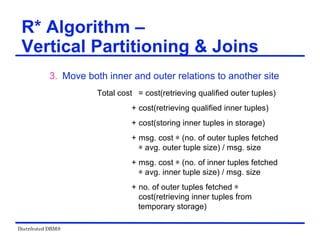
3. Move both inner and outer relations to another site
Total cost = cost(retrieving qualified outer tuples)
+ cost(retrieving qualified inner tuples)
+ cost(storing inner tuples in storage)
+ msg. cost ѽ (no. of outer tuples fetched
ѽ avg. outer tuple size) / msg. size
+ msg. cost ѽ (no. of inner tuples fetched
ѽ avg. inner tuple size) / msg. size
+ no. of outer tuples fetched ѽ
cost(retrieving inner tuples from
temporary storage)
R* Algorithm –
Vertical Partitioning & Joins
Distributed DBMS
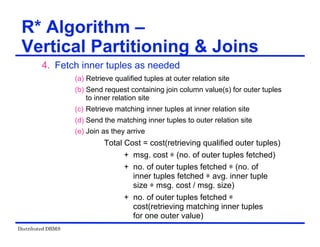
4. Fetch inner tuples as needed
(a) Retrieve qualified tuples at outer relation site
(b) Send request containing join column value(s) for outer tuples
to inner relation site
(c) Retrieve matching inner tuples at inner relation site
(d) Send the matching inner tuples to outer relation site
(e) Join as they arrive
Total Cost = cost(retrieving qualified outer tuples)
+ msg. cost ѽ (no. of outer tuples fetched)
+ no. of outer tuples fetched ѽ (no. of
inner tuples fetched ѽ avg. inner tuple
size ѽ msg. cost / msg. size)
+ no. of outer tuples fetched ѽ
cost(retrieving matching inner tuples
for one outer value)
R* Algorithm –
Vertical Partitioning & Joins
Distributed DBMS
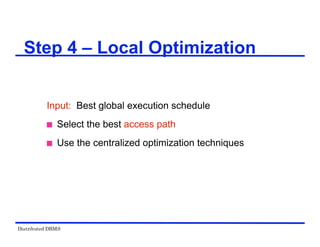
Step 4 – Local Optimization
Input: Best global execution schedule
 Select the best access path
 Use the centralized optimization techniques
Distributed DBMS
Outline
 Introduction
 Distributed DBMS Architecture
 Distributed Database Design
 Distributed Query Processing
 Distributed Concurrency Control
 Transaction Concepts & Models
 Serializability
 Distributed Concurrency Control Protocols
 Distributed Reliability Protocols
Distributed DBMS
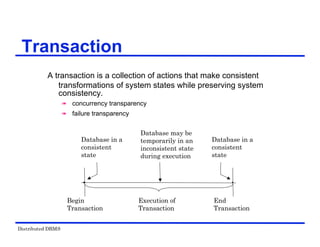
Transaction
A transaction is a collection of actions that make consistent
transformations of system states while preserving system
consistency.
 concurrency transparency
 failure transparency
Database in a
consistent
state
Database may be
temporarily in an
inconsistent state
during execution
Begin
Transaction
End
Transaction
Execution of
Transaction
Database in a
consistent
state
Distributed DBMS
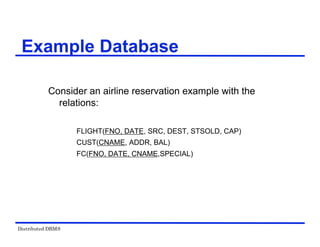
Example Database
Consider an airline reservation example with the
relations:
FLIGHT(FNO, DATE, SRC, DEST, STSOLD, CAP)
CUST(CNAME, ADDR, BAL)
FC(FNO, DATE, CNAME,SPECIAL)
Distributed DBMS
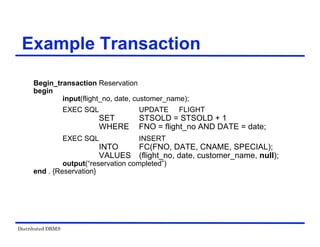
Example Transaction
Begin_transaction Reservation
begin
input(flight_no, date, customer_name);
EXEC SQL UPDATE FLIGHT
SET STSOLD = STSOLD + 1
WHERE FNO = flight_no AND DATE = date;
EXEC SQL INSERT
INTO FC(FNO, DATE, CNAME, SPECIAL);
VALUES (flight_no, date, customer_name, null);
output(“reservation completed”)
end . {Reservation}
Distributed DBMS
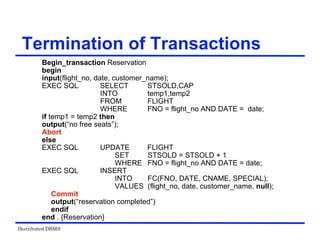
Termination of Transactions
Begin_transaction Reservation
begin
input(flight_no, date, customer_name);
EXEC SQL SELECT STSOLD,CAP
INTO temp1,temp2
FROM FLIGHT
WHERE FNO = flight_no AND DATE = date;
if temp1 = temp2 then
output(“no free seats”);
Abort
else
EXEC SQL UPDATE FLIGHT
SET STSOLD = STSOLD + 1
WHERE FNO = flight_no AND DATE = date;
EXEC SQL INSERT
INTO FC(FNO, DATE, CNAME, SPECIAL);
VALUES (flight_no, date, customer_name, null);
Commit
output(“reservation completed”)
endif
end . {Reservation}
Distributed DBMS
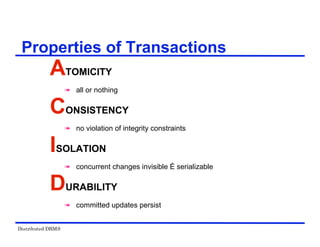
Properties of Transactions
ATOMICITY
 all or nothing
CONSISTENCY
 no violation of integrity constraints
ISOLATION
 concurrent changes invisible È serializable
DURABILITY
 committed updates persist
Distributed DBMS
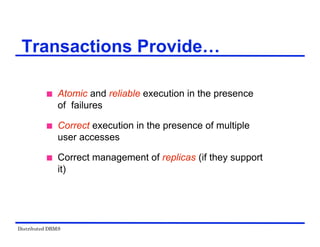
Transactions Provide…
 Atomic and reliable execution in the presence
of failures
 Correct execution in the presence of multiple
user accesses
 Correct management of replicas (if they support
it)
Distributed DBMS
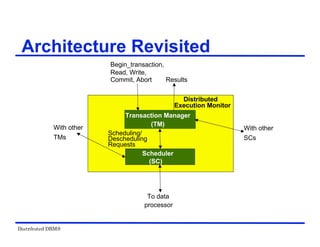
Architecture Revisited
Scheduling/
Descheduling
Requests
Transaction Manager
(TM)
Distributed
Execution Monitor
With other
SCs
With other
TMs
Begin_transaction,
Read, Write,
Commit, Abort
To data
processor
Results
Scheduler
(SC)
Distributed DBMS
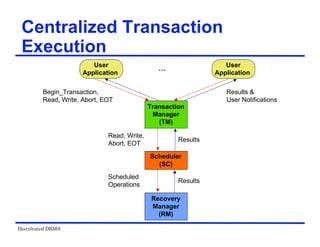
Centralized Transaction
Execution
Begin_Transaction,
Read, Write, Abort, EOT
Results &
User Notifications
Scheduled
Operations
Results
Results
…
Read, Write,
Abort, EOT
User
Application
User
Application
Transaction
Manager
(TM)
Scheduler
(SC)
Recovery
Manager
(RM)
Distributed DBMS
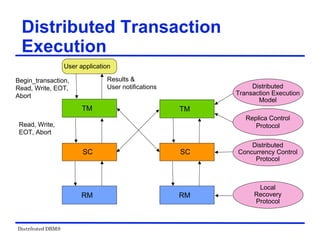
Distributed Transaction
Execution
Begin_transaction,
Read, Write, EOT,
Abort
User application
Results &
User notifications
Read, Write,
EOT, Abort
TM
SC
RM
SC
RM
TM
Local
Recovery
Protocol
Distributed
Concurrency Control
Protocol
Replica Control
Protocol
Distributed
Transaction Execution
Model
Distributed DBMS
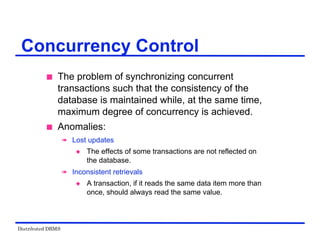
Concurrency Control
 The problem of synchronizing concurrent
transactions such that the consistency of the
database is maintained while, at the same time,
maximum degree of concurrency is achieved.
 Anomalies:
 Lost updates
 The effects of some transactions are not reflected on
the database.
 Inconsistent retrievals
 A transaction, if it reads the same data item more than
once, should always read the same value.
Distributed DBMS
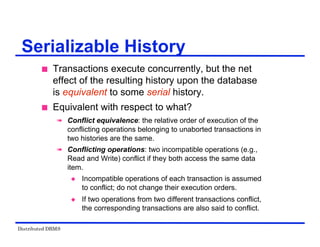
Serializable History
 Transactions execute concurrently, but the net
effect of the resulting history upon the database
is equivalent to some serial history.
 Equivalent with respect to what?
 Conflict equivalence: the relative order of execution of the
conflicting operations belonging to unaborted transactions in
two histories are the same.
 Conflicting operations: two incompatible operations (e.g.,
Read and Write) conflict if they both access the same data
item.
 Incompatible operations of each transaction is assumed
to conflict; do not change their execution orders.
 If two operations from two different transactions conflict,
the corresponding transactions are also said to conflict.
Distributed DBMS
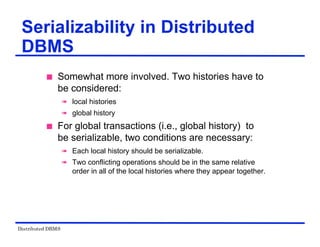
Serializability in Distributed
DBMS
 Somewhat more involved. Two histories have to
be considered:
 local histories
 global history
 For global transactions (i.e., global history) to
be serializable, two conditions are necessary:
 Each local history should be serializable.
 Two conflicting operations should be in the same relative
order in all of the local histories where they appear together.
Distributed DBMS
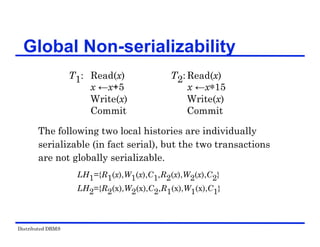
Global Non-serializability
The following two local histories are individually
serializable (in fact serial), but the two transactions
are not globally serializable.
T1: Read(x) T2: Read(x)
x ←x+5 x ←xѽ15
Write(x) Write(x)
Commit Commit
LH1={R1(x),W1(x),C1,R2(x),W2(x),C2}
LH2={R2(x),W2(x),C2,R1(x),W1(x),C1}
Distributed DBMS
Concurrency Control
Algorithms
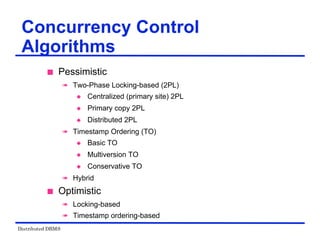
 Pessimistic
 Two-Phase Locking-based (2PL)
 Centralized (primary site) 2PL
 Primary copy 2PL
 Distributed 2PL
 Timestamp Ordering (TO)
 Basic TO
 Multiversion TO
 Conservative TO
 Hybrid
 Optimistic
 Locking-based
 Timestamp ordering-based
Distributed DBMS
Locking-Based Algorithms
 Transactions indicate their intentions by requesting
locks from the scheduler (called lock manager).
 Locks are either read lock (rl) [also called shared
lock] or write lock (wl) [also called exclusive lock]
 Read locks and write locks conflict (because Read
and Write operations are incompatible
rl wl
rl yes no
wl no no
 Locking works nicely to allow concurrent processing
of transactions.
Distributed DBMS
Centralized 2PL
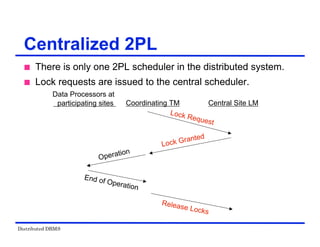
 There is only one 2PL scheduler in the distributed system.
 Lock requests are issued to the central scheduler.
Data Processors at
participating sites Coordinating TM Central Site LM
Lock Request
Lock Granted
Operation
End of Operation
Release Locks
Distributed DBMS
Distributed 2PL
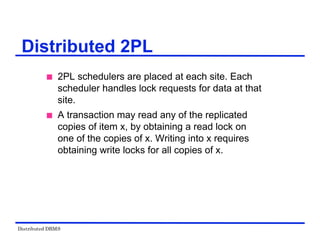
 2PL schedulers are placed at each site. Each
scheduler handles lock requests for data at that
site.
 A transaction may read any of the replicated
copies of item x, by obtaining a read lock on
one of the copies of x. Writing into x requires
obtaining write locks for all copies of x.
Distributed DBMS
Distributed 2PL Execution
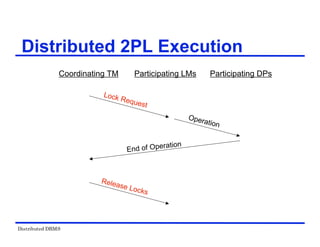
Coordinating TM Participating LMs Participating DPs
Lock Request
Operation
End of Operation
Release Locks
Distributed DBMS
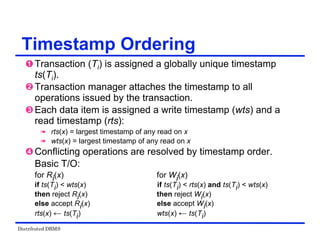
Timestamp Ordering
 Transaction (Ti) is assigned a globally unique timestamp
ts(Ti).
 Transaction manager attaches the timestamp to all
operations issued by the transaction.
 Each data item is assigned a write timestamp (wts) and a
read timestamp (rts):
 rts(x) = largest timestamp of any read on x
 wts(x) = largest timestamp of any read on x
 Conflicting operations are resolved by timestamp order.
Basic T/O:
for Ri(x) for Wi(x)
if ts(Ti) < wts(x) if ts(Ti) < rts(x) and ts(Ti) < wts(x)
then reject Ri(x) then reject Wi(x)
else accept Ri(x) else accept Wi(x)
rts(x) ← ts(Ti) wts(x) ← ts(Ti)
Distributed DBMS
Outline
 Introduction
 Distributed DBMS Architecture
 Distributed Database Design
 Distributed Query Processing
 Distributed Concurrency Control
 Distributed Reliability Protocols
 Distributed Commit Protocols
 Distributed Recovery Protocols
Distributed DBMS
Problem:
How to maintain
atomicity
durability
properties of transactions
Reliability
Distributed DBMS
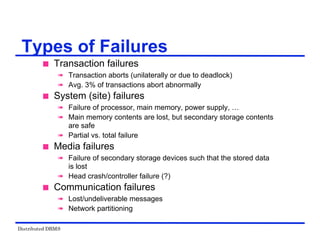
Types of Failures
 Transaction failures
 Transaction aborts (unilaterally or due to deadlock)
 Avg. 3% of transactions abort abnormally
 System (site) failures
 Failure of processor, main memory, power supply, …
 Main memory contents are lost, but secondary storage contents
are safe
 Partial vs. total failure
 Media failures
 Failure of secondary storage devices such that the stored data
is lost
 Head crash/controller failure (?)
 Communication failures
 Lost/undeliverable messages
 Network partitioning
Distributed DBMS
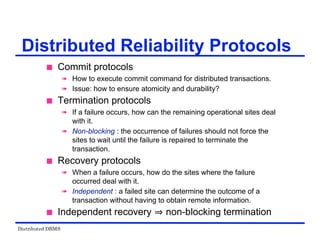
Distributed Reliability Protocols
 Commit protocols
 How to execute commit command for distributed transactions.
 Issue: how to ensure atomicity and durability?
 Termination protocols
 If a failure occurs, how can the remaining operational sites deal
with it.
 Non-blocking : the occurrence of failures should not force the
sites to wait until the failure is repaired to terminate the
transaction.
 Recovery protocols
 When a failure occurs, how do the sites where the failure
occurred deal with it.
 Independent : a failed site can determine the outcome of a
transaction without having to obtain remote information.
 Independent recovery non-blocking termination
Distributed DBMS
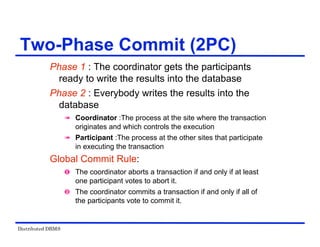
Two-Phase Commit (2PC)
Phase 1 : The coordinator gets the participants
ready to write the results into the database
Phase 2 : Everybody writes the results into the
database
 Coordinator :The process at the site where the transaction
originates and which controls the execution
 Participant :The process at the other sites that participate
in executing the transaction
Global Commit Rule:
 The coordinator aborts a transaction if and only if at least
one participant votes to abort it.
 The coordinator commits a transaction if and only if all of
the participants vote to commit it.
Distributed DBMS
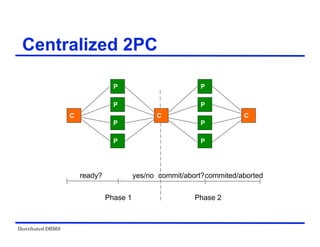
Centralized 2PC
ready? yes/no commit/abort?commited/aborted
Phase 1 Phase 2
C C C
P
P
P
P
P
P
P
P
Distributed DBMS
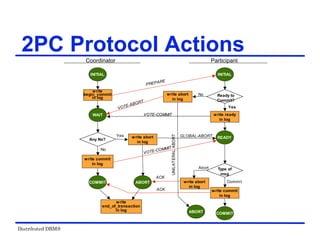
2PC Protocol Actions
Participant
Coordinator
No
Yes
VOTE-COMMIT
Yes GLOBAL-ABORT
No
write abort
in log
Abort
Commit
ACK
ACK
INITIAL
write abort
in log
write ready
in log
write commit
in log
Type of
msg
WAIT
Ready to
Commit?
write commit
in log
Any No?
write abort
in log
ABORT
COMMIT
COMMIT
ABORT
write
begin_commit
in log
write
end_of_transaction
in log
READY
INITIAL
PREPARE
VOTE-ABORT
VOTE-COMMIT
UNILATERAL
ABORT
Distributed DBMS
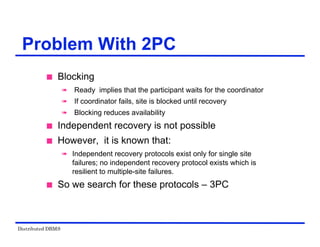
Problem With 2PC
 Blocking
 Ready implies that the participant waits for the coordinator
 If coordinator fails, site is blocked until recovery
 Blocking reduces availability
 Independent recovery is not possible
 However, it is known that:
 Independent recovery protocols exist only for single site
failures; no independent recovery protocol exists which is
resilient to multiple-site failures.
 So we search for these protocols – 3PC

SingleLecture.pdf

  • 1.
  • 2.
    Distributed DBMS Outline  Introduction Distributed DBMS Architecture  Distributed Database Design  Distributed Query Processing  Distributed Concurrency Control  Distributed Reliability Protocols
  • 3.
    Distributed DBMS Outline  Introduction What is a distributed DBMS  Problems  Current state-of-affairs  Distributed DBMS Architecture  Distributed Database Design  Distributed Query Processing  Distributed Concurrency Control  Distributed Reliability Protocols
  • 4.
  • 5.
    Distributed DBMS What isa Distributed Database System? A distributed database (DDB) is a collection of multiple, logically interrelated databases distributed over a computer network. A distributed database management system (D–DBMS) is the software that manages the DDB and provides an access mechanism that makes this distribution transparent to the users. Distributed database system (DDBS) = DDB + D–DBMS
  • 6.
    Distributed DBMS Centralized DBMSon Network Communication Network Site 5 Site 1 Site 2 Site 3 Site 4
  • 7.
    Distributed DBMS Distributed DBMSEnvironment Communication Network Site 5 Site 1 Site 2 Site 3 Site 4
  • 8.
    Distributed DBMS Implicit Assumptions Data stored at a number of sites  each site logically consists of a single processor.  Processors at different sites are interconnected by a computer network  no multiprocessors  parallel database systems  Distributed database is a database, not a collection of files  data logically related as exhibited in the users’ access patterns  relational data model  D-DBMS is a full-fledged DBMS  not remote file system, not a TP system
  • 9.
    Distributed DBMS Distributed DBMSPromises  Transparent management of distributed, fragmented, and replicated data  Improved reliability/availability through distributed transactions  Improved performance  Easier and more economical system expansion
  • 10.
    Distributed DBMS Transparency  Transparencyis the separation of the higher level semantics of a system from the lower level implementation issues.  Fundamental issue is to provide data independence in the distributed environment  Network (distribution) transparency  Replication transparency  Fragmentation transparency horizontal fragmentation: selection vertical fragmentation: projection hybrid
  • 11.
    Distributed DBMS Example TITLE SAL PAY Elect.Eng. 40000 Syst. Anal. 34000 Mech. Eng. 27000 Programmer 24000 PROJ PNO PNAME BUDGET ENO ENAME TITLE E1 J. Doe Elect. Eng. E2 M. Smith Syst. Anal. E3 A. Lee Mech. Eng. E4 J. Miller Programmer E5 B. Casey Syst. Anal. E6 L. Chu Elect. Eng. E7 R. Davis Mech. Eng. E8 J. Jones Syst. Anal. EMP ENO PNO RESP E1 P1 Manager 12 DUR E2 P1 Analyst 24 E2 P2 Analyst 6 E3 P3 Consultant 10 E3 P4 Engineer 48 E4 P2 Programmer 18 E5 P2 Manager 24 E6 P4 Manager 48 E7 P3 Engineer 36 E8 P3 Manager 40 ASG P1 Instrumentation 150000 P3 CAD/CAM 250000 P2 Database Develop. 135000 P4 Maintenance 310000 E7 P5 Engineer 23
  • 12.
    Distributed DBMS Transparent Access SELECTENAME,SAL FROM EMP,ASG,PAY WHERE DUR > 12 AND EMP.ENO = ASG.ENO AND PAY.TITLE = EMP.TITLE Paris projects Paris employees Paris assignments Boston employees Montreal projects Paris projects New York projects with budget > 200000 Montreal employees Montreal assignments Boston Communication Network Montreal Paris New York Boston projects Boston employees Boston assignments Boston projects New York employees New York projects New York assignments Tokyo
  • 13.
  • 14.
    Distributed DBMS Distributed DBMS- Reality Communication Subsystem User Query DBMS Software DBMS Software User Application DBMS Software User Application User Query DBMS Software User Query DBMS Software
  • 15.
    Distributed DBMS Potentially Improved Performance Proximity of data to its points of use  Requires some support for fragmentation and replication  Parallelism in execution  Inter-query parallelism  Intra-query parallelism
  • 16.
    Distributed DBMS Parallelism Requirements Have as much of the data required by each application at the site where the application executes  Full replication  How about updates?  Updates to replicated data requires implementation of distributed concurrency control and commit protocols
  • 17.
    Distributed DBMS System Expansion Issue is database scaling  Emergence of microprocessor and workstation technologies  Demise of Grosh's law  Client-server model of computing  Data communication cost vs telecommunication cost
  • 18.
    Distributed DBMS Distributed DBMSIssues  Distributed Database Design  how to distribute the database  replicated & non-replicated database distribution  a related problem in directory management  Query Processing  convert user transactions to data manipulation instructions  optimization problem  min{cost = data transmission + local processing}  general formulation is NP-hard
  • 19.
    Distributed DBMS Distributed DBMSIssues  Concurrency Control  synchronization of concurrent accesses  consistency and isolation of transactions' effects  deadlock management  Reliability  how to make the system resilient to failures  atomicity and durability
  • 20.
    Distributed DBMS Directory Management Relationship BetweenIssues Reliability Deadlock Management Query Processing Concurrency Control Distribution Design
  • 21.
    Distributed DBMS Outline  Introduction Distributed DBMS Architecture  Implementation Alternatives  Component Architecture  Distributed Database Design  Distributed Query Processing  Distributed Concurrency Control  Distributed Reliability Protocols
  • 22.
  • 23.
    Distributed DBMS Dimensions ofthe Problem  Distribution  Whether the components of the system are located on the same machine or not  Heterogeneity  Various levels (hardware, communications, operating system)  DBMS important one  data model, query language,transaction management algorithms  Autonomy  Not well understood and most troublesome  Various versions  Design autonomy: Ability of a component DBMS to decide on issues related to its own design.  Communication autonomy: Ability of a component DBMS to decide whether and how to communicate with other DBMSs.  Execution autonomy: Ability of a component DBMS to execute local operations in any manner it wants to.
  • 24.
    Distributed DBMS Datalogical Distributed DBMSArchitecture ... ... ... ES1 ES2 ESn GCS LCS1 LCS2 LCSn LIS1 LIS2 LISn
  • 25.
    Distributed DBMS Datalogical Multi-DBMS Architecture ... GCS …… GES1 LCS2 LCSn … … LIS2 LISn LES11 LES1n LESn1 LESnm GES2 GESn LIS1 LCS1
  • 26.
    Distributed DBMS Clients/Server Communications Client Services Applications Communications DBMS Services LAN High-level requests Filtered dataonly Communications Client Services Applications Communications Client Services Applications Database Multiple client/single server
  • 27.
    Distributed DBMS Task Distribution Application CommunicationsManager Communications Manager Lock Manager Storage Manager Page & Cache Manager Query Optimizer QL Interface Programmatic Interface … SQL query result table Database
  • 28.
    Distributed DBMS Advantages ofClient- Server Architectures  More efficient division of labor  Horizontal and vertical scaling of resources  Better price/performance on client machines  Ability to use familiar tools on client machines  Client access to remote data (via standards)  Full DBMS functionality provided to client workstations  Overall better system price/performance
  • 29.
    Distributed DBMS Problems WithMultiple- Client/Single Server  Server forms bottleneck  Server forms single point of failure  Database scaling difficult
  • 30.
    Distributed DBMS Multiple Clients/MultipleServers Communications Client Services Applications LAN  directory  caching  query decomposition  commit protocols Communications DBMS Services Database Communications DBMS Services Database
  • 31.
    Distributed DBMS Server-to-Server Communications DBMS Services LAN Communications DBMSServices  SQL interface  programmatic interface  other application support environments Communications Client Services Applications Database Database
  • 32.
    Distributed DBMS Peer-to-Peer Component Architecture Database DATAPROCESSOR USER PROCESSOR USER User requests System responses External Schema User Interface Handler Global Conceptual Schema Semantic Data Controller Global Execution Monitor System Log Local Recovery Manager Local Internal Schema Runtime Support Processor Local Query Processor Local Conceptual Schema Global Query Optimizer GD/D
  • 33.
    Distributed DBMS Outline  Introduction Distributed DBMS Architecture  Distributed Database Design  Fragmentation  Data Placement  Distributed Query Processing  Distributed Concurrency Control  Distributed Reliability Protocols
  • 34.
    Distributed DBMS Design Problem In the general setting :  Making decisions about the placement of data and programs across the sites of a computer network as well as possibly designing the network itself.  In Distributed DBMS, the placement of applications entails  placement of the distributed DBMS software; and  placement of the applications that run on the database
  • 35.
    Distributed DBMS Distribution Design Top-down  mostly in designing systems from scratch  mostly in homogeneous systems  Bottom-up  when the databases already exist at a number of sites
  • 36.
    Distributed DBMS Top-Down Design UserInput View Integration User Input Requirements Analysis Objectives Conceptual Design View Design Access Information ES’s GCS Distribution Design Physical Design LCS’s LIS’s
  • 37.
    Distributed DBMS Distribution Design Fragmentation  Localize access  Horizontal fragmentation  Vertical fragmentation  Hybrid fragmentation  Distribution  Placement of fragments on nodes of a network
  • 38.
    Distributed DBMS PROJ1 :projects with budgets less than $200,000 PROJ2 : projects with budgets greater than or equal to $200,000 PROJ1 PNO PNAME BUDGET LOC P3 CAD/CAM 250000 New York P4 Maintenance 310000 Paris P5 CAD/CAM 500000 Boston PNO PNAME LOC P1 Instrumentation 150000 Montreal P2 Database Develop. 135000 New York BUDGET PROJ2 Horizontal Fragmentation New York New York PROJ PNO PNAME BUDGET LOC P1 Instrumentation 150000 Montreal P3 CAD/CAM 250000 P2 Database Develop. 135000 P4 Maintenance 310000 Paris P5 CAD/CAM 500000 Boston New York New York
  • 39.
    Distributed DBMS Vertical Fragmentation PROJ1:information about project budgets PROJ2: information about project names and locations PNO BUDGET P1 150000 P3 250000 P2 135000 P4 310000 P5 500000 PNO PNAME LOC P1 Instrumentation Montreal P3 CAD/CAM New York P2 Database Develop. New York P4 Maintenance Paris P5 CAD/CAM Boston PROJ1 PROJ2 New York New York PROJ PNO PNAME BUDGET LOC P1 Instrumentation 150000 Montreal P3 CAD/CAM 250000 P2 Database Develop. 135000 P4 Maintenance 310000 Paris P5 CAD/CAM 500000 Boston New York New York
  • 40.
    Distributed DBMS  Completeness Decomposition of relation R into fragments R1, R2, ..., Rn is complete iff each data item in R can also be found in some Ri  Reconstruction  If relation R is decomposed into fragments R1, R2, ..., Rn, then there should exist some relational operator ∇ such that R = ∇1≤i≤nRi  Disjointness  If relation R is decomposed into fragments R1, R2, ..., Rn, and data item di is in Rj, then di should not be in any other fragment Rk (k ≠ j ). Correctness of Fragmentation
  • 41.
    Distributed DBMS Allocation Alternatives Non-replicated  partitioned : each fragment resides at only one site  Replicated  fully replicated : each fragment at each site  partially replicated : each fragment at some of the sites  Rule of thumb: If replication is advantageous, otherwise replication may cause problems read - only queries update queries ≥ 1
  • 42.
    Distributed DBMS Fragment Allocation Problem Statement  Given  F = {F1, F2, …, Fn} fragments  S ={S1, S2, …, Sm} network sites  Q = {q1, q2,…, qq} applications  Find the "optimal" distribution of F to S.  Optimality  Minimal cost  Communication + storage + processing (read & update)  Cost in terms of time (usually)  Performance  Response time and/or throughput  Constraints  Per site constraints (storage & processing)
  • 43.
    Distributed DBMS General Form min(TotalCost) subject to response time constraint storage constraint processing constraint Decision Variable Allocation Model xij = 1 if fragment Fi is stored at site Sj 0 otherwise ⎧ ⎨ ⎩
  • 44.
    Distributed DBMS Outline  Introduction Distributed DBMS Architecture  Distributed Database Design  Distributed Query Processing  Query Processing Methodology  Distributed Query Optimization  Distributed Concurrency Control  Distributed Reliability Protocols
  • 45.
    Distributed DBMS Query Processing highlevel user query query processor low level data manipulation commands
  • 46.
    Distributed DBMS Query ProcessingComponents  Query language that is used  SQL: “intergalactic dataspeak”  Query execution methodology  The steps that one goes through in executing high-level (declarative) user queries.  Query optimization  How do we determine the “best” execution plan?
  • 47.
    Distributed DBMS SELECT ENAME FROMEMP,ASG WHERE EMP.ENO = ASG.ENO AND DUR > 37 Strategy 1 ΠENAME(σDUR>37 EMP.ENO=ASG.ENO (EMP × ASG)) Strategy 2 ΠENAME(EMP ENO (σDUR>37 (ASG))) Selecting Alternatives Strategy 2 avoids Cartesian product, so is “better”
  • 48.
    Distributed DBMS What isthe Problem? Site 1 Site 2 Site 3 Site 4 Site 5 EMP1=σENO≤“E3”(EMP) EMP2=σENO>“E3”(EMP) ASG2=σENO>“E3”(ASG) ASG1=σENO≤“E3”(ASG) Result Site 5 Site 1 Site 2 Site 3 Site 4 ASG1 EMP1 EMP2 ASG2 result2=(EMP1 EMP2) ENOσDUR>37(ASG1 ASG1) Site 4 result = EMP1 ’ EMP2 ’ Site 3 Site 1 Site 2 EMP2 ’=EMP2 ENOASG2 ’ EMP1 ’=EMP1 ENOASG1 ’ ASG1 ’=σDUR>37(ASG1) ASG2 ’=σDUR>37(ASG2) Site 5 ASG2 ’ ASG1 ’ EMP1 ’ EMP2 ’
  • 49.
    Distributed DBMS  Assume: size(EMP) = 400, size(ASG) = 1000  tuple access cost = 1 unit; tuple transfer cost = 10 units  Strategy 1  produce ASG': (10+10)ѽtuple access cost 20  transfer ASG' to the sites of EMP: (10+10)ѽtuple transfer cost 200  produce EMP': (10+10) ѽtuple access costѽ2 40  transfer EMP' to result site: (10+10) ѽtuple transfer cost 200 Total cost 460  Strategy 2  transfer EMP to site 5:400ѽtuple transfer cost 4,000  transfer ASG to site 5 :1000ѽtuple transfer cost 10,000  produce ASG':1000ѽtuple access cost 1,000  join EMP and ASG':400ѽ20ѽtuple access cost 8,000 Total cost 23,000 Cost of Alternatives
  • 50.
    Distributed DBMS Minimize acost function I/O cost + CPU cost + communication cost These might have different weights in different distributed environments Wide area networks  communication cost will dominate  low bandwidth  low speed  high protocol overhead  most algorithms ignore all other cost components Local area networks  communication cost not that dominant  total cost function should be considered Can also maximize throughput Query Optimization Objectives
  • 51.
    Distributed DBMS Query OptimizationIssues – Types of Optimizers  Exhaustive search  cost-based  optimal  combinatorial complexity in the number of relations  Heuristics  not optimal  regroup common sub-expressions  perform selection, projection first  replace a join by a series of semijoins  reorder operations to reduce intermediate relation size  optimize individual operations
  • 52.
    Distributed DBMS Query OptimizationIssues – Optimization Granularity  Single query at a time  cannot use common intermediate results  Multiple queries at a time  efficient if many similar queries  decision space is much larger
  • 53.
    Distributed DBMS Query OptimizationIssues – Optimization Timing  Static  compilation optimize prior to the execution  difficult to estimate the size of the intermediate results error propagation  can amortize over many executions  R*  Dynamic  run time optimization  exact information on the intermediate relation sizes  have to reoptimize for multiple executions  Distributed INGRES  Hybrid  compile using a static algorithm  if the error in estimate sizes > threshold, reoptimize at run time  MERMAID
  • 54.
    Distributed DBMS Query OptimizationIssues – Statistics  Relation  cardinality  size of a tuple  fraction of tuples participating in a join with another relation  Attribute  cardinality of domain  actual number of distinct values  Common assumptions  independence between different attribute values  uniform distribution of attribute values within their domain
  • 55.
    Distributed DBMS Query Optimization Issues– Decision Sites  Centralized  single site determines the “best” schedule  simple  need knowledge about the entire distributed database  Distributed  cooperation among sites to determine the schedule  need only local information  cost of cooperation  Hybrid  one site determines the global schedule  each site optimizes the local subqueries
  • 56.
    Distributed DBMS Query OptimizationIssues – Network Topology  Wide area networks (WAN) – point-to-point  characteristics  low bandwidth  low speed  high protocol overhead  communication cost will dominate; ignore all other cost factors  global schedule to minimize communication cost  local schedules according to centralized query optimization  Local area networks (LAN)  communication cost not that dominant  total cost function should be considered  broadcasting can be exploited (joins)  special algorithms exist for star networks
  • 57.
    Distributed DBMS Distributed QueryProcessing Methodology Calculus Query on Distributed Relations CONTROL SITE LOCAL SITES Query Decomposition Data Localization Algebraic Query on Distributed Relations Global Optimization Fragment Query Local Optimization Optimized Fragment Query with Communication Operations Optimized Local Queries GLOBAL SCHEMA FRAGMENT SCHEMA STATS ON FRAGMENTS LOCAL SCHEMAS
  • 58.
    Distributed DBMS Step 1– Query Decomposition Input : Calculus query on global relations  Normalization  manipulate query quantifiers and qualification  Analysis  detect and reject “incorrect” queries  possible for only a subset of relational calculus  Simplification  eliminate redundant predicates  Restructuring  calculus query algebraic query  more than one translation is possible  use transformation rules
  • 59.
    Distributed DBMS  Convertrelational calculus to relational algebra  Make use of query trees  Example Find the names of employees other than J. Doe who worked on the CAD/CAM project for either 1 or 2 years. SELECT ENAME FROM EMP, ASG, PROJ WHERE EMP.ENO = ASG.ENO AND ASG.PNO = PROJ.PNO AND ENAME ≠ “J. Doe” AND PNAME = “CAD/CAM” AND (DUR = 12 OR DUR = 24) Restructuring ΠENAME σDUR=12 OR DUR=24 σPNAME=“CAD/CAM” σENAME≠“J. DOE” PROJ ASG EMP Project Select Join PNO ENO
  • 60.
    Distributed DBMS  Commutativityof binary operations  R × S S × R  R S S R  R S S R  Associativity of binary operations  ( R × S ) × T R × (S × T)  ( R S ) T R (S T )  Idempotence of unary operations  ΠA’(ΠA’(R)) ΠA’(R)  σp1(A1)(σp2(A2)(R)) = σp1(A1) p2(A2)(R) where R[A] and A' A, A" A and A' A"  Commuting selection with projection Restructuring –Transformation Rules (Examples)
  • 61.
    Distributed DBMS Example Recall theprevious example: Find the names of employees other than J. Doe who worked on the CAD/CAM project for either one or two years. SELECT ENAME FROM PROJ, ASG, EMP WHERE ASG.ENO=EMP.ENO AND ASG.PNO=PROJ.PNO AND ENAME≠“J. Doe” AND PROJ.PNAME=“CAD/CAM” AND (DUR=12 OR DUR=24) ΠENAME σDUR=12 OR DUR=24 σPNAME=“CAD/CAM” σENAME≠“J. DOE” PROJ ASG EMP Project Select Join PNO ENO
  • 62.
    Distributed DBMS Equivalent Query ΠENAME σPNAME=“CAD/CAM”(DUR=12 DUR=24) ENAME≠“J. DOE” × PROJ ASG EMP PNO ENO
  • 63.
    Distributed DBMS EMP ΠENAME σENAME ≠"J. Doe" ASG PROJ ΠPNO,ENAME σPNAME = "CAD/CAM" ΠPNO σDUR =12 DUR=24 ΠPNO,ENO ΠPNO,ENAME Restructuring PNO ENO
  • 64.
    Distributed DBMS Step 2– Data Localization Input: Algebraic query on distributed relations  Determine which fragments are involved  Localization program  substitute for each global query its materialization program  optimize
  • 65.
    Distributed DBMS Example Assume  EMPis fragmented into EMP1, EMP2, EMP3 as follows:  EMP1=σENO≤“E3”(EMP)  EMP2= σ“E3”<ENO≤“E6”(EMP)  EMP3=σENO≥“E6”(EMP)  ASG fragmented into ASG1 and ASG2 as follows:  ASG1=σENO≤“E3”(ASG)  ASG2=σENO>“E3”(ASG) Replace EMP by (EMP1 EMP2 EMP3 ) and ASG by (ASG1 ASG2) in any query ΠENAME σDUR=12 OR DUR=24 σENAME≠“J. DOE” PROJ EMP1 EMP2 EMP3 ASG1 ASG2 PNO ENO σPNAME=“CAD/CAM”
  • 66.
    Distributed DBMS Provides Parallellism EMP3ASG1 EMP2 ASG2 EMP1 ASG1 EMP3 ASG2 ENO ENO ENO ENO
  • 67.
    Distributed DBMS Eliminates UnnecessaryWork EMP2 ASG2 EMP1 ASG1 EMP3 ASG2 ENO ENO ENO
  • 68.
    Distributed DBMS Step 3– Global Query Optimization Input: Fragment query  Find the best (not necessarily optimal) global schedule  Minimize a cost function  Distributed join processing  Bushy vs. linear trees  Which relation to ship where?  Ship-whole vs ship-as-needed  Decide on the use of semijoins  Semijoin saves on communication at the expense of more local processing.  Join methods  nested loop vs ordered joins (merge join or hash join)
  • 69.
    Distributed DBMS Cost-Based Optimization Solution space  The set of equivalent algebra expressions (query trees).  Cost function (in terms of time)  I/O cost + CPU cost + communication cost  These might have different weights in different distributed environments (LAN vs WAN).  Can also maximize throughput  Search algorithm  How do we move inside the solution space?  Exhaustive search, heuristic algorithms (iterative improvement, simulated annealing, genetic,…)
  • 70.
    Distributed DBMS Query OptimizationProcess Search Space Generation Search Strategy Equivalent QEP Input Query Transformation Rules Cost Model Best QEP
  • 71.
    Distributed DBMS Search Space Search space characterized by alternative execution plans  Focus on join trees  For N relations, there are O(N!) equivalent join trees that can be obtained by applying commutativity and associativity rules SELECTENAME,RESP FROM EMP, ASG, PROJ WHERE EMP.ENO=ASG.ENO AND ASG.PNO=PROJ.PNO PROJ ASG EMP PROJ ASG EMP PROJ ASG EMP × ENO ENO PNO PNO ENO,PNO
  • 72.
    Distributed DBMS Search Space Restrict by means of heuristics  Perform unary operations before binary operations  …  Restrict the shape of the join tree  Consider only linear trees, ignore bushy ones R2 R1 R3 R4 Linear Join Tree R2 R1 R4 R3 Bushy Join Tree
  • 73.
    Distributed DBMS Search Strategy How to “move” in the search space.  Deterministic  Start from base relations and build plans by adding one relation at each step  Dynamic programming: breadth-first  Greedy: depth-first  Randomized  Search for optimalities around a particular starting point  Trade optimization time for execution time  Better when > 5-6 relations  Simulated annealing  Iterative improvement
  • 74.
    Distributed DBMS Search Strategies Deterministic  Randomized R2 R1 R3 R4 R2 R1 R2 R1 R3 R2 R1 R3 R3 R1 R2
  • 75.
    Distributed DBMS  TotalTime (or Total Cost)  Reduce each cost (in terms of time) component individually  Do as little of each cost component as possible  Optimizes the utilization of the resources Increases system throughput  Response Time  Do as many things as possible in parallel  May increase total time because of increased total activity Cost Functions
  • 76.
    Distributed DBMS Summation ofall cost factors Total cost = CPU cost + I/O cost + communication cost CPU cost = unit instruction cost ѽ no.of instructions I/O cost = unit disk I/O cost ѽ no. of disk I/Os communication cost = message initiation + transmission Total Cost
  • 77.
    Distributed DBMS  Widearea network  message initiation and transmission costs high  local processing cost is low (fast mainframes or minicomputers)  ratio of communication to I/O costs = 20:1  Local area networks  communication and local processing costs are more or less equal  ratio = 1:1.6 Total Cost Factors
  • 78.
    Distributed DBMS Elapsed timebetween the initiation and the completion of a query Response time = CPU time + I/O time + communication time CPU time = unit instruction time ѽ no. of sequential instructions I/O time = unit I/O time ѽ no. of sequential I/Os communication time = unit msg initiation time ѽ no. of sequential msg + unit transmission time ѽ no. of sequential bytes Response Time
  • 79.
    Distributed DBMS Assume thatonly the communication cost is considered Total time = 2 ѽ message initialization time + unit transmission time ѽ (x+y) Response time = max {time to send x from 1 to 3, time to send y from 2 to 3} time to send x from 1 to 3 = message initialization time + unit transmission time ѽ x time to send y from 2 to 3 = message initialization time + unit transmission time ѽ y Example Site 1 Site 2 x units y units Site 3
  • 80.
    Distributed DBMS  Alternatives Ordering joins  Semijoin ordering  Consider two relations only  Multiple relations more difficult because too many alternatives.  Compute the cost of all alternatives and select the best one.  Necessary to compute the size of intermediate relations which is difficult.  Use heuristics Join Ordering R if size (R) < size (S) if size (R) > size (S) S
  • 81.
    Distributed DBMS Consider PROJ PNOASG ENO EMP Join Ordering – Example Site 2 Site 3 Site 1 PNO ENO PROJ ASG EMP
  • 82.
    Distributed DBMS Execution alternatives: 1.EMP → Site 2 2. ASG → Site 1 Site 2 computes EMP'=EMP ASG Site 1 computes EMP'=EMP ASG EMP' → Site 3 EMP' → Site 3 Site 3 computes EMP’ PROJ Site 3 computes EMP’ PROJ 3. ASG → Site 3 4. PROJ → Site 2 Site 3 computes ASG'=ASG PROJ Site 2 computes PROJ'=PROJ ASG ASG' → Site 1 PROJ' → Site 1 Site 1 computes ASG' EMP Site 1 computes PROJ' EMP 5. EMP → Site 2 PROJ → Site 2 Site 2 computes EMP PROJ ASG Join Ordering – Example
  • 83.
    Distributed DBMS  Considerthe join of two relations:  R[A] (located at site 1)  S[A] (located at site 2)  Alternatives: 1 Do the join R A S 2 Perform one of the semijoin equivalents R A S (R A S) A S R A (S A R) (R A S) A (S A R) Semijoin Algorithms
  • 84.
    Distributed DBMS  Performthe join  send R to Site 2  Site 2 computes R A S  Consider semijoin (R A S) A S  S' ← ∏A(S)  S' → Site 1  Site 1 computes R' = R A S'  R' → Site 2  Site 2 computes R' A S Semijoin is better if size(ΠA(S)) + size(R A S)) < size(R) Semijoin Algorithms
  • 85.
    Distributed DBMS  Costfunction includes local processing as well as transmission  Considers only joins  Exhaustive search  Compilation  Published papers provide solutions to handling horizontal and vertical fragmentations but the implemented prototype does not R* Algorithm
  • 86.
    Distributed DBMS Performing joins Ship whole  larger data transfer  smaller number of messages  better if relations are small  Fetch as needed  number of messages = O(cardinality of external relation)  data transfer per message is minimal  better if relations are large and the selectivity is good R* Algorithm
  • 87.
    Distributed DBMS 1. Moveouter relation tuples to the site of the inner relation (a) Retrieve outer tuples (b) Send them to the inner relation site (c) Join them as they arrive Total Cost = cost(retrieving qualified outer tuples) + no. of outer tuples fetched ѽ cost(retrieving qualified inner tuples) + msg. cost ѽ (no. outer tuples fetched ѽ avg. outer tuple size) / msg. size R* Algorithm – Vertical Partitioning & Joins
  • 88.
    Distributed DBMS 2. Moveinner relation to the site of outer relation cannot join as they arrive; they need to be stored Total Cost = cost(retrieving qualified outer tuples) + no. of outer tuples fetched ѽ cost(retrieving matching inner tuples from temporary storage) + cost(retrieving qualified inner tuples) + cost(storing all qualified inner tuples in temporary storage) + msg. cost ѽ (no. of inner tuples fetched ѽ avg. inner tuple size) / msg. size R* Algorithm – Vertical Partitioning & Joins
  • 89.
    Distributed DBMS 3. Moveboth inner and outer relations to another site Total cost = cost(retrieving qualified outer tuples) + cost(retrieving qualified inner tuples) + cost(storing inner tuples in storage) + msg. cost ѽ (no. of outer tuples fetched ѽ avg. outer tuple size) / msg. size + msg. cost ѽ (no. of inner tuples fetched ѽ avg. inner tuple size) / msg. size + no. of outer tuples fetched ѽ cost(retrieving inner tuples from temporary storage) R* Algorithm – Vertical Partitioning & Joins
  • 90.
    Distributed DBMS 4. Fetchinner tuples as needed (a) Retrieve qualified tuples at outer relation site (b) Send request containing join column value(s) for outer tuples to inner relation site (c) Retrieve matching inner tuples at inner relation site (d) Send the matching inner tuples to outer relation site (e) Join as they arrive Total Cost = cost(retrieving qualified outer tuples) + msg. cost ѽ (no. of outer tuples fetched) + no. of outer tuples fetched ѽ (no. of inner tuples fetched ѽ avg. inner tuple size ѽ msg. cost / msg. size) + no. of outer tuples fetched ѽ cost(retrieving matching inner tuples for one outer value) R* Algorithm – Vertical Partitioning & Joins
  • 91.
    Distributed DBMS Step 4– Local Optimization Input: Best global execution schedule  Select the best access path  Use the centralized optimization techniques
  • 92.
    Distributed DBMS Outline  Introduction Distributed DBMS Architecture  Distributed Database Design  Distributed Query Processing  Distributed Concurrency Control  Transaction Concepts & Models  Serializability  Distributed Concurrency Control Protocols  Distributed Reliability Protocols
  • 93.
    Distributed DBMS Transaction A transactionis a collection of actions that make consistent transformations of system states while preserving system consistency.  concurrency transparency  failure transparency Database in a consistent state Database may be temporarily in an inconsistent state during execution Begin Transaction End Transaction Execution of Transaction Database in a consistent state
  • 94.
    Distributed DBMS Example Database Consideran airline reservation example with the relations: FLIGHT(FNO, DATE, SRC, DEST, STSOLD, CAP) CUST(CNAME, ADDR, BAL) FC(FNO, DATE, CNAME,SPECIAL)
  • 95.
    Distributed DBMS Example Transaction Begin_transactionReservation begin input(flight_no, date, customer_name); EXEC SQL UPDATE FLIGHT SET STSOLD = STSOLD + 1 WHERE FNO = flight_no AND DATE = date; EXEC SQL INSERT INTO FC(FNO, DATE, CNAME, SPECIAL); VALUES (flight_no, date, customer_name, null); output(“reservation completed”) end . {Reservation}
  • 96.
    Distributed DBMS Termination ofTransactions Begin_transaction Reservation begin input(flight_no, date, customer_name); EXEC SQL SELECT STSOLD,CAP INTO temp1,temp2 FROM FLIGHT WHERE FNO = flight_no AND DATE = date; if temp1 = temp2 then output(“no free seats”); Abort else EXEC SQL UPDATE FLIGHT SET STSOLD = STSOLD + 1 WHERE FNO = flight_no AND DATE = date; EXEC SQL INSERT INTO FC(FNO, DATE, CNAME, SPECIAL); VALUES (flight_no, date, customer_name, null); Commit output(“reservation completed”) endif end . {Reservation}
  • 97.
    Distributed DBMS Properties ofTransactions ATOMICITY  all or nothing CONSISTENCY  no violation of integrity constraints ISOLATION  concurrent changes invisible È serializable DURABILITY  committed updates persist
  • 98.
    Distributed DBMS Transactions Provide… Atomic and reliable execution in the presence of failures  Correct execution in the presence of multiple user accesses  Correct management of replicas (if they support it)
  • 99.
    Distributed DBMS Architecture Revisited Scheduling/ Descheduling Requests TransactionManager (TM) Distributed Execution Monitor With other SCs With other TMs Begin_transaction, Read, Write, Commit, Abort To data processor Results Scheduler (SC)
  • 100.
    Distributed DBMS Centralized Transaction Execution Begin_Transaction, Read,Write, Abort, EOT Results & User Notifications Scheduled Operations Results Results … Read, Write, Abort, EOT User Application User Application Transaction Manager (TM) Scheduler (SC) Recovery Manager (RM)
  • 101.
    Distributed DBMS Distributed Transaction Execution Begin_transaction, Read,Write, EOT, Abort User application Results & User notifications Read, Write, EOT, Abort TM SC RM SC RM TM Local Recovery Protocol Distributed Concurrency Control Protocol Replica Control Protocol Distributed Transaction Execution Model
  • 102.
    Distributed DBMS Concurrency Control The problem of synchronizing concurrent transactions such that the consistency of the database is maintained while, at the same time, maximum degree of concurrency is achieved.  Anomalies:  Lost updates  The effects of some transactions are not reflected on the database.  Inconsistent retrievals  A transaction, if it reads the same data item more than once, should always read the same value.
  • 103.
    Distributed DBMS Serializable History Transactions execute concurrently, but the net effect of the resulting history upon the database is equivalent to some serial history.  Equivalent with respect to what?  Conflict equivalence: the relative order of execution of the conflicting operations belonging to unaborted transactions in two histories are the same.  Conflicting operations: two incompatible operations (e.g., Read and Write) conflict if they both access the same data item.  Incompatible operations of each transaction is assumed to conflict; do not change their execution orders.  If two operations from two different transactions conflict, the corresponding transactions are also said to conflict.
  • 104.
    Distributed DBMS Serializability inDistributed DBMS  Somewhat more involved. Two histories have to be considered:  local histories  global history  For global transactions (i.e., global history) to be serializable, two conditions are necessary:  Each local history should be serializable.  Two conflicting operations should be in the same relative order in all of the local histories where they appear together.
  • 105.
    Distributed DBMS Global Non-serializability Thefollowing two local histories are individually serializable (in fact serial), but the two transactions are not globally serializable. T1: Read(x) T2: Read(x) x ←x+5 x ←xѽ15 Write(x) Write(x) Commit Commit LH1={R1(x),W1(x),C1,R2(x),W2(x),C2} LH2={R2(x),W2(x),C2,R1(x),W1(x),C1}
  • 106.
    Distributed DBMS Concurrency Control Algorithms Pessimistic  Two-Phase Locking-based (2PL)  Centralized (primary site) 2PL  Primary copy 2PL  Distributed 2PL  Timestamp Ordering (TO)  Basic TO  Multiversion TO  Conservative TO  Hybrid  Optimistic  Locking-based  Timestamp ordering-based
  • 107.
    Distributed DBMS Locking-Based Algorithms Transactions indicate their intentions by requesting locks from the scheduler (called lock manager).  Locks are either read lock (rl) [also called shared lock] or write lock (wl) [also called exclusive lock]  Read locks and write locks conflict (because Read and Write operations are incompatible rl wl rl yes no wl no no  Locking works nicely to allow concurrent processing of transactions.
  • 108.
    Distributed DBMS Centralized 2PL There is only one 2PL scheduler in the distributed system.  Lock requests are issued to the central scheduler. Data Processors at participating sites Coordinating TM Central Site LM Lock Request Lock Granted Operation End of Operation Release Locks
  • 109.
    Distributed DBMS Distributed 2PL 2PL schedulers are placed at each site. Each scheduler handles lock requests for data at that site.  A transaction may read any of the replicated copies of item x, by obtaining a read lock on one of the copies of x. Writing into x requires obtaining write locks for all copies of x.
  • 110.
    Distributed DBMS Distributed 2PLExecution Coordinating TM Participating LMs Participating DPs Lock Request Operation End of Operation Release Locks
  • 111.
    Distributed DBMS Timestamp Ordering Transaction (Ti) is assigned a globally unique timestamp ts(Ti).  Transaction manager attaches the timestamp to all operations issued by the transaction.  Each data item is assigned a write timestamp (wts) and a read timestamp (rts):  rts(x) = largest timestamp of any read on x  wts(x) = largest timestamp of any read on x  Conflicting operations are resolved by timestamp order. Basic T/O: for Ri(x) for Wi(x) if ts(Ti) < wts(x) if ts(Ti) < rts(x) and ts(Ti) < wts(x) then reject Ri(x) then reject Wi(x) else accept Ri(x) else accept Wi(x) rts(x) ← ts(Ti) wts(x) ← ts(Ti)
  • 112.
    Distributed DBMS Outline  Introduction Distributed DBMS Architecture  Distributed Database Design  Distributed Query Processing  Distributed Concurrency Control  Distributed Reliability Protocols  Distributed Commit Protocols  Distributed Recovery Protocols
  • 113.
    Distributed DBMS Problem: How tomaintain atomicity durability properties of transactions Reliability
  • 114.
    Distributed DBMS Types ofFailures  Transaction failures  Transaction aborts (unilaterally or due to deadlock)  Avg. 3% of transactions abort abnormally  System (site) failures  Failure of processor, main memory, power supply, …  Main memory contents are lost, but secondary storage contents are safe  Partial vs. total failure  Media failures  Failure of secondary storage devices such that the stored data is lost  Head crash/controller failure (?)  Communication failures  Lost/undeliverable messages  Network partitioning
  • 115.
    Distributed DBMS Distributed ReliabilityProtocols  Commit protocols  How to execute commit command for distributed transactions.  Issue: how to ensure atomicity and durability?  Termination protocols  If a failure occurs, how can the remaining operational sites deal with it.  Non-blocking : the occurrence of failures should not force the sites to wait until the failure is repaired to terminate the transaction.  Recovery protocols  When a failure occurs, how do the sites where the failure occurred deal with it.  Independent : a failed site can determine the outcome of a transaction without having to obtain remote information.  Independent recovery non-blocking termination
  • 116.
    Distributed DBMS Two-Phase Commit(2PC) Phase 1 : The coordinator gets the participants ready to write the results into the database Phase 2 : Everybody writes the results into the database  Coordinator :The process at the site where the transaction originates and which controls the execution  Participant :The process at the other sites that participate in executing the transaction Global Commit Rule:  The coordinator aborts a transaction if and only if at least one participant votes to abort it.  The coordinator commits a transaction if and only if all of the participants vote to commit it.
  • 117.
    Distributed DBMS Centralized 2PC ready?yes/no commit/abort?commited/aborted Phase 1 Phase 2 C C C P P P P P P P P
  • 118.
    Distributed DBMS 2PC ProtocolActions Participant Coordinator No Yes VOTE-COMMIT Yes GLOBAL-ABORT No write abort in log Abort Commit ACK ACK INITIAL write abort in log write ready in log write commit in log Type of msg WAIT Ready to Commit? write commit in log Any No? write abort in log ABORT COMMIT COMMIT ABORT write begin_commit in log write end_of_transaction in log READY INITIAL PREPARE VOTE-ABORT VOTE-COMMIT UNILATERAL ABORT
  • 119.
    Distributed DBMS Problem With2PC  Blocking  Ready implies that the participant waits for the coordinator  If coordinator fails, site is blocked until recovery  Blocking reduces availability  Independent recovery is not possible  However, it is known that:  Independent recovery protocols exist only for single site failures; no independent recovery protocol exists which is resilient to multiple-site failures.  So we search for these protocols – 3PC