The Mall Through Time
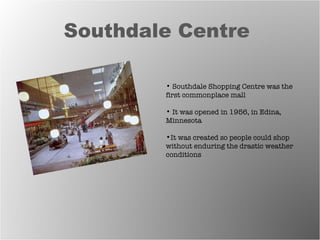
Southdale Centre  Southdale Shopping Centre was the first commonplace mall It was opened in 1956, in Edina, Minnesota It was created so people could shop without enduring the drastic weather conditions
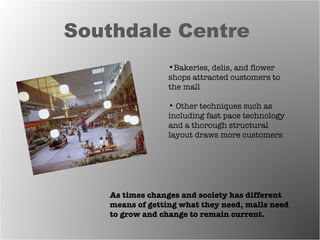
Southdale Centre  As times changes and society has different means of getting what they need, malls need to grow and change to remain current.  Bakeries, delis, and flower shops attracted customers to the mall Other techniques such as including fast pace technology and a thorough structural layout draws more customers
 
Malls were first created to bring a sense of community It attracted customers of all ages, ex. young children & elders Adults usually met up with old friends to catch up Elders usually got light exercise while walking through the mall Typically, it was teenagers who gathered to spend time with friends
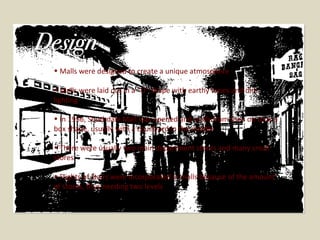
Malls were designed to create a unique atmosphere Malls were laid out in a “U” shape with earthy tones and dim lighting In 1956, Southdale Mall was opened and malls from then on took a box shape, usually with a courtyard in the middle There were usually two main department stores and many small stores Flights of stairs were incorporated in malls because of the amount of stores, thus needing two levels
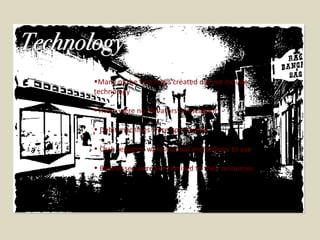
Many of the first malls created did not include technology There were no elevators or escalators Debit machines were not created Cash registers were manual and tedious to use Businesses were very limited to their resources
Malls of the PRESENT
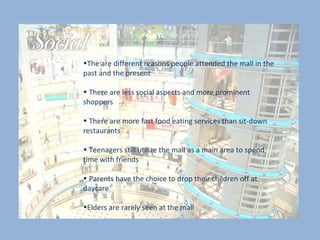
The are different reasons people attended the mall in the past and the present There are less social aspects and more prominent shoppers  There are more fast food eating services than sit-down restaurants Teenagers still utilize the mall as a main area to spend time with friends Parents have the choice to drop their children off at daycare Elders are rarely seen at the mall
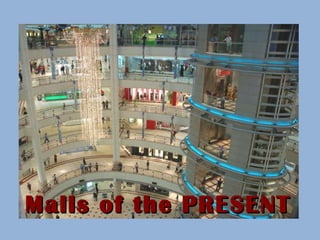
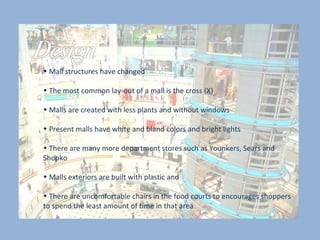
Mall structures have changed  The most common lay-out of a mall is the cross (X) Malls are created with less plants and without windows  Present malls have white and bland colors and bright lights  There are many more department stores such as Younkers, Sears and Shopko  Malls exteriors are built with plastic and  There are uncomfortable chairs in the food courts to encourages shoppers to spend the least amount of time in that area
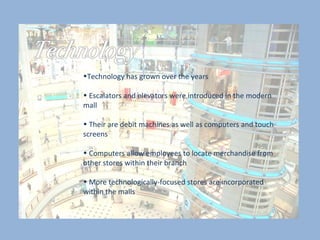
Technology has grown over the years  Escalators and elevators were introduced in the modern mall  Their are debit machines as well as computers and touch screens  Computers allow employees to locate merchandise from other stores within their branch  More technologically-focused stores are incorporated within the malls
Malls for the FUTURE
In past malls, there was a sense of community Present malls are lacking socialization and leading  more towards assertive shopping interactions For future malls, socialization must come back to attract more people  According to the article “How America Shops and Spends”, 31% of purchases are impulse buys It is apparent to have a large mass of people within the mall to gain revenue on these whim purchases
The layout of the mall distinguishes its identity  Past malls had a lot of open space and courtyards Present malls are prominently structured to encourage more shopping Future malls must incorporate socialization as well as assertive shopping  The mall must offer something different than just shopping because there is now online shopping
Past to the present, technology has been integrated within the mall  It is important to continue to use up-to-date technology in future malls By using all available resources, the chances of increasing revenue also increases
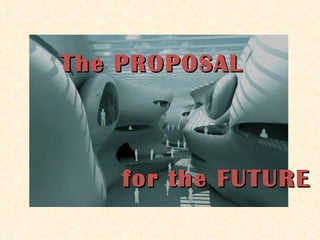
The PROPOSAL  for the FUTURE
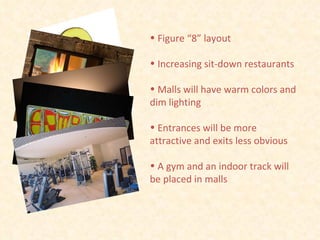
Figure “8” layout Increasing sit-down restaurants Malls will have warm colors and dim lighting Entrances will be more attractive and exits less obvious A gym and an indoor track will be placed in malls
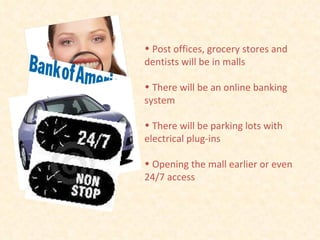
Post offices, grocery stores and dentists will be in malls There will be an online banking system There will be parking lots with electrical plug-ins Opening the mall earlier or even 24/7 access
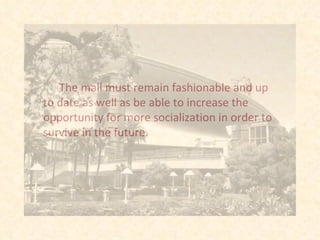
The mall must remain fashionable and up to date as well as be able to increase the opportunity for more socialization in order to survive in the future.

The mall through time!!!

  • 1.
  • 2.
    Southdale Centre Southdale Shopping Centre was the first commonplace mall It was opened in 1956, in Edina, Minnesota It was created so people could shop without enduring the drastic weather conditions
  • 3.
    Southdale Centre As times changes and society has different means of getting what they need, malls need to grow and change to remain current. Bakeries, delis, and flower shops attracted customers to the mall Other techniques such as including fast pace technology and a thorough structural layout draws more customers
  • 4.
  • 5.
    Malls were firstcreated to bring a sense of community It attracted customers of all ages, ex. young children & elders Adults usually met up with old friends to catch up Elders usually got light exercise while walking through the mall Typically, it was teenagers who gathered to spend time with friends
  • 6.
    Malls were designedto create a unique atmosphere Malls were laid out in a “U” shape with earthy tones and dim lighting In 1956, Southdale Mall was opened and malls from then on took a box shape, usually with a courtyard in the middle There were usually two main department stores and many small stores Flights of stairs were incorporated in malls because of the amount of stores, thus needing two levels
  • 7.
    Many of thefirst malls created did not include technology There were no elevators or escalators Debit machines were not created Cash registers were manual and tedious to use Businesses were very limited to their resources
  • 8.
    Malls of thePRESENT
  • 9.
    The are differentreasons people attended the mall in the past and the present There are less social aspects and more prominent shoppers There are more fast food eating services than sit-down restaurants Teenagers still utilize the mall as a main area to spend time with friends Parents have the choice to drop their children off at daycare Elders are rarely seen at the mall
  • 10.
    Mall structures havechanged The most common lay-out of a mall is the cross (X) Malls are created with less plants and without windows Present malls have white and bland colors and bright lights There are many more department stores such as Younkers, Sears and Shopko Malls exteriors are built with plastic and There are uncomfortable chairs in the food courts to encourages shoppers to spend the least amount of time in that area
  • 11.
    Technology has grownover the years Escalators and elevators were introduced in the modern mall Their are debit machines as well as computers and touch screens Computers allow employees to locate merchandise from other stores within their branch More technologically-focused stores are incorporated within the malls
  • 12.
  • 13.
    In past malls,there was a sense of community Present malls are lacking socialization and leading more towards assertive shopping interactions For future malls, socialization must come back to attract more people According to the article “How America Shops and Spends”, 31% of purchases are impulse buys It is apparent to have a large mass of people within the mall to gain revenue on these whim purchases
  • 14.
    The layout ofthe mall distinguishes its identity Past malls had a lot of open space and courtyards Present malls are prominently structured to encourage more shopping Future malls must incorporate socialization as well as assertive shopping The mall must offer something different than just shopping because there is now online shopping
  • 15.
    Past to thepresent, technology has been integrated within the mall It is important to continue to use up-to-date technology in future malls By using all available resources, the chances of increasing revenue also increases
  • 16.
    The PROPOSAL for the FUTURE
  • 17.
    Figure “8” layoutIncreasing sit-down restaurants Malls will have warm colors and dim lighting Entrances will be more attractive and exits less obvious A gym and an indoor track will be placed in malls
  • 18.
    Post offices, grocerystores and dentists will be in malls There will be an online banking system There will be parking lots with electrical plug-ins Opening the mall earlier or even 24/7 access
  • 19.
    The mall mustremain fashionable and up to date as well as be able to increase the opportunity for more socialization in order to survive in the future.