Information Retrieval : 10
Vector and Probabilistic Models
Prof Neeraj Bhargava
Vaibhav Khanna
Department of Computer Science
School of Engineering and Systems Sciences
Maharshi Dayanand Saraswati University Ajmer
The Vector Model
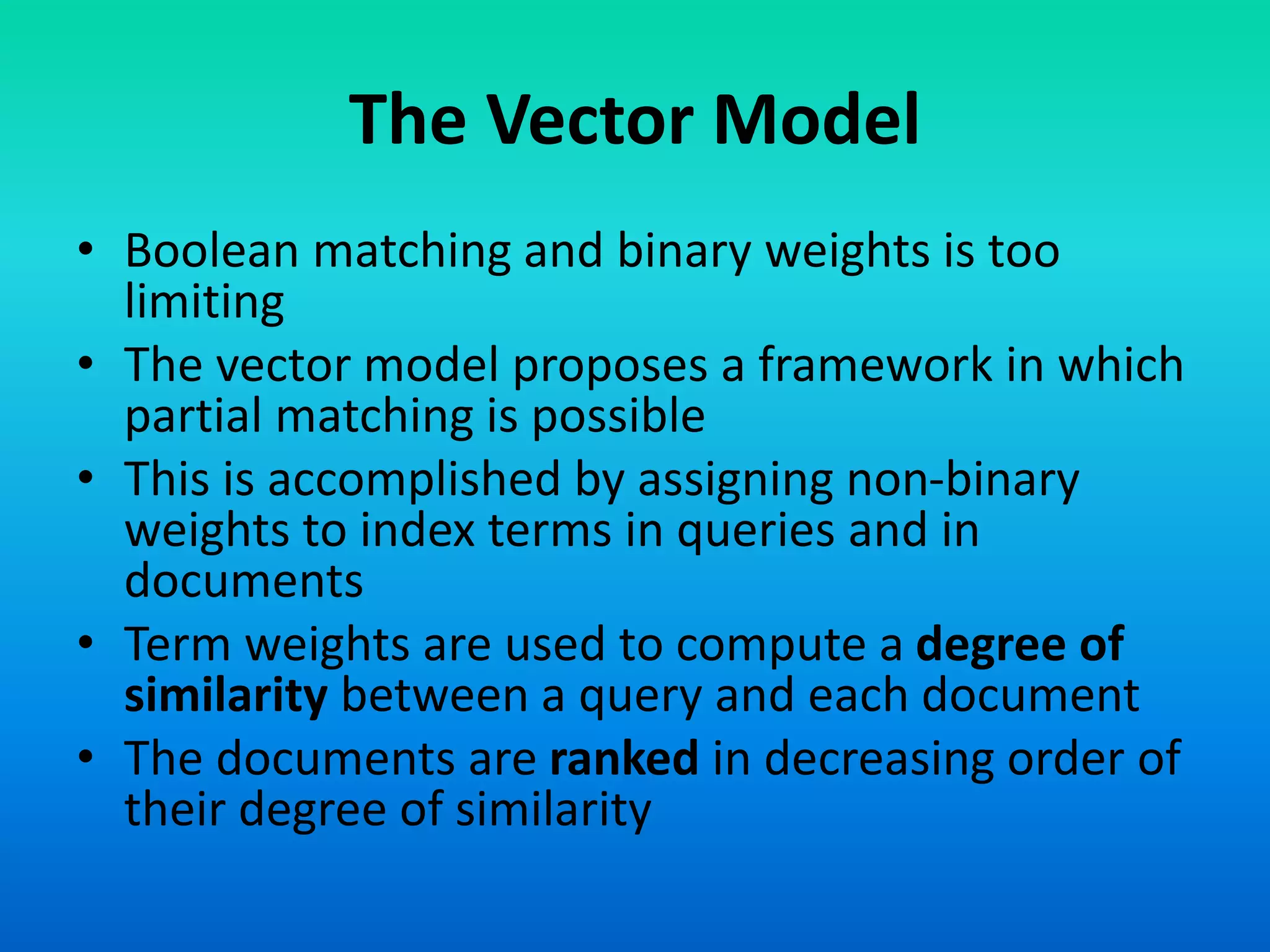
• Boolean matching and binary weights is too
limiting
• The vector model proposes a framework in which
partial matching is possible
• This is accomplished by assigning non-binary
weights to index terms in queries and in
documents
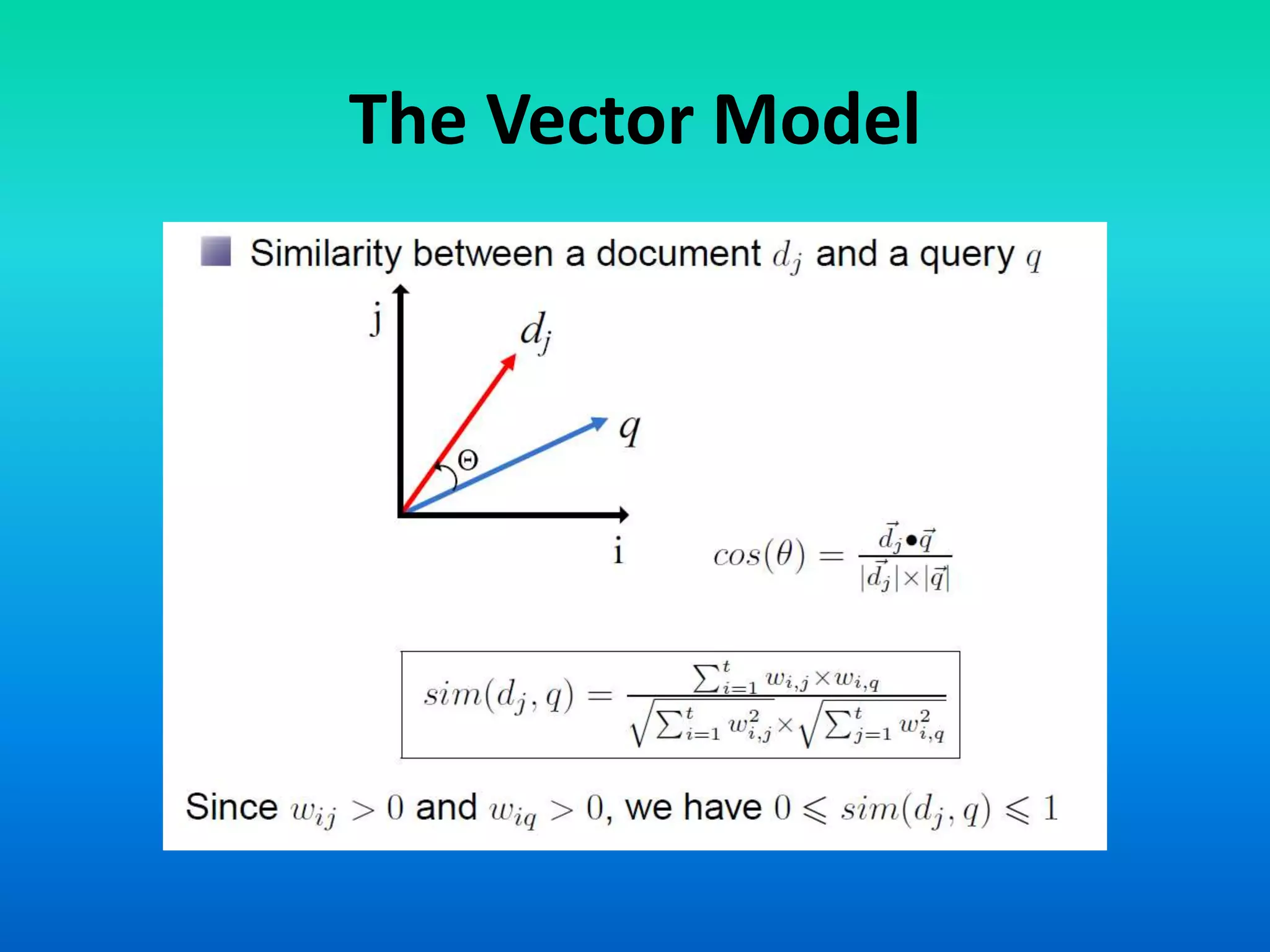
• Term weights are used to compute a degree of
similarity between a query and each document
• The documents are ranked in decreasing order of
their degree of similarity
The Vector Model
• For the vector model:
• The weight wi,j associated with a pair (ki, dj) is positive and
non-binary
• The index terms are assumed to be all mutually independent
• They are represented as unit vectors of a t-dimensional space
(t is the total number of index terms)
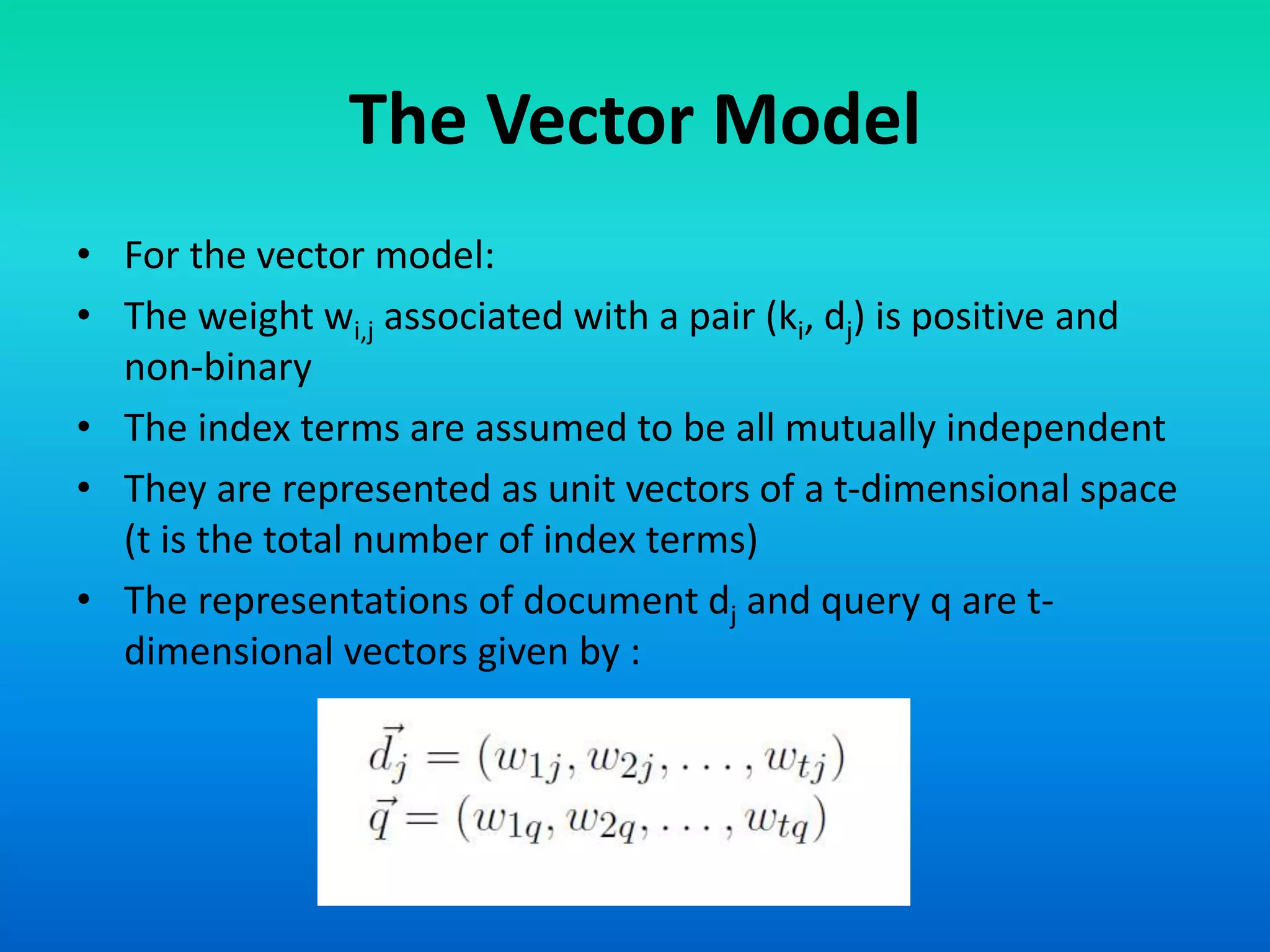
• The representations of document dj and query q are t-
dimensional vectors given by :
The Vector Model
The Vector Model
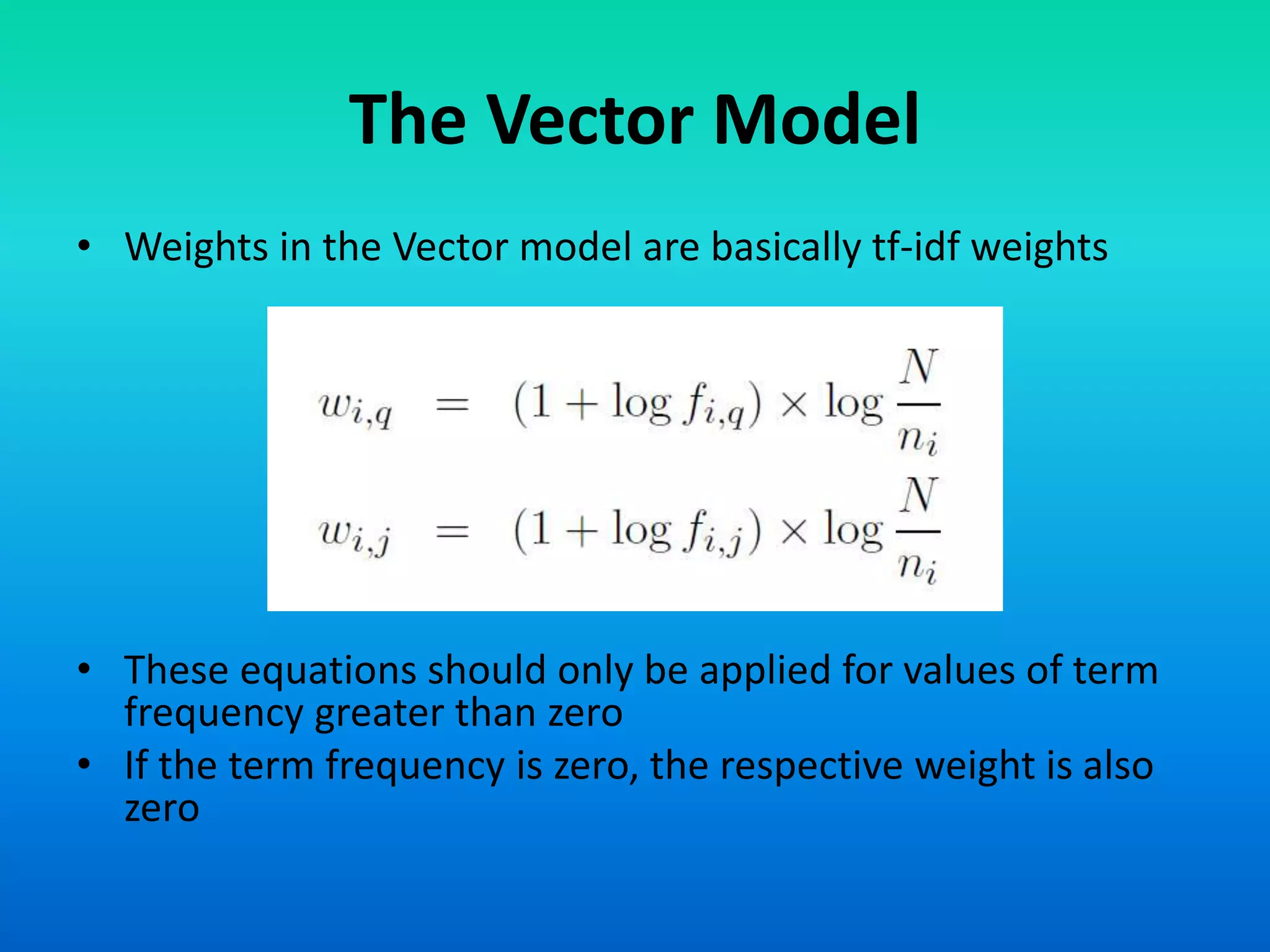
• Weights in the Vector model are basically tf-idf weights
• These equations should only be applied for values of term
frequency greater than zero
• If the term frequency is zero, the respective weight is also
zero
The Vector Model
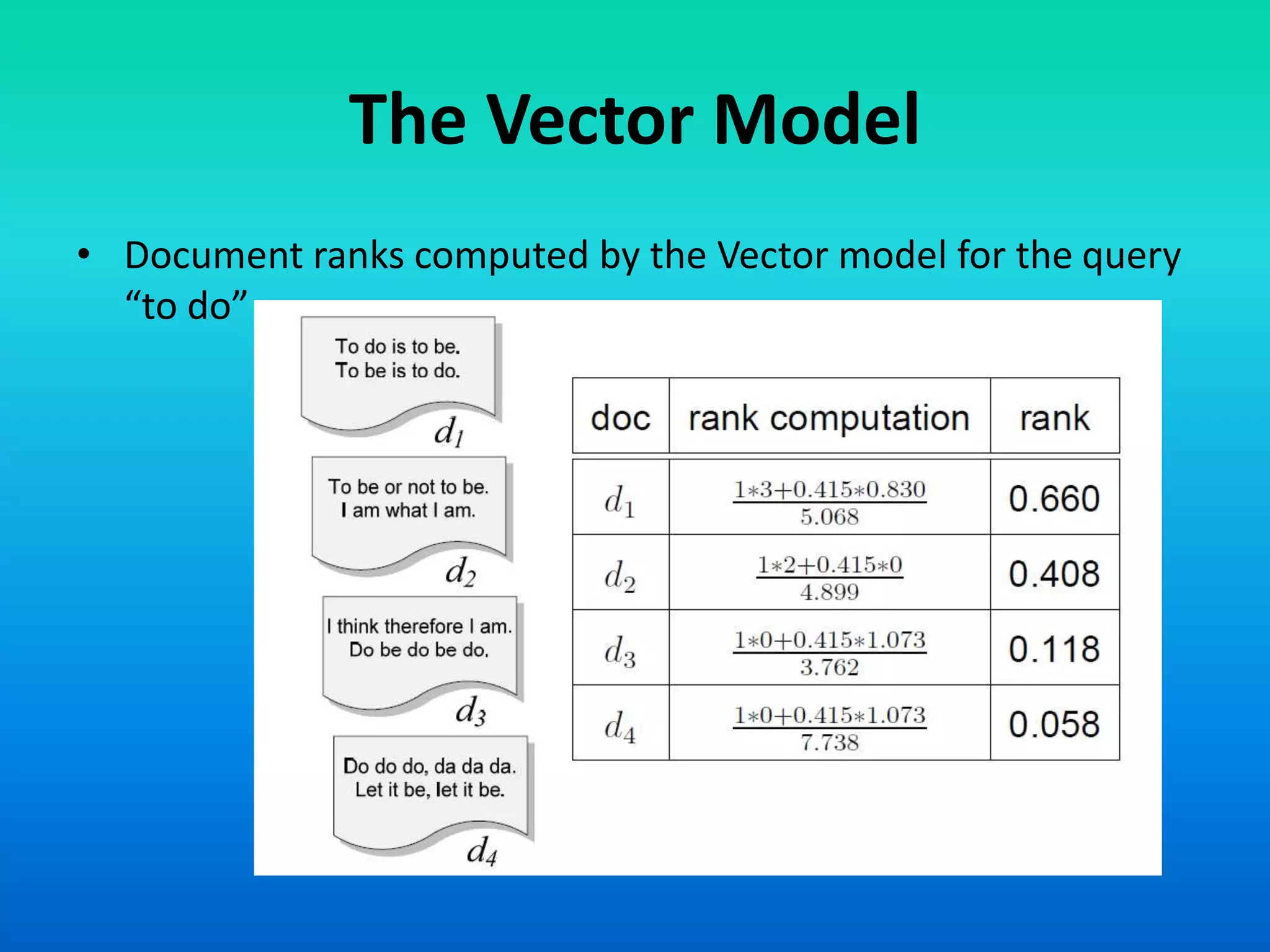
• Document ranks computed by the Vector model for the query
“to do”
The Vector Model
• Advantages:
– term-weighting improves quality of the answer set
– partial matching allows retrieval of docs that
approximate the query conditions
– cosine ranking formula sorts documents according to
a degree of similarity to the query
– document length normalization is naturally built-in
into the ranking
• Disadvantages:
– It assumes independence of index terms
Probabilistic Model
• The probabilistic model captures the IR problem
using a probabilistic framework
• Given a user query, there is an ideal answer set
for this query
• Given a description of this ideal answer set, we
could retrieve the relevant documents
• Querying is seen as a specification of the
properties of this ideal answer set
• But, what are these properties?
Probabilistic Model
• An initial set of documents is retrieved somehow
• The user inspects these docs looking for the
relevant ones (in truth, only top 10-20 need to be
inspected)
• The IR system uses this information to refine the
description of the ideal answer set
• By repeating this process, it is expected that the
description of the ideal answer set will improve
Probabilistic Ranking Principle
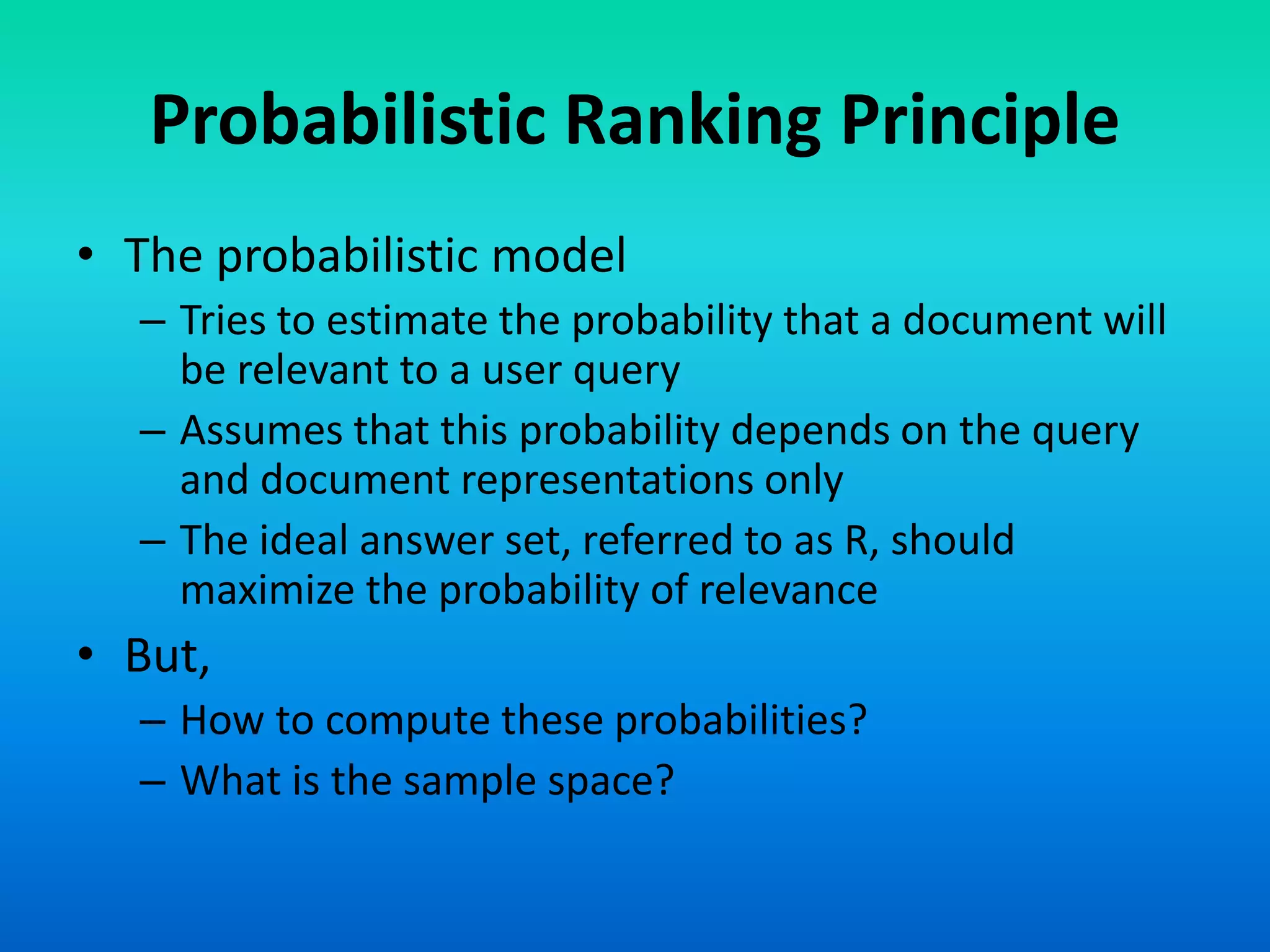
• The probabilistic model
– Tries to estimate the probability that a document will
be relevant to a user query
– Assumes that this probability depends on the query
and document representations only
– The ideal answer set, referred to as R, should
maximize the probability of relevance
• But,
– How to compute these probabilities?
– What is the sample space?
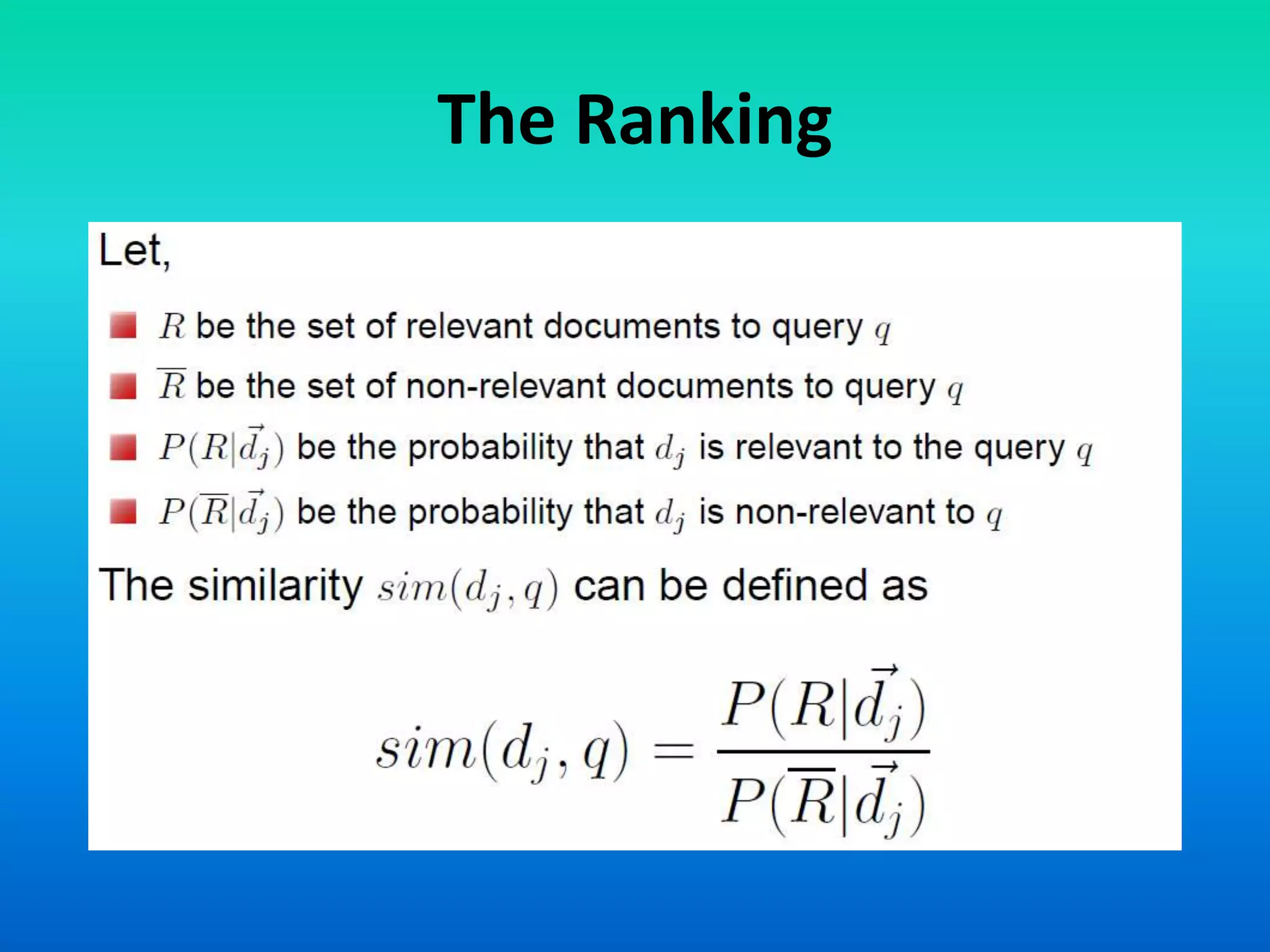
The Ranking
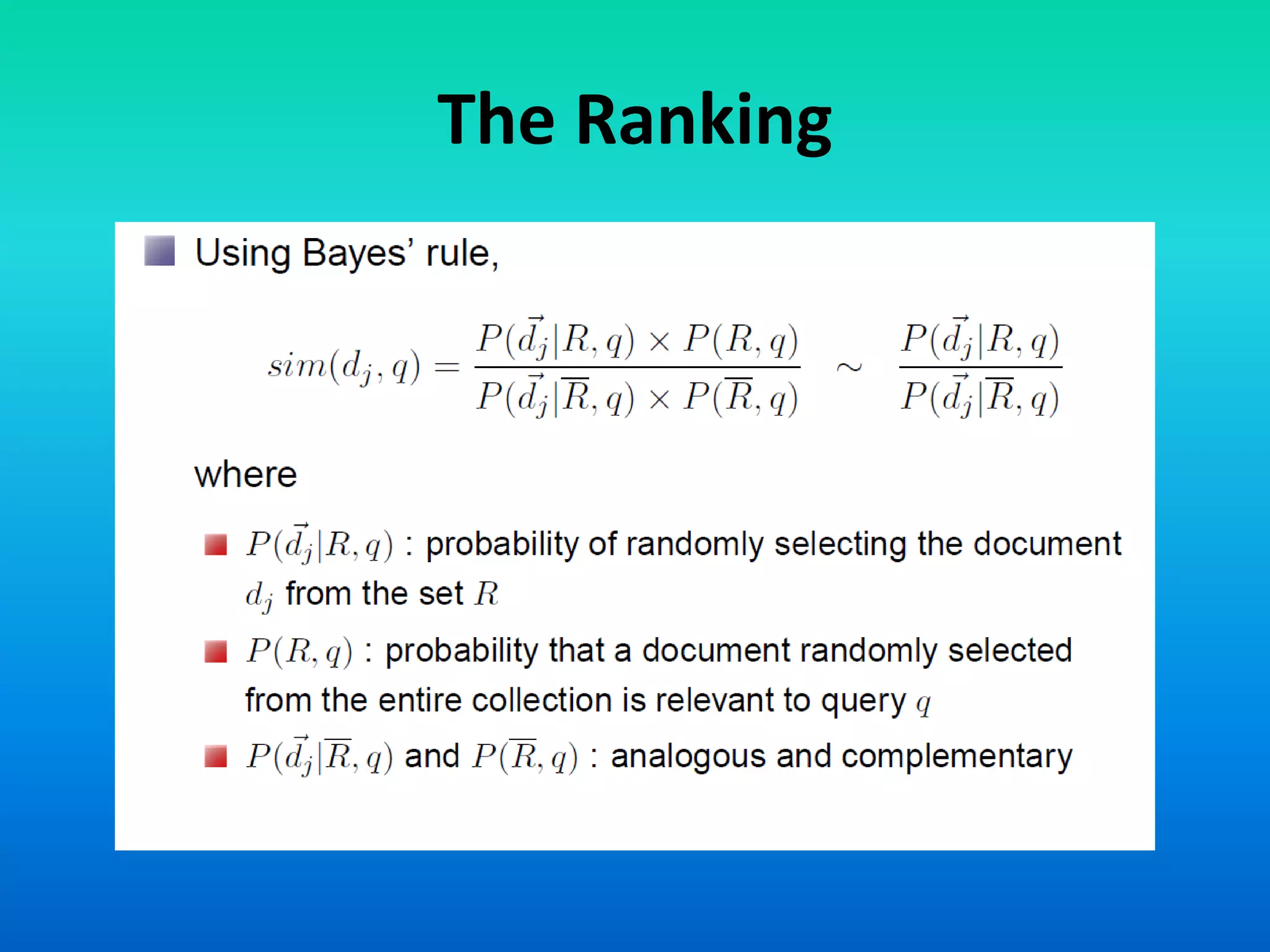
The Ranking
Ranking Formula
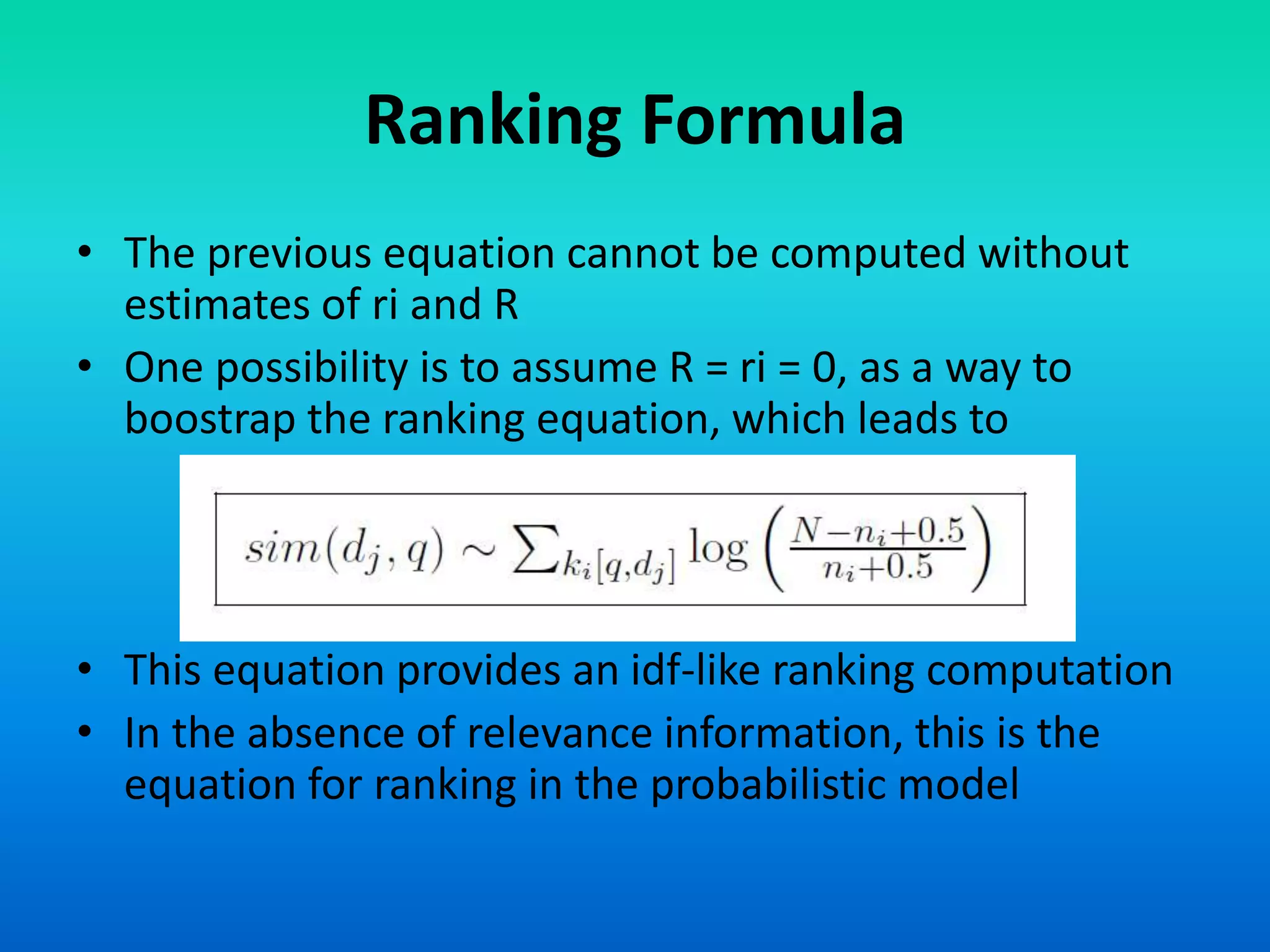
• The previous equation cannot be computed without
estimates of ri and R
• One possibility is to assume R = ri = 0, as a way to
boostrap the ranking equation, which leads to
• This equation provides an idf-like ranking computation
• In the absence of relevance information, this is the
equation for ranking in the probabilistic model
Advantages and Disadvantages
• Advantages:
– Docs ranked in decreasing order of probability of
relevance
• Disadvantages:
– need to guess initial estimates for piR
– method does not take into account tf factors
– the lack of document length normalization
Assignment
• Explain the vector model of information
Retrieval
• Explain the probabilistic model of Information
Retrieval

Information retrieval 10 vector and probabilistic models

  • 1.
    Information Retrieval :10 Vector and Probabilistic Models Prof Neeraj Bhargava Vaibhav Khanna Department of Computer Science School of Engineering and Systems Sciences Maharshi Dayanand Saraswati University Ajmer
  • 2.
    The Vector Model •Boolean matching and binary weights is too limiting • The vector model proposes a framework in which partial matching is possible • This is accomplished by assigning non-binary weights to index terms in queries and in documents • Term weights are used to compute a degree of similarity between a query and each document • The documents are ranked in decreasing order of their degree of similarity
  • 3.
    The Vector Model •For the vector model: • The weight wi,j associated with a pair (ki, dj) is positive and non-binary • The index terms are assumed to be all mutually independent • They are represented as unit vectors of a t-dimensional space (t is the total number of index terms) • The representations of document dj and query q are t- dimensional vectors given by :
  • 4.
  • 5.
    The Vector Model •Weights in the Vector model are basically tf-idf weights • These equations should only be applied for values of term frequency greater than zero • If the term frequency is zero, the respective weight is also zero
  • 6.
    The Vector Model •Document ranks computed by the Vector model for the query “to do”
  • 7.
    The Vector Model •Advantages: – term-weighting improves quality of the answer set – partial matching allows retrieval of docs that approximate the query conditions – cosine ranking formula sorts documents according to a degree of similarity to the query – document length normalization is naturally built-in into the ranking • Disadvantages: – It assumes independence of index terms
  • 8.
    Probabilistic Model • Theprobabilistic model captures the IR problem using a probabilistic framework • Given a user query, there is an ideal answer set for this query • Given a description of this ideal answer set, we could retrieve the relevant documents • Querying is seen as a specification of the properties of this ideal answer set • But, what are these properties?
  • 9.
    Probabilistic Model • Aninitial set of documents is retrieved somehow • The user inspects these docs looking for the relevant ones (in truth, only top 10-20 need to be inspected) • The IR system uses this information to refine the description of the ideal answer set • By repeating this process, it is expected that the description of the ideal answer set will improve
  • 10.
    Probabilistic Ranking Principle •The probabilistic model – Tries to estimate the probability that a document will be relevant to a user query – Assumes that this probability depends on the query and document representations only – The ideal answer set, referred to as R, should maximize the probability of relevance • But, – How to compute these probabilities? – What is the sample space?
  • 11.
  • 12.
  • 13.
    Ranking Formula • Theprevious equation cannot be computed without estimates of ri and R • One possibility is to assume R = ri = 0, as a way to boostrap the ranking equation, which leads to • This equation provides an idf-like ranking computation • In the absence of relevance information, this is the equation for ranking in the probabilistic model
  • 14.
    Advantages and Disadvantages •Advantages: – Docs ranked in decreasing order of probability of relevance • Disadvantages: – need to guess initial estimates for piR – method does not take into account tf factors – the lack of document length normalization
  • 15.
    Assignment • Explain thevector model of information Retrieval • Explain the probabilistic model of Information Retrieval