


Statistical Language Models
for Information Retrieval
by: Nik Spirinat:
Disclaimer: The slides are significantly based on the lectures of Prof. ChengXiang Zhai at UIUC
(http://czhai.cs.illinois.edu/). All the credit goes to the author. All the blame is for the presenter.
This talk will help
you help people
find jobs! 
Talk outline
• Background
– Overview of classical ranking models
– Intro to statistical language models
• Basic language modeling for IR
• Advanced ranking approaches based on
statistical language models
• Ranking approach based on probabilistic
distance of statistical language models
• Conclusions
Talk outline
• Background
– Overview of classical ranking models
– Intro to statistical language models
• Basic language modeling for IR
• Advanced ranking approaches based on
statistical language models
• Ranking approach based on probabilistic
distance of statistical language models
• Conclusions
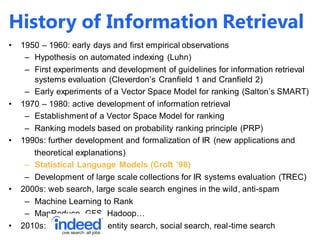
History of Information Retrieval
• 1950 – 1960: early days and first empirical observations
– Hypothesis on automated indexing (Luhn)
– First experiments and development of guidelines for information retrieval
systems evaluation (Cleverdon’s Cranfield 1 and Cranfield 2)
– Early experiments of a Vector Space Model for ranking (Salton’s SMART)
• 1970 – 1980: active development of information retrieval
– Establishment of a Vector Space Model for ranking
– Ranking models based on probability ranking principle (PRP)
• 1990s: further development and formalization of IR (new applications and
theoretical explanations)
– Statistical Language Models (Croft ’98)
– Development of large scale collections for IR systems evaluation (TREC)
• 2000s: web search, large scale search engines in the wild, anti-spam
– Machine Learning to Rank
– MapReduce, GFS, Hadoop…
• 2010s: vertical search, entity search, social search, real-time search
Problem formulation
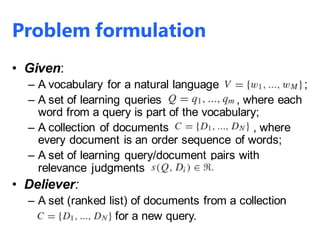
• Given:
– A vocabulary for a natural language ;
– A set of learning queries , where each
word from a query is part of the vocabulary;
– A collection of documents , where
every document is an order sequence of words;
– A set of learning query/document pairs with
relevance judgments
• Deliever:
– A set (ranked list) of documents from a collection
for a new query.
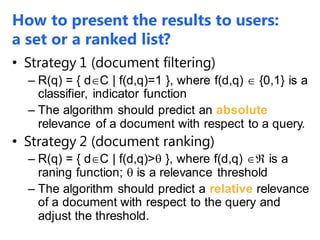
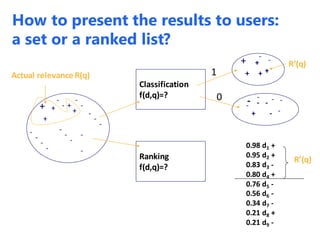
How to present the results to users:
a set or a ranked list?
• Strategy 1 (document filtering)
– R(q) = { dC | f(d,q)=1 }, where f(d,q)  {0,1} is a
classifier, indicator function
– The algorithm should predict an absolute
relevance of a document with respect to a query.
• Strategy 2 (document ranking)
– R(q) = { dC | f(d,q)> }, where f(d,q)  is a
raning function;  is a relevance threshold
– The algorithm should predict a relative relevance
of a document with respect to the query and
adjust the threshold.
+
+
+ +
-
-
-
-
-
-
-
-
-
-
-
-
-
-
+
-
-
Classification
f(d,q)=?
+
+
+
+
- -
+
-
+
-
-
- -
-
--
-
Ranking
f(d,q)=?
1
0.98 d1 +
0.95 d2 +
0.83 d3 -
0.80 d4 +
0.76 d5 -
0.56 d6 -
0.34 d7 -
0.21 d8 +
0.21 d9 -
R’(q)
R’(q)
Actual relevance R(q)
How to present the results to users:
a set or a ranked list?
0
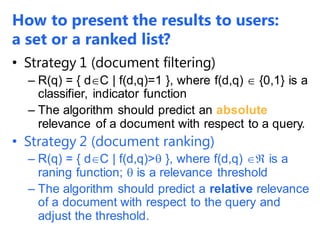
How to present the results to users:
a set or a ranked list?
• Strategy 1 (document filtering)
– R(q) = { dC | f(d,q)=1 }, where f(d,q)  {0,1} is a
classifier, indicator function
– The algorithm should predict an absolute
relevance of a document with respect to a query.
• Strategy 2 (document ranking)
– R(q) = { dC | f(d,q)> }, where f(d,q)  is a
raning function;  is a relevance threshold
– The algorithm should predict a relative relevance
of a document with respect to the query and
adjust the threshold.
Models based on text similarity (1)
• Insight:
– A document relevance for a query correlates with
the textual similarity between a document and a
query
• Vector Space Model for ranking(VSM)
– Document and query are represented as vectors
in a metric space (dim ~ |V|);
– Each word in a vocabulary has an associated
weight, which serves as a proxy for the word
informativeness and uniqueness;
– Relevance is a function of vectors similarity.
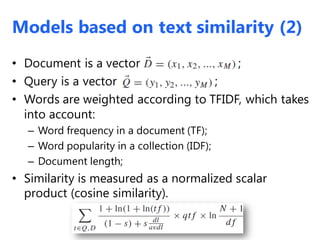
• Document is a vector ;
• Query is a vector ;
• Words are weighted according to TFIDF, which takes
into account:
– Word frequency in a document (TF);
– Word popularity in a collection (IDF);
– Document length;
• Similarity is measured as a normalized scalar
product (cosine similarity).
Models based on text similarity (2)
• Advantages:
– Gives the best results among all classical ranking
models;
– Very simple conceptually and implementation-wise;
– There are many collections and benchmarks for
evaluation with the peers;
• Disadvantages:
– Based on heuristics and assumes independence of
words in the query and documents;
– Difficult to extend given a domain knowledge;
– Requires careful parameter tuning by experts;
– Doesn’t explain how to represent queries and
documents and why vectors are good.
Models based on text similarity (3)
Probabilistic Ranking Principle, PRP (1)
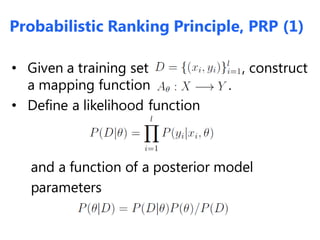
• Given a training set , construct
a mapping function .
• Define a likelihood function
and a function of a posterior model
parameters
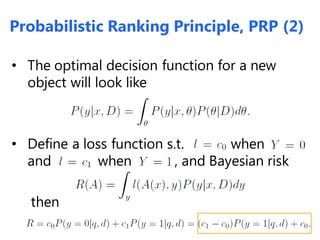
• The optimal decision function for a new
object will look like
• Define a loss function s.t. when
and when , and Bayesian risk
then
Probabilistic Ranking Principle, PRP (2)
Probabilistic Ranking Models (1)
• Insight:
– What is the probability that a document is
relevant for a query?
• Probabilistic Ranking Model (PRM):
– Consider three random variables (query,
document, relevance R  {0,1});
– Goal: sort the documents in the decreasing order
using probabilistic scores, P(R=1|Q,D);
– There are several major ways to estimate the
probability P(R=1|Q,D).
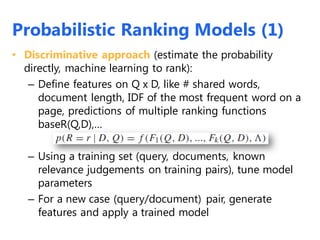
• Discriminative approach (estimate the probability
directly, machine learning to rank):
– Define features on Q x D, like # shared words,
document length, IDF of the most frequent word on a
page, predictions of multiple ranking functions
baseR(Q,D),…
– Using a training set (query, documents, known
relevance judgements on training pairs), tune model
parameters
– For a new case (query/document) pair, generate
features and apply a trained model
Probabilistic Ranking Models (1)
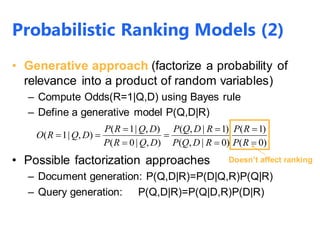
• Generative approach (factorize a probability of
relevance into a product of random variables)
– Compute Odds(R=1|Q,D) using Bayes rule
– Define a generative model P(Q,D|R)
• Possible factorization approaches
– Document generation: P(Q,D|R)=P(D|Q,R)P(Q|R)
– Query generation: P(Q,D|R)=P(Q|D,R)P(D|R)
)0(
)1(
)0|,(
)1|,(
),|0(
),|1(
),|1(








RP
RP
RDQP
RDQP
DQRP
DQRP
DQRO
Doesn’t affect ranking
Probabilistic Ranking Models (2)
)0,|(
)1,|(
)0|()0,|(
)1|()1,|(
)0|,(
)1|,(
),|0(
),|1(











RQDP
RQDP
RQPRQDP
RQPRQDP
RDQP
RDQP
DQRP
DQRP
Model for relevant document for Q
Model for irrelevant document for Q
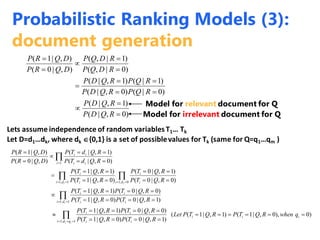
Lets assume independence of random variablesT1… Tk
Let D=d1…dk, where dk {0,1} is a set of possiblevalues for Tk (same for Q=q1…qm )
)0),0,|1()1,|1((
)1,|0()0,|1(
)0,|0()1,|1(
)1,|0()0,|1(
)0,|0()1,|1(
)0,|0(
)1,|0(
)0,|1(
)1,|1(
)0,|(
)1,|(
),|0(
),|1(
1,1
1,1
0,11,1
1

























iii
qdi ii
ii
di ii
ii
di i
i
di i
i
i ii
ii
qwhenRQTPRQTPLet
RQTPRQTP
RQTPRQTP
RQTPRQTP
RQTPRQTP
RQTP
RQTP
RQTP
RQTP
RQdTP
RQdTP
DQRP
DQRP
ii
i
ii
Probabilistic Ranking Models (3):
document generation
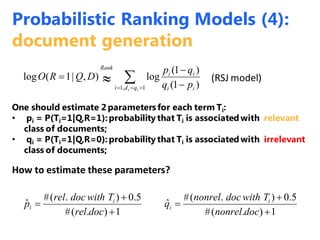
One should estimate 2 parameters for each term Ti:
• pi = P(Ti=1|Q,R=1):probability that Ti is associated with relevant
class of documents;
• qi = P(Ti=1|Q,R=0):probability that Ti is associated with irrelevant
class of documents;
  


1,1 )1(
)1(
log),|1(log
ii qdi ii
ii
Rank
pq
qp
DQRO (RSJ model)
How to estimate these parameters?
1).(#
5.0).(#
ˆ
1).(#
5.0).(#
ˆ






docnonrel
Twithdocnonrel
q
docrel
Twithdocrel
p i
i
i
i
Probabilistic Ranking Models (4):
document generation
))0|()0,|((
)0|(
)1|(
)1,|(
)0|()0,|(
)1|()1,|(
)0|,(
)1|,(
),|1(










RQPRDQPПусть
RDP
RDP
RDQP
RDPRDQP
RDPRDQP
RDQP
RDQP
DQRO
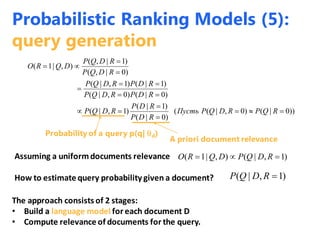
Assuming a uniform documents relevance
Probability of a query p(q| d)
A priori document relevance
)1,|(),|1(  RDQPDQRO
How to estimate query probability given a document? )1,|( RDQP
The approach consists of 2 stages:
• Build a language model for each document D
• Compute relevance of documents for the query.
Probabilistic Ranking Models (5):
query generation
Other classical IR models
• Ranking based on graphical models
– Insight: using a full Bayesian inference derive the
relevance of a document for a query
• Ranking based on genetic algorithms and
symbolic regression
– Insight: generate, test, pick the most promising
• Full empirical risk minimization
• Heuristic approach based on structural
properties of a ranking function
Talk outline
• Background
– Overview of classical ranking models
– Intro to statistical language models
• Basic language modeling for IR
• Advanced ranking approaches based on
statistical language models
• Ranking approach based on probabilistic
distance of statistical language models
• Conclusions
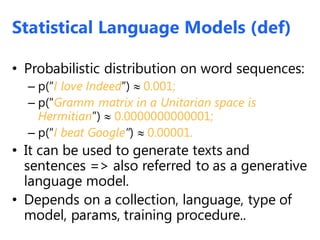
Statistical Language Models (def)
• Probabilistic distribution on word sequences:
– p(“I love Indeed”)  0.001;
– p(“Gramm matrix in a Unitarian space is
Hermitian”)  0.0000000000001;
– p(“I beat Google”)  0.00001.
• It can be used to generate texts and
sentences => also referred to as a generative
language model.
• Depends on a collection, language, type of
model, params, training procedure..
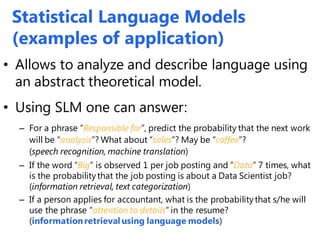
Statistical Language Models
(examples of application)
• Allows to analyze and describe language using
an abstract theoretical model.
• Using SLM one can answer:
– For a phrase “Responsible for”, predict the probability that the next work
will be “analysis”? What about “sales”? May be “coffee”?
(speech recognition, machine translation)
– If the word “Big” is observed 1 per job posting and “Data” 7 times, what
is the probabilitythat the job posting is about a Data Scientist job?
(information retrieval, text categorization)
– If a person applies for accountant, what is the probabilitythat s/he will
use the phrase “attention to details” in the resume?
(informationretrieval using language models)
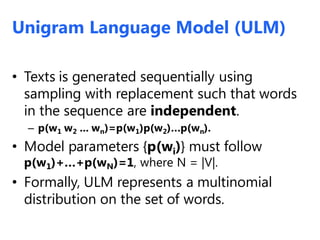
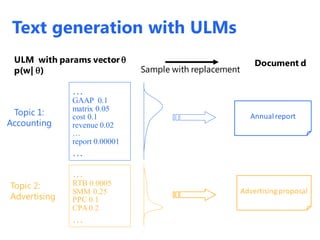
• Texts is generated sequentially using
sampling with replacement such that words
in the sequence are independent.
– p(w1 w2 ... wn)=p(w1)p(w2)…p(wn).
• Model parameters {p(wi)} must follow
p(w1)+…+p(wN)=1, where N = |V|.
• Formally, ULM represents a multinomial
distribution on the set of words.
Unigram Language Model (ULM)
ULM with params vector 
p(w| )
…
GAAP 0.1
matrix 0.05
cost 0.1
revenue 0.02
…
report 0.00001
…
Topic 1:
Accounting
…
RTB 0.0005
SMM 0.25
PPC 0.1
CPA 0.2
…
Topic 2:
Advertising
Document d
Annualreport
Advertising proposal
Sample with replacement
Text generation with ULMs
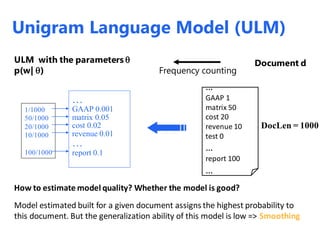
ULM with the parameters 
p(w| )
Document d
Frequency counting
…
GAAP 1
matrix 50
cost 20
revenue 10
test 0
…
report 100
…
DocLen = 1000
1/1000
50/1000
20/1000
10/1000
100/1000
…
GAAP 0.001
matrix 0.05
cost 0.02
revenue 0.01
…
report 0.1
How to estimate model quality? Whether the model is good?
Model estimated built for a given document assigns the highest probability to
this document. But the generalization ability of this model is low => Smoothing
Unigram Language Model (ULM)
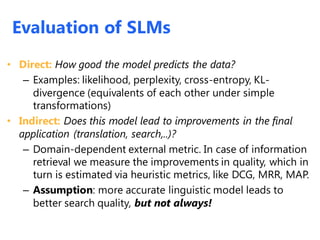
Evaluation of SLMs
• Direct: How good the model predicts the data?
– Examples: likelihood, perplexity, cross-entropy, KL-
divergence (equivalents of each other under simple
transformations)
• Indirect: Does this model lead to improvements in the final
application (translation, search,..)?
– Domain-dependent external metric. In case of information
retrieval we measure the improvements in quality, which in
turn is estimated via heuristic metrics, like DCG, MRR, MAP.
– Assumption: more accurate linguistic model leads to
better search quality, but not always!
Evaluation of SLMs
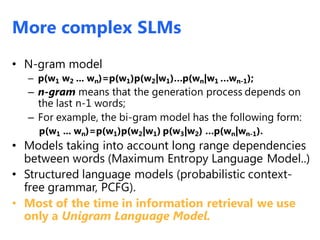
• N-gram model
– p(w1 w2 ... wn)=p(w1)p(w2|w1)…p(wn|w1 …wn-1);
– n-gram means that the generation process depends on
the last n-1 words;
– For example, the bi-gram model has the following form:
p(w1 ... wn)=p(w1)p(w2|w1) p(w3|w2) …p(wn|wn-1).
• Models taking into account long range dependencies
between words (Maximum Entropy Language Model..)
• Structured language models (probabilistic context-
free grammar, PCFG).
• Most of the time in information retrieval we use
only a Unigram Language Model.
More complex SLMs
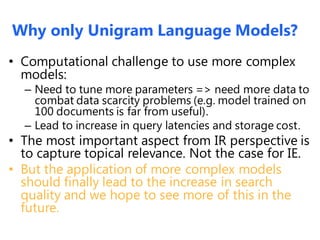
Why only Unigram Language Models?
• Computational challenge to use more complex
models:
– Need to tune more parameters => need more data to
combat data scarcity problems (e.g. model trained on
100 documents is far from useful).
– Lead to increase in query latencies and storage cost.
• The most important aspect from IR perspective is
to capture topical relevance. Not the case for IE.
• But the application of more complex models
should finally lead to the increase in search
quality and we hope to see more of this in the
future.
Talk outline
• Background
– Overview of classical ranking models
– Intro to statistical language models
• Basic language modeling for IR
• Advanced ranking approaches based on
statistical language models
• Ranking approach based on probabilistic
distance of statistical language models
• Conclusions
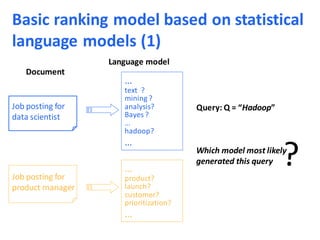
Document
Job posting for
data scientist
Job posting for
product manager
Language model
…
text ?
mining ?
analysis?
Bayes ?
…
hadoop?
…
…
product?
launch?
customer?
prioritization?
…
Query: Q = “Hadoop”
Which model most likely
generated this query
Basic ranking model based on statistical
language models (1)
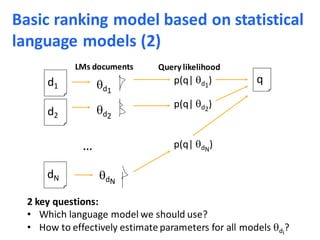
d1
d2
dN
qd1
d2
dN
LMs documents
p(q| d1
)
p(q| d2
)
p(q| dN
)
Query likelihood
…
2 key questions:
• Which language model we should use?
• How to effectively estimate parameters for all models di
?
Basic ranking model based on statistical
language models (2)
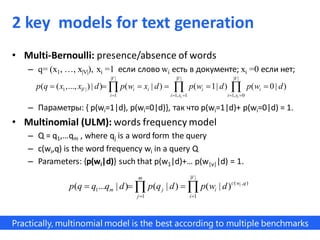
• Multi-Bernoulli: presence/absence of words
– q= (x1, …, x|V|), xi =1 если слово wi есть в документе; xi =0 если нет;
– Параметры: { p(wi=1|d), p(wi=0|d)}, так что p(wi=1|d)+ p(wi=0|d) = 1.
• Multinomial (ULM): words frequency model
– Q = q1,…qm , where qj is a word form the query
– c(wi,q) is the word frequency wi in a query Q
– Parameters: {p(wi|d)} such that p(w1|d)+… p(w|v||d) = 1.
| | | | | |
1 | |
1 1, 1 1, 0
( ( ,..., ) | ) ( | ) ( 1| ) ( 0| )
i i
V V V
V i i i i
i i x i x
p q x x d p w x d p w d p w d
    
       
| |
( , )
1
1 1
( ... | ) ( | ) ( | ) i
Vm
c w q
m j i
j i
p q q q d p q d p w d
 
   
Practically, multinomial model is the best according to multiple benchmarks
2 key models for text generation
The key problem to use statistical
language models for IR is..
• How to estimate accurate language model
for a document p(wi|d)?
• How to smooth document language model?
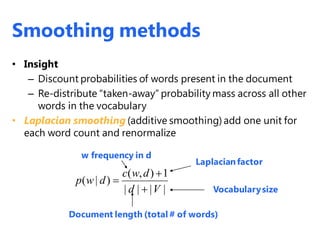
• Insight
– Discount probabilities of words present in the document
– Re-distribute “taken-away” probability mass across all other
words in the vocabulary
• Laplacian smoothing (additive smoothing)add one unit for
each word count and renormalize
( , ) 1
( | )
| | | |
c w d
p w d
d V



Laplacianfactor
Vocabularysize
w frequency in d
Document length (total # of words)
Smoothing methods
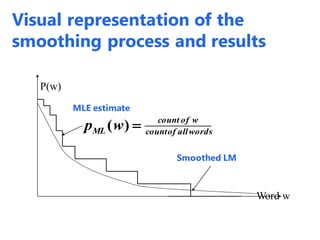
P(w)
Word w
MLE estimate
wordsallofcount
wofcount
ML wp )(
Smoothed LM
Visual representation of the
smoothing process and results
• Insight
– Should we consider all words as equal?
– Nope.
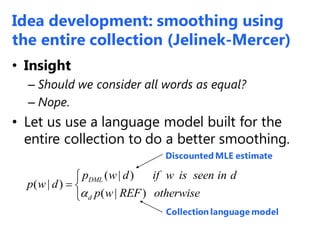
• Let us use a language model built for the
entire collection to do a better smoothing.
Discounted MLE estimate
Collection language model
( | )
( | )
( | )
DML
d
p w d if w is seen in d
p w d
p w REF otherwise

 

Idea development: smoothing using
the entire collection (Jelinek-Mercer)
Idea development: smoothing with the
a priori word distribution (Dirichlet)
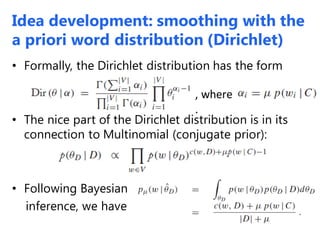
• Formally, the Dirichlet distribution has the form
• The nice part of the Dirichlet distribution is in its
connection to Multinomial (conjugate prior):
• Following Bayesian
inference, we have
, where
.
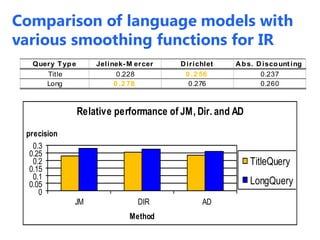
Query Type Jelinek- M ercer Dirichlet Abs. Discount ing
Title 0.228 0 .2 56 0.237
Long 0 .2 78 0.276 0.260
0
0.05
0.1
0.15
0.2
0.25
0.3
JM DIR AD
precision
Method
Relative performance of JM, Dir. and AD
TitleQuery
LongQuery
Comparison of language models with
various smoothing functions for IR
( | )
( | )
( | )
DML
d
p w d if w is seen in d
p w d
p w REF otherwise

 

Discounted MLE estimate
ULM for collection
Ranking principle with
smoothing in a general
form
General smoothing formula
 
 
 

 
 
 





0),(,
0),(,0),(,
0),(, 0),(,
)|(log),(log||
)|(
)|(
log),(
)|(log),()|(log),()|(log),(
)|(log),()|(log),(
)|(log),()|(log
dwcVw Vw
d
d
DML
dwcVw
d
dwcVw Vw
dDML
dwcVw dwcVw
dDML
Vw
REFwpqwcq
REFwp
dwp
qwc
REFwpqwcREFwpqwcdwpqwc
REFwpqwcdwpqwc
dwpqwcdqp




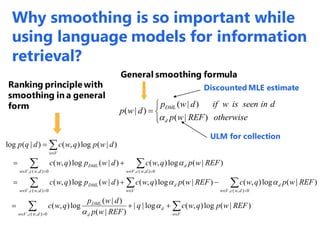
Why smoothing is so important while
using language models for information
retrieval?
, ( , ) 0
( , ) 0
( | )
log ( | ) ( , )log | | log ( , ) ( | )
( | )
DML
d
w V c w d w Vd
c w q
p w d
p q d c w q q c w q p w REF
p w REF

  

   
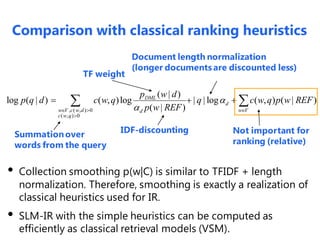
Not important for
ranking (relative)
IDF-discounting
TF weight
Document length normalization
(longer documents are discounted less)
• Collection smoothing p(w|C) is similar to TFIDF + length
normalization. Therefore, smoothing is exactly a realization of
classical heuristics used for IR.
• SLM-IR with the simple heuristics can be computed as
efficiently as classical retrieval models (VSM).
Summationover
words from the query
Comparison with classical ranking heuristics
Talk outline
• Background
– Overview of classical ranking models
– Intro to statistical language models
• Basic language modeling for IR
• Advanced ranking approaches based on
statistical language models
• Ranking approach based on probabilistic
distance of statistical language models
• Conclusions
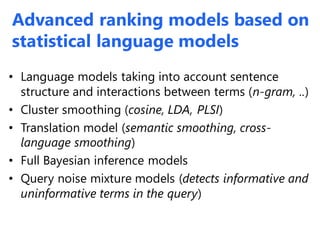
Advanced ranking models based on
statistical language models
• Language models taking into account sentence
structure and interactions between terms (n-gram, ..)
• Cluster smoothing (cosine, LDA, PLSI)
• Translation model (semantic smoothing, cross-
language smoothing)
• Full Bayesian inference models
• Query noise mixture models (detects informative and
uninformative terms in the query)
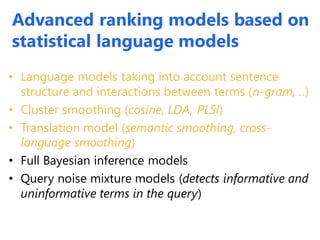
Advanced ranking models based on
statistical language models
• Language models taking into account sentence
structure and interactions between terms (n-gram, ..)
• Cluster smoothing (cosine, LDA, PLSI)
• Translation model (semantic smoothing, cross-
language smoothing)
• Full Bayesian inference models
• Query noise mixture models (detects informative and
uninformative terms in the query)
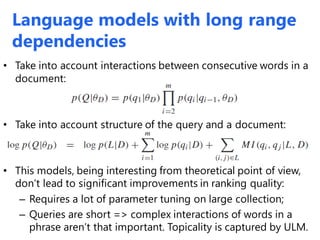
Language models with long range
dependencies
• Take into account interactions between consecutive words in a
document:
• Take into account structure of the query and a document:
• This models, being interesting from theoretical point of view,
don’t lead to significant improvements in ranking quality:
– Requires a lot of parameter tuning on large collection;
– Queries are short => complex interactions of words in a
phrase aren’t that important. Topicality is captured by ULM.
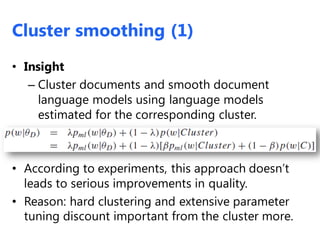
Cluster smoothing (1)
• Insight
– Cluster documents and smooth document
language models using language models
estimated for the corresponding cluster.
• According to experiments, this approach doesn’t
leads to serious improvements in quality.
• Reason: hard clustering and extensive parameter
tuning discount important from the cluster more.
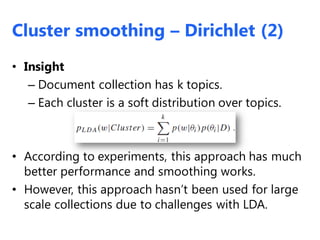
• Insight
– Document collection has k topics.
– Each cluster is a soft distribution over topics.
• According to experiments, this approach has much
better performance and smoothing works.
• However, this approach hasn’t been used for large
scale collections due to challenges with LDA.
Cluster smoothing – Dirichlet (2)
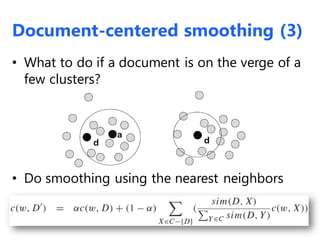
• What to do if a document is on the verge of a
few clusters?
• Do smoothing using the nearest neighbors
Document-centered smoothing (3)
• Insight
– All considered models do search using the words from
the query. Do we miss some relevant documents because
of that? Yes.
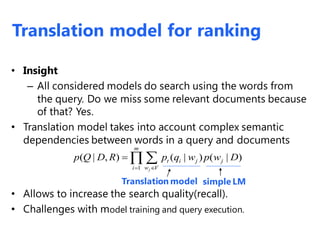
• Translation model takes into account complex semantic
dependencies between words in a query and documents
• Allows to increase the search quality(recall).
• Challenges with model training and query execution.
1
( | , ) ( | ) ( | )
j
m
t i j j
w Vi
p Q D R p q w p w D

 
Translation model simple LM
Translation model for ranking
Talk outline
• Background
– Overview of classical ranking models
– Intro to statistical language models
• Basic language modeling for IR
• Advanced ranking approaches based on
statistical language models
• Ranking approach based on probabilistic
distance of statistical language models
• Conclusions
• Motivation
– Models based on query-document similarity and
probabilistic document generation models allow to easily
incorporate user relevance feedback for re-ranking.
– Models based on query likelihood (statistical language
models) doesn’t allow to take into account this
information.
• Insight
– Similarly to the Vector Space Model we will represent a
query and a document in the same space (now
probabilistic space) and define a measure of query-
document similarity to enable relevance feedback.
Ranking approach based on probabilistic
distance of statistical language models
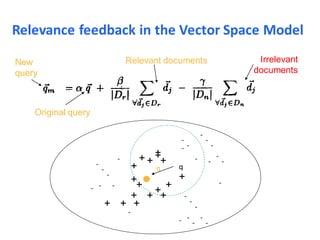
Relevance feedback in the Vector Space Model
Original query
+
qq
+ +
++
+ +
+
+
++
+
+
+
+
+
-
--
-
-
-
-
-
-
-
-
-
-
-
-
-
-
-
-
-
-
-
-
-
-
-
-
+ + +
Irrelevant
documents
New
query
Relevant documents
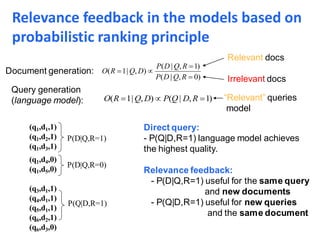
( 1| , ) ( | , 1)O R Q D P Q D R  
( | , 1)
( 1| , )
( | , 0)
P D Q R
O R Q D
P D Q R

 

Document generation:
Query generation
(language model):
Relevant docs
Irrelevant docs
“Relevant” queries
model
P(D|Q,R=1)
P(D|Q,R=0)
P(Q|D,R=1)
(q1,d1,1)
(q1,d2,1)
(q1,d3,1)
(q1,d4,0)
(q1,d5,0)
(q3,d1,1)
(q4,d1,1)
(q5,d1,1)
(q6,d2,1)
(q6,d3,0)
Direct query:
- P(Q|D,R=1) language model achieves
the highest quality.
Relevance feedback:
- P(D|Q,R=1) useful for the same query
and new documents
- P(Q|D,R=1) useful for new queries
and the same document
Relevance feedback in the models based on
probabilistic ranking principle
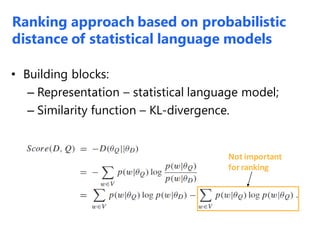
• Building blocks:
– Representation – statistical language model;
– Similarity function – KL-divergence.
Not important
for ranking
Ranking approach based on probabilistic
distance of statistical language models
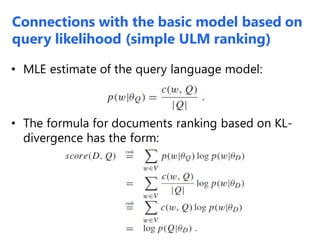
• MLE estimate of the query language model:
• The formula for documents ranking based on KL-
divergence has the form:
Connections with the basic model based on
query likelihood (simple ULM ranking)
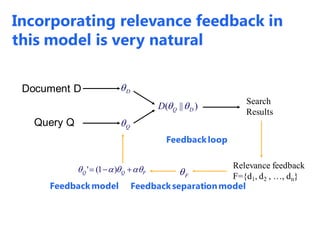
Query Q
D
)||( DQD 
Document D
Search
Results
Relevance feedback
F={d1, d2 , …, dn}
FQQ   )1('
Feedbackseparationmodel
Q
F
Feedbackmodel
Incorporating relevance feedback in
this model is very natural
Feedbackloop
Talk outline
• Background
– Overview of classical ranking models
– Intro to statistical language models
• Basic language modeling for IR
• Advanced ranking approaches based on
statistical language models
• Ranking approach based on probabilistic
distance of statistical language models
• Conclusions
• Advantages:
– Theoretically elegant model (simple parameter tuning, clear
probabilistic assumptions and framework, matches and
generalizes existing approaches).
– Extensible for special problems/domains (themes, opinion
search,..).
– A lot of research in related communities (NLP, MT,..).
– Achieves state-of-the-art ranking accuracy and comparable
with fine-tuned classical heuristic models (Okapi BM25)
– Allows to incorporate relevance feedback
• Disadvantages:
– Requires estimation of a generative model (difficult for no ULMs).
– Computationally more expensive to achieve the same ranking
quality of simple heuristic models.
Comparison of classical ranking models and
models based on query likelihood (SLM)
• Theoretical framework for known ranking heuristics
• Empirically models from this algorithmic family achieve
state-of-the-art quality:
– Basic SLM with Dirichlet smoothing
– Basic SLM with domain-dependent document relevance
modeling (URL, PageRank,..).
– Translation model can incorporate semantic connections
between words from the same and different languages.
– Model based on KL-divergence allows to incorporate relevance
feedback within a probabilistic framework.
– Advanced probabilistic models (mixtures, cluster smoothing)
demonstrate model extensibility.
• Fully automated and explained model estimation
Statistical language models (summary)
Many thanks to major contributors and
experts on statistical language models!
Thank you!

Language Models for Information Retrieval

  • 1.
    Statistical Language Models forInformation Retrieval by: Nik Spirinat: Disclaimer: The slides are significantly based on the lectures of Prof. ChengXiang Zhai at UIUC (http://czhai.cs.illinois.edu/). All the credit goes to the author. All the blame is for the presenter.
  • 2.
    This talk willhelp you help people find jobs! 
  • 3.
    Talk outline • Background –Overview of classical ranking models – Intro to statistical language models • Basic language modeling for IR • Advanced ranking approaches based on statistical language models • Ranking approach based on probabilistic distance of statistical language models • Conclusions
  • 4.
    Talk outline • Background –Overview of classical ranking models – Intro to statistical language models • Basic language modeling for IR • Advanced ranking approaches based on statistical language models • Ranking approach based on probabilistic distance of statistical language models • Conclusions
  • 5.
    History of InformationRetrieval • 1950 – 1960: early days and first empirical observations – Hypothesis on automated indexing (Luhn) – First experiments and development of guidelines for information retrieval systems evaluation (Cleverdon’s Cranfield 1 and Cranfield 2) – Early experiments of a Vector Space Model for ranking (Salton’s SMART) • 1970 – 1980: active development of information retrieval – Establishment of a Vector Space Model for ranking – Ranking models based on probability ranking principle (PRP) • 1990s: further development and formalization of IR (new applications and theoretical explanations) – Statistical Language Models (Croft ’98) – Development of large scale collections for IR systems evaluation (TREC) • 2000s: web search, large scale search engines in the wild, anti-spam – Machine Learning to Rank – MapReduce, GFS, Hadoop… • 2010s: vertical search, entity search, social search, real-time search
  • 6.
    Problem formulation • Given: –A vocabulary for a natural language ; – A set of learning queries , where each word from a query is part of the vocabulary; – A collection of documents , where every document is an order sequence of words; – A set of learning query/document pairs with relevance judgments • Deliever: – A set (ranked list) of documents from a collection for a new query.
  • 7.
    How to presentthe results to users: a set or a ranked list? • Strategy 1 (document filtering) – R(q) = { dC | f(d,q)=1 }, where f(d,q)  {0,1} is a classifier, indicator function – The algorithm should predict an absolute relevance of a document with respect to a query. • Strategy 2 (document ranking) – R(q) = { dC | f(d,q)> }, where f(d,q)  is a raning function;  is a relevance threshold – The algorithm should predict a relative relevance of a document with respect to the query and adjust the threshold.
  • 8.
    + + + + - - - - - - - - - - - - - - + - - Classification f(d,q)=? + + + + - - + - + - - -- - -- - Ranking f(d,q)=? 1 0.98 d1 + 0.95 d2 + 0.83 d3 - 0.80 d4 + 0.76 d5 - 0.56 d6 - 0.34 d7 - 0.21 d8 + 0.21 d9 - R’(q) R’(q) Actual relevance R(q) How to present the results to users: a set or a ranked list? 0
  • 9.
    How to presentthe results to users: a set or a ranked list? • Strategy 1 (document filtering) – R(q) = { dC | f(d,q)=1 }, where f(d,q)  {0,1} is a classifier, indicator function – The algorithm should predict an absolute relevance of a document with respect to a query. • Strategy 2 (document ranking) – R(q) = { dC | f(d,q)> }, where f(d,q)  is a raning function;  is a relevance threshold – The algorithm should predict a relative relevance of a document with respect to the query and adjust the threshold.
  • 10.
    Models based ontext similarity (1) • Insight: – A document relevance for a query correlates with the textual similarity between a document and a query • Vector Space Model for ranking(VSM) – Document and query are represented as vectors in a metric space (dim ~ |V|); – Each word in a vocabulary has an associated weight, which serves as a proxy for the word informativeness and uniqueness; – Relevance is a function of vectors similarity.
  • 11.
    • Document isa vector ; • Query is a vector ; • Words are weighted according to TFIDF, which takes into account: – Word frequency in a document (TF); – Word popularity in a collection (IDF); – Document length; • Similarity is measured as a normalized scalar product (cosine similarity). Models based on text similarity (2)
  • 12.
    • Advantages: – Givesthe best results among all classical ranking models; – Very simple conceptually and implementation-wise; – There are many collections and benchmarks for evaluation with the peers; • Disadvantages: – Based on heuristics and assumes independence of words in the query and documents; – Difficult to extend given a domain knowledge; – Requires careful parameter tuning by experts; – Doesn’t explain how to represent queries and documents and why vectors are good. Models based on text similarity (3)
  • 13.
    Probabilistic Ranking Principle,PRP (1) • Given a training set , construct a mapping function . • Define a likelihood function and a function of a posterior model parameters
  • 14.
    • The optimaldecision function for a new object will look like • Define a loss function s.t. when and when , and Bayesian risk then Probabilistic Ranking Principle, PRP (2)
  • 15.
    Probabilistic Ranking Models(1) • Insight: – What is the probability that a document is relevant for a query? • Probabilistic Ranking Model (PRM): – Consider three random variables (query, document, relevance R  {0,1}); – Goal: sort the documents in the decreasing order using probabilistic scores, P(R=1|Q,D); – There are several major ways to estimate the probability P(R=1|Q,D).
  • 16.
    • Discriminative approach(estimate the probability directly, machine learning to rank): – Define features on Q x D, like # shared words, document length, IDF of the most frequent word on a page, predictions of multiple ranking functions baseR(Q,D),… – Using a training set (query, documents, known relevance judgements on training pairs), tune model parameters – For a new case (query/document) pair, generate features and apply a trained model Probabilistic Ranking Models (1)
  • 17.
    • Generative approach(factorize a probability of relevance into a product of random variables) – Compute Odds(R=1|Q,D) using Bayes rule – Define a generative model P(Q,D|R) • Possible factorization approaches – Document generation: P(Q,D|R)=P(D|Q,R)P(Q|R) – Query generation: P(Q,D|R)=P(Q|D,R)P(D|R) )0( )1( )0|,( )1|,( ),|0( ),|1( ),|1(         RP RP RDQP RDQP DQRP DQRP DQRO Doesn’t affect ranking Probabilistic Ranking Models (2)
  • 18.
    )0,|( )1,|( )0|()0,|( )1|()1,|( )0|,( )1|,( ),|0( ),|1(            RQDP RQDP RQPRQDP RQPRQDP RDQP RDQP DQRP DQRP Model for relevantdocument for Q Model for irrelevant document for Q Lets assume independence of random variablesT1… Tk Let D=d1…dk, where dk {0,1} is a set of possiblevalues for Tk (same for Q=q1…qm ) )0),0,|1()1,|1(( )1,|0()0,|1( )0,|0()1,|1( )1,|0()0,|1( )0,|0()1,|1( )0,|0( )1,|0( )0,|1( )1,|1( )0,|( )1,|( ),|0( ),|1( 1,1 1,1 0,11,1 1                          iii qdi ii ii di ii ii di i i di i i i ii ii qwhenRQTPRQTPLet RQTPRQTP RQTPRQTP RQTPRQTP RQTPRQTP RQTP RQTP RQTP RQTP RQdTP RQdTP DQRP DQRP ii i ii Probabilistic Ranking Models (3): document generation
  • 19.
    One should estimate2 parameters for each term Ti: • pi = P(Ti=1|Q,R=1):probability that Ti is associated with relevant class of documents; • qi = P(Ti=1|Q,R=0):probability that Ti is associated with irrelevant class of documents;      1,1 )1( )1( log),|1(log ii qdi ii ii Rank pq qp DQRO (RSJ model) How to estimate these parameters? 1).(# 5.0).(# ˆ 1).(# 5.0).(# ˆ       docnonrel Twithdocnonrel q docrel Twithdocrel p i i i i Probabilistic Ranking Models (4): document generation
  • 20.
    ))0|()0,|(( )0|( )1|( )1,|( )0|()0,|( )1|()1,|( )0|,( )1|,( ),|1(           RQPRDQPПусть RDP RDP RDQP RDPRDQP RDPRDQP RDQP RDQP DQRO Assuming a uniformdocuments relevance Probability of a query p(q| d) A priori document relevance )1,|(),|1(  RDQPDQRO How to estimate query probability given a document? )1,|( RDQP The approach consists of 2 stages: • Build a language model for each document D • Compute relevance of documents for the query. Probabilistic Ranking Models (5): query generation
  • 21.
    Other classical IRmodels • Ranking based on graphical models – Insight: using a full Bayesian inference derive the relevance of a document for a query • Ranking based on genetic algorithms and symbolic regression – Insight: generate, test, pick the most promising • Full empirical risk minimization • Heuristic approach based on structural properties of a ranking function
  • 22.
    Talk outline • Background –Overview of classical ranking models – Intro to statistical language models • Basic language modeling for IR • Advanced ranking approaches based on statistical language models • Ranking approach based on probabilistic distance of statistical language models • Conclusions
  • 23.
    Statistical Language Models(def) • Probabilistic distribution on word sequences: – p(“I love Indeed”)  0.001; – p(“Gramm matrix in a Unitarian space is Hermitian”)  0.0000000000001; – p(“I beat Google”)  0.00001. • It can be used to generate texts and sentences => also referred to as a generative language model. • Depends on a collection, language, type of model, params, training procedure..
  • 24.
    Statistical Language Models (examplesof application) • Allows to analyze and describe language using an abstract theoretical model. • Using SLM one can answer: – For a phrase “Responsible for”, predict the probability that the next work will be “analysis”? What about “sales”? May be “coffee”? (speech recognition, machine translation) – If the word “Big” is observed 1 per job posting and “Data” 7 times, what is the probabilitythat the job posting is about a Data Scientist job? (information retrieval, text categorization) – If a person applies for accountant, what is the probabilitythat s/he will use the phrase “attention to details” in the resume? (informationretrieval using language models)
  • 25.
    • Texts isgenerated sequentially using sampling with replacement such that words in the sequence are independent. – p(w1 w2 ... wn)=p(w1)p(w2)…p(wn). • Model parameters {p(wi)} must follow p(w1)+…+p(wN)=1, where N = |V|. • Formally, ULM represents a multinomial distribution on the set of words. Unigram Language Model (ULM)
  • 26.
    ULM with paramsvector  p(w| ) … GAAP 0.1 matrix 0.05 cost 0.1 revenue 0.02 … report 0.00001 … Topic 1: Accounting … RTB 0.0005 SMM 0.25 PPC 0.1 CPA 0.2 … Topic 2: Advertising Document d Annualreport Advertising proposal Sample with replacement Text generation with ULMs
  • 27.
    ULM with theparameters  p(w| ) Document d Frequency counting … GAAP 1 matrix 50 cost 20 revenue 10 test 0 … report 100 … DocLen = 1000 1/1000 50/1000 20/1000 10/1000 100/1000 … GAAP 0.001 matrix 0.05 cost 0.02 revenue 0.01 … report 0.1 How to estimate model quality? Whether the model is good? Model estimated built for a given document assigns the highest probability to this document. But the generalization ability of this model is low => Smoothing Unigram Language Model (ULM)
  • 28.
    Evaluation of SLMs •Direct: How good the model predicts the data? – Examples: likelihood, perplexity, cross-entropy, KL- divergence (equivalents of each other under simple transformations) • Indirect: Does this model lead to improvements in the final application (translation, search,..)? – Domain-dependent external metric. In case of information retrieval we measure the improvements in quality, which in turn is estimated via heuristic metrics, like DCG, MRR, MAP. – Assumption: more accurate linguistic model leads to better search quality, but not always! Evaluation of SLMs
  • 29.
    • N-gram model –p(w1 w2 ... wn)=p(w1)p(w2|w1)…p(wn|w1 …wn-1); – n-gram means that the generation process depends on the last n-1 words; – For example, the bi-gram model has the following form: p(w1 ... wn)=p(w1)p(w2|w1) p(w3|w2) …p(wn|wn-1). • Models taking into account long range dependencies between words (Maximum Entropy Language Model..) • Structured language models (probabilistic context- free grammar, PCFG). • Most of the time in information retrieval we use only a Unigram Language Model. More complex SLMs
  • 30.
    Why only UnigramLanguage Models? • Computational challenge to use more complex models: – Need to tune more parameters => need more data to combat data scarcity problems (e.g. model trained on 100 documents is far from useful). – Lead to increase in query latencies and storage cost. • The most important aspect from IR perspective is to capture topical relevance. Not the case for IE. • But the application of more complex models should finally lead to the increase in search quality and we hope to see more of this in the future.
  • 31.
    Talk outline • Background –Overview of classical ranking models – Intro to statistical language models • Basic language modeling for IR • Advanced ranking approaches based on statistical language models • Ranking approach based on probabilistic distance of statistical language models • Conclusions
  • 32.
    Document Job posting for datascientist Job posting for product manager Language model … text ? mining ? analysis? Bayes ? … hadoop? … … product? launch? customer? prioritization? … Query: Q = “Hadoop” Which model most likely generated this query Basic ranking model based on statistical language models (1)
  • 33.
    d1 d2 dN qd1 d2 dN LMs documents p(q| d1 ) p(q|d2 ) p(q| dN ) Query likelihood … 2 key questions: • Which language model we should use? • How to effectively estimate parameters for all models di ? Basic ranking model based on statistical language models (2)
  • 34.
    • Multi-Bernoulli: presence/absenceof words – q= (x1, …, x|V|), xi =1 если слово wi есть в документе; xi =0 если нет; – Параметры: { p(wi=1|d), p(wi=0|d)}, так что p(wi=1|d)+ p(wi=0|d) = 1. • Multinomial (ULM): words frequency model – Q = q1,…qm , where qj is a word form the query – c(wi,q) is the word frequency wi in a query Q – Parameters: {p(wi|d)} such that p(w1|d)+… p(w|v||d) = 1. | | | | | | 1 | | 1 1, 1 1, 0 ( ( ,..., ) | ) ( | ) ( 1| ) ( 0| ) i i V V V V i i i i i i x i x p q x x d p w x d p w d p w d              | | ( , ) 1 1 1 ( ... | ) ( | ) ( | ) i Vm c w q m j i j i p q q q d p q d p w d       Practically, multinomial model is the best according to multiple benchmarks 2 key models for text generation
  • 35.
    The key problemto use statistical language models for IR is.. • How to estimate accurate language model for a document p(wi|d)? • How to smooth document language model?
  • 36.
    • Insight – Discountprobabilities of words present in the document – Re-distribute “taken-away” probability mass across all other words in the vocabulary • Laplacian smoothing (additive smoothing)add one unit for each word count and renormalize ( , ) 1 ( | ) | | | | c w d p w d d V    Laplacianfactor Vocabularysize w frequency in d Document length (total # of words) Smoothing methods
  • 37.
    P(w) Word w MLE estimate wordsallofcount wofcount MLwp )( Smoothed LM Visual representation of the smoothing process and results
  • 38.
    • Insight – Shouldwe consider all words as equal? – Nope. • Let us use a language model built for the entire collection to do a better smoothing. Discounted MLE estimate Collection language model ( | ) ( | ) ( | ) DML d p w d if w is seen in d p w d p w REF otherwise     Idea development: smoothing using the entire collection (Jelinek-Mercer)
  • 39.
    Idea development: smoothingwith the a priori word distribution (Dirichlet) • Formally, the Dirichlet distribution has the form • The nice part of the Dirichlet distribution is in its connection to Multinomial (conjugate prior): • Following Bayesian inference, we have , where .
  • 40.
    Query Type Jelinek-M ercer Dirichlet Abs. Discount ing Title 0.228 0 .2 56 0.237 Long 0 .2 78 0.276 0.260 0 0.05 0.1 0.15 0.2 0.25 0.3 JM DIR AD precision Method Relative performance of JM, Dir. and AD TitleQuery LongQuery Comparison of language models with various smoothing functions for IR
  • 41.
    ( | ) (| ) ( | ) DML d p w d if w is seen in d p w d p w REF otherwise     Discounted MLE estimate ULM for collection Ranking principle with smoothing in a general form General smoothing formula                   0),(, 0),(,0),(, 0),(, 0),(, )|(log),(log|| )|( )|( log),( )|(log),()|(log),()|(log),( )|(log),()|(log),( )|(log),()|(log dwcVw Vw d d DML dwcVw d dwcVw Vw dDML dwcVw dwcVw dDML Vw REFwpqwcq REFwp dwp qwc REFwpqwcREFwpqwcdwpqwc REFwpqwcdwpqwc dwpqwcdqp     Why smoothing is so important while using language models for information retrieval?
  • 42.
    , ( ,) 0 ( , ) 0 ( | ) log ( | ) ( , )log | | log ( , ) ( | ) ( | ) DML d w V c w d w Vd c w q p w d p q d c w q q c w q p w REF p w REF          Not important for ranking (relative) IDF-discounting TF weight Document length normalization (longer documents are discounted less) • Collection smoothing p(w|C) is similar to TFIDF + length normalization. Therefore, smoothing is exactly a realization of classical heuristics used for IR. • SLM-IR with the simple heuristics can be computed as efficiently as classical retrieval models (VSM). Summationover words from the query Comparison with classical ranking heuristics
  • 43.
    Talk outline • Background –Overview of classical ranking models – Intro to statistical language models • Basic language modeling for IR • Advanced ranking approaches based on statistical language models • Ranking approach based on probabilistic distance of statistical language models • Conclusions
  • 44.
    Advanced ranking modelsbased on statistical language models • Language models taking into account sentence structure and interactions between terms (n-gram, ..) • Cluster smoothing (cosine, LDA, PLSI) • Translation model (semantic smoothing, cross- language smoothing) • Full Bayesian inference models • Query noise mixture models (detects informative and uninformative terms in the query)
  • 45.
    Advanced ranking modelsbased on statistical language models • Language models taking into account sentence structure and interactions between terms (n-gram, ..) • Cluster smoothing (cosine, LDA, PLSI) • Translation model (semantic smoothing, cross- language smoothing) • Full Bayesian inference models • Query noise mixture models (detects informative and uninformative terms in the query)
  • 46.
    Language models withlong range dependencies • Take into account interactions between consecutive words in a document: • Take into account structure of the query and a document: • This models, being interesting from theoretical point of view, don’t lead to significant improvements in ranking quality: – Requires a lot of parameter tuning on large collection; – Queries are short => complex interactions of words in a phrase aren’t that important. Topicality is captured by ULM.
  • 47.
    Cluster smoothing (1) •Insight – Cluster documents and smooth document language models using language models estimated for the corresponding cluster. • According to experiments, this approach doesn’t leads to serious improvements in quality. • Reason: hard clustering and extensive parameter tuning discount important from the cluster more.
  • 48.
    • Insight – Documentcollection has k topics. – Each cluster is a soft distribution over topics. • According to experiments, this approach has much better performance and smoothing works. • However, this approach hasn’t been used for large scale collections due to challenges with LDA. Cluster smoothing – Dirichlet (2)
  • 49.
    • What todo if a document is on the verge of a few clusters? • Do smoothing using the nearest neighbors Document-centered smoothing (3)
  • 50.
    • Insight – Allconsidered models do search using the words from the query. Do we miss some relevant documents because of that? Yes. • Translation model takes into account complex semantic dependencies between words in a query and documents • Allows to increase the search quality(recall). • Challenges with model training and query execution. 1 ( | , ) ( | ) ( | ) j m t i j j w Vi p Q D R p q w p w D    Translation model simple LM Translation model for ranking
  • 51.
    Talk outline • Background –Overview of classical ranking models – Intro to statistical language models • Basic language modeling for IR • Advanced ranking approaches based on statistical language models • Ranking approach based on probabilistic distance of statistical language models • Conclusions
  • 52.
    • Motivation – Modelsbased on query-document similarity and probabilistic document generation models allow to easily incorporate user relevance feedback for re-ranking. – Models based on query likelihood (statistical language models) doesn’t allow to take into account this information. • Insight – Similarly to the Vector Space Model we will represent a query and a document in the same space (now probabilistic space) and define a measure of query- document similarity to enable relevance feedback. Ranking approach based on probabilistic distance of statistical language models
  • 53.
    Relevance feedback inthe Vector Space Model Original query + qq + + ++ + + + + ++ + + + + + - -- - - - - - - - - - - - - - - - - - - - - - - - - + + + Irrelevant documents New query Relevant documents
  • 54.
    ( 1| ,) ( | , 1)O R Q D P Q D R   ( | , 1) ( 1| , ) ( | , 0) P D Q R O R Q D P D Q R     Document generation: Query generation (language model): Relevant docs Irrelevant docs “Relevant” queries model P(D|Q,R=1) P(D|Q,R=0) P(Q|D,R=1) (q1,d1,1) (q1,d2,1) (q1,d3,1) (q1,d4,0) (q1,d5,0) (q3,d1,1) (q4,d1,1) (q5,d1,1) (q6,d2,1) (q6,d3,0) Direct query: - P(Q|D,R=1) language model achieves the highest quality. Relevance feedback: - P(D|Q,R=1) useful for the same query and new documents - P(Q|D,R=1) useful for new queries and the same document Relevance feedback in the models based on probabilistic ranking principle
  • 55.
    • Building blocks: –Representation – statistical language model; – Similarity function – KL-divergence. Not important for ranking Ranking approach based on probabilistic distance of statistical language models
  • 56.
    • MLE estimateof the query language model: • The formula for documents ranking based on KL- divergence has the form: Connections with the basic model based on query likelihood (simple ULM ranking)
  • 57.
    Query Q D )||( DQD Document D Search Results Relevance feedback F={d1, d2 , …, dn} FQQ   )1(' Feedbackseparationmodel Q F Feedbackmodel Incorporating relevance feedback in this model is very natural Feedbackloop
  • 58.
    Talk outline • Background –Overview of classical ranking models – Intro to statistical language models • Basic language modeling for IR • Advanced ranking approaches based on statistical language models • Ranking approach based on probabilistic distance of statistical language models • Conclusions
  • 59.
    • Advantages: – Theoreticallyelegant model (simple parameter tuning, clear probabilistic assumptions and framework, matches and generalizes existing approaches). – Extensible for special problems/domains (themes, opinion search,..). – A lot of research in related communities (NLP, MT,..). – Achieves state-of-the-art ranking accuracy and comparable with fine-tuned classical heuristic models (Okapi BM25) – Allows to incorporate relevance feedback • Disadvantages: – Requires estimation of a generative model (difficult for no ULMs). – Computationally more expensive to achieve the same ranking quality of simple heuristic models. Comparison of classical ranking models and models based on query likelihood (SLM)
  • 60.
    • Theoretical frameworkfor known ranking heuristics • Empirically models from this algorithmic family achieve state-of-the-art quality: – Basic SLM with Dirichlet smoothing – Basic SLM with domain-dependent document relevance modeling (URL, PageRank,..). – Translation model can incorporate semantic connections between words from the same and different languages. – Model based on KL-divergence allows to incorporate relevance feedback within a probabilistic framework. – Advanced probabilistic models (mixtures, cluster smoothing) demonstrate model extensibility. • Fully automated and explained model estimation Statistical language models (summary)
  • 61.
    Many thanks tomajor contributors and experts on statistical language models!
  • 62.