INDEX
• Introduction
• Types of Prism
• Uses of Prism
• Parts Of Prism
• How do Prisms work ?
INTRODUCTION
• A prism (from Greek) is a structure whose outer surfaces are triangular and converge to a
single point at the top, making the shape roughly a pyramid in the geometric sense. The base
of a pyramid can be trilateral, quadrilateral, or any polygon shape, meaning that a pyramid
has at least three outer triangular surfaces (at least four faces including the base). The square
pyramid, with square base and four triangular outer surfaces is a common version.
TYPES OF PRISM
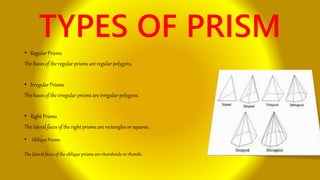
• Regular Prisms
The bases of the regular prisms are regular polygons.
• Irregular Prisms
The bases of the irregular prisms are irregular polygons.
• Right Prisms
The lateral faces of the right prisms are rectangles or squares.
• Oblique Prisms
The lateral faces of the oblique prisms are rhomboids or rhombi.
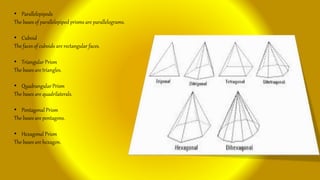
• Parallelepipeds
The bases of parallelepiped prisms are parallelograms.
• Cuboid
The faces of cuboids are rectangular faces.
• Triangular Prism
The bases are triangles.
• Quadrangular Prism
The bases are quadrilaterals.
• Pentagonal Prism
The bases are pentagons.
• Hexagonal Prism
The bases are hexagon.
USES OF PRISM
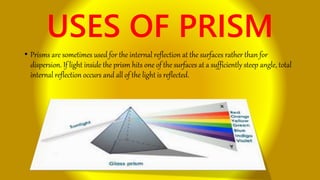
• Prisms are sometimes used for the internal reflection at the surfaces rather than for
dispersion. If light inside the prism hits one of the surfaces at a sufficiently steep angle, total
internal reflection occurs and all of the light is reflected.
PARTS OF
PRISM
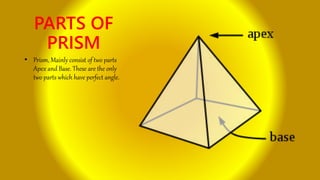
• Prism, Mainly consist of two parts
Apex and Base. These are the only
two parts which have perfect angle.
HOW DO PRISM
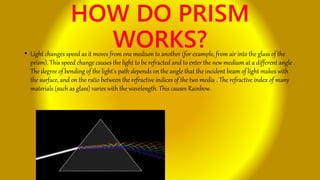
WORKS?• Light changes speed as it moves from one medium to another (for example, from air into the glass of the
prism). This speed change causes the light to be refracted and to enter the new medium at a different angle .
The degree of bending of the light's path depends on the angle that the incident beam of light makes with
the surface, and on the ratio between the refractive indices of the two media . The refractive index of many
materials (such as glass) varies with the wavelength. This causes Rainbow.
Efforts By-
PAARTH
GERA

Prisms

  • 2.
    INDEX • Introduction • Typesof Prism • Uses of Prism • Parts Of Prism • How do Prisms work ?
  • 3.
    INTRODUCTION • A prism(from Greek) is a structure whose outer surfaces are triangular and converge to a single point at the top, making the shape roughly a pyramid in the geometric sense. The base of a pyramid can be trilateral, quadrilateral, or any polygon shape, meaning that a pyramid has at least three outer triangular surfaces (at least four faces including the base). The square pyramid, with square base and four triangular outer surfaces is a common version.
  • 4.
    TYPES OF PRISM •Regular Prisms The bases of the regular prisms are regular polygons. • Irregular Prisms The bases of the irregular prisms are irregular polygons. • Right Prisms The lateral faces of the right prisms are rectangles or squares. • Oblique Prisms The lateral faces of the oblique prisms are rhomboids or rhombi.
  • 5.
    • Parallelepipeds The basesof parallelepiped prisms are parallelograms. • Cuboid The faces of cuboids are rectangular faces. • Triangular Prism The bases are triangles. • Quadrangular Prism The bases are quadrilaterals. • Pentagonal Prism The bases are pentagons. • Hexagonal Prism The bases are hexagon.
  • 6.
    USES OF PRISM •Prisms are sometimes used for the internal reflection at the surfaces rather than for dispersion. If light inside the prism hits one of the surfaces at a sufficiently steep angle, total internal reflection occurs and all of the light is reflected.
  • 7.
    PARTS OF PRISM • Prism,Mainly consist of two parts Apex and Base. These are the only two parts which have perfect angle.
  • 8.
    HOW DO PRISM WORKS?•Light changes speed as it moves from one medium to another (for example, from air into the glass of the prism). This speed change causes the light to be refracted and to enter the new medium at a different angle . The degree of bending of the light's path depends on the angle that the incident beam of light makes with the surface, and on the ratio between the refractive indices of the two media . The refractive index of many materials (such as glass) varies with the wavelength. This causes Rainbow.
  • 9.