PRIONS
Dr. Shimna .C .S
Junior Resident
Department of Physiology
• Definition
• Structure
• Physiological functions of PrPc
• Chemical Properties
• Differences From Bacteria & Viruses
• Prion Diseases
– Neuropathology
– Features
• New Concepts
Definition
• Proteinaceous infectious particle
• Lacks nucleic acid
• Neurodegenerative diseases
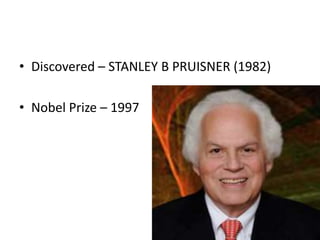
• Discovered – STANLEY B PRUISNER (1982)
• Nobel Prize – 1997
Structure
• PrP-254 amino acids.
• PrPc : Normal cellular isoform
:Rich in alpha helix
• PrPsc : Disease causing isoform
:Rich in beta pleated
• Both PrPC and PrPSc -209 AA
PrPc PrPsc
• Cellular
• Dominant alpha helix
• Easily soluble
• Monomeric
• Digested by Proteases
• Gene PRNP (short arm
of chromosome 20)
• Disease causing
• Beta pleated
• Insoluble
• Multimeric
• Resistant to digestion
• Reproduce by binding
to PrPC and stimulating
conversion of PrPC into
PrPsc
Physiological functions of PrPc
• Modulate
– 1) Functions of the nervous and immune systems,
including memory and inflammatory reactions
– 2) Cell proliferation, differentiation, and sensitivity to
programmed cell death both in the nervous and immune
systems, as well as in various cell lines
– 3) Activity of numerous signal transduction pathways,
including cAMP/protein kinase A
– 4) Antioxidative ( ncbi )
• Antioxidative
PrPC + Cu (Copper)

Resistance to oxidative stress

Prevent neuronal dysfunction
Chemical Properties
• Limited proteolysis of PrPSc - PrP27-30(142 AA)
-Protease Resistant.
• Presence of detergent PrP27-30 Amyloid
• Prion Rods – limited proteolysis & detergent extraction of
PrPSc
Amyloid & Prion rods
• Similar ultrastructural morphology
• Green gold birefringence with Congo red dye
Differences From Bacteria & Viruses
• PrP isoforms are encoded by a chromosomal
gene.
• Do not contain nucleic acid.
• Extremely resistant to heat and chemicals.
• Difficult to decompose biologically;survive in
soil for many years.
Prion Diseases
Human
• Kuru
• Creutzfeldt-Jakob disease
– Sporadic
– Iatrogenic
– Variant
– Familial
• Gerstmann-Straussler-
Scheinker disease
• Fatal familial insomnia
• Sporadic fatal insomnia
Animals
• Scrapie
• Bovine spongiform
encephalopathy
• Transmissible mink
encephalopathy
• Chronic wasting disease
• Feline spongiform
encephalopathy
• Exotic ungulate
encephalopathy
• SPORADIC - 85%
– CJD
• FAMILIAL – 15%
– GSS, FFI
• TRANSMISSIBLE - rare
– KURU ,BSE
Neuropathology
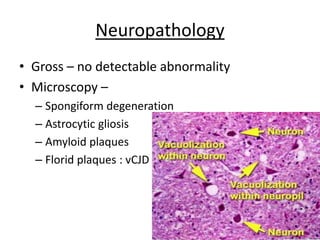
• Gross – no detectable abnormality
• Microscopy –
– Spongiform degeneration
– Astrocytic gliosis
– Amyloid plaques
– Florid plaques : vCJD
Clinical Features
• Deficits in higher cortical function
• Dementia
• Visual impairment
• Cerebellar gait and coordination deficits
• Extrapyramidal dysfunction
• Myoclonus
New concepts
• Only known infectious pathogens devoid of nucleic acid
• Manifest as infectious, genetic, and sporadic disorders; no
other group of illnesses with a single etiology presents with
such a wide spectrum of clinical manifestations.
• Prion diseases result from the accumulation of PrPSc, the
conformation of which differs substantially from that of its
precursor, PrPC
References
• Harrison's
PRINCIPLES OF INTERNAL MEDICINE
• Harper’s TEXTBOOK OF BIOCHEMISTRY
THANK YOU

Prions

  • 1.
    PRIONS Dr. Shimna .C.S Junior Resident Department of Physiology
  • 2.
    • Definition • Structure •Physiological functions of PrPc • Chemical Properties • Differences From Bacteria & Viruses • Prion Diseases – Neuropathology – Features • New Concepts
  • 3.
    Definition • Proteinaceous infectiousparticle • Lacks nucleic acid • Neurodegenerative diseases
  • 4.
    • Discovered –STANLEY B PRUISNER (1982) • Nobel Prize – 1997
  • 5.
    Structure • PrP-254 aminoacids. • PrPc : Normal cellular isoform :Rich in alpha helix • PrPsc : Disease causing isoform :Rich in beta pleated • Both PrPC and PrPSc -209 AA
  • 6.
    PrPc PrPsc • Cellular •Dominant alpha helix • Easily soluble • Monomeric • Digested by Proteases • Gene PRNP (short arm of chromosome 20) • Disease causing • Beta pleated • Insoluble • Multimeric • Resistant to digestion • Reproduce by binding to PrPC and stimulating conversion of PrPC into PrPsc
  • 9.
    Physiological functions ofPrPc • Modulate – 1) Functions of the nervous and immune systems, including memory and inflammatory reactions – 2) Cell proliferation, differentiation, and sensitivity to programmed cell death both in the nervous and immune systems, as well as in various cell lines – 3) Activity of numerous signal transduction pathways, including cAMP/protein kinase A – 4) Antioxidative ( ncbi )
  • 10.
    • Antioxidative PrPC +Cu (Copper)  Resistance to oxidative stress  Prevent neuronal dysfunction
  • 11.
    Chemical Properties • Limitedproteolysis of PrPSc - PrP27-30(142 AA) -Protease Resistant. • Presence of detergent PrP27-30 Amyloid • Prion Rods – limited proteolysis & detergent extraction of PrPSc
  • 12.
    Amyloid & Prionrods • Similar ultrastructural morphology • Green gold birefringence with Congo red dye
  • 13.
    Differences From Bacteria& Viruses • PrP isoforms are encoded by a chromosomal gene. • Do not contain nucleic acid. • Extremely resistant to heat and chemicals. • Difficult to decompose biologically;survive in soil for many years.
  • 14.
    Prion Diseases Human • Kuru •Creutzfeldt-Jakob disease – Sporadic – Iatrogenic – Variant – Familial • Gerstmann-Straussler- Scheinker disease • Fatal familial insomnia • Sporadic fatal insomnia Animals • Scrapie • Bovine spongiform encephalopathy • Transmissible mink encephalopathy • Chronic wasting disease • Feline spongiform encephalopathy • Exotic ungulate encephalopathy
  • 15.
    • SPORADIC -85% – CJD • FAMILIAL – 15% – GSS, FFI • TRANSMISSIBLE - rare – KURU ,BSE
  • 16.
    Neuropathology • Gross –no detectable abnormality • Microscopy – – Spongiform degeneration – Astrocytic gliosis – Amyloid plaques – Florid plaques : vCJD
  • 17.
    Clinical Features • Deficitsin higher cortical function • Dementia • Visual impairment • Cerebellar gait and coordination deficits • Extrapyramidal dysfunction • Myoclonus
  • 18.
    New concepts • Onlyknown infectious pathogens devoid of nucleic acid • Manifest as infectious, genetic, and sporadic disorders; no other group of illnesses with a single etiology presents with such a wide spectrum of clinical manifestations. • Prion diseases result from the accumulation of PrPSc, the conformation of which differs substantially from that of its precursor, PrPC
  • 19.
    References • Harrison's PRINCIPLES OFINTERNAL MEDICINE • Harper’s TEXTBOOK OF BIOCHEMISTRY
  • 20.