PRION
DISEASE
The word prion is derived from the word infection and protein .

Prion diseases or transmissible spongiform encephalopathies
(TSEs) are a family of rare progressive neurodegenerative
disorders ( loss of structure or function of neurons, including
death of neurons. ) that affect both humans and animals.
known as "mad cow disease" in cattle and “Creutzfeldt -Jakob
disease” (CJD) in humans.
   in the year 1986 farmers recognized that something
    was happening to their cattle.
    In farming, it is convenient and healthy for cattle to
    be fed soybean meal as a part of their diet.
    In England, soybeans don’t grow well, so British
    farmers fed their cattle an animal byproduct which
    contained the mixed meat and bones of cattle and
    sheep.
    This practice caused the infected brains, nervous
    systems, and blood of infected cattle to be fed to
    other cows, thus filling them with an accumulation of
    infected meat. Obviously, more and more cows
    became infected and more and more cattle began
    to die.
 also
     the massive use of
 hormones, pesticides and other harmful
 substances which destroy the animal's
 immune system. When these diseased
 animals are eaten by people, then the
 people get sick and die.
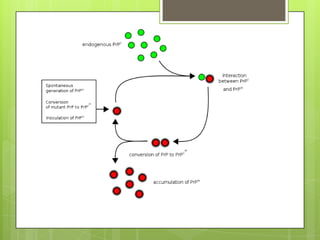
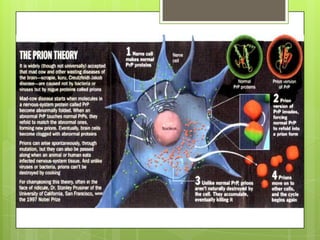
   Prions propagate by transmitting a misfolded protein state.
   When a prion enters a healthy organism, it induces
    existing, properly folded proteins -which is found most
    abundantly in the brain- to convert into the disease-
    associated, prion form.
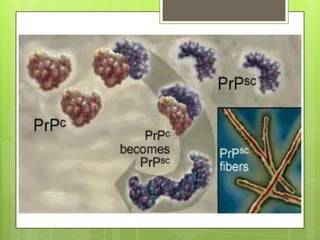
   Alteration in the conformation of the protein where normal
    α-helix structure is converted to β-sheet structure.
    the prion acts as a template to guide the misfolding of
    more protein into prion form.
   These newly formed prions can then go on to convert
    more proteins themselves; this triggers a chain reaction
    that produces large amounts of the prion form.
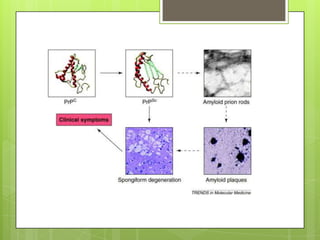
   Aggregations of these abnormal isoforms form highly
    structured amyloid fibers, which accumulate to form
    plaques.
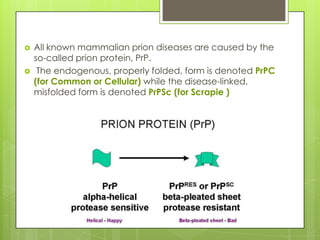
   All known mammalian prion diseases are caused by the
    so-called prion protein, PrP.
    The endogenous, properly folded, form is denoted PrPC
    (for Common or Cellular) while the disease-linked,
    misfolded form is denoted PrPSc (for Scrapie )
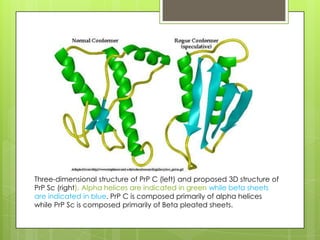
Three-dimensional structure of PrP C (left) and proposed 3D structure of
PrP Sc (right). Alpha helices are indicated in green while beta sheets
are indicated in blue. PrP C is composed primarily of alpha helices
while PrP Sc is composed primarily of Beta pleated sheets.
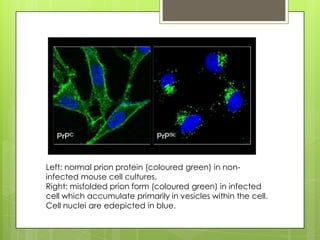
Left: normal prion protein (coloured green) in non-
infected mouse cell cultures.
Right: misfolded prion form (coloured green) in infected
cell which accumulate primarily in vesicles within the cell.
Cell nuclei are edepicted in blue.
 This
     . altered structure is extremely
  stable, insoluble and accumulates in
  infected tissue, causing tissue
  damage and cell death
 This structural stability means that
  prions are resistant to denaturation
  by chemical and physical
  agents, making disposal and
  containment of these particles
  difficult.
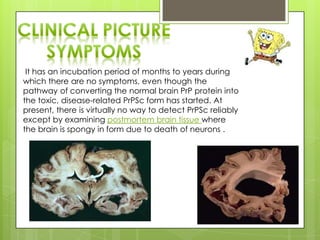
It has an incubation period of months to years during
which there are no symptoms, even though the
pathway of converting the normal brain PrP protein into
the toxic, disease-related PrPSc form has started. At
present, there is virtually no way to detect PrPSc reliably
except by examining postmortem brain tissue where
the brain is spongy in form due to death of neurons .
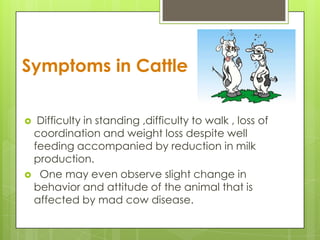
Symptoms in Cattle

 Difficulty in standing ,difficulty to walk , loss of
 coordination and weight loss despite well
 feeding accompanied by reduction in milk
 production.
 One may even observe slight change in
 behavior and attitude of the animal that is
 affected by mad cow disease.
Behavioural Symptoms
   Often mood disturbance e.g. aggression
    or loss of interest and personality changes
    persist into the illness.
   Anxiety and depression are fairly common
    features. There may also be a lack of
    social judgment and disinhibition.
    People may prefer to keep to familiar
    routines, changes in the regular daily
    pattern of events, or new faces may
    cause distress and anxiety.
Communication Problems
   Speech tends to become slurred (dysarthria) and
    quiet and as a result speech may become hard to
    understand, making communication difficult.
    There is often a reduction in the content of
    language, word finding difficulties and there may
    be repetition of words or sentences. Eventually
    the person can become mute.
    As the illness progresses the ability to read and
    write are gradually lost. Problems may occur with
    understanding written material and with spelling
    and signing forms; the person may also have
    difficulty following instructions.
Memory/Cognitive Deficits
   Problems develop with memory and thinking
    and there is often a general decline in
    intellect.
    There may be forgetfulness of day to day
    events, often accompanied by disorientation
    and poor concentration or attention.
    Everyday skills that we take for granted may
    be lost. Typically the person affected will
    forget the day and date. They may also start
    to forget how to carry out everyday skills, for
    example making a cup of tea. In the latter
    stages of the disease the person may become
    increasingly unaware of their immediate
    environment and the people around them.
Movement Problems
   Initially there may be a disturbance in balance
    and gait, leading to unsteadiness
    (ataxia). Walking will therefore be affected and
    so extra care will have to be taken to try to
    prevent falls.
     Involuntary rhythmic muscle contractions leading
    to jerky movements (myoclonus) and difficulties
    coordinating hand movements leading to
    apparent clumsiness. Shakiness (tremor) and
    stiffness (rigidity) are often seen.
     As movements become increasingly
    uncoordinated the individual will need help with
    carrying out their daily activities, for
    example, personal hygiene and use of the toilet.
Swallowing Problems
   With the progression of the disease there may also
    be difficulty in swallowing. There are a number of
    strategies, which may make swallowing easier and
    an assessment by a speech and language therapist
    can identify problems and give advice regarding
    strategies to help.

   As swallowing becomes increasingly difficult in the
    later stages of the disease, it may be suggested
    that nutrition be supplemented with tube
    feeding. This issue will require careful consideration
    and is rarely done in prion disease. Relatives need
    support in making an informed decision. A speech
    and language therapist, Macmillan nurse, dietician
    as well as your own GP may be able to offer
    advice.
Visual/Perceptual Problems
   Visual problems include double vision and
    difficulty moving eyes to follow objects.
    Hallucinations are fairly common. There may be a
    failure to understand and correctly interpret visual
    stimuli. There may be misidentification of
    objects/people, whereby something/someone
    may not be recognized accurately.
   Some patients may suffer from what is known as
    cortical blindness, a condition in which an
    individual appears to be blind (although the eyes
    themselves are normal), due to damage in the
    visual processing and interpretation areas of the
    brain.
Seizures
 Very occasionally a person may suffer
 from seizures in the later stages of the
 disease.
 Medication is available to help control
 seizures should they occur.
Other symptoms
   Personality changes
   Psychiatric problems
   Depression
   Lack of coordination
   Unsteady gait
   Myoclonus
   Unusual sensations
   Insomnia
   Confusion
   Memory problems
   Severe mental impairment
   Inability to move
   Inability to speak
   It has been hard to develop a test for
    prion disease because the body’s immune
    system does not fight off prion infection by
    making antibodies in the same way it does
    against germs like bacteria or viruses.
    It has been challenging to develop a test
    that can distinguish between the normal
    prion protein, which we all have in our
    blood, and the abnormal form linked to
    the disease which is chemically very similar
    At present, the best diagnostic tests for
    CJD use cerebral spinal fluid or actual
    brain tissue as test samples; neither is
    easily obtained Moreover, the current
    spinal fluid-based tests are not fully
    sensitive or specific for CJD
   .Scientists have developed a prototype test. This
    involves taking a small blood sample from a patient as
    with any other blood test.
   A small sample of blood is mixed with special metal
    beads to which the rogue prion proteins stick tightly.
   These are then washed to remove the normal prion
    protein and other blood components that would
    interfere with the test.
   Finally, the amount of rogue prion protein attached to
    the beads is measured using antibodies we have
    developed that bind very tightly to the prion protein.
   At present the test does not work in other forms of prion
    disease such as sporadic CJD but we are hoping this will
    be possible with further work in the future.
   Prions disease is a fungal infection and is
    caused by a protein.
   There are ways to control, prevent and
    infections from spreading.
   No treatment has been confirmed to be
    a definite cure for prions disease.
   Let`s remember that; Prions cause
    neurodegenerative disease by
    aggregating extracellularly within the
    central nervous system to form plaques
    known as amyloid
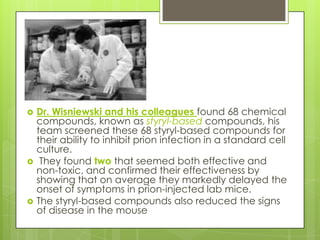
   Dr. Wisniewski and his colleagues found 68 chemical
    compounds, known as styryl-based compounds, his
    team screened these 68 styryl-based compounds for
    their ability to inhibit prion infection in a standard cell
    culture.
    They found two that seemed both effective and
    non-toxic, and confirmed their effectiveness by
    showing that on average they markedly delayed the
    onset of symptoms in prion-injected lab mice.
   The styryl-based compounds also reduced the signs
    of disease in the mouse
   .they found similar results the
    antidepressant trimipramine and the
    anti-scizophrenia drug fluphenazine
    Both are chemically related to the anti-
    protozoal drug quinacrine, which is
    known to slow prion infection in cell
    cultures,
   Although it fails to protect prion-
    infected mice or humans. Their
    chemical differences from quinacrine
    apparently enable the two drugs to
    bind more tightly to toxic prion
    aggregates, and-like the styryl-based
    compounds-prevent these aggregates
    from assembling new copies of
    themselves.
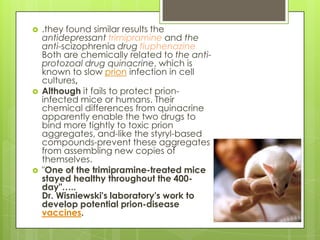
   "One of the trimipramine-treated mice
    stayed healthy throughout the 400-
    day"…..
    Dr. Wisniewski's laboratory's work to
    develop potential prion-disease
    vaccines.
References
 http://www.drday.com/madcow.htm
 http://library.thinkquest.org/05aug/00112/
  mad_cow_frameset.htm
 http://www.cdc.gov/ncidod/dvrd/prions/
 http://en.wikipedia.org/wiki/Prion
 http://www.helmholtz.de/index.php?id=2
  224&L=1&type=0
Made by :
                Yomna gharieb

      Yossra ahmed

                Yomna elfeky
Prion disease

Prion disease

  • 1.
  • 2.
    The word prionis derived from the word infection and protein . Prion diseases or transmissible spongiform encephalopathies (TSEs) are a family of rare progressive neurodegenerative disorders ( loss of structure or function of neurons, including death of neurons. ) that affect both humans and animals. known as "mad cow disease" in cattle and “Creutzfeldt -Jakob disease” (CJD) in humans.
  • 3.
    in the year 1986 farmers recognized that something was happening to their cattle.  In farming, it is convenient and healthy for cattle to be fed soybean meal as a part of their diet.  In England, soybeans don’t grow well, so British farmers fed their cattle an animal byproduct which contained the mixed meat and bones of cattle and sheep.  This practice caused the infected brains, nervous systems, and blood of infected cattle to be fed to other cows, thus filling them with an accumulation of infected meat. Obviously, more and more cows became infected and more and more cattle began to die.
  • 4.
     also the massive use of hormones, pesticides and other harmful substances which destroy the animal's immune system. When these diseased animals are eaten by people, then the people get sick and die.
  • 5.
    Prions propagate by transmitting a misfolded protein state.  When a prion enters a healthy organism, it induces existing, properly folded proteins -which is found most abundantly in the brain- to convert into the disease- associated, prion form.  Alteration in the conformation of the protein where normal α-helix structure is converted to β-sheet structure.  the prion acts as a template to guide the misfolding of more protein into prion form.  These newly formed prions can then go on to convert more proteins themselves; this triggers a chain reaction that produces large amounts of the prion form.  Aggregations of these abnormal isoforms form highly structured amyloid fibers, which accumulate to form plaques.
  • 6.
    All known mammalian prion diseases are caused by the so-called prion protein, PrP.  The endogenous, properly folded, form is denoted PrPC (for Common or Cellular) while the disease-linked, misfolded form is denoted PrPSc (for Scrapie )
  • 7.
    Three-dimensional structure ofPrP C (left) and proposed 3D structure of PrP Sc (right). Alpha helices are indicated in green while beta sheets are indicated in blue. PrP C is composed primarily of alpha helices while PrP Sc is composed primarily of Beta pleated sheets.
  • 8.
    Left: normal prionprotein (coloured green) in non- infected mouse cell cultures. Right: misfolded prion form (coloured green) in infected cell which accumulate primarily in vesicles within the cell. Cell nuclei are edepicted in blue.
  • 9.
     This . altered structure is extremely stable, insoluble and accumulates in infected tissue, causing tissue damage and cell death  This structural stability means that prions are resistant to denaturation by chemical and physical agents, making disposal and containment of these particles difficult.
  • 15.
    It has anincubation period of months to years during which there are no symptoms, even though the pathway of converting the normal brain PrP protein into the toxic, disease-related PrPSc form has started. At present, there is virtually no way to detect PrPSc reliably except by examining postmortem brain tissue where the brain is spongy in form due to death of neurons .
  • 16.
    Symptoms in Cattle Difficulty in standing ,difficulty to walk , loss of coordination and weight loss despite well feeding accompanied by reduction in milk production.  One may even observe slight change in behavior and attitude of the animal that is affected by mad cow disease.
  • 17.
    Behavioural Symptoms  Often mood disturbance e.g. aggression or loss of interest and personality changes persist into the illness.  Anxiety and depression are fairly common features. There may also be a lack of social judgment and disinhibition.  People may prefer to keep to familiar routines, changes in the regular daily pattern of events, or new faces may cause distress and anxiety.
  • 18.
    Communication Problems  Speech tends to become slurred (dysarthria) and quiet and as a result speech may become hard to understand, making communication difficult.  There is often a reduction in the content of language, word finding difficulties and there may be repetition of words or sentences. Eventually the person can become mute.  As the illness progresses the ability to read and write are gradually lost. Problems may occur with understanding written material and with spelling and signing forms; the person may also have difficulty following instructions.
  • 19.
    Memory/Cognitive Deficits  Problems develop with memory and thinking and there is often a general decline in intellect.  There may be forgetfulness of day to day events, often accompanied by disorientation and poor concentration or attention.  Everyday skills that we take for granted may be lost. Typically the person affected will forget the day and date. They may also start to forget how to carry out everyday skills, for example making a cup of tea. In the latter stages of the disease the person may become increasingly unaware of their immediate environment and the people around them.
  • 20.
    Movement Problems  Initially there may be a disturbance in balance and gait, leading to unsteadiness (ataxia). Walking will therefore be affected and so extra care will have to be taken to try to prevent falls.  Involuntary rhythmic muscle contractions leading to jerky movements (myoclonus) and difficulties coordinating hand movements leading to apparent clumsiness. Shakiness (tremor) and stiffness (rigidity) are often seen.  As movements become increasingly uncoordinated the individual will need help with carrying out their daily activities, for example, personal hygiene and use of the toilet.
  • 21.
    Swallowing Problems  With the progression of the disease there may also be difficulty in swallowing. There are a number of strategies, which may make swallowing easier and an assessment by a speech and language therapist can identify problems and give advice regarding strategies to help.  As swallowing becomes increasingly difficult in the later stages of the disease, it may be suggested that nutrition be supplemented with tube feeding. This issue will require careful consideration and is rarely done in prion disease. Relatives need support in making an informed decision. A speech and language therapist, Macmillan nurse, dietician as well as your own GP may be able to offer advice.
  • 22.
    Visual/Perceptual Problems  Visual problems include double vision and difficulty moving eyes to follow objects. Hallucinations are fairly common. There may be a failure to understand and correctly interpret visual stimuli. There may be misidentification of objects/people, whereby something/someone may not be recognized accurately.  Some patients may suffer from what is known as cortical blindness, a condition in which an individual appears to be blind (although the eyes themselves are normal), due to damage in the visual processing and interpretation areas of the brain.
  • 23.
    Seizures  Very occasionallya person may suffer from seizures in the later stages of the disease.  Medication is available to help control seizures should they occur.
  • 24.
    Other symptoms  Personality changes  Psychiatric problems  Depression  Lack of coordination  Unsteady gait  Myoclonus  Unusual sensations  Insomnia  Confusion  Memory problems  Severe mental impairment  Inability to move  Inability to speak
  • 25.
    It has been hard to develop a test for prion disease because the body’s immune system does not fight off prion infection by making antibodies in the same way it does against germs like bacteria or viruses.  It has been challenging to develop a test that can distinguish between the normal prion protein, which we all have in our blood, and the abnormal form linked to the disease which is chemically very similar
  • 26.
    At present, the best diagnostic tests for CJD use cerebral spinal fluid or actual brain tissue as test samples; neither is easily obtained Moreover, the current spinal fluid-based tests are not fully sensitive or specific for CJD
  • 27.
    .Scientists have developed a prototype test. This involves taking a small blood sample from a patient as with any other blood test.  A small sample of blood is mixed with special metal beads to which the rogue prion proteins stick tightly.  These are then washed to remove the normal prion protein and other blood components that would interfere with the test.  Finally, the amount of rogue prion protein attached to the beads is measured using antibodies we have developed that bind very tightly to the prion protein.  At present the test does not work in other forms of prion disease such as sporadic CJD but we are hoping this will be possible with further work in the future.
  • 28.
    Prions disease is a fungal infection and is caused by a protein.  There are ways to control, prevent and infections from spreading.  No treatment has been confirmed to be a definite cure for prions disease.  Let`s remember that; Prions cause neurodegenerative disease by aggregating extracellularly within the central nervous system to form plaques known as amyloid
  • 29.
    Dr. Wisniewski and his colleagues found 68 chemical compounds, known as styryl-based compounds, his team screened these 68 styryl-based compounds for their ability to inhibit prion infection in a standard cell culture.  They found two that seemed both effective and non-toxic, and confirmed their effectiveness by showing that on average they markedly delayed the onset of symptoms in prion-injected lab mice.  The styryl-based compounds also reduced the signs of disease in the mouse
  • 30.
    .they found similar results the antidepressant trimipramine and the anti-scizophrenia drug fluphenazine Both are chemically related to the anti- protozoal drug quinacrine, which is known to slow prion infection in cell cultures,  Although it fails to protect prion- infected mice or humans. Their chemical differences from quinacrine apparently enable the two drugs to bind more tightly to toxic prion aggregates, and-like the styryl-based compounds-prevent these aggregates from assembling new copies of themselves.  "One of the trimipramine-treated mice stayed healthy throughout the 400- day"….. Dr. Wisniewski's laboratory's work to develop potential prion-disease vaccines.
  • 31.
    References  http://www.drday.com/madcow.htm  http://library.thinkquest.org/05aug/00112/ mad_cow_frameset.htm  http://www.cdc.gov/ncidod/dvrd/prions/  http://en.wikipedia.org/wiki/Prion  http://www.helmholtz.de/index.php?id=2 224&L=1&type=0
  • 32.
    Made by : Yomna gharieb Yossra ahmed Yomna elfeky