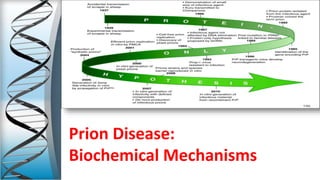
Prion Disease:
Biochemical Mechanisms
Beyond Viruses…Beyond Viroids…
 Can create an “infection” that can lead to the death of
the “infected organism”?
 Appears to be able to replicate itself…
 Is not a bacteria!
 Is smaller than a virus?
 Is not a virus!
 Contains no genetic information
 Whose structure is made by all living things…
 The early history of the prion model is the history of the
biochemical and biophysical properties of the scrapie
infectious agent.
 In search of a virus, no viral features were found.
 However, highly enigmatic properties of the infectious agent
were demonstrated.
 Absence of particles in the electron microscope
 No immune response during the infection
 High resistance of the agent against chemical and physical
treatment.
 Alper et al Radiation experiments concluded that the target
size of the scrapie infectious agent (50–150 kDa) is too small for
a virus but more characteristic of a protein.
 Prusiner took up the inactivation studies and performed
systematic analysis using not only chemical and physical, but
also enzymatic procedures.
 He summarized the results under two groups:
(i) procedures which modify or destroy nucleic acids do not
inactivate scrapie infectivity.
(ii) procedures which modify or destroy proteins inactivate the
infectivity.
PRIONS: The Brain Eater…
 A PRION is a PROteinaceous INfectious particle.
The Prion Hypothesis
 Transmissible Spongiform Encephalopathy(TSEs)/Prion
Disease occur when the normal ‘cellular’ form of the prion
protein (PrPc) is converted to the abnormal form (PrPsc). PrPc
and PrPsc differ in conformation. The conversion is
‘autocatalytic’ - PrPsc facilitates the conversion of more PrPc
to PrPsc.
PRIONS: Are PRIONs a new form of life?
1. Are PRIONs made of cell?
NO
2. Are PRIONs organized?
YES
3. Do PRIONs use energy?
NO
4. Are PRIONs responsive?
NO (hypothesized)
5. Do PRIONs grow? (enlarge and divide)
NO
6. Do PRIONs reproduce?
YES (hypothesized)
~ They recruit normal proteins by changing their shape
7. Do PRIONs adapt?
Don’t know yet,
They may mutate in other viable forms.
PRIONS: Are PRIONs a new form of life?
8. Do PRIONs die?
NO,
Inhibits the Ubiquitin-Protease System, cannot
be degraded.
9. Do PRIONs come from pre-existing prions?
YES (hypothesized)
~ existing PRIONs convert normal Prion-like protein
structures into abnormal viable PRION geometries.
PRIONS: Are PRIONs a new form of life?
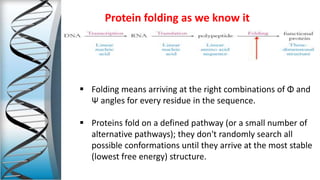
 Folding means arriving at the right combinations of Φ and
Ψ angles for every residue in the sequence.
 Proteins fold on a defined pathway (or a small number of
alternative pathways); they don't randomly search all
possible conformations until they arrive at the most stable
(lowest free energy) structure.
Protein folding as we know it
 Proteins that don't (re)fold on
their own, need "molecular
chaperones" (which are also
proteins) to keep them from
slipping off the folding pathway
or to help them to get back on it.
 Some Chaperones require
"expenditure" of energy
currency (hydrolysis of ATP) to
carry out their function.
Prion protein folding
PrPc
PrPsc
kfolding-c
kfolding-sc
kunfolding-sckunfolding-c
Intermediates?
Prions: Origin and Structure
 Mature PrPC is a 210 amino acid protein; mol wt. 35-
36 kDa.
 Largely localizes to detergent-resistant subdomains
known as “Lipid Rafts” on the outer surface of the
plasma membrane via a C-Terminal
Glycophophatidylinositol (GPI) anchor.
 After ~5 h at the cell surface (its average half-life) it is
internalized through a caveolae-dependent
mechanism and is degraded in the endolysosome
compartment.
Post-translational processing of PrP
S S
AC B
 Despite many intriguing leads, the normal cellular function of PrPC has
remained shrouded in MYSTERY.
Proposed Physiological roles of PrPC :
I. Copper Internalization and Homeostasis to Anti-Apoptotic activities.
II. Protection against Oxidative stress.
III. Cell Adhesion
IV. Cell- Signaling
V. Modulation of Synaptic Structure and Function
WHY DOES PrPSc CAUSE DISEASE?
Possible explanations include:
• Neurotoxic
• Deposits disrupt cells
• Deposits disrupt intercellular contacts (synapses etc)
• Loss of PrPC
Normal (PrPc) and abnormal (PrPs) forms of prion
protein
PrPc
•Precursor ~ 250 amino acids. Mature PrPc ~ 210 aas
•Hydrophobic glycoprotein
•GPI anchor (glucosyl phosphatidyl inositol)
•NMR structure - C-terminal end a-helical, N-terminal end unordered
PrPsc
•Same sequence and postranslational modifications as PrPc
•Different conformation - more b-sheet.
•Tends to form insoluble aggregates.
•More resistant to proteolysis than PrPc .
 This idea goes against the longstanding belief that the amino acid
sequence specifies one biologically active conformation of a protein.
One protein: Two structures
• http://www.uccs.edu/~rmelamed/MicroFall2002/Chapter%2010/Prion%20Structure.html
PrPc
“NORMAL”
conformation
PrPsc
“BAD”
conformation
Not all pretty pictures can be trusted!
Based
on NMR
results
Proposed
based on
low-
resolution
structural
studies
Differences between cellular and scrapie proteins
PrPC PrPSC
Solubility
Soluble Non soluble
Structure
Alpha-helical Beta-sheeted
Multimerisation state
Monomeric Multimeric
Infectivity
Non infectious Infectious
Susceptibility to Proteinase K
Susceptible Resistant
 One of the surprising things about prion protein is that this
single protein can fold up in so many different ways that are
toxic and cause disease. The diagram below illustrates how
just one protein – PrP (green) – can fold up in several different
ways, creating several different strains of prion (red).
There are actually a dizzying number of different forms of human
prion disease. Kuru and vCJD, two strains that people have acquired
by infection, are probably the most famous but also the most rare.
There are also at least 6 strains of sporadic prion disease [Parchi
2011] and over 40 genetic mutations that cause prion disease [Beck
2010].
By what means does this
transformation from a seemingly
innocuous cellular protein into a
Monstrous pathogenic isoform occur?
 Hypothesis: Self Propagation of
Infectious PrPSC via
recruitment of normal
cellular PrPC.
 PrPC and PrPSC appear to share the same
covalent structure, but they differ in
biochemical and biophysical properties.
 Prion Diseases, oftentimes associated with the deposition of Amyloid-Like
Fibrils similar to those observed in other neurodegenerative diorders such
as Alzeihmer’s , Huntington’s and Parkinson’s Disease.
 All Amyloids display resistance to proteolytic digestion, Insolubility, and
Affinity for Aromatic Dyes such as Thioflavin T and Congo Red.
 Furthermore, X-Ray Diffraction shows Common “Cross- β” Core, where β
strands lay Perpendicular and Hydrogen Bonds parallel to the Long Fibril
Axis.
Pathogenesis
O – Origin of PRIONs
Contaminated meat
Digestive Tract
Blood Stream
L – White Blood Cell
S – Spleen
N – Spleen to Brain
B – Brain
Inherited forms of CJD, GSS, FFI
 Mutations may stabilise PrPsc conformation.
e.g. P102L in GSS
[when this was engineered into mice they developed
'scrapie').
 Met/Val129 polymorphism in man - Val homozygotes more
susceptible to CJD? Met homozygotes more susceptible to
vCJD??
Species Barriers to Transfer of PrPsc
 Sequence differences between PrP from different species may provide
some barrier to infection - but incomplete.
 E.g. Mouse  mouse transfer gives more rapid infection than mouse 
hamster etc. But, mouse  hamster  hamster gives faster infection.
 PrPSC of one species can convert PrPC of same species more efficiently
than PrPC of another Species.
Strains of Prion Diseases
 Scrapie occurs as about 20 different strains
(differentiated by time taken to infect mice and different
behavioural effects). CJD occurs as 2-4 different strains.
BSE only one.
 For 2 CJD strains - evidence for different conformations
(pattern of proteolysis).
 Depending of Phenotype and Incubation period depicts
various strains of Prion Disease.
Mechanism of PrP
sc
induced apoptosis
 It was proposed that prion-associated toxicity involves altered
trafficking of PrP
c
.
 Inhibition of ubiquitin-proteasome system(UPS).
 Deposition of aggresomes of PrP
Sc
in nerve cells.
 Induction of Apoptosis with activation of Caspase 3 and
Caspase 8.
 Complete molecular basis for neuronal death is not known.
 Aggregates of over expressed PrP
c
does not cause cell death.
Tabrizi et al., 2005
Role of Caspases
“...Prions violate most of biology's sacred rules.
They are one of those annoying reminders of
how much we don't know.”
― Jonah Lehrer, Proust Was a Neuroscientist
BRAIN TEASER
What makes prion a prion?
• Why don’t other proteins adopt two drastically different
stably folded conformations?
• A helix is a helix…but why are helices in prion protein likely
to undergo a big structural change?
• Yeast prions do not cause a disease. Are there other non-
harmful prion-like proteins? Can prions be beneficial?
References:
I. The Metabolic and Molecular Bases of Inherited Disease ; Volume III,
Charles R. Scriver, Arthur L. Beaudet, William S. Sly, David Valle
II. Harrisson’s Principle of Internal Medicine; 18th Edition.
III. Review: Molecular basis of prion diseases. Detlev Riesner; Institut f ¨
ur Physikalische Biologie, Heinrich-Heine-Universit ¨at D¨usseldorf,
D ¨usseldorf, Germany.Journal of NeuroVirology(2002)8(suppl.
2),8–20.
IV. Prion Diseases and Their Biochemical Mechanisms.Nathan J. Cobband
Witold K. Surewicz*Departments of Physiology and Biophysics and
Chemistry, Case Western Reserve University,Cleveland, Ohio
44106. Biochemistry. 2009 March 31; 48(12): 2574–2585.
doi:10.1021/bi900108v.NIH
References:
V. Biochemistry and structure of PrPCand PrPSc.Detlev
Riesner;Institut für Physikalische Biologie, Heinrich-Heine-
Universität Düsseldorf, Düsseldorf, Germany
VI. Prions: Protein Aggregation and Infectious Diseases. ADRIANO
AGUZZI AND ANNA MARIA CALELLA. Institute of Neuropathology,
University Hospital of Zurich, Zurich, SwitzerlandPhysiol Rev89: 1105-
1152, 2009;doi:10.1152/physrev1152,2009.
VII. PRIONDISEASES OFHUMANS ANDANIMALS:Their Causes and
Molecular Basis.John Collinge;MRC Prion Unit and Department of
Neurogenetics, Imperial College School of Medicine at St. Mary’s,
London, United Kingdom; e-mail: J.Collinge@ic.ac.uk. Annu. Rev.
Neurosci. 2001. 24:519–50.

Prions disease

  • 1.
  • 2.
    Beyond Viruses…Beyond Viroids… Can create an “infection” that can lead to the death of the “infected organism”?  Appears to be able to replicate itself…  Is not a bacteria!  Is smaller than a virus?  Is not a virus!  Contains no genetic information  Whose structure is made by all living things…
  • 3.
     The earlyhistory of the prion model is the history of the biochemical and biophysical properties of the scrapie infectious agent.  In search of a virus, no viral features were found.  However, highly enigmatic properties of the infectious agent were demonstrated.  Absence of particles in the electron microscope  No immune response during the infection  High resistance of the agent against chemical and physical treatment.
  • 4.
     Alper etal Radiation experiments concluded that the target size of the scrapie infectious agent (50–150 kDa) is too small for a virus but more characteristic of a protein.  Prusiner took up the inactivation studies and performed systematic analysis using not only chemical and physical, but also enzymatic procedures.  He summarized the results under two groups: (i) procedures which modify or destroy nucleic acids do not inactivate scrapie infectivity. (ii) procedures which modify or destroy proteins inactivate the infectivity.
  • 5.
    PRIONS: The BrainEater…  A PRION is a PROteinaceous INfectious particle. The Prion Hypothesis  Transmissible Spongiform Encephalopathy(TSEs)/Prion Disease occur when the normal ‘cellular’ form of the prion protein (PrPc) is converted to the abnormal form (PrPsc). PrPc and PrPsc differ in conformation. The conversion is ‘autocatalytic’ - PrPsc facilitates the conversion of more PrPc to PrPsc.
  • 6.
    PRIONS: Are PRIONsa new form of life? 1. Are PRIONs made of cell? NO 2. Are PRIONs organized? YES 3. Do PRIONs use energy? NO 4. Are PRIONs responsive? NO (hypothesized)
  • 7.
    5. Do PRIONsgrow? (enlarge and divide) NO 6. Do PRIONs reproduce? YES (hypothesized) ~ They recruit normal proteins by changing their shape 7. Do PRIONs adapt? Don’t know yet, They may mutate in other viable forms. PRIONS: Are PRIONs a new form of life?
  • 8.
    8. Do PRIONsdie? NO, Inhibits the Ubiquitin-Protease System, cannot be degraded. 9. Do PRIONs come from pre-existing prions? YES (hypothesized) ~ existing PRIONs convert normal Prion-like protein structures into abnormal viable PRION geometries. PRIONS: Are PRIONs a new form of life?
  • 9.
     Folding meansarriving at the right combinations of Φ and Ψ angles for every residue in the sequence.  Proteins fold on a defined pathway (or a small number of alternative pathways); they don't randomly search all possible conformations until they arrive at the most stable (lowest free energy) structure. Protein folding as we know it
  • 10.
     Proteins thatdon't (re)fold on their own, need "molecular chaperones" (which are also proteins) to keep them from slipping off the folding pathway or to help them to get back on it.  Some Chaperones require "expenditure" of energy currency (hydrolysis of ATP) to carry out their function.
  • 12.
  • 13.
    Prions: Origin andStructure  Mature PrPC is a 210 amino acid protein; mol wt. 35- 36 kDa.  Largely localizes to detergent-resistant subdomains known as “Lipid Rafts” on the outer surface of the plasma membrane via a C-Terminal Glycophophatidylinositol (GPI) anchor.  After ~5 h at the cell surface (its average half-life) it is internalized through a caveolae-dependent mechanism and is degraded in the endolysosome compartment.
  • 15.
  • 16.
     Despite manyintriguing leads, the normal cellular function of PrPC has remained shrouded in MYSTERY. Proposed Physiological roles of PrPC : I. Copper Internalization and Homeostasis to Anti-Apoptotic activities. II. Protection against Oxidative stress. III. Cell Adhesion IV. Cell- Signaling V. Modulation of Synaptic Structure and Function
  • 17.
    WHY DOES PrPScCAUSE DISEASE? Possible explanations include: • Neurotoxic • Deposits disrupt cells • Deposits disrupt intercellular contacts (synapses etc) • Loss of PrPC
  • 18.
    Normal (PrPc) andabnormal (PrPs) forms of prion protein PrPc •Precursor ~ 250 amino acids. Mature PrPc ~ 210 aas •Hydrophobic glycoprotein •GPI anchor (glucosyl phosphatidyl inositol) •NMR structure - C-terminal end a-helical, N-terminal end unordered PrPsc •Same sequence and postranslational modifications as PrPc •Different conformation - more b-sheet. •Tends to form insoluble aggregates. •More resistant to proteolysis than PrPc .  This idea goes against the longstanding belief that the amino acid sequence specifies one biologically active conformation of a protein.
  • 19.
    One protein: Twostructures • http://www.uccs.edu/~rmelamed/MicroFall2002/Chapter%2010/Prion%20Structure.html PrPc “NORMAL” conformation PrPsc “BAD” conformation
  • 20.
    Not all prettypictures can be trusted! Based on NMR results Proposed based on low- resolution structural studies
  • 21.
    Differences between cellularand scrapie proteins PrPC PrPSC Solubility Soluble Non soluble Structure Alpha-helical Beta-sheeted Multimerisation state Monomeric Multimeric Infectivity Non infectious Infectious Susceptibility to Proteinase K Susceptible Resistant
  • 26.
     One ofthe surprising things about prion protein is that this single protein can fold up in so many different ways that are toxic and cause disease. The diagram below illustrates how just one protein – PrP (green) – can fold up in several different ways, creating several different strains of prion (red). There are actually a dizzying number of different forms of human prion disease. Kuru and vCJD, two strains that people have acquired by infection, are probably the most famous but also the most rare. There are also at least 6 strains of sporadic prion disease [Parchi 2011] and over 40 genetic mutations that cause prion disease [Beck 2010].
  • 27.
    By what meansdoes this transformation from a seemingly innocuous cellular protein into a Monstrous pathogenic isoform occur?  Hypothesis: Self Propagation of Infectious PrPSC via recruitment of normal cellular PrPC.  PrPC and PrPSC appear to share the same covalent structure, but they differ in biochemical and biophysical properties.
  • 33.
     Prion Diseases,oftentimes associated with the deposition of Amyloid-Like Fibrils similar to those observed in other neurodegenerative diorders such as Alzeihmer’s , Huntington’s and Parkinson’s Disease.  All Amyloids display resistance to proteolytic digestion, Insolubility, and Affinity for Aromatic Dyes such as Thioflavin T and Congo Red.  Furthermore, X-Ray Diffraction shows Common “Cross- β” Core, where β strands lay Perpendicular and Hydrogen Bonds parallel to the Long Fibril Axis.
  • 34.
  • 35.
    O – Originof PRIONs Contaminated meat Digestive Tract Blood Stream L – White Blood Cell S – Spleen N – Spleen to Brain B – Brain
  • 36.
    Inherited forms ofCJD, GSS, FFI  Mutations may stabilise PrPsc conformation. e.g. P102L in GSS [when this was engineered into mice they developed 'scrapie').  Met/Val129 polymorphism in man - Val homozygotes more susceptible to CJD? Met homozygotes more susceptible to vCJD??
  • 37.
    Species Barriers toTransfer of PrPsc  Sequence differences between PrP from different species may provide some barrier to infection - but incomplete.  E.g. Mouse  mouse transfer gives more rapid infection than mouse  hamster etc. But, mouse  hamster  hamster gives faster infection.  PrPSC of one species can convert PrPC of same species more efficiently than PrPC of another Species.
  • 38.
    Strains of PrionDiseases  Scrapie occurs as about 20 different strains (differentiated by time taken to infect mice and different behavioural effects). CJD occurs as 2-4 different strains. BSE only one.  For 2 CJD strains - evidence for different conformations (pattern of proteolysis).  Depending of Phenotype and Incubation period depicts various strains of Prion Disease.
  • 39.
  • 40.
     It wasproposed that prion-associated toxicity involves altered trafficking of PrP c .  Inhibition of ubiquitin-proteasome system(UPS).  Deposition of aggresomes of PrP Sc in nerve cells.  Induction of Apoptosis with activation of Caspase 3 and Caspase 8.  Complete molecular basis for neuronal death is not known.  Aggregates of over expressed PrP c does not cause cell death. Tabrizi et al., 2005 Role of Caspases
  • 41.
    “...Prions violate mostof biology's sacred rules. They are one of those annoying reminders of how much we don't know.” ― Jonah Lehrer, Proust Was a Neuroscientist
  • 42.
    BRAIN TEASER What makesprion a prion? • Why don’t other proteins adopt two drastically different stably folded conformations? • A helix is a helix…but why are helices in prion protein likely to undergo a big structural change? • Yeast prions do not cause a disease. Are there other non- harmful prion-like proteins? Can prions be beneficial?
  • 43.
    References: I. The Metabolicand Molecular Bases of Inherited Disease ; Volume III, Charles R. Scriver, Arthur L. Beaudet, William S. Sly, David Valle II. Harrisson’s Principle of Internal Medicine; 18th Edition. III. Review: Molecular basis of prion diseases. Detlev Riesner; Institut f ¨ ur Physikalische Biologie, Heinrich-Heine-Universit ¨at D¨usseldorf, D ¨usseldorf, Germany.Journal of NeuroVirology(2002)8(suppl. 2),8–20. IV. Prion Diseases and Their Biochemical Mechanisms.Nathan J. Cobband Witold K. Surewicz*Departments of Physiology and Biophysics and Chemistry, Case Western Reserve University,Cleveland, Ohio 44106. Biochemistry. 2009 March 31; 48(12): 2574–2585. doi:10.1021/bi900108v.NIH
  • 44.
    References: V. Biochemistry andstructure of PrPCand PrPSc.Detlev Riesner;Institut für Physikalische Biologie, Heinrich-Heine- Universität Düsseldorf, Düsseldorf, Germany VI. Prions: Protein Aggregation and Infectious Diseases. ADRIANO AGUZZI AND ANNA MARIA CALELLA. Institute of Neuropathology, University Hospital of Zurich, Zurich, SwitzerlandPhysiol Rev89: 1105- 1152, 2009;doi:10.1152/physrev1152,2009. VII. PRIONDISEASES OFHUMANS ANDANIMALS:Their Causes and Molecular Basis.John Collinge;MRC Prion Unit and Department of Neurogenetics, Imperial College School of Medicine at St. Mary’s, London, United Kingdom; e-mail: J.Collinge@ic.ac.uk. Annu. Rev. Neurosci. 2001. 24:519–50.

Editor's Notes

  • #5 In 1966 from inactivation studies using ionising and UV-irradiation, Alper et al
  • #6 He came to the conclusion that the scrapie infectious agent could not be a virus but a novel proteinaceous type of an agent, which he termed ‘Prion’ (Proteinaceous Infectious particle). The major component of the prion was shown to be a host-encoded protein, later called Prion protein.
  • #11 Proteins that don't (re)fold on their own, without assistance, don't need other "instructions" they just need "molecular chaperones" (which are also proteins) to keep them from slipping off the folding pathway or to help them to get back on it.
  • #15 PrP Globular domain is highly conserved over many different species.Consisting of Two Short β Strands and Three α Helices with a disulfide bond bridging helices 2 and 3.
  • #29 Prusiner and his group proposed the “heterodimer model.” A complex of PrPC and PrPSc Is formed, in which PrPC is transformed into PrPSc, similar to the enzymatic mechanism of an induced fit.More recently, the model was specified in that a protein X has to be involved in the complex (Tellinget al,1995). Regarding the equilibrium PrPC↔PrPSc,PrPSc would be the favored state, otherwise there would be no driving force for the catalytic turnover.
  • #30 Lansbury and his colleagues (Comeet al, 1993), in which formation of fibrils—as known for actin orβ-amyloid and called “linear crystals”—and generation of infectivity are closely connected. The model is depicted in Figure 10. Monomeric PrPC is in fast equilibrium with a PrPSc-like conformation, with PrPC being the favorable state. A number of PrPSc-like molecules can form aggregates with decreasing concentrations,down to a nucleus ofnPrP Sc-like molecules. If the nucleus has formed, growth of the aggregates is faster than dissociation, and increasingly larger aggregates will be formed. In that mechanism—and in contrast with the heterodimer model—the first stable aggregate corresponding to a functional PrPSc will be the nucleus of nPrPSc-like molecules. Both models assume conformation transition of PrP occurs freely in solution.
  • #31 The so-called two-phase model (Figure 11; Riesner,2001) takes into account that PrPC is normally dispersed due to its glycolipid anchor on the outer cellular suface and thereby is prevented from aggregation. If it is released in sufficient amounts from the surface, then the conformational transitions as depicted in Figure 8 can occur in the water phase. Spontaneous occurrence of PrPSc -like states in the water phase is possible but improbable because of the low concentration of PrP. If, however, a prion particle as exogenic seed is present, the newly transformed.PrP can be bound quickly and stabilized in the β-sheet form, thus leading to an amplification of PrP in the PrPSc state.
  • #32 Prions are pathogenic variants of proteins that are naturally produced in nerve cells and certain other cells. The normal "healthy" prions are referred to as PrPc (Prion Protein cellular). The word "prion" stands for "proteinaceous infectious particle" and so should properly only be applied to the pathogenic variants. In this picture, the production of PrPc is illustrated from the nucleus at bottom right. RNA that codes for PrPc is produced in the nucleus and exits via the nuclear pore. The RNA then passes along ribosomes attached to the rER. PrPc is formed in the rER and then progresses up through the Golgi. At the upper face of the Golgi, vesicles containing PrPc bud off and travel to the cell surface. Here, they fuse with the cell membrane and so discharge their cargo at "PrPc". By this means, the cellular proteins come to sit on the exterior of the cell. At "f", PrPc encounter rogue (purple) prions. These are termed PrPsc (sc stands for scrapie, the prion disease of sheep). The rogue prions seem to force the normal proteins to change shape. Both types of protein, the PrPc and their corresponding prions, are the same chemical - just different shapes. It is this shape-flipping which is equivalent to the transmission of infection. Such a conformational shift or flip could happen at the cell surface or in caveolae (one is shown as a small invagination in the cell membrane). Residual PrPc might continue to be flipped by contact with the rogue confomations for some time in these vesicles. Prions polymerise, finally appearing as purple fibrils in the picture at "P". PrPsc is resistant to degradation by the enzymes contained in the lysosomes that are seen floating nearby. Consequently, PrPsc accumulates in the cell. PrPsc vesicles may also travel to the Golgi and intercept PrPc that is being processed there. In this way, PrPc particles could be switched to the rogue form before they reach the surface of the cell. By such mechanisms, PrPc might be switched to PrPsc at various points in and on the cell. Prions could enter the brain along the axons of neurons, shown here at "ax". This probably happens by a retrograde flow of prion filled vesicles. These are shown in the picture as purple spheres ascending the axon like elevators going up a shaft . Another route of entry could be the blood, probably in immune cells. A lymphocyte "im" is shown exiting the capillary at bottom left where it could then contact the astrocyte "ast". Astrocytes and other glial cells also support the production of prions. It must be emphasised that prion biology is not fully understood and much remains speculative. This picture is an attempt to illustrate various concepts but nothing is intended to be definitive. The picture was painted digitally and so it can be easily modified as and when mechanisms are elucidated.