
Department of Microbiology
Midnapore College (Autonomous)
Seminar 2017-2018
Made By : Sourav Pan
Contant
 Introduction
 Structure
 Difference from Simple Protein
 Diseases
 Symptoms
 Replicati0n
 Transmission
 Difference from bacteria and virus
 Diagnosisi
 Treatment
 Preventation
Introduction
Pronounced“pree-on“.Prions are the infectious proteinous
particle without nucleic acid which cause disease in humans
and animals,
Prions composed of the prion protein (PrP) are
believed to be the cause of transmissible spongiform
encephalopathies (TSEs) among other diseases.
In 1960 two researches found two type of diseases
which were Scrapie and Mad Cow Diseases ,after research
they found an interesting information about these diseases
that these diseases are not caused by any Bacteria or Virus,
Hence this diseases are caused by a Misfold Protein which is
called prion.
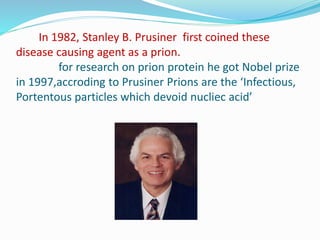
In 1982, Stanley B. Prusiner first coined these
disease causing agent as a prion.
for research on prion protein he got Nobel prize
in 1997,accroding to Prusiner Prions are the ‘Infectious,
Portentous particles which devoid nucliec acid’
Structure
 Prions are consist of PrPSC Proteins(Here “PrP” means
‘Prion Protein’ and “sc” means “scrapie”)it is a abnormal
protein.
 Prions are don’t contain any Nucleic Acid(RNA & DNA).
 They are not effected by the UV ray, heat, enzyme.
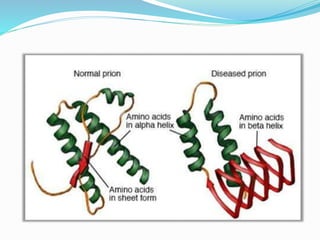
 Normal prions are contain about 200-250 amino acids
twisted into three telephone chord-likes coils known as
helices, with tail of more amino acids.
 They are 100 times smaller then viruses.
 Prion proteins are misfold protein
Difference from Simple Protein
Simple Protein Prion Protein
 There amino acids are show
alpha helix structure.
 This Proteins are structurally
well-defined
 There amino acids show beta
helix structure.
 They are structurally
abnormal or misfolded
protein.
Diseases
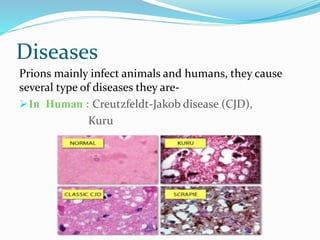
Prions mainly infect animals and humans, they cause
several type of diseases they are-
In Human : Creutzfeldt-Jakob disease (CJD),
Kuru
Diseases
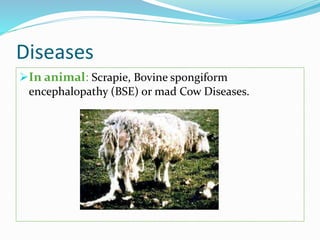
In animal: Scrapie, Bovine spongiform
encephalopathy (BSE) or mad Cow Diseases.
Symptoms
 Rapidly developing dementia
 Difficulty walking and changes in gait
 Muscle stiffness
 Confusion
 Weakness
 Difficulty speaking
 Paralysis and death
Replication
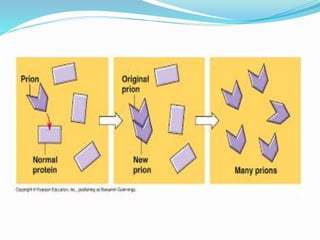
 After injection inside the host cell prion proteins
(PrPsc) are catalyze the normal proteins(PrPc) to
transform into infectious prion protein.
 After transformation this newly formed prion proteins
catalyze more simple protein into infectious prion
proteins(PrPsc).
Transmission
 Prions are transmitted through the contaminated food
particles.
 Prions are transmitted into human by the eating of
beef of infected cow.
 Prions are transmitted through the contaminated
medical instrument.
 They are transmitted while transplant of infected
organs.
Difference From Bacteria and Virus
 Prion does not contain any nucleic acid (DNA &
RNA).
 They are extremely resistant in heat and Chemical.
 They cannot mutate .
Diagnosis
 Prion diseases are confirmed by taking a sample of
brain tissue during a biopsy or after death.
 There are present several type of test for diagnosis
of prion protein such as - MRI (magnetic resonance
imaging) scans of the brain, Samples of fluid from
the spinal cord, Blood tests etc.
Treatment
 No effective medical treatment is known. Prion
diseases can't be cured, it is a fatal diseases , but
certain medicines may help slow their progress.
Preventation
Properly cleaning and sterilizing medical
equipment may prevent the spread of
the disease. If you have or may have
CJD, do not donate organs or tissue.
Newer regulations that govern the
handling and feeding of cows may help
prevent the spread of prion diseases.
References
 https://www.hopkinsmedicine.org/healthlibrary/cond
itions/nervous_system_disorders/prion_diseases_134,5
6
 https://www.evolvingsciences.com/Prions.html
 https://www.sciencealert.com/scientists-might-
finally-understand-how-prions-become-so-dangerous
 https://en.m.wikipedia.org/wiki/Prion
Prion Protein by sourav pan

Prion Protein by sourav pan

  • 1.
    Department of Microbiology MidnaporeCollege (Autonomous) Seminar 2017-2018 Made By : Sourav Pan
  • 2.
    Contant  Introduction  Structure Difference from Simple Protein  Diseases  Symptoms  Replicati0n  Transmission  Difference from bacteria and virus  Diagnosisi  Treatment  Preventation
  • 3.
    Introduction Pronounced“pree-on“.Prions are theinfectious proteinous particle without nucleic acid which cause disease in humans and animals, Prions composed of the prion protein (PrP) are believed to be the cause of transmissible spongiform encephalopathies (TSEs) among other diseases. In 1960 two researches found two type of diseases which were Scrapie and Mad Cow Diseases ,after research they found an interesting information about these diseases that these diseases are not caused by any Bacteria or Virus, Hence this diseases are caused by a Misfold Protein which is called prion.
  • 4.
    In 1982, StanleyB. Prusiner first coined these disease causing agent as a prion. for research on prion protein he got Nobel prize in 1997,accroding to Prusiner Prions are the ‘Infectious, Portentous particles which devoid nucliec acid’
  • 5.
    Structure  Prions areconsist of PrPSC Proteins(Here “PrP” means ‘Prion Protein’ and “sc” means “scrapie”)it is a abnormal protein.  Prions are don’t contain any Nucleic Acid(RNA & DNA).  They are not effected by the UV ray, heat, enzyme.  Normal prions are contain about 200-250 amino acids twisted into three telephone chord-likes coils known as helices, with tail of more amino acids.  They are 100 times smaller then viruses.  Prion proteins are misfold protein
  • 6.
    Difference from SimpleProtein Simple Protein Prion Protein  There amino acids are show alpha helix structure.  This Proteins are structurally well-defined  There amino acids show beta helix structure.  They are structurally abnormal or misfolded protein.
  • 8.
    Diseases Prions mainly infectanimals and humans, they cause several type of diseases they are- In Human : Creutzfeldt-Jakob disease (CJD), Kuru
  • 9.
    Diseases In animal: Scrapie,Bovine spongiform encephalopathy (BSE) or mad Cow Diseases.
  • 10.
    Symptoms  Rapidly developingdementia  Difficulty walking and changes in gait  Muscle stiffness  Confusion  Weakness  Difficulty speaking  Paralysis and death
  • 11.
    Replication  After injectioninside the host cell prion proteins (PrPsc) are catalyze the normal proteins(PrPc) to transform into infectious prion protein.  After transformation this newly formed prion proteins catalyze more simple protein into infectious prion proteins(PrPsc).
  • 13.
    Transmission  Prions aretransmitted through the contaminated food particles.  Prions are transmitted into human by the eating of beef of infected cow.  Prions are transmitted through the contaminated medical instrument.  They are transmitted while transplant of infected organs.
  • 14.
    Difference From Bacteriaand Virus  Prion does not contain any nucleic acid (DNA & RNA).  They are extremely resistant in heat and Chemical.  They cannot mutate .
  • 15.
    Diagnosis  Prion diseasesare confirmed by taking a sample of brain tissue during a biopsy or after death.  There are present several type of test for diagnosis of prion protein such as - MRI (magnetic resonance imaging) scans of the brain, Samples of fluid from the spinal cord, Blood tests etc.
  • 16.
    Treatment  No effectivemedical treatment is known. Prion diseases can't be cured, it is a fatal diseases , but certain medicines may help slow their progress.
  • 17.
    Preventation Properly cleaning andsterilizing medical equipment may prevent the spread of the disease. If you have or may have CJD, do not donate organs or tissue. Newer regulations that govern the handling and feeding of cows may help prevent the spread of prion diseases.
  • 18.
    References  https://www.hopkinsmedicine.org/healthlibrary/cond itions/nervous_system_disorders/prion_diseases_134,5 6  https://www.evolvingsciences.com/Prions.html https://www.sciencealert.com/scientists-might- finally-understand-how-prions-become-so-dangerous  https://en.m.wikipedia.org/wiki/Prion