Prion Disease / Degenerative
Diseases
Dr. Reetu Baral MD
Associate Professor
Department of Pathology
Transmissable Spongiform
Encephalopathies (Prion Diseases)
Group of diseases:
– Creutzfeldt-Jacob disease (CJD)
– Gerstmann-Straussler-Scheinker syndrome GSS
– Fatal Familial Insomnia
– Kuru in humans
– Scrapie in sheep and goats
– Bovine Spongiform Encephalopathy (BSE)
• Characterized by “Spongiform change”
caused by intracellular vacuoles in neurons
and glia.
Prion diseases
• These maybe:
– Sporadic,
– Familial,
– Iatrogenic, and
• They can be sporadic, transmitted, or
inherited.
• Clinically most of the patients develop
dementia.
Prion diseases
• The agent - abnormal form of a cellular protein.
• Termed: prion protein (PrP) - undergoes a
conformational change from its normal shape
(PrPc) to an abnormal conformation called PrPsc
(sc for scrapie).
• PrP normally is rich in α-helices,
• PrPsc
has a high content of β-sheets, a
characteristic that makes it resistant to
proteolysis (hence an alternative term for the
pathogenic form, PrPres
— protease resistant).
Prion diseases
• When PrPsc
physically interacts with PrP
molecules - induces them to also adopt the
PrPsc
conformation- “infectious nature”
• Over time, this self amplifying process leads
to the accumulation of a high burden of
pathogenic PrPsc
molecules in the brain.
• PrPc also may change its conformation
spontaneously (but a extremely low rate),
accounting for sporadic cases of prion disease
(sCJD).
Prion diseases
• Certain mutations in the gene encoding PrPc
(PRNP) accelerate the rate of spontaneous
conformational change.
• These variants are associated with early onset
familial forms of prion disease (fCJD).
• Accumulation of PrPsc
in neural tissue seems
to be the cause of cell injury,
• The mechanisms underlying the cytopathic
changes and eventual neuronal death are still
unknown.
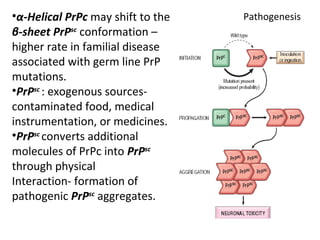
Pathogenesis•α-Helical PrPc may shift to the
β-sheet PrPsc
conformation –
higher rate in familial disease
associated with germ line PrP
mutations.
•PrPsc
: exogenous sources-
contaminated food, medical
instrumentation, or medicines.
•PrPsc
converts additional
molecules of PrPc into PrPsc
through physical
Interaction- formation of
pathogenic PrPsc
aggregates.
Creutzfeldt-Jakob Disease
• Rapidly progressive dementing illness- first onset of
subtle changes in memory and behavior to death- 7
months.
• It is sporadic in approximately 85% of cases and has
a worldwide annual incidence of about 1 per
million.
• Commonly seen in 70 years or older
• Familial forms caused by mutations in PRNP may
present in younger people.
• Well-established cases of iatrogenic transmission
-contaminated deep implantation electrodes and
contaminated human growth hormone
preparations.
MORPHOLOGY: CJD• Progression of disease to
death – very rapid – no
macroscopic evidence of brain
atrophy.
• Spongiform transformation of
the cerebral cortex and deep
gray matter structures
(caudate, putamen);
• Uneven formation of small,
vacuoles of varying sizes
within the neuropil and
sometimes in the perikaryon
of neurons.
• No inflammatory infiltrate is
present.
Variant Creutzfeldt-Jakob Disease
• 1995 - CJD-like illness appeared in the United
Kingdom.
• Affects young adults
• Behavioral disorders – prominent - in early
disease stages.
• Neurologic syndrome -progressed more slowly
-than in other forms of CJD.
• Variant Creutzfeldt-Jakob disease (vCJD) – due
to exposure to the prion disease of cattle, called
bovine spongiform encephalopathy.
• There has now also been documentation of
transmission by blood transfusion.
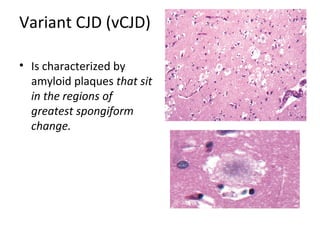
Variant CJD (vCJD)
• Is characterized by
amyloid plaques that sit
in the regions of
greatest spongiform
change.
NEURODEGENERATIVE DISEASES
• Degenerative diseases of the CNS are
disorders characterized by the cellular
degeneration of subsets of neurons that
typically are related by function, rather than
by physical location in the brain.
• Associated with the accumulation of
abnormal proteins.
NEURODEGENERATIVE DISEASES
Those that affect the:
• Cerebral cortical neurons result in loss of
memory, language, insight, and planning, all
components of dementia;
• Neurons of the basal ganglia result in
movement disorders;
• Cerebellum result in ataxia;
• Motor neurons result in weakness.
NEURODEGENERATIVE DISEASES
• Dementia is defined as the development of
memory impairment and other cognitive
deficits severe enough to decrease the
affected person’s capacity to function at the
previous level despite a normal level of
consciousness.
• It arises during the course of many
neurodegenerative diseases and numerous
other diseases that injure the cerebral cortex.
Alzheimer Disease
• Most common cause of dementia in the elderly
population.
• Manifestations: insidious onset of impaired
higher intellectual function and altered mood
and behavior.
• Progresses to disorientation, memory loss, and
aphasia, findings indicative of severe cortical
dysfunction.
• After 5 to 10 years, the patient becomes
profoundly disabled, mute, and immobile.
• Death: Pneumonia or other infections.
Alzheimer Disease
Incidence:
– 3% in persons 65 to 74 years old,
– 19% in those 75 to 84 years old,
– 47% in those older than 84 years.
• Most cases of AD are sporadic, but at least 5%
to 10% are familial.
• Sporadic cases rarely present before 50 years
of age.
PATHOGENESIS: Alzheimer Disease
• A peptide called beta amyloid, or Aβ,
accumulates in the brain over time, initiating
a chain of events that result in AD.
• Aβ is created when the transmembrane
protein amyloid precursor protein (APP) is
sequentially cleaved by the enzymes β-
amyloid converting enzyme (BACE) and Îł-
secretase.
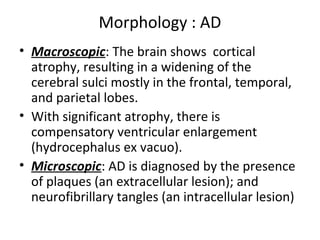
Morphology : AD
• Macroscopic: The brain shows cortical
atrophy, resulting in a widening of the
cerebral sulci mostly in the frontal, temporal,
and parietal lobes.
• With significant atrophy, there is
compensatory ventricular enlargement
(hydrocephalus ex vacuo).
• Microscopic: AD is diagnosed by the presence
of plaques (an extracellular lesion); and
neurofibrillary tangles (an intracellular lesion)
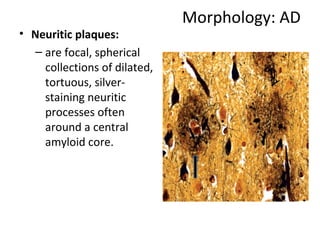
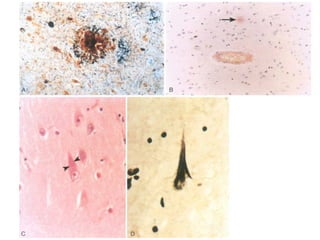
Morphology: AD
• Neuritic plaques:
– are focal, spherical
collections of dilated,
tortuous, silver-
staining neuritic
processes often
around a central
amyloid core.
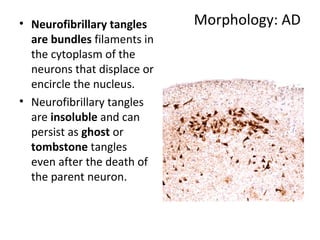
Morphology: AD• Neurofibrillary tangles
are bundles filaments in
the cytoplasm of the
neurons that displace or
encircle the nucleus.
• Neurofibrillary tangles
are insoluble and can
persist as ghost or
tombstone tangles
even after the death of
the parent neuron.
Parkinson Disease
• Parkinsonism is a clinical syndrome
characterized by:
– Pill rolling tremor, Rigidity,
– Bradykinesia, Instability,
– Diminshed facial expression, stooped posture,
– Festinating gait.
• These types of motor disturbances may be
seen in a range of diseases that damage
dopaminergic neurons, which project from
the substantia nigra to the striatum.
Parkinson Disease
• Parkinson disease(PD)- associated with characteristic
neuronal inclusions containing α-synuclein.
• Parkinsonism may be present:
– Multiple system atrophy (MSA), in which α-
synuclein aggregates are found in
oligodendrocytes;
– Progressive supranuclear palsy (PSP) and
– Corticobasal degeneration (CBD)- both associated
with tau-containing inclusions in neurons and glial
cells;
– Postencephalitic parkinsonism, which was
associated with the 1918 influenza pandemic.
PD: PATHOGENESIS
• Mostly sporadic.
• Maybe autosomal dominant and recessive.
• Point mutations and duplications of the gene
encoding α-synuclein, a protein involved in
synaptic transmission, cause autosomal
dominant PD.
• The diagnostic feature of the disease—the
Lewy body—is an inclusion containing α-
synuclein.
PD: MORPHOLOGY
• Gross finding: Pallor of
the substantia nigra
and locus ceruleus.
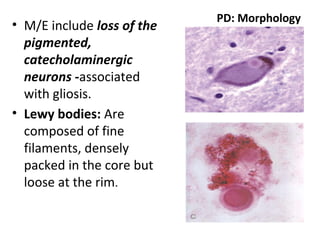
PD: Morphology
• M/E include loss of the
pigmented,
catecholaminergic
neurons -associated
with gliosis.
• Lewy bodies: Are
composed of fine
filaments, densely
packed in the core but
loose at the rim.
PD: Clinical Features
• Movement disorder in the absence of a toxic
exposure or underlying etiology.
• The disease usually progresses over 10 to 15 years -
severe motor slowing to the point of near
immobility.
• Death -intercurrent infection or trauma-frequent fall.
• Movement symptoms initially respond to L-
dihydroxyphenylalanine (L-DOPA), but this treatment
does not slow disease progression.
• Over time, L-DOPA becomes less effective and begins
to cause potentially problematic fluctuations in
motor function.
PD: Clinical Features
• In advanced cases: Autonomic dysfunction
and behavioral disorders.
• Involvement of Cerebral cortex: Dementia,
Hallucinations.
• When dementia arises within 1 year of the
onset of motor symptoms, it is referred to
Lewy body dementia (LBD).
The end

Prion disease

  • 1.
    Prion Disease /Degenerative Diseases Dr. Reetu Baral MD Associate Professor Department of Pathology
  • 2.
    Transmissable Spongiform Encephalopathies (PrionDiseases) Group of diseases: – Creutzfeldt-Jacob disease (CJD) – Gerstmann-Straussler-Scheinker syndrome GSS – Fatal Familial Insomnia – Kuru in humans – Scrapie in sheep and goats – Bovine Spongiform Encephalopathy (BSE) • Characterized by “Spongiform change” caused by intracellular vacuoles in neurons and glia.
  • 3.
    Prion diseases • Thesemaybe: – Sporadic, – Familial, – Iatrogenic, and • They can be sporadic, transmitted, or inherited. • Clinically most of the patients develop dementia.
  • 4.
    Prion diseases • Theagent - abnormal form of a cellular protein. • Termed: prion protein (PrP) - undergoes a conformational change from its normal shape (PrPc) to an abnormal conformation called PrPsc (sc for scrapie). • PrP normally is rich in α-helices, • PrPsc has a high content of β-sheets, a characteristic that makes it resistant to proteolysis (hence an alternative term for the pathogenic form, PrPres — protease resistant).
  • 5.
    Prion diseases • WhenPrPsc physically interacts with PrP molecules - induces them to also adopt the PrPsc conformation- “infectious nature” • Over time, this self amplifying process leads to the accumulation of a high burden of pathogenic PrPsc molecules in the brain. • PrPc also may change its conformation spontaneously (but a extremely low rate), accounting for sporadic cases of prion disease (sCJD).
  • 6.
    Prion diseases • Certainmutations in the gene encoding PrPc (PRNP) accelerate the rate of spontaneous conformational change. • These variants are associated with early onset familial forms of prion disease (fCJD). • Accumulation of PrPsc in neural tissue seems to be the cause of cell injury, • The mechanisms underlying the cytopathic changes and eventual neuronal death are still unknown.
  • 7.
    Pathogenesis•α-Helical PrPc mayshift to the β-sheet PrPsc conformation – higher rate in familial disease associated with germ line PrP mutations. •PrPsc : exogenous sources- contaminated food, medical instrumentation, or medicines. •PrPsc converts additional molecules of PrPc into PrPsc through physical Interaction- formation of pathogenic PrPsc aggregates.
  • 8.
    Creutzfeldt-Jakob Disease • Rapidlyprogressive dementing illness- first onset of subtle changes in memory and behavior to death- 7 months. • It is sporadic in approximately 85% of cases and has a worldwide annual incidence of about 1 per million. • Commonly seen in 70 years or older • Familial forms caused by mutations in PRNP may present in younger people. • Well-established cases of iatrogenic transmission -contaminated deep implantation electrodes and contaminated human growth hormone preparations.
  • 9.
    MORPHOLOGY: CJD• Progressionof disease to death – very rapid – no macroscopic evidence of brain atrophy. • Spongiform transformation of the cerebral cortex and deep gray matter structures (caudate, putamen); • Uneven formation of small, vacuoles of varying sizes within the neuropil and sometimes in the perikaryon of neurons. • No inflammatory infiltrate is present.
  • 10.
    Variant Creutzfeldt-Jakob Disease •1995 - CJD-like illness appeared in the United Kingdom. • Affects young adults • Behavioral disorders – prominent - in early disease stages. • Neurologic syndrome -progressed more slowly -than in other forms of CJD. • Variant Creutzfeldt-Jakob disease (vCJD) – due to exposure to the prion disease of cattle, called bovine spongiform encephalopathy. • There has now also been documentation of transmission by blood transfusion.
  • 11.
    Variant CJD (vCJD) •Is characterized by amyloid plaques that sit in the regions of greatest spongiform change.
  • 12.
    NEURODEGENERATIVE DISEASES • Degenerativediseases of the CNS are disorders characterized by the cellular degeneration of subsets of neurons that typically are related by function, rather than by physical location in the brain. • Associated with the accumulation of abnormal proteins.
  • 13.
    NEURODEGENERATIVE DISEASES Those thataffect the: • Cerebral cortical neurons result in loss of memory, language, insight, and planning, all components of dementia; • Neurons of the basal ganglia result in movement disorders; • Cerebellum result in ataxia; • Motor neurons result in weakness.
  • 14.
    NEURODEGENERATIVE DISEASES • Dementiais defined as the development of memory impairment and other cognitive deficits severe enough to decrease the affected person’s capacity to function at the previous level despite a normal level of consciousness. • It arises during the course of many neurodegenerative diseases and numerous other diseases that injure the cerebral cortex.
  • 15.
    Alzheimer Disease • Mostcommon cause of dementia in the elderly population. • Manifestations: insidious onset of impaired higher intellectual function and altered mood and behavior. • Progresses to disorientation, memory loss, and aphasia, findings indicative of severe cortical dysfunction. • After 5 to 10 years, the patient becomes profoundly disabled, mute, and immobile. • Death: Pneumonia or other infections.
  • 16.
    Alzheimer Disease Incidence: – 3%in persons 65 to 74 years old, – 19% in those 75 to 84 years old, – 47% in those older than 84 years. • Most cases of AD are sporadic, but at least 5% to 10% are familial. • Sporadic cases rarely present before 50 years of age.
  • 17.
    PATHOGENESIS: Alzheimer Disease •A peptide called beta amyloid, or Aβ, accumulates in the brain over time, initiating a chain of events that result in AD. • Aβ is created when the transmembrane protein amyloid precursor protein (APP) is sequentially cleaved by the enzymes β- amyloid converting enzyme (BACE) and γ- secretase.
  • 19.
    Morphology : AD •Macroscopic: The brain shows cortical atrophy, resulting in a widening of the cerebral sulci mostly in the frontal, temporal, and parietal lobes. • With significant atrophy, there is compensatory ventricular enlargement (hydrocephalus ex vacuo). • Microscopic: AD is diagnosed by the presence of plaques (an extracellular lesion); and neurofibrillary tangles (an intracellular lesion)
  • 20.
    Morphology: AD • Neuriticplaques: – are focal, spherical collections of dilated, tortuous, silver- staining neuritic processes often around a central amyloid core.
  • 21.
    Morphology: AD• Neurofibrillarytangles are bundles filaments in the cytoplasm of the neurons that displace or encircle the nucleus. • Neurofibrillary tangles are insoluble and can persist as ghost or tombstone tangles even after the death of the parent neuron.
  • 23.
    Parkinson Disease • Parkinsonismis a clinical syndrome characterized by: – Pill rolling tremor, Rigidity, – Bradykinesia, Instability, – Diminshed facial expression, stooped posture, – Festinating gait. • These types of motor disturbances may be seen in a range of diseases that damage dopaminergic neurons, which project from the substantia nigra to the striatum.
  • 24.
    Parkinson Disease • Parkinsondisease(PD)- associated with characteristic neuronal inclusions containing α-synuclein. • Parkinsonism may be present: – Multiple system atrophy (MSA), in which α- synuclein aggregates are found in oligodendrocytes; – Progressive supranuclear palsy (PSP) and – Corticobasal degeneration (CBD)- both associated with tau-containing inclusions in neurons and glial cells; – Postencephalitic parkinsonism, which was associated with the 1918 influenza pandemic.
  • 25.
    PD: PATHOGENESIS • Mostlysporadic. • Maybe autosomal dominant and recessive. • Point mutations and duplications of the gene encoding α-synuclein, a protein involved in synaptic transmission, cause autosomal dominant PD. • The diagnostic feature of the disease—the Lewy body—is an inclusion containing α- synuclein.
  • 26.
    PD: MORPHOLOGY • Grossfinding: Pallor of the substantia nigra and locus ceruleus.
  • 27.
    PD: Morphology • M/Einclude loss of the pigmented, catecholaminergic neurons -associated with gliosis. • Lewy bodies: Are composed of fine filaments, densely packed in the core but loose at the rim.
  • 28.
    PD: Clinical Features •Movement disorder in the absence of a toxic exposure or underlying etiology. • The disease usually progresses over 10 to 15 years - severe motor slowing to the point of near immobility. • Death -intercurrent infection or trauma-frequent fall. • Movement symptoms initially respond to L- dihydroxyphenylalanine (L-DOPA), but this treatment does not slow disease progression. • Over time, L-DOPA becomes less effective and begins to cause potentially problematic fluctuations in motor function.
  • 29.
    PD: Clinical Features •In advanced cases: Autonomic dysfunction and behavioral disorders. • Involvement of Cerebral cortex: Dementia, Hallucinations. • When dementia arises within 1 year of the onset of motor symptoms, it is referred to Lewy body dementia (LBD).
  • 30.