

Principles of Heutagogy
Dr Stewart Hase
Principles of Heutagogy
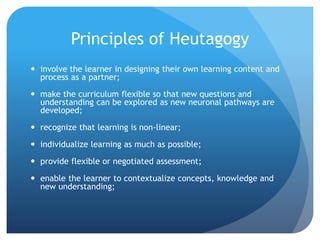
 involve the learner in designing their own learning content and
process as a partner;
 make the curriculum flexible so that new questions and
understanding can be explored as new neuronal pathways are
developed;
 recognize that learning is non-linear;
 individualize learning as much as possible;
 provide flexible or negotiated assessment;
 enable the learner to contextualize concepts, knowledge and
new understanding;
Principles of Heutagogy
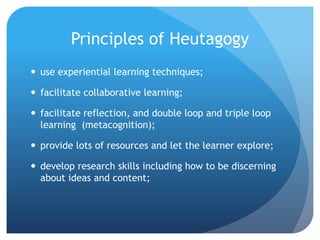
 use experiential learning techniques;
 facilitate collaborative learning;
 facilitate reflection, and double loop and triple loop
learning (metacognition);
 provide lots of resources and let the learner explore;
 develop research skills including how to be discerning
about ideas and content;
Principles of Heutagogy
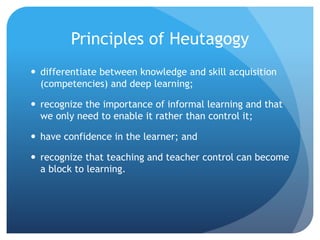
 differentiate between knowledge and skill acquisition
(competencies) and deep learning;
 recognize the importance of informal learning and that
we only need to enable it rather than control it;
 have confidence in the learner; and
 recognize that teaching and teacher control can become
a block to learning.

Principles of heutagogy

  • 1.
  • 2.
    Principles of Heutagogy involve the learner in designing their own learning content and process as a partner;  make the curriculum flexible so that new questions and understanding can be explored as new neuronal pathways are developed;  recognize that learning is non-linear;  individualize learning as much as possible;  provide flexible or negotiated assessment;  enable the learner to contextualize concepts, knowledge and new understanding;
  • 3.
    Principles of Heutagogy use experiential learning techniques;  facilitate collaborative learning;  facilitate reflection, and double loop and triple loop learning (metacognition);  provide lots of resources and let the learner explore;  develop research skills including how to be discerning about ideas and content;
  • 4.
    Principles of Heutagogy differentiate between knowledge and skill acquisition (competencies) and deep learning;  recognize the importance of informal learning and that we only need to enable it rather than control it;  have confidence in the learner; and  recognize that teaching and teacher control can become a block to learning.