Saad Bin Hasan
B.Sc. In Chemical Engineering, JUST
 Potentiostatic polarization curve of active-
passive metal (Fe).
 Fade potential of Fe.
 Passivity is defined as a condition of
corrosion resistance due to formation of thin
surface film under oxidizing conditions ,
some metals and alloys having simple barrier
films with reduced corrosion of active
potential .
 Passive metals are susceptible to local
breakdown and accelerated localized attack.
 Potentiostatic is a polarization technique that
allows for the controlled polarization of
metal surfaces in electrolytes, in order to
observe cathodic and anodic behaviours.
 Corrosion product identification and
analysis
 Industrial and chemical plant corrosion and
chemical attack
 Alloy selection
 Crevice corrosion analysis
 Electronics corrosion
 Local corrosion analysis
 ipass- Passive current density
 Epp - primary passivation potential
 icrit - Critical current density
 For an active-passive metal exposed to a cathodic reaction,
the corrosion rate will increase upto certain velocity levels,
beyond which the corrosion rate decreases rapidly to a very
low value on the onset of passivity and would remain at
passive state for still higher velocities.
 Corrosion rate of an active-passive alloy initially increases
with oxidizer concentration (while in its active state).
 As soon as passive state is reached, the corrosion rate
steeply decreases to a very low value and remains at this
low corrosion passive level.
 With still further increase in oxidizer concentration,
corrosion rate further increases due to transpassive
behavior.
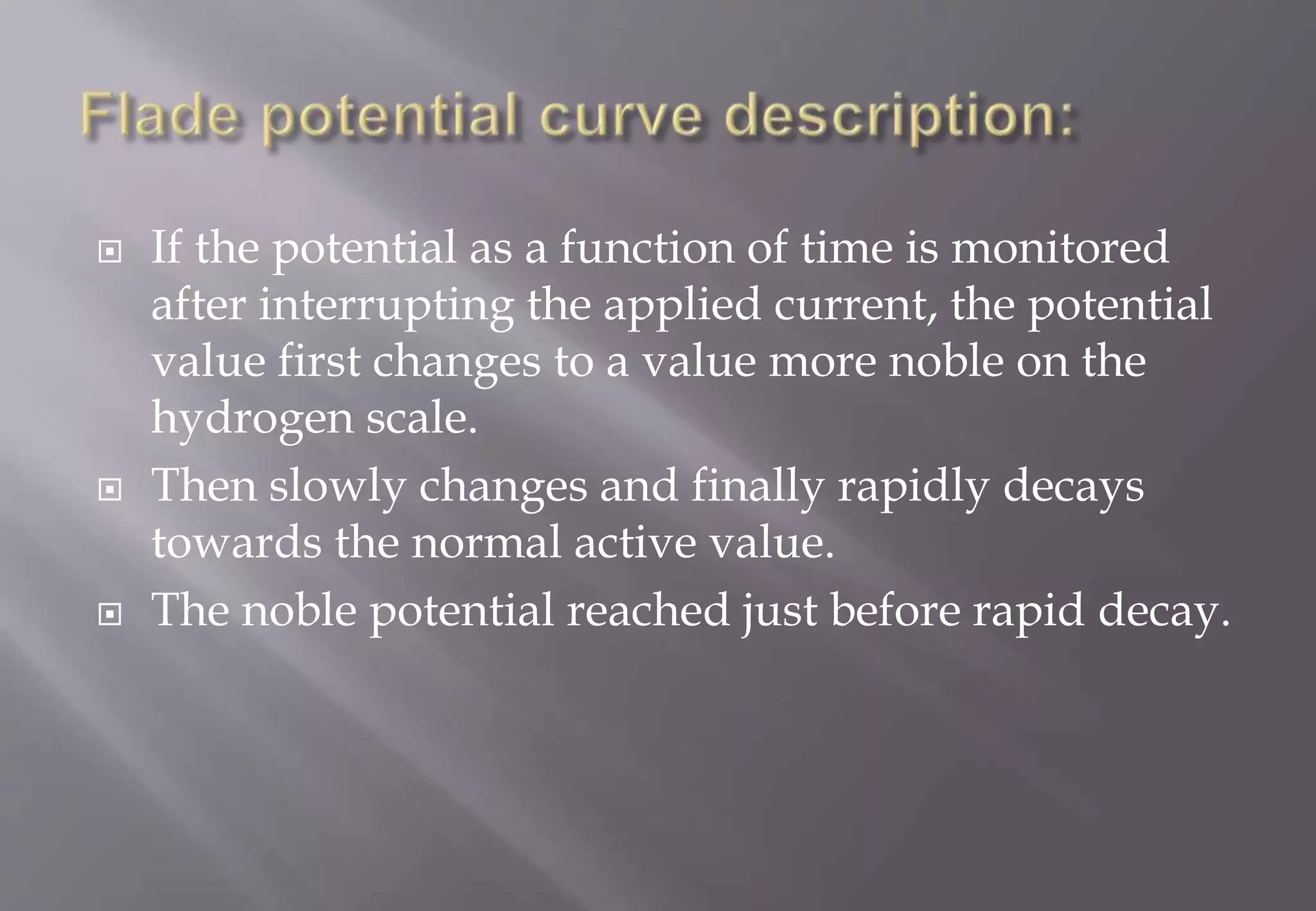
 Flade Potential (EF) the
potential at which a
metal changes from a
passive state to an
active state
Fig: Decay of passivity showing Flade potential
 If the potential as a function of time is monitored
after interrupting the applied current, the potential
value first changes to a value more noble on the
hydrogen scale.
 Then slowly changes and finally rapidly decays
towards the normal active value.
 The noble potential reached just before rapid decay.
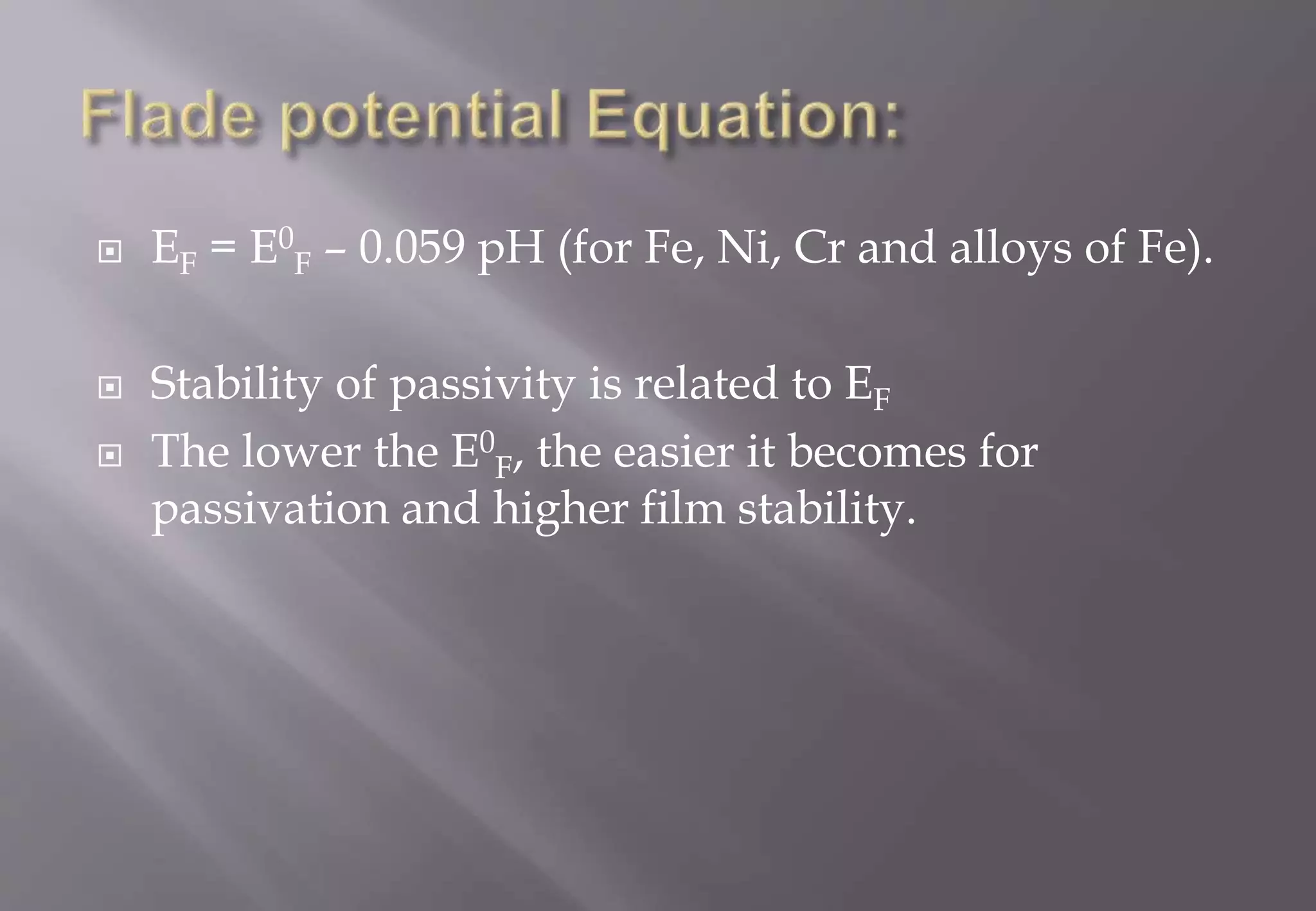
 EF = E0
F – 0.059 pH (for Fe, Ni, Cr and alloys of Fe).
 Stability of passivity is related to EF
 The lower the E0
F, the easier it becomes for
passivation and higher film stability.

Potentiostatic polarization curve of active-passive metal (Fe) & Flade potential of Fe.

  • 1.
    Saad Bin Hasan B.Sc.In Chemical Engineering, JUST
  • 2.
     Potentiostatic polarizationcurve of active- passive metal (Fe).  Fade potential of Fe.
  • 3.
     Passivity isdefined as a condition of corrosion resistance due to formation of thin surface film under oxidizing conditions , some metals and alloys having simple barrier films with reduced corrosion of active potential .  Passive metals are susceptible to local breakdown and accelerated localized attack.
  • 4.
     Potentiostatic isa polarization technique that allows for the controlled polarization of metal surfaces in electrolytes, in order to observe cathodic and anodic behaviours.
  • 5.
     Corrosion productidentification and analysis  Industrial and chemical plant corrosion and chemical attack  Alloy selection  Crevice corrosion analysis  Electronics corrosion  Local corrosion analysis
  • 6.
     ipass- Passivecurrent density  Epp - primary passivation potential  icrit - Critical current density
  • 7.
     For anactive-passive metal exposed to a cathodic reaction, the corrosion rate will increase upto certain velocity levels, beyond which the corrosion rate decreases rapidly to a very low value on the onset of passivity and would remain at passive state for still higher velocities.  Corrosion rate of an active-passive alloy initially increases with oxidizer concentration (while in its active state).  As soon as passive state is reached, the corrosion rate steeply decreases to a very low value and remains at this low corrosion passive level.  With still further increase in oxidizer concentration, corrosion rate further increases due to transpassive behavior.
  • 8.
     Flade Potential(EF) the potential at which a metal changes from a passive state to an active state Fig: Decay of passivity showing Flade potential
  • 9.
     If thepotential as a function of time is monitored after interrupting the applied current, the potential value first changes to a value more noble on the hydrogen scale.  Then slowly changes and finally rapidly decays towards the normal active value.  The noble potential reached just before rapid decay.
  • 10.
     EF =E0 F – 0.059 pH (for Fe, Ni, Cr and alloys of Fe).  Stability of passivity is related to EF  The lower the E0 F, the easier it becomes for passivation and higher film stability.