THE HOLY GEETA
COMMENTARY by
swami Chinmayananda
T K G NAMBOODHIRI
THIRUVALLA, KERALA, INDIA
Presentation adapted from
THE HOLY GEETA, Central Chinmaya Mission Trust, July 2013
Mumbai
THE HOLI GEETA
THE HOLY GEETA is the
commentary on Bhagavad GEETA
by Swami Chinmayananda(1916-
1993). Swamiji gave extensive
discourses on Gita throughout
India & across the world, over four
decades, till his Samadhi in 1993.
His talks have been compiled into
this commentary, & published by
the Central Chinmaya Mission
Trust, in September 2008. The
present Edition was printed in July
2013.
T K G Namboodhiri
THE HOLI GEETA
T K G Namboodhiri
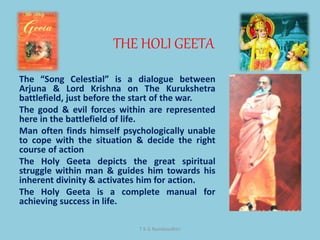
The “Song Celestial” is a dialogue between
Arjuna & Lord Krishna on The Kurukshetra
battlefield, just before the start of the war.
The good & evil forces within are represented
here in the battlefield of life.
Man often finds himself psychologically unable
to cope with the situation & decide the right
course of action
The Holy Geeta depicts the great spiritual
struggle within man & guides him towards his
inherent divinity & activates him for action.
The Holy Geeta is a complete manual for
achieving success in life.
THE HOLI GEETA
T K G Namboodhiri
GENERAL INTRODUCTION
Geeta is a handbook of instructions for human beings to live the subtle
philosophical principles of Vedanta in the actual work-a-day world.
This great handbook of practical living revolutionized Hinduism &
inaugurated a renaissance for the post- Puranic Era.
Religion is philosophy in action. An ancient philosophy may need
periodic intelligent reinterpretations in the context of changing times. Sri
Krishna, here, guides the common man on how to apply effectively the
ancient laws in his present life.
In the Geeta, the Poet-Seer Vyasa has brought the Vedic truths into the
active fields of political life & into the confusing tensions of an imminent
war. Arjuna who got shattered in his mental equipoise & lost his capacity
to discriminate, takes refuge in Lord Krishna, who treats his neurotic
mind with Vedic truths.
THE HOLI GEETA
T K G Namboodhiri
General Introduction-2
Geeta teaches us that actions performed without
egocentric desires purge the mind of its deep-seated
impressions & make it increasingly subtle in its
purification.
Mind is man. As the mind, so is the individual. If the
mind is disturbed, the individual is disturbed.
Let us consider human mind & its working in detail:
THE HOLI GEETA
T K G Namboodhiri
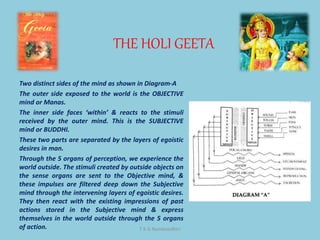
Two distinct sides of the mind as shown in Diagram-A
The outer side exposed to the world is the OBJECTIVE
mind or Manas.
The inner side faces ‘within’ & reacts to the stimuli
received by the outer mind. This is the SUBJECTIVE
mind or BUDDHI.
These two parts are separated by the layers of egoistic
desires in man.
Through the 5 organs of perception, we experience the
world outside. The stimuli created by outside objects on
the sense organs are sent to the Objective mind, &
these impulses are filtered deep down the Subjective
mind through the intervening layers of egoistic desires.
They then react with the existing impressions of past
actions stored in the Subjective mind & express
themselves in the world outside through the 5 organs
of action.
THE HOLI GEETA
T K G Namboodhiri
General Introduction-3
At each moment. Man meets with different patterns of these stimuli, &
constantly gathers new impressions in the Subjective mind. These new
impressions are ‘coloured’ by the existing Vasanas stored there. By this
process, the Subjective mind gets increasingly granulated by overlapping
Vasanas of our past. These granulations make the Subjective mind dull &
opaque, & form an impregnable wall between ourselves & the spiritual
Divinity within.
In a healthy & whole individual, the Objective & Subjective parts of the mind
work in unison, & in moments of doubt, the Objective mind comes under
the discipline of the Subjective mind. In most people, these parts of the
mind are separated by egoistic desires, which distorts the impulses reaching
the Subjective mind, & creates confusion. To bring the two parts together,
the egocentric desires must be removed. This is achieved through Buddhi
Yoga.
THE HOLI GEETA
T K G Namboodhiri
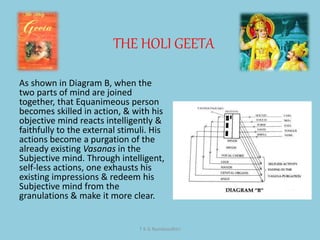
As shown in Diagram B, when the
two parts of mind are joined
together, that Equanimeous person
becomes skilled in action, & with his
objective mind reacts intelligently &
faithfully to the external stimuli. His
actions become a purgation of the
already existing Vasanas in the
Subjective mind. Through intelligent,
self-less actions, one exhausts his
existing impressions & redeem his
Subjective mind from the
granulations & make it more clear.
THE HOLI GEETA
T K G Namboodhiri
General Introduction-4
Selfless activity, performed in a spirit of egoless adoration &
reverence to the divine ideal, would ultimately result in inner
purification. This is the most unavoidable prerequisite before the
‘subjective mind’ can turn inward seeking to rediscover the sanctuary
of the Self, the Spiritual Reality.
The ‘subjective mind’ is thus a secret weapon man has to eliminate
the existing impressions in it. Unfortunately, an average man, in his
ignorance, misuses this dangerous weapon, as an Inlet, and creates,
with his selfish actions, a new stock of mental impressions. In order to
exhaust these Vasanas, one is forced to take up new bodies, one after
the other, till by proper actions, all the existing Vasanas are
eliminated.
THE HOLI GEETA
T K G Namboodhiri
General Introduction-5
An unhealthy mind, divided in itself, becomes an easy prey to a host
of psychological diseases. Modern psychology describes the dreary
results of suppression & repression of emotions. We knowingly
suppress many of our emotions. More often, we unconsciously
repress many of our sentiments, which leads to accumulation of
tremendous amounts of dynamic energy which seeks a field for
expression. Unless these energies are properly guided, they would
boomerang back to destroy the very individual. Arjuna, the great hero
on the battlefield came under the influence of his repressed
conditions & behaved as a victim of perfect neurosis.
THE HOLI GEETA
T K G Namboodhiri
General Introduction-6
Arjuna, the Pandava hero had repressed emotions caused by the injustices
meted out to them from his childhood. The 14 years of unjust exile to the
forest, & the refusal of Kauravas to give them back their rightful kingdom
added to this repressed emotions. The repressed energy in him was
channelled wrongly by a secret message he received from King Dritarashtra
on the eve of the war. By seeing his elders, teachers, relatives ready to fight
him with a larger well equipped army than his own, his mental stamina was
seriously challenged, & his ‘objective mind’ could not get any advice from his
‘subjective mind’ which was separated by his egocentric assumptions &
desire-prompted anxieties. He thus suddenly became a despondent,
bewildered, neurotic patient. Lord Krishna gave him the ‘Krishna treatment’
on the battlefield which cured Arjuna of the ‘Arjuna disease’.
THE HOLI GEETA
T K G Namboodhiri
General Introduction-7
The two main lines of the ‘Krishna treatment’ are indicated in Chapter
2 of The Geeta. The first is a ‘treatment of Idealism’ wherein Arjuna is
directed to a greater Reality than his mind, ego & intellect, which
eliminated, to some extent, the divorce between the ‘subjective’ &
‘objective’ aspects of his mind. The second line was the instructions
on selfless activity to purge the existing Vasanas in Arjuna. Being a
Kshatriya, Arjuna’s mind was coloured by the Rajo-guna, & so he
needed a battlefield to exhaust those impressions. The repeated
instructions of Krishna to ‘get-up & fight’ we see in the Geeta should
be seen in this light, & not as a ‘war-mongering’ advice. It is a call to
each one of us to get up & fight the battle of our own life, according
to our own Vasanas, so that we may exhaust them & thus get inner
purity.

The holy geeta general introduction

  • 1.
    THE HOLY GEETA COMMENTARYby swami Chinmayananda T K G NAMBOODHIRI THIRUVALLA, KERALA, INDIA Presentation adapted from THE HOLY GEETA, Central Chinmaya Mission Trust, July 2013 Mumbai
  • 2.
    THE HOLI GEETA THEHOLY GEETA is the commentary on Bhagavad GEETA by Swami Chinmayananda(1916- 1993). Swamiji gave extensive discourses on Gita throughout India & across the world, over four decades, till his Samadhi in 1993. His talks have been compiled into this commentary, & published by the Central Chinmaya Mission Trust, in September 2008. The present Edition was printed in July 2013. T K G Namboodhiri
  • 3.
    THE HOLI GEETA TK G Namboodhiri The “Song Celestial” is a dialogue between Arjuna & Lord Krishna on The Kurukshetra battlefield, just before the start of the war. The good & evil forces within are represented here in the battlefield of life. Man often finds himself psychologically unable to cope with the situation & decide the right course of action The Holy Geeta depicts the great spiritual struggle within man & guides him towards his inherent divinity & activates him for action. The Holy Geeta is a complete manual for achieving success in life.
  • 4.
    THE HOLI GEETA TK G Namboodhiri GENERAL INTRODUCTION Geeta is a handbook of instructions for human beings to live the subtle philosophical principles of Vedanta in the actual work-a-day world. This great handbook of practical living revolutionized Hinduism & inaugurated a renaissance for the post- Puranic Era. Religion is philosophy in action. An ancient philosophy may need periodic intelligent reinterpretations in the context of changing times. Sri Krishna, here, guides the common man on how to apply effectively the ancient laws in his present life. In the Geeta, the Poet-Seer Vyasa has brought the Vedic truths into the active fields of political life & into the confusing tensions of an imminent war. Arjuna who got shattered in his mental equipoise & lost his capacity to discriminate, takes refuge in Lord Krishna, who treats his neurotic mind with Vedic truths.
  • 5.
    THE HOLI GEETA TK G Namboodhiri General Introduction-2 Geeta teaches us that actions performed without egocentric desires purge the mind of its deep-seated impressions & make it increasingly subtle in its purification. Mind is man. As the mind, so is the individual. If the mind is disturbed, the individual is disturbed. Let us consider human mind & its working in detail:
  • 6.
    THE HOLI GEETA TK G Namboodhiri Two distinct sides of the mind as shown in Diagram-A The outer side exposed to the world is the OBJECTIVE mind or Manas. The inner side faces ‘within’ & reacts to the stimuli received by the outer mind. This is the SUBJECTIVE mind or BUDDHI. These two parts are separated by the layers of egoistic desires in man. Through the 5 organs of perception, we experience the world outside. The stimuli created by outside objects on the sense organs are sent to the Objective mind, & these impulses are filtered deep down the Subjective mind through the intervening layers of egoistic desires. They then react with the existing impressions of past actions stored in the Subjective mind & express themselves in the world outside through the 5 organs of action.
  • 7.
    THE HOLI GEETA TK G Namboodhiri General Introduction-3 At each moment. Man meets with different patterns of these stimuli, & constantly gathers new impressions in the Subjective mind. These new impressions are ‘coloured’ by the existing Vasanas stored there. By this process, the Subjective mind gets increasingly granulated by overlapping Vasanas of our past. These granulations make the Subjective mind dull & opaque, & form an impregnable wall between ourselves & the spiritual Divinity within. In a healthy & whole individual, the Objective & Subjective parts of the mind work in unison, & in moments of doubt, the Objective mind comes under the discipline of the Subjective mind. In most people, these parts of the mind are separated by egoistic desires, which distorts the impulses reaching the Subjective mind, & creates confusion. To bring the two parts together, the egocentric desires must be removed. This is achieved through Buddhi Yoga.
  • 8.
    THE HOLI GEETA TK G Namboodhiri As shown in Diagram B, when the two parts of mind are joined together, that Equanimeous person becomes skilled in action, & with his objective mind reacts intelligently & faithfully to the external stimuli. His actions become a purgation of the already existing Vasanas in the Subjective mind. Through intelligent, self-less actions, one exhausts his existing impressions & redeem his Subjective mind from the granulations & make it more clear.
  • 9.
    THE HOLI GEETA TK G Namboodhiri General Introduction-4 Selfless activity, performed in a spirit of egoless adoration & reverence to the divine ideal, would ultimately result in inner purification. This is the most unavoidable prerequisite before the ‘subjective mind’ can turn inward seeking to rediscover the sanctuary of the Self, the Spiritual Reality. The ‘subjective mind’ is thus a secret weapon man has to eliminate the existing impressions in it. Unfortunately, an average man, in his ignorance, misuses this dangerous weapon, as an Inlet, and creates, with his selfish actions, a new stock of mental impressions. In order to exhaust these Vasanas, one is forced to take up new bodies, one after the other, till by proper actions, all the existing Vasanas are eliminated.
  • 10.
    THE HOLI GEETA TK G Namboodhiri General Introduction-5 An unhealthy mind, divided in itself, becomes an easy prey to a host of psychological diseases. Modern psychology describes the dreary results of suppression & repression of emotions. We knowingly suppress many of our emotions. More often, we unconsciously repress many of our sentiments, which leads to accumulation of tremendous amounts of dynamic energy which seeks a field for expression. Unless these energies are properly guided, they would boomerang back to destroy the very individual. Arjuna, the great hero on the battlefield came under the influence of his repressed conditions & behaved as a victim of perfect neurosis.
  • 11.
    THE HOLI GEETA TK G Namboodhiri General Introduction-6 Arjuna, the Pandava hero had repressed emotions caused by the injustices meted out to them from his childhood. The 14 years of unjust exile to the forest, & the refusal of Kauravas to give them back their rightful kingdom added to this repressed emotions. The repressed energy in him was channelled wrongly by a secret message he received from King Dritarashtra on the eve of the war. By seeing his elders, teachers, relatives ready to fight him with a larger well equipped army than his own, his mental stamina was seriously challenged, & his ‘objective mind’ could not get any advice from his ‘subjective mind’ which was separated by his egocentric assumptions & desire-prompted anxieties. He thus suddenly became a despondent, bewildered, neurotic patient. Lord Krishna gave him the ‘Krishna treatment’ on the battlefield which cured Arjuna of the ‘Arjuna disease’.
  • 12.
    THE HOLI GEETA TK G Namboodhiri General Introduction-7 The two main lines of the ‘Krishna treatment’ are indicated in Chapter 2 of The Geeta. The first is a ‘treatment of Idealism’ wherein Arjuna is directed to a greater Reality than his mind, ego & intellect, which eliminated, to some extent, the divorce between the ‘subjective’ & ‘objective’ aspects of his mind. The second line was the instructions on selfless activity to purge the existing Vasanas in Arjuna. Being a Kshatriya, Arjuna’s mind was coloured by the Rajo-guna, & so he needed a battlefield to exhaust those impressions. The repeated instructions of Krishna to ‘get-up & fight’ we see in the Geeta should be seen in this light, & not as a ‘war-mongering’ advice. It is a call to each one of us to get up & fight the battle of our own life, according to our own Vasanas, so that we may exhaust them & thus get inner purity.