THERMAL PROPERTIES OF MATERIALS
OBJECT
To understand what a thermal property is and to
look at various thermal properties of materials.
THERMAL PROPERTY
 The properties of a material that determine
how it reacts when it is subjected to
excessive heat, or heat fluctuations over time
are called thermal properties.
 We shall take a look at the following thermal
properties
1. Heat Capacity
2. Thermal Expansion
3. Thermal Conductivity
4. Thermal Stress
1. HEAT CAPACITY
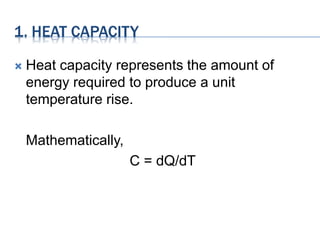
 Heat capacity represents the amount of
energy required to produce a unit
temperature rise.
Mathematically,
C = dQ/dT
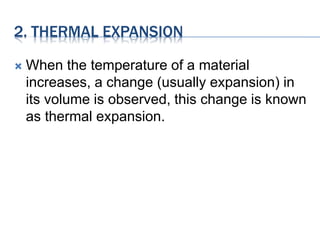
2. THERMAL EXPANSION
 When the temperature of a material
increases, a change (usually expansion) in
its volume is observed, this change is known
as thermal expansion.
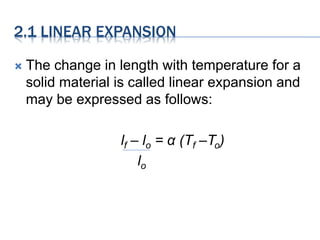
 The change in length with temperature for a
solid material is called linear expansion and
may be expressed as follows:
lf – lo = α (Tf –To)
lo
2.1 LINEAR EXPANSION
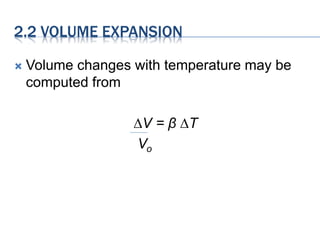
2.2 VOLUME EXPANSION
 Volume changes with temperature may be
computed from
∆V = β ∆T
Vo
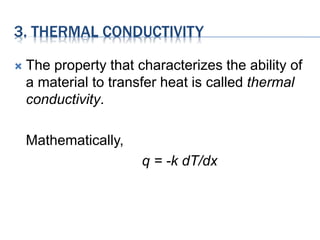
3. THERMAL CONDUCTIVITY
 The property that characterizes the ability of
a material to transfer heat is called thermal
conductivity.
Mathematically,
q = -k dT/dx
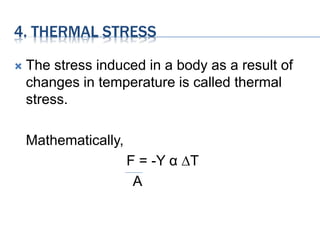
4. THERMAL STRESS
 The stress induced in a body as a result of
changes in temperature is called thermal
stress.
Mathematically,
F = -Y α ∆T
A

Thermal properties of materials

  • 1.
    THERMAL PROPERTIES OFMATERIALS OBJECT To understand what a thermal property is and to look at various thermal properties of materials.
  • 2.
    THERMAL PROPERTY  Theproperties of a material that determine how it reacts when it is subjected to excessive heat, or heat fluctuations over time are called thermal properties.
  • 3.
     We shalltake a look at the following thermal properties 1. Heat Capacity 2. Thermal Expansion 3. Thermal Conductivity 4. Thermal Stress
  • 4.
    1. HEAT CAPACITY Heat capacity represents the amount of energy required to produce a unit temperature rise. Mathematically, C = dQ/dT
  • 5.
    2. THERMAL EXPANSION When the temperature of a material increases, a change (usually expansion) in its volume is observed, this change is known as thermal expansion.
  • 6.
     The changein length with temperature for a solid material is called linear expansion and may be expressed as follows: lf – lo = α (Tf –To) lo 2.1 LINEAR EXPANSION
  • 7.
    2.2 VOLUME EXPANSION Volume changes with temperature may be computed from ∆V = β ∆T Vo
  • 8.
    3. THERMAL CONDUCTIVITY The property that characterizes the ability of a material to transfer heat is called thermal conductivity. Mathematically, q = -k dT/dx
  • 9.
    4. THERMAL STRESS The stress induced in a body as a result of changes in temperature is called thermal stress. Mathematically, F = -Y α ∆T A

Editor's Notes

  • #3 By thermal property is meant the response of a material to the application of heat. The properties of a material that determine how it reacts when it is subjected to excessive heat, or heat fluctuations over time are called thermal properties.
  • #5 A solid material, when heated, experiences an increase in temperature signifying that some energy has been absorbed. Heat capacity is a property that is indicative of a material’s ability to absorb heat from the external surroundings. Heat capacity represents the amount of energy required to produce a unit temperature rise. Mathematically, C = dQ/dT Ordinarily, heat capacity is specified per mole of material (e.g. J/mol-K). We often talk about the heat capacity per unit mass which is called the specific heat capacity.
  • #7 The change in length with temperature for a solid material is known as linear expansion may be expressed as follows: lf – lo = α (Tf –To) lo where lo and lf represent, respectively, initial and final lengths with the temperature change from To to Tf . The parameter α is called the linear coefficient of thermal expansion. It is a material property that is indicative of the extent to which a material expands upon heating, and has units of reciprocal temperature (oC-1).
  • #8 It is obvious that as the atoms get farther apart, every dimension increases and the entire volume expands. This Volume change (or volume expansion) with temperature may be computed from ∆V = β ∆T Vo Where ∆V and Vo are the volume change and the original volume, respectively, and β symbolizes the volume coefficient of thermal expansion.
  • #9 Thermal conduction is the phenomenon by which heat is transported from high to low temperature regions of a substance. The property that characterizes the ability of a material to transfer heat is the thermal conductivity. Thermal conductivity is the property of a material to conduct heat. Mathematically, q = -k dT/dx Where q denotes the heat flux, or heat flow, per unit time per unit area (area being taken as that perpendicular to the flow direction), k is the thermal conductivity, and dT/dx is the temperature gradient through the conducting medium. In SI units, thermal conductivity is measured in watts per meter kelvin W/(m·K). The above equation is valid only for steady-state heat flow, that is, for situations in which the heat flux does not change with time. Also, the minus sign in the expression indicates that the direction of heat flow is from hot to cold, or down the temperature gradient.
  • #10 The stress induced in a body as a result of changes in temperature is called thermal stress. As an example, If we clamp the ends of a rod rigidly to prevent expansion or contraction and then change the temperature, thermal stresses develop. The rod would like to expandor contract, but the clamps won’t let it. The resulting stresses may become large enough to strain the rod irreversibly or even break it. Mathematically, F = -Y α ∆T A Where F/A is the thermal stress, Y is the young’s modulus, α is the co-efficient of thermal expansion and ∆T is the temperature change. The minus sign in the equation came as a result of mathematical simplification.