14
Groups
& Teams
*Group: two or more people who interact with each other
to accomplish a goal.
*Team: group who work intensively with each other to
achieve a specific common goal.
* All teams are groups, BUT, not all groups are teams.
*Teams often are difficult to form.
* Takes time for members to work together.
* Teams can improve organizational performance.
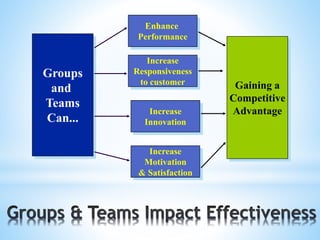
Groups
and
Teams
Can...
Enhance
Performance
Increase
Responsiveness
to customer
Increase
Innovation
Increase
Motivation
& Satisfaction
Gaining a
Competitive
Advantage
* Performance Enhancement: Make use of synergy
* Workers in a group have the opportunity to produce more or
better output than separate workers.
*Members correct other’s errors, bring new ideas to bear.
*Managers should build groups with members of
complimentary skills.
* Responsive to Customers: Difficult to achieve given many
constraints.
* Safety issues, regulations, costs.
* Cross-functional teams provide the wide variety of skills
needed.
*Teams consist of members of different departments.
* Innovation: individuals rarely possess the wide variety of
skills needed.
* Team members also uncover flaws and develop new
ideas.
* Managers should empower the team for the full
innovation process.
* Motivation: members of groups, and particularly teams,
are often better motivated and satisfied than individuals.
* It is fun to work next to other motivated people.
* Team members see their contribution to the team.
*Teams also provide social interaction.
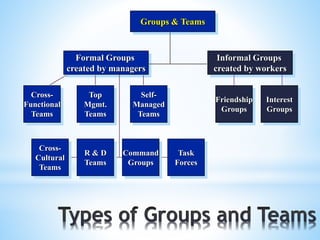
Cross-
Functional
Teams
Interest
Groups
Groups & Teams
Formal Groups
created by managers
Cross-
Cultural
Teams
Top
Mgmt.
Teams
R & D
Teams
Self-
Managed
Teams
Command
Groups
Task
Forces
Informal Groups
created by workers
Friendship
Groups
*Created by manager to meet the firm’s goals.
Cross-functional: members of different departments.
Cross-cultural: members of different cultures.
Research and Development Teams: Create new products.
Top Management team: help develop firm’s direction.
*Important to have diversity in it to avoid group think.
Command Groups: members report to same manager.
Task Force: created to meet a given objective.
*Standing committees are permanent task forces.
Self-Managed Teams: members are empowered to complete
some given work.
*Team decides how to do the task.
* Keys to effective self managed teams:
* Give the team enough responsibility and autonomy to
be self-managing.
* The team’s task should be complex enough to include
many different steps.
* Select members carefully. Look for diversity, skills,
and enthusiasm.
* Manager should guide and coach, not supervise.
* Determine training needs and be sure it is provided.
* Teams may have trouble with performance reviews of
members.
*Created by the workers to meet their needs.
* Friendship group: made up of employees who enjoy
each other’s company.
* Satisfy the need for human interaction and social
support.
* Interest Groups: Workers seek to achieve a common
goal based on their membership in the organization.
* Managers should observe interest groups to learn
what employees see as important.
*Dynamics affect how a group or team functions.
* Group size: affects how a group performs.
* Normally, keep group small (2 to 9 members).
*Small groups interact better and tend to be more
motivated.
* Use large groups when more resources are needed.
*Division of labor is possible with large group.
* Group Tasks: impacts how a group interacts.
* Task interdependence shows how work of one
member impacts another.
*As interdependence rises, members work closer
together.
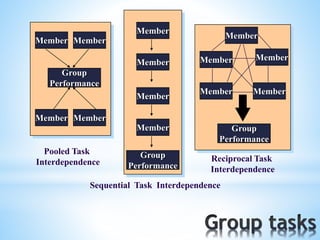
* Task interdependence types:
* Pooled Task Interdependence: members make separate,
independent contributions to group.
*Group performance is the sum of member
contributions.
* Sequential Task Interdependence: members perform
tasks in a sequential order.
*Hard to determine individual performance since one
member depends on another.
* Reciprocal Task Interdependence: work performed by a
member is dependent on work by others.
*Members share information and work closely together.
Sequential Task Interdependence
Member Member
Member Member
Group
Performance
Member
Member
Member
Member
Group
Performance
Pooled Task
Interdependence
Member
MemberMember
MemberMember
Group
Performance
Reciprocal Task
Interdependence
* Role: set of behaviors a group member is expected to
perform because of their position in the group.
* In cross-functional teams, members perform roles in
their specialty.
* Managers need to clearly describe expected roles to
group members when they are assigned to the group.
*Role-making occurs as workers take on more roles
as group members.
* Self-managed teams may assign the roles to members
themselves.
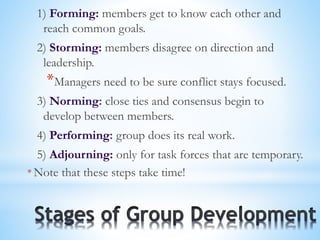
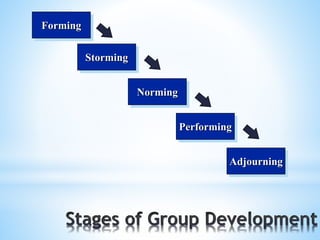
1) Forming: members get to know each other and
reach common goals.
2) Storming: members disagree on direction and
leadership.
*Managers need to be sure conflict stays focused.
3) Norming: close ties and consensus begin to
develop between members.
4) Performing: group does its real work.
5) Adjourning: only for task forces that are temporary.
* Note that these steps take time!
Performing
Adjourning
Norming
Storming
Forming
* Group Norms: shared rules that members follow.
* Groups may set working hours, behavior rules, etc.
* Conformity & Deviance: members conform to norms
to:
* Obtain rewards, imitate respected members, and
because they feel the behavior is right.
* When a member deviates, other members will try to
make them conform, expel the member, or change
the group norms to accommodate them.
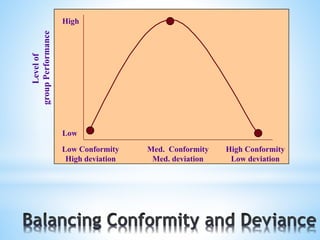
* Conformity and deviance must be balanced for high
performance from the group.
* Deviance allows for new ideas in the group.
Levelof
groupPerformance
Low
High
Low Conformity
High deviation
Med. Conformity
Med. deviation
High Conformity
Low deviation
* Group cohesiveness: measures the loyalty to the group by its
members.
* Level of Participation: as cohesiveness rises, so will
participation.
*Participation helps get members actively involved, but too
much can waste time.
* Level of Conformity: as conformity rises, so does
cohesiveness.
*With too much conformity, performance can suffer.
* Level of Group Goal Accomplishment: as cohesiveness
rises, the emphasis on group accomplishment will rise.
*High levels of cohesiveness can cause the group to focus
more on itself than the firm.
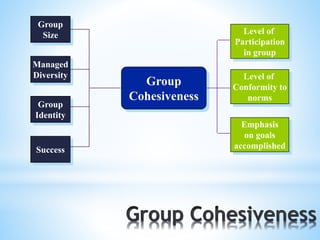
Group
Size
Managed
Diversity
Group
Identity
Success
Group
Cohesiveness
Level of
Conformity to
norms
Level of
Participation
in group
Emphasis
on goals
accomplished
* Determinates of cohesiveness: can be altered to change
cohesiveness levels in a group.
* Group Size: small groups allow high cohesiveness.
*Low cohesiveness groups with many members can benefit
from splitting into two groups.
* Managed Diversity: Diverse groups often come up with
better solutions.
* Group Identity: When cohesiveness is low, encourage a
group to adopt a unique identity and engage in healthy
competition with others.
* Success: cohesiveness increases with success.
*Look for a way for a group to find some small success.
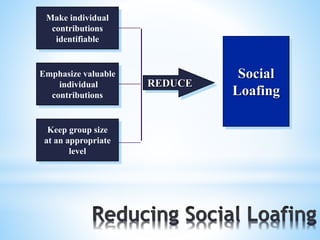
Make individual
contributions
identifiable
Emphasize valuable
individual
contributions
Keep group size
at an appropriate
level
REDUCE
Social
Loafing
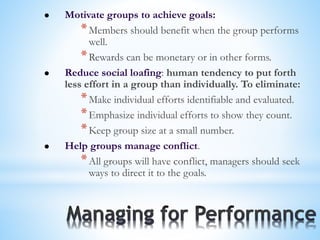
 Motivate groups to achieve goals:
*Members should benefit when the group performs
well.
*Rewards can be monetary or in other forms.
 Reduce social loafing: human tendency to put forth
less effort in a group than individually. To eliminate:
*Make individual efforts identifiable and evaluated.
*Emphasize individual efforts to show they count.
*Keep group size at a small number.
 Help groups manage conflict.
*All groups will have conflict, managers should seek
ways to direct it to the goals.

Principi del Management: 14^ - Gruppi e Team

  • 1.
  • 2.
    *Group: two ormore people who interact with each other to accomplish a goal. *Team: group who work intensively with each other to achieve a specific common goal. * All teams are groups, BUT, not all groups are teams. *Teams often are difficult to form. * Takes time for members to work together. * Teams can improve organizational performance.
  • 3.
  • 4.
    * Performance Enhancement:Make use of synergy * Workers in a group have the opportunity to produce more or better output than separate workers. *Members correct other’s errors, bring new ideas to bear. *Managers should build groups with members of complimentary skills. * Responsive to Customers: Difficult to achieve given many constraints. * Safety issues, regulations, costs. * Cross-functional teams provide the wide variety of skills needed. *Teams consist of members of different departments.
  • 5.
    * Innovation: individualsrarely possess the wide variety of skills needed. * Team members also uncover flaws and develop new ideas. * Managers should empower the team for the full innovation process. * Motivation: members of groups, and particularly teams, are often better motivated and satisfied than individuals. * It is fun to work next to other motivated people. * Team members see their contribution to the team. *Teams also provide social interaction.
  • 6.
    Cross- Functional Teams Interest Groups Groups & Teams FormalGroups created by managers Cross- Cultural Teams Top Mgmt. Teams R & D Teams Self- Managed Teams Command Groups Task Forces Informal Groups created by workers Friendship Groups
  • 7.
    *Created by managerto meet the firm’s goals. Cross-functional: members of different departments. Cross-cultural: members of different cultures. Research and Development Teams: Create new products. Top Management team: help develop firm’s direction. *Important to have diversity in it to avoid group think. Command Groups: members report to same manager. Task Force: created to meet a given objective. *Standing committees are permanent task forces. Self-Managed Teams: members are empowered to complete some given work. *Team decides how to do the task.
  • 8.
    * Keys toeffective self managed teams: * Give the team enough responsibility and autonomy to be self-managing. * The team’s task should be complex enough to include many different steps. * Select members carefully. Look for diversity, skills, and enthusiasm. * Manager should guide and coach, not supervise. * Determine training needs and be sure it is provided. * Teams may have trouble with performance reviews of members.
  • 9.
    *Created by theworkers to meet their needs. * Friendship group: made up of employees who enjoy each other’s company. * Satisfy the need for human interaction and social support. * Interest Groups: Workers seek to achieve a common goal based on their membership in the organization. * Managers should observe interest groups to learn what employees see as important.
  • 10.
    *Dynamics affect howa group or team functions. * Group size: affects how a group performs. * Normally, keep group small (2 to 9 members). *Small groups interact better and tend to be more motivated. * Use large groups when more resources are needed. *Division of labor is possible with large group. * Group Tasks: impacts how a group interacts. * Task interdependence shows how work of one member impacts another. *As interdependence rises, members work closer together.
  • 11.
    * Task interdependencetypes: * Pooled Task Interdependence: members make separate, independent contributions to group. *Group performance is the sum of member contributions. * Sequential Task Interdependence: members perform tasks in a sequential order. *Hard to determine individual performance since one member depends on another. * Reciprocal Task Interdependence: work performed by a member is dependent on work by others. *Members share information and work closely together.
  • 12.
    Sequential Task Interdependence MemberMember Member Member Group Performance Member Member Member Member Group Performance Pooled Task Interdependence Member MemberMember MemberMember Group Performance Reciprocal Task Interdependence
  • 13.
    * Role: setof behaviors a group member is expected to perform because of their position in the group. * In cross-functional teams, members perform roles in their specialty. * Managers need to clearly describe expected roles to group members when they are assigned to the group. *Role-making occurs as workers take on more roles as group members. * Self-managed teams may assign the roles to members themselves.
  • 14.
    1) Forming: membersget to know each other and reach common goals. 2) Storming: members disagree on direction and leadership. *Managers need to be sure conflict stays focused. 3) Norming: close ties and consensus begin to develop between members. 4) Performing: group does its real work. 5) Adjourning: only for task forces that are temporary. * Note that these steps take time!
  • 15.
  • 16.
    * Group Norms:shared rules that members follow. * Groups may set working hours, behavior rules, etc. * Conformity & Deviance: members conform to norms to: * Obtain rewards, imitate respected members, and because they feel the behavior is right. * When a member deviates, other members will try to make them conform, expel the member, or change the group norms to accommodate them. * Conformity and deviance must be balanced for high performance from the group. * Deviance allows for new ideas in the group.
  • 17.
    Levelof groupPerformance Low High Low Conformity High deviation Med.Conformity Med. deviation High Conformity Low deviation
  • 18.
    * Group cohesiveness:measures the loyalty to the group by its members. * Level of Participation: as cohesiveness rises, so will participation. *Participation helps get members actively involved, but too much can waste time. * Level of Conformity: as conformity rises, so does cohesiveness. *With too much conformity, performance can suffer. * Level of Group Goal Accomplishment: as cohesiveness rises, the emphasis on group accomplishment will rise. *High levels of cohesiveness can cause the group to focus more on itself than the firm.
  • 19.
  • 20.
    * Determinates ofcohesiveness: can be altered to change cohesiveness levels in a group. * Group Size: small groups allow high cohesiveness. *Low cohesiveness groups with many members can benefit from splitting into two groups. * Managed Diversity: Diverse groups often come up with better solutions. * Group Identity: When cohesiveness is low, encourage a group to adopt a unique identity and engage in healthy competition with others. * Success: cohesiveness increases with success. *Look for a way for a group to find some small success.
  • 21.
  • 22.
     Motivate groupsto achieve goals: *Members should benefit when the group performs well. *Rewards can be monetary or in other forms.  Reduce social loafing: human tendency to put forth less effort in a group than individually. To eliminate: *Make individual efforts identifiable and evaluated. *Emphasize individual efforts to show they count. *Keep group size at a small number.  Help groups manage conflict. *All groups will have conflict, managers should seek ways to direct it to the goals.