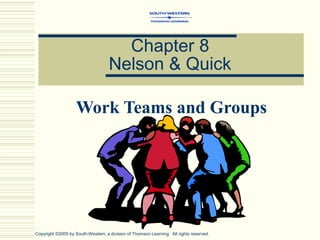
Chapter 8
Nelson & Quick
Work Teams and Groups
Copyright ©2005 by South-Western, a division of Thomson Learning. All rights reserved.
Groups & Teams
Group - two or more people with common
interests, objectives, and continuing interaction
Work Team - a group of people with
complementary skills who are committed to a
common mission, performance goals, and
approach for which they hold themselves
mutually accountable
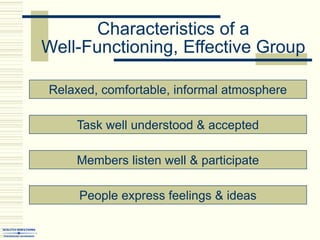
Characteristics of a
Well-Functioning, Effective Group
Relaxed, comfortable, informal atmosphere
Task well understood & accepted
People express feelings & ideas
Members listen well & participate
Characteristics of a
Well-Functioning, Effective Group
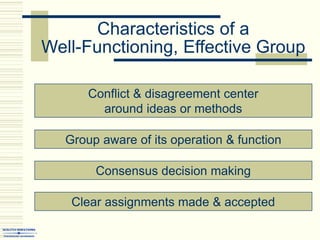
Consensus decision making
Conflict & disagreement center
around ideas or methods
Clear assignments made & accepted
Group aware of its operation & function
Group Behavior
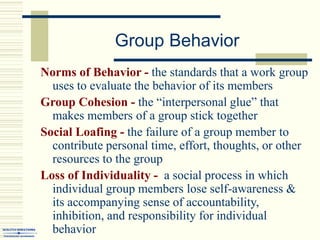
Norms of Behavior - the standards that a work group
uses to evaluate the behavior of its members
Group Cohesion - the “interpersonal glue” that
makes members of a group stick together
Social Loafing - the failure of a group member to
contribute personal time, effort, thoughts, or other
resources to the group
Loss of Individuality - a social process in which
individual group members lose self-awareness &
its accompanying sense of accountability,
inhibition, and responsibility for individual
behavior
Group Formation
Formal Groups -
official or assigned
groups gathered to
perform various tasks
 need ethnic, gender,
cultural, and
interpersonal
diversity
 need professional
and geographical
diversity
Informal Groups -
unofficial or emergent
groups that evolve in
the work setting to
gratify a variety of
member needs not met
by formal groups
Stages of Group Formation
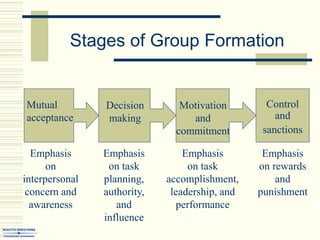
Mutual
acceptance
Emphasis
on
interpersonal
concern and
awareness
Motivation
and
commitment
Decision
making
Control
and
sanctions
Emphasis
on task
planning,
authority,
and
influence
Emphasis
on task
accomplishment,
leadership, and
performance
Emphasis
on rewards
and
punishment
Mature Group Characteristics
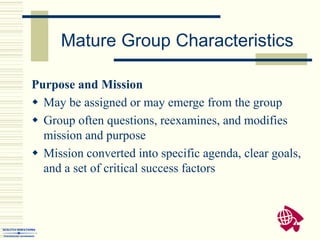
Purpose and Mission
 May be assigned or may emerge from the group
 Group often questions, reexamines, and modifies
mission and purpose
 Mission converted into specific agenda, clear goals,
and a set of critical success factors
Productivity Norms - may be consistent or
inconsistent, supportive or unsupportive of
organization’s productivity standards
Mature Group Characteristics
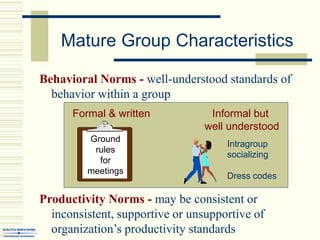
Behavioral Norms - well-understood standards of
behavior within a group
Formal & written
Ground
rules
for
meetings
Informal but
well understood
Intragroup
socializing
Dress codes
Mature Group Characteristics
Group Cohesion - interpersonal attraction binding
group members together
 Enables groups to exercise effective control over
the members
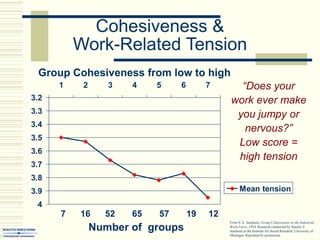
 Groups with high cohesiveness
 demonstrate lower tension & anxiety
 demonstrate less variation in productivity
 demonstrate better member satisfaction,
commitment, & communication
Cohesiveness &
Work-Related Tension
3.2
3.3
3.4
3.5
3.6
3.7
3.8
3.9
4
1 2 3 4 5 6 7
Mean tension
Group Cohesiveness from low to high
7 16 52 65 57 19 12
Number of groups
“Does your
work ever make
you jumpy or
nervous?”
Low score =
high tension
From S. E. Seashore, Group Cohesiveness in the Industrial
Work Force, 1954. Research conducted by Stanley E.
Seashore at the Institute for Social Research, University of
Michigan. Reprinted by permission.
Mature Group Characteristics
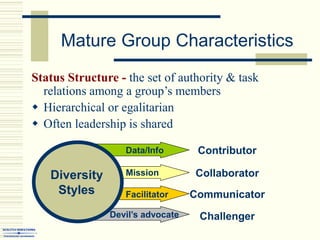
Status Structure - the set of authority & task
relations among a group’s members
 Hierarchical or egalitarian
 Often leadership is shared
Contributor
Data/Info
Collaborator
Mission
Communicator
Facilitator
Challenger
Devil’s advocate
Diversity
Styles
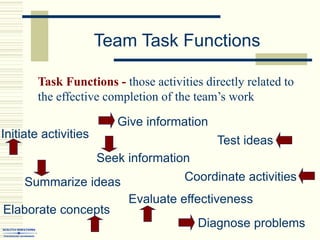
Team Task Functions
Task Functions - those activities directly related to
the effective completion of the team’s work
Initiate activities
Evaluate effectiveness
Elaborate concepts
Summarize ideas
Diagnose problems
Seek information
Give information
Test ideas
Coordinate activities
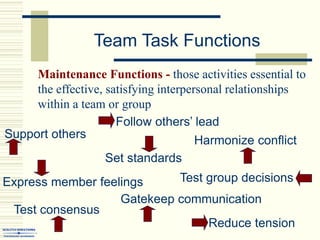
Team Task Functions
Maintenance Functions - those activities essential to
the effective, satisfying interpersonal relationships
within a team or group
Support others
Gatekeep communication
Test consensus
Express member feelings
Reduce tension
Set standards
Follow others’ lead
Harmonize conflict
Test group decisions
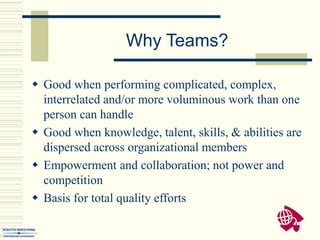
 Good when performing complicated, complex,
interrelated and/or more voluminous work than one
person can handle
 Good when knowledge, talent, skills, & abilities are
dispersed across organizational members
 Empowerment and collaboration; not power and
competition
 Basis for total quality efforts
Why Teams?
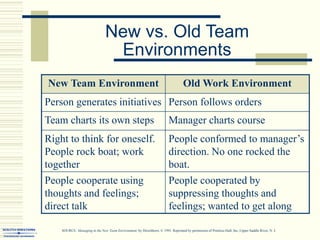
New vs. Old Team
Environments
New Team Environment Old Work Environment
Person generates initiatives Person follows orders
Team charts its own steps Manager charts course
Right to think for oneself.
People rock boat; work
together
People conformed to manager’s
direction. No one rocked the
boat.
People cooperate using
thoughts and feelings;
direct talk
People cooperated by
suppressing thoughts and
feelings; wanted to get along
SOURCE: Managing in the New Team Environment, by Hirschhorn, © 1991. Reprinted by permission of Prentice-Hall, Inc.,Upper Saddle River, N. J.
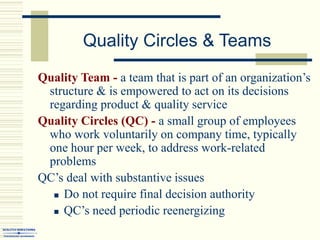
Quality Circles & Teams
Quality Team - a team that is part of an organization’s
structure & is empowered to act on its decisions
regarding product & quality service
Quality Circles (QC) - a small group of employees
who work voluntarily on company time, typically
one hour per week, to address work-related
problems
QC’s deal with substantive issues
 Do not require final decision authority
 QC’s need periodic reenergizing
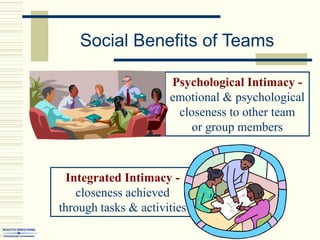
Social Benefits of Teams
Psychological Intimacy -
emotional & psychological
closeness to other team
or group members
Integrated Intimacy -
closeness achieved
through tasks & activities
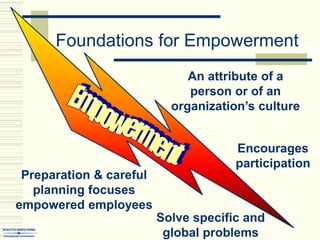
An attribute of a
person or of an
organization’s culture
Preparation & careful
planning focuses
empowered employees
Encourages
participation
Solve specific and
global problems
Foundations for Empowerment
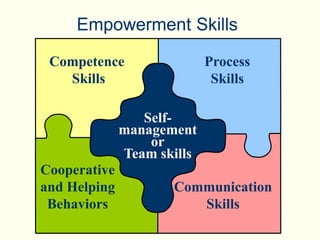
Empowerment Skills
Self-
management
or
Team skills
Process
Skills
Competence
Skills
Cooperative
and Helping
Behaviors
Communication
Skills
Self-Managed Teams
Self-Managed Teams - teams that make decisions
that were once reserved for managers
How does an organization capitalize
on the advantages and avoid the risks
of self managed teams?
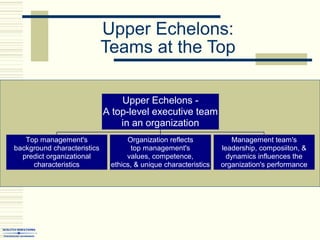
Upper Echelons:
Teams at the Top
Top management's
background characteristics
predict organizational
characteristics
Organization reflects
top management's
values, competence,
ethics, & unique characteristics
Management team's
leadership, composiiton, &
dynamics influences the
organization's performance
Upper Echelons -
A top-level executive team
in an organization
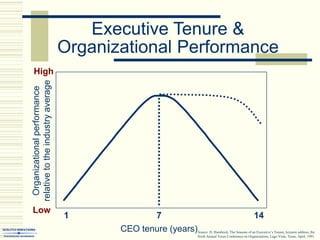
Executive Tenure &
Organizational Performance
Organizational
performance
relative
to
the
industry
average
High
Low
1 7 14
CEO tenure (years)Source: D. Hambrick, The Seasons of an Executive’s Tenure, keynote address, the
Sixth Annual Texas Conference on Organizations, Lago Vista, Texas, April, 1991.
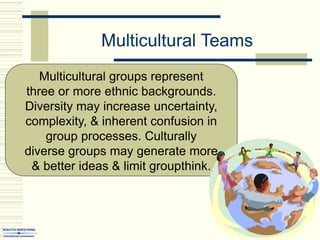
Multicultural Teams
Multicultural groups represent
three or more ethnic backgrounds.
Diversity may increase uncertainty,
complexity, & inherent confusion in
group processes. Culturally
diverse groups may generate more
& better ideas & limit groupthink.
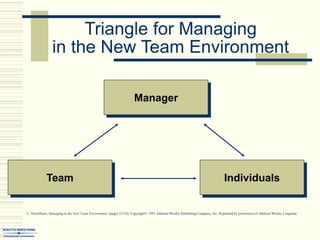
Triangle for Managing
in the New Team Environment
Manager
Individuals
Team
L. Hirschhorn, Managing in the New Team Environment, (pages 13/14). Copyright© 1991 Addison-Wesley Publishing Company, Inc. Reprinted by permission of Addison Wesley Longman.

tEAM MANAGEMENT PPT 1.ppt

  • 1.
    Chapter 8 Nelson &Quick Work Teams and Groups Copyright ©2005 by South-Western, a division of Thomson Learning. All rights reserved.
  • 2.
    Groups & Teams Group- two or more people with common interests, objectives, and continuing interaction Work Team - a group of people with complementary skills who are committed to a common mission, performance goals, and approach for which they hold themselves mutually accountable
  • 3.
    Characteristics of a Well-Functioning,Effective Group Relaxed, comfortable, informal atmosphere Task well understood & accepted People express feelings & ideas Members listen well & participate
  • 4.
    Characteristics of a Well-Functioning,Effective Group Consensus decision making Conflict & disagreement center around ideas or methods Clear assignments made & accepted Group aware of its operation & function
  • 5.
    Group Behavior Norms ofBehavior - the standards that a work group uses to evaluate the behavior of its members Group Cohesion - the “interpersonal glue” that makes members of a group stick together Social Loafing - the failure of a group member to contribute personal time, effort, thoughts, or other resources to the group Loss of Individuality - a social process in which individual group members lose self-awareness & its accompanying sense of accountability, inhibition, and responsibility for individual behavior
  • 6.
    Group Formation Formal Groups- official or assigned groups gathered to perform various tasks  need ethnic, gender, cultural, and interpersonal diversity  need professional and geographical diversity Informal Groups - unofficial or emergent groups that evolve in the work setting to gratify a variety of member needs not met by formal groups
  • 7.
    Stages of GroupFormation Mutual acceptance Emphasis on interpersonal concern and awareness Motivation and commitment Decision making Control and sanctions Emphasis on task planning, authority, and influence Emphasis on task accomplishment, leadership, and performance Emphasis on rewards and punishment
  • 8.
    Mature Group Characteristics Purposeand Mission  May be assigned or may emerge from the group  Group often questions, reexamines, and modifies mission and purpose  Mission converted into specific agenda, clear goals, and a set of critical success factors
  • 9.
    Productivity Norms -may be consistent or inconsistent, supportive or unsupportive of organization’s productivity standards Mature Group Characteristics Behavioral Norms - well-understood standards of behavior within a group Formal & written Ground rules for meetings Informal but well understood Intragroup socializing Dress codes
  • 10.
    Mature Group Characteristics GroupCohesion - interpersonal attraction binding group members together  Enables groups to exercise effective control over the members  Groups with high cohesiveness  demonstrate lower tension & anxiety  demonstrate less variation in productivity  demonstrate better member satisfaction, commitment, & communication
  • 11.
    Cohesiveness & Work-Related Tension 3.2 3.3 3.4 3.5 3.6 3.7 3.8 3.9 4 12 3 4 5 6 7 Mean tension Group Cohesiveness from low to high 7 16 52 65 57 19 12 Number of groups “Does your work ever make you jumpy or nervous?” Low score = high tension From S. E. Seashore, Group Cohesiveness in the Industrial Work Force, 1954. Research conducted by Stanley E. Seashore at the Institute for Social Research, University of Michigan. Reprinted by permission.
  • 12.
    Mature Group Characteristics StatusStructure - the set of authority & task relations among a group’s members  Hierarchical or egalitarian  Often leadership is shared Contributor Data/Info Collaborator Mission Communicator Facilitator Challenger Devil’s advocate Diversity Styles
  • 13.
    Team Task Functions TaskFunctions - those activities directly related to the effective completion of the team’s work Initiate activities Evaluate effectiveness Elaborate concepts Summarize ideas Diagnose problems Seek information Give information Test ideas Coordinate activities
  • 14.
    Team Task Functions MaintenanceFunctions - those activities essential to the effective, satisfying interpersonal relationships within a team or group Support others Gatekeep communication Test consensus Express member feelings Reduce tension Set standards Follow others’ lead Harmonize conflict Test group decisions
  • 15.
     Good whenperforming complicated, complex, interrelated and/or more voluminous work than one person can handle  Good when knowledge, talent, skills, & abilities are dispersed across organizational members  Empowerment and collaboration; not power and competition  Basis for total quality efforts Why Teams?
  • 16.
    New vs. OldTeam Environments New Team Environment Old Work Environment Person generates initiatives Person follows orders Team charts its own steps Manager charts course Right to think for oneself. People rock boat; work together People conformed to manager’s direction. No one rocked the boat. People cooperate using thoughts and feelings; direct talk People cooperated by suppressing thoughts and feelings; wanted to get along SOURCE: Managing in the New Team Environment, by Hirschhorn, © 1991. Reprinted by permission of Prentice-Hall, Inc.,Upper Saddle River, N. J.
  • 17.
    Quality Circles &Teams Quality Team - a team that is part of an organization’s structure & is empowered to act on its decisions regarding product & quality service Quality Circles (QC) - a small group of employees who work voluntarily on company time, typically one hour per week, to address work-related problems QC’s deal with substantive issues  Do not require final decision authority  QC’s need periodic reenergizing
  • 18.
    Social Benefits ofTeams Psychological Intimacy - emotional & psychological closeness to other team or group members Integrated Intimacy - closeness achieved through tasks & activities
  • 19.
    An attribute ofa person or of an organization’s culture Preparation & careful planning focuses empowered employees Encourages participation Solve specific and global problems Foundations for Empowerment
  • 20.
  • 21.
    Self-Managed Teams Self-Managed Teams- teams that make decisions that were once reserved for managers How does an organization capitalize on the advantages and avoid the risks of self managed teams?
  • 22.
    Upper Echelons: Teams atthe Top Top management's background characteristics predict organizational characteristics Organization reflects top management's values, competence, ethics, & unique characteristics Management team's leadership, composiiton, & dynamics influences the organization's performance Upper Echelons - A top-level executive team in an organization
  • 23.
    Executive Tenure & OrganizationalPerformance Organizational performance relative to the industry average High Low 1 7 14 CEO tenure (years)Source: D. Hambrick, The Seasons of an Executive’s Tenure, keynote address, the Sixth Annual Texas Conference on Organizations, Lago Vista, Texas, April, 1991.
  • 24.
    Multicultural Teams Multicultural groupsrepresent three or more ethnic backgrounds. Diversity may increase uncertainty, complexity, & inherent confusion in group processes. Culturally diverse groups may generate more & better ideas & limit groupthink.
  • 25.
    Triangle for Managing inthe New Team Environment Manager Individuals Team L. Hirschhorn, Managing in the New Team Environment, (pages 13/14). Copyright© 1991 Addison-Wesley Publishing Company, Inc. Reprinted by permission of Addison Wesley Longman.