CHAPTER 8:
MANAGING TEAMS
CH 8
© 2015 SAGE Publications
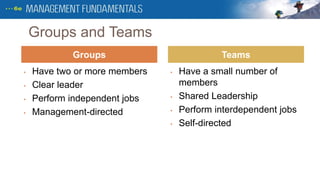
Groups and Teams
• Have two or more members
• Clear leader
• Perform independent jobs
• Management-directed
• Have a small number of
members
• Shared Leadership
• Perform interdependent jobs
• Self-directed
Groups Teams
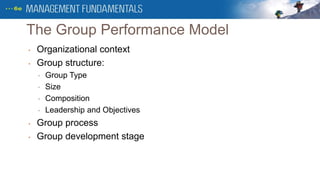
The Group Performance Model
• Organizational context
• Group structure:
• Group Type
• Size
• Composition
• Leadership and Objectives
• Group process
• Group development stage
Group Type
• Created by an organization
as part of its formal structure
• All employees have formal
group membership
• Large companies have formal
top managers leaders
• Are created
spontaneously
• Members join
together voluntarily
Formal Informal
• Members perform jobs
within one limited area
• Marketing, finance,
operation, and HR
departments are functional
groups
• From different areas
• From different levels of an
organization
• The higher the management
level, the more cross
functional responsibility
Functional Cross-Functional
Group Type
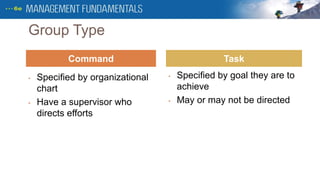
• Specified by organizational
chart
• Have a supervisor who
directs efforts
• Specified by goal they are to
achieve
• May or may not be directed
Command Task
Group Type
Group Size
• There is no ideal group size
• Depends on purpose, situation and type of work performed
• Size affects management
• Appropriate leadership style may depend on group size
• Management implications
• If you have a large department, you can break a larger group into teams
Group Composition,
Leadership & Objectives
• Group Composition
• The mix of members’ skills and abilities
• Group Leadership
• Leaders determine group structure and can affect team performance
• Group Objectives
• Apply for individuals and groups and teams set their own objectives
Group Process
• The patterns of interactions that emerge as members perform
their jobs
• Roles
• Norms
• Cohesiveness
• Status
• Decision making
• Conflict resolution
Group Roles
• Group task roles are played by members who do and say things that
directly aid in the accomplishment of the group’s objectives
• Group maintenance roles are played by members who do and say things
to develop and sustain the group process
• Self-interest roles are played by members who do and say things that help
themselves
Rules vs. Norms
• Rules
• Established by management or by the group itself
• Norms
• Expectations about behavior that are shared by members of a group
• Are not developed by management or by group
• Develop as members interact
Enforcement of Norms
• Breaking norms results in conflicts
• Peer pressure
• Powerful influence over our behavior
Group Cohesiveness
• Objectives
• Size
• Homogeneity
• Participation
• Competition
• Success
Stages of Groups Development
1. Forming
2. Storming
3. Norming
4. Performing
5. Adjourning/Termination
Management Styles
• Autocratic
• During the forming stage managers tells group what to do and how to do
it. Closely oversee their performance
• Consultative
• During the storming stage, managers are highly directive, oversee group
members performance, and need to be highly supportive
Management Styles
• Participative
• During the norming stage managers and group members share decision
making, and managers need to focus on maintenance behavior to get
the group through the issues it face
• Empowerment
• During the performing stage managers give group members the
authority to do the task in their own way, and the group has effective
shared leadership
Group Managers vs. Team Leaders
• Takes responsibility for
performing the four
management functions
(leading, planning, organizing
and staffing and controlling)
• Empowers members to take
responsibility for performing
management functions and
focus on developing effective
group structure and group
process, and on furthering
group development
Group Managers Team Leaders
The Management Functions
• Leading
• Teams do identify a specific person as the leader
• Planning
• Empower the members to set objectives and make decisions
• Organizing and Staffing
• Participate in selecting, evaluating and rewarding members is essential
• Controlling
• Help the team setting the standards and developing positive norms
Managing a Meeting
• Identify objectives
• Cover agenda items
• Summarize and review assignments

8 managing teams

  • 1.
    CHAPTER 8: MANAGING TEAMS CH8 © 2015 SAGE Publications
  • 2.
    Groups and Teams •Have two or more members • Clear leader • Perform independent jobs • Management-directed • Have a small number of members • Shared Leadership • Perform interdependent jobs • Self-directed Groups Teams
  • 3.
    The Group PerformanceModel • Organizational context • Group structure: • Group Type • Size • Composition • Leadership and Objectives • Group process • Group development stage
  • 4.
    Group Type • Createdby an organization as part of its formal structure • All employees have formal group membership • Large companies have formal top managers leaders • Are created spontaneously • Members join together voluntarily Formal Informal
  • 5.
    • Members performjobs within one limited area • Marketing, finance, operation, and HR departments are functional groups • From different areas • From different levels of an organization • The higher the management level, the more cross functional responsibility Functional Cross-Functional Group Type
  • 6.
    • Specified byorganizational chart • Have a supervisor who directs efforts • Specified by goal they are to achieve • May or may not be directed Command Task Group Type
  • 7.
    Group Size • Thereis no ideal group size • Depends on purpose, situation and type of work performed • Size affects management • Appropriate leadership style may depend on group size • Management implications • If you have a large department, you can break a larger group into teams
  • 8.
    Group Composition, Leadership &Objectives • Group Composition • The mix of members’ skills and abilities • Group Leadership • Leaders determine group structure and can affect team performance • Group Objectives • Apply for individuals and groups and teams set their own objectives
  • 9.
    Group Process • Thepatterns of interactions that emerge as members perform their jobs • Roles • Norms • Cohesiveness • Status • Decision making • Conflict resolution
  • 10.
    Group Roles • Grouptask roles are played by members who do and say things that directly aid in the accomplishment of the group’s objectives • Group maintenance roles are played by members who do and say things to develop and sustain the group process • Self-interest roles are played by members who do and say things that help themselves
  • 11.
    Rules vs. Norms •Rules • Established by management or by the group itself • Norms • Expectations about behavior that are shared by members of a group • Are not developed by management or by group • Develop as members interact
  • 12.
    Enforcement of Norms •Breaking norms results in conflicts • Peer pressure • Powerful influence over our behavior
  • 13.
    Group Cohesiveness • Objectives •Size • Homogeneity • Participation • Competition • Success
  • 14.
    Stages of GroupsDevelopment 1. Forming 2. Storming 3. Norming 4. Performing 5. Adjourning/Termination
  • 15.
    Management Styles • Autocratic •During the forming stage managers tells group what to do and how to do it. Closely oversee their performance • Consultative • During the storming stage, managers are highly directive, oversee group members performance, and need to be highly supportive
  • 16.
    Management Styles • Participative •During the norming stage managers and group members share decision making, and managers need to focus on maintenance behavior to get the group through the issues it face • Empowerment • During the performing stage managers give group members the authority to do the task in their own way, and the group has effective shared leadership
  • 17.
    Group Managers vs.Team Leaders • Takes responsibility for performing the four management functions (leading, planning, organizing and staffing and controlling) • Empowers members to take responsibility for performing management functions and focus on developing effective group structure and group process, and on furthering group development Group Managers Team Leaders
  • 18.
    The Management Functions •Leading • Teams do identify a specific person as the leader • Planning • Empower the members to set objectives and make decisions • Organizing and Staffing • Participate in selecting, evaluating and rewarding members is essential • Controlling • Help the team setting the standards and developing positive norms
  • 19.
    Managing a Meeting •Identify objectives • Cover agenda items • Summarize and review assignments

Editor's Notes

  • #14 Group Cohesiveness is the extent to which members stick together. The more cohesive the group, the more sticks together-bond-as a team.