Principles of Scientific Method Its Applications to Anthropology
Principles of Anthropological Method There are tenets common to all anthropological research Examples: Cultural Relativism (Various Definition) versus Ethnocentrism There are also tenets basic to all scientific research In this case, they involve careful data gathering and logical reasoning—in anthropology or in any other scientific discipline. In that way, information should be reliable and reflect what actually happens, whether in the field or in the lab. Let’s discuss these in turn.
Anthropological Method I: Fundamental Principles Holism:  All aspects of a culture  must be considered, especially their interconnections Cross-Cultural Comparison : Comparison of similar cultural traits in two or more cultures Cultural Relativism: Two Interpretations Scientific detachment: One observes what is out there—even cannibalism--dispassionately Noble savage complex: Involves acceptance of a culture according to its own standards—including cannibalism.
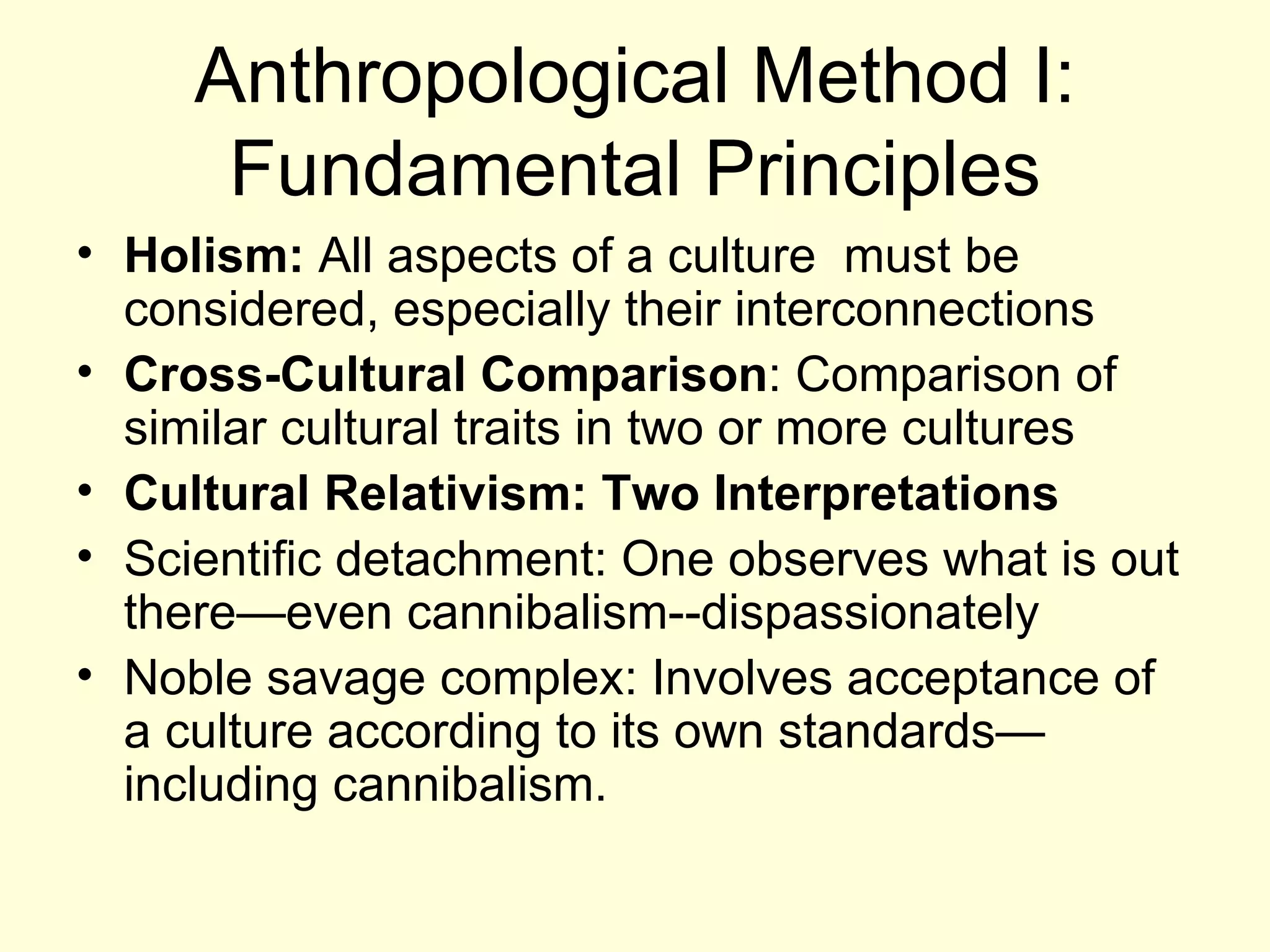
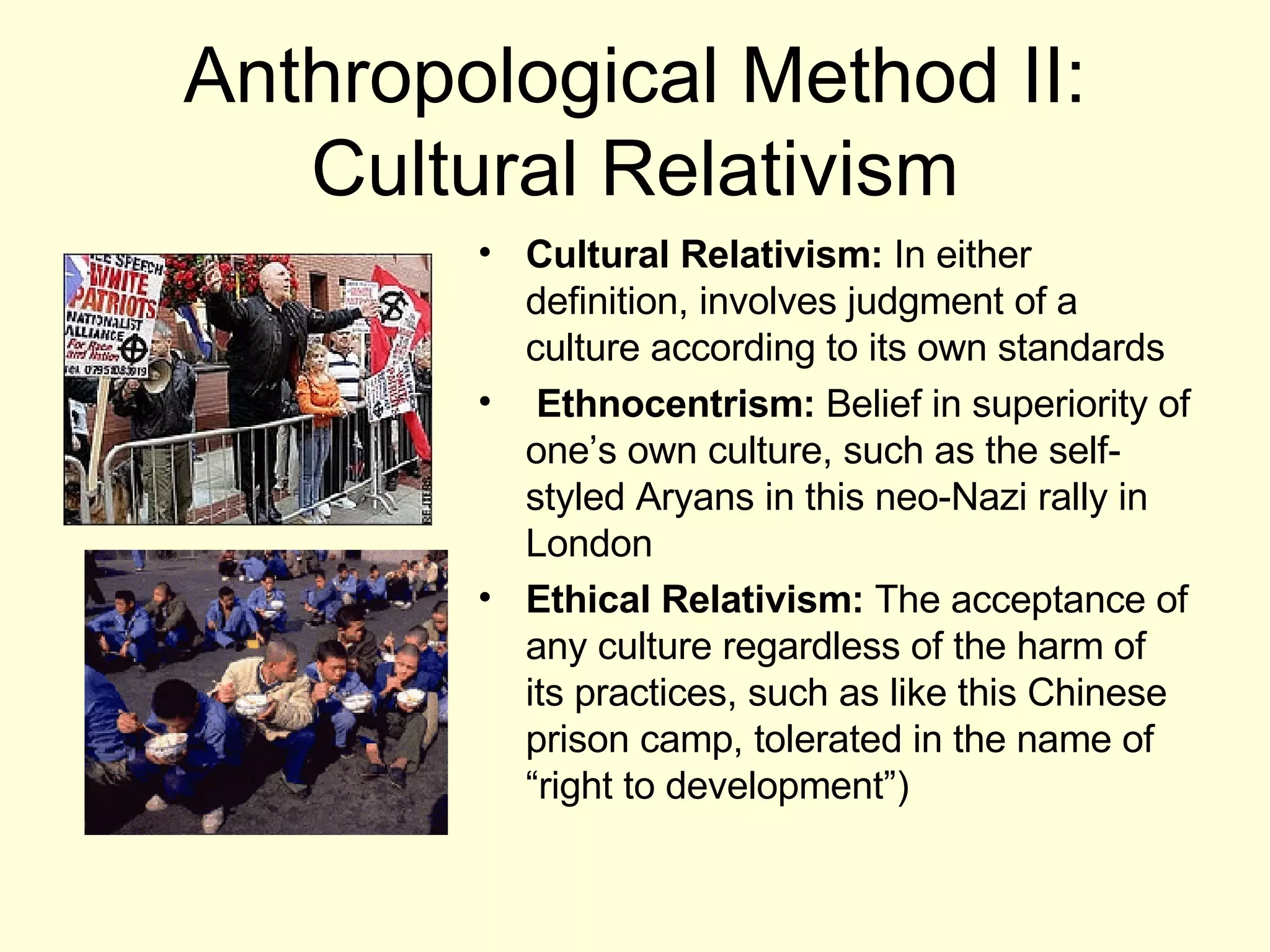
Anthropological Method II: Cultural Relativism Cultural Relativism:  In either definition, involves judgment of a culture according to its own standards Ethnocentrism:  Belief in superiority of one’s own culture, such as the self-styled Aryans in this neo-Nazi rally in London Ethical Relativism:  The acceptance of any culture regardless of the harm of its practices, such as like this Chinese prison camp, tolerated in the name of  “right to development”)
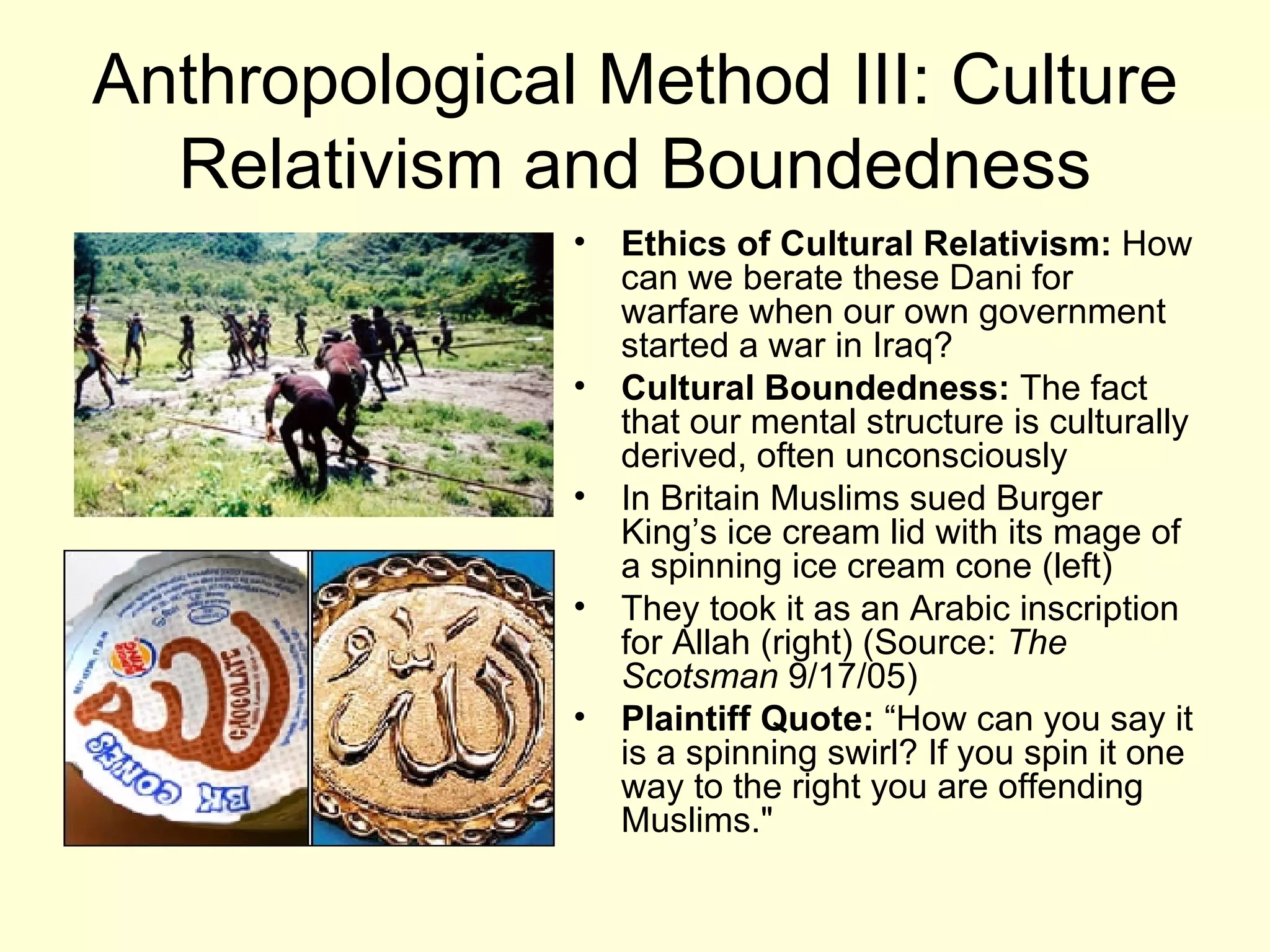
Anthropological Method III: Culture Relativism and Boundedness Ethics of Cultural Relativism:  How can we berate these Dani for warfare when our own government started a war in Iraq? Cultural Boundedness:  The fact that our mental structure is culturally derived, often unconsciously In Britain Muslims sued Burger King’s ice cream lid with its mage of a spinning ice cream cone (left) They took it as an Arabic inscription for Allah (right) (Source:  The Scotsman  9/17/05) Plaintiff Quote:  “How can you say it is a spinning swirl? If you spin it one way to the right you are offending Muslims."
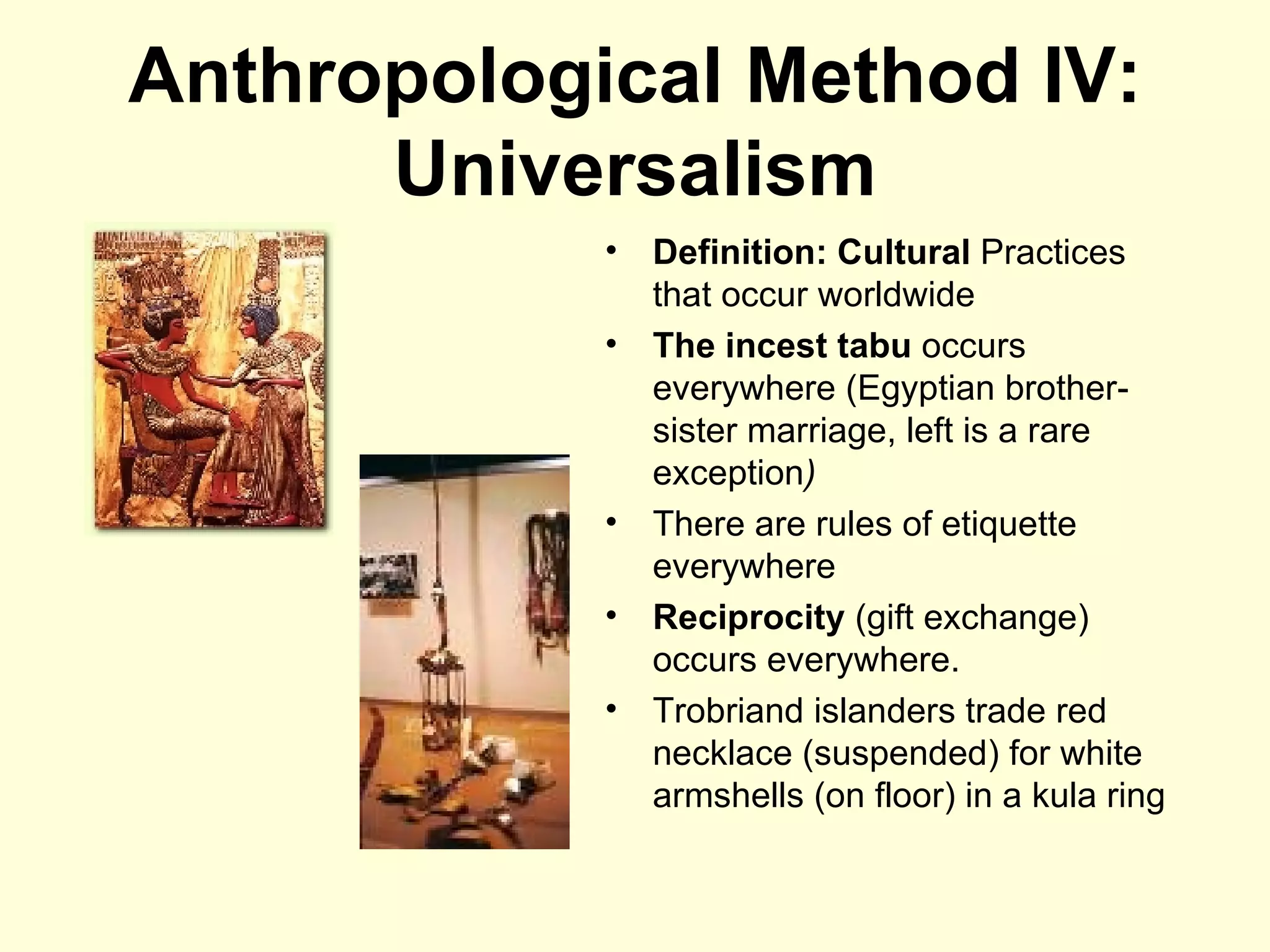
Anthropological Method IV: Universalism Definition: Cultural  Practices that occur worldwide The incest tabu  occurs everywhere   (Egyptian brother-sister marriage, left is a rare exception ) There are rules of etiquette everywhere Reciprocity  (gift exchange) occurs everywhere. Trobriand islanders trade red necklace (suspended) for white armshells (on floor) in a kula ring
Principles of Science Science involves two principles: Its practitioners seek principles that predict recurring events. As scientific method, it also sets forth a body of techniques for investigating phenomena, obtaining new knowledge, and correcting or confirming previous knowledge It is based on obtaining observable, empirical, and measurable evidence according to specific rules of reasoning We look at some of the basic concepts of scientific method
Some Basic Terms of Science Hypothesis : An educated guess explaining some thing or event that is observed in the lab or field Theory:  A hypothesis confirmed by these observations Induction  entails identifying patterns of knowledge from field observations or lab experiments Abduction  entails formulating hypotheses from the knowledge inferred from observations or experiments Deduction  predicts what should occur based on confirmed body of facts, principles, or beliefs
Some Basic Terms of Scientific Research I Sample : Part of a population selected for research Random sample:  A sample in which everyone has a chance of being included But random samples do not ensure that all groups, especially small ones, will be selected Representative sample : A sample in which all groups are included for research Universe:  Total population from which the sample is drawn
Some Basic Terms of Scientific Research II Bias:  Use of any technique that fails to elicit a random or representative sample For example, is a sample of enrollees who use online registration a biased one? Techniques:  Procedures used to gather information (observations, interviews, but also the use of videos, CD recorders, GPS mapping devices, and so on ) Method:  Scientific justification for selection of a technique Methodology:  Overall plan that forms a coherent relation among the methods and the techniques they generate
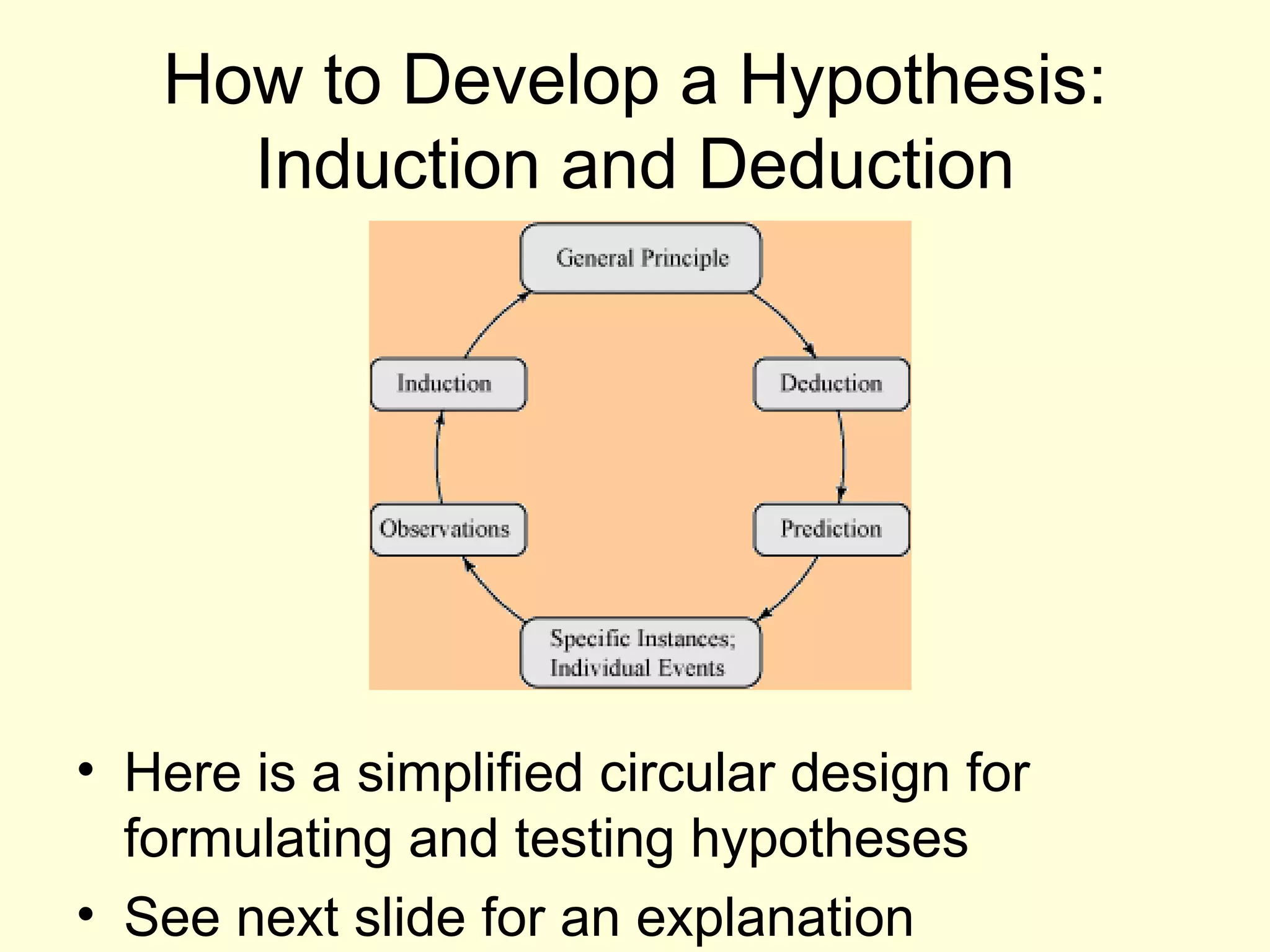
How to Develop a Hypothesis: Induction and Deduction Here is a simplified circular design for formulating and testing hypotheses See next slide for an explanation
The Phases of Scientific Method Phase 1: Observe Things/Events in Field Phase 2: Develop an explanation (hypothesis) using the inductive process Phase 3: Gather relevant data Phase 4: Evaluate hypothesis with data. Phase 5: Repeat procedure if a hypothesis is confirmed only in part or disconfirmed
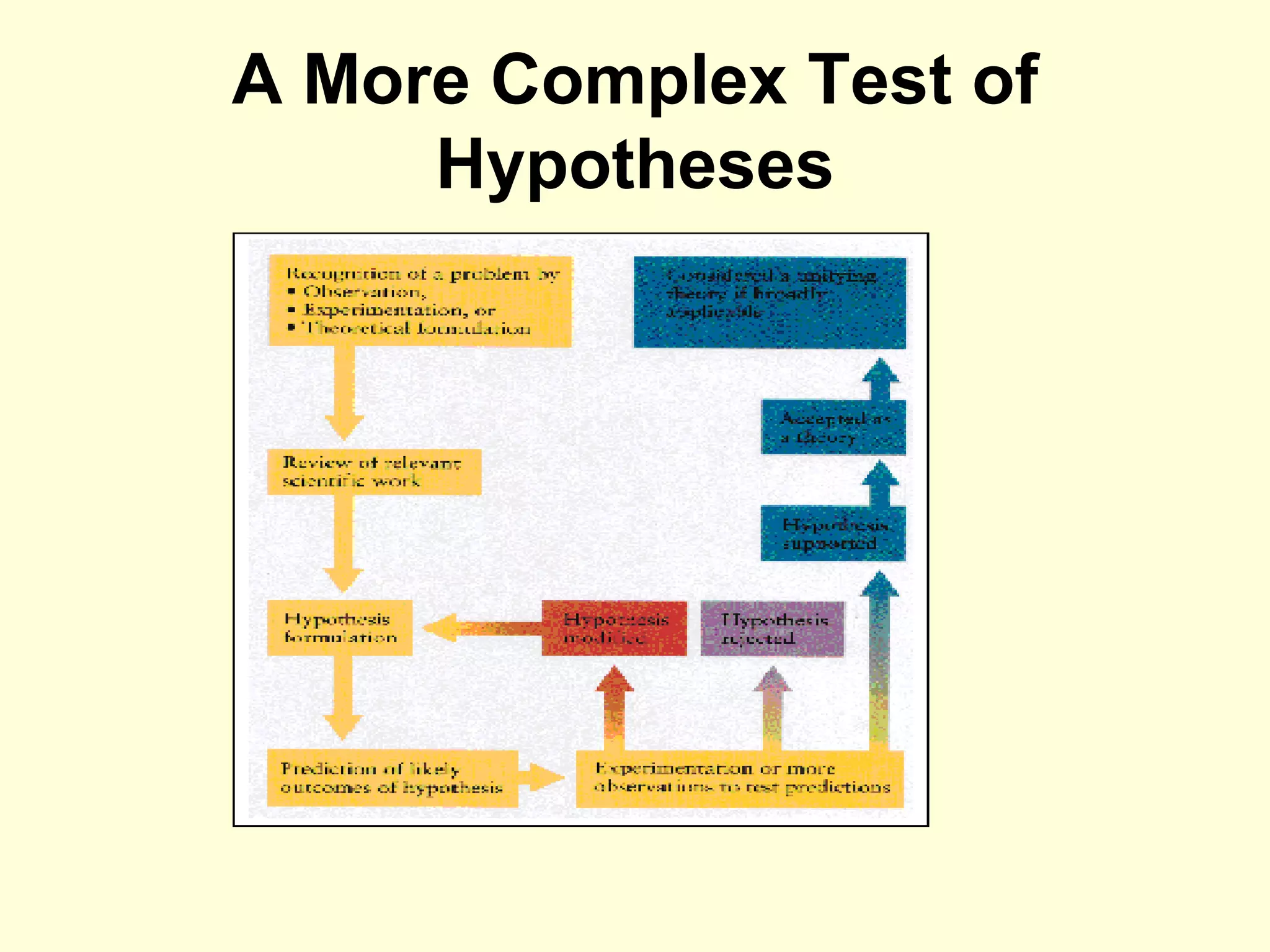
A More Complex Test of Hypotheses
Formulating and Testing a  Hypothesis The inductive/abductive process is shown in yellow It involves recognition of a research problem by (a) field observation, (b) experimentation, and/or (c) theory development Next comes consultation of existing sources Then the scientist formulates a hypothesis The expected outcomes are then specified if the hypothesis is confirmed  Finally, the observations and/or experiments are conducted to test the expected outcomes
Consequences of Each Outcome The hypothesis may be modified (red) or rejected (purple) Further developments occur when the hypothesis is confirmed (purple) The hypothesis becomes a theory if confirmed repeatedly It becomes a unifying of theory if the theory is widely supported and applied
Scientific Method as Probabilistic Any theory can be tossed as new information comes in. If a new hypothesis explains existing data better, then the old hypothesis make way for the new Therefore, all theories are probabilistic and none can be stated with finality
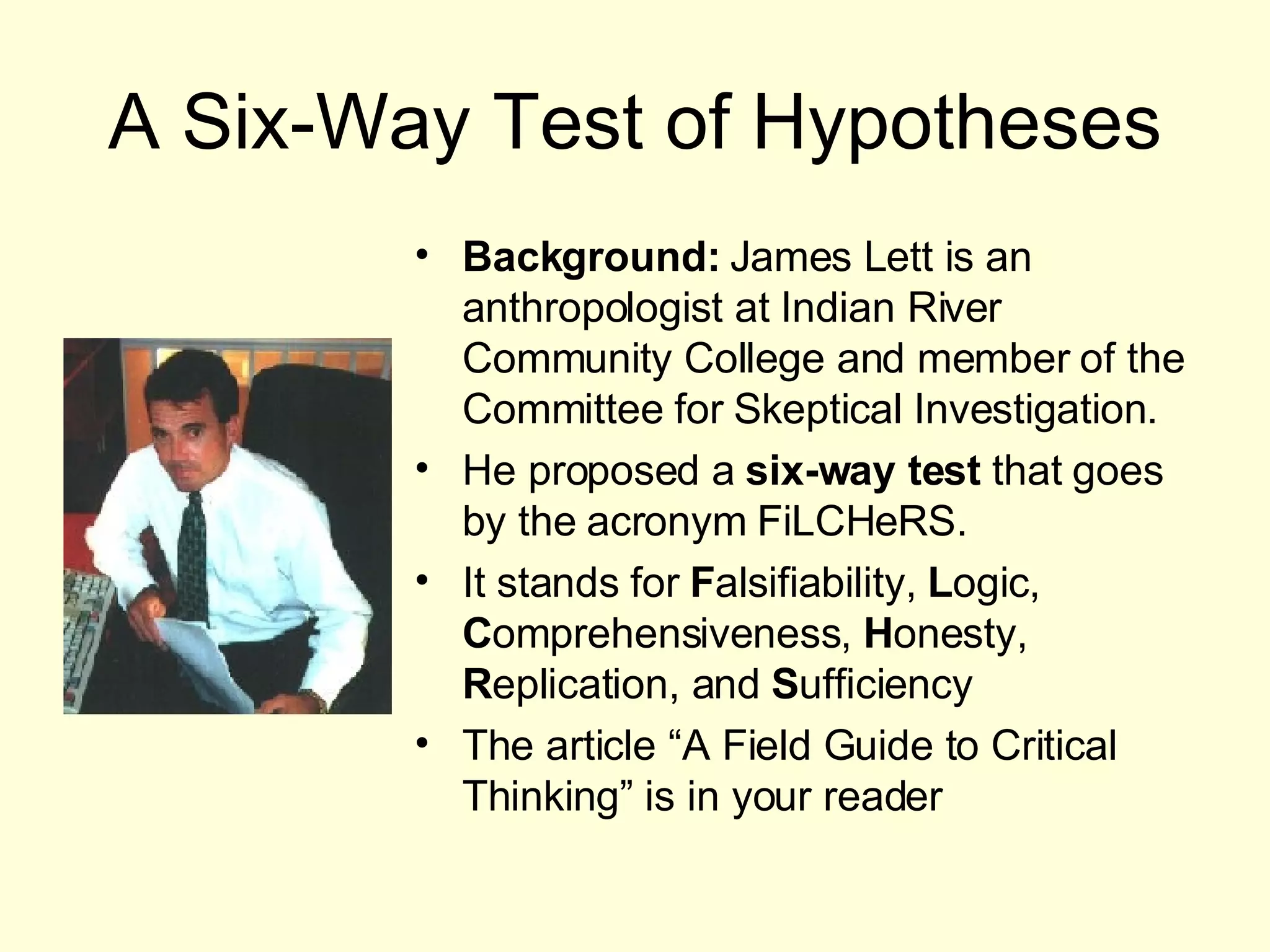
A Six-Way Test of Hypotheses Background:  James Lett is an anthropologist at Indian River Community College and member of the Committee for Skeptical Investigation. He proposed a  six-way test  that goes by the acronym FiLCHeRS. It stands for  F alsifiability,  L ogic,  C omprehensiveness,  H onesty,  R eplication, and  S ufficiency The article “A Field Guide to Critical Thinking” is in your reader
Falsifiability Does not mean to cook or fudge the data The hypothesis must be so stated that if unsupported it is rejected (or falsified) Thus, it must specify the conditions under which it is rejected.
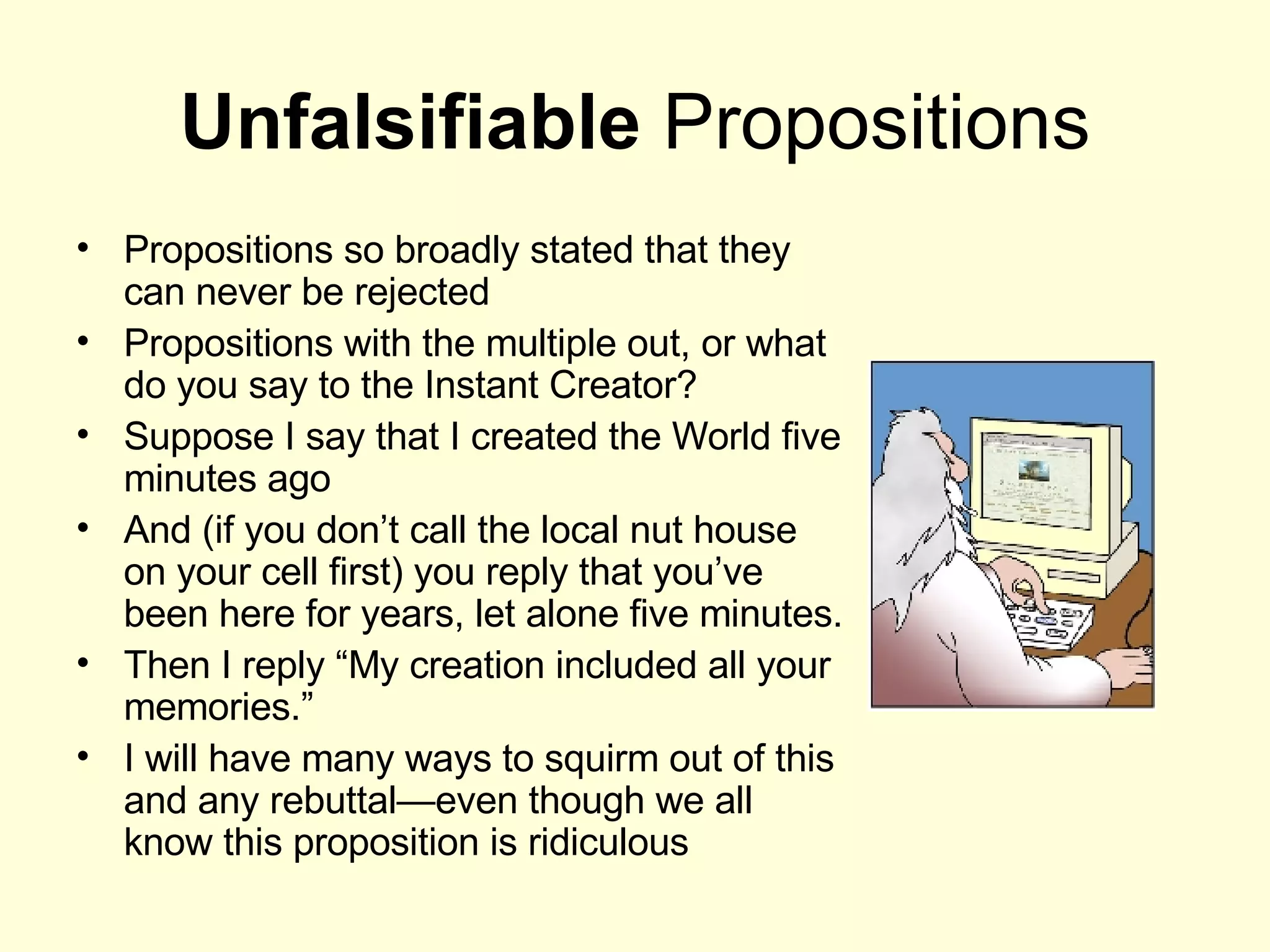
Unfalsifiable  Propositions Propositions so broadly stated that they can never be rejected Propositions with the multiple out, or what do you say to the Instant Creator? Suppose I say that I created the World five minutes ago And (if you don’t call the local nut house on your cell first) you reply that you’ve been here for years, let alone five minutes. Then I reply “My creation included all your memories.” I will have many ways to squirm out of this and any rebuttal—even though we all know this proposition is ridiculous
Logic As you know, there are two basic kinds of logic: inductive and deductive Inductive: gathering enough facts to lead to a conclusion.  Deductive: Starting at a major premise and reasoning down to a minor premise then a conclusion.  Lett argues from the deductive.
Logic (Continued) Basic statement:  Any argument offered as evidence in support of any claim must be both: Valid:  follow from accepted propositions of real life or of math, such as the postulate that a straight line is the shortest distance between two points, and Sound:  that is, the proposition must be true For further details, see your textbook (Ch. 2) or reader (Selection 2)
Comprehensiveness Evidence offered in support of any claim must be exhaustive All relevant evidence must be considered Opposite practice: Selective presentation of evidence that supports the claim Example: political promises, courtroom tactics, even stockbroker “predictions” rely on selective use of the facts for support. Remember George Bush’s “Mission Accomplished” claim about the Iraq invasion on May 1, 2003? Need I say more?
Honesty Evidence must be evaluated without either self-deception or intent to deceive Examples of temptations toward dishonesty Strong incentives such as funding to support pet theories Basic fault of advocacy groups, politicians, and lawyers Honesty could only lead to better hypotheses--i.e. to better explain facts
Replicability Positive results on one field study or lab experiment is not enough to verify a hypothesis. To verify positive results, the experiment or field research must be repeated under identical conditions.  Lab experiments fit the demand for replication because the conditions and procedures can be controlled so that they duplicate the first experiment exactly.
Replicability and Anthropology In ethnographic field work, restudies conducted in communities studied in earlier years to verify conclusions from the previous study. Restudies haven’t done well when it comes to replication Lewis v. Redfield in  Tepoztlan, Mexico,  is one example.  Robert Redfield  concluded in 1926 that Tepoztlan was a peaceful village In 1943,  Oscar Lewis  demonstrated that there was fractious conflict between groups: the bosses versus the other villagers, the factions on both sides of the Mexican revolution (1910-1920) For a summary in an article footnote, log on to:  http://books.google.com/books?id=uSMmA3Z0k5QC&pg=PA112&lpg=PA112&dq=%22redfield+lewis%22+controversy+on+tepoztlan&source=web&ots=1iaamQw8Dg&sig=Ei8bhu4WeUWOvAgAnfny6ZGw1YU#PPP9,M1
Restudies and the Mead-Freeman Controversy In 1928,  Margaret Mead  wrote  Coming of Age in Samoa ,  which claimed that teenagers engage in promiscuous sex and grew up without turmoil and rebelliousness The book was a long-term best seller and a great influence on anthropology In 1983,  Derek Freeman  wrote  Margaret Mead and Samoa , a refutation of Mead’s conclusions and showing that the Samoans were indeed puritanical about sex.  The debate that followed is summed up in the following two You Tube links:  http://www.youtube.com/watch?v=LFdaW1kZOaA&feature=related  and  http://www.youtube.com/watch?v=XDLyQb5Pd3w I recommend you view all six of this series,  Tales from the Jungle: Margaret Mead,  all on YouTube.
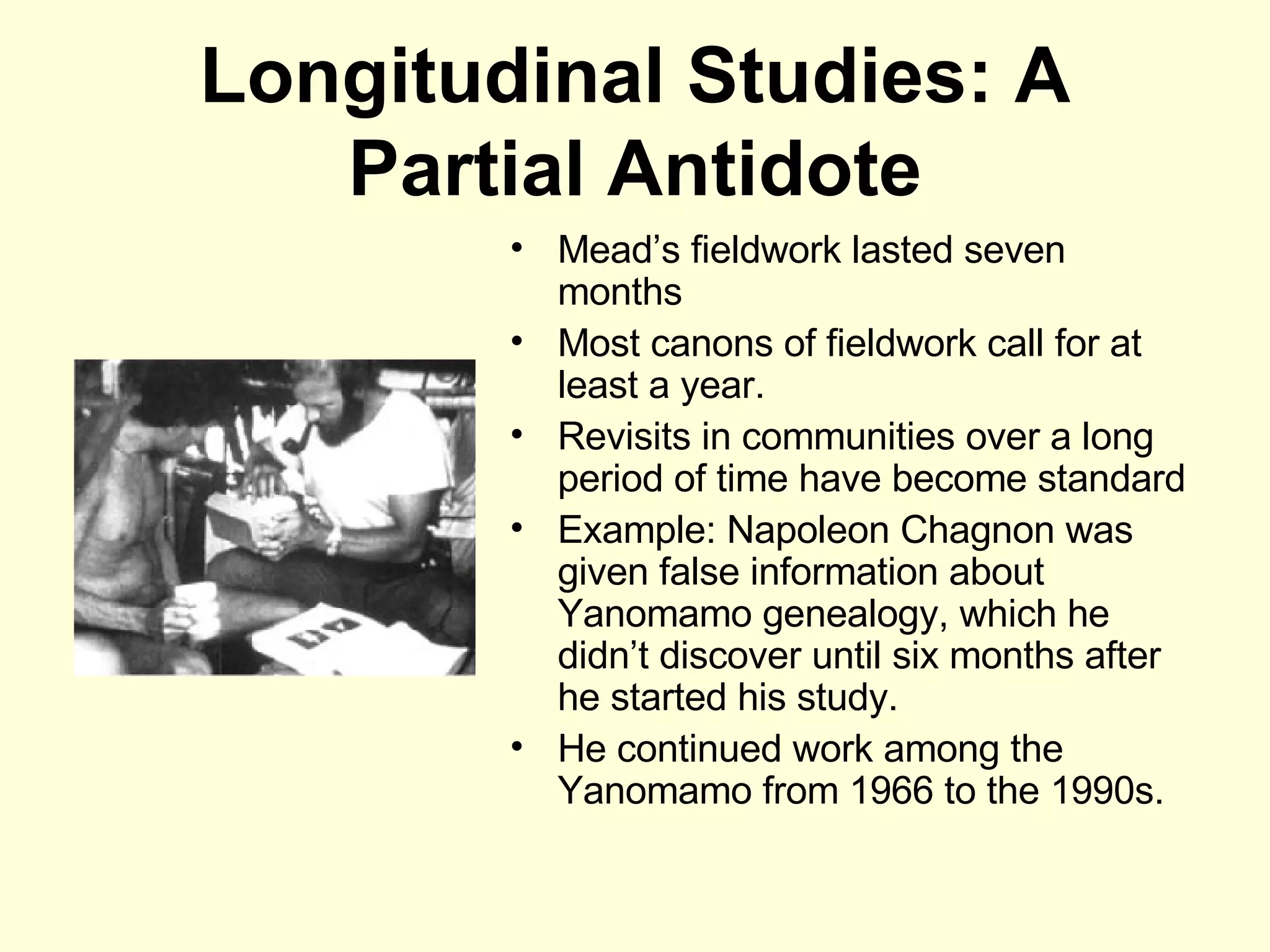
Longitudinal Studies: A Partial Antidote Mead’s fieldwork lasted seven months Most canons of fieldwork call for at least a year. Revisits in communities over a long period of time have become standard Example: Napoleon Chagnon was given false information about Yanomamo genealogy, which he didn’t discover until six months after he started his study. He continued work among the Yanomamo from 1966 to the 1990s.
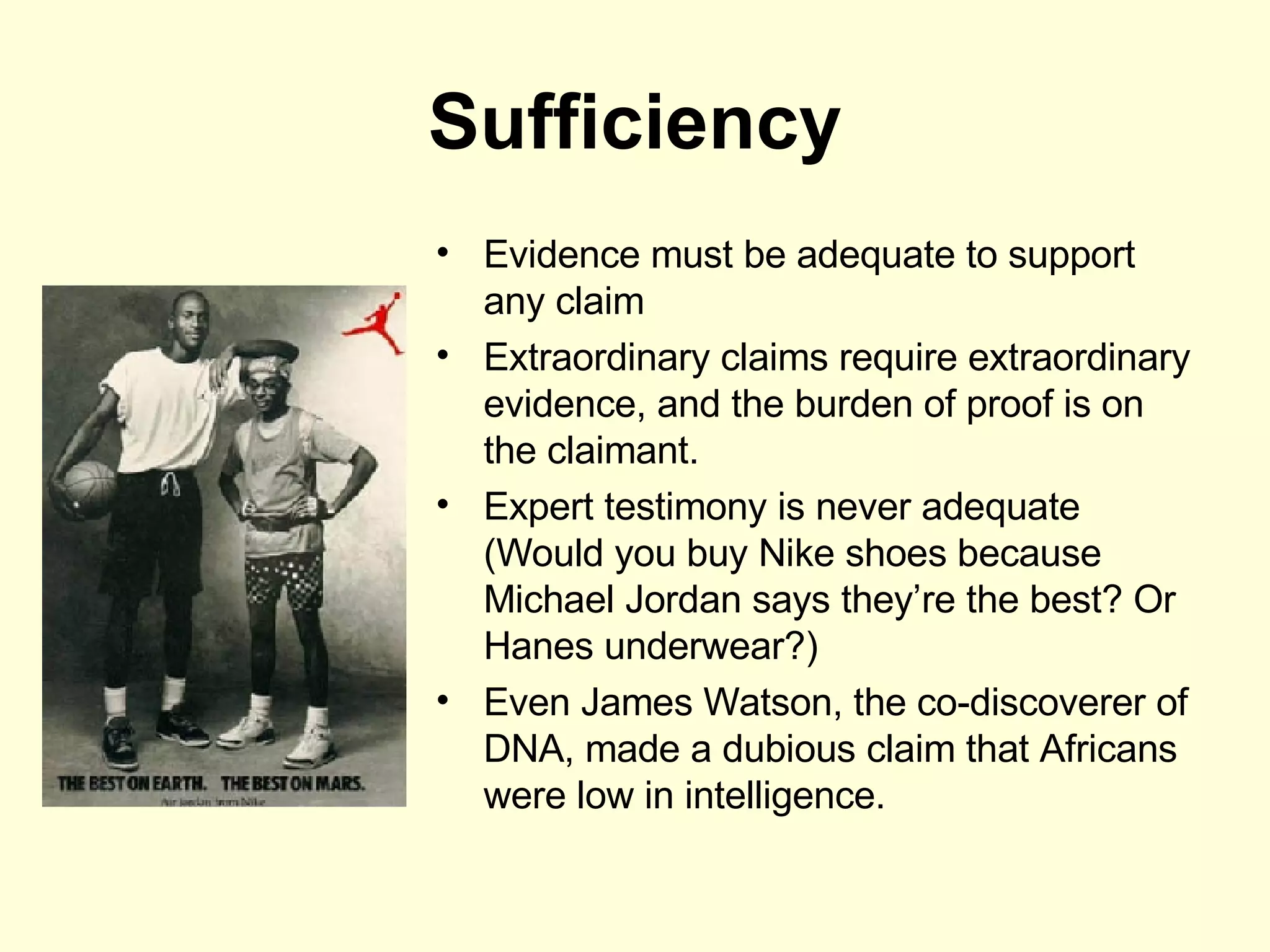
Sufficiency Evidence must be adequate to support any claim Extraordinary claims require extraordinary evidence, and the burden of proof is on the claimant. Expert testimony is never adequate (Would you buy Nike shoes because Michael Jordan says they’re the best? Or Hanes underwear?) Even James Watson, the co-discoverer of DNA, made a dubious claim that Africans were low in intelligence.
Welcome Back to the Real World The tests demand  a perfect world Real world: the field where ethnographic research is conducted is not a lab Homo sapiens have the same hardware worldwide—brain, bipedalism, tool making and use capacities But individuals and cultures vary The compromise involves a combination of careful preparation and observation, but always being flexible when circumstances affecting fieldwork change.
Conclusion First aim: to develop generalizations that apply to all societies Second aim: to explain the diversity of cultures Research must therefore meet rigorous standards, such as Lett’s Six-Way Test

Princiiples of Scientific Method in Anthropology

  • 1.
    Principles of ScientificMethod Its Applications to Anthropology
  • 2.
    Principles of AnthropologicalMethod There are tenets common to all anthropological research Examples: Cultural Relativism (Various Definition) versus Ethnocentrism There are also tenets basic to all scientific research In this case, they involve careful data gathering and logical reasoning—in anthropology or in any other scientific discipline. In that way, information should be reliable and reflect what actually happens, whether in the field or in the lab. Let’s discuss these in turn.
  • 3.
    Anthropological Method I:Fundamental Principles Holism: All aspects of a culture must be considered, especially their interconnections Cross-Cultural Comparison : Comparison of similar cultural traits in two or more cultures Cultural Relativism: Two Interpretations Scientific detachment: One observes what is out there—even cannibalism--dispassionately Noble savage complex: Involves acceptance of a culture according to its own standards—including cannibalism.
  • 4.
    Anthropological Method II:Cultural Relativism Cultural Relativism: In either definition, involves judgment of a culture according to its own standards Ethnocentrism: Belief in superiority of one’s own culture, such as the self-styled Aryans in this neo-Nazi rally in London Ethical Relativism: The acceptance of any culture regardless of the harm of its practices, such as like this Chinese prison camp, tolerated in the name of “right to development”)
  • 5.
    Anthropological Method III:Culture Relativism and Boundedness Ethics of Cultural Relativism: How can we berate these Dani for warfare when our own government started a war in Iraq? Cultural Boundedness: The fact that our mental structure is culturally derived, often unconsciously In Britain Muslims sued Burger King’s ice cream lid with its mage of a spinning ice cream cone (left) They took it as an Arabic inscription for Allah (right) (Source: The Scotsman 9/17/05) Plaintiff Quote: “How can you say it is a spinning swirl? If you spin it one way to the right you are offending Muslims."
  • 6.
    Anthropological Method IV:Universalism Definition: Cultural Practices that occur worldwide The incest tabu occurs everywhere (Egyptian brother-sister marriage, left is a rare exception ) There are rules of etiquette everywhere Reciprocity (gift exchange) occurs everywhere. Trobriand islanders trade red necklace (suspended) for white armshells (on floor) in a kula ring
  • 7.
    Principles of ScienceScience involves two principles: Its practitioners seek principles that predict recurring events. As scientific method, it also sets forth a body of techniques for investigating phenomena, obtaining new knowledge, and correcting or confirming previous knowledge It is based on obtaining observable, empirical, and measurable evidence according to specific rules of reasoning We look at some of the basic concepts of scientific method
  • 8.
    Some Basic Termsof Science Hypothesis : An educated guess explaining some thing or event that is observed in the lab or field Theory: A hypothesis confirmed by these observations Induction entails identifying patterns of knowledge from field observations or lab experiments Abduction entails formulating hypotheses from the knowledge inferred from observations or experiments Deduction predicts what should occur based on confirmed body of facts, principles, or beliefs
  • 9.
    Some Basic Termsof Scientific Research I Sample : Part of a population selected for research Random sample: A sample in which everyone has a chance of being included But random samples do not ensure that all groups, especially small ones, will be selected Representative sample : A sample in which all groups are included for research Universe: Total population from which the sample is drawn
  • 10.
    Some Basic Termsof Scientific Research II Bias: Use of any technique that fails to elicit a random or representative sample For example, is a sample of enrollees who use online registration a biased one? Techniques: Procedures used to gather information (observations, interviews, but also the use of videos, CD recorders, GPS mapping devices, and so on ) Method: Scientific justification for selection of a technique Methodology: Overall plan that forms a coherent relation among the methods and the techniques they generate
  • 11.
    How to Developa Hypothesis: Induction and Deduction Here is a simplified circular design for formulating and testing hypotheses See next slide for an explanation
  • 12.
    The Phases ofScientific Method Phase 1: Observe Things/Events in Field Phase 2: Develop an explanation (hypothesis) using the inductive process Phase 3: Gather relevant data Phase 4: Evaluate hypothesis with data. Phase 5: Repeat procedure if a hypothesis is confirmed only in part or disconfirmed
  • 13.
    A More ComplexTest of Hypotheses
  • 14.
    Formulating and Testinga Hypothesis The inductive/abductive process is shown in yellow It involves recognition of a research problem by (a) field observation, (b) experimentation, and/or (c) theory development Next comes consultation of existing sources Then the scientist formulates a hypothesis The expected outcomes are then specified if the hypothesis is confirmed Finally, the observations and/or experiments are conducted to test the expected outcomes
  • 15.
    Consequences of EachOutcome The hypothesis may be modified (red) or rejected (purple) Further developments occur when the hypothesis is confirmed (purple) The hypothesis becomes a theory if confirmed repeatedly It becomes a unifying of theory if the theory is widely supported and applied
  • 16.
    Scientific Method asProbabilistic Any theory can be tossed as new information comes in. If a new hypothesis explains existing data better, then the old hypothesis make way for the new Therefore, all theories are probabilistic and none can be stated with finality
  • 17.
    A Six-Way Testof Hypotheses Background: James Lett is an anthropologist at Indian River Community College and member of the Committee for Skeptical Investigation. He proposed a six-way test that goes by the acronym FiLCHeRS. It stands for F alsifiability, L ogic, C omprehensiveness, H onesty, R eplication, and S ufficiency The article “A Field Guide to Critical Thinking” is in your reader
  • 18.
    Falsifiability Does notmean to cook or fudge the data The hypothesis must be so stated that if unsupported it is rejected (or falsified) Thus, it must specify the conditions under which it is rejected.
  • 19.
    Unfalsifiable PropositionsPropositions so broadly stated that they can never be rejected Propositions with the multiple out, or what do you say to the Instant Creator? Suppose I say that I created the World five minutes ago And (if you don’t call the local nut house on your cell first) you reply that you’ve been here for years, let alone five minutes. Then I reply “My creation included all your memories.” I will have many ways to squirm out of this and any rebuttal—even though we all know this proposition is ridiculous
  • 20.
    Logic As youknow, there are two basic kinds of logic: inductive and deductive Inductive: gathering enough facts to lead to a conclusion. Deductive: Starting at a major premise and reasoning down to a minor premise then a conclusion. Lett argues from the deductive.
  • 21.
    Logic (Continued) Basicstatement: Any argument offered as evidence in support of any claim must be both: Valid: follow from accepted propositions of real life or of math, such as the postulate that a straight line is the shortest distance between two points, and Sound: that is, the proposition must be true For further details, see your textbook (Ch. 2) or reader (Selection 2)
  • 22.
    Comprehensiveness Evidence offeredin support of any claim must be exhaustive All relevant evidence must be considered Opposite practice: Selective presentation of evidence that supports the claim Example: political promises, courtroom tactics, even stockbroker “predictions” rely on selective use of the facts for support. Remember George Bush’s “Mission Accomplished” claim about the Iraq invasion on May 1, 2003? Need I say more?
  • 23.
    Honesty Evidence mustbe evaluated without either self-deception or intent to deceive Examples of temptations toward dishonesty Strong incentives such as funding to support pet theories Basic fault of advocacy groups, politicians, and lawyers Honesty could only lead to better hypotheses--i.e. to better explain facts
  • 24.
    Replicability Positive resultson one field study or lab experiment is not enough to verify a hypothesis. To verify positive results, the experiment or field research must be repeated under identical conditions. Lab experiments fit the demand for replication because the conditions and procedures can be controlled so that they duplicate the first experiment exactly.
  • 25.
    Replicability and AnthropologyIn ethnographic field work, restudies conducted in communities studied in earlier years to verify conclusions from the previous study. Restudies haven’t done well when it comes to replication Lewis v. Redfield in Tepoztlan, Mexico, is one example. Robert Redfield concluded in 1926 that Tepoztlan was a peaceful village In 1943, Oscar Lewis demonstrated that there was fractious conflict between groups: the bosses versus the other villagers, the factions on both sides of the Mexican revolution (1910-1920) For a summary in an article footnote, log on to: http://books.google.com/books?id=uSMmA3Z0k5QC&pg=PA112&lpg=PA112&dq=%22redfield+lewis%22+controversy+on+tepoztlan&source=web&ots=1iaamQw8Dg&sig=Ei8bhu4WeUWOvAgAnfny6ZGw1YU#PPP9,M1
  • 26.
    Restudies and theMead-Freeman Controversy In 1928, Margaret Mead wrote Coming of Age in Samoa , which claimed that teenagers engage in promiscuous sex and grew up without turmoil and rebelliousness The book was a long-term best seller and a great influence on anthropology In 1983, Derek Freeman wrote Margaret Mead and Samoa , a refutation of Mead’s conclusions and showing that the Samoans were indeed puritanical about sex. The debate that followed is summed up in the following two You Tube links: http://www.youtube.com/watch?v=LFdaW1kZOaA&feature=related and http://www.youtube.com/watch?v=XDLyQb5Pd3w I recommend you view all six of this series, Tales from the Jungle: Margaret Mead, all on YouTube.
  • 27.
    Longitudinal Studies: APartial Antidote Mead’s fieldwork lasted seven months Most canons of fieldwork call for at least a year. Revisits in communities over a long period of time have become standard Example: Napoleon Chagnon was given false information about Yanomamo genealogy, which he didn’t discover until six months after he started his study. He continued work among the Yanomamo from 1966 to the 1990s.
  • 28.
    Sufficiency Evidence mustbe adequate to support any claim Extraordinary claims require extraordinary evidence, and the burden of proof is on the claimant. Expert testimony is never adequate (Would you buy Nike shoes because Michael Jordan says they’re the best? Or Hanes underwear?) Even James Watson, the co-discoverer of DNA, made a dubious claim that Africans were low in intelligence.
  • 29.
    Welcome Back tothe Real World The tests demand a perfect world Real world: the field where ethnographic research is conducted is not a lab Homo sapiens have the same hardware worldwide—brain, bipedalism, tool making and use capacities But individuals and cultures vary The compromise involves a combination of careful preparation and observation, but always being flexible when circumstances affecting fieldwork change.
  • 30.
    Conclusion First aim:to develop generalizations that apply to all societies Second aim: to explain the diversity of cultures Research must therefore meet rigorous standards, such as Lett’s Six-Way Test