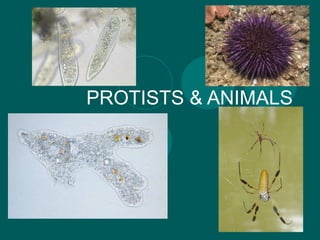
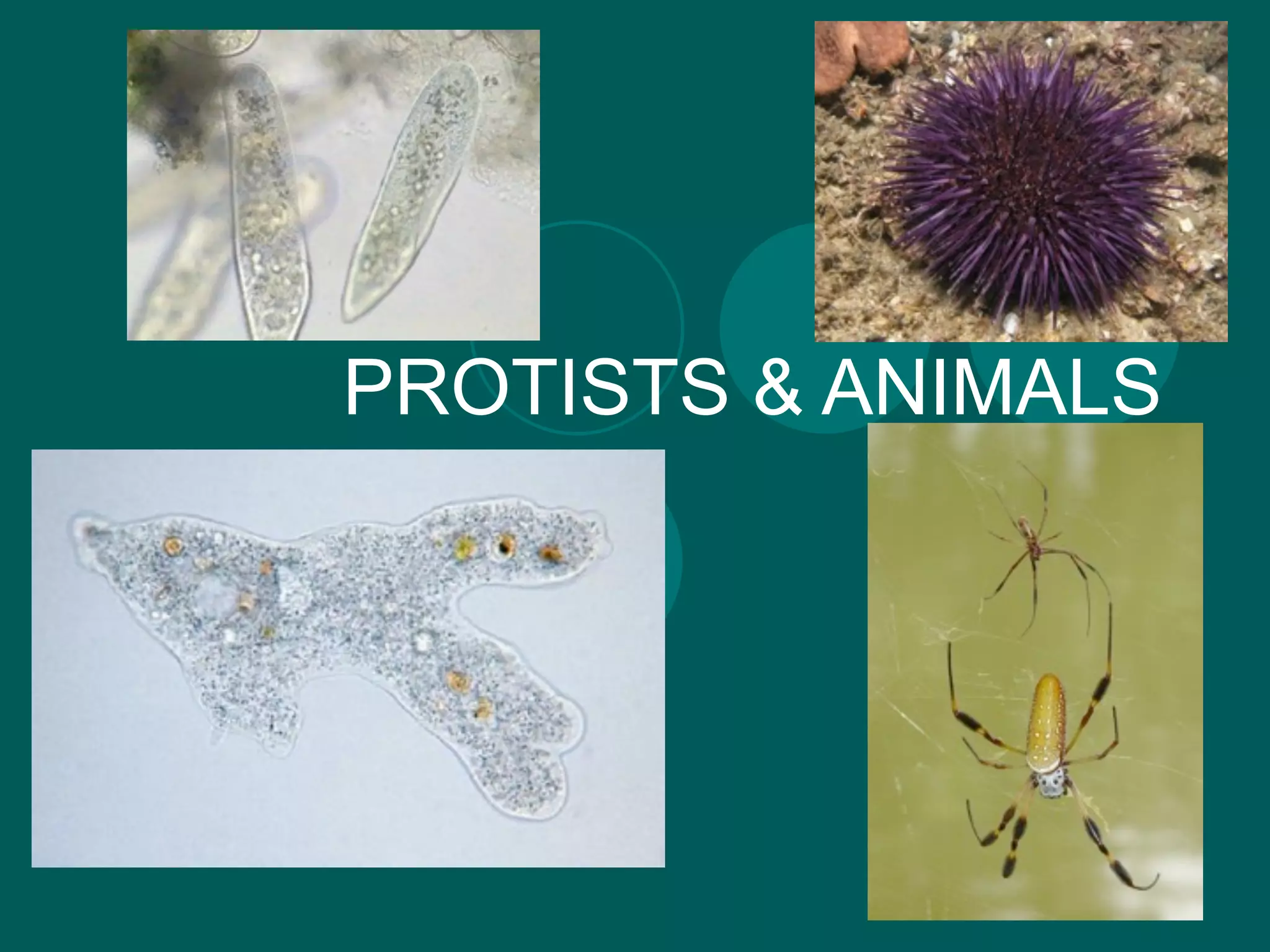
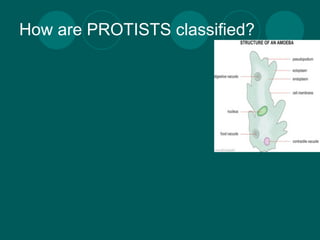
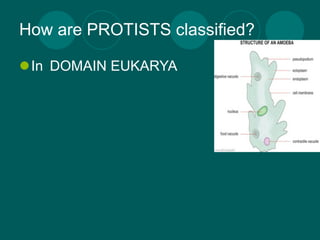
PROTISTS & ANIMALS
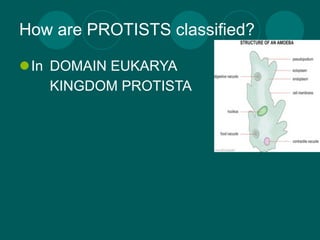
How are PROTISTS classified?

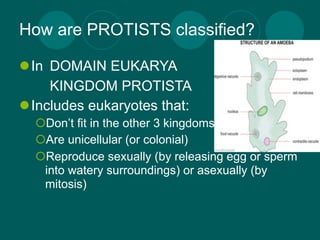
In DOMAIN EUKARYA
How are PROTISTS classified?

In DOMAIN EUKARYA
    KINGDOM PROTISTA
How are PROTISTS classified?

In DOMAIN EUKARYA
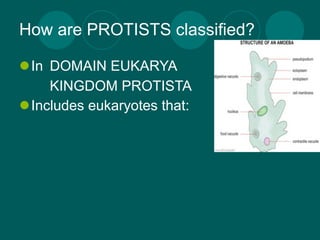
    KINGDOM PROTISTA
Includes eukaryotes that:
How are PROTISTS classified?

In DOMAIN EUKARYA
    KINGDOM PROTISTA
Includes eukaryotes that:
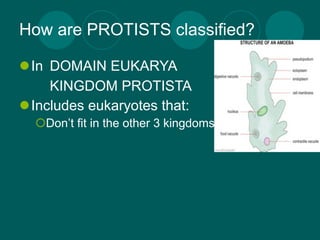
  Don’t fit in the other 3 kingdoms
How are PROTISTS classified?

In DOMAIN EUKARYA
    KINGDOM PROTISTA
Includes eukaryotes that:
  Don’t fit in the other 3 kingdoms
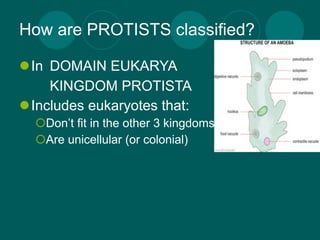
  Are unicellular (or colonial)
How are PROTISTS classified?

In DOMAIN EUKARYA
    KINGDOM PROTISTA
Includes eukaryotes that:
  Don’t fit in the other 3 kingdoms
  Are unicellular (or colonial)
  Reproduce sexually (by releasing egg or sperm
   into watery surroundings) or asexually (by
   mitosis)
Examples of PROTISTS

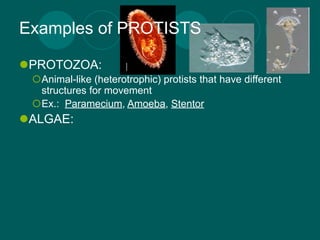
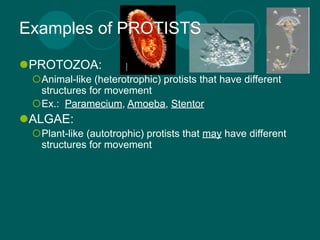
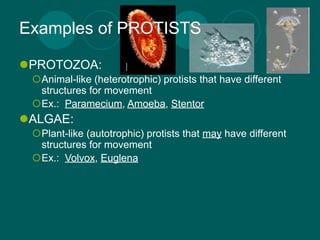
PROTOZOA:
Examples of PROTISTS

PROTOZOA:
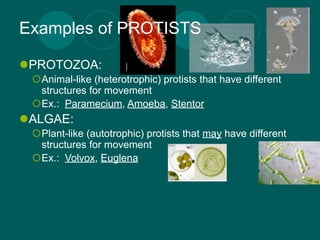
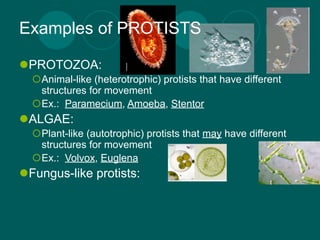
 Animal-like (heterotrophic) protists that have different
  structures for movement
Examples of PROTISTS

PROTOZOA:
 Animal-like (heterotrophic) protists that have different
  structures for movement
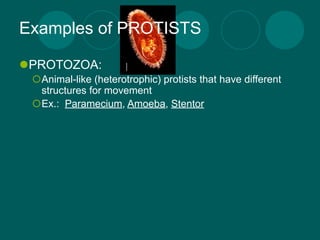
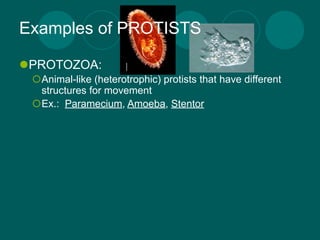
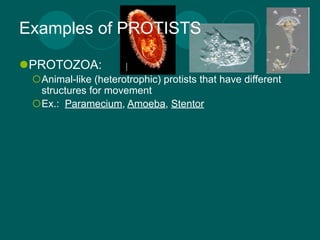
 Ex.: Paramecium, Amoeba, Stentor
Examples of PROTISTS

PROTOZOA:
 Animal-like (heterotrophic) protists that have different
  structures for movement
 Ex.: Paramecium, Amoeba, Stentor
Examples of PROTISTS

PROTOZOA:
 Animal-like (heterotrophic) protists that have different
  structures for movement
 Ex.: Paramecium, Amoeba, Stentor
Examples of PROTISTS

PROTOZOA:
 Animal-like (heterotrophic) protists that have different
  structures for movement
 Ex.: Paramecium, Amoeba, Stentor
Examples of PROTISTS

PROTOZOA:
 Animal-like (heterotrophic) protists that have different
  structures for movement
 Ex.: Paramecium, Amoeba, Stentor
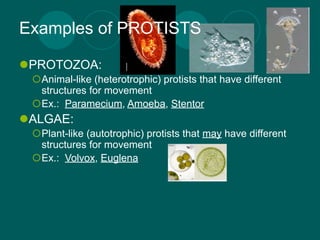
ALGAE:
Examples of PROTISTS

PROTOZOA:
 Animal-like (heterotrophic) protists that have different
  structures for movement
 Ex.: Paramecium, Amoeba, Stentor
ALGAE:
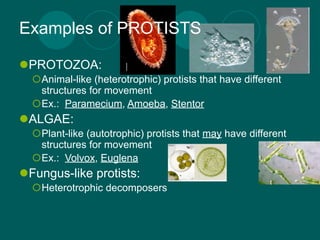
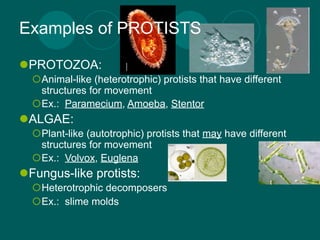
 Plant-like (autotrophic) protists that may have different
  structures for movement
Examples of PROTISTS

PROTOZOA:
 Animal-like (heterotrophic) protists that have different
  structures for movement
 Ex.: Paramecium, Amoeba, Stentor
ALGAE:
 Plant-like (autotrophic) protists that may have different
  structures for movement
 Ex.: Volvox, Euglena
Examples of PROTISTS

PROTOZOA:
 Animal-like (heterotrophic) protists that have different
  structures for movement
 Ex.: Paramecium, Amoeba, Stentor
ALGAE:
 Plant-like (autotrophic) protists that may have different
  structures for movement
 Ex.: Volvox, Euglena
Examples of PROTISTS

PROTOZOA:
 Animal-like (heterotrophic) protists that have different
  structures for movement
 Ex.: Paramecium, Amoeba, Stentor
ALGAE:
 Plant-like (autotrophic) protists that may have different
  structures for movement
 Ex.: Volvox, Euglena
Examples of PROTISTS

PROTOZOA:
  Animal-like (heterotrophic) protists that have different
   structures for movement
  Ex.: Paramecium, Amoeba, Stentor
ALGAE:
  Plant-like (autotrophic) protists that may have different
   structures for movement
  Ex.: Volvox, Euglena
Fungus-like protists:
Examples of PROTISTS

PROTOZOA:
  Animal-like (heterotrophic) protists that have different
   structures for movement
  Ex.: Paramecium, Amoeba, Stentor
ALGAE:
  Plant-like (autotrophic) protists that may have different
   structures for movement
  Ex.: Volvox, Euglena
Fungus-like protists:
  Heterotrophic decomposers
Examples of PROTISTS

PROTOZOA:
  Animal-like (heterotrophic) protists that have different
   structures for movement
  Ex.: Paramecium, Amoeba, Stentor
ALGAE:
  Plant-like (autotrophic) protists that may have different
   structures for movement
  Ex.: Volvox, Euglena
Fungus-like protists:
  Heterotrophic decomposers
  Ex.: slime molds
Why are PROTISTS important?

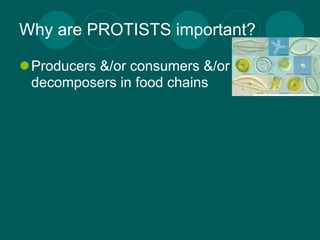
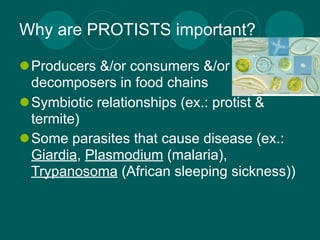
Producers &/or consumers &/or
 decomposers in food chains
Why are PROTISTS important?

Producers &/or consumers &/or
 decomposers in food chains
Why are PROTISTS important?

Producers &/or consumers &/or
 decomposers in food chains
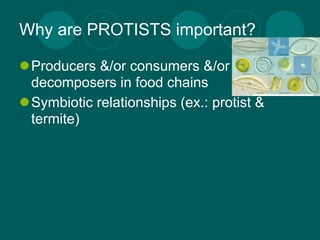
Symbiotic relationships (ex.: protist &
 termite)
Why are PROTISTS important?

Producers &/or consumers &/or
 decomposers in food chains
Symbiotic relationships (ex.: protist &
 termite)
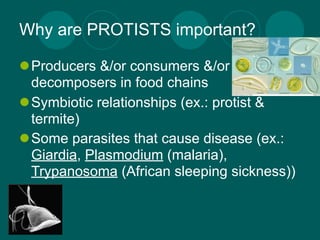
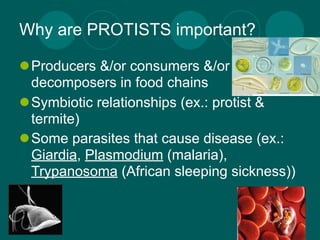
Some parasites that cause disease (ex.:
 Giardia, Plasmodium (malaria),
 Trypanosoma (African sleeping sickness))
Why are PROTISTS important?

Producers &/or consumers &/or
 decomposers in food chains
Symbiotic relationships (ex.: protist &
 termite)
Some parasites that cause disease (ex.:
 Giardia, Plasmodium (malaria),
 Trypanosoma (African sleeping sickness))
Why are PROTISTS important?

Producers &/or consumers &/or
 decomposers in food chains
Symbiotic relationships (ex.: protist &
 termite)
Some parasites that cause disease (ex.:
 Giardia, Plasmodium (malaria),
 Trypanosoma (African sleeping sickness))
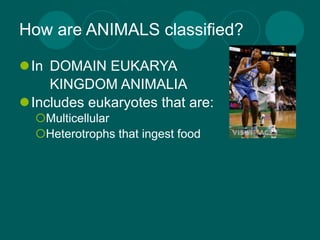
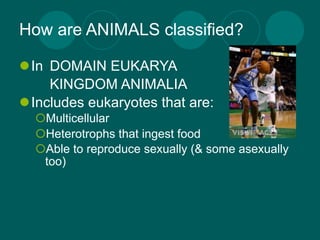
How are ANIMALS classified?

In DOMAIN EUKARYA
How are ANIMALS classified?

In DOMAIN EUKARYA
    KINGDOM ANIMALIA
How are ANIMALS classified?

In DOMAIN EUKARYA
    KINGDOM ANIMALIA
Includes eukaryotes that are:
How are ANIMALS classified?

In DOMAIN EUKARYA
    KINGDOM ANIMALIA
Includes eukaryotes that are:
  Multicellular
How are ANIMALS classified?

In DOMAIN EUKARYA
    KINGDOM ANIMALIA
Includes eukaryotes that are:
  Multicellular
  Heterotrophs that ingest food
How are ANIMALS classified?

In DOMAIN EUKARYA
    KINGDOM ANIMALIA
Includes eukaryotes that are:
  Multicellular
  Heterotrophs that ingest food
  Able to reproduce sexually (& some asexually
   too)
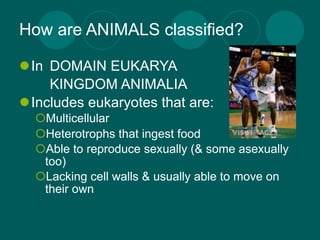
How are ANIMALS classified?

In DOMAIN EUKARYA
    KINGDOM ANIMALIA
Includes eukaryotes that are:
  Multicellular
  Heterotrophs that ingest food
  Able to reproduce sexually (& some asexually
   too)
  Lacking cell walls & usually able to move on
   their own
Examples of ANIMALS
Examples of ANIMALS
 INVERTEBRATES:
Examples of ANIMALS
 INVERTEBRATES:
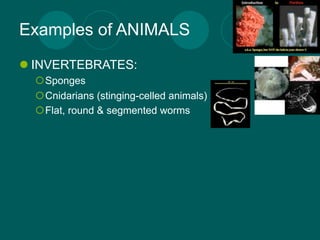
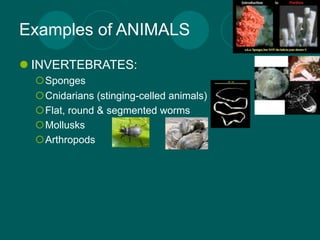
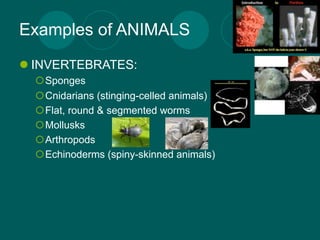
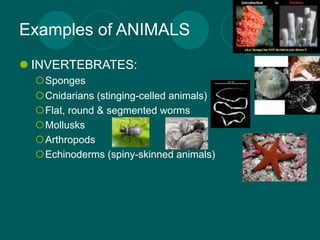
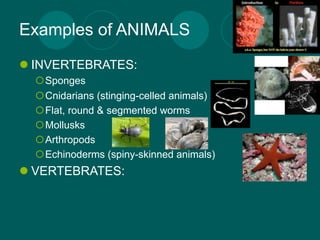
  Sponges
Examples of ANIMALS
 INVERTEBRATES:
  Sponges
Examples of ANIMALS
 INVERTEBRATES:
  Sponges
  Cnidarians (stinging-celled animals)
Examples of ANIMALS
 INVERTEBRATES:
  Sponges
  Cnidarians (stinging-celled animals)
Examples of ANIMALS
 INVERTEBRATES:
  Sponges
  Cnidarians (stinging-celled animals)
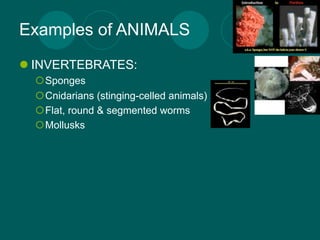
  Flat, round & segmented worms
Examples of ANIMALS
 INVERTEBRATES:
  Sponges
  Cnidarians (stinging-celled animals)
  Flat, round & segmented worms
Examples of ANIMALS
 INVERTEBRATES:
  Sponges
  Cnidarians (stinging-celled animals)
  Flat, round & segmented worms
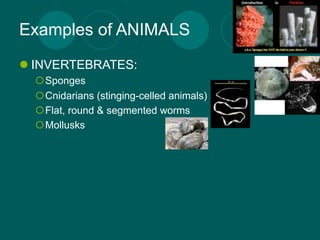
  Mollusks
Examples of ANIMALS
 INVERTEBRATES:
  Sponges
  Cnidarians (stinging-celled animals)
  Flat, round & segmented worms
  Mollusks
Examples of ANIMALS
 INVERTEBRATES:
  Sponges
  Cnidarians (stinging-celled animals)
  Flat, round & segmented worms
  Mollusks
  Arthropods
Examples of ANIMALS
 INVERTEBRATES:
  Sponges
  Cnidarians (stinging-celled animals)
  Flat, round & segmented worms
  Mollusks
  Arthropods
Examples of ANIMALS
 INVERTEBRATES:
  Sponges
  Cnidarians (stinging-celled animals)
  Flat, round & segmented worms
  Mollusks
  Arthropods
  Echinoderms (spiny-skinned animals)
Examples of ANIMALS
 INVERTEBRATES:
  Sponges
  Cnidarians (stinging-celled animals)
  Flat, round & segmented worms
  Mollusks
  Arthropods
  Echinoderms (spiny-skinned animals)
Examples of ANIMALS
 INVERTEBRATES:
  Sponges
  Cnidarians (stinging-celled animals)
  Flat, round & segmented worms
  Mollusks
  Arthropods
  Echinoderms (spiny-skinned animals)
 VERTEBRATES:
Examples of ANIMALS
 INVERTEBRATES:
  Sponges
  Cnidarians (stinging-celled animals)
  Flat, round & segmented worms
  Mollusks
  Arthropods
  Echinoderms (spiny-skinned animals)
 VERTEBRATES:
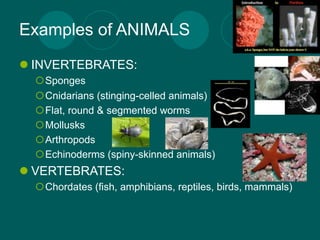
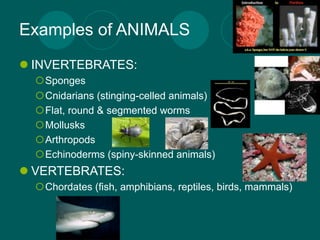
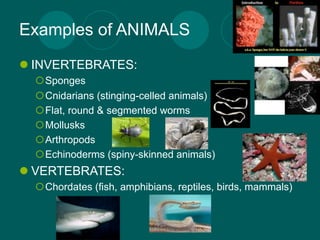
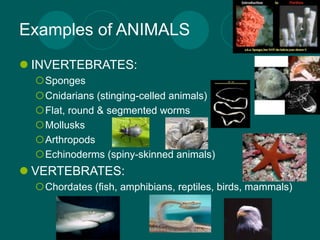
  Chordates (fish, amphibians, reptiles, birds, mammals)
Examples of ANIMALS
 INVERTEBRATES:
  Sponges
  Cnidarians (stinging-celled animals)
  Flat, round & segmented worms
  Mollusks
  Arthropods
  Echinoderms (spiny-skinned animals)
 VERTEBRATES:
  Chordates (fish, amphibians, reptiles, birds, mammals)
Examples of ANIMALS
 INVERTEBRATES:
  Sponges
  Cnidarians (stinging-celled animals)
  Flat, round & segmented worms
  Mollusks
  Arthropods
  Echinoderms (spiny-skinned animals)
 VERTEBRATES:
  Chordates (fish, amphibians, reptiles, birds, mammals)
Examples of ANIMALS
 INVERTEBRATES:
  Sponges
  Cnidarians (stinging-celled animals)
  Flat, round & segmented worms
  Mollusks
  Arthropods
  Echinoderms (spiny-skinned animals)
 VERTEBRATES:
  Chordates (fish, amphibians, reptiles, birds, mammals)
Examples of ANIMALS
 INVERTEBRATES:
  Sponges
  Cnidarians (stinging-celled animals)
  Flat, round & segmented worms
  Mollusks
  Arthropods
  Echinoderms (spiny-skinned animals)
 VERTEBRATES:
  Chordates (fish, amphibians, reptiles, birds, mammals)
Why are ANIMALS important?

Food chains
Why are ANIMALS important?

Food chains
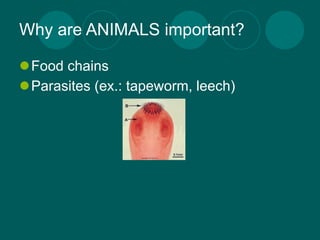
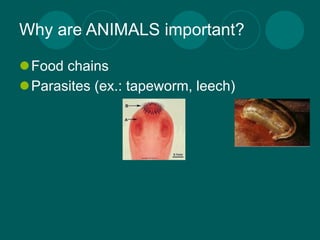
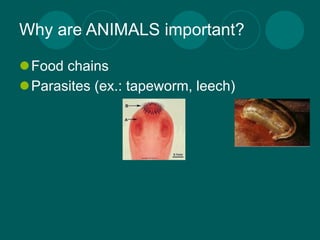
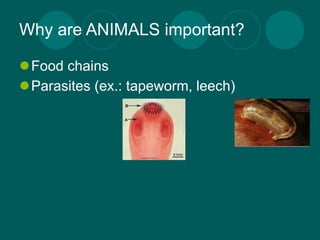
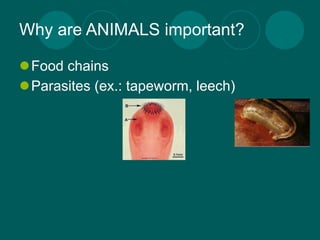
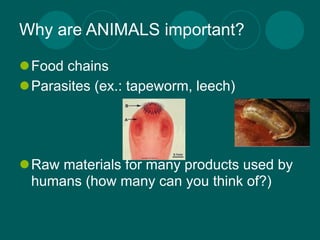
Parasites (ex.: tapeworm, leech)
Why are ANIMALS important?

Food chains
Parasites (ex.: tapeworm, leech)
Why are ANIMALS important?

Food chains
Parasites (ex.: tapeworm, leech)
Why are ANIMALS important?

Food chains
Parasites (ex.: tapeworm, leech)
Why are ANIMALS important?

Food chains
Parasites (ex.: tapeworm, leech)
Why are ANIMALS important?

Food chains
Parasites (ex.: tapeworm, leech)
Why are ANIMALS important?

Food chains
Parasites (ex.: tapeworm, leech)


Raw materials for many products used by
 humans (how many can you think of?)
Summary Activity


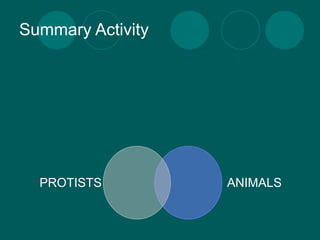
  PROTISTS         ANIMALS
Summary Activity
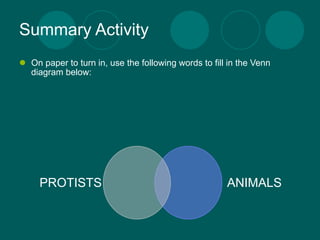
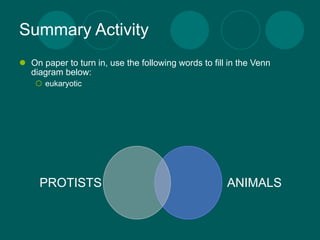
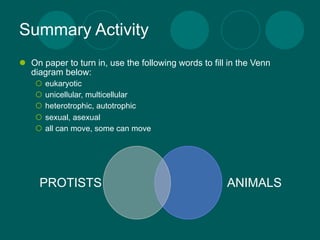
 On paper to turn in, use the following words to fill in the Venn
  diagram below:


     PROTISTS                                         ANIMALS
Summary Activity
 On paper to turn in, use the following words to fill in the Venn
  diagram below:
     eukaryotic


     PROTISTS                                         ANIMALS
Summary Activity
 On paper to turn in, use the following words to fill in the Venn
  diagram below:
     eukaryotic
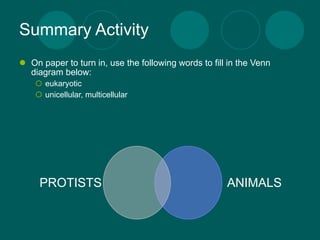
     unicellular, multicellular


     PROTISTS                                         ANIMALS
Summary Activity
 On paper to turn in, use the following words to fill in the Venn
  diagram below:
     eukaryotic
     unicellular, multicellular
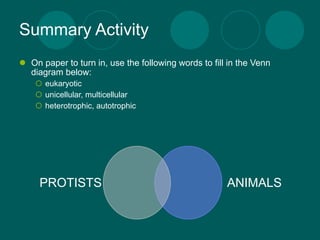
     heterotrophic, autotrophic


     PROTISTS                                         ANIMALS
Summary Activity
 On paper to turn in, use the following words to fill in the Venn
  diagram below:
       eukaryotic
       unicellular, multicellular
       heterotrophic, autotrophic
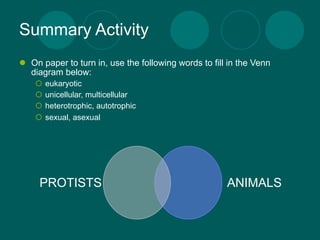
       sexual, asexual


     PROTISTS                                         ANIMALS
Summary Activity
 On paper to turn in, use the following words to fill in the Venn
  diagram below:
       eukaryotic
       unicellular, multicellular
       heterotrophic, autotrophic
       sexual, asexual
       all can move, some can move


     PROTISTS                                         ANIMALS
Plants and Fungi
Plants
DOMAIN ?________
KINGDOM? _________

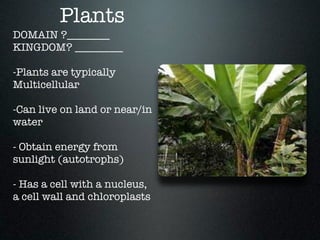
-Plants are typically
Multicellular

-Can live on land or near/in
water

- Obtain energy from
sunlight (autotrophs)

- Has a cell with a nucleus,
a cell wall and chloroplasts
WHY ARE PLANTS IMPORTANT?
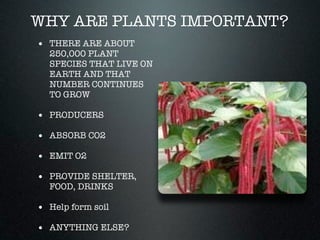
• THERE ARE ABOUT
  250,000 PLANT
  SPECIES THAT LIVE ON
  EARTH AND THAT
  NUMBER CONTINUES
  TO GROW

• PRODUCERS
• ABSORB CO2
• EMIT O2
• PROVIDE SHELTER,
  FOOD, DRINKS

• Help form soil
• ANYTHING ELSE?
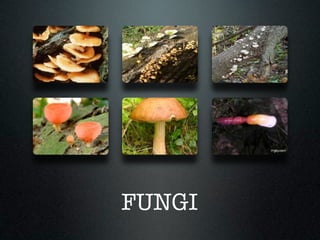
FUNGI
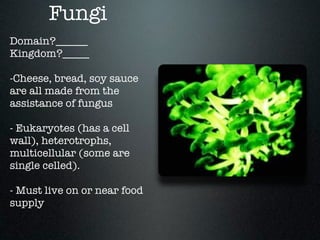
Fungi
Domain?______
Kingdom?_____

-Cheese, bread, soy sauce
are all made from the
assistance of fungus

- Eukaryotes (has a cell
wall), heterotrophs,
multicellular (some are
single celled).

- Must live on or near food
supply
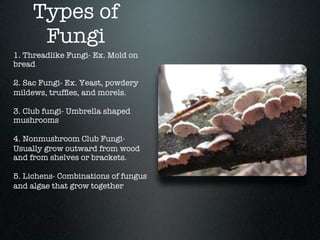
Types of
      Fungi
1. Threadlike Fungi- Ex. Mold on
bread

2. Sac Fungi- Ex. Yeast, powdery
mildews, truffles, and morels.

3. Club fungi- Umbrella shaped
mushrooms

4. Nonmushroom Club Fungi-
Usually grow outward from wood
and from shelves or brackets.

5. Lichens- Combinations of fungus
and algae that grow together
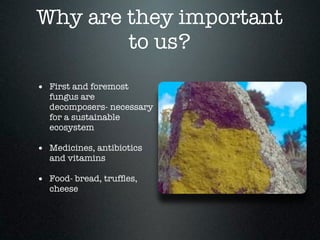
Why are they important
        to us?
• First and foremost
  fungus are
  decomposers- necessary
  for a sustainable
  ecosystem

• Medicines, antibiotics
  and vitamins

• Food- bread, truffles,
  cheese

Protists animals plants_fungi

  • 1.
  • 2.
    How are PROTISTSclassified?
  • 3.
    How are PROTISTSclassified? In DOMAIN EUKARYA
  • 4.
    How are PROTISTSclassified? In DOMAIN EUKARYA KINGDOM PROTISTA
  • 5.
    How are PROTISTSclassified? In DOMAIN EUKARYA KINGDOM PROTISTA Includes eukaryotes that:
  • 6.
    How are PROTISTSclassified? In DOMAIN EUKARYA KINGDOM PROTISTA Includes eukaryotes that: Don’t fit in the other 3 kingdoms
  • 7.
    How are PROTISTSclassified? In DOMAIN EUKARYA KINGDOM PROTISTA Includes eukaryotes that: Don’t fit in the other 3 kingdoms Are unicellular (or colonial)
  • 8.
    How are PROTISTSclassified? In DOMAIN EUKARYA KINGDOM PROTISTA Includes eukaryotes that: Don’t fit in the other 3 kingdoms Are unicellular (or colonial) Reproduce sexually (by releasing egg or sperm into watery surroundings) or asexually (by mitosis)
  • 9.
  • 10.
  • 11.
    Examples of PROTISTS PROTOZOA: Animal-like (heterotrophic) protists that have different structures for movement
  • 12.
    Examples of PROTISTS PROTOZOA: Animal-like (heterotrophic) protists that have different structures for movement Ex.: Paramecium, Amoeba, Stentor
  • 13.
    Examples of PROTISTS PROTOZOA: Animal-like (heterotrophic) protists that have different structures for movement Ex.: Paramecium, Amoeba, Stentor
  • 14.
    Examples of PROTISTS PROTOZOA: Animal-like (heterotrophic) protists that have different structures for movement Ex.: Paramecium, Amoeba, Stentor
  • 15.
    Examples of PROTISTS PROTOZOA: Animal-like (heterotrophic) protists that have different structures for movement Ex.: Paramecium, Amoeba, Stentor
  • 16.
    Examples of PROTISTS PROTOZOA: Animal-like (heterotrophic) protists that have different structures for movement Ex.: Paramecium, Amoeba, Stentor ALGAE:
  • 17.
    Examples of PROTISTS PROTOZOA: Animal-like (heterotrophic) protists that have different structures for movement Ex.: Paramecium, Amoeba, Stentor ALGAE: Plant-like (autotrophic) protists that may have different structures for movement
  • 18.
    Examples of PROTISTS PROTOZOA: Animal-like (heterotrophic) protists that have different structures for movement Ex.: Paramecium, Amoeba, Stentor ALGAE: Plant-like (autotrophic) protists that may have different structures for movement Ex.: Volvox, Euglena
  • 19.
    Examples of PROTISTS PROTOZOA: Animal-like (heterotrophic) protists that have different structures for movement Ex.: Paramecium, Amoeba, Stentor ALGAE: Plant-like (autotrophic) protists that may have different structures for movement Ex.: Volvox, Euglena
  • 20.
    Examples of PROTISTS PROTOZOA: Animal-like (heterotrophic) protists that have different structures for movement Ex.: Paramecium, Amoeba, Stentor ALGAE: Plant-like (autotrophic) protists that may have different structures for movement Ex.: Volvox, Euglena
  • 21.
    Examples of PROTISTS PROTOZOA: Animal-like (heterotrophic) protists that have different structures for movement Ex.: Paramecium, Amoeba, Stentor ALGAE: Plant-like (autotrophic) protists that may have different structures for movement Ex.: Volvox, Euglena Fungus-like protists:
  • 22.
    Examples of PROTISTS PROTOZOA: Animal-like (heterotrophic) protists that have different structures for movement Ex.: Paramecium, Amoeba, Stentor ALGAE: Plant-like (autotrophic) protists that may have different structures for movement Ex.: Volvox, Euglena Fungus-like protists: Heterotrophic decomposers
  • 23.
    Examples of PROTISTS PROTOZOA: Animal-like (heterotrophic) protists that have different structures for movement Ex.: Paramecium, Amoeba, Stentor ALGAE: Plant-like (autotrophic) protists that may have different structures for movement Ex.: Volvox, Euglena Fungus-like protists: Heterotrophic decomposers Ex.: slime molds
  • 24.
    Why are PROTISTSimportant?
  • 25.
    Why are PROTISTSimportant? Producers &/or consumers &/or decomposers in food chains
  • 26.
    Why are PROTISTSimportant? Producers &/or consumers &/or decomposers in food chains
  • 27.
    Why are PROTISTSimportant? Producers &/or consumers &/or decomposers in food chains Symbiotic relationships (ex.: protist & termite)
  • 28.
    Why are PROTISTSimportant? Producers &/or consumers &/or decomposers in food chains Symbiotic relationships (ex.: protist & termite) Some parasites that cause disease (ex.: Giardia, Plasmodium (malaria), Trypanosoma (African sleeping sickness))
  • 29.
    Why are PROTISTSimportant? Producers &/or consumers &/or decomposers in food chains Symbiotic relationships (ex.: protist & termite) Some parasites that cause disease (ex.: Giardia, Plasmodium (malaria), Trypanosoma (African sleeping sickness))
  • 30.
    Why are PROTISTSimportant? Producers &/or consumers &/or decomposers in food chains Symbiotic relationships (ex.: protist & termite) Some parasites that cause disease (ex.: Giardia, Plasmodium (malaria), Trypanosoma (African sleeping sickness))
  • 31.
    How are ANIMALSclassified?
  • 32.
    How are ANIMALSclassified? In DOMAIN EUKARYA
  • 33.
    How are ANIMALSclassified? In DOMAIN EUKARYA KINGDOM ANIMALIA
  • 34.
    How are ANIMALSclassified? In DOMAIN EUKARYA KINGDOM ANIMALIA Includes eukaryotes that are:
  • 35.
    How are ANIMALSclassified? In DOMAIN EUKARYA KINGDOM ANIMALIA Includes eukaryotes that are: Multicellular
  • 36.
    How are ANIMALSclassified? In DOMAIN EUKARYA KINGDOM ANIMALIA Includes eukaryotes that are: Multicellular Heterotrophs that ingest food
  • 37.
    How are ANIMALSclassified? In DOMAIN EUKARYA KINGDOM ANIMALIA Includes eukaryotes that are: Multicellular Heterotrophs that ingest food Able to reproduce sexually (& some asexually too)
  • 38.
    How are ANIMALSclassified? In DOMAIN EUKARYA KINGDOM ANIMALIA Includes eukaryotes that are: Multicellular Heterotrophs that ingest food Able to reproduce sexually (& some asexually too) Lacking cell walls & usually able to move on their own
  • 39.
  • 40.
  • 41.
    Examples of ANIMALS INVERTEBRATES: Sponges
  • 42.
    Examples of ANIMALS INVERTEBRATES: Sponges
  • 43.
    Examples of ANIMALS INVERTEBRATES: Sponges Cnidarians (stinging-celled animals)
  • 44.
    Examples of ANIMALS INVERTEBRATES: Sponges Cnidarians (stinging-celled animals)
  • 45.
    Examples of ANIMALS INVERTEBRATES: Sponges Cnidarians (stinging-celled animals) Flat, round & segmented worms
  • 46.
    Examples of ANIMALS INVERTEBRATES: Sponges Cnidarians (stinging-celled animals) Flat, round & segmented worms
  • 47.
    Examples of ANIMALS INVERTEBRATES: Sponges Cnidarians (stinging-celled animals) Flat, round & segmented worms Mollusks
  • 48.
    Examples of ANIMALS INVERTEBRATES: Sponges Cnidarians (stinging-celled animals) Flat, round & segmented worms Mollusks
  • 49.
    Examples of ANIMALS INVERTEBRATES: Sponges Cnidarians (stinging-celled animals) Flat, round & segmented worms Mollusks Arthropods
  • 50.
    Examples of ANIMALS INVERTEBRATES: Sponges Cnidarians (stinging-celled animals) Flat, round & segmented worms Mollusks Arthropods
  • 51.
    Examples of ANIMALS INVERTEBRATES: Sponges Cnidarians (stinging-celled animals) Flat, round & segmented worms Mollusks Arthropods Echinoderms (spiny-skinned animals)
  • 52.
    Examples of ANIMALS INVERTEBRATES: Sponges Cnidarians (stinging-celled animals) Flat, round & segmented worms Mollusks Arthropods Echinoderms (spiny-skinned animals)
  • 53.
    Examples of ANIMALS INVERTEBRATES: Sponges Cnidarians (stinging-celled animals) Flat, round & segmented worms Mollusks Arthropods Echinoderms (spiny-skinned animals)  VERTEBRATES:
  • 54.
    Examples of ANIMALS INVERTEBRATES: Sponges Cnidarians (stinging-celled animals) Flat, round & segmented worms Mollusks Arthropods Echinoderms (spiny-skinned animals)  VERTEBRATES: Chordates (fish, amphibians, reptiles, birds, mammals)
  • 55.
    Examples of ANIMALS INVERTEBRATES: Sponges Cnidarians (stinging-celled animals) Flat, round & segmented worms Mollusks Arthropods Echinoderms (spiny-skinned animals)  VERTEBRATES: Chordates (fish, amphibians, reptiles, birds, mammals)
  • 56.
    Examples of ANIMALS INVERTEBRATES: Sponges Cnidarians (stinging-celled animals) Flat, round & segmented worms Mollusks Arthropods Echinoderms (spiny-skinned animals)  VERTEBRATES: Chordates (fish, amphibians, reptiles, birds, mammals)
  • 57.
    Examples of ANIMALS INVERTEBRATES: Sponges Cnidarians (stinging-celled animals) Flat, round & segmented worms Mollusks Arthropods Echinoderms (spiny-skinned animals)  VERTEBRATES: Chordates (fish, amphibians, reptiles, birds, mammals)
  • 58.
    Examples of ANIMALS INVERTEBRATES: Sponges Cnidarians (stinging-celled animals) Flat, round & segmented worms Mollusks Arthropods Echinoderms (spiny-skinned animals)  VERTEBRATES: Chordates (fish, amphibians, reptiles, birds, mammals)
  • 59.
    Why are ANIMALSimportant?
  • 60.
    Why are ANIMALSimportant? Food chains
  • 61.
    Why are ANIMALSimportant? Food chains Parasites (ex.: tapeworm, leech)
  • 62.
    Why are ANIMALSimportant? Food chains Parasites (ex.: tapeworm, leech)
  • 63.
    Why are ANIMALSimportant? Food chains Parasites (ex.: tapeworm, leech)
  • 64.
    Why are ANIMALSimportant? Food chains Parasites (ex.: tapeworm, leech)
  • 65.
    Why are ANIMALSimportant? Food chains Parasites (ex.: tapeworm, leech)
  • 66.
    Why are ANIMALSimportant? Food chains Parasites (ex.: tapeworm, leech)
  • 67.
    Why are ANIMALSimportant? Food chains Parasites (ex.: tapeworm, leech) Raw materials for many products used by humans (how many can you think of?)
  • 68.
    Summary Activity PROTISTS ANIMALS
  • 69.
    Summary Activity  Onpaper to turn in, use the following words to fill in the Venn diagram below: PROTISTS ANIMALS
  • 70.
    Summary Activity  Onpaper to turn in, use the following words to fill in the Venn diagram below:  eukaryotic PROTISTS ANIMALS
  • 71.
    Summary Activity  Onpaper to turn in, use the following words to fill in the Venn diagram below:  eukaryotic  unicellular, multicellular PROTISTS ANIMALS
  • 72.
    Summary Activity  Onpaper to turn in, use the following words to fill in the Venn diagram below:  eukaryotic  unicellular, multicellular  heterotrophic, autotrophic PROTISTS ANIMALS
  • 73.
    Summary Activity  Onpaper to turn in, use the following words to fill in the Venn diagram below:  eukaryotic  unicellular, multicellular  heterotrophic, autotrophic  sexual, asexual PROTISTS ANIMALS
  • 74.
    Summary Activity  Onpaper to turn in, use the following words to fill in the Venn diagram below:  eukaryotic  unicellular, multicellular  heterotrophic, autotrophic  sexual, asexual  all can move, some can move PROTISTS ANIMALS
  • 75.
  • 76.
    Plants DOMAIN ?________ KINGDOM? _________ -Plantsare typically Multicellular -Can live on land or near/in water - Obtain energy from sunlight (autotrophs) - Has a cell with a nucleus, a cell wall and chloroplasts
  • 77.
    WHY ARE PLANTSIMPORTANT? • THERE ARE ABOUT 250,000 PLANT SPECIES THAT LIVE ON EARTH AND THAT NUMBER CONTINUES TO GROW • PRODUCERS • ABSORB CO2 • EMIT O2 • PROVIDE SHELTER, FOOD, DRINKS • Help form soil • ANYTHING ELSE?
  • 78.
  • 79.
    Fungi Domain?______ Kingdom?_____ -Cheese, bread, soysauce are all made from the assistance of fungus - Eukaryotes (has a cell wall), heterotrophs, multicellular (some are single celled). - Must live on or near food supply
  • 80.
    Types of Fungi 1. Threadlike Fungi- Ex. Mold on bread 2. Sac Fungi- Ex. Yeast, powdery mildews, truffles, and morels. 3. Club fungi- Umbrella shaped mushrooms 4. Nonmushroom Club Fungi- Usually grow outward from wood and from shelves or brackets. 5. Lichens- Combinations of fungus and algae that grow together
  • 81.
    Why are theyimportant to us? • First and foremost fungus are decomposers- necessary for a sustainable ecosystem • Medicines, antibiotics and vitamins • Food- bread, truffles, cheese