PRIMARY PROGRESSIVE
APHASIA
Ade Wijaya, MD
April 2023
Definition
 Primary Progressive Aphasia (PPA):
Neurodegenerative clinical syndrome
Predominance and insidious onset of language
impairments
Gradual deterioration over time
Associated with atrophy of the language network
of the brain, including frontal, temporal, and
parietal regions of the left hemisphere
Mesulam MM: Primary progressive aphasia. Ann Neurol. 2001;49(4):425–32. 10.1002/ana.91
Mesulam MM: Primary progressive aphasia and the language network: The 2013 H. Houston Merritt Lecture. Neurology. 2013;81(5):456–62. 10.1212/WNL.0b013e31829d87df
Gorno-Tempini ML, Hillis AE, Weintraub S, et al.: Classification of primary progressive aphasia and its variants. Neurology. 2011;76(11):1006–14. 10.1212/WNL.0b013e31821103e6
Introduction
 Rare disease
 Affects individuals in the prime of their lives,
compromising their ability to work and engage
in home and community life
 Diagnosis is challenging
Primary progressive aphasia. Orphanet. Accessed 10/01/2019.
Tippett DC. Classification of primary progressive aphasia: challenges and complexities. F1000Research. 2020;9.
Classification
Logopenic variant PPA
(lvPPA)
Nonfluent agrammatic PPA
(nfaPPA)
Semantic variant PPA
(svPPA)
Gorno-Tempini ML, Hillis AE, Weintraub S, et al.: Classification of primary progressive aphasia and its variants. Neurology. 2011;76(11):1006–14. 10.1212/WNL.0b013e31821103e6
Logopenic variant PPA (lvPPA)
Impaired single-word retrieval in
spontaneous speech and naming
Impaired repetition of phrases
and sentences
Left temporoparietal atrophy
Tippett DC. Classification of primary progressive aphasia: challenges and complexities. F1000Research. 2020;9.
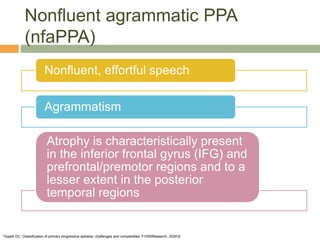
Nonfluent agrammatic PPA
(nfaPPA)
Nonfluent, effortful speech
Agrammatism
Atrophy is characteristically present
in the inferior frontal gyrus (IFG) and
prefrontal/premotor regions and to a
lesser extent in the posterior
temporal regions
Tippett DC. Classification of primary progressive aphasia: challenges and complexities. F1000Research. 2020;9.
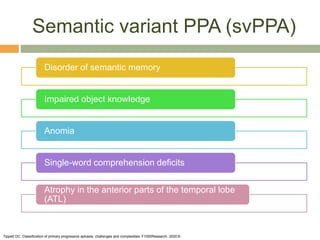
Semantic variant PPA (svPPA)
Disorder of semantic memory
Impaired object knowledge
Anomia
Single-word comprehension deficits
Atrophy in the anterior parts of the temporal lobe
(ATL)
Tippett DC. Classification of primary progressive aphasia: challenges and complexities. F1000Research. 2020;9.
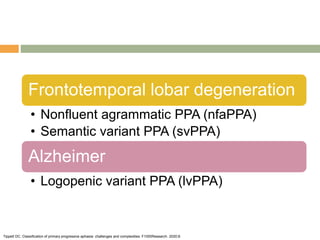
Frontotemporal lobar degeneration
• Nonfluent agrammatic PPA (nfaPPA)
• Semantic variant PPA (svPPA)
Alzheimer
• Logopenic variant PPA (lvPPA)
Tippett DC. Classification of primary progressive aphasia: challenges and complexities. F1000Research. 2020;9.
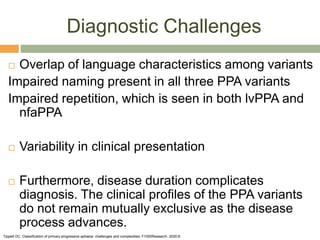
Diagnostic Challenges
 Overlap of language characteristics among variants
Impaired naming present in all three PPA variants
Impaired repetition, which is seen in both lvPPA and
nfaPPA
 Variability in clinical presentation
 Furthermore, disease duration complicates
diagnosis. The clinical profiles of the PPA variants
do not remain mutually exclusive as the disease
process advances.
Tippett DC. Classification of primary progressive aphasia: challenges and complexities. F1000Research. 2020;9.
Diagnostic Challenges
 Apraxia of speech can be demonstrated on single-
word-level repetition tasks in nfaPPA, although in
the early stages of disease, errors may emerge
only during repetition of lengthy or complex words,
phrases, and sentences
 Agrammatism, a core component of nfaPPA, may
be difficult to detect in the presence of
concomitant apraxia of speech
 The distinction between phonetic (apraxia of
speech) and phonemic speech sound errors is
challenging for even experienced clinicians.
Tippett DC. Classification of primary progressive aphasia: challenges and complexities. F1000Research. 2020;9.
Diagnostic Challenges
 svPPA present with the hallmark
characteristics of:
 Impairments in single-word comprehension
(e.g. difficulty selecting a pictured item from an
array when told the object label)
 Impairments in semantic knowledge (e.g.
difficulty demonstrating the use of a common
object or difficulty identifying pictured objects
which “go together”, such as “pencil and
paper” versus “pencil and car”).
Tippett DC. Classification of primary progressive aphasia: challenges and complexities. F1000Research. 2020;9.
Management
 No cure
 Multidisciplinary approach
 Appropriate management depends on the
accurate diagnosis of PPA variants
- cholinesterase inhibitors and/or memantine may
be used in lvPPA because of its underlying AD
pathology done
- transcranial direct cortical stimulation (tDCS)
combined with written-language therapy was
beneficial in those with lvPPA and nfaPPA; tDCS
did not confer an advantage for those with svPPA
Tsapkini K, Webster KT, Ficek BN, et al.: Electrical brain stimulation in different variants of primary progressive aphasia: A randomized clinical trial. Alzheimers Dement (N Y). 2018;4:461–72.
10.1016/j.trci.2018.08.002
Tippett DC, Hillis AE, Tsapkini K: Treatment of Primary Progressive Aphasia. Curr Treat Options Neurol. 2015;17(8):362. 10.1007/s11940-015-0362-5
Summary
 The classification of PPA variants is complex,
and several factors contribute to this challenge
 Valid, comprehensive assessment of
individuals with PPA remains central to the
characterization of speech, language, and
behavioral manifestations of PPA.
THANK YOU

Primary Progressive Aphasia.pptx

  • 1.
  • 2.
    Definition  Primary ProgressiveAphasia (PPA): Neurodegenerative clinical syndrome Predominance and insidious onset of language impairments Gradual deterioration over time Associated with atrophy of the language network of the brain, including frontal, temporal, and parietal regions of the left hemisphere Mesulam MM: Primary progressive aphasia. Ann Neurol. 2001;49(4):425–32. 10.1002/ana.91 Mesulam MM: Primary progressive aphasia and the language network: The 2013 H. Houston Merritt Lecture. Neurology. 2013;81(5):456–62. 10.1212/WNL.0b013e31829d87df Gorno-Tempini ML, Hillis AE, Weintraub S, et al.: Classification of primary progressive aphasia and its variants. Neurology. 2011;76(11):1006–14. 10.1212/WNL.0b013e31821103e6
  • 3.
    Introduction  Rare disease Affects individuals in the prime of their lives, compromising their ability to work and engage in home and community life  Diagnosis is challenging Primary progressive aphasia. Orphanet. Accessed 10/01/2019. Tippett DC. Classification of primary progressive aphasia: challenges and complexities. F1000Research. 2020;9.
  • 4.
    Classification Logopenic variant PPA (lvPPA) Nonfluentagrammatic PPA (nfaPPA) Semantic variant PPA (svPPA) Gorno-Tempini ML, Hillis AE, Weintraub S, et al.: Classification of primary progressive aphasia and its variants. Neurology. 2011;76(11):1006–14. 10.1212/WNL.0b013e31821103e6
  • 5.
    Logopenic variant PPA(lvPPA) Impaired single-word retrieval in spontaneous speech and naming Impaired repetition of phrases and sentences Left temporoparietal atrophy Tippett DC. Classification of primary progressive aphasia: challenges and complexities. F1000Research. 2020;9.
  • 6.
    Nonfluent agrammatic PPA (nfaPPA) Nonfluent,effortful speech Agrammatism Atrophy is characteristically present in the inferior frontal gyrus (IFG) and prefrontal/premotor regions and to a lesser extent in the posterior temporal regions Tippett DC. Classification of primary progressive aphasia: challenges and complexities. F1000Research. 2020;9.
  • 7.
    Semantic variant PPA(svPPA) Disorder of semantic memory Impaired object knowledge Anomia Single-word comprehension deficits Atrophy in the anterior parts of the temporal lobe (ATL) Tippett DC. Classification of primary progressive aphasia: challenges and complexities. F1000Research. 2020;9.
  • 8.
    Frontotemporal lobar degeneration •Nonfluent agrammatic PPA (nfaPPA) • Semantic variant PPA (svPPA) Alzheimer • Logopenic variant PPA (lvPPA) Tippett DC. Classification of primary progressive aphasia: challenges and complexities. F1000Research. 2020;9.
  • 9.
    Diagnostic Challenges  Overlapof language characteristics among variants Impaired naming present in all three PPA variants Impaired repetition, which is seen in both lvPPA and nfaPPA  Variability in clinical presentation  Furthermore, disease duration complicates diagnosis. The clinical profiles of the PPA variants do not remain mutually exclusive as the disease process advances. Tippett DC. Classification of primary progressive aphasia: challenges and complexities. F1000Research. 2020;9.
  • 10.
    Diagnostic Challenges  Apraxiaof speech can be demonstrated on single- word-level repetition tasks in nfaPPA, although in the early stages of disease, errors may emerge only during repetition of lengthy or complex words, phrases, and sentences  Agrammatism, a core component of nfaPPA, may be difficult to detect in the presence of concomitant apraxia of speech  The distinction between phonetic (apraxia of speech) and phonemic speech sound errors is challenging for even experienced clinicians. Tippett DC. Classification of primary progressive aphasia: challenges and complexities. F1000Research. 2020;9.
  • 11.
    Diagnostic Challenges  svPPApresent with the hallmark characteristics of:  Impairments in single-word comprehension (e.g. difficulty selecting a pictured item from an array when told the object label)  Impairments in semantic knowledge (e.g. difficulty demonstrating the use of a common object or difficulty identifying pictured objects which “go together”, such as “pencil and paper” versus “pencil and car”). Tippett DC. Classification of primary progressive aphasia: challenges and complexities. F1000Research. 2020;9.
  • 12.
    Management  No cure Multidisciplinary approach  Appropriate management depends on the accurate diagnosis of PPA variants - cholinesterase inhibitors and/or memantine may be used in lvPPA because of its underlying AD pathology done - transcranial direct cortical stimulation (tDCS) combined with written-language therapy was beneficial in those with lvPPA and nfaPPA; tDCS did not confer an advantage for those with svPPA Tsapkini K, Webster KT, Ficek BN, et al.: Electrical brain stimulation in different variants of primary progressive aphasia: A randomized clinical trial. Alzheimers Dement (N Y). 2018;4:461–72. 10.1016/j.trci.2018.08.002 Tippett DC, Hillis AE, Tsapkini K: Treatment of Primary Progressive Aphasia. Curr Treat Options Neurol. 2015;17(8):362. 10.1007/s11940-015-0362-5
  • 13.
    Summary  The classificationof PPA variants is complex, and several factors contribute to this challenge  Valid, comprehensive assessment of individuals with PPA remains central to the characterization of speech, language, and behavioral manifestations of PPA.
  • 14.