What is Primaryand Secondary
Brain Injury?
Primarybraininjury
refers to the sudden and profound injury to
the brain that is considered to be more or
lesscompleteatthetimeofimpact.
8.
What is Primaryand Secondary
Brain Injury?
Secondarybraininjury
refers to the changes that evolve over a
period of hours to days after the primary
braininjury.
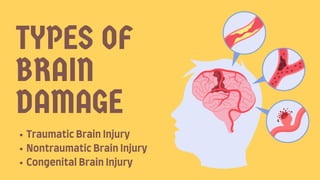
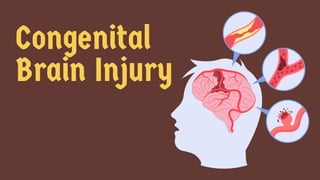
Congenital brain defectsare abnormalities in the
brain that are present at birth. There are many
different types of these defects. They can vary
greatlyfrommildtosevereconditions.
Congenital Brain Injury
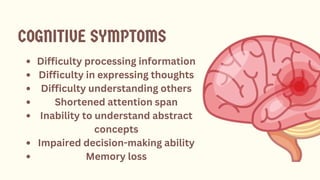
Difficulty processing information
Difficultyin expressing thoughts
Difficulty understanding others
Shortened attention span
Inability to understand abstract
concepts
Impaired decision-making ability
Memory loss
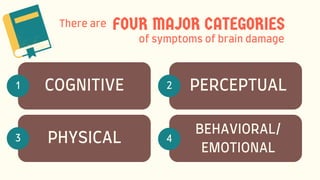
COGNITIVE SYMPTOMS
29.
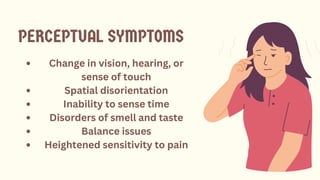
Change in vision,hearing, or
sense of touch
Spatial disorientation
Inability to sense time
Disorders of smell and taste
Balance issues
Heightened sensitivity to pain
PERCEPTUAL SYMPTOMS
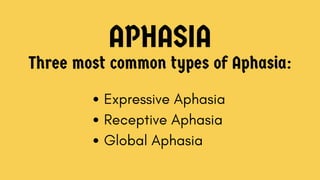
APHASIA
is the termused to describe an acquired
loss of language that causes problems
with any or all of the following:
speaking, listening, reading and writing.
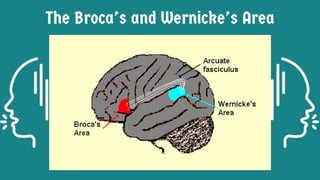
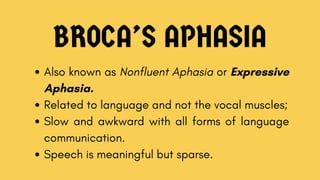
BROCA’S APHASIA
Also knownas Nonfluent Aphasia or Expressive
Aphasia.
Related to language and not the vocal muscles;
Slow and awkward with all forms of language
communication.
Speech is meaningful but sparse.
44.
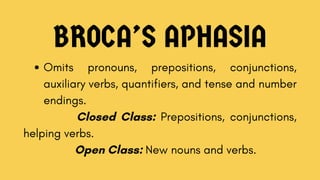
BROCA’S APHASIA
Omits pronouns,prepositions, conjunctions,
auxiliary verbs, quantifiers, and tense and number
endings.
Closed Class: Prepositions, conjunctions,
helping verbs.
Open Class: New nouns and verbs.
45.
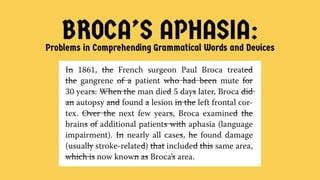
BROCA’S APHASIA:
Problems inComprehending Grammatical Words and Devices
People with Broca’s Aphasia understand most
speech, except when the meaning depends
on prepositions, word endings, or complex
grammar.
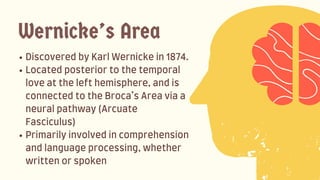
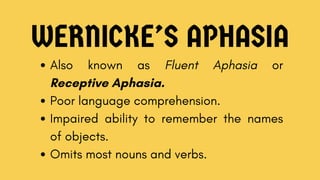
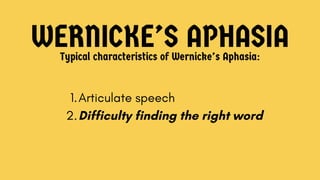
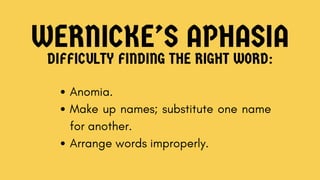
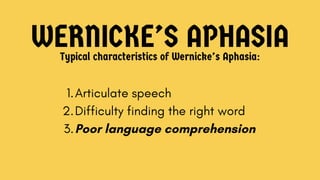
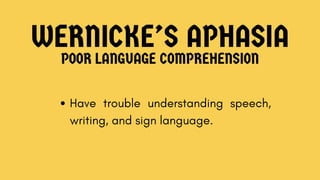
WERNICKE’S APHASIA
Also knownas Fluent Aphasia or
Receptive Aphasia.
Poor language comprehension.
Impaired ability to remember the names
of objects.
Omits most nouns and verbs.
GLOBAL APHASIA
Most severeform of Aphasia;
Impairment of both Broca’s Aphasia and
Wernicke’s Aphasia.
Speech and language are affected.
Significantly impaired comprehension.
Can perform normally on Nonverbal tasks.
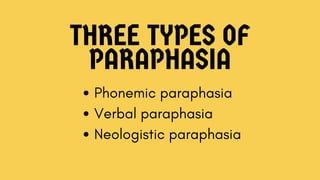
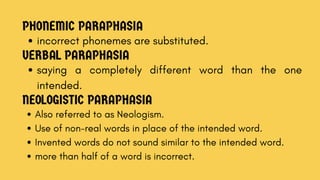
PHONEMIC PARAPHASIA
incorrect phonemesare substituted.
VERBAL PARAPHASIA
saying a completely different word than the one
intended.
NEOLOGISTIC PARAPHASIA
Also referred to as Neologism.
Use of non-real words in place of the intended word.
Invented words do not sound similar to the intended word.
more than half of a word is incorrect.
DYSLEXIA
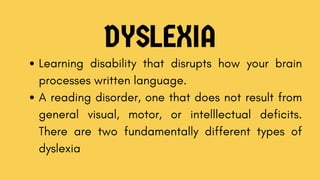
Learning disability thatdisrupts how your brain
processes written language.
A reading disorder, one that does not result from
general visual, motor, or intelllectual deficits.
There are two fundamentally different types of
dyslexia
69.
DEVELOPMENTAL DYSLEXIA
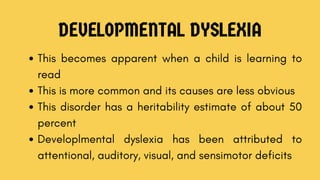
This becomesapparent when a child is learning to
read
This is more common and its causes are less obvious
This disorder has a heritability estimate of about 50
percent
Developlmental dyslexia has been attributed to
attentional, auditory, visual, and sensimotor deficits
70.
DEVELOPMENTAL DYSLEXIA
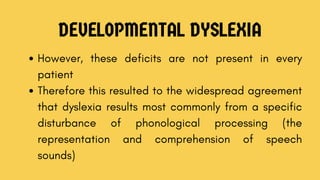
However, thesedeficits are not present in every
patient
Therefore this resulted to the widespread agreement
that dyslexia results most commonly from a specific
disturbance of phonological processing (the
representation and comprehension of speech
sounds)





![[INFOGRAPHIC] Understanding Aphasia](https://cdn.slidesharecdn.com/ss_thumbnails/aphasia-130729151927-phpapp01-thumbnail.jpg?width=640&height=640&fit=bounds)


