Self study notes on Aphasia
on Chapter 18
Clinical Neuropsychology - a pocket handbook for assessment
by Parsons and Hammeke
20240916lc
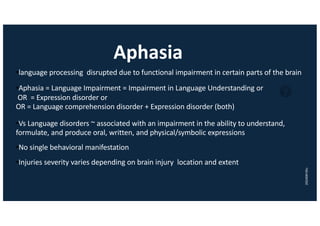
Aphasia
•language processing disrupted due to functional impairment in certain parts of the brain
•Aphasia = Language Impairment = Impairment in Language Understanding or
OR = Expression disorder or
OR = Language comprehension disorder + Expression disorder (both)
•Vs Language disorders ~ associated with an impairment in the ability to understand,
formulate, and produce oral, written, and physical/symbolic expressions
•No single behavioral manifestation
•Injuries severity varies depending on brain injury location and extent
20240916lc
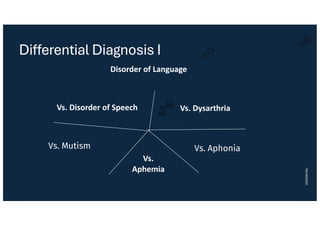
Differential Diagnosis I
Vs. Disorder of Speech
Vs. Mutism
Vs. Dysarthria
Vs. Aphonia
Disorder of Language
Vs.
Aphemia
20240916lc
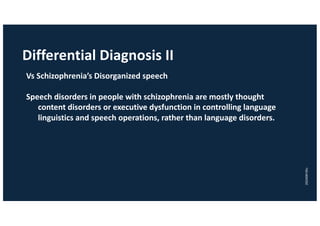
Differential Diagnosis II
Vs Schizophrenia’s Disorganized speech
Speech disorders in people with schizophrenia are mostly thought
content disorders or executive dysfunction in controlling language
linguistics and speech operations, rather than language disorders.
20240916lc
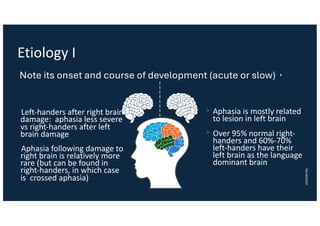
Etiology I
• Aphasia is mostly related
to lesion in left brain
• Over 95% normal right-
handers and 60%-70%
left-handers have their
left brain as the language
dominant brain
Left-handers after right brain
damage: aphasia less severe
vs right-handers after left
brain damage
Aphasia following damage to
right brain is relatively more
rare (but can be found in
right-handers, in which case
is crossed aphasia)
Note its onset and course of development (acute or slow),
20240916lc
Etiology II
Traumatic brain injury
Inflammation
• Most common
• Acute or sudden
• Usually relate to cerebral
vascular incident
Stroke
Transient aphasia may occur
in dominant hemisphere
during/ after seizure or TIA
Epilepsy
Infection
Usually
related to
subacute or
slow onset
Aphasia
Tumor
Neurodegeneration
20240916lc
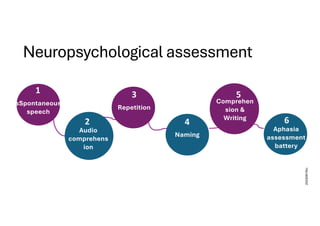
Neuropsychological assessment
1
2
3
4 6
Audio
comprehens
ion
sSpontaneous
speech
Repetition
Naming
Aphasia
assessment
battery
5
Comprehen
sion &
Writing
20240916lc
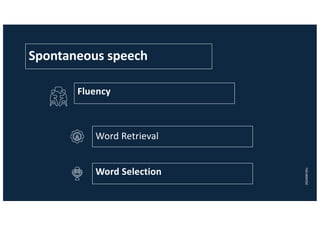
Fluency
Word Retrieval
Word Selection
Spontaneous speech
20240916lc
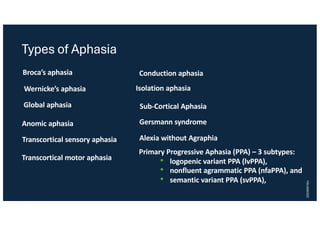
Types of Aphasia
Broca’s aphasia
Transcortical motor aphasia
Global aphasia
Isolation aphasia
Wernicke’s aphasia
Transcortical sensory aphasia
Conduction aphasia
Anomic aphasia
Alexia without Agraphia
Gersmann syndrome
Sub-Cortical Aphasia
Primary Progressive Aphasia (PPA) – 3 subtypes:
• logopenic variant PPA (lvPPA),
• nonfluent agrammatic PPA (nfaPPA), and
• semantic variant PPA (svPPA),
20240916lc
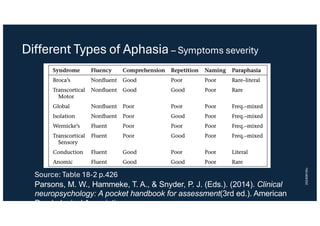
Different Types of Aphasia – Symptoms severity
Source: Table 18-2 p.426
Parsons, M. W., Hammeke, T. A., & Snyder, P. J. (Eds.). (2014). Clinical
neuropsychology: A pocket handbook for assessment(3rd ed.). American
Psychological Association. https://doi.org/10.1037/14339-000
20240916lc
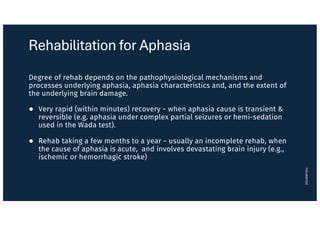
Rehabilitation for Aphasia
Degree of rehab depends on the pathophysiological mechanisms and
processes underlying aphasia, aphasia characteristics and, and the extent of
the underlying brain damage.
● Very rapid (within minutes) recovery ~ when aphasia cause is transient &
reversible (e.g. aphasia under complex partial seizures or hemi-sedation
used in the Wada test).
● Rehab taking a few months to a year ~ usually an incomplete rehab, when
the cause of aphasia is acute, and involves devastating brain injury (e.g.,
ischemic or hemorrhagic stroke)
20240916lc
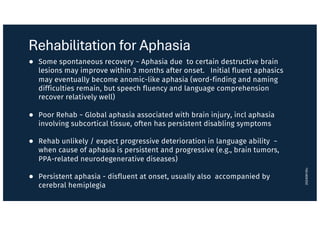
Rehabilitation for Aphasia
● Some spontaneous recovery ~ Aphasia due to certain destructive brain
lesions may improve within 3 months after onset. Initial fluent aphasics
may eventually become anomic-like aphasia (word-finding and naming
difficulties remain, but speech fluency and language comprehension
recover relatively well)
● Poor Rehab ~ Global aphasia associated with brain injury, incl aphasia
involving subcortical tissue, often has persistent disabling symptoms
● Rehab unlikely / expect progressive deterioration in language ability ~
when cause of aphasia is persistent and progressive (e.g., brain tumors,
PPA-related neurodegenerative diseases)
● Persistent aphasia - disfluent at onset, usually also accompanied by
cerebral hemiplegia
20240916lc
Rehabilitation for Aphasia
1. Speech & language therapy
2. Brain plasticity
3. Patience
20240916lc
Reference
Parsons, M. W., Hammeke, T. A., & Snyder, P. J. (Eds.). (2014). Clinical
neuropsychology: A pocket handbook for assessment (3rd ed.).
American Psychological Association. https://doi.org/10.1037/14339-000
20240916lc

Intro to Aphasia study notes20240916lc.pdf

  • 1.
    Self study noteson Aphasia on Chapter 18 Clinical Neuropsychology - a pocket handbook for assessment by Parsons and Hammeke 20240916lc
  • 2.
    Aphasia •language processing disrupteddue to functional impairment in certain parts of the brain •Aphasia = Language Impairment = Impairment in Language Understanding or OR = Expression disorder or OR = Language comprehension disorder + Expression disorder (both) •Vs Language disorders ~ associated with an impairment in the ability to understand, formulate, and produce oral, written, and physical/symbolic expressions •No single behavioral manifestation •Injuries severity varies depending on brain injury location and extent 20240916lc
  • 3.
    Differential Diagnosis I Vs.Disorder of Speech Vs. Mutism Vs. Dysarthria Vs. Aphonia Disorder of Language Vs. Aphemia 20240916lc
  • 4.
    Differential Diagnosis II VsSchizophrenia’s Disorganized speech Speech disorders in people with schizophrenia are mostly thought content disorders or executive dysfunction in controlling language linguistics and speech operations, rather than language disorders. 20240916lc
  • 5.
    Etiology I • Aphasiais mostly related to lesion in left brain • Over 95% normal right- handers and 60%-70% left-handers have their left brain as the language dominant brain Left-handers after right brain damage: aphasia less severe vs right-handers after left brain damage Aphasia following damage to right brain is relatively more rare (but can be found in right-handers, in which case is crossed aphasia) Note its onset and course of development (acute or slow), 20240916lc
  • 6.
    Etiology II Traumatic braininjury Inflammation • Most common • Acute or sudden • Usually relate to cerebral vascular incident Stroke Transient aphasia may occur in dominant hemisphere during/ after seizure or TIA Epilepsy Infection Usually related to subacute or slow onset Aphasia Tumor Neurodegeneration 20240916lc
  • 7.
  • 8.
  • 9.
    Types of Aphasia Broca’saphasia Transcortical motor aphasia Global aphasia Isolation aphasia Wernicke’s aphasia Transcortical sensory aphasia Conduction aphasia Anomic aphasia Alexia without Agraphia Gersmann syndrome Sub-Cortical Aphasia Primary Progressive Aphasia (PPA) – 3 subtypes: • logopenic variant PPA (lvPPA), • nonfluent agrammatic PPA (nfaPPA), and • semantic variant PPA (svPPA), 20240916lc
  • 10.
    Different Types ofAphasia – Symptoms severity Source: Table 18-2 p.426 Parsons, M. W., Hammeke, T. A., & Snyder, P. J. (Eds.). (2014). Clinical neuropsychology: A pocket handbook for assessment(3rd ed.). American Psychological Association. https://doi.org/10.1037/14339-000 20240916lc
  • 11.
    Rehabilitation for Aphasia Degreeof rehab depends on the pathophysiological mechanisms and processes underlying aphasia, aphasia characteristics and, and the extent of the underlying brain damage. ● Very rapid (within minutes) recovery ~ when aphasia cause is transient & reversible (e.g. aphasia under complex partial seizures or hemi-sedation used in the Wada test). ● Rehab taking a few months to a year ~ usually an incomplete rehab, when the cause of aphasia is acute, and involves devastating brain injury (e.g., ischemic or hemorrhagic stroke) 20240916lc
  • 12.
    Rehabilitation for Aphasia ●Some spontaneous recovery ~ Aphasia due to certain destructive brain lesions may improve within 3 months after onset. Initial fluent aphasics may eventually become anomic-like aphasia (word-finding and naming difficulties remain, but speech fluency and language comprehension recover relatively well) ● Poor Rehab ~ Global aphasia associated with brain injury, incl aphasia involving subcortical tissue, often has persistent disabling symptoms ● Rehab unlikely / expect progressive deterioration in language ability ~ when cause of aphasia is persistent and progressive (e.g., brain tumors, PPA-related neurodegenerative diseases) ● Persistent aphasia - disfluent at onset, usually also accompanied by cerebral hemiplegia 20240916lc
  • 13.
    Rehabilitation for Aphasia 1.Speech & language therapy 2. Brain plasticity 3. Patience 20240916lc
  • 14.
    Reference Parsons, M. W.,Hammeke, T. A., & Snyder, P. J. (Eds.). (2014). Clinical neuropsychology: A pocket handbook for assessment (3rd ed.). American Psychological Association. https://doi.org/10.1037/14339-000 20240916lc