Principles of Marketing
Kotler and Armstrong
Insert
Textbook
Cover Image
Chapter 11:
Pricing Strategies
Additional Considerations
New Product Pricing Strategies
Market-skimming Pricing
Market-skimming pricing strategy sets high initial prices to
“skim” revenue layers from the market.
• Product quality and image must support the price.
• Buyers must want the product at the price.
Market-penetration Pricing
Market-penetration pricing involves setting a low
price for a new product in order to attract many
buyers and a large market share.
Product Mix Pricing Strategies
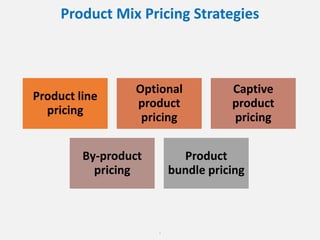
Product line
pricing
Optional
product
pricing
Captive
product
pricing
By-product
pricing
Product
bundle pricing
.
Product Mix Pricing Strategies
Product Line and Optional Product Pricing
Product line pricing considers the cost differences
between products in the line, customer evaluations of
their features, and competitors’ prices.
Optional product pricing considers optional or accessory
products along with the main product.
Product Mix Pricing Strategies
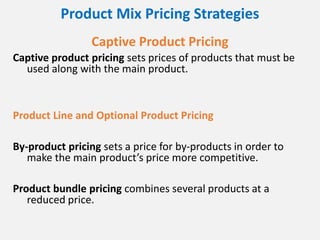
Captive Product Pricing
Captive product pricing sets prices of products that must be
used along with the main product.
Product Line and Optional Product Pricing
By-product pricing sets a price for by-products in order to
make the main product’s price more competitive.
Product bundle pricing combines several products at a
reduced price.
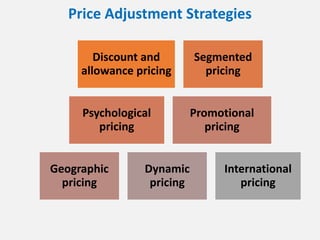
Price Adjustment Strategies
Discount and
allowance pricing
Segmented
pricing
Psychological
pricing
Promotional
pricing
Geographic
pricing
Dynamic
pricing
International
pricing
Price Adjustment Strategies
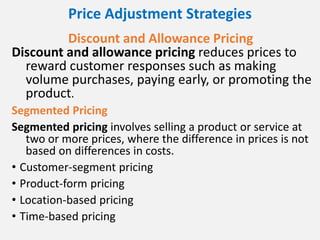
Discount and Allowance Pricing
Discount and allowance pricing reduces prices to
reward customer responses such as making
volume purchases, paying early, or promoting the
product.
Segmented Pricing
Segmented pricing involves selling a product or service at
two or more prices, where the difference in prices is not
based on differences in costs.
• Customer-segment pricing
• Product-form pricing
• Location-based pricing
• Time-based pricing
Price Adjustment Strategies
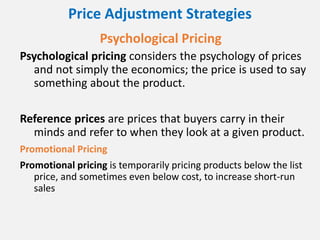
Psychological Pricing
Psychological pricing considers the psychology of prices
and not simply the economics; the price is used to say
something about the product.
Reference prices are prices that buyers carry in their
minds and refer to when they look at a given product.
Promotional Pricing
Promotional pricing is temporarily pricing products below the list
price, and sometimes even below cost, to increase short-run
sales
Price Adjustment Strategies
Geographical Pricing
Geographical pricing is used for customers in different
parts of the country or the world.
• FOB-origin pricing
• Uniform-delivered pricing
• Zone pricing
• Basing-point pricing
• Freight-absorption pricing
Price Adjustment Strategies
Geographical Pricing
FOB-origin (free on board) pricing is a geographical
pricing strategy in which goods are placed free on
board a carrier; the customer pays the freight from the
factory to the destination.
Uniform-delivered pricing is a geographical pricing
strategy in which the company charges the same price
plus freight to all customers, regardless of their
location.
Zone pricing is a strategy in which the company sets up
two or more zones where customers within a given
zone pay the same price.
Basing-point pricing means that a seller selects a given
city as a “basing point” and charges all customers the
freight cost from that city to the customer.
Price Adjustment Strategies
Geographical Pricing
Freight-absorption pricing is a strategy in
which the seller absorbs all or part of the
freight charges in order to get the desired
business.
Dynamic pricing involves adjusting prices
continually to meet the characteristics and
needs of individual customers and situations.
Price Adjustment Strategies
International Pricing
International pricing sets prices in a specific country
based on many factors.
• Economic conditions
• Competitive situations
• Laws and regulations
• Wholesaling and retail systems
.
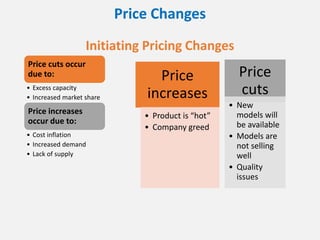
Price Changes
Initiating Pricing Changes
Price cuts occur
due to:
• Excess capacity
• Increased market share
Price increases
occur due to:
• Cost inflation
• Increased demand
• Lack of supply
Price
increases
• Product is “hot”
• Company greed
Price
cuts
• New
models will
be available
• Models are
not selling
well
• Quality
issues
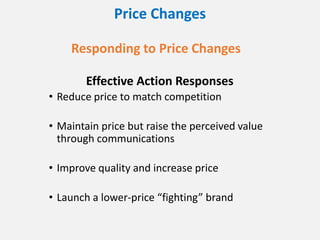
Price Changes
Responding to Price Changes
Effective Action Responses
• Reduce price to match competition
• Maintain price but raise the perceived value
through communications
• Improve quality and increase price
• Launch a lower-price “fighting” brand
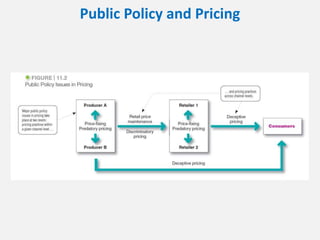
Public Policy and Pricing
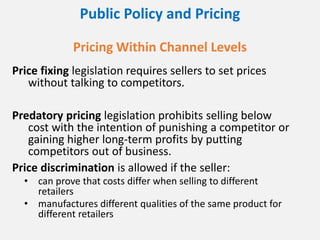
Pricing Within Channel Levels
Price fixing legislation requires sellers to set prices
without talking to competitors.
Predatory pricing legislation prohibits selling below
cost with the intention of punishing a competitor or
gaining higher long-term profits by putting
competitors out of business.
Price discrimination is allowed if the seller:
• can prove that costs differ when selling to different
retailers
• manufactures different qualities of the same product for
different retailers
Public Policy and Pricing
Pricing Across Channel Levels
Retail (or resale) price maintenance is when a
manufacturer requires a dealer to charge a specific
retail price for its product, which is prohibited by law.
Pricing Across Channel Levels
Deceptive pricing occurs when a seller states prices or price
savings that mislead consumers or are not actually available
to consumers.
• Bogus reference or comparison prices
• Scanner fraud and price confusion

Kotle presentaion.pptx

  • 1.
    Principles of Marketing Kotlerand Armstrong Insert Textbook Cover Image Chapter 11: Pricing Strategies Additional Considerations
  • 2.
    New Product PricingStrategies Market-skimming Pricing Market-skimming pricing strategy sets high initial prices to “skim” revenue layers from the market. • Product quality and image must support the price. • Buyers must want the product at the price. Market-penetration Pricing Market-penetration pricing involves setting a low price for a new product in order to attract many buyers and a large market share.
  • 3.
    Product Mix PricingStrategies Product line pricing Optional product pricing Captive product pricing By-product pricing Product bundle pricing .
  • 4.
    Product Mix PricingStrategies Product Line and Optional Product Pricing Product line pricing considers the cost differences between products in the line, customer evaluations of their features, and competitors’ prices. Optional product pricing considers optional or accessory products along with the main product.
  • 5.
    Product Mix PricingStrategies Captive Product Pricing Captive product pricing sets prices of products that must be used along with the main product. Product Line and Optional Product Pricing By-product pricing sets a price for by-products in order to make the main product’s price more competitive. Product bundle pricing combines several products at a reduced price.
  • 6.
    Price Adjustment Strategies Discountand allowance pricing Segmented pricing Psychological pricing Promotional pricing Geographic pricing Dynamic pricing International pricing
  • 7.
    Price Adjustment Strategies Discountand Allowance Pricing Discount and allowance pricing reduces prices to reward customer responses such as making volume purchases, paying early, or promoting the product. Segmented Pricing Segmented pricing involves selling a product or service at two or more prices, where the difference in prices is not based on differences in costs. • Customer-segment pricing • Product-form pricing • Location-based pricing • Time-based pricing
  • 8.
    Price Adjustment Strategies PsychologicalPricing Psychological pricing considers the psychology of prices and not simply the economics; the price is used to say something about the product. Reference prices are prices that buyers carry in their minds and refer to when they look at a given product. Promotional Pricing Promotional pricing is temporarily pricing products below the list price, and sometimes even below cost, to increase short-run sales
  • 9.
    Price Adjustment Strategies GeographicalPricing Geographical pricing is used for customers in different parts of the country or the world. • FOB-origin pricing • Uniform-delivered pricing • Zone pricing • Basing-point pricing • Freight-absorption pricing
  • 10.
    Price Adjustment Strategies GeographicalPricing FOB-origin (free on board) pricing is a geographical pricing strategy in which goods are placed free on board a carrier; the customer pays the freight from the factory to the destination. Uniform-delivered pricing is a geographical pricing strategy in which the company charges the same price plus freight to all customers, regardless of their location. Zone pricing is a strategy in which the company sets up two or more zones where customers within a given zone pay the same price. Basing-point pricing means that a seller selects a given city as a “basing point” and charges all customers the freight cost from that city to the customer.
  • 11.
    Price Adjustment Strategies GeographicalPricing Freight-absorption pricing is a strategy in which the seller absorbs all or part of the freight charges in order to get the desired business. Dynamic pricing involves adjusting prices continually to meet the characteristics and needs of individual customers and situations.
  • 12.
    Price Adjustment Strategies InternationalPricing International pricing sets prices in a specific country based on many factors. • Economic conditions • Competitive situations • Laws and regulations • Wholesaling and retail systems .
  • 13.
    Price Changes Initiating PricingChanges Price cuts occur due to: • Excess capacity • Increased market share Price increases occur due to: • Cost inflation • Increased demand • Lack of supply Price increases • Product is “hot” • Company greed Price cuts • New models will be available • Models are not selling well • Quality issues
  • 14.
    Price Changes Responding toPrice Changes Effective Action Responses • Reduce price to match competition • Maintain price but raise the perceived value through communications • Improve quality and increase price • Launch a lower-price “fighting” brand
  • 15.
  • 16.
    Public Policy andPricing Pricing Within Channel Levels Price fixing legislation requires sellers to set prices without talking to competitors. Predatory pricing legislation prohibits selling below cost with the intention of punishing a competitor or gaining higher long-term profits by putting competitors out of business. Price discrimination is allowed if the seller: • can prove that costs differ when selling to different retailers • manufactures different qualities of the same product for different retailers
  • 17.
    Public Policy andPricing Pricing Across Channel Levels Retail (or resale) price maintenance is when a manufacturer requires a dealer to charge a specific retail price for its product, which is prohibited by law. Pricing Across Channel Levels Deceptive pricing occurs when a seller states prices or price savings that mislead consumers or are not actually available to consumers. • Bogus reference or comparison prices • Scanner fraud and price confusion

Editor's Notes

  • #3 Pricing strategies usually change as the product passes through its life cycle. The introductory stage is especially challenging. Companies bringing out a new product face the challenge of setting prices for the first time. They can choose between two broad strategies: market-skimming pricing and market-penetration pricing. Apple frequently uses market-skimming pricing (or price skimming). When Apple first introduced the iPhone, its initial price was as high as $599 per phone. The phones were purchased only by customers who really wanted the sleek new gadget and could afford to pay a high price for it. Six months later, Apple dropped the price to $399 for an 8-GB model and $499 for the 16-GB model to attract new buyers. Within a year, it dropped prices again to $199 and $299, respectively, and you can now get a basic 8-GB model for free with a wireless phone contract. In this way, Apple has skimmed the maximum amount of revenue from the various segments of the market. Market skimming makes sense only under certain conditions. First, the product’s quality and image must support its higher price, and enough buyers must want the product at that price. Second, the costs of producing a smaller volume cannot be so high that they cancel the advantage of charging more. Finally, competitors should not be able to enter the market easily and undercut the high price.
  • #4 The strategy for setting a product’s price often has to be changed when the product is part of a product mix. In this case, the firm looks for a set of prices that maximizes its profits on the total product mix. Pricing is difficult because the various products have related demands and costs and face different degrees of competition.
  • #5 Product Line Pricing Companies usually develop product lines rather than single products. In product line pricing, management must determine the price steps to set between the various products in a line. The product line could include a broad range of prices for the various products. Optional Product Pricing Pricing options is a sticky problem. Companies must decide which items to include in the base price and which to offer as options.
  • #6 Captive product pricing: Nearly 73 percent of Keurig’s sales come from its K-Cup portion packs. The brand must find the right balance between main-product and captive-product prices. Examples of captive products are razor blade cartridges, videogames, printer cartridges, and e-books. Producers of the main products often price them low and set high markups on the supplies. For example, Amazon introduced its Kindle Fire tablet for as low as $199, a loss of an estimated $10 per machine. It hoped to more than make up for the loss through sales of digital books, music, and movies to be viewed on the devices. However, companies that use captive product pricing must be careful. Finding the right balance between the main product and captive product prices can be tricky. Even more, consumers trapped into buying expensive captive products may come to resent the brand that ensnared them. In the case of services, captive product pricing is called two-part pricing. The price of the service is broken into a fixed fee plus a variable usage rate. Thus, at Six Flags and other amusement parks, you pay a daily ticket or season pass charge plus additional fees for food and other in-park features.
  • #7 Companies usually adjust their basic prices to account for various customer differences and changing situations. Here, we examine the seven price adjustment strategies summarized in Table 11.2: discount and allowance pricing, segmented pricing, psychological pricing, promotional pricing, geographical pricing, dynamic pricing, and international pricing.
  • #8 Discounts include cash discounts for paying promptly, quantity discounts for buying in large volume, or functional (trade) discounts for selling, storing, distribution, and record keeping. Allowances include trade-in allowances for turning in old items when buying new ones and promotional allowances to reward dealers for participating in advertising or sales support programs.
  • #9 Discussion Question How well do you carry prices of coffee, pizza, and milk in your head? It might be interesting to collect the prices of items sold near or on campus including coffee, pizza, and sandwiches. Ask students how well they know these prices, have them write down the price of these items, and then check themselves. You will often find that people do NOT know prices as well as they think they do. With psychological pricing, consumers usually perceive higher-priced products as having higher quality. Who’s the better lawyer, one who charges $50 per hour or one who charges $500 per hour? Another aspect of psychological pricing is reference prices which might be formed by noting current prices, remembering past prices, or assessing the buying situation. Sellers can influence or use these consumers’ reference prices when setting price. For example a grocery retailer might place its store brand next to a more expensive branded item or offer more expensive models that don’t sell very well to make its less expensive but still high-priced models look more affordable by comparison. Even small differences in price can signal product differences. A 9 or 0.99 at the end of a price often signals a bargain. High-end retailers might favor prices ending in a whole number and others use 00-cent endings on regularly priced items and 99-cent endings on discount merchandise.
  • #10 Geographical Pricing A company also must decide how to price its products for customers located in different parts of the United States or the world. Should the company risk losing the business of more-distant customers by charging them higher prices to cover the higher shipping costs?
  • #11 Since a customer picks up its own cost, supporters of FOB-origin pricing feel that this is the fairest way to assess freight charges. The disadvantage, however, is that the company will be a high-cost firm to distant customers. Uniform-delivered pricing is the opposite of FOB pricing. Here, the company charges the same price plus freight to all customers, regardless of their location. The freight charge is set at the average freight cost.
  • #12 The seller who is anxious to do business with a certain customer or geographical area might use freight-absorption pricing. The seller might reason that if it can get more business, its average costs will decrease and more than compensate for its extra freight cost. Freight-absorption pricing is used for market penetration and to hold on to increasingly competitive markets.
  • #13 International pricing: To lower prices in emerging markets, such as Indonesia shown here, Unilever developed smaller, single-use packets of its Sunsilk, Ponds, Dove, and other brands that sell at prices even the world’s poorest consumers can afford. Companies that market their products internationally must decide what prices to charge in different countries. In some cases, a company can set a uniform worldwide price. For example, Boeing sells its jetliners at about the same price everywhere. However, most companies adjust their prices to reflect local market conditions and cost considerations. Consumer perceptions and preferences also may vary from country to country, calling for different prices. Or the company may have different marketing objectives in various world markets, which require changes in pricing strategy. For example, Apple introduces sophisticated, feature-rich, premium smartphones in carefully segmented mature markets in highly developed countries using a market-skimming pricing strategy. By contrast, it’s now under pressure to discount older models and develop a more basic phone for sizable but less affluent markets in developing countries, supported by penetration pricing. Price escalation resulting from differences in selling strategies, market conditions, or simply a result of the higher costs of selling in another country plays an important role in setting international prices. Price has become a key element in the international marketing strategies of companies attempting to enter less affluent emerging markets. Typically, entering such markets has meant targeting the exploding middle classes in developing countries. More recently, however, as the weakened global economy has slowed growth in both domestic and emerging markets, many companies are shifting their sights to include a new target—the so-called “bottom of the pyramid,” the vast untapped market consisting of the world’s poorest consumers.
  • #14 Initiating Price Cuts Several situations may lead a firm to consider cutting prices. One such circumstance is excess capacity. Another is falling demand in the face of strong price competition or a weakened economy. In such cases, the firm may aggressively cut prices to boost sales and market share. Cutting prices in an industry loaded with excess capacity may lead to price wars as competitors try to hold on to market share. A company may also cut prices in a drive to dominate the market through lower costs. Either the company starts with lower costs than its competitors, or it cuts prices in the hope of gaining market share that will further cut costs through larger volume. For example, computer and electronics maker Lenovo uses an aggressive low-cost, low-price strategy to increase its share of the PC market in developing countries. Initiating Price Increases A successful price increase can greatly improve profits. For example, if the company’s profit margin is 3 percent of sales, a 1 percent price increase will boost profits by 33 percent if sales volume is unaffected. When a company cannot supply all that its customers need, it may raise its prices, ration products to customers, or both—consider today’s worldwide oil and gas industry. When raising prices, the company must avoid being perceived as a price gouger. Customers have long memories, and they will eventually turn away from companies or even whole industries that they perceive as charging excessive prices. In the extreme, claims of price gouging may even bring about increased government regulation. There are some techniques for avoiding these problems. One is to maintain a sense of fairness surrounding any price increase. Price increases should be supported by company communications telling customers why prices are being raised. Wherever possible, the company should consider ways to meet higher costs or demand without raising prices, such as by: using more cost-effective ways to produce or distribute its products. “unbundling” its market offering and price elements separately. shrinking the product or substituting less-expensive ingredients.
  • #15 If the company decides that effective action can and should be taken, it might make any of four responses shown on this slide.
  • #16 Figure 11.2 shows the major public policy issues in pricing. These include potentially damaging pricing practices within a given level of the channel (price-fixing and predatory pricing) and across levels of the channel (retail price maintenance, discriminatory pricing, and deceptive pricing).
  • #17 Price competition is a core element of our free-market economy. In setting prices, companies usually are not free to charge whatever prices they wish. Many federal, state, and even local laws govern the rules of fair play in pricing. In addition, companies must consider broader societal pricing concerns. In setting their prices, for example, pharmaceutical firms must balance their development costs and profit objectives against the sometimes life-and-death needs of drug consumers. The most important pieces of legislation affecting pricing are the Sherman Act, the Clayton Act, and the Robinson-Patman Act, initially adopted to curb the formation of monopolies and regulate business practices that might unfairly restrain trade. Price-fixing is illegal per se—that is, the government does not accept any excuses for price-fixing. As such, companies found guilty of these practices can receive heavy fines. Recently, governments at the state and national levels have been aggressively enforcing price-fixing regulations in industries ranging from gasoline, insurance, and concrete to credit cards, CDs, and computer chips. Price-fixing is also prohibited in many international markets. For example, European Union regulators recently fined consumer products giants Unilever and P&G a combined $456 million for fixing laundry detergent prices in eight EU countries. France also fined the two consumer products giants, along with competitors Colgate and Henkel. It claimed that officials from the four companies met regularly at hotels and restaurants in Paris to agree to limits on the size of discounts and on price differences between their laundry detergent brands. Sellers are also prohibited from using predatory pricing—selling below cost with the intention of punishing a competitor or gaining higher long-run profits by putting competitors out of business. This protects small sellers from larger ones who might sell items below cost temporarily or in a specific locale to drive them out of business. The biggest problem is determining just what constitutes predatory pricing behavior. Selling below cost to unload excess inventory is not considered predatory; selling below cost to drive out competitors is. Thus, a given action may or may not be predatory depending on intent, and intent can be very difficult to determine or prove.
  • #18 Although the seller can propose a manufacturer’s suggested retail price to dealers, it cannot refuse to sell to a dealer that takes independent pricing action, nor can it punish the dealer by shipping late or denying advertising allowances. For example, the Florida attorney general’s office investigated Nike for allegedly fixing the retail price of its shoes and clothing. It was concerned that Nike might be withholding items from retailers who were not selling its most expensive shoes at prices the company considered suitable.