Pricing Strategy
Pricing
Decisions are
Creating
Major
Challenges
for Many
Companies
Threats to major airlines by discount
carriers.
Pressures on drug companies to reduce
prices.
Intense price competition on
supermarket chains
Aggressive discounting by automobile
producers to retain market share.
Threats to strong brands by counterfeit
products.
What is price ?
Price is the one element of the
marketing mix that produces
revenue
The amount paid for some goods
and services
According to Kotler and
Armstrong (2009, p. 263) the price is
“the amount of money charged for a
product or service, or the sum of all
the values that customers give up in
order to gain the benefit of having or
using a product or service
Pricing is the process whereby a
business sets the price at which it
will sell its products and services
Pricing Situations
 New product pricing
 Life cycle pricing
 Changing positioning strategy
 Countering competitive threats
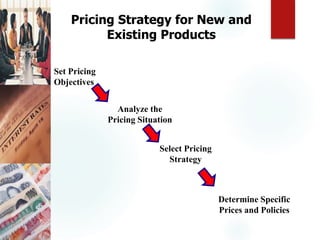
Pricing Strategy for New and
Existing Products
Set Pricing
Objectives
Analyze the
Pricing Situation
Select Pricing
Strategy
Determine Specific
Prices and Policies
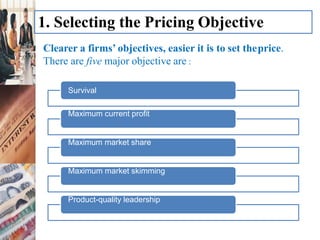
1. Selecting the Pricing Objective
Clearer a firms’ objectives, easier it is to set theprice.
There are five major objective are :
Survival
Maximum current profit
Maximum market share
Maximum market skimming
Product-quality leadership
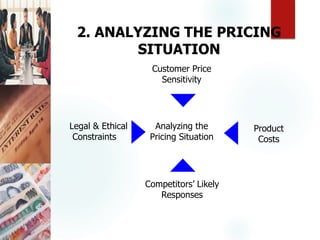
Customer Price
Sensitivity
Legal & Ethical
Constraints
Competitors’ Likely
Responses
Analyzing the
Pricing Situation
Product
Costs
2. ANALYZING THE PRICING
SITUATION
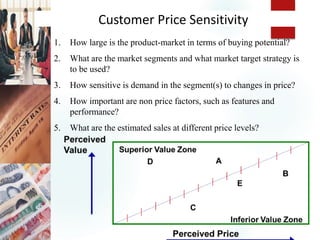
1. How large is the product-market in terms of buying potential?
2. What are the market segments and what market target strategy is
to be used?
3. How sensitive is demand in the segment(s) to changes in price?
4. How important are non price factors, such as features and
performance?
5. What are the estimated sales at different price levels?
Customer Price Sensitivity
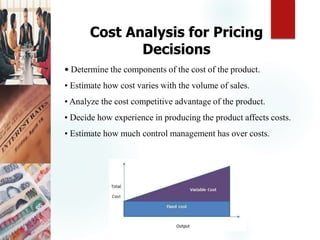
Cost Analysis for Pricing
Decisions
• Determine the components of the cost of the product.
• Estimate how cost varies with the volume of sales.
• Analyze the cost competitive advantage of the product.
• Decide how experience in producing the product affects costs.
• Estimate how much control management has over costs.
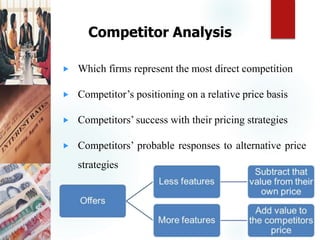
Competitor Analysis
 Which firms represent the most direct competition
 Competitor’s positioning on a relative price basis
 Competitors’ success with their pricing strategies
 Competitors’ probable responses to alternative price
strategies
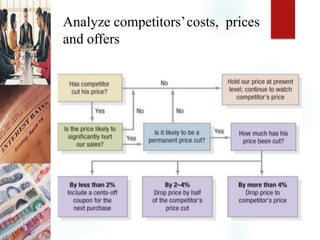
Analyze competitors’costs, prices
and offers
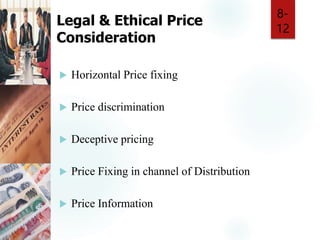
Legal & Ethical Price
Consideration
 Horizontal Price fixing
 Price discrimination
 Deceptive pricing
 Price Fixing in channel of Distribution
 Price Information
8-
12
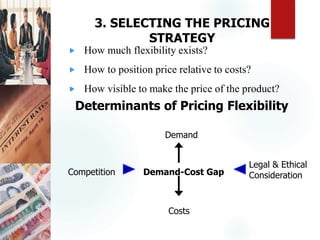
3. SELECTING THE PRICING
STRATEGY
 How much flexibility exists?
 How to position price relative to costs?
 How visible to make the price of the product?
Determinants of Pricing Flexibility
Demand
Costs
Demand-Cost Gap
Competition
Legal & Ethical
Consideration
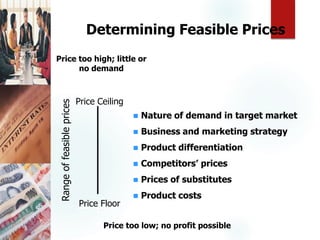
Price too high; little or
no demand
Price Floor
Price Ceiling
 Nature of demand in target market
 Business and marketing strategy
 Product differentiation
 Competitors’ prices
 Prices of substitutes
 Product costs
Range
of
feasible
prices
Price too low; no profit possible
Determining Feasible Prices
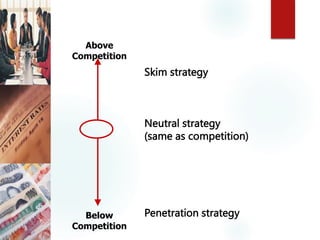
Above
Competition
Below
Competition
Skim strategy
Neutral strategy
(same as competition)
Penetration strategy
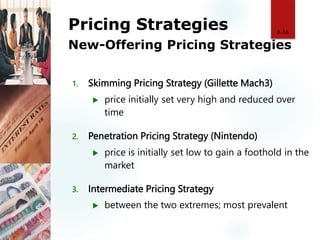
Pricing Strategies
New-Offering Pricing Strategies
1. Skimming Pricing Strategy (Gillette Mach3)
 price initially set very high and reduced over
time
2. Penetration Pricing Strategy (Nintendo)
 price is initially set low to gain a foothold in the
market
3. Intermediate Pricing Strategy
 between the two extremes; most prevalent
8-16
Pricing Strategies
When to Use Skimming Pricing
1. Demand is likely to be price inelastic
2. There are different price-market segments
3. The offering is unique enough to be protected from
competition by patent, copyright, or trade secret
4. Production or marketing costs are unknown
5. A capacity constraint in producing the product or
providing the service exists
6. An organization wants to generate funds quickly
7. There is a realistic perceived value in the product or
service
8-17
Appropriate when:
Pricing Strategies
When to Use Penetration Pricing
1. Demand is likely to be price elastic
2. The offering is not unique or protected by patents,
copyrights, or trade secrets
3. Competitors are expected to enter market quickly
4. There are no distinct and separate price-market
segments
5. There is a possibility of large savings in production
and marketing costs if a large sales volume can be
generated
6. The organization’s major objective is to obtain a large
market share
8-18
Appropriate when:
4. DETERMINING SPECIFIC
PRICES AND POLICIES
 Selecting Specific Prices
 Policies to Manage Pricing Strategy
 Special Pricing Issues
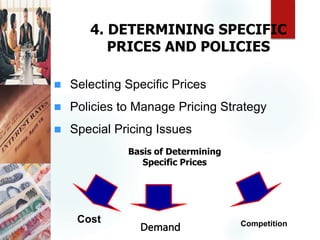
Cost
Demand Competition
Basis of Determining
Specific Prices
Selecting a Pricing Method
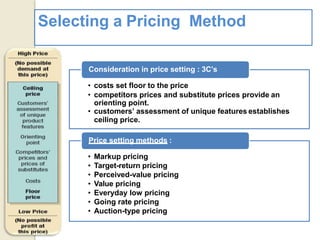
Consideration in price setting : 3C’s
• costs set floor to the price
• competitors prices and substitute prices provide an
orienting point.
• customers’ assessment of unique features establishes
ceiling price.
Price setting methods :
• Markup pricing
• Target-return pricing
• Perceived-value pricing
• Value pricing
• Everyday low pricing
• Going rate pricing
• Auction-type pricing
Establishing Pricing Policy and
Structure
Policy
Discounts, allowances, returns, and other
operating guidelines
Pricing Structure
Product mix and line pricing relationships
How individual items in the line are
priced in relation to one another
Managing Pricing Strategy
1. The more that the competitors and customers know about
your pricing, the better off you are. In an information age, it
is necessary to be transparent about prices and the value of a
firm’s offerings.
2. In highly competitive markets, the focus should be on those
market segments that provide opportunities to gain
competitive advantage. Such a focus leads to a value-oriented
pricing approach.
3. Pricing decisions should be made within the context of an
overall marketing strategy that is embedded within a business
or corporate strategy.
4. Successful pricing decisions are profit oriented, not sales
volume or market share oriented.
Managing Pricing Strategy
5. Prices should be set according to customers’ perceptions of
value.
6. Pricing for new products should start as soon as product
development begins.
7. The relevant costs for pricing are the incremental avoidable
costs.
8. A price may be profitable when it provides for incremental
revenues in excess of incremental costs.
9. A central organizing unit should administer the pricing
function. Generally, it is better to avoid letting salespeople
set price, especially without access to profitability
information and specific training in pricing and revenue
management.
10. Pricing management should be viewed as a process and
price setting as a daily management activity, not a once-a-
year activity.

12. Pricing Strategy.pptx

  • 1.
  • 2.
    Pricing Decisions are Creating Major Challenges for Many Companies Threatsto major airlines by discount carriers. Pressures on drug companies to reduce prices. Intense price competition on supermarket chains Aggressive discounting by automobile producers to retain market share. Threats to strong brands by counterfeit products.
  • 3.
    What is price? Price is the one element of the marketing mix that produces revenue The amount paid for some goods and services According to Kotler and Armstrong (2009, p. 263) the price is “the amount of money charged for a product or service, or the sum of all the values that customers give up in order to gain the benefit of having or using a product or service Pricing is the process whereby a business sets the price at which it will sell its products and services
  • 4.
    Pricing Situations  Newproduct pricing  Life cycle pricing  Changing positioning strategy  Countering competitive threats
  • 5.
    Pricing Strategy forNew and Existing Products Set Pricing Objectives Analyze the Pricing Situation Select Pricing Strategy Determine Specific Prices and Policies
  • 6.
    1. Selecting thePricing Objective Clearer a firms’ objectives, easier it is to set theprice. There are five major objective are : Survival Maximum current profit Maximum market share Maximum market skimming Product-quality leadership
  • 7.
    Customer Price Sensitivity Legal &Ethical Constraints Competitors’ Likely Responses Analyzing the Pricing Situation Product Costs 2. ANALYZING THE PRICING SITUATION
  • 8.
    1. How largeis the product-market in terms of buying potential? 2. What are the market segments and what market target strategy is to be used? 3. How sensitive is demand in the segment(s) to changes in price? 4. How important are non price factors, such as features and performance? 5. What are the estimated sales at different price levels? Customer Price Sensitivity
  • 9.
    Cost Analysis forPricing Decisions • Determine the components of the cost of the product. • Estimate how cost varies with the volume of sales. • Analyze the cost competitive advantage of the product. • Decide how experience in producing the product affects costs. • Estimate how much control management has over costs.
  • 10.
    Competitor Analysis  Whichfirms represent the most direct competition  Competitor’s positioning on a relative price basis  Competitors’ success with their pricing strategies  Competitors’ probable responses to alternative price strategies
  • 11.
  • 12.
    Legal & EthicalPrice Consideration  Horizontal Price fixing  Price discrimination  Deceptive pricing  Price Fixing in channel of Distribution  Price Information 8- 12
  • 13.
    3. SELECTING THEPRICING STRATEGY  How much flexibility exists?  How to position price relative to costs?  How visible to make the price of the product? Determinants of Pricing Flexibility Demand Costs Demand-Cost Gap Competition Legal & Ethical Consideration
  • 14.
    Price too high;little or no demand Price Floor Price Ceiling  Nature of demand in target market  Business and marketing strategy  Product differentiation  Competitors’ prices  Prices of substitutes  Product costs Range of feasible prices Price too low; no profit possible Determining Feasible Prices
  • 15.
  • 16.
    Pricing Strategies New-Offering PricingStrategies 1. Skimming Pricing Strategy (Gillette Mach3)  price initially set very high and reduced over time 2. Penetration Pricing Strategy (Nintendo)  price is initially set low to gain a foothold in the market 3. Intermediate Pricing Strategy  between the two extremes; most prevalent 8-16
  • 17.
    Pricing Strategies When toUse Skimming Pricing 1. Demand is likely to be price inelastic 2. There are different price-market segments 3. The offering is unique enough to be protected from competition by patent, copyright, or trade secret 4. Production or marketing costs are unknown 5. A capacity constraint in producing the product or providing the service exists 6. An organization wants to generate funds quickly 7. There is a realistic perceived value in the product or service 8-17 Appropriate when:
  • 18.
    Pricing Strategies When toUse Penetration Pricing 1. Demand is likely to be price elastic 2. The offering is not unique or protected by patents, copyrights, or trade secrets 3. Competitors are expected to enter market quickly 4. There are no distinct and separate price-market segments 5. There is a possibility of large savings in production and marketing costs if a large sales volume can be generated 6. The organization’s major objective is to obtain a large market share 8-18 Appropriate when:
  • 19.
    4. DETERMINING SPECIFIC PRICESAND POLICIES  Selecting Specific Prices  Policies to Manage Pricing Strategy  Special Pricing Issues Cost Demand Competition Basis of Determining Specific Prices
  • 20.
    Selecting a PricingMethod Consideration in price setting : 3C’s • costs set floor to the price • competitors prices and substitute prices provide an orienting point. • customers’ assessment of unique features establishes ceiling price. Price setting methods : • Markup pricing • Target-return pricing • Perceived-value pricing • Value pricing • Everyday low pricing • Going rate pricing • Auction-type pricing
  • 21.
    Establishing Pricing Policyand Structure Policy Discounts, allowances, returns, and other operating guidelines Pricing Structure Product mix and line pricing relationships How individual items in the line are priced in relation to one another
  • 22.
    Managing Pricing Strategy 1.The more that the competitors and customers know about your pricing, the better off you are. In an information age, it is necessary to be transparent about prices and the value of a firm’s offerings. 2. In highly competitive markets, the focus should be on those market segments that provide opportunities to gain competitive advantage. Such a focus leads to a value-oriented pricing approach. 3. Pricing decisions should be made within the context of an overall marketing strategy that is embedded within a business or corporate strategy. 4. Successful pricing decisions are profit oriented, not sales volume or market share oriented.
  • 23.
    Managing Pricing Strategy 5.Prices should be set according to customers’ perceptions of value. 6. Pricing for new products should start as soon as product development begins. 7. The relevant costs for pricing are the incremental avoidable costs. 8. A price may be profitable when it provides for incremental revenues in excess of incremental costs. 9. A central organizing unit should administer the pricing function. Generally, it is better to avoid letting salespeople set price, especially without access to profitability information and specific training in pricing and revenue management. 10. Pricing management should be viewed as a process and price setting as a daily management activity, not a once-a- year activity.