BOUNDARY TENSION 
AND WETTABILITY
IMMISCIBLE PHASES 
Earlier discussions have considered only a 
single fluid in the pores 
porosity 
permeability 
Saturation: fraction of pore space 
occupied by a particular fluid (immiscible 
phases) 
Sw+So+Sg=1 
When more than a single phase is present, 
the fluids interact with the rock, and with 
each other
DEFINITION OF INTERFACIAL TENSION 
Interfacial (boundary) tension is the energy per 
unit area (force per unit distance) at the 
surface between phases 
Commonly expressed in milli-Newtons/meter 
(also, dynes/cm)
INTERFACIAL TENSION 
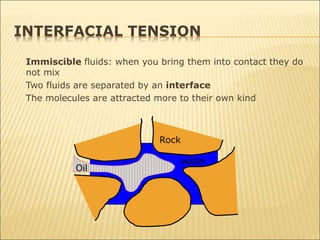
Immiscible fluids: when you bring them into contact they do 
not mix 
Two fluids are separated by an interface 
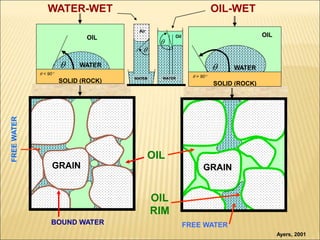
The molecules are attracted more to their own kind 
Oil 
Rock 
water
INTERFACIAL TENSION 
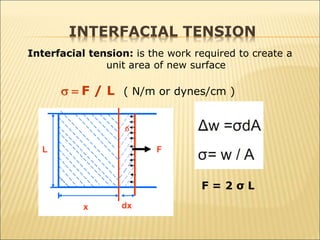
Interfacial tension: is the work required to create a 
unit area of new surface 
s = F / L ( N/m or dynes/cm ) 
F = 2 σ L
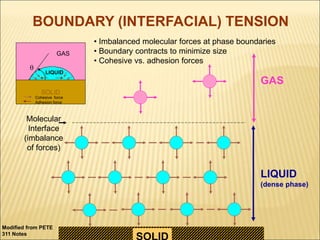
BOUNDARY (INTERFACIAL) TENSION 
GAS 
LIQUID 
Modified from PETE 
311 Notes 
• Imbalanced molecular forces at phase boundaries 
• Boundary contracts to minimize size 
• Cohesive vs. adhesion forces 
LIQUID 
(dense phase) 
Molecular 
Interface 
(imbalance 
of forces) 
GAS 
SOLID 
 
SOLID 
Cohesive force 
Adhesion force
DEFINITION OF WETTABILITY 
Wettability is the tendency of one fluid 
to spread on or adhere to a solid 
surface in the presence of other 
immiscible fluids. 
Wettability refers to interaction between 
fluid and solid phases. 
• Reservoir rocks (sandstone, limestone, 
dolomite, etc.) are the solid surfaces 
• Oil, water, and/or gas are the fluids
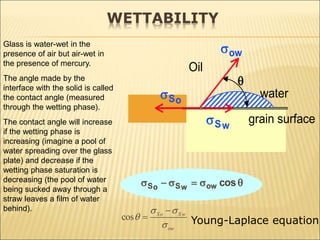
sow 
 
water 
WETTABILITY 
Oil 
grain surface 
sSo 
sSw 
sSo  sSw = sow cos  
s  
s 
cos S o S w 
= Young-Laplace equation 
ow 
 
s 
Glass is water-wet in the 
presence of air but air-wet in 
the presence of mercury. 
The angle made by the 
interface with the solid is called 
the contact angle (measured 
through the wetting phase). 
The contact angle will increase 
if the wetting phase is 
increasing (imagine a pool of 
water spreading over the glass 
plate) and decrease if the 
wetting phase saturation is 
decreasing (the pool of water 
being sucked away through a 
straw leaves a film of water 
behind).
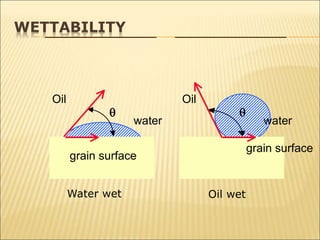
WETTABILITY 
 
water 
Oil 
grain surface 
 
water 
Oil 
grain surface 
Water wet Oil wet
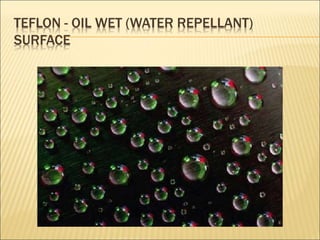
TEFLON - OIL WET (WATER REPELLANT) 
SURFACE
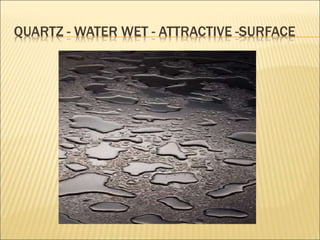
QUARTZ - WATER WET - ATTRACTIVE -SURFACE
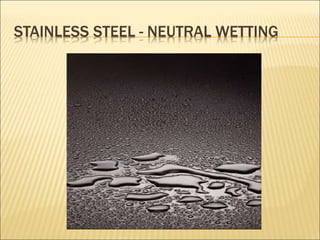
STAINLESS STEEL - NEUTRAL WETTING
WHY STUDY WETTABILITY? 
•Understand physical and chemical interactions between 
• Individual fluids and reservoir rocks 
• Different fluids with in a reservoir 
• Individual fluids and reservoir rocks when multiple 
fluids are present 
•Petroleum reservoirs commonly have 2 – 3 fluids 
(multiphase systems) 
• When 2 or more fluids are present, there are at least 3 
sets of forces acting on the fluids and affecting HC recovery
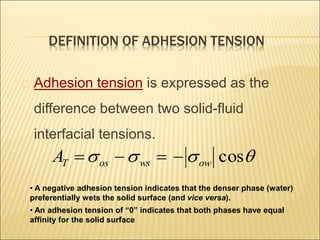
DEFINITION OF ADHESION TENSION 
Adhesion tension is expressed as the 
difference between two solid-fluid 
interfacial tensions. 
s s s cos T os ws ow A =  =  
• A negative adhesion tension indicates that the denser phase (water) 
preferentially wets the solid surface (and vice versa). 
• An adhesion tension of “0” indicates that both phases have equal 
affinity for the solid surface
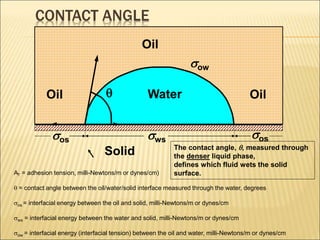
CONTACT ANGLE 
Oil 
Water 
sow 
 
Oil Oil 
sos 
The contact angle,  , measured through 
the denser liquid phase, 
defines which fluid wets the solid 
sos sws 
Solid 
A surface. T = adhesion tension, milli-Newtons/m or dynes/cm) 
 = contact angle between the oil/water/solid interface measured through the water, degrees 
sos = interfacial energy between the oil and solid, milli-Newtons/m or dynes/cm 
sws = interfacial energy between the water and solid, milli-Newtons/m or dynes/cm 
sow = interfacial energy (interfacial tension) between the oil and water, milli-Newtons/m or dynes/cm
WETTING PHASE FLUID 
Wetting phase fluid preferentially wets the solid 
rock surface. 
Attractive forces between rock and fluid draw the 
wetting phase into small pores. 
Wetting phase fluid often has low mobile. 
Attractive forces limit reduction in wetting phase 
saturation to an irreducible value (irreducible 
wetting phase saturation). 
Many hydrocarbon reservoirs are either totally or 
partially water-wet.
NONWETTING PHASE FLUID 
Nonwetting phase does not preferentially wet 
the solid rock surface 
Repulsive forces between rock and fluid 
cause nonwetting phase to occupy largest 
pores 
Nonwetting phase fluid is often the most 
mobile fluid, especially at large nonwetting 
phase saturations 
Natural gas is never the wetting phase in 
hydrocarbon reservoirs
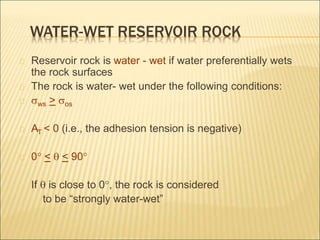
WATER-WET RESERVOIR ROCK 
Reservoir rock is water - wet if water preferentially wets 
the rock surfaces 
The rock is water- wet under the following conditions: 
sws > sos 
AT < 0 (i.e., the adhesion tension is negative) 
0 <  < 90 
If  is close to 0, the rock is considered 
to be “strongly water-wet”
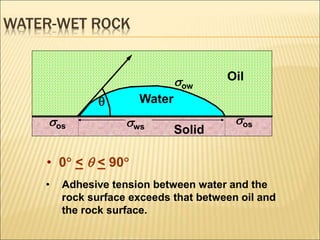
WATER-WET ROCK 
 
sos sws 
• 0 <  < 90 
sow 
Solid 
Water 
Oil 
sos 
• Adhesive tension between water and the 
rock surface exceeds that between oil and 
the rock surface.
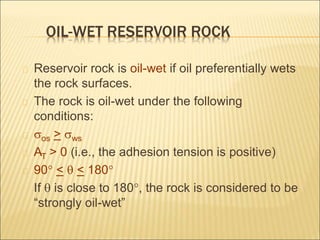
OIL-WET RESERVOIR ROCK 
Reservoir rock is oil-wet if oil preferentially wets 
the rock surfaces. 
The rock is oil-wet under the following 
conditions: 
sos > sws 
AT > 0 (i.e., the adhesion tension is positive) 
90 <  < 180 
If  is close to 180, the rock is considered to be 
“strongly oil-wet”
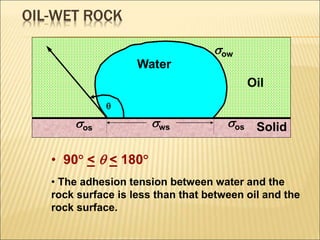
OIL-WET ROCK 
Water 
 
sos sws 
• 90 <  < 180 
Oil 
Solid 
sow 
sos 
• The adhesion tension between water and the 
rock surface is less than that between oil and the 
rock surface.
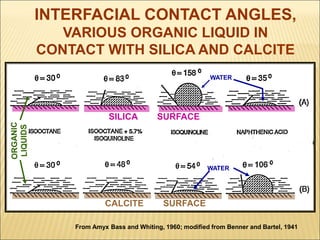
INTERFACIAL CONTACT ANGLES, 
VARIOUS ORGANIC LIQUID IN 
CONTACT WITH SILICA AND CALCITE 
SILICA SURFACE 
CALCITE SURFACE 
WATER 
WATER 
From Amyx Bass and Whiting, 1960; modified from Benner and Bartel, 1941
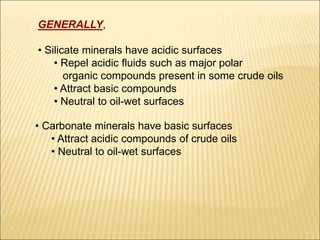
GENERALLY, 
• Silicate minerals have acidic surfaces 
• Repel acidic fluids such as major polar 
organic compounds present in some crude oils 
• Attract basic compounds 
• Neutral to oil-wet surfaces 
• Carbonate minerals have basic surfaces 
• Attract acidic compounds of crude oils 
• Neutral to oil-wet surfaces
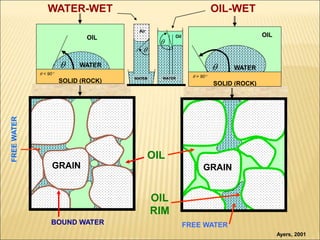
WATER-WET OIL-WET 
Ayers, 2001 
GRAIN 
FREE WATER 
OIL 
WATER 
 
SOLID (ROCK) 
WATER 
SOLID (ROCK) 
OIL 
 
GRAIN 
BOUND WATER 
FREE WATER 
Air 
 
 
OIL 
OIL 
RIM 
 < 90 
Oil 
 > 90 WATER 
WATER
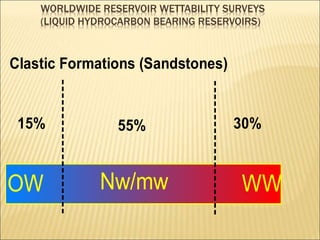
WORLDWIDE RESERVOIR WETTABILITY SURVEYS 
(LIQUID HYDROCARBON BEARING RESERVOIRS) 
Clastic Formations (Sandstones) 
15% 55% 30% 
OW Nw/mw WW
WORLDWIDE RESERVOIR WETTABILITY SURVEYS 
(LIQUID HYDROCARBON BEARING RESERVOIRS) 
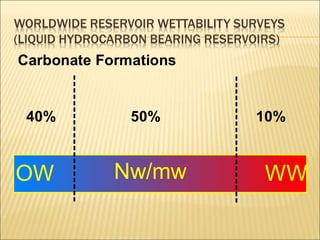
Carbonate Formations 
40% 50% 10% 
OW Nw/mw WW
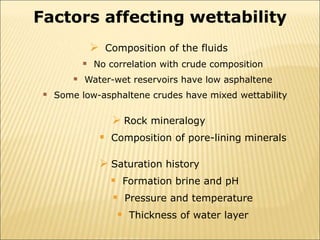
Factors affecting wettability 
 Composition of the fluids 
 No correlation with crude composition 
 Water-wet reservoirs have low asphaltene 
 Some low-asphaltene crudes have mixed wettability 
 Rock mineralogy 
 Composition of pore-lining minerals 
 Saturation history 
 Formation brine and pH 
 Pressure and temperature 
 Thickness of water layer
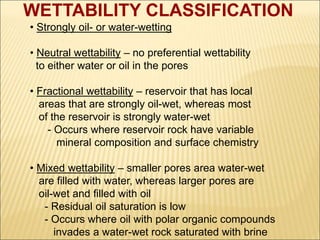
WETTABILITY CLASSIFICATION 
• Strongly oil- or water-wetting 
• Neutral wettability – no preferential wettability 
to either water or oil in the pores 
• Fractional wettability – reservoir that has local 
areas that are strongly oil-wet, whereas most 
of the reservoir is strongly water-wet 
- Occurs where reservoir rock have variable 
mineral composition and surface chemistry 
• Mixed wettability – smaller pores area water-wet 
are filled with water, whereas larger pores are 
oil-wet and filled with oil 
- Residual oil saturation is low 
- Occurs where oil with polar organic compounds 
invades a water-wet rock saturated with brine
IMBIBITION 
Imbibition is a fluid flow process in which 
the saturation of the wetting phase 
increases and the nonwetting phase 
saturation decreases. (e.g., waterflood of an 
oil reservoir that is water-wet). 
Mobility of wetting phase increases as 
wetting phase saturation increases 
mobility is the fraction of total flow capacity for a particular phase
WATER-WET RESERVOIR, 
IMBIBITION 
• Water will occupy the smallest pores 
• Water will wet the circumference of most larger pores 
• In pores having high oil saturation, oil rests on a water film 
• Imbibition - If a water-wet rock saturated with oil is 
placed in water, it will imbibe water into the smallest 
pores, displacing oil
OIL-WET RESERVOIR, 
IMBIBITION 
• Oil will occupy the smallest pores 
• Oil will wet the circumference of most larger pores 
• In pores having high water saturation, water rests on an 
oil film 
• Imbibition - If an oil-wet rock saturated with water is 
placed in oil, it will imbibe oil into the smallest 
pores, displacing water 
e.g., Oil-wet reservoir – accumulation of oil in trap
DRAINAGE 
Fluid flow process in which the saturation 
of the nonwetting phase increases 
Mobility of nonwetting fluid phase 
increases as nonwetting phase saturation 
increases 
e.g., waterflood of an oil reservoir that is oil-wet 
Gas injection in an oil- or water-wet reservoir 
Pressure maintenance or gas cycling by gas injection 
in a retrograde condensate reservoir 
Water-wet reservoir – accumulation of oil or gas in trap
IMPLICATIONS OF WETTABILITY 
Primary oil recovery is affected by the 
wettability of the system. 
A water-wet system will exhibit greater 
primary oil recovery.
WATER-WET OIL-WET 
Ayers, 2001 
GRAIN 
FREE WATER 
OIL 
WATER 
 
SOLID (ROCK) 
WATER 
SOLID (ROCK) 
OIL 
 
GRAIN 
BOUND WATER 
FREE WATER 
Air 
 
 
OIL 
OIL 
RIM 
 < 90 
Oil 
 > 90 WATER 
WATER
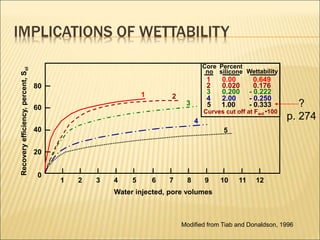
IMPLICATIONS OF WETTABILITY 
Oil recovery under waterflooding is 
affected by the wettability of the system. 
A water-wet system will exhibit greater oil 
recovery under waterflooding.
IMPLICATIONS OF WETTABILITY 
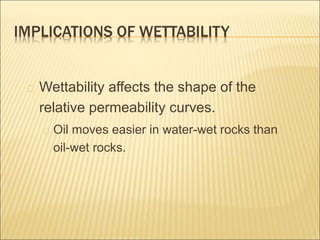
Wettability affects the shape of the 
relative permeability curves. 
Oil moves easier in water-wet rocks than 
oil-wet rocks.
IMPLICATIONS OF WETTABILITY 
Core 
no 
1 2 3 4 5 6 7 8 9 10 11 12 
80 
60 
40 
20 
0 
123 
4 
5 
Percent 
silicone Wettability 
0.00 
0.649 
0.020 
0.176 
0.200 
- 0.222 
2.00 
- 0.250 
1.00 
- 0.333 
Curves cut off at Fwd •100 
1 2 
3 
4 
5 
Water injected, pore volumes 
Recovery efficiency, percent, Soi 
Modified from Tiab and Donaldson, 1996 
? 
p. 274
IMPLICATIONS OF WETTABILITY 
Squirrel oil - 0.10 N NaCl - Torpedo core ( • 33 O W • 663, 
K • 0945, Swi • 21.20%) 
Squirrel oil - 0.10 N NaCl • Torpedo Sandstone core, 
after remaining in oil for 84 days ( • 33.0 W • 663, K • 
0.925, Swi • 23.28%) 
Water injection, pore volumes 
80 
60 
40 
20 
0 
1 2 3 4 5 6 7 8 9 10 
Recovery efficiency, percent Spi 
Modified from NExT, 1999
WETTABILITY AFFECTS: 
• Capillary Pressure 
• Irreducible water saturation 
• Residual oil and water saturations 
• Relative permeability 
• Electrical properties
LABORATORY MEASUREMENT OF WETTABILITY 
Most common measurement techniques 
Contact angle measurement method 
Amott method 
United States Bureau of Mines (USBM) 
Method 
Note that wettability measurements using core samples yield an indication of 
wetting preference of the rock in the lab…. Not necessarily in the reservoir. 
Knowing the wettability does not allow us to predict multi-phase flow properties. 
We still need to know capillary pressure and relative permeability in order to predict 
the multi-phase properties. However, knowing the wettability helps us understand 
the reservoir and anticipate or explain its behavior.
NOMENCLATURE 
AT = adhesion tension, milli-Newtons/m or dynes/cm) 
 = contact angle between the oil/water/solid interface measured through 
the water (more dense phase), degrees 
sos = interfacial tension between the oil and solid, milli-Newtons/m or 
dynes/cm 
sws = interfacial tension between the water and solid, milli-Newtons/m or 
dynes/cm 
sow = interfacial tension between the oil and water, milli-Newtons/m or 
dynes/cm

Boundary Tension & Wettability

  • 1.
  • 2.
    IMMISCIBLE PHASES Earlierdiscussions have considered only a single fluid in the pores porosity permeability Saturation: fraction of pore space occupied by a particular fluid (immiscible phases) Sw+So+Sg=1 When more than a single phase is present, the fluids interact with the rock, and with each other
  • 3.
    DEFINITION OF INTERFACIALTENSION Interfacial (boundary) tension is the energy per unit area (force per unit distance) at the surface between phases Commonly expressed in milli-Newtons/meter (also, dynes/cm)
  • 4.
    INTERFACIAL TENSION Immisciblefluids: when you bring them into contact they do not mix Two fluids are separated by an interface The molecules are attracted more to their own kind Oil Rock water
  • 5.
    INTERFACIAL TENSION Interfacialtension: is the work required to create a unit area of new surface s = F / L ( N/m or dynes/cm ) F = 2 σ L
  • 6.
    BOUNDARY (INTERFACIAL) TENSION GAS LIQUID Modified from PETE 311 Notes • Imbalanced molecular forces at phase boundaries • Boundary contracts to minimize size • Cohesive vs. adhesion forces LIQUID (dense phase) Molecular Interface (imbalance of forces) GAS SOLID  SOLID Cohesive force Adhesion force
  • 7.
    DEFINITION OF WETTABILITY Wettability is the tendency of one fluid to spread on or adhere to a solid surface in the presence of other immiscible fluids. Wettability refers to interaction between fluid and solid phases. • Reservoir rocks (sandstone, limestone, dolomite, etc.) are the solid surfaces • Oil, water, and/or gas are the fluids
  • 8.
    sow  water WETTABILITY Oil grain surface sSo sSw sSo  sSw = sow cos  s  s cos S o S w = Young-Laplace equation ow  s Glass is water-wet in the presence of air but air-wet in the presence of mercury. The angle made by the interface with the solid is called the contact angle (measured through the wetting phase). The contact angle will increase if the wetting phase is increasing (imagine a pool of water spreading over the glass plate) and decrease if the wetting phase saturation is decreasing (the pool of water being sucked away through a straw leaves a film of water behind).
  • 9.
    WETTABILITY  water Oil grain surface  water Oil grain surface Water wet Oil wet
  • 10.
    TEFLON - OILWET (WATER REPELLANT) SURFACE
  • 11.
    QUARTZ - WATERWET - ATTRACTIVE -SURFACE
  • 12.
    STAINLESS STEEL -NEUTRAL WETTING
  • 13.
    WHY STUDY WETTABILITY? •Understand physical and chemical interactions between • Individual fluids and reservoir rocks • Different fluids with in a reservoir • Individual fluids and reservoir rocks when multiple fluids are present •Petroleum reservoirs commonly have 2 – 3 fluids (multiphase systems) • When 2 or more fluids are present, there are at least 3 sets of forces acting on the fluids and affecting HC recovery
  • 14.
    DEFINITION OF ADHESIONTENSION Adhesion tension is expressed as the difference between two solid-fluid interfacial tensions. s s s cos T os ws ow A =  =  • A negative adhesion tension indicates that the denser phase (water) preferentially wets the solid surface (and vice versa). • An adhesion tension of “0” indicates that both phases have equal affinity for the solid surface
  • 15.
    CONTACT ANGLE Oil Water sow  Oil Oil sos The contact angle,  , measured through the denser liquid phase, defines which fluid wets the solid sos sws Solid A surface. T = adhesion tension, milli-Newtons/m or dynes/cm)  = contact angle between the oil/water/solid interface measured through the water, degrees sos = interfacial energy between the oil and solid, milli-Newtons/m or dynes/cm sws = interfacial energy between the water and solid, milli-Newtons/m or dynes/cm sow = interfacial energy (interfacial tension) between the oil and water, milli-Newtons/m or dynes/cm
  • 16.
    WETTING PHASE FLUID Wetting phase fluid preferentially wets the solid rock surface. Attractive forces between rock and fluid draw the wetting phase into small pores. Wetting phase fluid often has low mobile. Attractive forces limit reduction in wetting phase saturation to an irreducible value (irreducible wetting phase saturation). Many hydrocarbon reservoirs are either totally or partially water-wet.
  • 17.
    NONWETTING PHASE FLUID Nonwetting phase does not preferentially wet the solid rock surface Repulsive forces between rock and fluid cause nonwetting phase to occupy largest pores Nonwetting phase fluid is often the most mobile fluid, especially at large nonwetting phase saturations Natural gas is never the wetting phase in hydrocarbon reservoirs
  • 18.
    WATER-WET RESERVOIR ROCK Reservoir rock is water - wet if water preferentially wets the rock surfaces The rock is water- wet under the following conditions: sws > sos AT < 0 (i.e., the adhesion tension is negative) 0 <  < 90 If  is close to 0, the rock is considered to be “strongly water-wet”
  • 19.
    WATER-WET ROCK  sos sws • 0 <  < 90 sow Solid Water Oil sos • Adhesive tension between water and the rock surface exceeds that between oil and the rock surface.
  • 20.
    OIL-WET RESERVOIR ROCK Reservoir rock is oil-wet if oil preferentially wets the rock surfaces. The rock is oil-wet under the following conditions: sos > sws AT > 0 (i.e., the adhesion tension is positive) 90 <  < 180 If  is close to 180, the rock is considered to be “strongly oil-wet”
  • 21.
    OIL-WET ROCK Water  sos sws • 90 <  < 180 Oil Solid sow sos • The adhesion tension between water and the rock surface is less than that between oil and the rock surface.
  • 22.
    INTERFACIAL CONTACT ANGLES, VARIOUS ORGANIC LIQUID IN CONTACT WITH SILICA AND CALCITE SILICA SURFACE CALCITE SURFACE WATER WATER From Amyx Bass and Whiting, 1960; modified from Benner and Bartel, 1941
  • 23.
    GENERALLY, • Silicateminerals have acidic surfaces • Repel acidic fluids such as major polar organic compounds present in some crude oils • Attract basic compounds • Neutral to oil-wet surfaces • Carbonate minerals have basic surfaces • Attract acidic compounds of crude oils • Neutral to oil-wet surfaces
  • 24.
    WATER-WET OIL-WET Ayers,2001 GRAIN FREE WATER OIL WATER  SOLID (ROCK) WATER SOLID (ROCK) OIL  GRAIN BOUND WATER FREE WATER Air   OIL OIL RIM  < 90 Oil  > 90 WATER WATER
  • 25.
    WORLDWIDE RESERVOIR WETTABILITYSURVEYS (LIQUID HYDROCARBON BEARING RESERVOIRS) Clastic Formations (Sandstones) 15% 55% 30% OW Nw/mw WW
  • 26.
    WORLDWIDE RESERVOIR WETTABILITYSURVEYS (LIQUID HYDROCARBON BEARING RESERVOIRS) Carbonate Formations 40% 50% 10% OW Nw/mw WW
  • 27.
    Factors affecting wettability  Composition of the fluids  No correlation with crude composition  Water-wet reservoirs have low asphaltene  Some low-asphaltene crudes have mixed wettability  Rock mineralogy  Composition of pore-lining minerals  Saturation history  Formation brine and pH  Pressure and temperature  Thickness of water layer
  • 28.
    WETTABILITY CLASSIFICATION •Strongly oil- or water-wetting • Neutral wettability – no preferential wettability to either water or oil in the pores • Fractional wettability – reservoir that has local areas that are strongly oil-wet, whereas most of the reservoir is strongly water-wet - Occurs where reservoir rock have variable mineral composition and surface chemistry • Mixed wettability – smaller pores area water-wet are filled with water, whereas larger pores are oil-wet and filled with oil - Residual oil saturation is low - Occurs where oil with polar organic compounds invades a water-wet rock saturated with brine
  • 29.
    IMBIBITION Imbibition isa fluid flow process in which the saturation of the wetting phase increases and the nonwetting phase saturation decreases. (e.g., waterflood of an oil reservoir that is water-wet). Mobility of wetting phase increases as wetting phase saturation increases mobility is the fraction of total flow capacity for a particular phase
  • 30.
    WATER-WET RESERVOIR, IMBIBITION • Water will occupy the smallest pores • Water will wet the circumference of most larger pores • In pores having high oil saturation, oil rests on a water film • Imbibition - If a water-wet rock saturated with oil is placed in water, it will imbibe water into the smallest pores, displacing oil
  • 31.
    OIL-WET RESERVOIR, IMBIBITION • Oil will occupy the smallest pores • Oil will wet the circumference of most larger pores • In pores having high water saturation, water rests on an oil film • Imbibition - If an oil-wet rock saturated with water is placed in oil, it will imbibe oil into the smallest pores, displacing water e.g., Oil-wet reservoir – accumulation of oil in trap
  • 32.
    DRAINAGE Fluid flowprocess in which the saturation of the nonwetting phase increases Mobility of nonwetting fluid phase increases as nonwetting phase saturation increases e.g., waterflood of an oil reservoir that is oil-wet Gas injection in an oil- or water-wet reservoir Pressure maintenance or gas cycling by gas injection in a retrograde condensate reservoir Water-wet reservoir – accumulation of oil or gas in trap
  • 33.
    IMPLICATIONS OF WETTABILITY Primary oil recovery is affected by the wettability of the system. A water-wet system will exhibit greater primary oil recovery.
  • 34.
    WATER-WET OIL-WET Ayers,2001 GRAIN FREE WATER OIL WATER  SOLID (ROCK) WATER SOLID (ROCK) OIL  GRAIN BOUND WATER FREE WATER Air   OIL OIL RIM  < 90 Oil  > 90 WATER WATER
  • 35.
    IMPLICATIONS OF WETTABILITY Oil recovery under waterflooding is affected by the wettability of the system. A water-wet system will exhibit greater oil recovery under waterflooding.
  • 36.
    IMPLICATIONS OF WETTABILITY Wettability affects the shape of the relative permeability curves. Oil moves easier in water-wet rocks than oil-wet rocks.
  • 37.
    IMPLICATIONS OF WETTABILITY Core no 1 2 3 4 5 6 7 8 9 10 11 12 80 60 40 20 0 123 4 5 Percent silicone Wettability 0.00 0.649 0.020 0.176 0.200 - 0.222 2.00 - 0.250 1.00 - 0.333 Curves cut off at Fwd •100 1 2 3 4 5 Water injected, pore volumes Recovery efficiency, percent, Soi Modified from Tiab and Donaldson, 1996 ? p. 274
  • 38.
    IMPLICATIONS OF WETTABILITY Squirrel oil - 0.10 N NaCl - Torpedo core ( • 33 O W • 663, K • 0945, Swi • 21.20%) Squirrel oil - 0.10 N NaCl • Torpedo Sandstone core, after remaining in oil for 84 days ( • 33.0 W • 663, K • 0.925, Swi • 23.28%) Water injection, pore volumes 80 60 40 20 0 1 2 3 4 5 6 7 8 9 10 Recovery efficiency, percent Spi Modified from NExT, 1999
  • 39.
    WETTABILITY AFFECTS: •Capillary Pressure • Irreducible water saturation • Residual oil and water saturations • Relative permeability • Electrical properties
  • 40.
    LABORATORY MEASUREMENT OFWETTABILITY Most common measurement techniques Contact angle measurement method Amott method United States Bureau of Mines (USBM) Method Note that wettability measurements using core samples yield an indication of wetting preference of the rock in the lab…. Not necessarily in the reservoir. Knowing the wettability does not allow us to predict multi-phase flow properties. We still need to know capillary pressure and relative permeability in order to predict the multi-phase properties. However, knowing the wettability helps us understand the reservoir and anticipate or explain its behavior.
  • 41.
    NOMENCLATURE AT =adhesion tension, milli-Newtons/m or dynes/cm)  = contact angle between the oil/water/solid interface measured through the water (more dense phase), degrees sos = interfacial tension between the oil and solid, milli-Newtons/m or dynes/cm sws = interfacial tension between the water and solid, milli-Newtons/m or dynes/cm sow = interfacial tension between the oil and water, milli-Newtons/m or dynes/cm