GEOL602-Global & Regional Tectonics
Presentation – I
Enhanced Geothermal Systems
[EGS]
Omar A. Radwan
PhD Student – Geosciences Dept. - KFUPM
Olasolo, P., Juárez, M. C., Morales, M. P., & Liarte, I. A. (2016).
Enhanced geothermal systems (EGS): A review. Renewable and
Sustainable Energy Reviews, 56, 133-144.
Outline
• Thermal gradient
• Enhanced Geothermal Systems (EGS)
Introduction
• Finding a site
• Creating the reservoir
• Operating the reservoir
Development of a geothermal plant
Case Study
Introduction
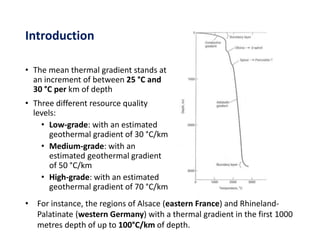
• The mean thermal gradient stands at
an increment of between 25 °C and
30 °C per km of depth
• Three different resource quality
levels:
• Low-grade: with an estimated
geothermal gradient of 30 °C/km
• Medium-grade: with an
estimated geothermal gradient
of 50 °C/km
• High-grade: with an estimated
geothermal gradient of 70 °C/km
• For instance, the regions of Alsace (eastern France) and Rhineland-
Palatinate (western Germany) with a thermal gradient in the first 1000
metres depth of up to 100°C/km of depth.
Introduction
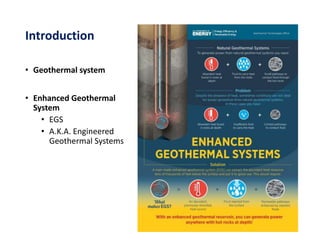
• Geothermal system
• Enhanced Geothermal
System
• EGS
• A.K.A. Engineered
Geothermal Systems
Development of a geothermal plant
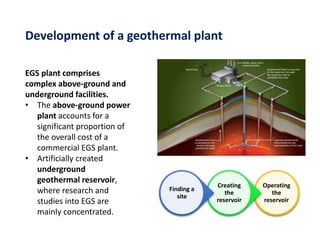
EGS plant comprises
complex above-ground and
underground facilities.
• The above-ground power
plant accounts for a
significant proportion of
the overall cost of a
commercial EGS plant.
• Artificially created
underground
geothermal reservoir,
where research and
studies into EGS are
mainly concentrated.
Operating
the
reservoir
Creating
the
reservoir
Finding a
site
Development of a geothermal plant
Finding a site
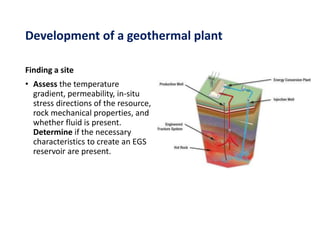
• Assess the temperature
gradient, permeability, in-situ
stress directions of the resource,
rock mechanical properties, and
whether fluid is present.
Determine if the necessary
characteristics to create an EGS
reservoir are present.
Creating the reservoir
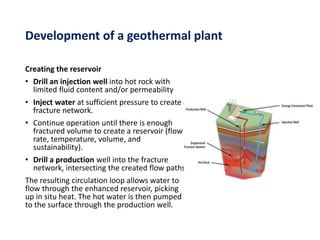
• Drill an injection well into hot rock with
limited fluid content and/or permeability
• Inject water at sufficient pressure to create a
fracture network.
• Continue operation until there is enough
fractured volume to create a reservoir (flow
rate, temperature, volume, and
sustainability).
• Drill a production well into the fracture
network, intersecting the created flow paths.
The resulting circulation loop allows water to
flow through the enhanced reservoir, picking
up in situ heat. The hot water is then pumped
to the surface through the production well.
Development of a geothermal plant
Operating the reservoir
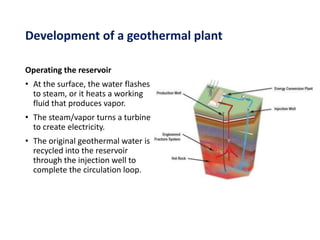
• At the surface, the water flashes
to steam, or it heats a working
fluid that produces vapor.
• The steam/vapor turns a turbine
to create electricity.
• The original geothermal water is
recycled into the reservoir
through the injection well to
complete the circulation loop.
Development of a geothermal plant
• It has been estimated that the total heat available in the crust of the
earth, is around 540x107 EJ (EJ=Exajoules=1018 J).
• If we could use just 1% of this amount to meet global energy needs
(which come to around 500 EJ per annum) it would provide us with all
the energy that the planet requires for 2800 years at a constant
consumption rate.
• However, this energy is continuously being renewed by heat received
from various sources.
Development of a geothermal plant
Case Study

Enhanced Geothermal Systems

  • 1.
    GEOL602-Global & RegionalTectonics Presentation – I Enhanced Geothermal Systems [EGS] Omar A. Radwan PhD Student – Geosciences Dept. - KFUPM Olasolo, P., Juárez, M. C., Morales, M. P., & Liarte, I. A. (2016). Enhanced geothermal systems (EGS): A review. Renewable and Sustainable Energy Reviews, 56, 133-144.
  • 2.
    Outline • Thermal gradient •Enhanced Geothermal Systems (EGS) Introduction • Finding a site • Creating the reservoir • Operating the reservoir Development of a geothermal plant Case Study
  • 3.
    Introduction • The meanthermal gradient stands at an increment of between 25 °C and 30 °C per km of depth • Three different resource quality levels: • Low-grade: with an estimated geothermal gradient of 30 °C/km • Medium-grade: with an estimated geothermal gradient of 50 °C/km • High-grade: with an estimated geothermal gradient of 70 °C/km • For instance, the regions of Alsace (eastern France) and Rhineland- Palatinate (western Germany) with a thermal gradient in the first 1000 metres depth of up to 100°C/km of depth.
  • 4.
    Introduction • Geothermal system •Enhanced Geothermal System • EGS • A.K.A. Engineered Geothermal Systems
  • 5.
    Development of ageothermal plant EGS plant comprises complex above-ground and underground facilities. • The above-ground power plant accounts for a significant proportion of the overall cost of a commercial EGS plant. • Artificially created underground geothermal reservoir, where research and studies into EGS are mainly concentrated. Operating the reservoir Creating the reservoir Finding a site
  • 6.
    Development of ageothermal plant Finding a site • Assess the temperature gradient, permeability, in-situ stress directions of the resource, rock mechanical properties, and whether fluid is present. Determine if the necessary characteristics to create an EGS reservoir are present.
  • 7.
    Creating the reservoir •Drill an injection well into hot rock with limited fluid content and/or permeability • Inject water at sufficient pressure to create a fracture network. • Continue operation until there is enough fractured volume to create a reservoir (flow rate, temperature, volume, and sustainability). • Drill a production well into the fracture network, intersecting the created flow paths. The resulting circulation loop allows water to flow through the enhanced reservoir, picking up in situ heat. The hot water is then pumped to the surface through the production well. Development of a geothermal plant
  • 8.
    Operating the reservoir •At the surface, the water flashes to steam, or it heats a working fluid that produces vapor. • The steam/vapor turns a turbine to create electricity. • The original geothermal water is recycled into the reservoir through the injection well to complete the circulation loop. Development of a geothermal plant
  • 9.
    • It hasbeen estimated that the total heat available in the crust of the earth, is around 540x107 EJ (EJ=Exajoules=1018 J). • If we could use just 1% of this amount to meet global energy needs (which come to around 500 EJ per annum) it would provide us with all the energy that the planet requires for 2800 years at a constant consumption rate. • However, this energy is continuously being renewed by heat received from various sources. Development of a geothermal plant
  • 10.

Editor's Notes

  • #3 Performance optimisation techniques Using dense fluids for hydraulic stimulation Using carbon dioxide (CO2) as a working fluid
  • #4 From its core to its surface the earth is a gigantic storehouse of thermal energy. This is because it has a molten metal core that is constantly transferring heat to the outer crust.
  • #5 Geothermal system Is defied by three key elements: heat, fluid, and permeability at depth. Enhanced Geothermal System EGS A.K.A. Engineered Geothermal Systems man-made reservoir, created where there is hot rock but insufficient or little natural permeability or fluid saturation. In an EGS, fluid is injected into the subsurface under carefully controlled conditions, which cause pre-existing fractures to re-open, creating permeability The process of generating large quantities of electricity from geothermal energy has conventionally been associated with the search for large reserves of hydrothermal resources. The first step is to locate a reservoir [19] and extract the fluid contained in it, so that the geothermal energy in that fluid can then be converted to electricity. The main drawback is that these reservoirs can only be exploited for a limited period, i.e. until most of the fluid contained in them has been extracted. In this geothermal reserves are very similar to oil reserves: they must first be located, and then examined to determine whether they contain sufficient fluid for their operation to be viable. Next, a plant must be built and the resources extracted, and finally those resources will become exhausted and the process will come to an end. An estimate of geothermal resources in the USA [13] calculates that after 30 years of exploitation worldwide the estimated total potential has not increased significantly, and some leading analysts have concluded that natural geothermal resources are limited.