GEOL 501 - Geology of the Middle East
Instructor: Dr. Khalid Al-Ramadan
Assignment 2
Najd Fault System
by
Omar Atef Radwan
g201306050
ESD
OUTLINE
• Location
• Geochronology
• Tectonics
• Causes
• Implications
• References
2
LOACTION
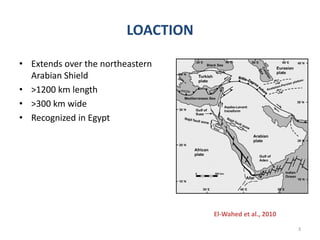
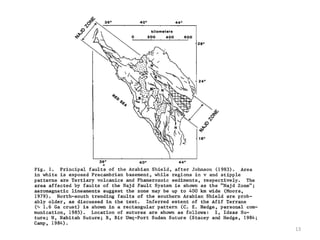
• Extends over the northeastern
Arabian Shield
• >1200 km length
• >300 km wide
• Recognized in Egypt
El-Wahed et al., 2010
3
GEOCHRONOLOGY
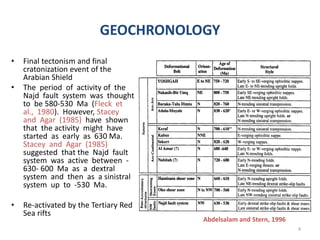
• Final tectonism and final
cratonization event of the
Arabian Shield
• The period of activity of the
Najd fault system was thought
to be 580-530 Ma (Fleck et
al., 1980). However, Stacey
and Agar (1985) have shown
that the activity might have
started as early as 630 Ma.
Stacey and Agar (1985)
suggested that the Najd fault
system was active between -
630- 600 Ma as a dextral
system and then as a sinistral
system up to -530 Ma.
• Re-activated by the Tertiary Red
Sea rifts
Abdelsalam and Stern, 1996
4
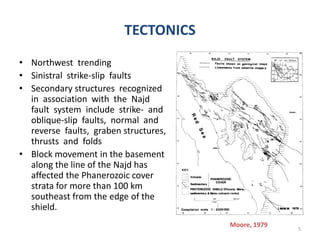
TECTONICS
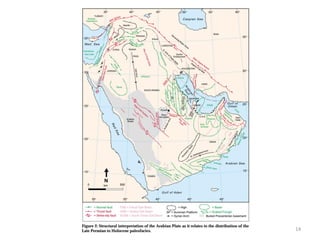
• Northwest trending
• Sinistral strike-slip faults
• Secondary structures recognized
in association with the Najd
fault system include strike- and
oblique-slip faults, normal and
reverse faults, graben structures,
thrusts and folds
• Block movement in the basement
along the line of the Najd has
affected the Phanerozoic cover
strata for more than 100 km
southeast from the edge of the
shield.
5
Moore, 1979
CAUSES
• Moore (1979) proposed that the Najd fault system was the
product of deformation of a brittle cover overlying a basement
comprising rigid blocks which were moving laterally relative to each
other.
• Schmidt et al. (1979), Fleck et al. (1980), Davies (1984) and Agar
(1987) proposed that the Najd fault system is related to collision
between the ANS and a rigid indentor to the east of the Ar Amar
suture.
• Stern (1985) argued that the Najd fault system could not have
been formed by continent-continent collision in eastern Arabia.
Alternatively, Stern (1985) suggested that the Najd system
represents a set of transform faults developed in response to a
major episode of extension in the northwestern part of the ANS.
6
CAUSES
• Abdelsalam (1994) suggested that the northwest trending,
sinistral strike-slip faults were developed by continuous east-
west shortening deformation as zones of high shear strain when
the ANS collided with the Nile Craton in the west and the Ar-
Rayn micro-plate to the east at 670-610 Ma.
• Stern (1994) suggested that the northwest trending faults were
associated with escape tectonics due to collision between East
and West Gondwana along the Mozambique Belt.
7
IMPLICATIONS-COMPOSITION
• Igneous intrustion associated with the Najd tectonics has
produced small plutons and dike swarms
• Some of the alkaline and calc-alkaline intrusions and basalt-
andesite- rhyolite dike swarms have been dislocated by
continued fault movement after emplacement
• Radiometric ages obtained from small intrusions indicate that
the faults were active from late Proterozoic into early
Phanerozoic times
8
IMPLICATIONS-Mineral Resources
• Hydrothermal activity also occurred in parts of the fault zone,
producing tectonically controlled quartz veins, some of which
contain:
– gold
– Copper
– Zinc
– Silver
– Lead
• The distribution of these veins reflects the mechanical conditions
associated with faulting
• The origins of these veins are controversial; some are associated
with metavolcanic rocks while others occur in metasediments or
igneous intrusions along the fault zone
9
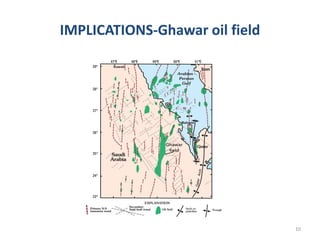
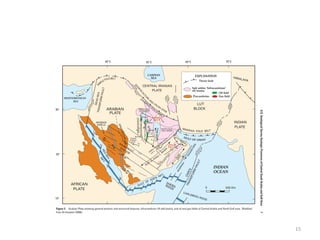
IMPLICATIONS-Ghawar oil field
10
11
REFERENCES
• Abdelsalam, M. G., & Stern, R. J., 1996. Sutures and shear zones in the
Arabian-Nubian Shield. Journal of African Earth Sciences, 23(3), 289-310.
• Fleck, R. J., Coleman, R. G., Cornwall, H. R., Greenwood, W. R., Hadley, D. G.,
Schmidt, D. L., ... & Ratte, J. C. , 1976. Geochronology of the Arabian shield,
western Saudi Arabia: K-Ar results. Geological Society of America Bulletin,
87(1), 9-21.
• Moore, J. M., 1979. Tectonics of the Najd transcurrent fault system, Saudi
Arabia. Journal of the Geological Society, 136(4), 441-452.
• Stacey, J. S., & Agar, R. A., 1985. U-Pb isotopic evidence for the accretion of a
continental microplate in the Zalm region of the Saudi Arabian Shield. Journal
of the Geological Society, 142(6), 1189-1203.
• Pollastro, R. M., 2003. Total petroleum systems of the Paleozoic and Jurassic,
greater Ghawar uplift and adjoining provinces of central Saudi Arabia and
northern Arabian-Persian Gulf. US Department of the Interior, US Geological
Survey.
• El-Wahed, M. A., Ashmawy, M., & Tawfik, H., 2010. Structural setting of
Cretaceous pull-apart basins and Miocene extensional folds in the Quseir–
Umm Gheig region, northwestern Red Sea, Egypt. Lithosphere, 2(1), 13-32.
12
13
14
15

Najd Fault System

  • 1.
    GEOL 501 -Geology of the Middle East Instructor: Dr. Khalid Al-Ramadan Assignment 2 Najd Fault System by Omar Atef Radwan g201306050 ESD
  • 2.
    OUTLINE • Location • Geochronology •Tectonics • Causes • Implications • References 2
  • 3.
    LOACTION • Extends overthe northeastern Arabian Shield • >1200 km length • >300 km wide • Recognized in Egypt El-Wahed et al., 2010 3
  • 4.
    GEOCHRONOLOGY • Final tectonismand final cratonization event of the Arabian Shield • The period of activity of the Najd fault system was thought to be 580-530 Ma (Fleck et al., 1980). However, Stacey and Agar (1985) have shown that the activity might have started as early as 630 Ma. Stacey and Agar (1985) suggested that the Najd fault system was active between - 630- 600 Ma as a dextral system and then as a sinistral system up to -530 Ma. • Re-activated by the Tertiary Red Sea rifts Abdelsalam and Stern, 1996 4
  • 5.
    TECTONICS • Northwest trending •Sinistral strike-slip faults • Secondary structures recognized in association with the Najd fault system include strike- and oblique-slip faults, normal and reverse faults, graben structures, thrusts and folds • Block movement in the basement along the line of the Najd has affected the Phanerozoic cover strata for more than 100 km southeast from the edge of the shield. 5 Moore, 1979
  • 6.
    CAUSES • Moore (1979)proposed that the Najd fault system was the product of deformation of a brittle cover overlying a basement comprising rigid blocks which were moving laterally relative to each other. • Schmidt et al. (1979), Fleck et al. (1980), Davies (1984) and Agar (1987) proposed that the Najd fault system is related to collision between the ANS and a rigid indentor to the east of the Ar Amar suture. • Stern (1985) argued that the Najd fault system could not have been formed by continent-continent collision in eastern Arabia. Alternatively, Stern (1985) suggested that the Najd system represents a set of transform faults developed in response to a major episode of extension in the northwestern part of the ANS. 6
  • 7.
    CAUSES • Abdelsalam (1994)suggested that the northwest trending, sinistral strike-slip faults were developed by continuous east- west shortening deformation as zones of high shear strain when the ANS collided with the Nile Craton in the west and the Ar- Rayn micro-plate to the east at 670-610 Ma. • Stern (1994) suggested that the northwest trending faults were associated with escape tectonics due to collision between East and West Gondwana along the Mozambique Belt. 7
  • 8.
    IMPLICATIONS-COMPOSITION • Igneous intrustionassociated with the Najd tectonics has produced small plutons and dike swarms • Some of the alkaline and calc-alkaline intrusions and basalt- andesite- rhyolite dike swarms have been dislocated by continued fault movement after emplacement • Radiometric ages obtained from small intrusions indicate that the faults were active from late Proterozoic into early Phanerozoic times 8
  • 9.
    IMPLICATIONS-Mineral Resources • Hydrothermalactivity also occurred in parts of the fault zone, producing tectonically controlled quartz veins, some of which contain: – gold – Copper – Zinc – Silver – Lead • The distribution of these veins reflects the mechanical conditions associated with faulting • The origins of these veins are controversial; some are associated with metavolcanic rocks while others occur in metasediments or igneous intrusions along the fault zone 9
  • 10.
  • 11.
  • 12.
    REFERENCES • Abdelsalam, M.G., & Stern, R. J., 1996. Sutures and shear zones in the Arabian-Nubian Shield. Journal of African Earth Sciences, 23(3), 289-310. • Fleck, R. J., Coleman, R. G., Cornwall, H. R., Greenwood, W. R., Hadley, D. G., Schmidt, D. L., ... & Ratte, J. C. , 1976. Geochronology of the Arabian shield, western Saudi Arabia: K-Ar results. Geological Society of America Bulletin, 87(1), 9-21. • Moore, J. M., 1979. Tectonics of the Najd transcurrent fault system, Saudi Arabia. Journal of the Geological Society, 136(4), 441-452. • Stacey, J. S., & Agar, R. A., 1985. U-Pb isotopic evidence for the accretion of a continental microplate in the Zalm region of the Saudi Arabian Shield. Journal of the Geological Society, 142(6), 1189-1203. • Pollastro, R. M., 2003. Total petroleum systems of the Paleozoic and Jurassic, greater Ghawar uplift and adjoining provinces of central Saudi Arabia and northern Arabian-Persian Gulf. US Department of the Interior, US Geological Survey. • El-Wahed, M. A., Ashmawy, M., & Tawfik, H., 2010. Structural setting of Cretaceous pull-apart basins and Miocene extensional folds in the Quseir– Umm Gheig region, northwestern Red Sea, Egypt. Lithosphere, 2(1), 13-32. 12
  • 13.
  • 14.
  • 15.