Presentation on
PRESTRESSED
CONCRETE STRUCTURES
Civil Engineering Department of SGI, Sikar
Presented To-
Mr. Aqeel Ali (HOD, CE)
Mr. Hemant Agrawal (Assit. Prof.)
Presented By-
Devraj Regar
13ESOCE011
Discovery of pre-stressing:
 i . The concept of pre stressing was invented
invented years ago when metal
brands were wound
 around wooden pieces to form barrels.

 ii . The metal brands
were tighten under tensile stress which
creates compression between the
staves allowing them to resist internal
liquid pressure.
Principle of pre-stressing:
• Pre-stressing is a method in which compression force is
applied to the reinforced concrete section.
• The effect of pre stressing is to reduce the tensile stress in the
section to the point till the tensile stress is below the cracking
stress. Thus the concrete does not crack.
• It is then possible to treat concrete as a elastic material.
• The concrete can be visualized to have two compressive force
i . Internal pre-stressing force.
ii . External forces (d.l , l.l etc )
• These two forces must counteract each other.
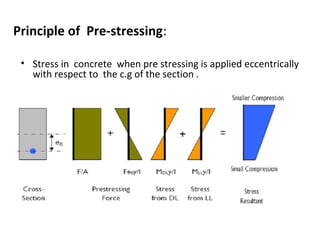
Principle of Pre-stressing:
• Stress in concrete when pre stressing is applied eccentrically
with respect to the c.g of the section .
Pre-stressed Concrete
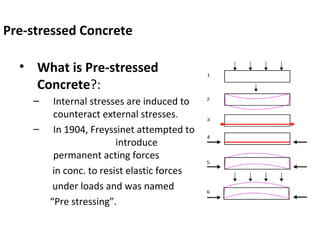
• What is Pre-stressed
Concrete?:
– Internal stresses are induced to
counteract external stresses.
– In 1904, Freyssinet attempted to
introduce
permanent acting forces
in conc. to resist elastic forces
under loads and was named
“Pre stressing”.
Pre-stressed Concrete Methods
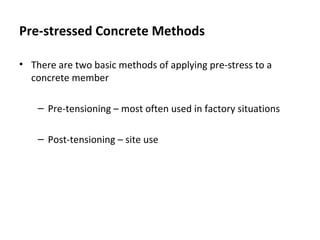
• There are two basic methods of applying pre-stress to a
concrete member
– Pre-tensioning – most often used in factory situations
– Post-tensioning – site use
Types of pre-stressing:
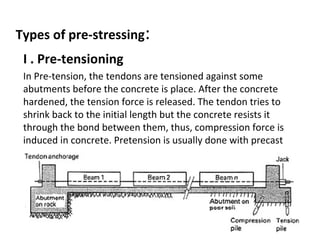
I . Pre-tensioning
In Pre-tension, the tendons are tensioned against some
abutments before the concrete is place. After the concrete
hardened, the tension force is released. The tendon tries to
shrink back to the initial length but the concrete resists it
through the bond between them, thus, compression force is
induced in concrete. Pretension is usually done with precast
members
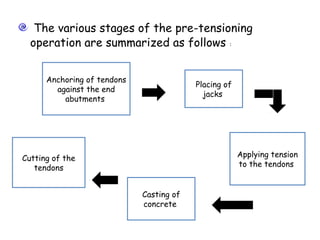
The various stages of the pre-tensioning
operation are summarized as follows :
Anchoring of tendons
against the end
abutments
Placing of
jacks
Cutting of the
tendons
Casting of
concrete
Applying tension
to the tendons
Cont.
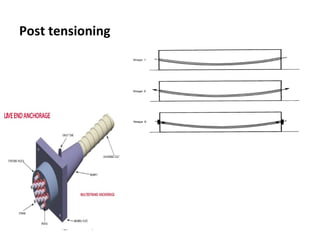
II . Post tensioning
• In Post tension, the tendons are tensioned after the
concrete has hardened. Commonly, metal or plastic
ducts are placed inside the concrete before casting.
After the concrete hardened and had enough strength,
the tendon was placed inside the duct, stressed, and
anchored against concrete. Grout may be injected into
the duct later. This can be done either as precast or
cast-in-place.
Post tensioning
Losses of Prestress Concrete
Advantages:
•Take full advantages of high strength concrete
and high strength steel
•Need less materials
•Smaller and lighter structure
•No cracks
•Use the entire section to resist the load
•Better corrosion resistance
•Good for water tanks and nuclear plant
•Very effective for deflection control
•Better shear resistance
Disadvantages compared to RC:
• Need higher quality materials
• More complex technically
• More expensive
• Harder to re-cycle
Application:
•Bridges
•Slabs in buildings
•Water Tank
•Concrete Pile
•Thin Shell Structures
•Offshore Platform
•Nuclear Power Plant
•Repair and Rehabilitations
CONCLUSION
• Thus, pre-stressed concrete increases the
quality, strength, span of the structure.
• Since it is cost effective, it is used widely on
recent days.
Question?
thank You

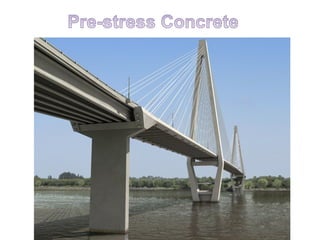
Prestress concrete

  • 1.
    Presentation on PRESTRESSED CONCRETE STRUCTURES CivilEngineering Department of SGI, Sikar Presented To- Mr. Aqeel Ali (HOD, CE) Mr. Hemant Agrawal (Assit. Prof.) Presented By- Devraj Regar 13ESOCE011
  • 3.
    Discovery of pre-stressing: i . The concept of pre stressing was invented invented years ago when metal brands were wound  around wooden pieces to form barrels.   ii . The metal brands were tighten under tensile stress which creates compression between the staves allowing them to resist internal liquid pressure.
  • 4.
    Principle of pre-stressing: •Pre-stressing is a method in which compression force is applied to the reinforced concrete section. • The effect of pre stressing is to reduce the tensile stress in the section to the point till the tensile stress is below the cracking stress. Thus the concrete does not crack. • It is then possible to treat concrete as a elastic material. • The concrete can be visualized to have two compressive force i . Internal pre-stressing force. ii . External forces (d.l , l.l etc ) • These two forces must counteract each other.
  • 5.
    Principle of Pre-stressing: •Stress in concrete when pre stressing is applied eccentrically with respect to the c.g of the section .
  • 6.
    Pre-stressed Concrete • Whatis Pre-stressed Concrete?: – Internal stresses are induced to counteract external stresses. – In 1904, Freyssinet attempted to introduce permanent acting forces in conc. to resist elastic forces under loads and was named “Pre stressing”.
  • 8.
    Pre-stressed Concrete Methods •There are two basic methods of applying pre-stress to a concrete member – Pre-tensioning – most often used in factory situations – Post-tensioning – site use
  • 9.
    Types of pre-stressing: I. Pre-tensioning In Pre-tension, the tendons are tensioned against some abutments before the concrete is place. After the concrete hardened, the tension force is released. The tendon tries to shrink back to the initial length but the concrete resists it through the bond between them, thus, compression force is induced in concrete. Pretension is usually done with precast members
  • 10.
    The various stagesof the pre-tensioning operation are summarized as follows : Anchoring of tendons against the end abutments Placing of jacks Cutting of the tendons Casting of concrete Applying tension to the tendons
  • 11.
  • 12.
    II . Posttensioning • In Post tension, the tendons are tensioned after the concrete has hardened. Commonly, metal or plastic ducts are placed inside the concrete before casting. After the concrete hardened and had enough strength, the tendon was placed inside the duct, stressed, and anchored against concrete. Grout may be injected into the duct later. This can be done either as precast or cast-in-place.
  • 13.
  • 15.
  • 16.
    Advantages: •Take full advantagesof high strength concrete and high strength steel •Need less materials •Smaller and lighter structure •No cracks •Use the entire section to resist the load •Better corrosion resistance •Good for water tanks and nuclear plant •Very effective for deflection control •Better shear resistance
  • 17.
    Disadvantages compared toRC: • Need higher quality materials • More complex technically • More expensive • Harder to re-cycle
  • 18.
    Application: •Bridges •Slabs in buildings •WaterTank •Concrete Pile •Thin Shell Structures •Offshore Platform •Nuclear Power Plant •Repair and Rehabilitations
  • 19.
    CONCLUSION • Thus, pre-stressedconcrete increases the quality, strength, span of the structure. • Since it is cost effective, it is used widely on recent days.
  • 20.