DEPARTMENT OF CIVIL ENGINEERING
[2020-2021]
TRANSOPRTATION ENGINEERING
T.A.E. 2A
PRE-STRESSED CONCRETE BRIDGE
SUBJECT :-BRIDGE ENGINEERING
SUBMITTED BY :-
SHUBHAM DAS [TRE-I-A-18]
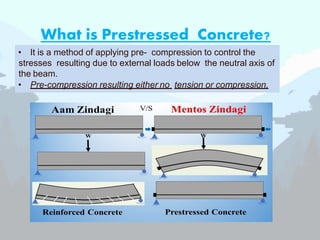
What is Prestressed Concrete?
• It is a method of applying pre- compression to control the
stresses resulting due to external loads below the neutral axis of
the beam.
• Pre-compression resulting either no tension or compression.
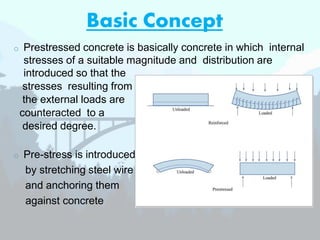
Basic Concept
o Prestressed concrete is basically concrete in which internal
stresses of a suitable magnitude and distribution are
introduced so that the
stresses resulting from
the external loads are
counteracted to a
desired degree.
o Pre-stress is introduced
by stretching steel wire
and anchoring them
against concrete
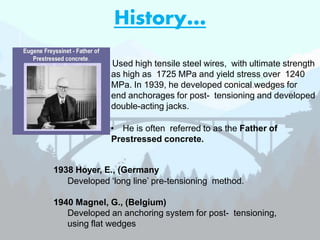
History…
Used high tensile steel wires, with ultimate strength
as high as 1725 MPa and yield stress over 1240
MPa. In 1939, he developed conical wedges for
end anchorages for post- tensioning and developed
double-acting jacks.
• He is often referred to as the Father of
Prestressed concrete.
1938 Hoyer, E., (Germany
Developed ‘long line’ pre-tensioning method.
1940 Magnel, G., (Belgium)
Developed an anchoring system for post- tensioning,
using flat wedges
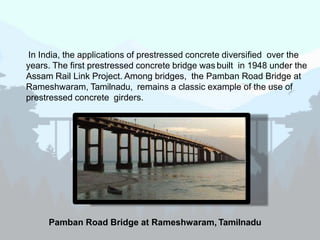
In India, the applications of prestressed concrete diversified over the
years. The first prestressed concrete bridge was built in 1948 under the
Assam Rail Link Project. Among bridges, the Pamban Road Bridge at
Rameshwaram, Tamilnadu, remains a classic example of the use of
prestressed concrete girders.
Pamban Road Bridge at Rameshwaram, Tamilnadu
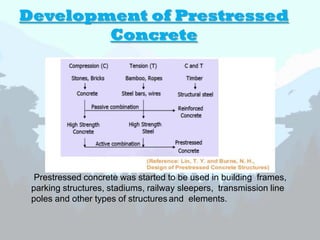
Development of Prestressed
Concrete
Prestressed concrete was started to be used in building frames,
parking structures, stadiums, railway sleepers, transmission line
poles and other types of structures and elements.
Principles of Prestressing
• Prestressing is a method in which compression force is applied
to the reinforced concrete section.
• The effects of prestressing is to reduce the tension stress in the
section to the point till the tensile stress is below the cracking
stress. Thus the concrete does not crack.
• It is then possible to treat concrete as a elastic material.
• The concrete can be visualized to have two compressive force
– Internal pre-stressing force
– External Forces (D.L, L.l ,etc)
• This two forces must counter act each other.
Terminology
• Tendon: A stretched element used in a concrete member of structure
to impart prestress to the concrete.
• Anchorage: A device generally used to enable the tendon to impart
and maintain prestress in concrete.
• Pretensioning: A method of prestressing concrete in which the
tendons are tensioned before the concrete is placed. In this
method, the concrete is introduced by bond between steel &
concrete.
• Post-tensioning: A method of prestressing concrete by tensioning
the tendons against hardened concrete. In this method, the
prestress is imparted to concrete by bearing
Types of Pre-stressing
1. External or internal pre-stressing.
–It is based on the location of the pre-stressing tendons with
respect to concrete section.
2. Pre-tensioning or post-tensioning.
– It based on the sequence of casting the concrete and
applying tension to the tendons.
3. Linear or circular pre-stressing.
– It based on the shape of the member pre-stressed.
4. Full, limited or partial pre-stressing.
– It based on the pre-stressing force.
5. Uniaxial, biaxial or multi-axial pre-stressing.
– It based on the direction of the pre-stressing member.
Tensioning
• Pre-tensioning: A method of prestessing concrete in which tendons
are tensioned before the concrete is placed. The operation
commonly a 5-step process.
• Post-tensioning: A method of prestessing concrete in which
tendons are tensioned after the concrete has place. The
operation commonly a 6-step process.
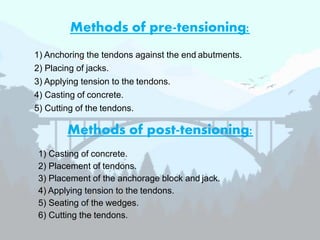
Methods of post-tensioning:
1) Anchoring the tendons against the end abutments.
2) Placing of jacks.
3) Applying tension to the tendons.
4) Casting of concrete.
5) Cutting of the tendons.
Methods of pre-tensioning:
1) Casting of concrete.
2) Placement of tendons.
3) Placement of the anchorage block and jack.
4) Applying tension to the tendons.
5) Seating of the wedges.
6) Cutting the tendons.
Advantages of pre-stressed
concrete.
 Factory products are possible.
 Long span structure are possible so that saving of wt is significant &
thus it become economical.
 Pre-stressed member are tested before use.
 Dead load are get counter balanced by eccentric pre- stressing
 It has high ability to resist the impact.
 It has high fatigue resistance.
 It has high live load carrying capacity.
 It free from cracks from service loads and enable entire section to
take part in resisting moments.
 Member are free from the tensile stresses.
Disadvantages of pre-stressed
concrete.
 Required skilled builders & experienced engineers.
 Initial equipment cost is very high.
 Availability of experienced engineers is less.
 Required complicated formwork.
 It requires high strength concrete & steel.
 Pre-stressed concrete is less fiber resistant.
“Engineers like to solve problems. If there are no
problems handily available, they will create their
own problems.”
― Scott Adams
THANK YOU !!!
SUBMITTED BY :-
SHUBHAM DAS [TRE-I-A-18]

Pre stressed concrete Bridge

  • 1.
    DEPARTMENT OF CIVILENGINEERING [2020-2021] TRANSOPRTATION ENGINEERING T.A.E. 2A PRE-STRESSED CONCRETE BRIDGE SUBJECT :-BRIDGE ENGINEERING SUBMITTED BY :- SHUBHAM DAS [TRE-I-A-18]
  • 2.
    What is PrestressedConcrete? • It is a method of applying pre- compression to control the stresses resulting due to external loads below the neutral axis of the beam. • Pre-compression resulting either no tension or compression.
  • 3.
    Basic Concept o Prestressedconcrete is basically concrete in which internal stresses of a suitable magnitude and distribution are introduced so that the stresses resulting from the external loads are counteracted to a desired degree. o Pre-stress is introduced by stretching steel wire and anchoring them against concrete
  • 4.
    History… Used high tensilesteel wires, with ultimate strength as high as 1725 MPa and yield stress over 1240 MPa. In 1939, he developed conical wedges for end anchorages for post- tensioning and developed double-acting jacks. • He is often referred to as the Father of Prestressed concrete. 1938 Hoyer, E., (Germany Developed ‘long line’ pre-tensioning method. 1940 Magnel, G., (Belgium) Developed an anchoring system for post- tensioning, using flat wedges
  • 5.
    In India, theapplications of prestressed concrete diversified over the years. The first prestressed concrete bridge was built in 1948 under the Assam Rail Link Project. Among bridges, the Pamban Road Bridge at Rameshwaram, Tamilnadu, remains a classic example of the use of prestressed concrete girders. Pamban Road Bridge at Rameshwaram, Tamilnadu
  • 6.
    Development of Prestressed Concrete Prestressedconcrete was started to be used in building frames, parking structures, stadiums, railway sleepers, transmission line poles and other types of structures and elements.
  • 7.
    Principles of Prestressing •Prestressing is a method in which compression force is applied to the reinforced concrete section. • The effects of prestressing is to reduce the tension stress in the section to the point till the tensile stress is below the cracking stress. Thus the concrete does not crack. • It is then possible to treat concrete as a elastic material. • The concrete can be visualized to have two compressive force – Internal pre-stressing force – External Forces (D.L, L.l ,etc) • This two forces must counter act each other.
  • 8.
    Terminology • Tendon: Astretched element used in a concrete member of structure to impart prestress to the concrete. • Anchorage: A device generally used to enable the tendon to impart and maintain prestress in concrete. • Pretensioning: A method of prestressing concrete in which the tendons are tensioned before the concrete is placed. In this method, the concrete is introduced by bond between steel & concrete. • Post-tensioning: A method of prestressing concrete by tensioning the tendons against hardened concrete. In this method, the prestress is imparted to concrete by bearing
  • 9.
    Types of Pre-stressing 1.External or internal pre-stressing. –It is based on the location of the pre-stressing tendons with respect to concrete section. 2. Pre-tensioning or post-tensioning. – It based on the sequence of casting the concrete and applying tension to the tendons. 3. Linear or circular pre-stressing. – It based on the shape of the member pre-stressed. 4. Full, limited or partial pre-stressing. – It based on the pre-stressing force. 5. Uniaxial, biaxial or multi-axial pre-stressing. – It based on the direction of the pre-stressing member.
  • 10.
    Tensioning • Pre-tensioning: Amethod of prestessing concrete in which tendons are tensioned before the concrete is placed. The operation commonly a 5-step process. • Post-tensioning: A method of prestessing concrete in which tendons are tensioned after the concrete has place. The operation commonly a 6-step process.
  • 11.
    Methods of post-tensioning: 1)Anchoring the tendons against the end abutments. 2) Placing of jacks. 3) Applying tension to the tendons. 4) Casting of concrete. 5) Cutting of the tendons. Methods of pre-tensioning: 1) Casting of concrete. 2) Placement of tendons. 3) Placement of the anchorage block and jack. 4) Applying tension to the tendons. 5) Seating of the wedges. 6) Cutting the tendons.
  • 12.
    Advantages of pre-stressed concrete. Factory products are possible.  Long span structure are possible so that saving of wt is significant & thus it become economical.  Pre-stressed member are tested before use.  Dead load are get counter balanced by eccentric pre- stressing  It has high ability to resist the impact.  It has high fatigue resistance.  It has high live load carrying capacity.  It free from cracks from service loads and enable entire section to take part in resisting moments.  Member are free from the tensile stresses.
  • 13.
    Disadvantages of pre-stressed concrete. Required skilled builders & experienced engineers.  Initial equipment cost is very high.  Availability of experienced engineers is less.  Required complicated formwork.  It requires high strength concrete & steel.  Pre-stressed concrete is less fiber resistant.
  • 14.
    “Engineers like tosolve problems. If there are no problems handily available, they will create their own problems.” ― Scott Adams THANK YOU !!! SUBMITTED BY :- SHUBHAM DAS [TRE-I-A-18]