PRE-STRESSING
Made by :-
1) Manisha Khandelwal
2) Kashif
Introduction
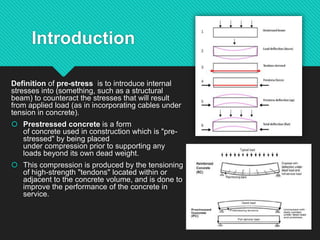
Definition of pre-stress is to introduce internal
stresses into (something, such as a structural
beam) to counteract the stresses that will result
from applied load (as in incorporating cables under
tension in concrete).
 Prestressed concrete is a form
of concrete used in construction which is "pre-
stressed" by being placed
under compression prior to supporting any
loads beyond its own dead weight.
 This compression is produced by the tensioning
of high-strength "tendons" located within or
adjacent to the concrete volume, and is done to
improve the performance of the concrete in
service.
Types / Classification
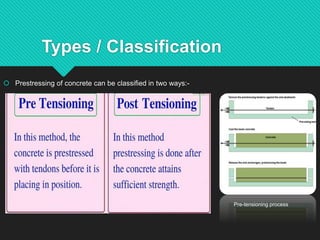
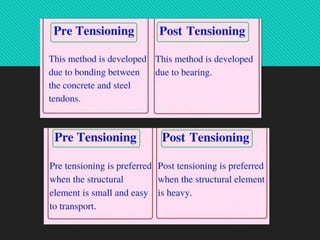
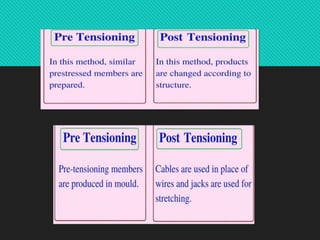
 Prestressing of concrete can be classified in two ways:-
Pre-tensioning process
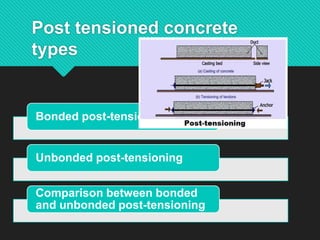
Post tensioned concrete
types
Bonded post-tensioning
Unbonded post-tensioning
Comparison between bonded
and unbonded post-tensioning
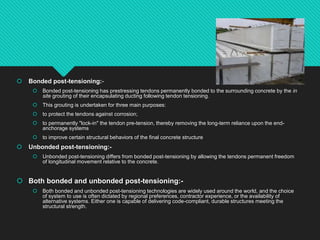
 Bonded post-tensioning:-
 Bonded post-tensioning has prestressing tendons permanently bonded to the surrounding concrete by the in
site grouting of their encapsulating ducting following tendon tensioning.
 This grouting is undertaken for three main purposes:
 to protect the tendons against corrosion;
 to permanently "lock-in" the tendon pre-tension, thereby removing the long-term reliance upon the end-
anchorage systems
 to improve certain structural behaviors of the final concrete structure
 Unbonded post-tensioning:-
 Unbonded post-tensioning differs from bonded post-tensioning by allowing the tendons permanent freedom
of longitudinal movement relative to the concrete.
 Both bonded and unbonded post-tensioning:-
 Both bonded and unbonded post-tensioning technologies are widely used around the world, and the choice
of system to use is often dictated by regional preferences, contractor experience, or the availability of
alternative systems. Either one is capable of delivering code-compliant, durable structures meeting the
structural strength.
Availability
 Prestressed can be available in various materials such as concrete, steel
etc.
 Some notable building structures constructed from prestressed concrete
include:
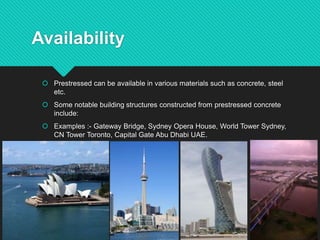
 Examples :- Gateway Bridge, Sydney Opera House, World Tower Sydney,
CN Tower Toronto, Capital Gate Abu Dhabi UAE.
Characteristics
 The essence of prestressed concrete is
that once the initial compression has been
applied, the resulting material has the
characteristics of :-
 high-strength concrete when subject to
any subsequent compression forces,
 ductile high-strength steel
when subject to tension forces.
 Durability
 Corrosion protection.
 Improves crack control.
 Improves fire performances.
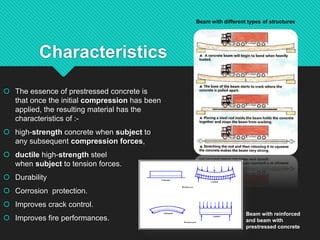
Beam with different types of structures
Beam with reinforced
and beam with
prestressed concrete
Uses
 Building structures
 Building structures are typically required to satisfy a broad range of structural, aesthetic and economic
requirements.
 Bridges
 materials that are available for the construction of bridges, concrete remains the most popular structural
material,
 Dams
 Concrete dams have used prestressing to counter uplift and increase their overall stability.
 Silos and tanks
 Circular storage structures such as silos and tanks can use prestressing forces to directly resist the
outward pressures generated by stored liquids or bulk-solids.
 Nuclear and blast-containment structures
 Prestressed concrete is long-established as a reliable construction material for high-pressure
containment structures
 Hardstands and pavements
 Heavily loaded concrete ground-slabs and pavements can be sensitive to cracking and subsequent
traffic-driven deterioration. As a result, prestressed concrete is regularly used in such structures
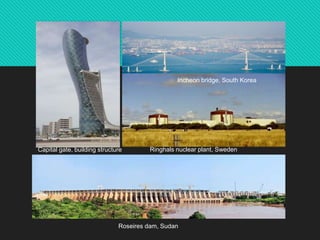
Capital gate, building structure Ringhals nuclear plant, Sweden
Incheon bridge, South Korea
Roseires dam, Sudan
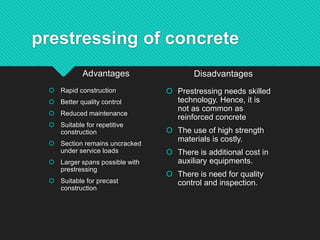
prestressing of concrete
Advantages
 Rapid construction
 Better quality control
 Reduced maintenance
 Suitable for repetitive
construction
 Section remains uncracked
under service loads
 Larger spans possible with
prestressing
 Suitable for precast
construction
Disadvantages
 Prestressing needs skilled
technology. Hence, it is
not as common as
reinforced concrete
 The use of high strength
materials is costly.
 There is additional cost in
auxiliary equipments.
 There is need for quality
control and inspection.
Thankyou

Pre-stressing

  • 1.
    PRE-STRESSING Made by :- 1)Manisha Khandelwal 2) Kashif
  • 2.
    Introduction Definition of pre-stressis to introduce internal stresses into (something, such as a structural beam) to counteract the stresses that will result from applied load (as in incorporating cables under tension in concrete).  Prestressed concrete is a form of concrete used in construction which is "pre- stressed" by being placed under compression prior to supporting any loads beyond its own dead weight.  This compression is produced by the tensioning of high-strength "tendons" located within or adjacent to the concrete volume, and is done to improve the performance of the concrete in service.
  • 3.
    Types / Classification Prestressing of concrete can be classified in two ways:- Pre-tensioning process
  • 6.
    Post tensioned concrete types Bondedpost-tensioning Unbonded post-tensioning Comparison between bonded and unbonded post-tensioning
  • 7.
     Bonded post-tensioning:- Bonded post-tensioning has prestressing tendons permanently bonded to the surrounding concrete by the in site grouting of their encapsulating ducting following tendon tensioning.  This grouting is undertaken for three main purposes:  to protect the tendons against corrosion;  to permanently "lock-in" the tendon pre-tension, thereby removing the long-term reliance upon the end- anchorage systems  to improve certain structural behaviors of the final concrete structure  Unbonded post-tensioning:-  Unbonded post-tensioning differs from bonded post-tensioning by allowing the tendons permanent freedom of longitudinal movement relative to the concrete.  Both bonded and unbonded post-tensioning:-  Both bonded and unbonded post-tensioning technologies are widely used around the world, and the choice of system to use is often dictated by regional preferences, contractor experience, or the availability of alternative systems. Either one is capable of delivering code-compliant, durable structures meeting the structural strength.
  • 8.
    Availability  Prestressed canbe available in various materials such as concrete, steel etc.  Some notable building structures constructed from prestressed concrete include:  Examples :- Gateway Bridge, Sydney Opera House, World Tower Sydney, CN Tower Toronto, Capital Gate Abu Dhabi UAE.
  • 9.
    Characteristics  The essenceof prestressed concrete is that once the initial compression has been applied, the resulting material has the characteristics of :-  high-strength concrete when subject to any subsequent compression forces,  ductile high-strength steel when subject to tension forces.  Durability  Corrosion protection.  Improves crack control.  Improves fire performances. Beam with different types of structures Beam with reinforced and beam with prestressed concrete
  • 10.
    Uses  Building structures Building structures are typically required to satisfy a broad range of structural, aesthetic and economic requirements.  Bridges  materials that are available for the construction of bridges, concrete remains the most popular structural material,  Dams  Concrete dams have used prestressing to counter uplift and increase their overall stability.  Silos and tanks  Circular storage structures such as silos and tanks can use prestressing forces to directly resist the outward pressures generated by stored liquids or bulk-solids.  Nuclear and blast-containment structures  Prestressed concrete is long-established as a reliable construction material for high-pressure containment structures  Hardstands and pavements  Heavily loaded concrete ground-slabs and pavements can be sensitive to cracking and subsequent traffic-driven deterioration. As a result, prestressed concrete is regularly used in such structures
  • 11.
    Capital gate, buildingstructure Ringhals nuclear plant, Sweden Incheon bridge, South Korea Roseires dam, Sudan
  • 12.
    prestressing of concrete Advantages Rapid construction  Better quality control  Reduced maintenance  Suitable for repetitive construction  Section remains uncracked under service loads  Larger spans possible with prestressing  Suitable for precast construction Disadvantages  Prestressing needs skilled technology. Hence, it is not as common as reinforced concrete  The use of high strength materials is costly.  There is additional cost in auxiliary equipments.  There is need for quality control and inspection.
  • 13.