PRESTO
Kiran Palaka
Problem to solve
 Huge production of data.
 As data is growing enormously to the point of peta bytes
, querying the database has become a big issue.
 So we should be able to run more interactive queries and get
results faster .
Introduction
 Presto is a open source distributed sql query engine.
 For running queries against of all sizes ranging from
gigabytes to petabytes .
 It supports ANSI SQL ,including complex
queries,aggresgations,joins and window functions .
 It is implemented in java.
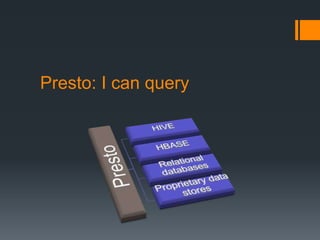
Presto: I can query
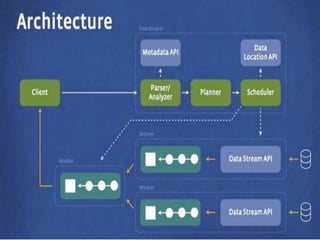
Architecture
Architecture Explanation
 Client sends sql to presto coordinator.
 Coordinator parses ,analyzes and plans the query execution.
 The scheduler wires together the execution pipeline ,assigns
work to nodes closest to data and monitors the progress.
 The client pulls the data from output stage which in turn pulls
data from underlying stages.
Hive/Mapreduce Execution model
 Hive translates queries into multiple stage of mapreduce
tasks and execute them one after the other.
 Each task reads input from disk and writes intermediate
output back to disk.
Presto Execution
 Presto engine does not use Mapreduce.
 It employs a custom query and execution engine with
operators designed to support sql semantics.
 Processing is in memory and pipelined across the network
between stages which avoids unnecessary I/O and
associated latency overhead.
 Pipelined execution model runs multiple stages at once and
streams data from one stage to next as it becomes available
which reduces end-to-end latency
Note
 Presto dynamically compiles certain portions of query plan to
byte code which lets JVM optimize and generate native
machine code.
Extensibility
 Presto was designed with a simple storage abstraction that
makes its easy to provide sql query capability against
disparate data sources.
 Connectors only need to provide interfaces for fetching meta
data, getting data locations and accessing data itself.
Limitations
 Size limitation on the join tables and cardinality of unique
groups.
 Lacks the ability to write output back to tables. Currently
query results are streamed to client.
Presto developers claim:
 Presto is 10x better than hive/Mapreduce in terms of cpu
efficiency and latency for most queries.
 Supports ANSI sql, including joins, left/right outer
joins,subqueries,most of the common aggregate and scalar
functions, including approximate distinct counts,
approximate percentiles

Presto: Distributed sql query engine

  • 1.
  • 2.
    Problem to solve Huge production of data.  As data is growing enormously to the point of peta bytes , querying the database has become a big issue.  So we should be able to run more interactive queries and get results faster .
  • 3.
    Introduction  Presto isa open source distributed sql query engine.  For running queries against of all sizes ranging from gigabytes to petabytes .  It supports ANSI SQL ,including complex queries,aggresgations,joins and window functions .  It is implemented in java.
  • 4.
  • 5.
  • 6.
    Architecture Explanation  Clientsends sql to presto coordinator.  Coordinator parses ,analyzes and plans the query execution.  The scheduler wires together the execution pipeline ,assigns work to nodes closest to data and monitors the progress.  The client pulls the data from output stage which in turn pulls data from underlying stages.
  • 7.
    Hive/Mapreduce Execution model Hive translates queries into multiple stage of mapreduce tasks and execute them one after the other.  Each task reads input from disk and writes intermediate output back to disk.
  • 8.
    Presto Execution  Prestoengine does not use Mapreduce.  It employs a custom query and execution engine with operators designed to support sql semantics.  Processing is in memory and pipelined across the network between stages which avoids unnecessary I/O and associated latency overhead.  Pipelined execution model runs multiple stages at once and streams data from one stage to next as it becomes available which reduces end-to-end latency
  • 9.
    Note  Presto dynamicallycompiles certain portions of query plan to byte code which lets JVM optimize and generate native machine code.
  • 10.
    Extensibility  Presto wasdesigned with a simple storage abstraction that makes its easy to provide sql query capability against disparate data sources.  Connectors only need to provide interfaces for fetching meta data, getting data locations and accessing data itself.
  • 11.
    Limitations  Size limitationon the join tables and cardinality of unique groups.  Lacks the ability to write output back to tables. Currently query results are streamed to client.
  • 12.
    Presto developers claim: Presto is 10x better than hive/Mapreduce in terms of cpu efficiency and latency for most queries.  Supports ANSI sql, including joins, left/right outer joins,subqueries,most of the common aggregate and scalar functions, including approximate distinct counts, approximate percentiles