Iceberg
A modern table format for big data
Ryan Blue @6d352b5d3028e4b
Owen O’Malley @owen_omalley
September 2018 - Strata NY
● A Netflix use case and performance results
● Hive tables
○ How large Hive tables work
○ Drawbacks of this table design
● Iceberg tables
○ How Iceberg addresses the challenges
○ Benefits of Iceberg’s design
● How to get started
Contents
Iceberg Performance
September 2018 - Strata NY
● Historical Atlas data:
○ Time-series metrics from Netflix runtime systems
○ 1 month: 2.7 million files in 2,688 partitions
○ Problem: cannot process more than a few days of data
● Sample query:
select distinct tags['type'] as type
from iceberg.atlas
where
name = 'metric-name' and
date > 20180222 and date <= 20180228
order by type;
Case Study: Netflix Atlas
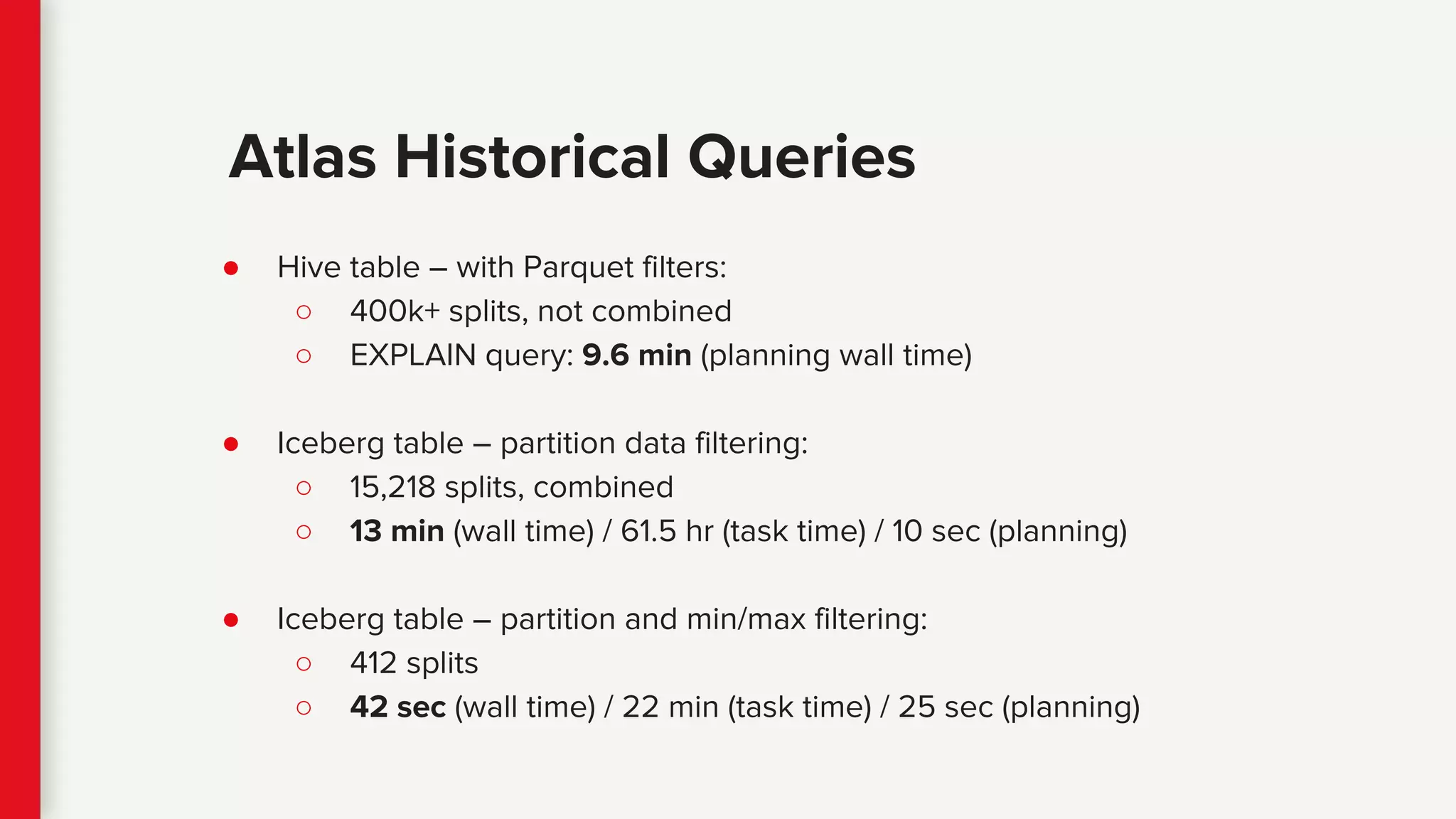
● Hive table – with Parquet filters:
○ 400k+ splits, not combined
○ EXPLAIN query: 9.6 min (planning wall time)
● Iceberg table – partition data filtering:
○ 15,218 splits, combined
○ 13 min (wall time) / 61.5 hr (task time) / 10 sec (planning)
● Iceberg table – partition and min/max filtering:
○ 412 splits
○ 42 sec (wall time) / 22 min (task time) / 25 sec (planning)
Atlas Historical Queries
What is a table format?
September 2018 - Strata NY
You meant file format, right?
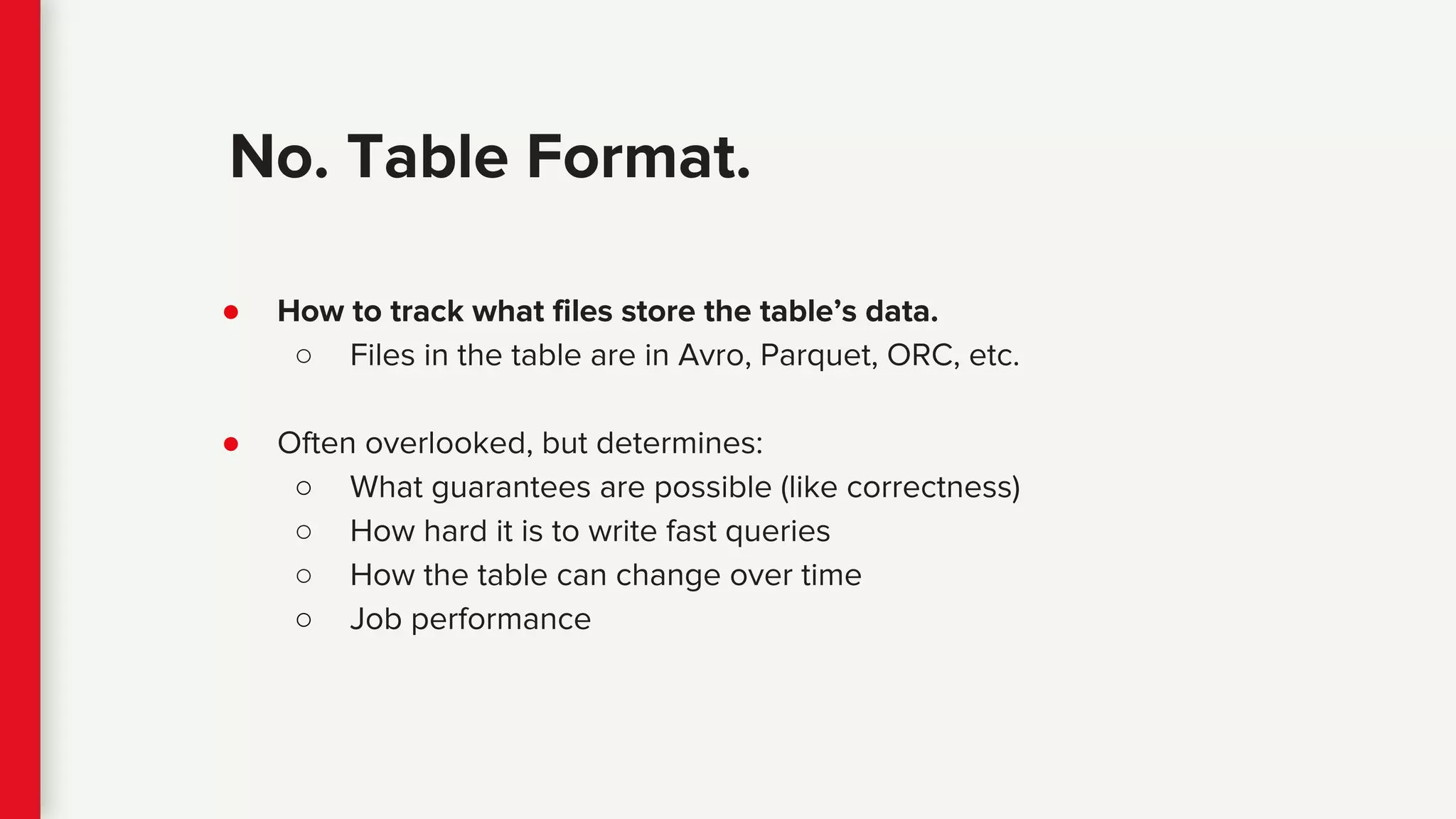
● How to track what files store the table’s data.
○ Files in the table are in Avro, Parquet, ORC, etc.
● Often overlooked, but determines:
○ What guarantees are possible (like correctness)
○ How hard it is to write fast queries
○ How the table can change over time
○ Job performance
No. Table Format.
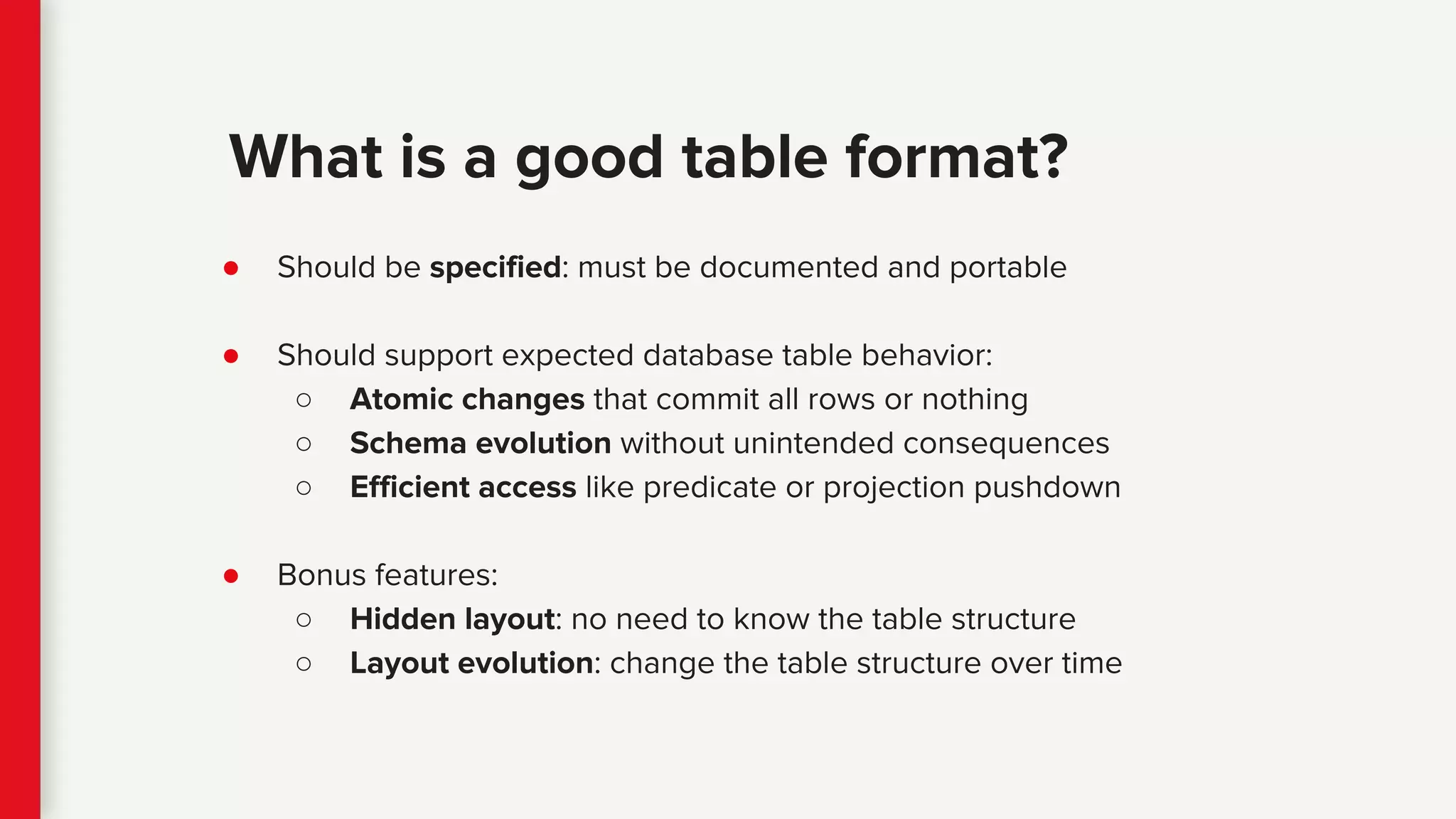
● Should be specified: must be documented and portable
● Should support expected database table behavior:
○ Atomic changes that commit all rows or nothing
○ Schema evolution without unintended consequences
○ Efficient access like predicate or projection pushdown
● Bonus features:
○ Hidden layout: no need to know the table structure
○ Layout evolution: change the table structure over time
What is a good table format?
Hive Tables
September 2018 - Strata NY
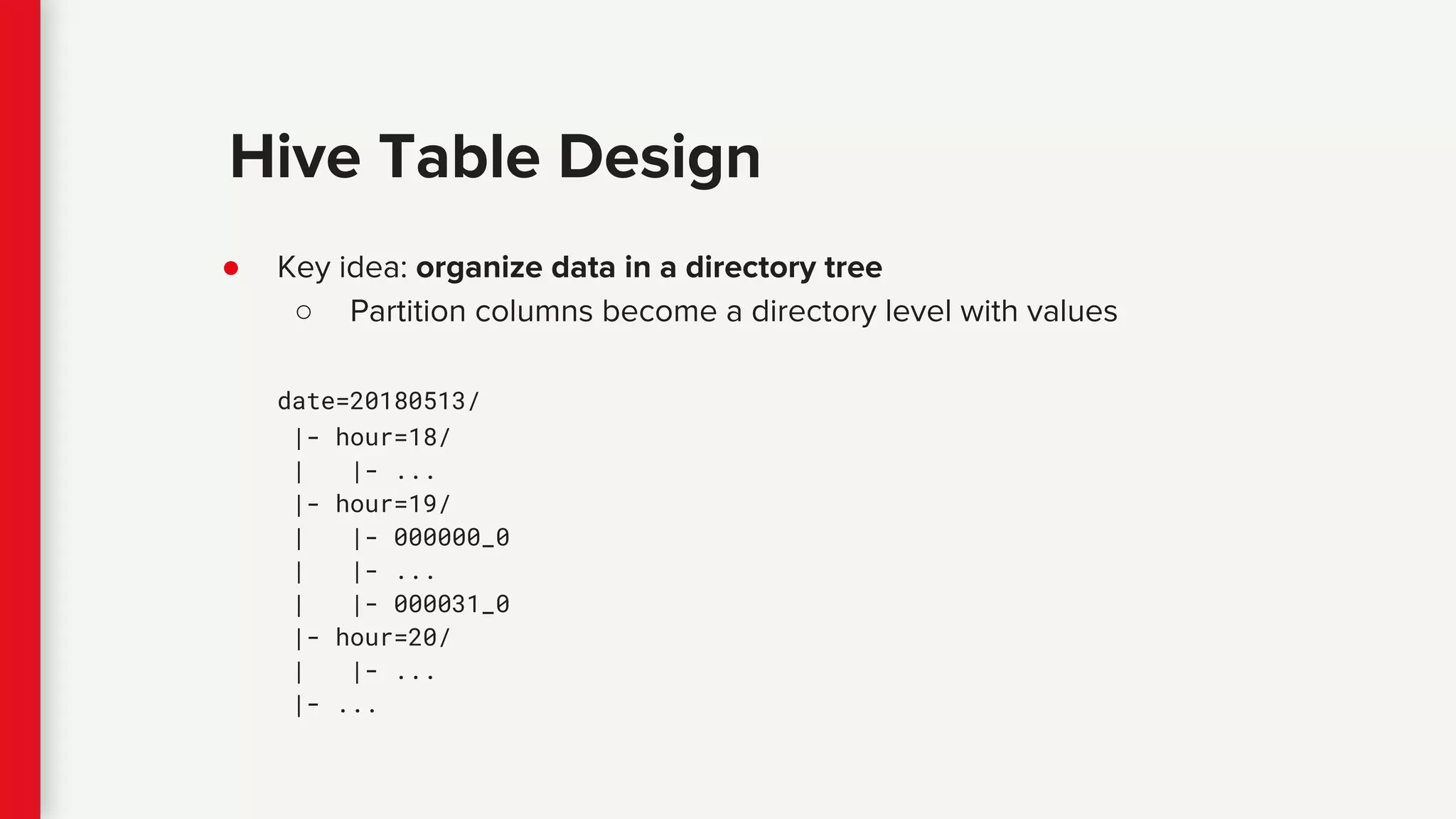
● Key idea: organize data in a directory tree
○ Partition columns become a directory level with values
date=20180513/
|- hour=18/
| |- ...
|- hour=19/
| |- 000000_0
| |- ...
| |- 000031_0
|- hour=20/
| |- ...
|- ...
Hive Table Design
● Filter by directories as columns
SELECT ... WHERE date = '20180513' AND hour = 19
date=20180513/
|- hour=18/
| |- ...
|- hour=19/
| |- 000000_0
| |- ...
| |- 000031_0
|- hour=20/
| |- ...
|- ...
Hive Table Design
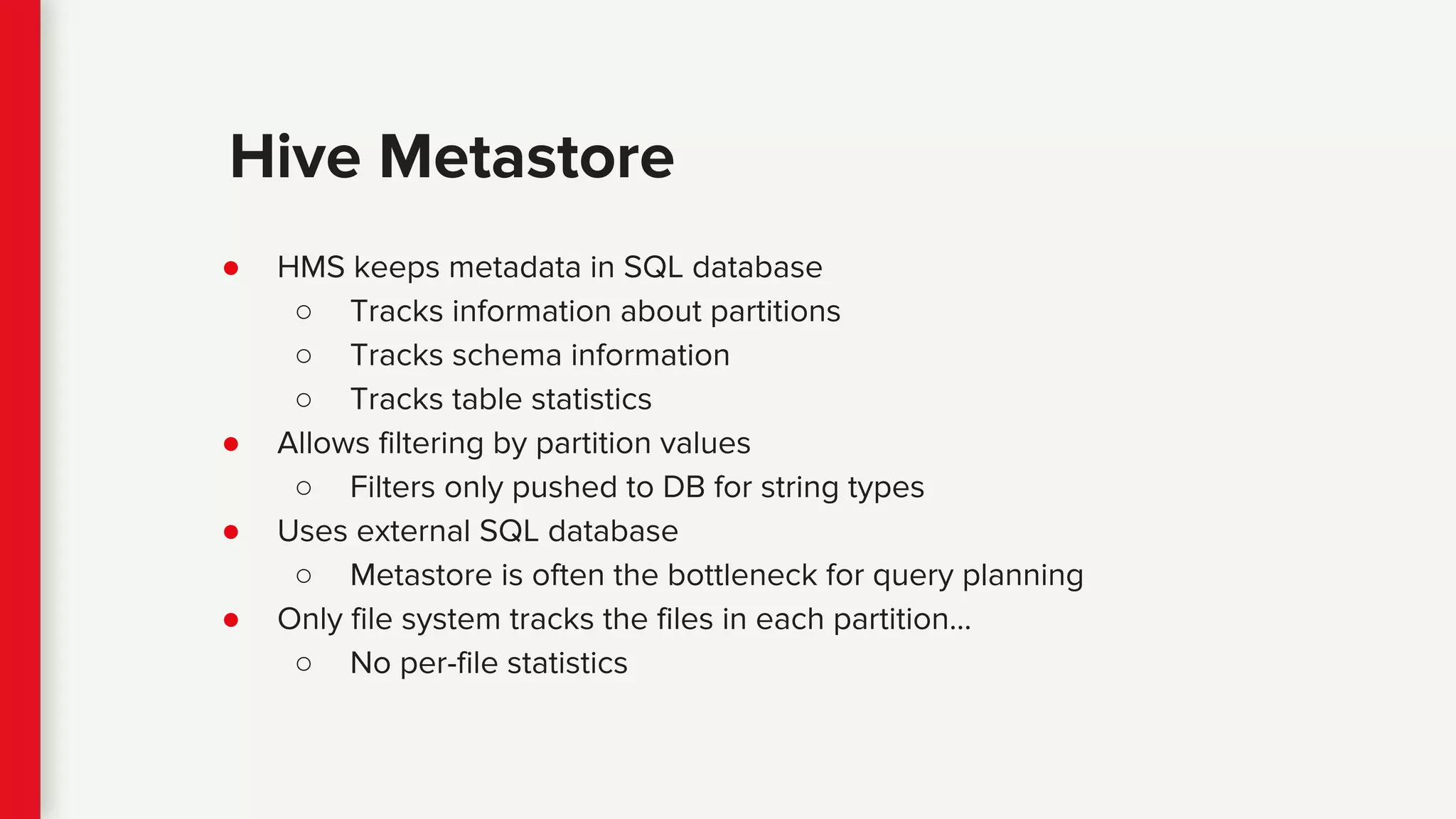
● HMS keeps metadata in SQL database
○ Tracks information about partitions
○ Tracks schema information
○ Tracks table statistics
● Allows filtering by partition values
○ Filters only pushed to DB for string types
● Uses external SQL database
○ Metastore is often the bottleneck for query planning
● Only file system tracks the files in each partition…
○ No per-file statistics
Hive Metastore
● Provides snapshot isolation and atomic updates
● Transaction state is stored in the metastore
● Uses the same partition/directory layout
○ Creates new directory structure inside partitions
date=20180513/
|- hour=19/
| |- base_0000000/
| | |- bucket_00000
| | |- ...
| | |- bucket_00031
| |- delta_0000001_0000100/
| | |- bucket_00000
| | |- ...
Hive ACID layout
● Table state is stored in two places
○ Partitions in the Hive Metastore
○ Files in a file system
● Bucketing is defined by Hive’s (Java) hash implementation.
● Non-ACID layout’s only atomic operation is add partition
● Requires atomic move of objects in file system
● Still requires directory listing to plan jobs
○ O(n) listing calls, n = # matching partitions
○ Eventual consistency breaks correctness
Design Problems
● Partition values are stored as strings
○ Requires character escaping
○ null stored as __HIVE_DEFAULT_PARTITION__
● HMS table statistics become stale
○ Statistics have to be regenerated manually
● A lot of undocumented layout variants
● Bucket definition tied to Java and Hive
Less Obvious Problems
● Users must know and use a table’s physical layout
○ ts > X ⇒ full table scan!
○ Did you mean this?
ts > X and (d > day(X) or (d = day(X) and hr >= hour(X))
● Schema evolution rules are dependent on file format
○ CSV – by position; Avro & ORC – by name
● Unreliable: type support varies across formats
○ Which formats support decimal?
○ Does CSV support maps with struct keys?
Other Annoyances
Iceberg Tables
September 2018 - Strata NY
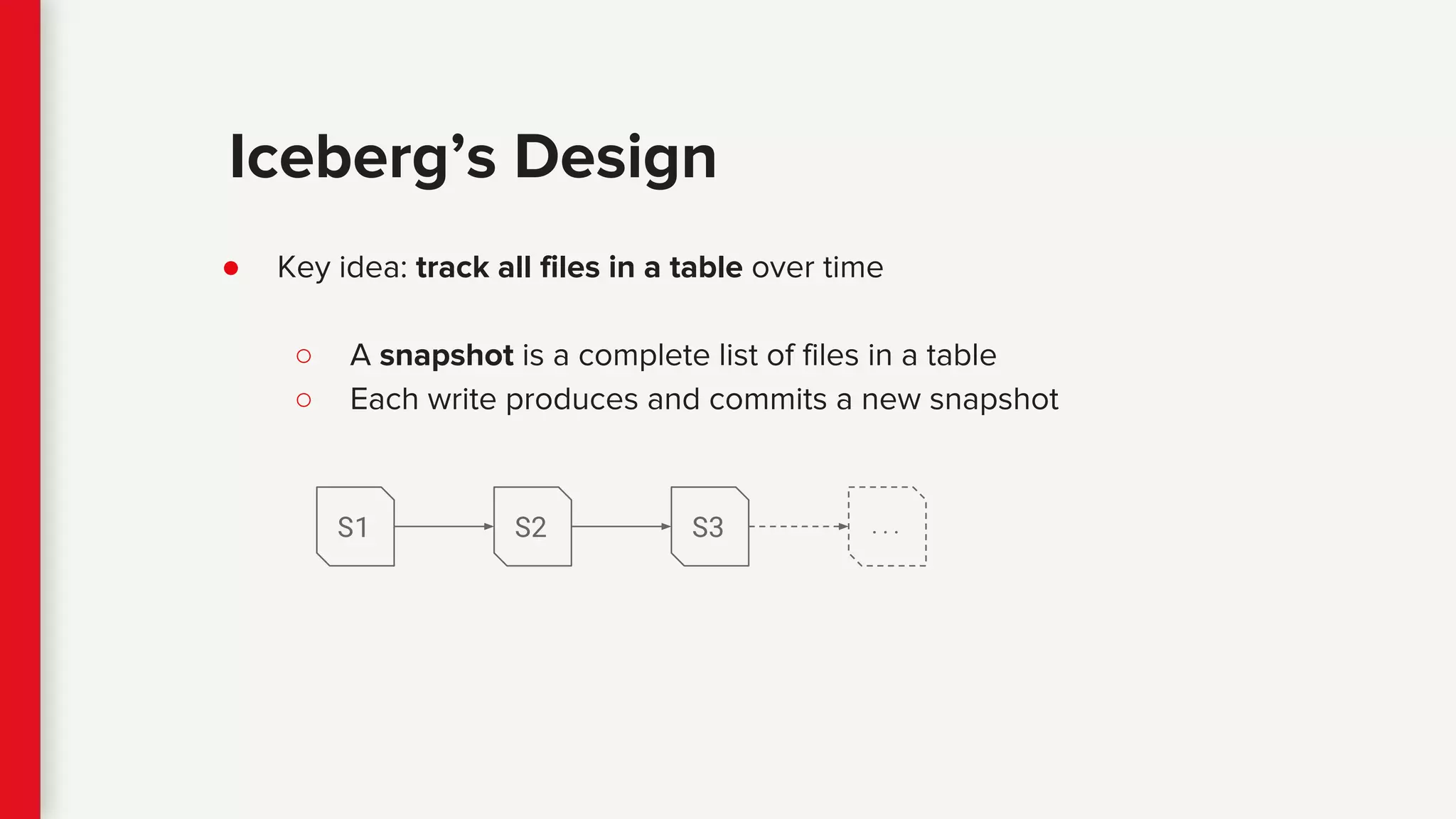
● Key idea: track all files in a table over time
○ A snapshot is a complete list of files in a table
○ Each write produces and commits a new snapshot
Iceberg’s Design
S1 S2 S3 ...
● Snapshot isolation without locking
○ Readers use a current snapshot
○ Writers produce new snapshots in isolation, then commit
● Any change to the file list is an atomic operation
○ Append data across partitions
○ Merge or rewrite files
Snapshot Design Benefits
S1 S2 S3 ...
R W
In reality, it’s a bit more
complicated...
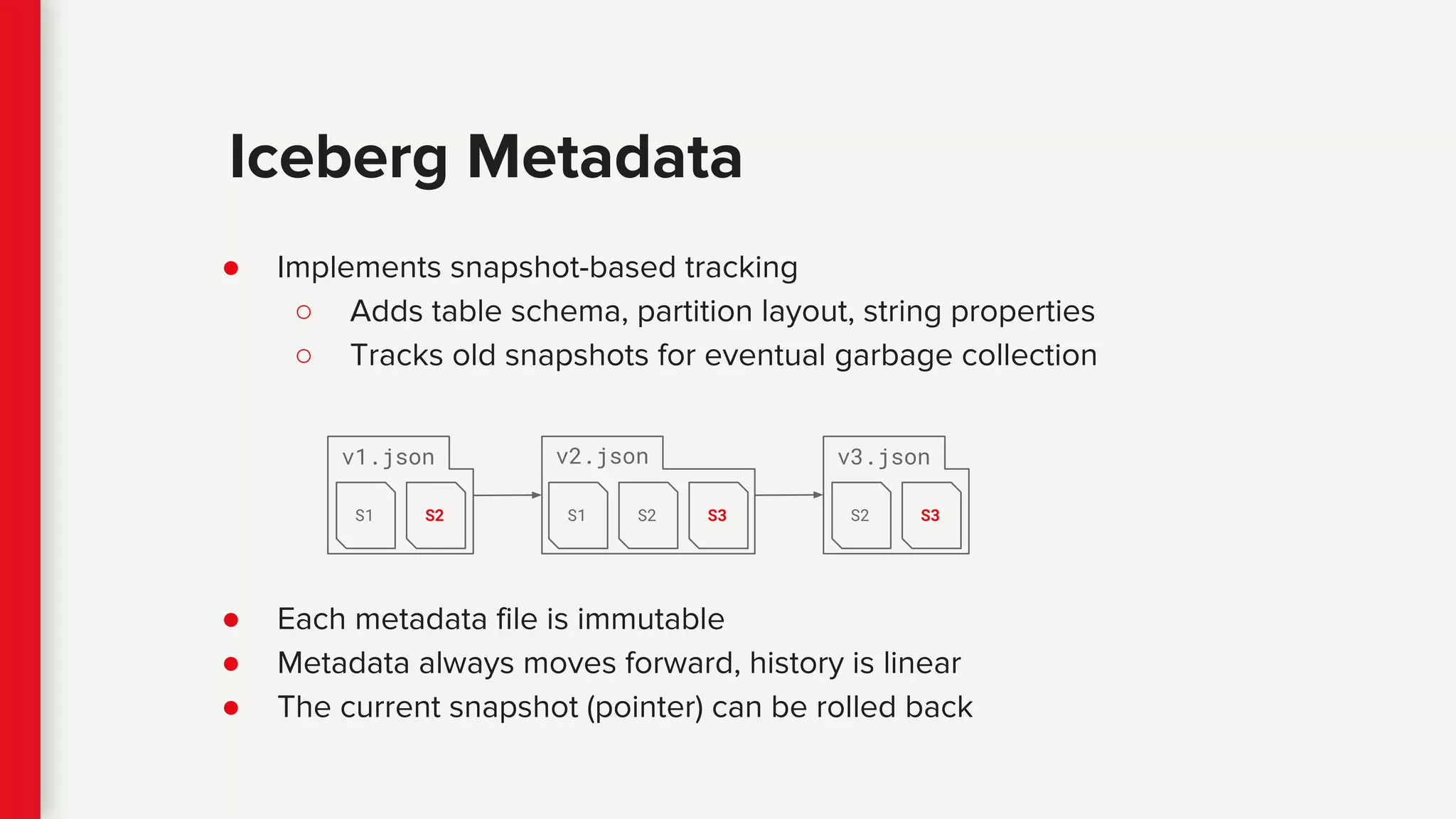
● Implements snapshot-based tracking
○ Adds table schema, partition layout, string properties
○ Tracks old snapshots for eventual garbage collection
● Each metadata file is immutable
● Metadata always moves forward, history is linear
● The current snapshot (pointer) can be rolled back
Iceberg Metadata
v1.json
S1 S2
v2.json
S1 S2 S3
v3.json
S2 S3
● Snapshots are split across one or more manifest files
○ A manifest stores files across many partitions
○ A partition data tuple is stored for each data file
○ Reused to avoid high write volume
Manifest Files
v2.json
S1 S2 S3
m0.avro m1.avro m2.avro
● Basic data file info:
○ File location and format
○ Iceberg tracking data
● Values to filter files for a scan:
○ Partition data values
○ Per-column lower and upper bounds
● Metrics for cost-based optimization:
○ File-level: row count, size
○ Column-level: value count, null count, size
Manifest File Contents
● To commit, a writer must:
○ Note the current metadata version – the base version
○ Create new metadata and manifest files
○ Atomically swap the base version for the new version
● This atomic swap ensures a linear history
● Atomic swap is implemented by:
○ A custom metastore implementation
○ Atomic rename for HDFS or local tables
Commits
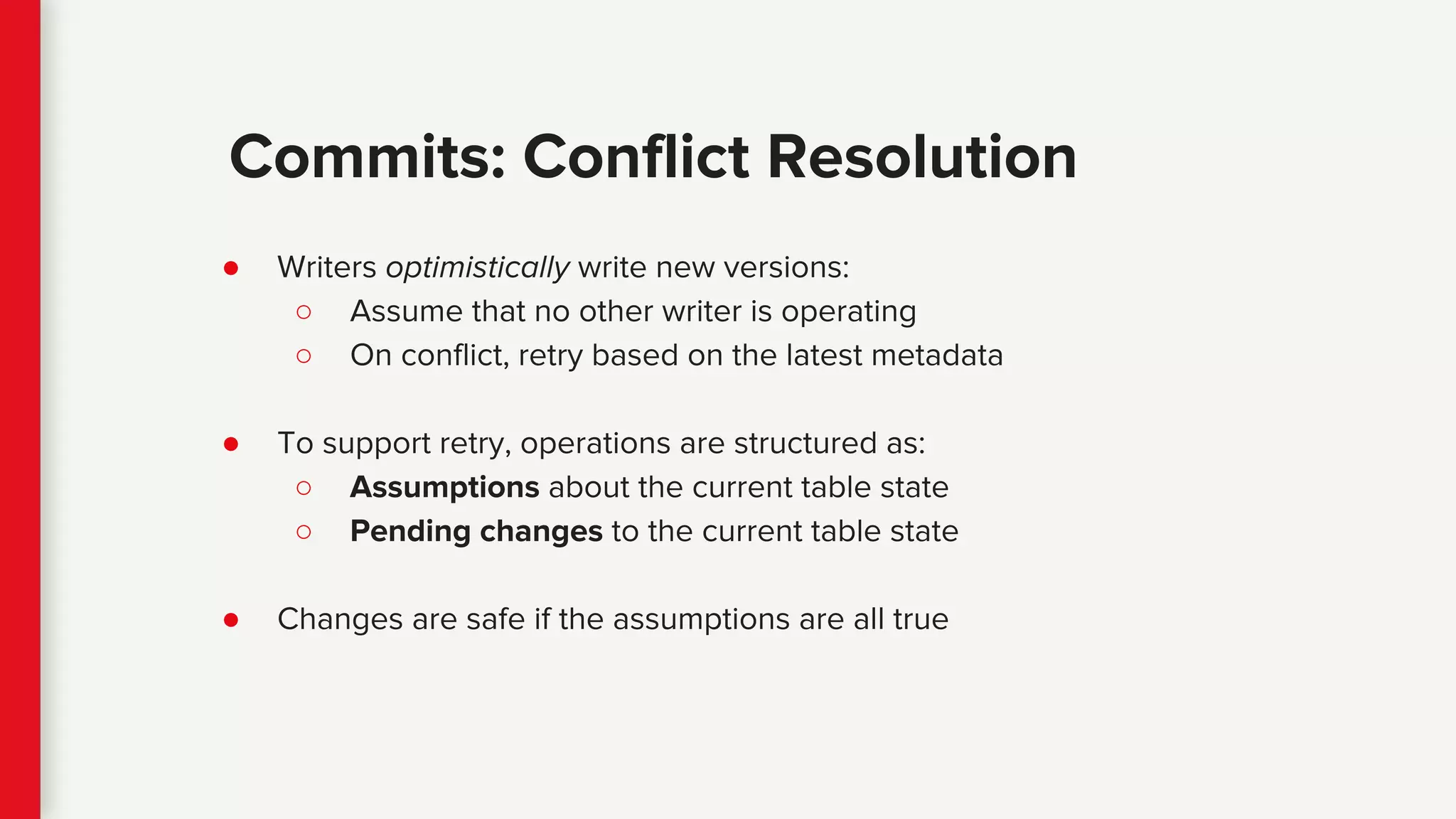
● Writers optimistically write new versions:
○ Assume that no other writer is operating
○ On conflict, retry based on the latest metadata
● To support retry, operations are structured as:
○ Assumptions about the current table state
○ Pending changes to the current table state
● Changes are safe if the assumptions are all true
Commits: Conflict Resolution
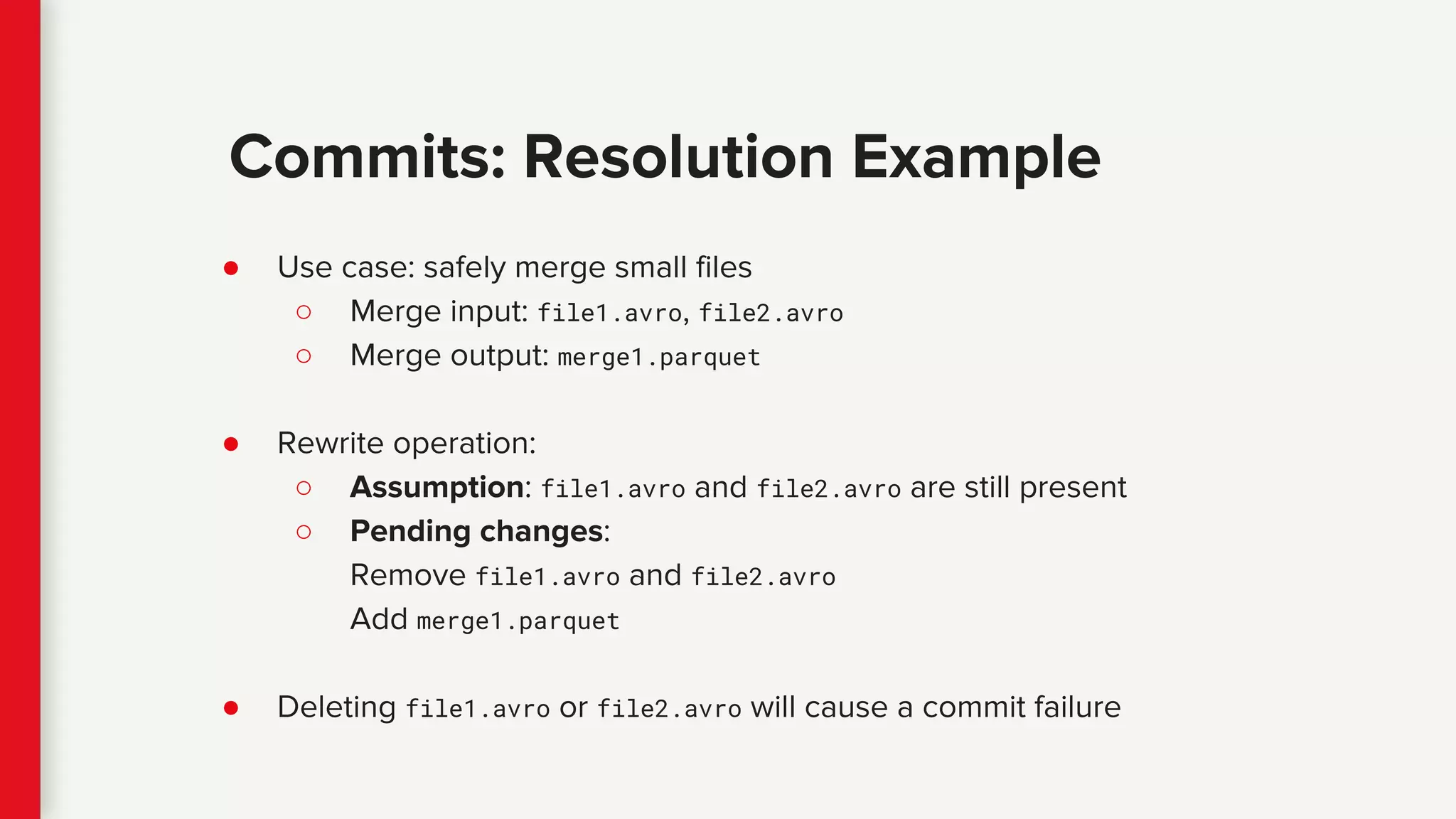
● Use case: safely merge small files
○ Merge input: file1.avro, file2.avro
○ Merge output: merge1.parquet
● Rewrite operation:
○ Assumption: file1.avro and file2.avro are still present
○ Pending changes:
Remove file1.avro and file2.avro
Add merge1.parquet
● Deleting file1.avro or file2.avro will cause a commit failure
Commits: Resolution Example
Design Benefits
● Reads and writes are isolated and all changes are atomic
● No expensive or eventually-consistent FS operations:
○ No directory or prefix listing
○ No rename: data files written in place
● Faster scan planning
○ O(1) manifest reads, not O(n) partition list calls
○ Without listing, partition granularity can be higher
○ Upper and lower bounds used to eliminate files
● Full schema evolution: add, drop, rename, reorder columns
● Reliable support for types
○ date, time, timestamp, and decimal
○ struct, list, map, and mixed nesting
● Hidden partitioning
○ Partition filters derived from data filters
○ Supports evolving table partitioning
● Mixed file format support, reliable CBO metrics, etc.
Other Improvements
● Spark improvements
○ Standard logical plans and behavior
○ Data source v2 API revisions
● ORC improvements
○ Added additional statistics
○ Adding timestamp with local timezone
● Parquet & Avro improvements
○ Column resolution by ID
○ New materialization API
Contributions to other projects
Getting Started with Iceberg
September 2018 - Strata NY
● github.com/Netflix/iceberg
○ Apache Licensed, ALv2
○ Core Java library available from JitPack
○ Contribute with github issues and pull requests
● Supported engines:
○ Spark 2.3.x - data source v2 plug-in
○ Read-only Pig support
● Mailing list:
○ iceberg-devel@googlegroups.com
Using Iceberg
● Hive Metastore catalog (PR available)
○ Uses table locking to implement atomic commits
● Python library coming soon
● Presto support PR coming soon
Future work
Questions?
blue@apache.org
omalley@apache.org
September 2018 - Strata NY

Iceberg: A modern table format for big data (Strata NY 2018)

  • 1.
    Iceberg A modern tableformat for big data Ryan Blue @6d352b5d3028e4b Owen O’Malley @owen_omalley September 2018 - Strata NY
  • 2.
    ● A Netflixuse case and performance results ● Hive tables ○ How large Hive tables work ○ Drawbacks of this table design ● Iceberg tables ○ How Iceberg addresses the challenges ○ Benefits of Iceberg’s design ● How to get started Contents
  • 3.
  • 4.
    ● Historical Atlasdata: ○ Time-series metrics from Netflix runtime systems ○ 1 month: 2.7 million files in 2,688 partitions ○ Problem: cannot process more than a few days of data ● Sample query: select distinct tags['type'] as type from iceberg.atlas where name = 'metric-name' and date > 20180222 and date <= 20180228 order by type; Case Study: Netflix Atlas
  • 5.
    ● Hive table– with Parquet filters: ○ 400k+ splits, not combined ○ EXPLAIN query: 9.6 min (planning wall time) ● Iceberg table – partition data filtering: ○ 15,218 splits, combined ○ 13 min (wall time) / 61.5 hr (task time) / 10 sec (planning) ● Iceberg table – partition and min/max filtering: ○ 412 splits ○ 42 sec (wall time) / 22 min (task time) / 25 sec (planning) Atlas Historical Queries
  • 6.
    What is atable format? September 2018 - Strata NY
  • 7.
    You meant fileformat, right?
  • 8.
    ● How totrack what files store the table’s data. ○ Files in the table are in Avro, Parquet, ORC, etc. ● Often overlooked, but determines: ○ What guarantees are possible (like correctness) ○ How hard it is to write fast queries ○ How the table can change over time ○ Job performance No. Table Format.
  • 9.
    ● Should bespecified: must be documented and portable ● Should support expected database table behavior: ○ Atomic changes that commit all rows or nothing ○ Schema evolution without unintended consequences ○ Efficient access like predicate or projection pushdown ● Bonus features: ○ Hidden layout: no need to know the table structure ○ Layout evolution: change the table structure over time What is a good table format?
  • 10.
  • 11.
    ● Key idea:organize data in a directory tree ○ Partition columns become a directory level with values date=20180513/ |- hour=18/ | |- ... |- hour=19/ | |- 000000_0 | |- ... | |- 000031_0 |- hour=20/ | |- ... |- ... Hive Table Design
  • 12.
    ● Filter bydirectories as columns SELECT ... WHERE date = '20180513' AND hour = 19 date=20180513/ |- hour=18/ | |- ... |- hour=19/ | |- 000000_0 | |- ... | |- 000031_0 |- hour=20/ | |- ... |- ... Hive Table Design
  • 13.
    ● HMS keepsmetadata in SQL database ○ Tracks information about partitions ○ Tracks schema information ○ Tracks table statistics ● Allows filtering by partition values ○ Filters only pushed to DB for string types ● Uses external SQL database ○ Metastore is often the bottleneck for query planning ● Only file system tracks the files in each partition… ○ No per-file statistics Hive Metastore
  • 14.
    ● Provides snapshotisolation and atomic updates ● Transaction state is stored in the metastore ● Uses the same partition/directory layout ○ Creates new directory structure inside partitions date=20180513/ |- hour=19/ | |- base_0000000/ | | |- bucket_00000 | | |- ... | | |- bucket_00031 | |- delta_0000001_0000100/ | | |- bucket_00000 | | |- ... Hive ACID layout
  • 15.
    ● Table stateis stored in two places ○ Partitions in the Hive Metastore ○ Files in a file system ● Bucketing is defined by Hive’s (Java) hash implementation. ● Non-ACID layout’s only atomic operation is add partition ● Requires atomic move of objects in file system ● Still requires directory listing to plan jobs ○ O(n) listing calls, n = # matching partitions ○ Eventual consistency breaks correctness Design Problems
  • 16.
    ● Partition valuesare stored as strings ○ Requires character escaping ○ null stored as __HIVE_DEFAULT_PARTITION__ ● HMS table statistics become stale ○ Statistics have to be regenerated manually ● A lot of undocumented layout variants ● Bucket definition tied to Java and Hive Less Obvious Problems
  • 17.
    ● Users mustknow and use a table’s physical layout ○ ts > X ⇒ full table scan! ○ Did you mean this? ts > X and (d > day(X) or (d = day(X) and hr >= hour(X)) ● Schema evolution rules are dependent on file format ○ CSV – by position; Avro & ORC – by name ● Unreliable: type support varies across formats ○ Which formats support decimal? ○ Does CSV support maps with struct keys? Other Annoyances
  • 18.
  • 19.
    ● Key idea:track all files in a table over time ○ A snapshot is a complete list of files in a table ○ Each write produces and commits a new snapshot Iceberg’s Design S1 S2 S3 ...
  • 20.
    ● Snapshot isolationwithout locking ○ Readers use a current snapshot ○ Writers produce new snapshots in isolation, then commit ● Any change to the file list is an atomic operation ○ Append data across partitions ○ Merge or rewrite files Snapshot Design Benefits S1 S2 S3 ... R W
  • 21.
    In reality, it’sa bit more complicated...
  • 22.
    ● Implements snapshot-basedtracking ○ Adds table schema, partition layout, string properties ○ Tracks old snapshots for eventual garbage collection ● Each metadata file is immutable ● Metadata always moves forward, history is linear ● The current snapshot (pointer) can be rolled back Iceberg Metadata v1.json S1 S2 v2.json S1 S2 S3 v3.json S2 S3
  • 23.
    ● Snapshots aresplit across one or more manifest files ○ A manifest stores files across many partitions ○ A partition data tuple is stored for each data file ○ Reused to avoid high write volume Manifest Files v2.json S1 S2 S3 m0.avro m1.avro m2.avro
  • 24.
    ● Basic datafile info: ○ File location and format ○ Iceberg tracking data ● Values to filter files for a scan: ○ Partition data values ○ Per-column lower and upper bounds ● Metrics for cost-based optimization: ○ File-level: row count, size ○ Column-level: value count, null count, size Manifest File Contents
  • 25.
    ● To commit,a writer must: ○ Note the current metadata version – the base version ○ Create new metadata and manifest files ○ Atomically swap the base version for the new version ● This atomic swap ensures a linear history ● Atomic swap is implemented by: ○ A custom metastore implementation ○ Atomic rename for HDFS or local tables Commits
  • 26.
    ● Writers optimisticallywrite new versions: ○ Assume that no other writer is operating ○ On conflict, retry based on the latest metadata ● To support retry, operations are structured as: ○ Assumptions about the current table state ○ Pending changes to the current table state ● Changes are safe if the assumptions are all true Commits: Conflict Resolution
  • 27.
    ● Use case:safely merge small files ○ Merge input: file1.avro, file2.avro ○ Merge output: merge1.parquet ● Rewrite operation: ○ Assumption: file1.avro and file2.avro are still present ○ Pending changes: Remove file1.avro and file2.avro Add merge1.parquet ● Deleting file1.avro or file2.avro will cause a commit failure Commits: Resolution Example
  • 28.
    Design Benefits ● Readsand writes are isolated and all changes are atomic ● No expensive or eventually-consistent FS operations: ○ No directory or prefix listing ○ No rename: data files written in place ● Faster scan planning ○ O(1) manifest reads, not O(n) partition list calls ○ Without listing, partition granularity can be higher ○ Upper and lower bounds used to eliminate files
  • 29.
    ● Full schemaevolution: add, drop, rename, reorder columns ● Reliable support for types ○ date, time, timestamp, and decimal ○ struct, list, map, and mixed nesting ● Hidden partitioning ○ Partition filters derived from data filters ○ Supports evolving table partitioning ● Mixed file format support, reliable CBO metrics, etc. Other Improvements
  • 30.
    ● Spark improvements ○Standard logical plans and behavior ○ Data source v2 API revisions ● ORC improvements ○ Added additional statistics ○ Adding timestamp with local timezone ● Parquet & Avro improvements ○ Column resolution by ID ○ New materialization API Contributions to other projects
  • 31.
    Getting Started withIceberg September 2018 - Strata NY
  • 32.
    ● github.com/Netflix/iceberg ○ ApacheLicensed, ALv2 ○ Core Java library available from JitPack ○ Contribute with github issues and pull requests ● Supported engines: ○ Spark 2.3.x - data source v2 plug-in ○ Read-only Pig support ● Mailing list: ○ iceberg-devel@googlegroups.com Using Iceberg
  • 33.
    ● Hive Metastorecatalog (PR available) ○ Uses table locking to implement atomic commits ● Python library coming soon ● Presto support PR coming soon Future work
  • 34.