1/51
Pressure Relief
“Grace under pressure”
– Ernest Hemingway
Harry J. Toups LSU Department of Chemical Engineering with
significant material from SACHE 2003 Workshop presentation
by Scott Ostrowski (ExxonMobil)
and Professor Emeritus Art Sterling
2/51
What is the Hazard?
 Despite safety precautions …
– Equipment failures
– Human error, and
– External events, can sometimes lead to …
 Increases in process pressures beyond safe
levels, potentially resulting in …
 OVERPRESSURE due to a RELIEF EVENT
3/51
What are Relief Events?
 External fire
 Flow from high pressure source
 Heat input from associated equipment
 Pumps and compressors
 Ambient heat transfer
 Liquid expansion in pipes and surge
4/51
Potential Lines of Defense
 Inherently Safe Design
 Passive Control
 Active Control
– Low pressure processes
– Install Relief Systems
– Overdesign of process equipment
5/51
What is a Relief System?
 A relief device, and
 Associated lines and process
equipment to safely handle the material
ejected
6/51
Why Use a Relief System?
 Inherently Safe Design simply can’t
eliminate every pressure hazard
 Passive designs can be exceedingly
expensive and cumbersome
 Relief systems work!
7/51
Pressure Terminology
 MAWP
 Design pressure
 Operating
pressure
 Set pressure
 Overpressure
 Accumulation
 Blowdown
8/51
Code Requirements
General Code requirements include:
– ASME Boiler & Pressure Vessel Codes
– ASME B31.3 / Petroleum Refinery Piping
– ASME B16.5 / Flanges & Flanged Fittings
9/51
Code Requirements
Relieving pressure shall not exceed
MAWP (accumulation) by more than:
– 3% for fired and unfired steam boilers
– 10% for vessels equipped with a single
pressure relief device
– 16% for vessels equipped with multiple
pressure relief devices
– 21% for fire contingency
10/51
Relief Design Methodology
LOCATE
RELIEFS
CHOOSE
TYPE
DEVELOP
SCENARIOS
SIZE RELIEFS
(1 or 2 Phase)
CHOOSE
WORST CASE
DESIGN RELIEF
SYSTEM
11/51
Locating Reliefs – Where?
 All vessels
 Blocked in sections of cool liquid lines
that are exposed to heat
 Discharge sides of positive
displacement pumps, compressors,
and turbines
 Vessel steam jackets
 Where PHA indicates the need
LOCATE
RELIEFS
12/51
Choosing Relief Types
 Spring-Operated Valves
 Rupture Devices
CHOOSE
TYPE
13/51
Spring-Operated Valves
 Conventional Type
CHOOSE
TYPE
14/51
Picture: Conventional Relief
Valve
Conventional
Relief Valve
CHOOSE
TYPE
15/51
Superimposed Back
Pressure
 Pressure in
discharge header
before valve opens
 Can be constant or
variable
CHOOSE
TYPE
16/51
Built-up Back Pressure
 Pressure in
discharge header
due to frictional
losses after valve
opens
 Total =
Superimposed +
Built-up
CHOOSE
TYPE
17/51
Spring-Operated Valves
 Balanced Bellows Type
CHOOSE
TYPE
18/51
Picture: Bellows Relief
Valve
Bellows
Relief Valve
CHOOSE
TYPE
19/51
Pros & Cons:
Conventional Valve
 Advantages
+ Most reliable type if properly sized and operated
+ Versatile -- can be used in many services
 Disadvantages
– Relieving pressure affected by back pressure
– Susceptible to chatter if built-up back pressure is
too high
CHOOSE
TYPE
20/51
Pros & Cons:
Balanced Bellows Valve
 Advantages
+ Relieving pressure not affected by back pressure
+ Can handle higher built-up back pressure
+ Protects spring from corrosion
 Disadvantages
– Bellows susceptible to fatigue/rupture
– May release flammables/toxics to atmosphere
– Requires separate venting system
CHOOSE
TYPE
21/51
Rupture Devices
 Rupture Disc
 Rupture Pin
CHOOSE
TYPE
22/51
Conventional
Metal Rupture Disc
CHOOSE
TYPE
23/51
Conventional
Rupture Pin Device
CHOOSE
TYPE
24/51
When to Use a Spring-
Operated Valve
 Losing entire contents is unacceptable
– Fluids above normal boiling point
– Toxic fluids
 Need to avoid failing low
 Return to normal operations quickly
 Withstand process pressure changes,
including vacuum
CHOOSE
TYPE
25/51
When to Use a Rupture
Disc/Pin
 Capital and maintenance savings
 Losing the contents is not an issue
 Benign service (nontoxic, non-
hazardous)
 Need for fast-acting device
 Potential for relief valve plugging
 High viscosity liquids
CHOOSE
TYPE
26/51
When to Use Both Types
 Need a positive seal (toxic material,
material balance requirements)
 Protect safety valve from corrosion
 System contains solids
CHOOSE
TYPE
27/51
Relief Event Scenarios
 A description of one specific relief event
 Usually each relief has more than one relief
event, more than one scenario
 Examples include:
– Overfilling/overpressuring
– Fire
– Runaway reaction
– Blocked lines with subsequent expansion
 Developed through Process Hazard Analysis
(PHA)
DEVELOP
SCENARIOS
28/51
An Example: Batch Reactor
 Control valve on
nitric acid feed line
stuck open, vessel
overfills
 Steam regulator to
jacket fails, vessel
overpressures
 Coolant system
fails, runaway
reaction
DEVELOP
SCENARIOS
Product
Raw
Material
Feeds
Organic substrate
Catalyst
Nitric Acid
Reactor ~ 100 gallons
29/51
Sizing Reliefs
 Determining relief rates
 Determine relief vent area
SIZE RELIEFS
(Single Phase)
30/51
Scenarios Drive Relief Rates
 Overfill (e.g., control valve failure)
 Fire
 Blocked discharge
SIZE RELIEFS
(Single Phase)
– Maximum flow rate thru valve into vessel
– Vaporization rate due to heat-up
– Design pump flow rate
31/51
Overfill Scenario Calcs
 Determined maximum flow thru valve
(i.e., blowthrough)
 Liquids:
 Gases:
SIZE RELIEFS
(Single Phase)
P
g
A
C
Q 
 c
v
m 2
)
1
/(
)
1
(
1
2
o
g
c
o
v
choked
m




























T
R
M
g
AP
C
Q
32/51
Fire Scenario Calcs
 API 520 gives all equations for
calculating fire relief rate, step-by-step
1. Determine the total wetted surface area
2. Determine the total heat absorption
3. Determine the rate of vapor or gas
vaporized from the liquid
SIZE RELIEFS
(Single Phase)
33/51
Determine Wetted Area
SIZE RELIEFS
(Single Phase)




































 180
/
wet
B
D
L
E
D
A 













  D
E
B 2
1
cos 1
34/51
Determine Heat Absorption
 Prompt fire-fighting & adequate
drainage:
 Otherwise:
where
SIZE RELIEFS
(Single Phase)
82
.
0
wet
000
,
21
Btu/hr 









 A
F
Q
82
.
0
wet
500
,
34
Btu/hr 









 A
F
Q
Q is the heat absorption (Btu/hr)
F is the environmental factor
– 1.0 for a bare vessel
– Smaller values for insulated vessels
Awet is the wetted surface area (ft2)
35/51
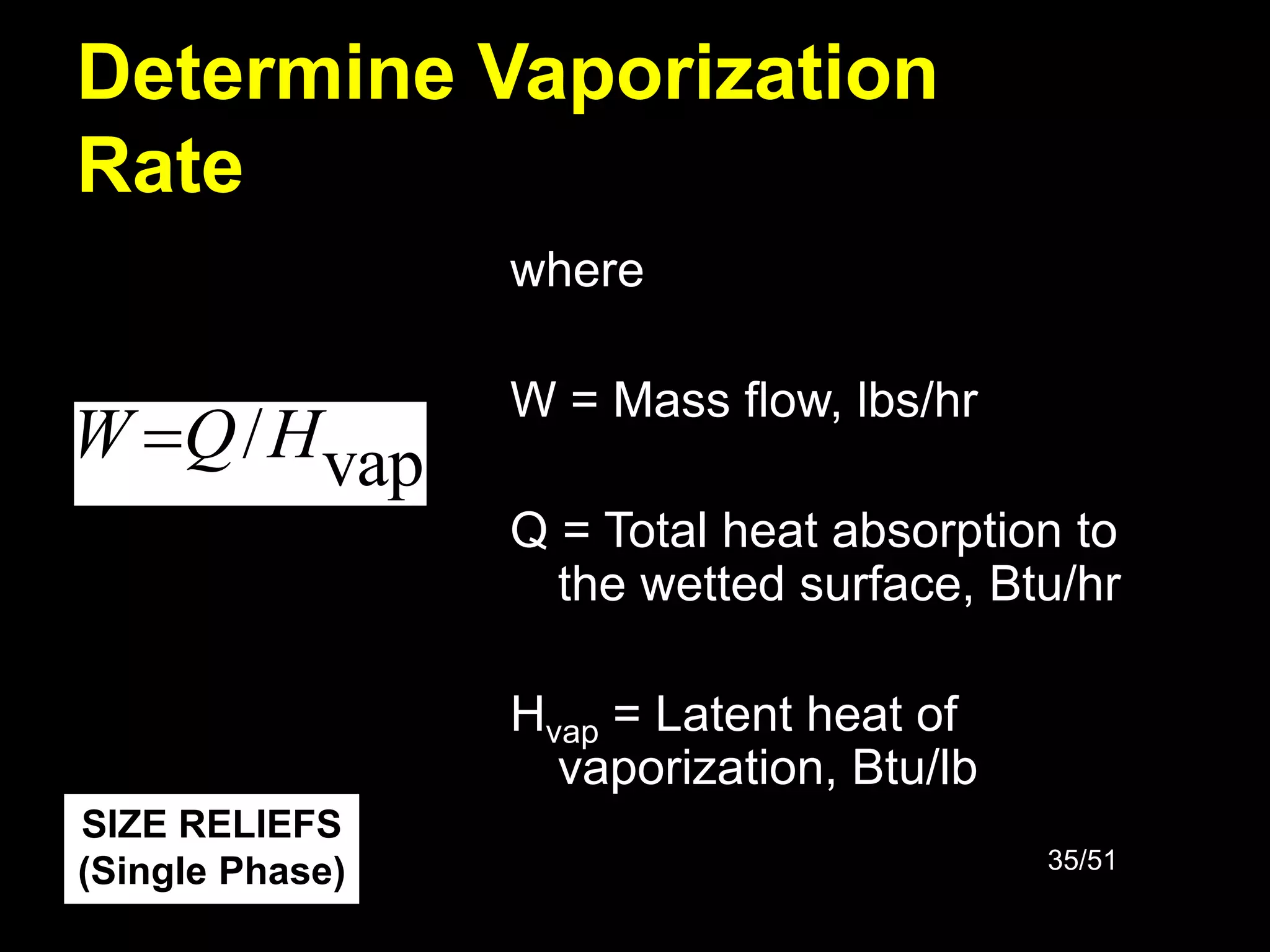
Determine Vaporization
Rate
vap
/H
Q
W 
where
W = Mass flow, lbs/hr
Q = Total heat absorption to
the wetted surface, Btu/hr
Hvap = Latent heat of
vaporization, Btu/lb
SIZE RELIEFS
(Single Phase)
36/51
Determine Relief Vent Area
 Liquid
Service
where
b
s
25
.
1
)
ref
(
b
p
v
o
v
Q
gpm
38.0
2
/
1
)
psi
(
2
in
P
P
K
K
K
C
A















 

 A is the computed relief area (in2)
 Qv is the volumetric flow thru the relief (gpm)
 Co is the discharge coefficient
 Kv is the viscosity correction
 Kp is the overpressure correction
 Kb is the backpressure correction
 (/ref) is the specific gravity of liquid
 Ps is the gauge set pressure (lbf/in2)
 Pb is the gauge backpressure (lbf/in2)
SIZE RELIEFS
(Single Phase)
37/51
Determine Relief Vent Area
 Gas
Service
where
M
Tz
P
K
C
A
b
o
m
Q


 A is the computed relief area (in2)
 Qm is the discharge flow thru the relief (lbm/hr)
 Co is the discharge coefficient
 Kb is the backpressure correction
 T is the absolute temperature of the discharge (°R)
 z is the compressibility factor
 M is average molecular weight of gas (lbm/lb-mol)
 P is maximum absolute discharge pressure (lbf/in2)
  is an isentropic expansion function
SIZE RELIEFS
(Single Phase)
valve
relief
for the
pressure
set
the
is
s
piping
for
s
33
.
1
max
fire
to
exposed
s
for vessel
s
2
.
1
max
vessels
pressure
unfired
for
s
1
.
1
max
7
.
14
max
P
P
P
P
P
P
P
P
P





38/51
Determine Relief Vent Area
 Gas
Service
where
)
1
/(
)
1
(
1
2
5
.
519























  is an isentropic expansion
function
  is heat capacity ratio for the gas
 Units are as described in previous
slide
SIZE RELIEFS
(Single Phase)
39/51
A Special Issue: Chatter
 Spring relief devices require 25-30%
of maximum flow capacity to maintain
the valve seat in the open position
 Lower flows result in chattering,
caused by rapid opening and closing
of the valve disc
 This can lead to destruction of the
device and a dangerous situation
SIZE RELIEFS
(Single Phase)
40/51
Chatter - Principal Causes
 Valve Issues
– Oversized valve
– Valve handling widely differing rates
 Relief System Issues
– Excessive inlet pressure drop
– Excessive built-up back pressure
SIZE RELIEFS
(Single Phase)
41/51
Worst Case Event Scenario
 Worst case for each relief is the event
requiring the largest relief vent area
 Worst cases are a subset of the overall
set of scenarios for each relief
 The identification of the worst-case
scenario frequently affects relief size
more than the accuracy of sizing calcs
CHOOSE
WORST CASE
42/51
Design Relief System
 Relief System is more than a safety
relief valve or rupture disc, it includes:
DESIGN RELIEF
SYSTEM
– Backup relief device(s)
– Line leading to relief device(s)
– Environmental conditioning of relief device
– Discharge piping/headers
– Blowdown drum
– Condenser, flare stack, or scrubber
43/51
Installation, Inspection, and
Maintenance
 To undermine all the good efforts of a
design crew, simply …
1. Improperly install relief devices
2. Fail to regularly inspect relief devices,
or
3. Fail to perform needed/required
maintenance on relief devices
44/51
?? Reduced Inlet Piping
Anything wrong
here?
Reduced
Inlet Piping
45/51
?? Plugged Bellows, Failed
Inspection, Maintenance
Bellows plugged
in spite of sign
Anything wrong
here?
Failed
Inspection
Program
Signs of
Maintenance
Issues
46/51
?? Discharges Pointing
Down
Anything wrong
here?
Anything wrong
here?
Discharges
Pointing Down
47/51
?? Long Moment Arm
Anything wrong
here?
Long
Moment Arm
48/51
?? Will these bolts hold in a
relief event
Anything wrong
here?
Will these
bolts hold
in a
relief event?
49/51
Mexico City Disaster
Major Contributing Cause:
Missing Safety Valve
50/51
Summary
 Pressure Relief
– Very Important ACTIVE safety element
– Connected intimately with Process Hazard
Analysis
– Requires diligence in design, equipment
selection, installation, inspection and
maintenance
 Look forward to …
– Two-phase flow methodology/exercise
51/51
References
 Crowl and Louvar – Chemical Process
Safety, Chapters 8 and 9
 Ostrowski – Fundamentals of Pressure
Relief Devices
 Sterling – Safety Valves: Practical
Design, Practices for Relief, and Valve
Sizing
END OF
PRESENTATION

pressure-relief-safety-valves.ppt

  • 1.
    1/51 Pressure Relief “Grace underpressure” – Ernest Hemingway Harry J. Toups LSU Department of Chemical Engineering with significant material from SACHE 2003 Workshop presentation by Scott Ostrowski (ExxonMobil) and Professor Emeritus Art Sterling
  • 2.
    2/51 What is theHazard?  Despite safety precautions … – Equipment failures – Human error, and – External events, can sometimes lead to …  Increases in process pressures beyond safe levels, potentially resulting in …  OVERPRESSURE due to a RELIEF EVENT
  • 3.
    3/51 What are ReliefEvents?  External fire  Flow from high pressure source  Heat input from associated equipment  Pumps and compressors  Ambient heat transfer  Liquid expansion in pipes and surge
  • 4.
    4/51 Potential Lines ofDefense  Inherently Safe Design  Passive Control  Active Control – Low pressure processes – Install Relief Systems – Overdesign of process equipment
  • 5.
    5/51 What is aRelief System?  A relief device, and  Associated lines and process equipment to safely handle the material ejected
  • 6.
    6/51 Why Use aRelief System?  Inherently Safe Design simply can’t eliminate every pressure hazard  Passive designs can be exceedingly expensive and cumbersome  Relief systems work!
  • 7.
    7/51 Pressure Terminology  MAWP Design pressure  Operating pressure  Set pressure  Overpressure  Accumulation  Blowdown
  • 8.
    8/51 Code Requirements General Coderequirements include: – ASME Boiler & Pressure Vessel Codes – ASME B31.3 / Petroleum Refinery Piping – ASME B16.5 / Flanges & Flanged Fittings
  • 9.
    9/51 Code Requirements Relieving pressureshall not exceed MAWP (accumulation) by more than: – 3% for fired and unfired steam boilers – 10% for vessels equipped with a single pressure relief device – 16% for vessels equipped with multiple pressure relief devices – 21% for fire contingency
  • 10.
    10/51 Relief Design Methodology LOCATE RELIEFS CHOOSE TYPE DEVELOP SCENARIOS SIZERELIEFS (1 or 2 Phase) CHOOSE WORST CASE DESIGN RELIEF SYSTEM
  • 11.
    11/51 Locating Reliefs –Where?  All vessels  Blocked in sections of cool liquid lines that are exposed to heat  Discharge sides of positive displacement pumps, compressors, and turbines  Vessel steam jackets  Where PHA indicates the need LOCATE RELIEFS
  • 12.
    12/51 Choosing Relief Types Spring-Operated Valves  Rupture Devices CHOOSE TYPE
  • 13.
  • 14.
  • 15.
    15/51 Superimposed Back Pressure  Pressurein discharge header before valve opens  Can be constant or variable CHOOSE TYPE
  • 16.
    16/51 Built-up Back Pressure Pressure in discharge header due to frictional losses after valve opens  Total = Superimposed + Built-up CHOOSE TYPE
  • 17.
  • 18.
  • 19.
    19/51 Pros & Cons: ConventionalValve  Advantages + Most reliable type if properly sized and operated + Versatile -- can be used in many services  Disadvantages – Relieving pressure affected by back pressure – Susceptible to chatter if built-up back pressure is too high CHOOSE TYPE
  • 20.
    20/51 Pros & Cons: BalancedBellows Valve  Advantages + Relieving pressure not affected by back pressure + Can handle higher built-up back pressure + Protects spring from corrosion  Disadvantages – Bellows susceptible to fatigue/rupture – May release flammables/toxics to atmosphere – Requires separate venting system CHOOSE TYPE
  • 21.
    21/51 Rupture Devices  RuptureDisc  Rupture Pin CHOOSE TYPE
  • 22.
  • 23.
  • 24.
    24/51 When to Usea Spring- Operated Valve  Losing entire contents is unacceptable – Fluids above normal boiling point – Toxic fluids  Need to avoid failing low  Return to normal operations quickly  Withstand process pressure changes, including vacuum CHOOSE TYPE
  • 25.
    25/51 When to Usea Rupture Disc/Pin  Capital and maintenance savings  Losing the contents is not an issue  Benign service (nontoxic, non- hazardous)  Need for fast-acting device  Potential for relief valve plugging  High viscosity liquids CHOOSE TYPE
  • 26.
    26/51 When to UseBoth Types  Need a positive seal (toxic material, material balance requirements)  Protect safety valve from corrosion  System contains solids CHOOSE TYPE
  • 27.
    27/51 Relief Event Scenarios A description of one specific relief event  Usually each relief has more than one relief event, more than one scenario  Examples include: – Overfilling/overpressuring – Fire – Runaway reaction – Blocked lines with subsequent expansion  Developed through Process Hazard Analysis (PHA) DEVELOP SCENARIOS
  • 28.
    28/51 An Example: BatchReactor  Control valve on nitric acid feed line stuck open, vessel overfills  Steam regulator to jacket fails, vessel overpressures  Coolant system fails, runaway reaction DEVELOP SCENARIOS Product Raw Material Feeds Organic substrate Catalyst Nitric Acid Reactor ~ 100 gallons
  • 29.
    29/51 Sizing Reliefs  Determiningrelief rates  Determine relief vent area SIZE RELIEFS (Single Phase)
  • 30.
    30/51 Scenarios Drive ReliefRates  Overfill (e.g., control valve failure)  Fire  Blocked discharge SIZE RELIEFS (Single Phase) – Maximum flow rate thru valve into vessel – Vaporization rate due to heat-up – Design pump flow rate
  • 31.
    31/51 Overfill Scenario Calcs Determined maximum flow thru valve (i.e., blowthrough)  Liquids:  Gases: SIZE RELIEFS (Single Phase) P g A C Q   c v m 2 ) 1 /( ) 1 ( 1 2 o g c o v choked m                             T R M g AP C Q
  • 32.
    32/51 Fire Scenario Calcs API 520 gives all equations for calculating fire relief rate, step-by-step 1. Determine the total wetted surface area 2. Determine the total heat absorption 3. Determine the rate of vapor or gas vaporized from the liquid SIZE RELIEFS (Single Phase)
  • 33.
    33/51 Determine Wetted Area SIZERELIEFS (Single Phase)                                      180 / wet B D L E D A                 D E B 2 1 cos 1
  • 34.
    34/51 Determine Heat Absorption Prompt fire-fighting & adequate drainage:  Otherwise: where SIZE RELIEFS (Single Phase) 82 . 0 wet 000 , 21 Btu/hr            A F Q 82 . 0 wet 500 , 34 Btu/hr            A F Q Q is the heat absorption (Btu/hr) F is the environmental factor – 1.0 for a bare vessel – Smaller values for insulated vessels Awet is the wetted surface area (ft2)
  • 35.
    35/51 Determine Vaporization Rate vap /H Q W  where W= Mass flow, lbs/hr Q = Total heat absorption to the wetted surface, Btu/hr Hvap = Latent heat of vaporization, Btu/lb SIZE RELIEFS (Single Phase)
  • 36.
    36/51 Determine Relief VentArea  Liquid Service where b s 25 . 1 ) ref ( b p v o v Q gpm 38.0 2 / 1 ) psi ( 2 in P P K K K C A                    A is the computed relief area (in2)  Qv is the volumetric flow thru the relief (gpm)  Co is the discharge coefficient  Kv is the viscosity correction  Kp is the overpressure correction  Kb is the backpressure correction  (/ref) is the specific gravity of liquid  Ps is the gauge set pressure (lbf/in2)  Pb is the gauge backpressure (lbf/in2) SIZE RELIEFS (Single Phase)
  • 37.
    37/51 Determine Relief VentArea  Gas Service where M Tz P K C A b o m Q    A is the computed relief area (in2)  Qm is the discharge flow thru the relief (lbm/hr)  Co is the discharge coefficient  Kb is the backpressure correction  T is the absolute temperature of the discharge (°R)  z is the compressibility factor  M is average molecular weight of gas (lbm/lb-mol)  P is maximum absolute discharge pressure (lbf/in2)   is an isentropic expansion function SIZE RELIEFS (Single Phase) valve relief for the pressure set the is s piping for s 33 . 1 max fire to exposed s for vessel s 2 . 1 max vessels pressure unfired for s 1 . 1 max 7 . 14 max P P P P P P P P P     
  • 38.
    38/51 Determine Relief VentArea  Gas Service where ) 1 /( ) 1 ( 1 2 5 . 519                          is an isentropic expansion function   is heat capacity ratio for the gas  Units are as described in previous slide SIZE RELIEFS (Single Phase)
  • 39.
    39/51 A Special Issue:Chatter  Spring relief devices require 25-30% of maximum flow capacity to maintain the valve seat in the open position  Lower flows result in chattering, caused by rapid opening and closing of the valve disc  This can lead to destruction of the device and a dangerous situation SIZE RELIEFS (Single Phase)
  • 40.
    40/51 Chatter - PrincipalCauses  Valve Issues – Oversized valve – Valve handling widely differing rates  Relief System Issues – Excessive inlet pressure drop – Excessive built-up back pressure SIZE RELIEFS (Single Phase)
  • 41.
    41/51 Worst Case EventScenario  Worst case for each relief is the event requiring the largest relief vent area  Worst cases are a subset of the overall set of scenarios for each relief  The identification of the worst-case scenario frequently affects relief size more than the accuracy of sizing calcs CHOOSE WORST CASE
  • 42.
    42/51 Design Relief System Relief System is more than a safety relief valve or rupture disc, it includes: DESIGN RELIEF SYSTEM – Backup relief device(s) – Line leading to relief device(s) – Environmental conditioning of relief device – Discharge piping/headers – Blowdown drum – Condenser, flare stack, or scrubber
  • 43.
    43/51 Installation, Inspection, and Maintenance To undermine all the good efforts of a design crew, simply … 1. Improperly install relief devices 2. Fail to regularly inspect relief devices, or 3. Fail to perform needed/required maintenance on relief devices
  • 44.
    44/51 ?? Reduced InletPiping Anything wrong here? Reduced Inlet Piping
  • 45.
    45/51 ?? Plugged Bellows,Failed Inspection, Maintenance Bellows plugged in spite of sign Anything wrong here? Failed Inspection Program Signs of Maintenance Issues
  • 46.
    46/51 ?? Discharges Pointing Down Anythingwrong here? Anything wrong here? Discharges Pointing Down
  • 47.
    47/51 ?? Long MomentArm Anything wrong here? Long Moment Arm
  • 48.
    48/51 ?? Will thesebolts hold in a relief event Anything wrong here? Will these bolts hold in a relief event?
  • 49.
    49/51 Mexico City Disaster MajorContributing Cause: Missing Safety Valve
  • 50.
    50/51 Summary  Pressure Relief –Very Important ACTIVE safety element – Connected intimately with Process Hazard Analysis – Requires diligence in design, equipment selection, installation, inspection and maintenance  Look forward to … – Two-phase flow methodology/exercise
  • 51.
    51/51 References  Crowl andLouvar – Chemical Process Safety, Chapters 8 and 9  Ostrowski – Fundamentals of Pressure Relief Devices  Sterling – Safety Valves: Practical Design, Practices for Relief, and Valve Sizing
  • 52.