TRANSFER MACHINES 
Combination of individual machines or machining 
heads arranged in the required sequence, 
connected by work transfer devices and integrated 
with interlocking controls. 
Transfer machines permit the maximum number of 
operations to be performed on workpieces at a 
maximum production rate. 
1 11/27/2014
FEATURES 
Parts are indexed in a straight line or circle from 
station to station. 
At each station required operations are performed 
simultaneously. 
Loading and unloading, either manually or 
automatically, occurs at each end of the line. 
When the component reaches the end of the line, all 
necessary operations have been completed. 
2 11/27/2014
Operations done on 
Transfer Machines 
 All types of machining operations such as 
drilling, boring, reaming, tapping and milling 
are economically combined on transfer 
machines. 
 Lathe type operations such as turning and 
facing are performed by rotating the work-pieces 
on selected work stations. 
3 11/27/2014
Types Of Transfer 
Machines 
The transfer machines are classified according to 
the arrangement of work stations. 
 In-line transfer machines 
 Rotary indexing table transfer machines 
 Drum type transfer machines 
4 11/27/2014
In-line Transfer 
Machines 
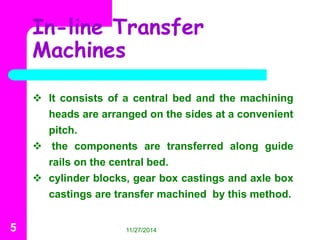
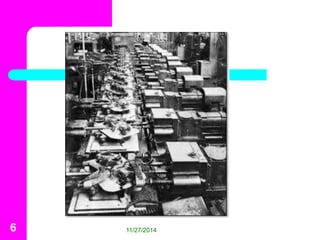
 It consists of a central bed and the machining 
heads are arranged on the sides at a convenient 
pitch. 
 the components are transferred along guide 
rails on the central bed. 
 cylinder blocks, gear box castings and axle box 
castings are transfer machined by this method. 
5 11/27/2014
6 11/27/2014
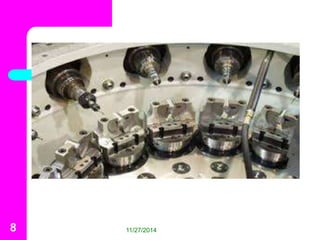
Rotary Indexing Table 
Transfer Machines 
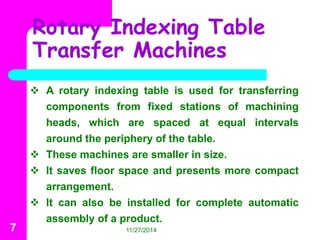
 A rotary indexing table is used for transferring 
components from fixed stations of machining 
heads, which are spaced at equal intervals 
around the periphery of the table. 
 These machines are smaller in size. 
 It saves floor space and presents more compact 
arrangement. 
 It can also be installed for complete automatic 
assembly of a product. 
7 11/27/2014
8 11/27/2014
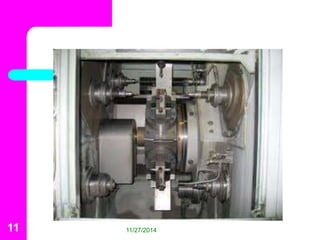
Drum Type Transfer 
Machines 
 Like rotary table type, this machine also transfers 
the components in a circular path to workstations 
positioned around at equal distances. 
 This machine instead of having a table has got a 
drum which rotates about a horizontal axis. 
 The work fixtures are fixed around the periphery 
of the drum. 
9 11/27/2014
Limitations 
 Lower station remains idle due to limitations 
of space. 
 Work at the lower station is always hanging, 
therefore needs firm clamping. 
 The drum size is limited. 
10 11/27/2014
11 11/27/2014
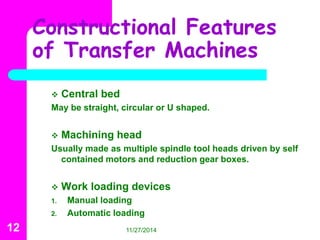
Constructional Features 
of Transfer Machines 
 Central bed 
May be straight, circular or U shaped. 
 Machining head 
Usually made as multiple spindle tool heads driven by self 
contained motors and reduction gear boxes. 
 Work loading devices 
1. Manual loading 
2. Automatic loading 
12 11/27/2014
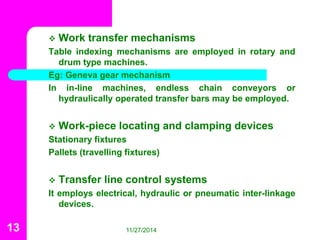
 Work transfer mechanisms 
Table indexing mechanisms are employed in rotary and 
drum type machines. 
Eg: Geneva gear mechanism 
In in-line machines, endless chain conveyors or 
hydraulically operated transfer bars may be employed. 
 Work-piece locating and clamping devices 
Stationary fixtures 
Pallets (travelling fixtures) 
 Transfer line control systems 
It employs electrical, hydraulic or pneumatic inter-linkage 
devices. 
13 11/27/2014
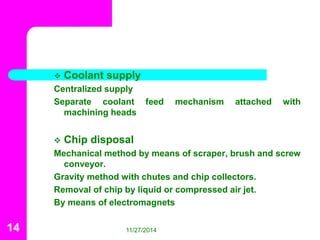
 Coolant supply 
Centralized supply 
Separate coolant feed mechanism attached with 
machining heads 
 Chip disposal 
Mechanical method by means of scraper, brush and screw 
conveyor. 
Gravity method with chutes and chip collectors. 
Removal of chip by liquid or compressed air jet. 
By means of electromagnets 
14 11/27/2014
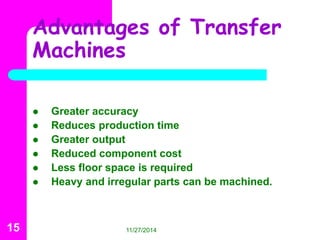
Advantages of Transfer 
Machines 
 Greater accuracy 
 Reduces production time 
 Greater output 
 Reduced component cost 
 Less floor space is required 
 Heavy and irregular parts can be machined. 
15 11/27/2014
Disadvantages 
 Initial cost is high. 
 Break-down of even one machine stops the 
operation of the entire transfer line. 
 Control systems are complex. 
 High skills are required for initial settings. 
 Lack of flexibility. 
16 11/27/2014
17 11/27/2014
THANK 
YOU 
11/27/2014 18

Transfer machines

  • 1.
    TRANSFER MACHINES Combinationof individual machines or machining heads arranged in the required sequence, connected by work transfer devices and integrated with interlocking controls. Transfer machines permit the maximum number of operations to be performed on workpieces at a maximum production rate. 1 11/27/2014
  • 2.
    FEATURES Parts areindexed in a straight line or circle from station to station. At each station required operations are performed simultaneously. Loading and unloading, either manually or automatically, occurs at each end of the line. When the component reaches the end of the line, all necessary operations have been completed. 2 11/27/2014
  • 3.
    Operations done on Transfer Machines  All types of machining operations such as drilling, boring, reaming, tapping and milling are economically combined on transfer machines.  Lathe type operations such as turning and facing are performed by rotating the work-pieces on selected work stations. 3 11/27/2014
  • 4.
    Types Of Transfer Machines The transfer machines are classified according to the arrangement of work stations.  In-line transfer machines  Rotary indexing table transfer machines  Drum type transfer machines 4 11/27/2014
  • 5.
    In-line Transfer Machines  It consists of a central bed and the machining heads are arranged on the sides at a convenient pitch.  the components are transferred along guide rails on the central bed.  cylinder blocks, gear box castings and axle box castings are transfer machined by this method. 5 11/27/2014
  • 6.
  • 7.
    Rotary Indexing Table Transfer Machines  A rotary indexing table is used for transferring components from fixed stations of machining heads, which are spaced at equal intervals around the periphery of the table.  These machines are smaller in size.  It saves floor space and presents more compact arrangement.  It can also be installed for complete automatic assembly of a product. 7 11/27/2014
  • 8.
  • 9.
    Drum Type Transfer Machines  Like rotary table type, this machine also transfers the components in a circular path to workstations positioned around at equal distances.  This machine instead of having a table has got a drum which rotates about a horizontal axis.  The work fixtures are fixed around the periphery of the drum. 9 11/27/2014
  • 10.
    Limitations  Lowerstation remains idle due to limitations of space.  Work at the lower station is always hanging, therefore needs firm clamping.  The drum size is limited. 10 11/27/2014
  • 11.
  • 12.
    Constructional Features ofTransfer Machines  Central bed May be straight, circular or U shaped.  Machining head Usually made as multiple spindle tool heads driven by self contained motors and reduction gear boxes.  Work loading devices 1. Manual loading 2. Automatic loading 12 11/27/2014
  • 13.
     Work transfermechanisms Table indexing mechanisms are employed in rotary and drum type machines. Eg: Geneva gear mechanism In in-line machines, endless chain conveyors or hydraulically operated transfer bars may be employed.  Work-piece locating and clamping devices Stationary fixtures Pallets (travelling fixtures)  Transfer line control systems It employs electrical, hydraulic or pneumatic inter-linkage devices. 13 11/27/2014
  • 14.
     Coolant supply Centralized supply Separate coolant feed mechanism attached with machining heads  Chip disposal Mechanical method by means of scraper, brush and screw conveyor. Gravity method with chutes and chip collectors. Removal of chip by liquid or compressed air jet. By means of electromagnets 14 11/27/2014
  • 15.
    Advantages of Transfer Machines  Greater accuracy  Reduces production time  Greater output  Reduced component cost  Less floor space is required  Heavy and irregular parts can be machined. 15 11/27/2014
  • 16.
    Disadvantages  Initialcost is high.  Break-down of even one machine stops the operation of the entire transfer line.  Control systems are complex.  High skills are required for initial settings.  Lack of flexibility. 16 11/27/2014
  • 17.
  • 18.

Editor's Notes