Forging & Press
Working
Presented by :
NILESH KABRA
SUBJECTS OF INTREST
FORGING & PRESS WORKING 2
• INTRODUCTION TO FORGING
• CLASSIFICATION OF FORGING
 OPEN DIE FORGING
 CLOSED DIE FORGING
 DROP FORGING
 HAMMER FORGING
 PRESS FORGING
 MACHINE FORGING
• FORGING TOOLS
• FORGING OPERATIONS
• INTRODUCTION TO PRESS WORK
• PRESS
• CLASSIFICATION OF PRESS
• PRESS WORKING OPERATIONS
 CUTTING OPERATIONS
 FORMING OPERATIONS
INTRODUCTION
FORGING & PRESS WORKING 3
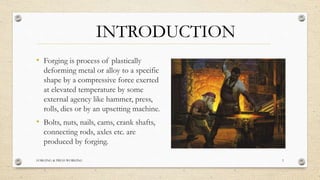
• Forging is process of plastically
deforming metal or alloy to a specific
shape by a compressive force exerted
at elevated temperature by some
external agency like hammer, press,
rolls, dies or by an upsetting machine.
• Bolts, nuts, nails, cams, crank shafts,
connecting rods, axles etc. are
produced by forging.
CLASSIFICATION OF FORGING
FORGING & PRESS WORKING 4
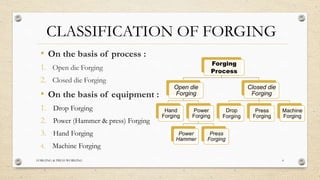
• On the basis of process :
1. Open die Forging
2. Closed die Forging
• On the basis of equipment :
1. Drop Forging
2. Power (Hammer & press) Forging
3. Hand Forging
4. Machine Forging
Forging
Process
Open die
Forging
Hand
Forging
Power
Forging
Power
Hammer
Press
Forging
Closed die
Forging
Drop
Forging
Press
Forging
Machine
Forging
OPEN DIE FORGING
FORGING & PRESS WORKING 5
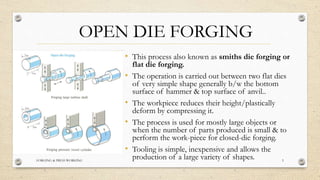
• This process also known as smiths die forging or
flat die forging.
• The operation is carried out between two flat dies
of very simple shape generally b/w the bottom
surface of hammer & top surface of anvil..
• The workpiece reduces their height/plastically
deform by compressing it.
• The process is used for mostly large objects or
when the number of parts produced is small & to
perform the work-piece for closed-die forging.
• Tooling is simple, inexpensive and allows the
production of a large variety of shapes.
CLOSED DIE FORGING
FORGING & PRESS WORKING 6
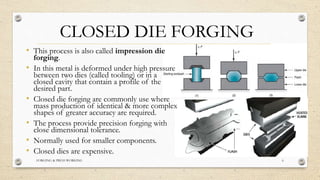
• This process is also called impression die
forging.
• In this metal is deformed under high pressure
between two dies (called tooling) or in a
closed cavity that contain a profile of the
desired part.
• Closed die forging are commonly use where
mass production of identical & more complex
shapes of greater accuracy are required.
• The process provide precision forging with
close dimensional tolerance.
• Normally used for smaller components.
• Closed dies are expensive.
DROP FORGING
FORGING & PRESS WORKING 7
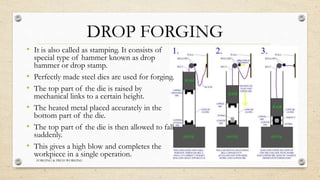
• It is also called as stamping. It consists of
special type of hammer known as drop
hammer or drop stamp.
• Perfectly made steel dies are used for forging.
• The top part of the die is raised by
mechanical links to a certain height.
• The heated metal placed accurately in the
bottom part of the die.
• The top part of the die is then allowed to fall
suddenly.
• This gives a high blow and completes the
workpiece in a single operation.
HAMMER FORGING
FORGING & PRESS WORKING 8
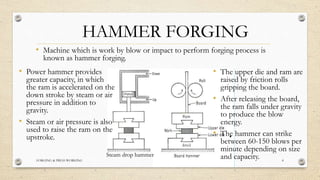
• Machine which is work by blow or impact to perform forging process is
known as hammer forging.
Steam drop hammer
•
• Power hammer provides
greater capacity, in which
the ram is accelerated on the
down stroke by steam or air
pressure in addition to
gravity.
• Steam or air pressure is also
used to raise the ram on the
upstroke.
• The upper die and ram are
raised by friction rolls
gripping the board.
• After releasing the board,
the ram falls under gravity
to produce the blow
energy.
• The hammer can strike
between 60-150 blows per
minute depending on size
and capacity.
PRESS FORGING
FORGING & PRESS WORKING 9
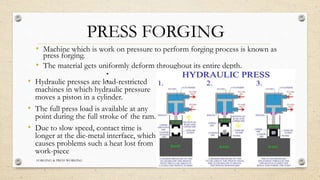
• Machine which is work on pressure to perform forging process is known as
press forging.
• The material gets uniformly deform throughout its entire depth.
•
• Hydraulic presses are load-restricted
machines in which hydraulic pressure
moves a piston in a cylinder.
• The full press load is available at any
point during the full stroke of the ram.
• Due to slow speed, contact time is
longer at the die-metal interface, which
causes problems such a heat lost from
work-piece
• The upper die and
•
•
FORGING & PRESS WORKING 10
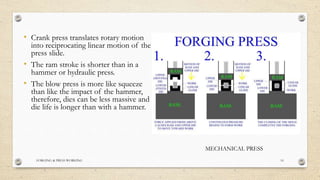
• Crank press translates rotary motion
into reciprocating linear motion of the
press slide.
• The ram stroke is shorter than in a
hammer or hydraulic press.
• The blow press is more like squeeze
than like the impact of the hammer,
therefore, dies can be less massive and
die life is longer than with a hammer.
MECHANICAL PRESS
MACHINE FORGING
FORGING & PRESS WORKING 11
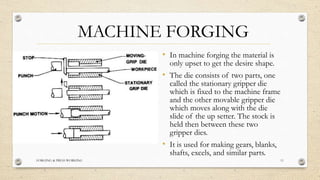
• In machine forging the material is
only upset to get the desire shape.
• The die consists of two parts, one
called the stationary gripper die
which is fixed to the machine frame
and the other movable gripper die
which moves along with the die
slide of the up setter. The stock is
held then between these two
gripper dies.
• It is used for making gears, blanks,
shafts, excels, and similar parts.
FORGING TOOLS
FORGING & PRESS WORKING 12
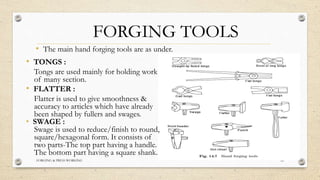
• The main hand forging tools are as under.
• TONGS :
Tongs are used mainly for holding work
of many section.
• FLATTER :
Flatter is used to give smoothness &
accuracy to articles which have already
been shaped by fullers and swages.
• SWAGE :
Swage is used to reduce/finish to round,
square/hexagonal form. It consists of
two parts-The top part having a handle.
The bottom part having a square shank.
FORGING & PRESS WORKING 13FORGING & PRESS WORKING 13
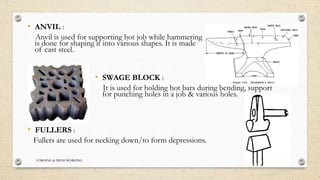
• ANVIL :
Anvil is used for supporting hot job while hammering
is done for shaping it into various shapes. It is made
of cast steel.
• SWAGE BLOCK :
It is used for holding hot bars during bending, support
for punching holes in a job & various holes.
• FULLERS :
Fullers are used for necking down/to form depressions.
FORGING TOOLS
FORGING & PRESS WORKING 14
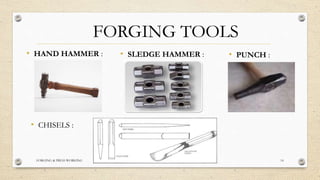
• HAND HAMMER : • SLEDGE HAMMER : • PUNCH :
• CHISELS :
FORGING OPERATIONS
FORGING & PRESS WORKING 15
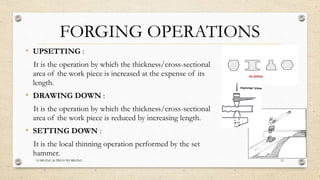
• UPSETTING :
It is the operation by which the thickness/cross-sectional
area of the work piece is increased at the expense of its
length.
• DRAWING DOWN :
It is the operation by which the thickness/cross-sectional
area of the work piece is reduced by increasing length.
• SETTING DOWN :
It is the local thinning operation performed by the set
hammer.
FORGING & PRESS WORKING 16
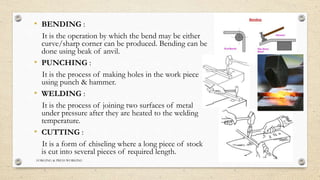
• BENDING :
It is the operation by which the bend may be either
curve/sharp corner can be produced. Bending can be
done using beak of anvil.
• PUNCHING :
It is the process of making holes in the work piece
using punch & hammer.
• WELDING :
It is the process of joining two surfaces of metal
under pressure after they are heated to the welding
temperature.
• CUTTING :
It is a form of chiseling where a long piece of stock
is cut into several pieces of required length.
INTRODUCTION TO PRESS WORKING
FORGING & PRESS WORKING 17
• Press working is a chip-less manufacturing process by which various
components are made from sheet metals. It involves the working of a sheet
between two die. In press working, the upper die is called a punch. This
process is also termed as cold stamping.
• The machine used for press working is called a Press. Press is a machine in
which there are two or more slides, which move relatively to compress the
material in the desired shape.
PRESS
FORGING & PRESS WORKING 18
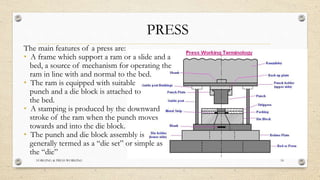
The main features of a press are:
• A frame which support a ram or a slide and a
bed, a source of mechanism for operating the
ram in line with and normal to the bed.
• The ram is equipped with suitable
punch and a die block is attached to
the bed.
• A stamping is produced by the downward
stroke of the ram when the punch moves
towards and into the die block.
• The punch and die block assembly is
generally termed as a “die set” or simple as
the “die”
CLASSIFICATION OF PRESS
FORGING & PRESS WORKING 19
Different types of presses are classified based on:
• Source of power :
Mechanical, Electrical, Hydraulic, Pneumatic etcetera
• Number of RAM :
Single, Double, Multiple.
• Method of transmitting power to RAM :
Crank-shaft, Eccentric, Cam type or rack and Pinion type.
• Design of frame :
Solid frame, C Frame, Movable frame, Tie rod etcetera.
• They are also classified based on the purpose and end usage.
PRESS WORKING OPERATIONS
FORGING & PRESS WORKING 20
The sheet metal operations done a press may be grouped into two categories.
• Cutting operations
• Forming operations
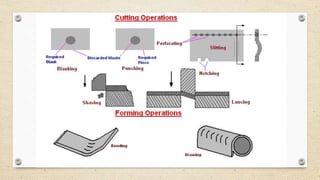
In cutting operations the work piece is stressed by its ultimate strength. The stresses
caused in the metal the applied forces will be shear stresses. The cutting operations
include:
(a) Blanking (b) Punching (c) Notching (d) Perforating
(e) Trimming (f) Shaving (g) Slitting (h) Lancing
In forming operations , the stresses are below the ultimate strength of the metal
.There is no cutting of the metal but only the contour of the work piece is changed
to get the desired product. The forming operations include:
(a) Bending (b) Drawing (c) Squeezing
FORGING & PRESS WORKING 21
CUTTING OPERATIONS
FORGING & PRESS WORKING 22
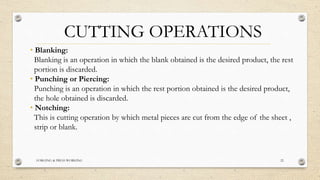
• Blanking:
Blanking is an operation in which the blank obtained is the desired product, the rest
portion is discarded.
• Punching or Piercing:
Punching is an operation in which the rest portion obtained is the desired product,
the hole obtained is discarded.
• Notching:
This is cutting operation by which metal pieces are cut from the edge of the sheet ,
strip or blank.
FORGING & PRESS WORKING 23
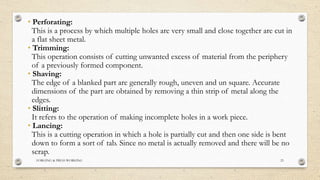
• Perforating:
This is a process by which multiple holes are very small and close together are cut in
a flat sheet metal.
• Trimming:
This operation consists of cutting unwanted excess of material from the periphery
of a previously formed component.
• Shaving:
The edge of a blanked part are generally rough, uneven and un square. Accurate
dimensions of the part are obtained by removing a thin strip of metal along the
edges.
• Slitting:
It refers to the operation of making incomplete holes in a work piece.
• Lancing:
This is a cutting operation in which a hole is partially cut and then one side is bent
down to form a sort of tab. Since no metal is actually removed and there will be no
scrap.
FORMING OPERATIONS
FORGING & PRESS WORKING 24
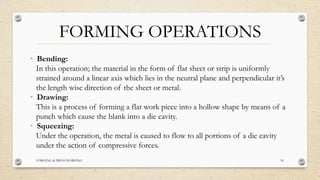
• Bending:
In this operation; the material in the form of flat sheet or strip is uniformly
strained around a linear axis which lies in the neutral plane and perpendicular it’s
the length wise direction of the sheet or metal.
• Drawing:
This is a process of forming a flat work piece into a hollow shape by means of a
punch which cause the blank into a die cavity.
• Squeezing:
Under the operation, the metal is caused to flow to all portions of a die cavity
under the action of compressive forces.
THANK YOU!!
FOR YOUR KIND ATTENTION

Forging & Press Working

  • 1.
  • 2.
    SUBJECTS OF INTREST FORGING& PRESS WORKING 2 • INTRODUCTION TO FORGING • CLASSIFICATION OF FORGING  OPEN DIE FORGING  CLOSED DIE FORGING  DROP FORGING  HAMMER FORGING  PRESS FORGING  MACHINE FORGING • FORGING TOOLS • FORGING OPERATIONS • INTRODUCTION TO PRESS WORK • PRESS • CLASSIFICATION OF PRESS • PRESS WORKING OPERATIONS  CUTTING OPERATIONS  FORMING OPERATIONS
  • 3.
    INTRODUCTION FORGING & PRESSWORKING 3 • Forging is process of plastically deforming metal or alloy to a specific shape by a compressive force exerted at elevated temperature by some external agency like hammer, press, rolls, dies or by an upsetting machine. • Bolts, nuts, nails, cams, crank shafts, connecting rods, axles etc. are produced by forging.
  • 4.
    CLASSIFICATION OF FORGING FORGING& PRESS WORKING 4 • On the basis of process : 1. Open die Forging 2. Closed die Forging • On the basis of equipment : 1. Drop Forging 2. Power (Hammer & press) Forging 3. Hand Forging 4. Machine Forging Forging Process Open die Forging Hand Forging Power Forging Power Hammer Press Forging Closed die Forging Drop Forging Press Forging Machine Forging
  • 5.
    OPEN DIE FORGING FORGING& PRESS WORKING 5 • This process also known as smiths die forging or flat die forging. • The operation is carried out between two flat dies of very simple shape generally b/w the bottom surface of hammer & top surface of anvil.. • The workpiece reduces their height/plastically deform by compressing it. • The process is used for mostly large objects or when the number of parts produced is small & to perform the work-piece for closed-die forging. • Tooling is simple, inexpensive and allows the production of a large variety of shapes.
  • 6.
    CLOSED DIE FORGING FORGING& PRESS WORKING 6 • This process is also called impression die forging. • In this metal is deformed under high pressure between two dies (called tooling) or in a closed cavity that contain a profile of the desired part. • Closed die forging are commonly use where mass production of identical & more complex shapes of greater accuracy are required. • The process provide precision forging with close dimensional tolerance. • Normally used for smaller components. • Closed dies are expensive.
  • 7.
    DROP FORGING FORGING &PRESS WORKING 7 • It is also called as stamping. It consists of special type of hammer known as drop hammer or drop stamp. • Perfectly made steel dies are used for forging. • The top part of the die is raised by mechanical links to a certain height. • The heated metal placed accurately in the bottom part of the die. • The top part of the die is then allowed to fall suddenly. • This gives a high blow and completes the workpiece in a single operation.
  • 8.
    HAMMER FORGING FORGING &PRESS WORKING 8 • Machine which is work by blow or impact to perform forging process is known as hammer forging. Steam drop hammer • • Power hammer provides greater capacity, in which the ram is accelerated on the down stroke by steam or air pressure in addition to gravity. • Steam or air pressure is also used to raise the ram on the upstroke. • The upper die and ram are raised by friction rolls gripping the board. • After releasing the board, the ram falls under gravity to produce the blow energy. • The hammer can strike between 60-150 blows per minute depending on size and capacity.
  • 9.
    PRESS FORGING FORGING &PRESS WORKING 9 • Machine which is work on pressure to perform forging process is known as press forging. • The material gets uniformly deform throughout its entire depth. • • Hydraulic presses are load-restricted machines in which hydraulic pressure moves a piston in a cylinder. • The full press load is available at any point during the full stroke of the ram. • Due to slow speed, contact time is longer at the die-metal interface, which causes problems such a heat lost from work-piece • The upper die and • •
  • 10.
    FORGING & PRESSWORKING 10 • Crank press translates rotary motion into reciprocating linear motion of the press slide. • The ram stroke is shorter than in a hammer or hydraulic press. • The blow press is more like squeeze than like the impact of the hammer, therefore, dies can be less massive and die life is longer than with a hammer. MECHANICAL PRESS
  • 11.
    MACHINE FORGING FORGING &PRESS WORKING 11 • In machine forging the material is only upset to get the desire shape. • The die consists of two parts, one called the stationary gripper die which is fixed to the machine frame and the other movable gripper die which moves along with the die slide of the up setter. The stock is held then between these two gripper dies. • It is used for making gears, blanks, shafts, excels, and similar parts.
  • 12.
    FORGING TOOLS FORGING &PRESS WORKING 12 • The main hand forging tools are as under. • TONGS : Tongs are used mainly for holding work of many section. • FLATTER : Flatter is used to give smoothness & accuracy to articles which have already been shaped by fullers and swages. • SWAGE : Swage is used to reduce/finish to round, square/hexagonal form. It consists of two parts-The top part having a handle. The bottom part having a square shank.
  • 13.
    FORGING & PRESSWORKING 13FORGING & PRESS WORKING 13 • ANVIL : Anvil is used for supporting hot job while hammering is done for shaping it into various shapes. It is made of cast steel. • SWAGE BLOCK : It is used for holding hot bars during bending, support for punching holes in a job & various holes. • FULLERS : Fullers are used for necking down/to form depressions.
  • 14.
    FORGING TOOLS FORGING &PRESS WORKING 14 • HAND HAMMER : • SLEDGE HAMMER : • PUNCH : • CHISELS :
  • 15.
    FORGING OPERATIONS FORGING &PRESS WORKING 15 • UPSETTING : It is the operation by which the thickness/cross-sectional area of the work piece is increased at the expense of its length. • DRAWING DOWN : It is the operation by which the thickness/cross-sectional area of the work piece is reduced by increasing length. • SETTING DOWN : It is the local thinning operation performed by the set hammer.
  • 16.
    FORGING & PRESSWORKING 16 • BENDING : It is the operation by which the bend may be either curve/sharp corner can be produced. Bending can be done using beak of anvil. • PUNCHING : It is the process of making holes in the work piece using punch & hammer. • WELDING : It is the process of joining two surfaces of metal under pressure after they are heated to the welding temperature. • CUTTING : It is a form of chiseling where a long piece of stock is cut into several pieces of required length.
  • 17.
    INTRODUCTION TO PRESSWORKING FORGING & PRESS WORKING 17 • Press working is a chip-less manufacturing process by which various components are made from sheet metals. It involves the working of a sheet between two die. In press working, the upper die is called a punch. This process is also termed as cold stamping. • The machine used for press working is called a Press. Press is a machine in which there are two or more slides, which move relatively to compress the material in the desired shape.
  • 18.
    PRESS FORGING & PRESSWORKING 18 The main features of a press are: • A frame which support a ram or a slide and a bed, a source of mechanism for operating the ram in line with and normal to the bed. • The ram is equipped with suitable punch and a die block is attached to the bed. • A stamping is produced by the downward stroke of the ram when the punch moves towards and into the die block. • The punch and die block assembly is generally termed as a “die set” or simple as the “die”
  • 19.
    CLASSIFICATION OF PRESS FORGING& PRESS WORKING 19 Different types of presses are classified based on: • Source of power : Mechanical, Electrical, Hydraulic, Pneumatic etcetera • Number of RAM : Single, Double, Multiple. • Method of transmitting power to RAM : Crank-shaft, Eccentric, Cam type or rack and Pinion type. • Design of frame : Solid frame, C Frame, Movable frame, Tie rod etcetera. • They are also classified based on the purpose and end usage.
  • 20.
    PRESS WORKING OPERATIONS FORGING& PRESS WORKING 20 The sheet metal operations done a press may be grouped into two categories. • Cutting operations • Forming operations In cutting operations the work piece is stressed by its ultimate strength. The stresses caused in the metal the applied forces will be shear stresses. The cutting operations include: (a) Blanking (b) Punching (c) Notching (d) Perforating (e) Trimming (f) Shaving (g) Slitting (h) Lancing In forming operations , the stresses are below the ultimate strength of the metal .There is no cutting of the metal but only the contour of the work piece is changed to get the desired product. The forming operations include: (a) Bending (b) Drawing (c) Squeezing
  • 21.
    FORGING & PRESSWORKING 21
  • 22.
    CUTTING OPERATIONS FORGING &PRESS WORKING 22 • Blanking: Blanking is an operation in which the blank obtained is the desired product, the rest portion is discarded. • Punching or Piercing: Punching is an operation in which the rest portion obtained is the desired product, the hole obtained is discarded. • Notching: This is cutting operation by which metal pieces are cut from the edge of the sheet , strip or blank.
  • 23.
    FORGING & PRESSWORKING 23 • Perforating: This is a process by which multiple holes are very small and close together are cut in a flat sheet metal. • Trimming: This operation consists of cutting unwanted excess of material from the periphery of a previously formed component. • Shaving: The edge of a blanked part are generally rough, uneven and un square. Accurate dimensions of the part are obtained by removing a thin strip of metal along the edges. • Slitting: It refers to the operation of making incomplete holes in a work piece. • Lancing: This is a cutting operation in which a hole is partially cut and then one side is bent down to form a sort of tab. Since no metal is actually removed and there will be no scrap.
  • 24.
    FORMING OPERATIONS FORGING &PRESS WORKING 24 • Bending: In this operation; the material in the form of flat sheet or strip is uniformly strained around a linear axis which lies in the neutral plane and perpendicular it’s the length wise direction of the sheet or metal. • Drawing: This is a process of forming a flat work piece into a hollow shape by means of a punch which cause the blank into a die cavity. • Squeezing: Under the operation, the metal is caused to flow to all portions of a die cavity under the action of compressive forces.
  • 25.
    THANK YOU!! FOR YOURKIND ATTENTION