IT PROJECT
MANAGEMENT
Learning
Outcomes
Project and Project Management
Project Management Scope
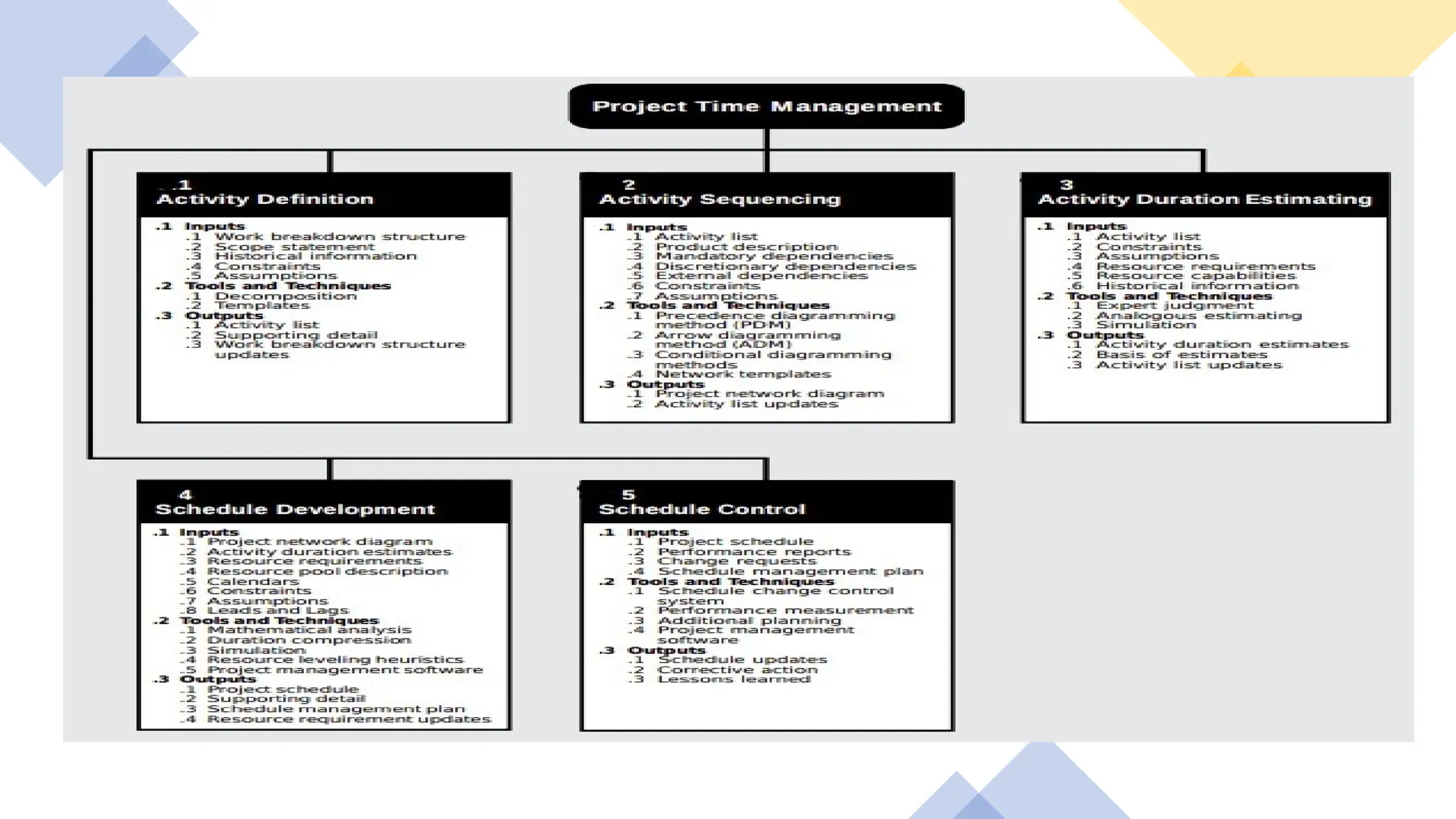
Project Time management
Project Cost Management
Agile Project Management
Project Management
Career Projections
By 2027, employers will need
88 million people in project
related roles
Advantages of Project Management
• Improved customer relations
• Better internal coordination
• Positive impact on meeting strategic goals
• Better control of financial, physical, and human resources
• Lower costs and improved productivity
• Higher profit margins
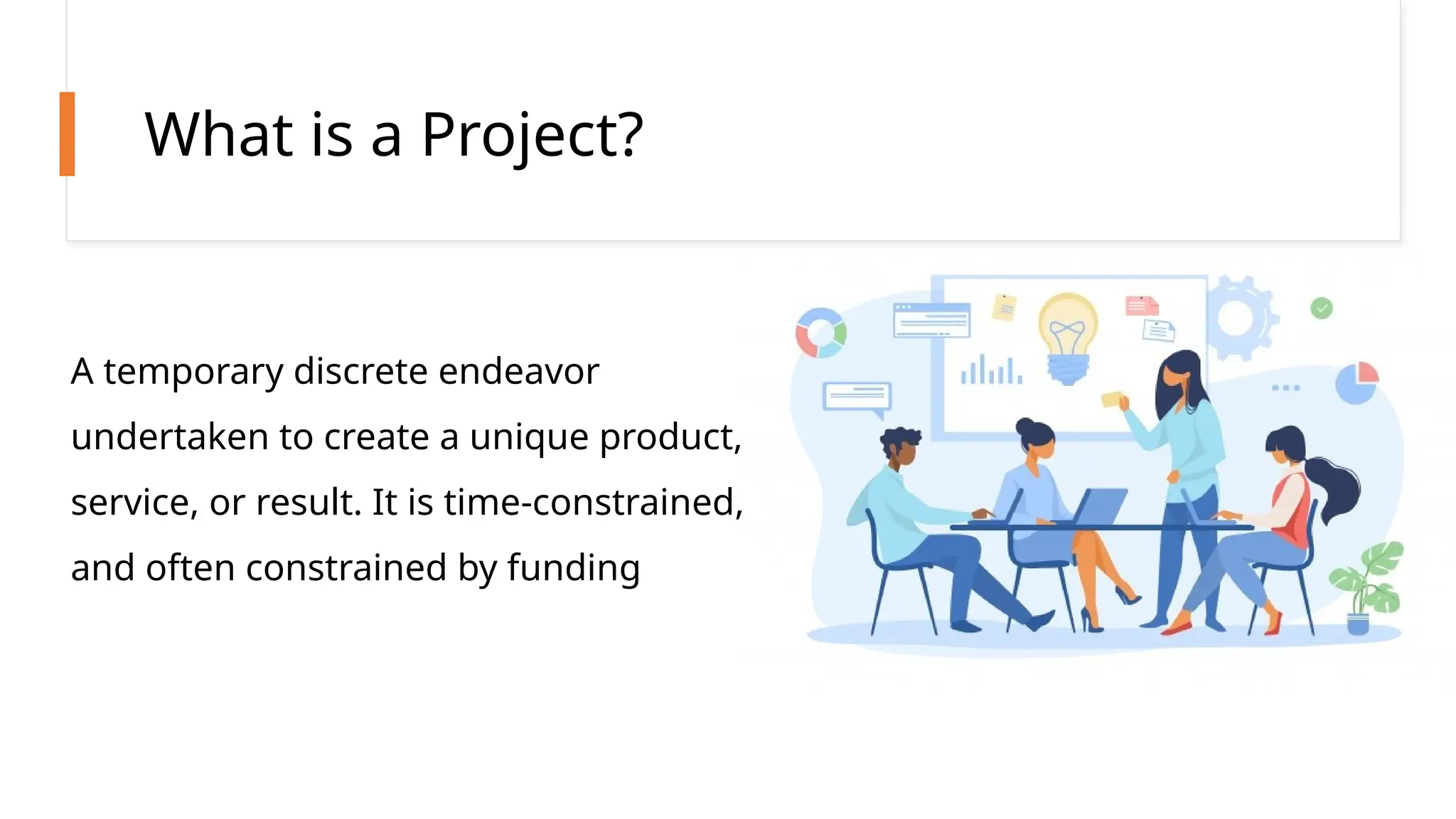
What is a Project?
A temporary discrete endeavor
undertaken to create a unique product,
service, or result. It is time-constrained,
and often constrained by funding
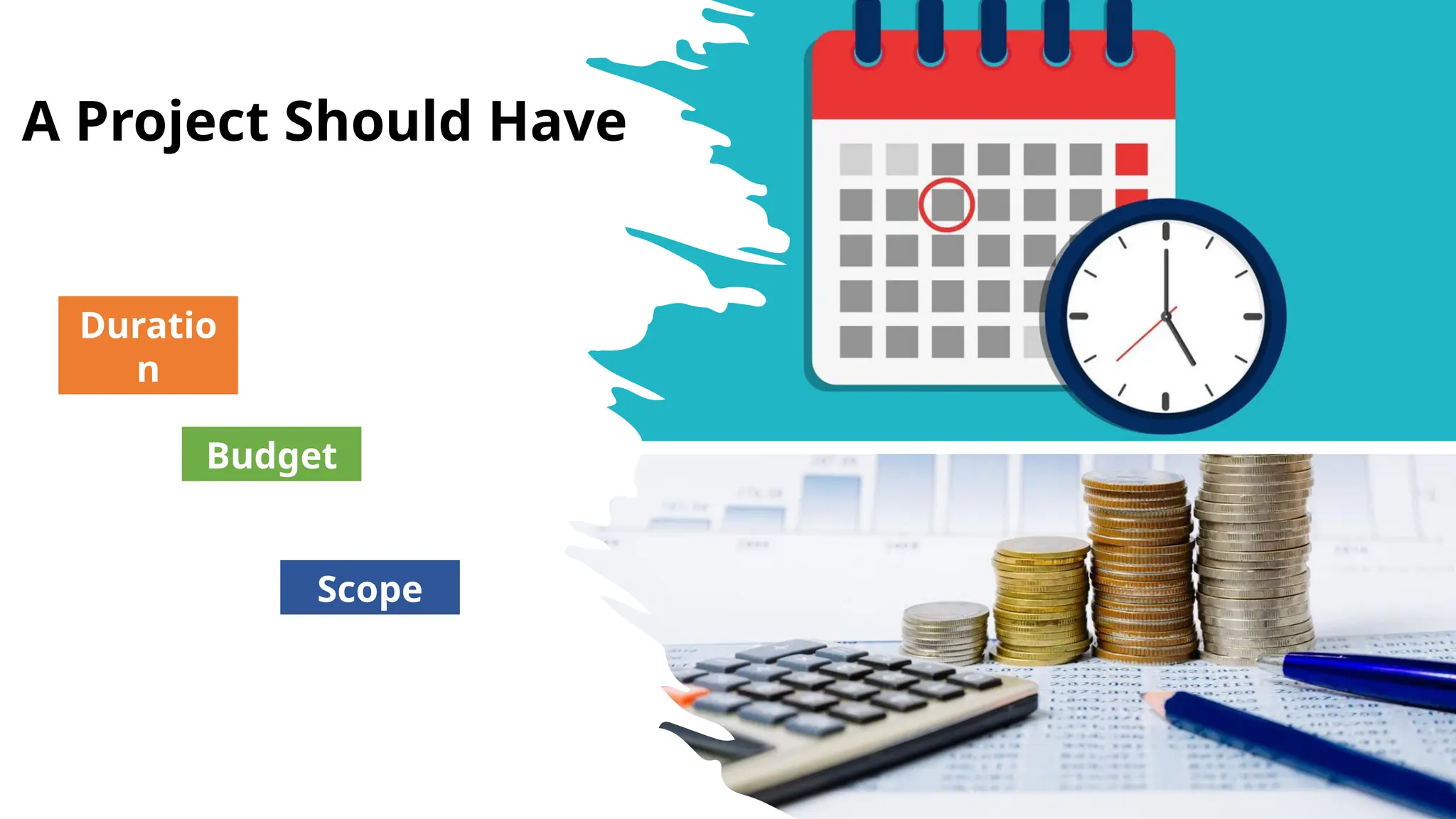
A Project Should Have
Duratio
n
Budget
Scope
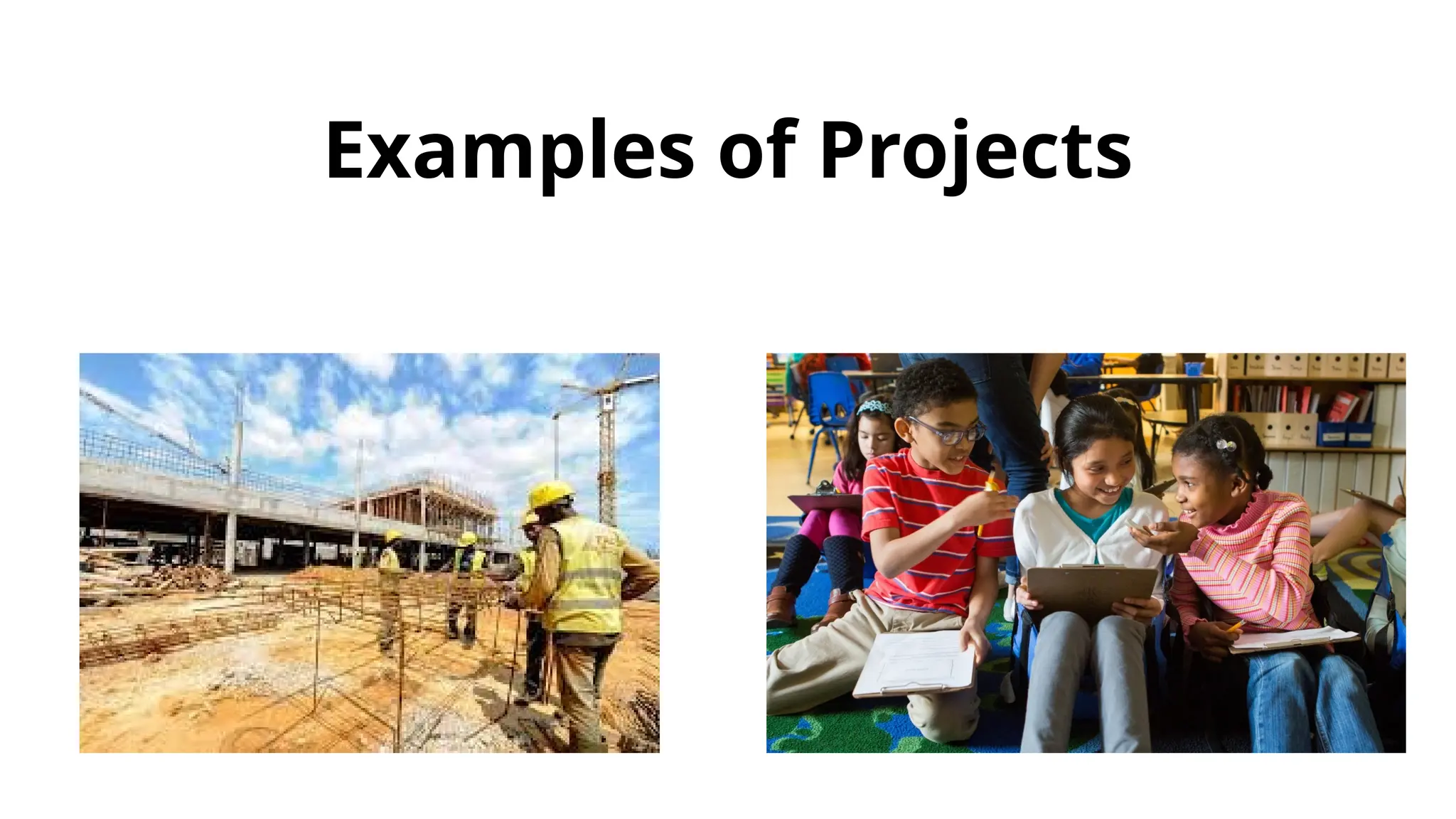
Examples of Projects
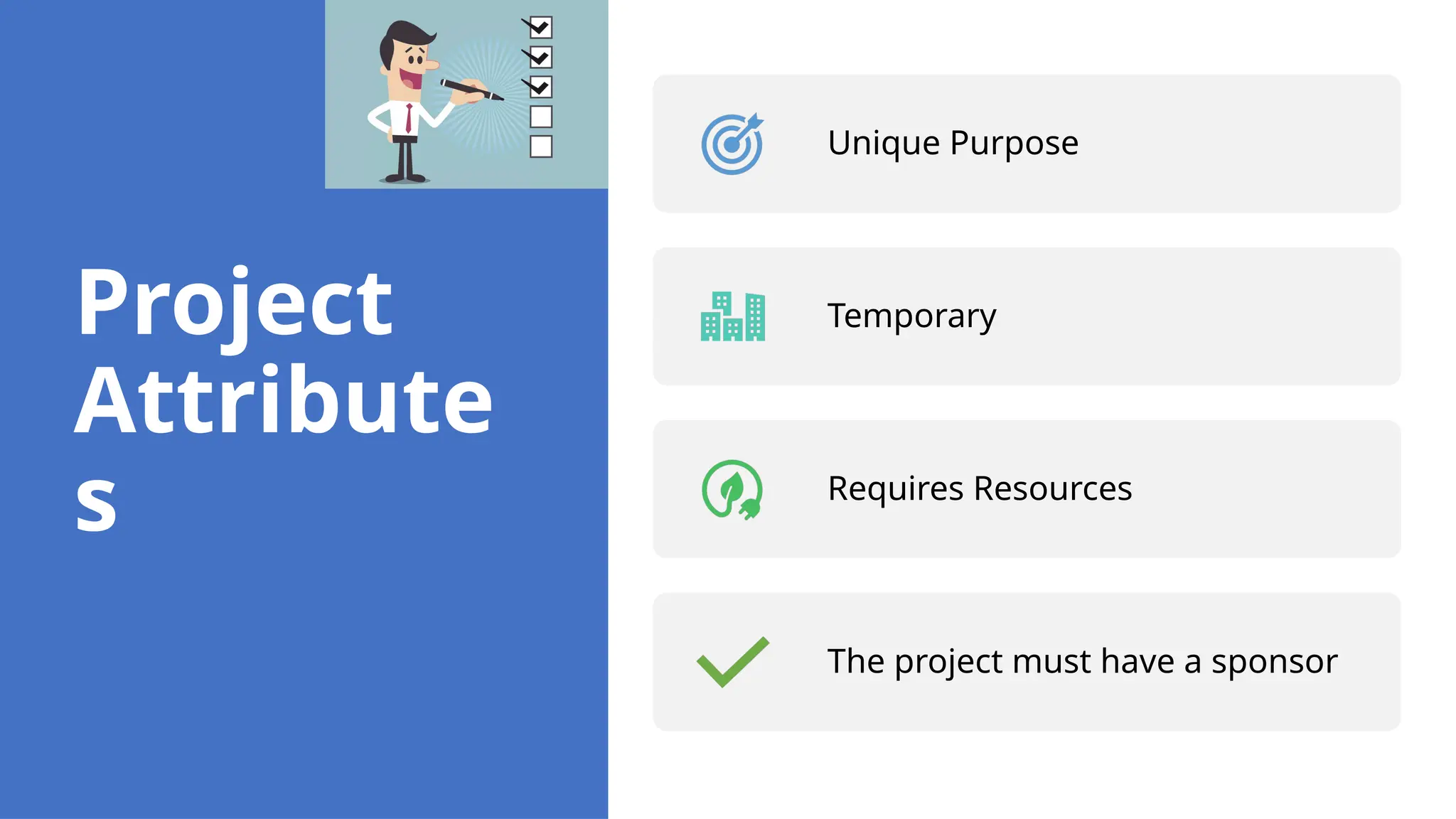
Project
Attribute
s
Unique Purpose
Temporary
Requires Resources
The project must have a sponsor
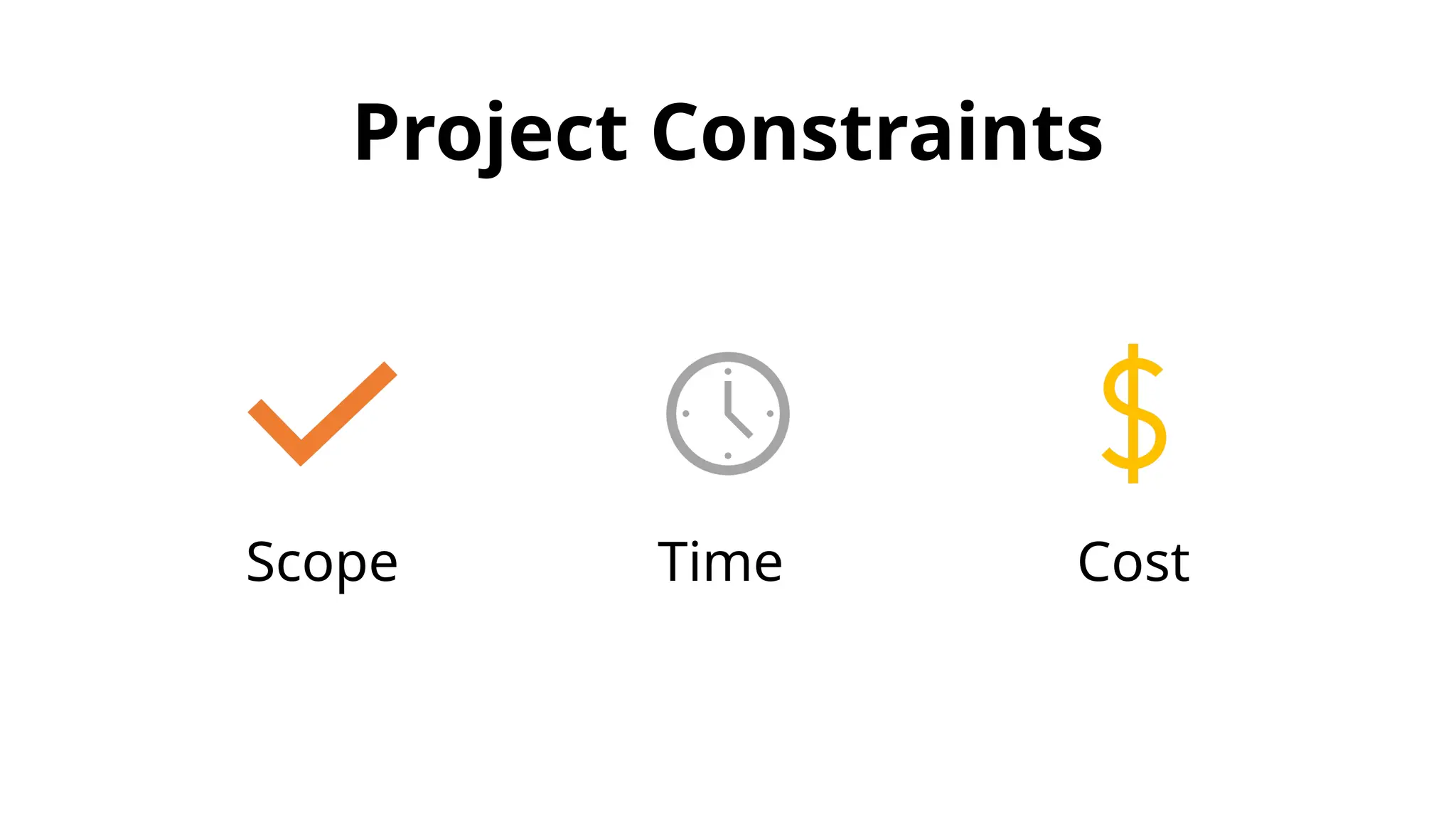
Project Constraints
Scope Time Cost
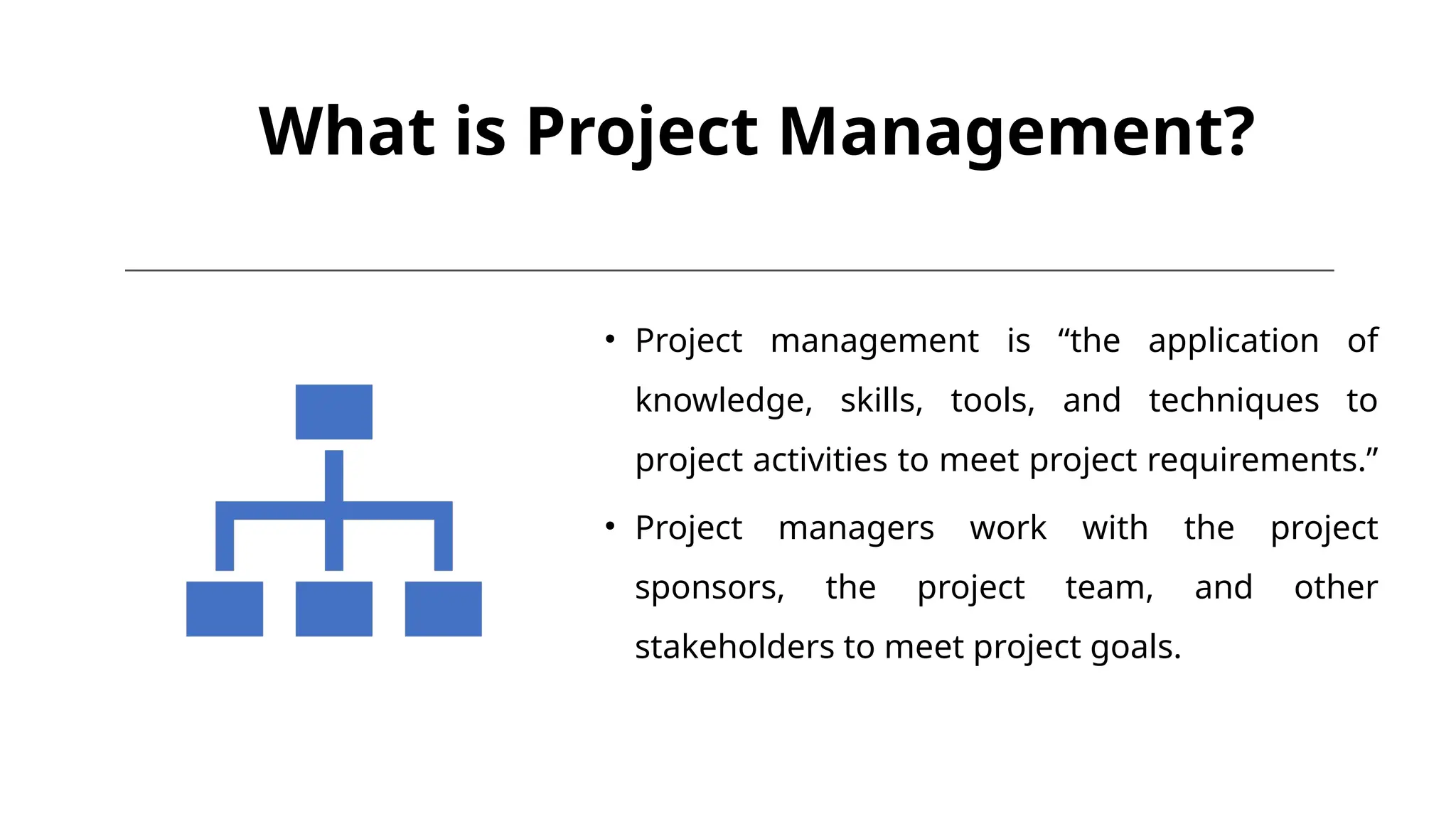
What is Project Management?
• Project management is “the application of
knowledge, skills, tools, and techniques to
project activities to meet project requirements.”
• Project managers work with the project
sponsors, the project team, and other
stakeholders to meet project goals.
Project Management ensures
successful delivery of projects
Project Stakeholders
• These are the people involved in or affected by project activities,
and include the project sponsor, project team, support staff,
customers, users, suppliers, and even opponents of the project
• These stakeholders often have very different needs and
expectations
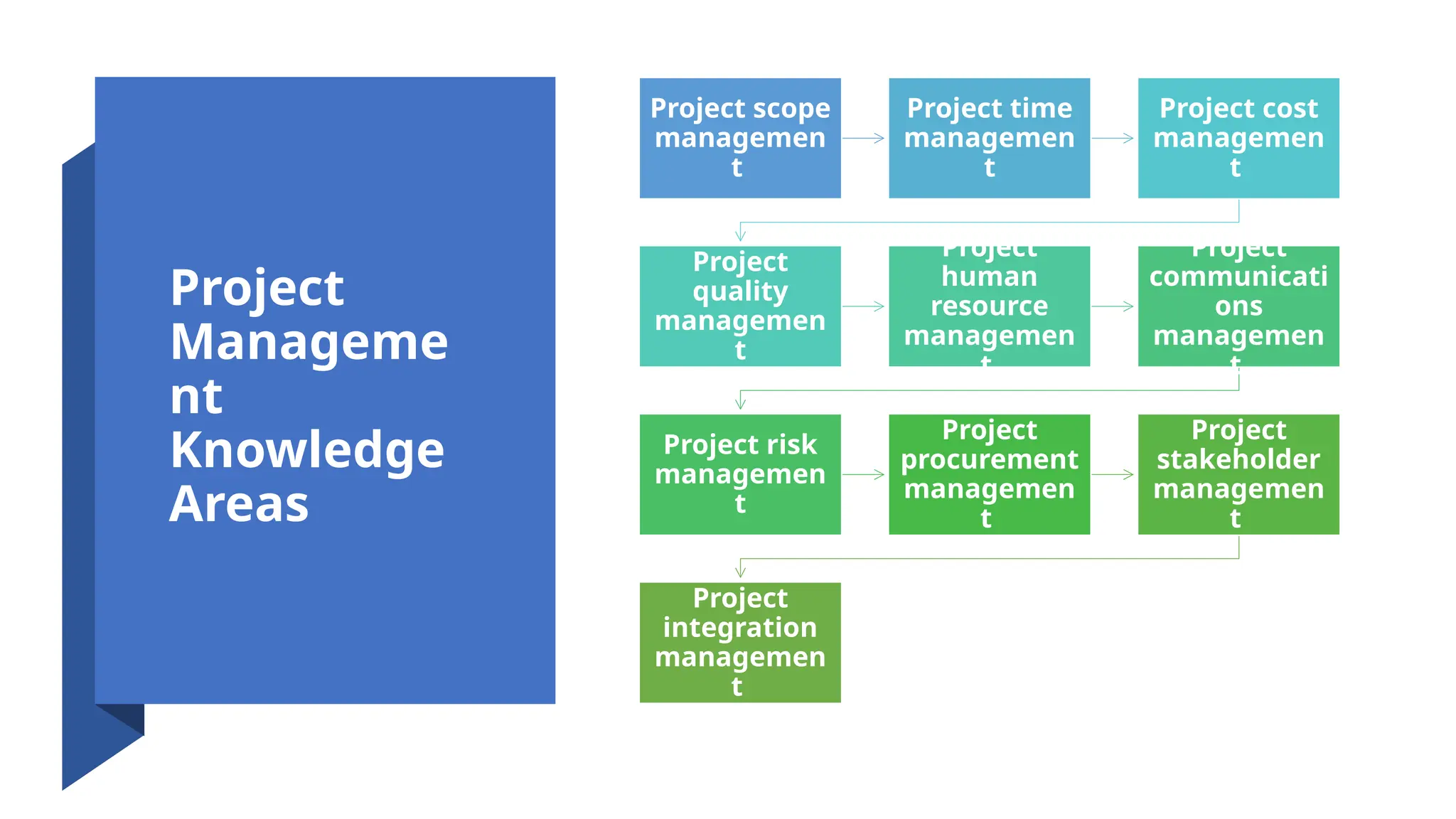
Project
Manageme
nt
Knowledge
Areas
Project scope
managemen
t
Project time
managemen
t
Project cost
managemen
t
Project
quality
managemen
t
Project
human
resource
managemen
t
Project
communicati
ons
managemen
t
Project risk
managemen
t
Project
procurement
managemen
t
Project
stakeholder
managemen
t
Project
integration
managemen
t
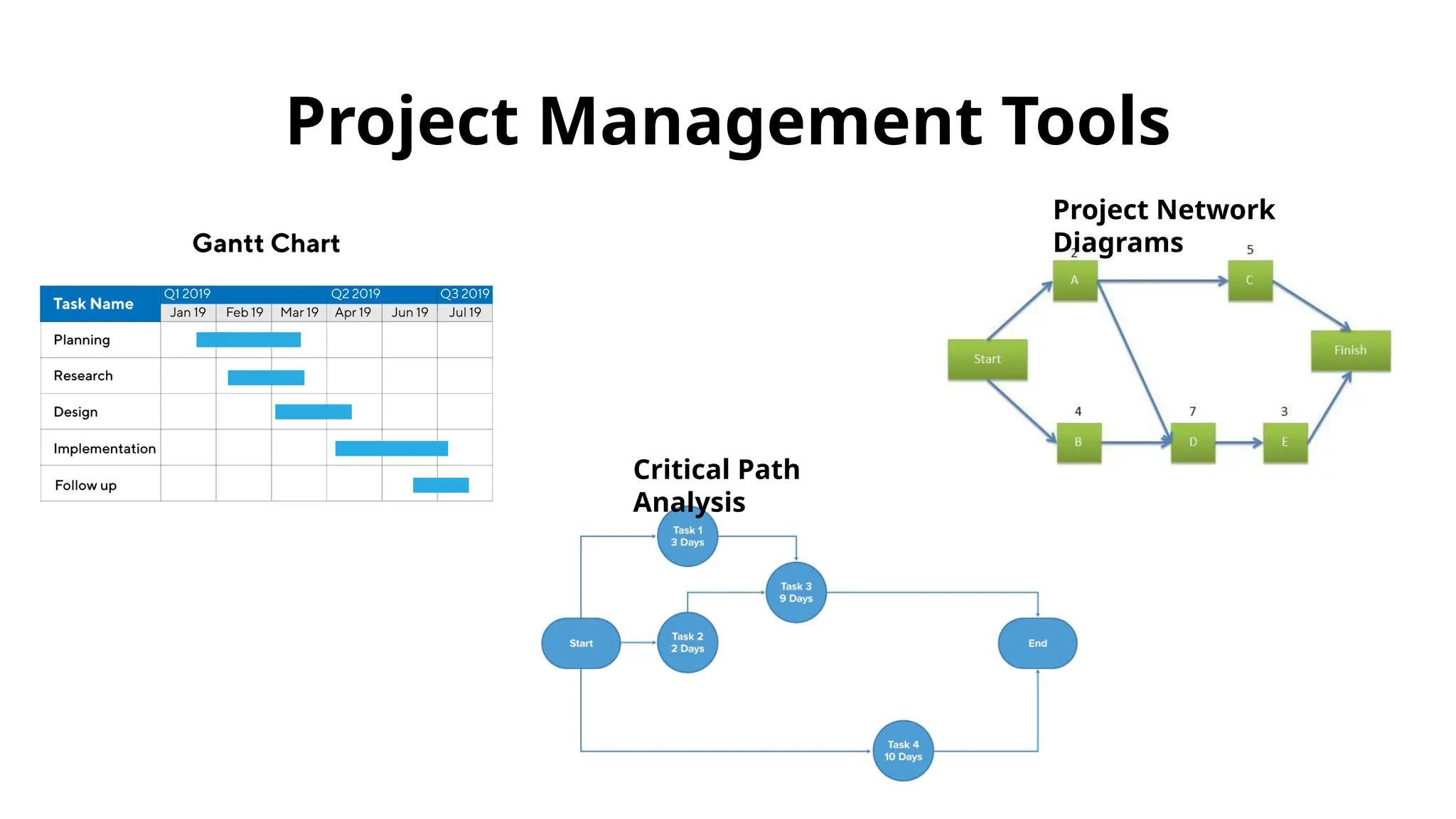
Project Management Tools
Critical Path
Analysis
Project Network
Diagrams
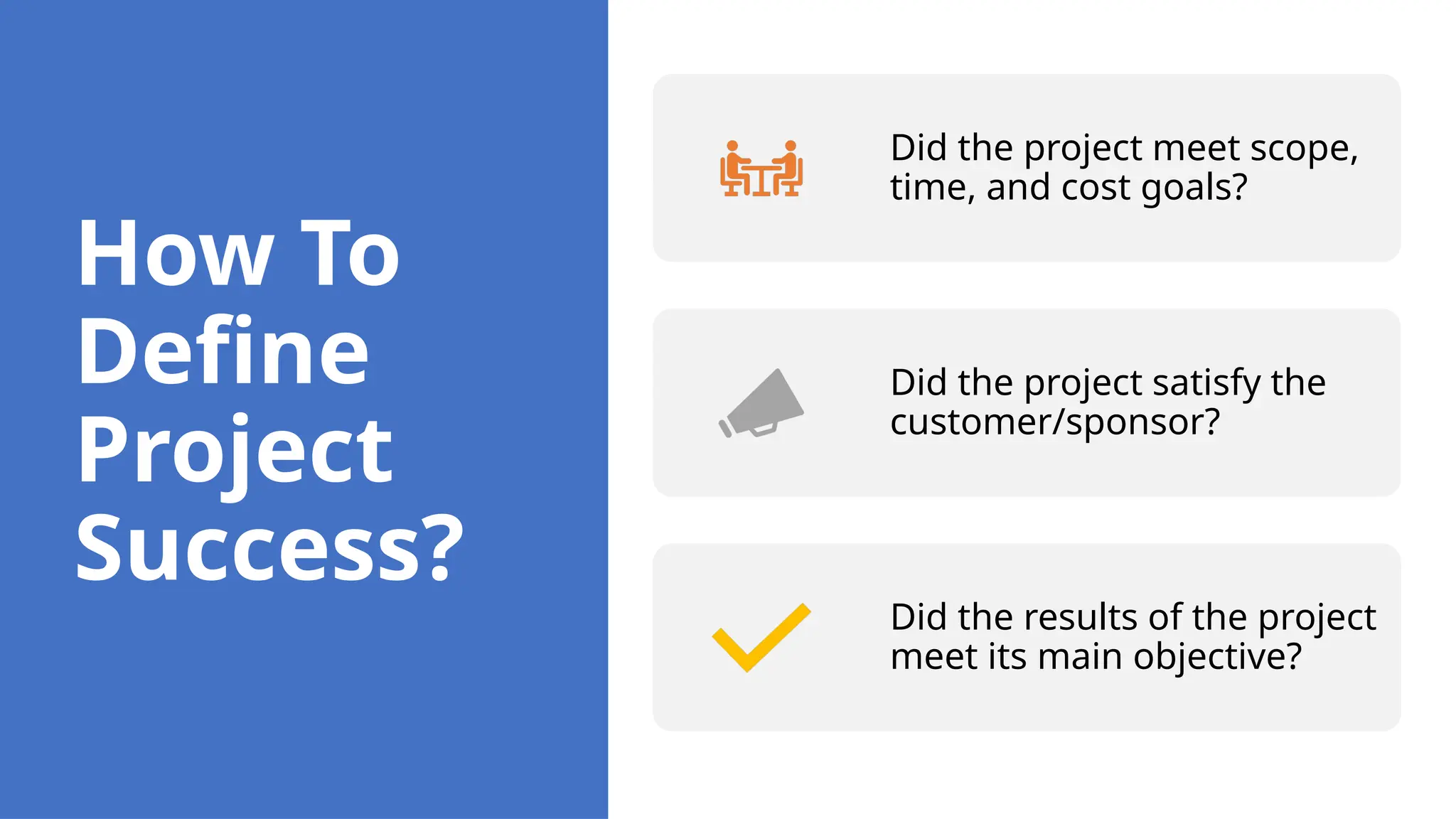
How To
Define
Project
Success?
Did the project meet scope,
time, and cost goals?
Did the project satisfy the
customer/sponsor?
Did the results of the project
meet its main objective?
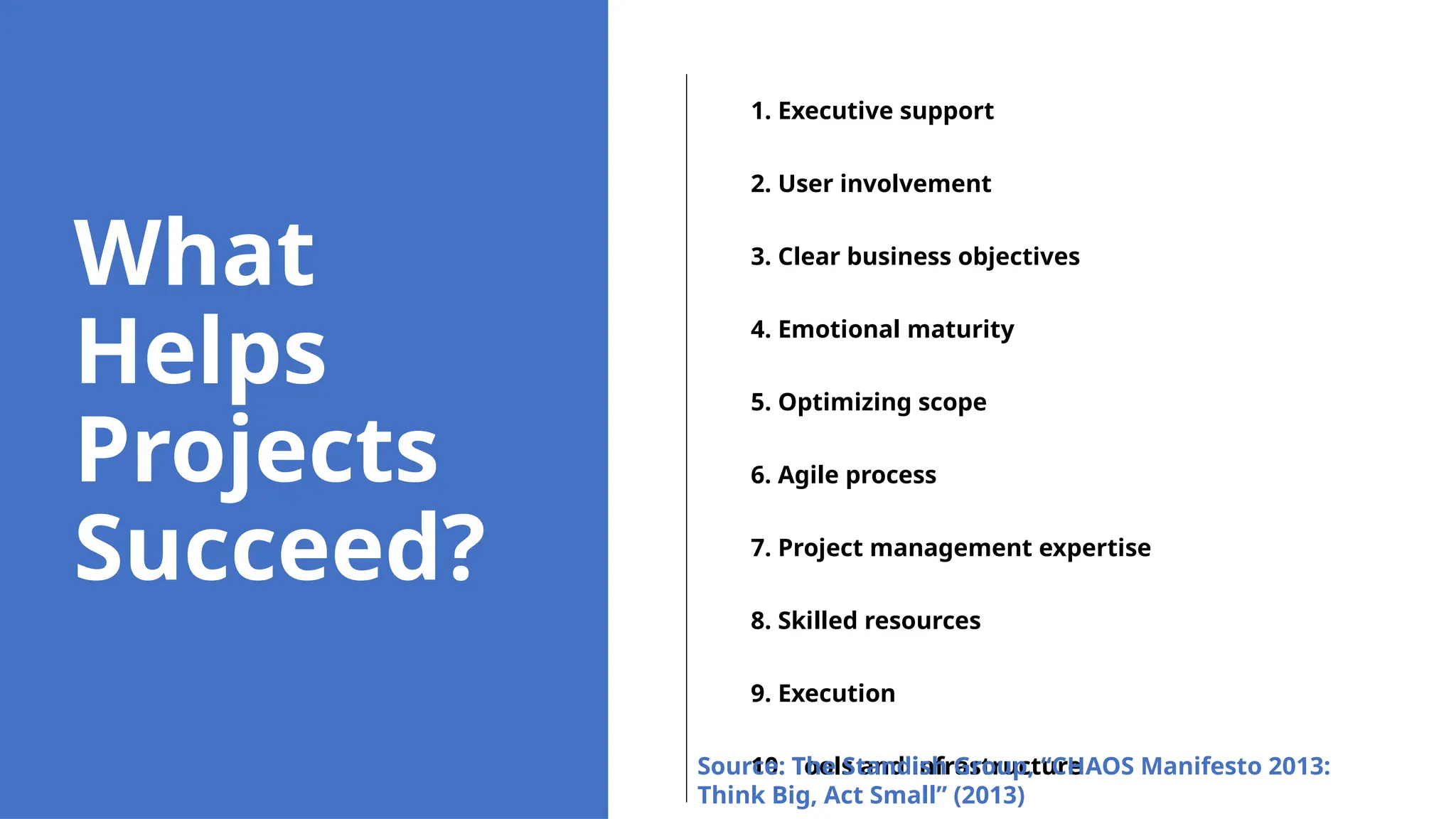
What
Helps
Projects
Succeed?
1. Executive support
2. User involvement
3. Clear business objectives
4. Emotional maturity
5. Optimizing scope
6. Agile process
7. Project management expertise
8. Skilled resources
9. Execution
10. Tools and infrastructure
Source: The Standish Group, “CHAOS Manifesto 2013:
Think Big, Act Small” (2013)
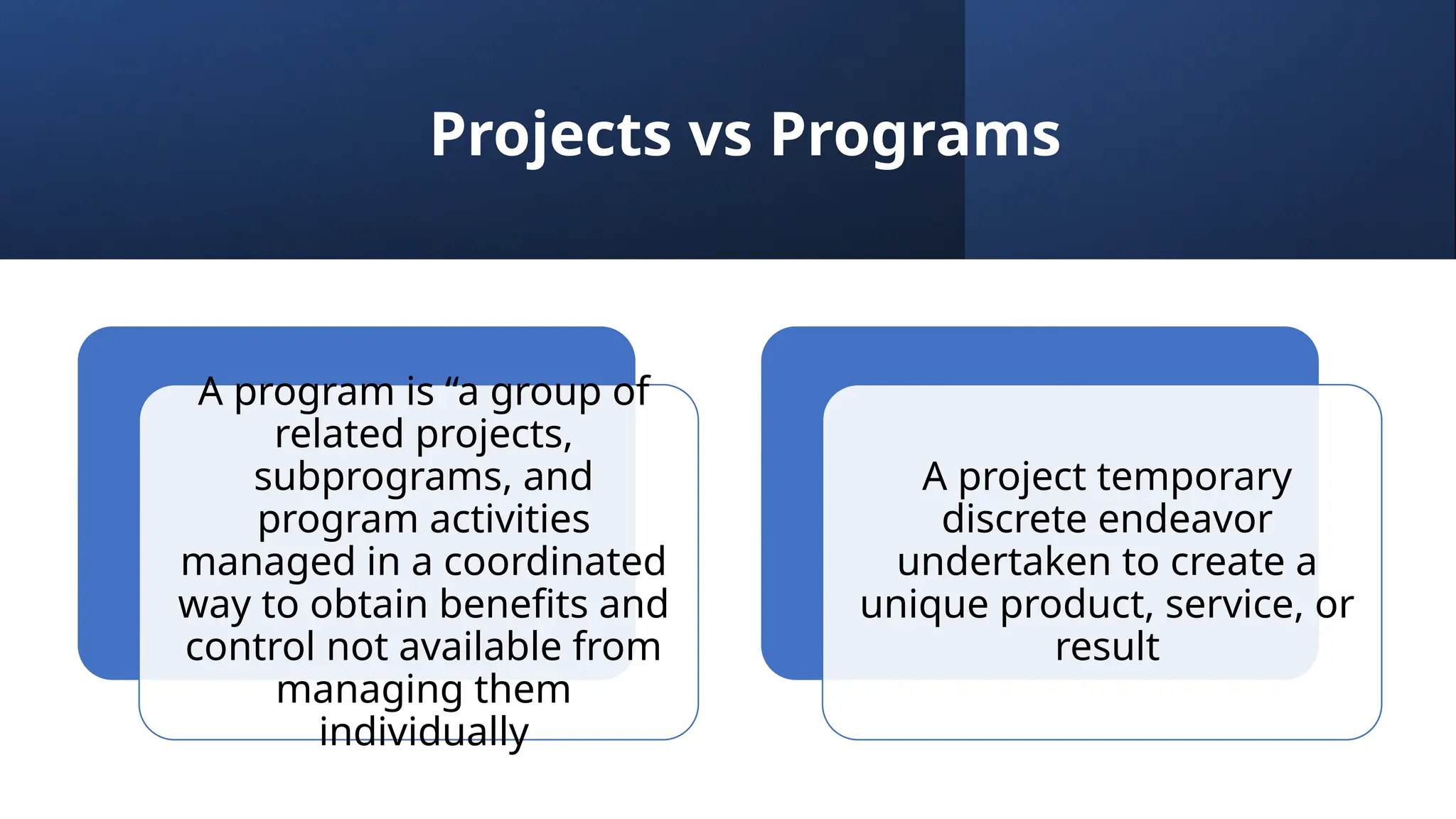
Projects vs Programs
A program is “a group of
related projects,
subprograms, and
program activities
managed in a coordinated
way to obtain benefits and
control not available from
managing them
individually
A project temporary
discrete endeavor
undertaken to create a
unique product, service, or
result
A program = project
+ project + project…
Program vs Portfolio
• A portfolio is a collection
of projects and programs
across an entire
organization
• Portfolio managers are
responsible for portfolios
of projects or programs
for one client
Project Portfolio Management
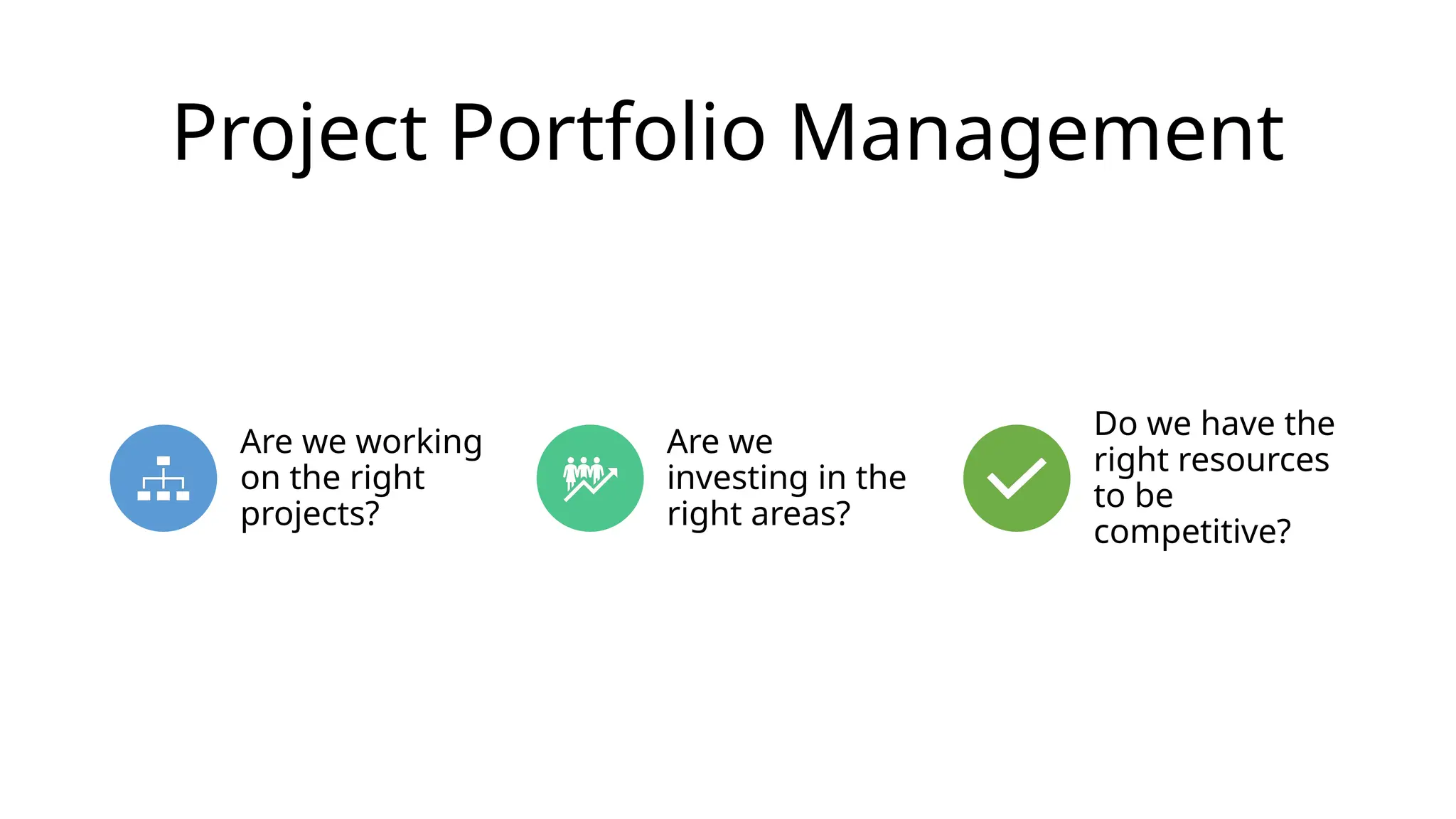
Are we working
on the right
projects?
Are we
investing in the
right areas?
Do we have the
right resources
to be
competitive?
The Role
of a
Project
Manager
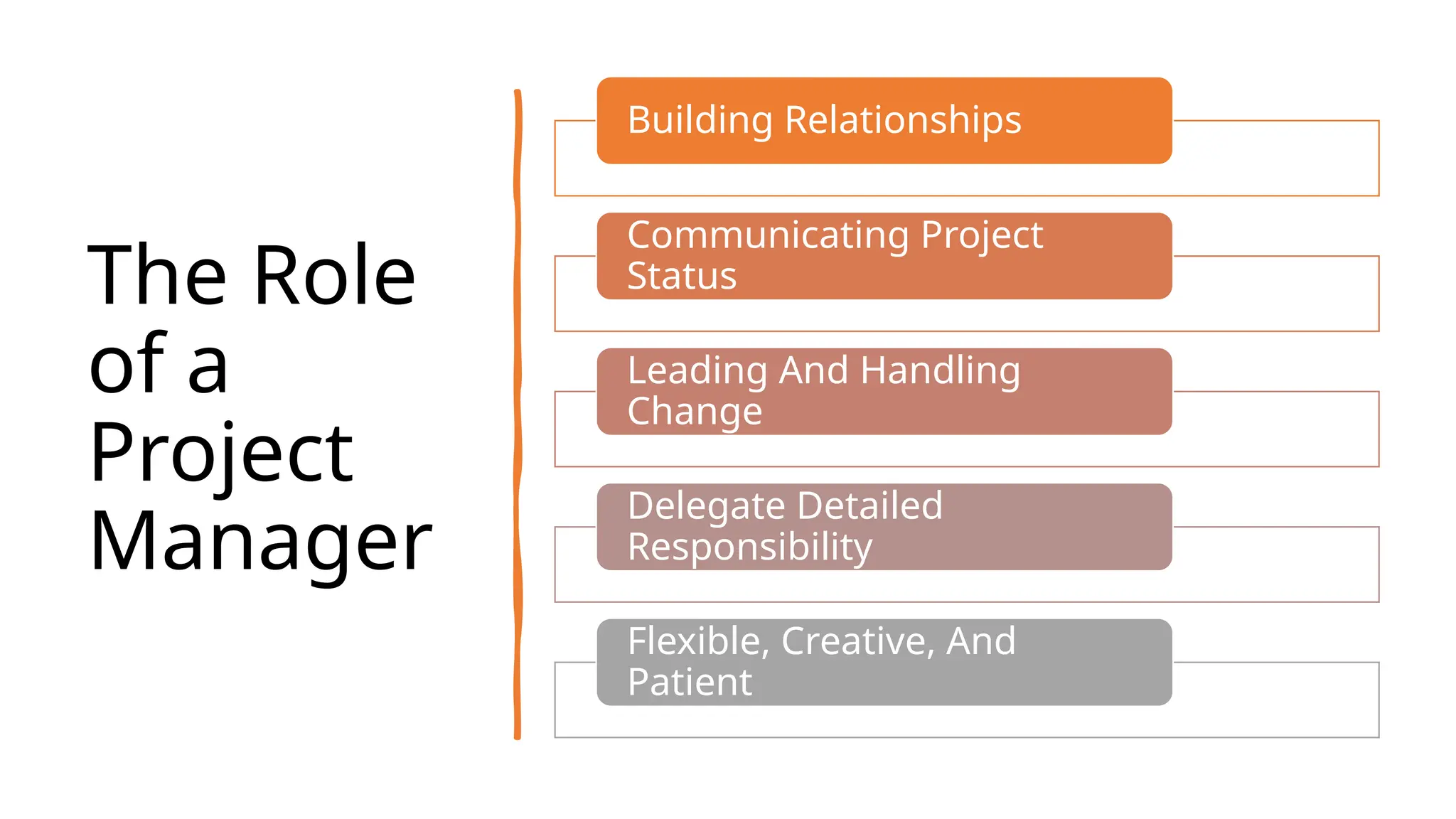
Building Relationships
Communicating Project
Status
Leading And Handling
Change
Delegate Detailed
Responsibility
Flexible, Creative, And
Patient
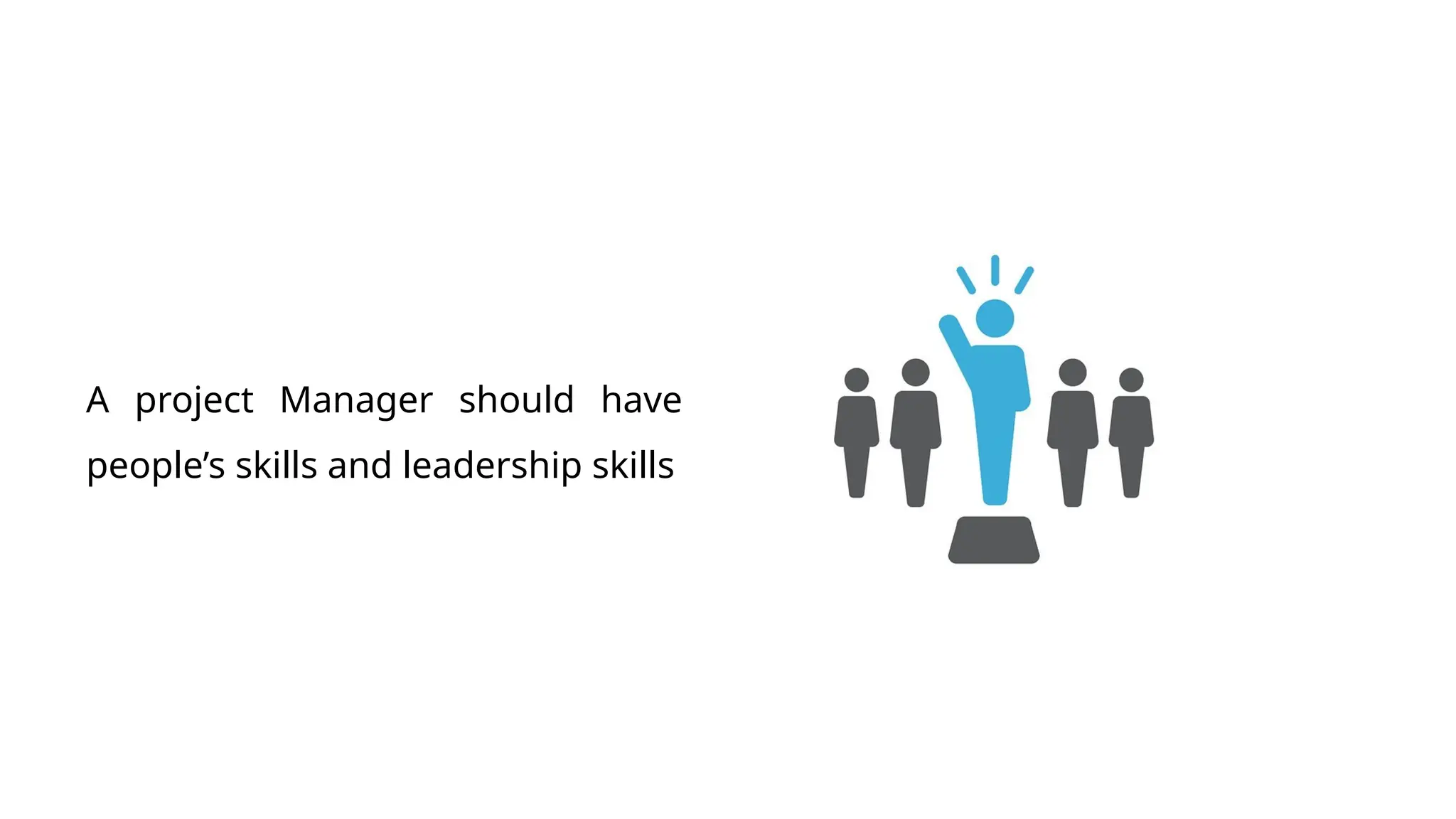
A project Manager should have
people’s skills and leadership skills
Project
Management
Profession
Ethics in Project Management
• Accept only those assignments that are consistent with
your background
• Listen to others’ points of view
• Approach directly those persons with whom we have a
conflict or disagreement
• Demonstrate transparency in your decision-making
process
• Earnestly seek to understand the truth.
• Be truthful in your communications and conduct
Project Scope
Management
Definition
Project scope management
includes processes involved in
defining and controlling what
work is included a what is
excluded in a project
Scope refers to all the work
involved in creating the products
(deliverable) of the project and
the processes used to create
them
Deliverables refers to what will
be provided as a product of a
project
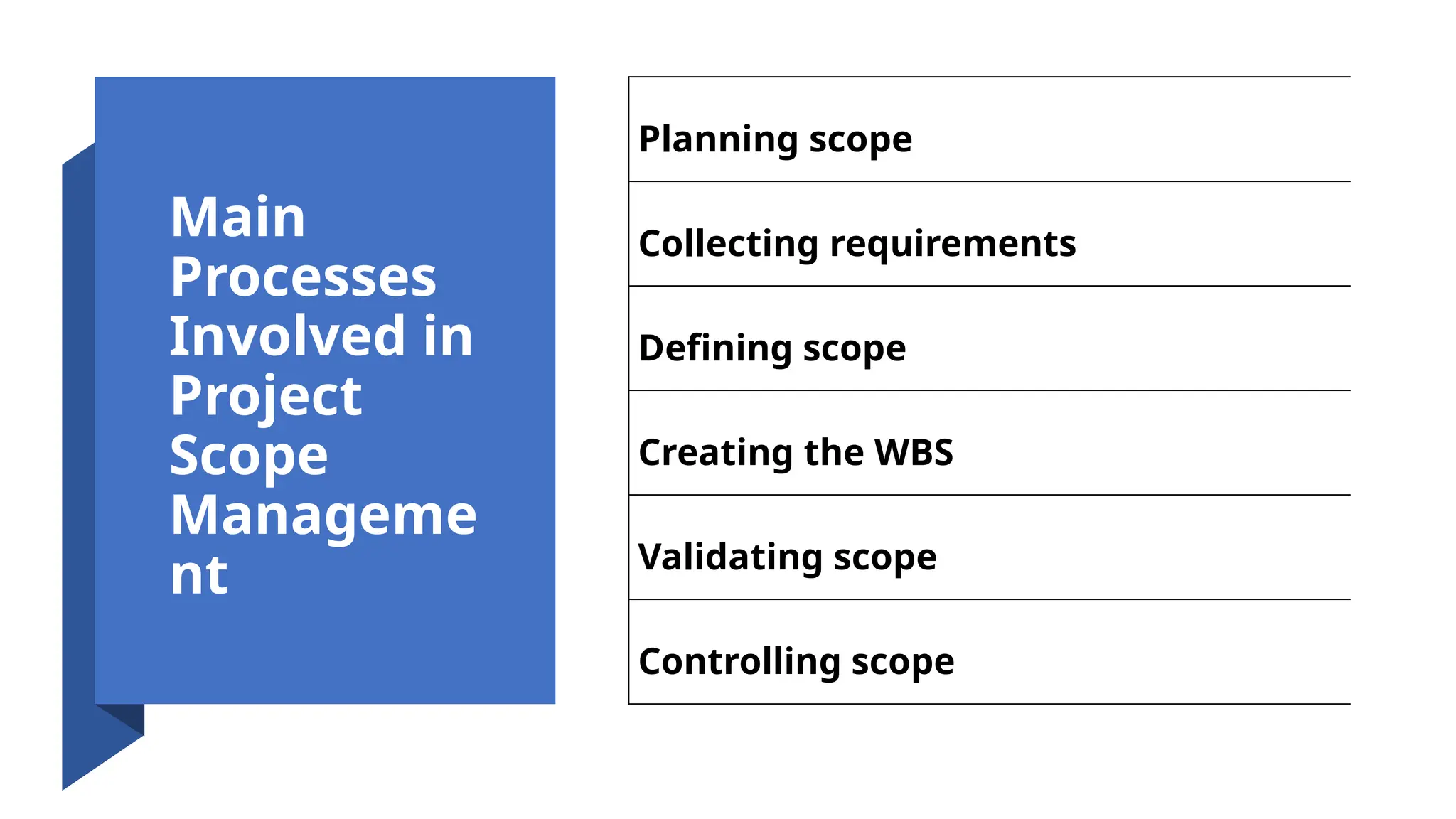
Main
Processes
Involved in
Project
Scope
Manageme
nt
Planning scope
Collecting requirements
Defining scope
Creating the WBS
Validating scope
Controlling scope
Planning Scope
Management
• This involves reviewing the project
management plan, project charter,
enterprise environmental factors, and
organizational process assets
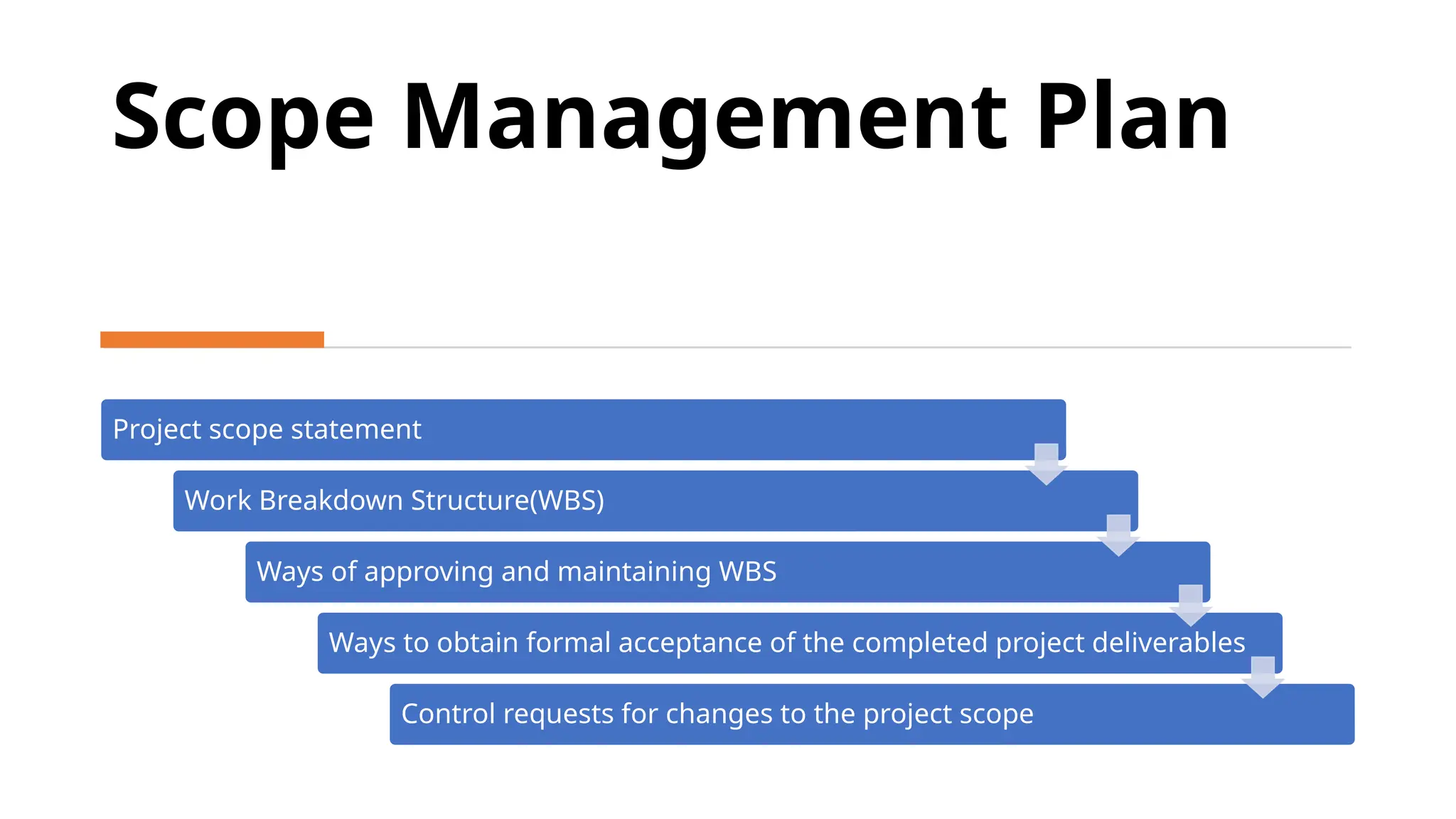
Scope Management Plan
Project scope statement
Work Breakdown Structure(WBS)
Ways of approving and maintaining WBS
Ways to obtain formal acceptance of the completed project deliverables
Control requests for changes to the project scope
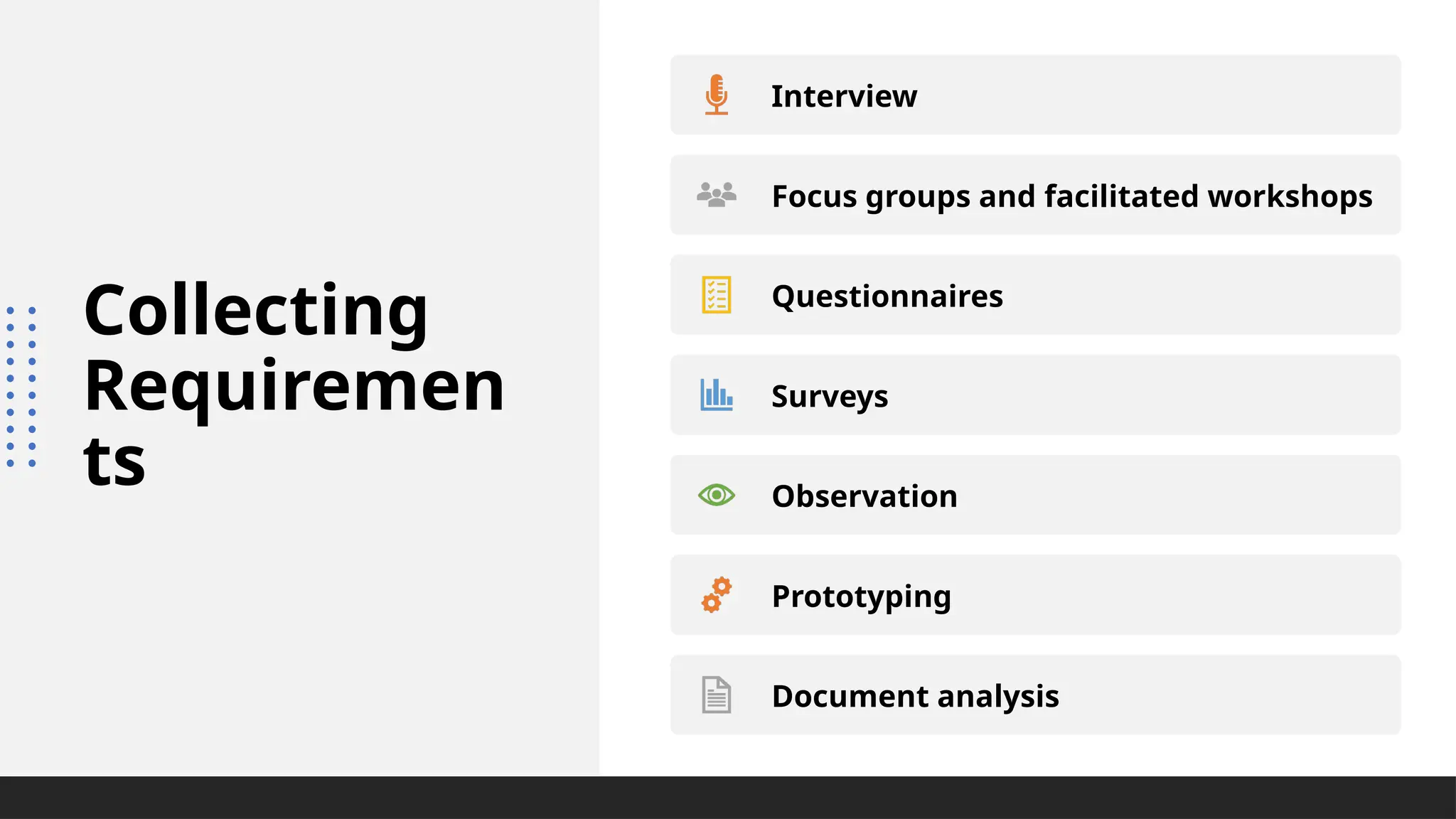
Collecting
Requiremen
ts
Interview
Focus groups and facilitated workshops
Questionnaires
Surveys
Observation
Prototyping
Document analysis
Defining
Scope
It describes in detail the work to be
accomplished on the project and is an
important tool for ensuring customer
satisfaction and preventing scope creep, as
described later in this chapter
It defines a baseline for performance
measurement and project control
It aids in communicating clear work
responsibilities
The main outputs of scope definition are the
project scope statement and project
documents updates
Creating The
Work Breakdown
Structure
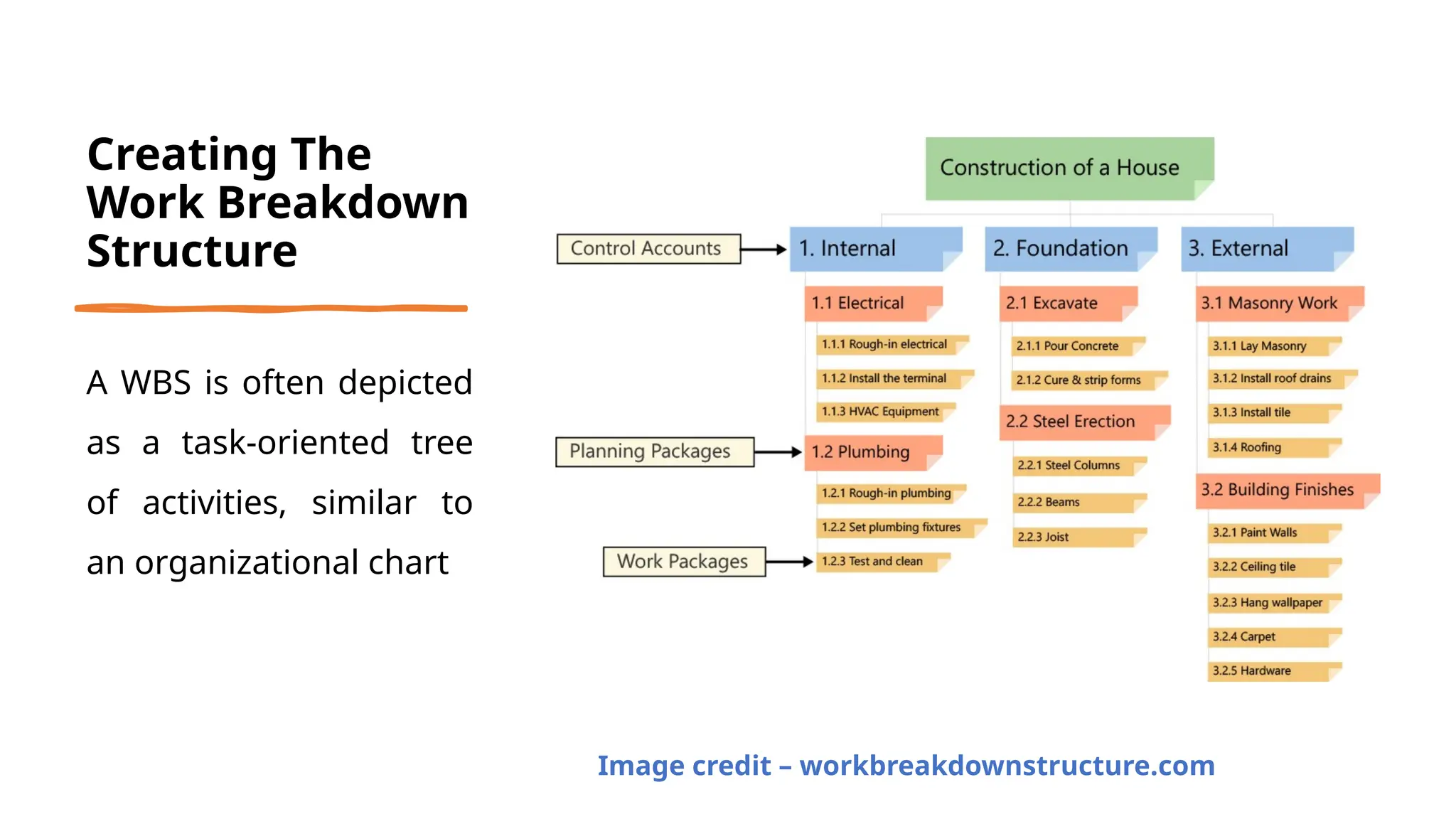
A WBS is often depicted
as a task-oriented tree
of activities, similar to
an organizational chart
Image credit – workbreakdownstructure.com
Scope Verification
Scope verification involves formal
acceptance of the completed project
scope by the stakeholder
Careful procedures must be developed
to ensure the customer is getting what
they want, and the project team has
enough time and money to produce the
desired products and services
Scope Control
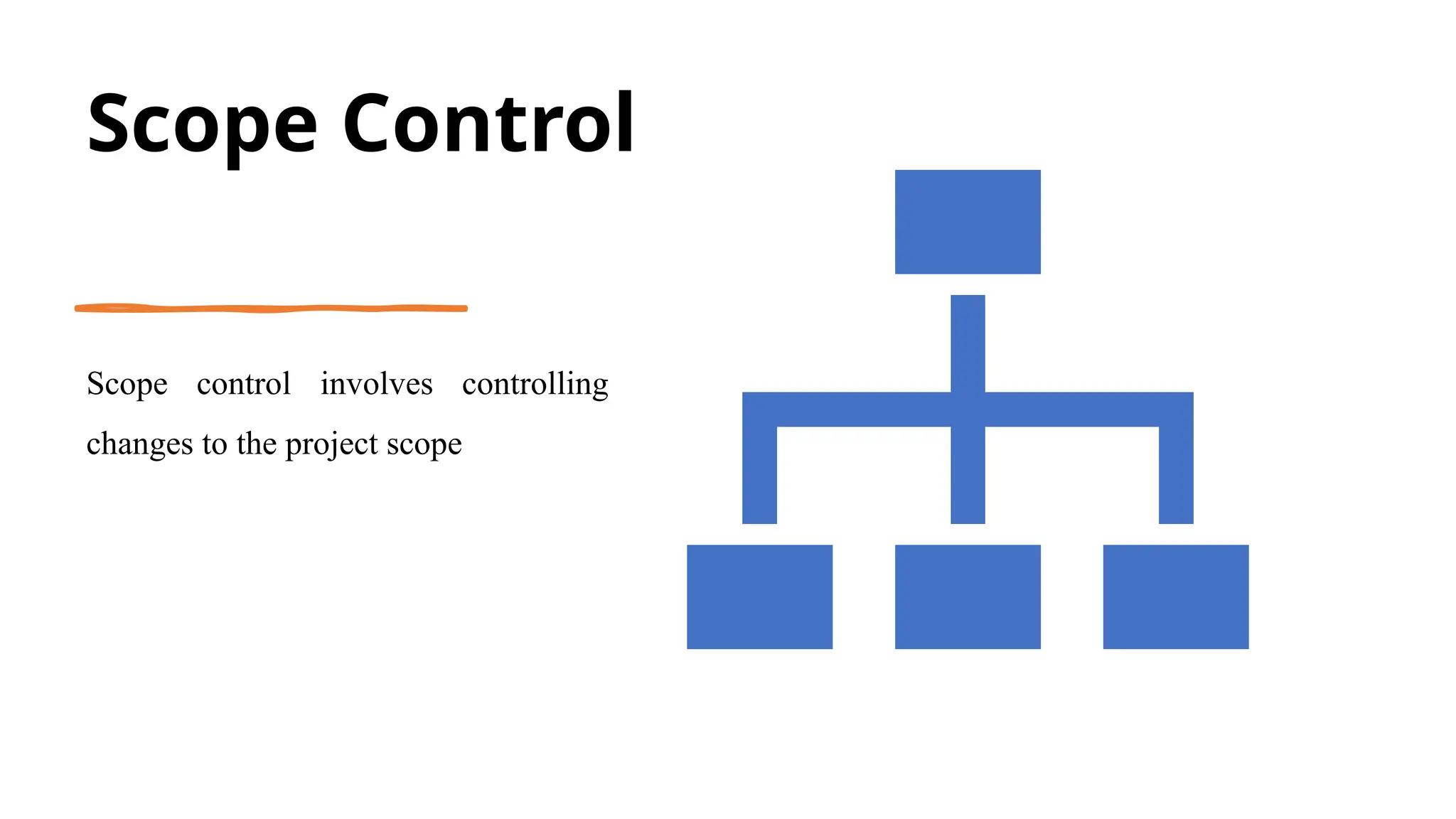
Scope control involves controlling
changes to the project scope
Project Time
Management
What is Project Time Management?
• Project time management refers to the
management of the time spent, and
progress made, on project tasks and
activities
• It deals with processes required to
manage timely completion of the project
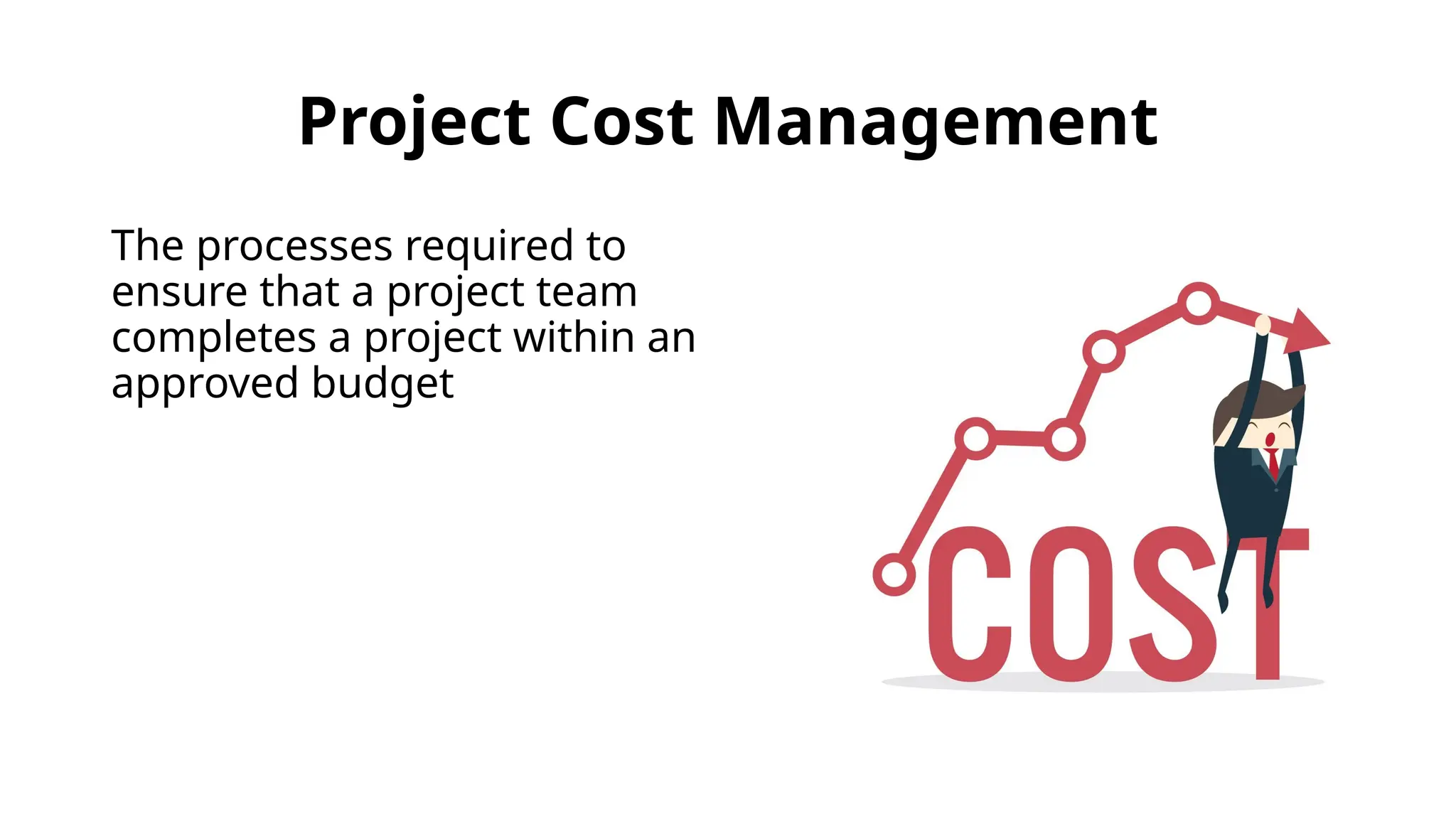
Project Cost Management
The processes required to
ensure that a project team
completes a project within an
approved budget
4 Processes in Project Cost
Management
• Planning cost management
• Estimating costs
• Determining the budget
• Controlling costs
Definition of Key Terms
• Cost
• Project Cost
• Project Cost Management
Basic Principles in Cost Management
• Profits
• Profit margin
• Life cycle costing
• Cash flow
• Tangible costs
• Intangible costs
• Direct costs
• Indirect costs
• Sunk costs
• Contingency reserves
• Management reserves
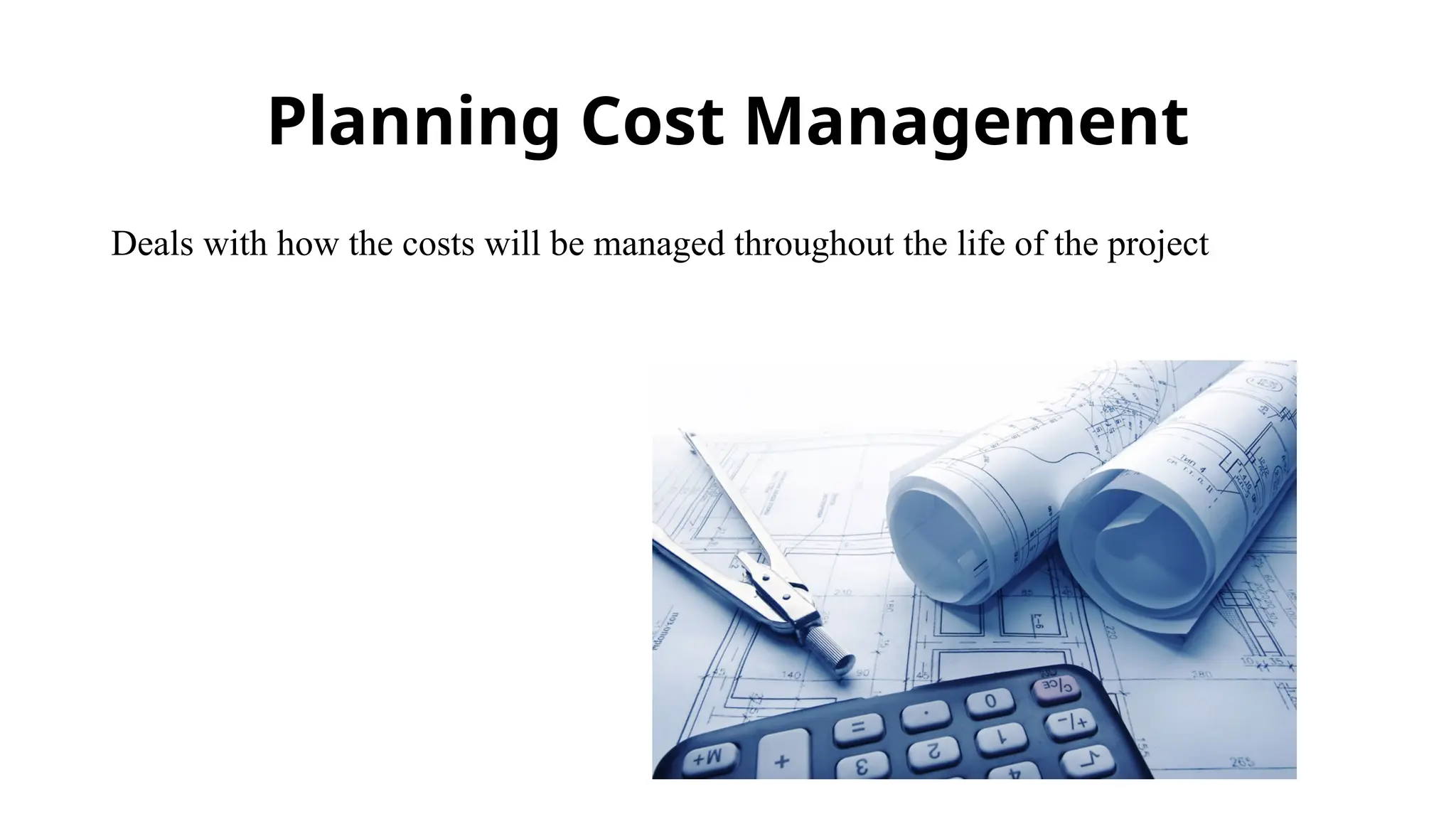
Planning Cost Management
Deals with how the costs will be managed throughout the life of the project
Cost Estimation
Project managers must take cost estimates seriously if they
want to complete projects within budget constraints
Cost Management Plan
• A cost management plan is a document that describes how the organization will manage cost variances on the
project
• A large percentage of total project costs are often labor costs, so project managers must develop and track
estimates for labor
Earned Value Management
EVM is a project performance measurement technique that
integrates scope, time, and cost data
Agile Project Management
What is Agile Project Management?
• Agile project management relies on incremental, iterative development cycles to complete less-predictable
projects
• Agile stands to be one of the most popular approaches to project management because of its flexibility and
evolutionary nature
Three Factors That Makes a System
Agile
• FLOW refers to the way work is processed by the system
• LEARNING refers to mechanisms in the system which allow the system to learn from past experiences,
mistakes or other people, but also to uncover unknown unknowns (knowledge discovery)
• COLLABORATION refers to various ways how people in the system can work together to achieve a single
goal
The Agile Manifesto
The Agile Manifesto
• Individuals and interactions over processes and tools
• Working software over comprehensive documentation
• Customer collaboration over contract negotiation
• Responding to change over following a plan
The Agile Principles
• Customer satisfaction by early and continuous delivery of valuable
software.
• Welcome changing requirements, even in late development.
• Deliver working software frequently (weeks rather than months).
• Close, daily cooperation between business people and developers.
• Projects are built around motivated individuals, who should be
trusted.
• Face-to-face conversation is the best form of communication (co-
location).
The Agile Principles
• Working software is the primary measure of progress.
• Sustainable development, able to maintain a constant pace.
• Continuous attention to technical excellence and good design.
• Simplicity - the art of maximizing the amount of work not done - is
essential.
• Best architectures, requirements, and designs emerge from self-
organizing teams.
• Regularly, the team reflects on how to become more effective, and
adjusts accordingly.
Advantages of Agile Project
Management
• Quality product
• Customer satisfaction
• Shorter time to market
• Better control
• Predictability
Advantages of Agile Project
Management
• Reduced risks
• Increased flexibility
• Continuous improvement
• Improved team morale
• Better estimate
Agile Project Management Methods
• Scrum
• Kanban
• Hybrid
• Bimodal
• Lean
• Extreme Programming
Ways to Use Agile Methodology
• Project planning
• Product roadmap creation
• Release planning
• Sprint planning
• Daily stand-ups
• Sprint review and retrospective

IT Project Management.pptxUnderstand the importance of project schedules and good project time management

  • 1.
  • 2.
    Learning Outcomes Project and ProjectManagement Project Management Scope Project Time management Project Cost Management Agile Project Management
  • 3.
    Project Management Career Projections By2027, employers will need 88 million people in project related roles
  • 4.
    Advantages of ProjectManagement • Improved customer relations • Better internal coordination • Positive impact on meeting strategic goals • Better control of financial, physical, and human resources • Lower costs and improved productivity • Higher profit margins
  • 5.
    What is aProject? A temporary discrete endeavor undertaken to create a unique product, service, or result. It is time-constrained, and often constrained by funding
  • 6.
    A Project ShouldHave Duratio n Budget Scope
  • 7.
  • 8.
  • 9.
  • 10.
    What is ProjectManagement? • Project management is “the application of knowledge, skills, tools, and techniques to project activities to meet project requirements.” • Project managers work with the project sponsors, the project team, and other stakeholders to meet project goals.
  • 11.
  • 12.
    Project Stakeholders • Theseare the people involved in or affected by project activities, and include the project sponsor, project team, support staff, customers, users, suppliers, and even opponents of the project • These stakeholders often have very different needs and expectations
  • 13.
    Project Manageme nt Knowledge Areas Project scope managemen t Project time managemen t Projectcost managemen t Project quality managemen t Project human resource managemen t Project communicati ons managemen t Project risk managemen t Project procurement managemen t Project stakeholder managemen t Project integration managemen t
  • 14.
    Project Management Tools CriticalPath Analysis Project Network Diagrams
  • 15.
    How To Define Project Success? Did theproject meet scope, time, and cost goals? Did the project satisfy the customer/sponsor? Did the results of the project meet its main objective?
  • 16.
    What Helps Projects Succeed? 1. Executive support 2.User involvement 3. Clear business objectives 4. Emotional maturity 5. Optimizing scope 6. Agile process 7. Project management expertise 8. Skilled resources 9. Execution 10. Tools and infrastructure Source: The Standish Group, “CHAOS Manifesto 2013: Think Big, Act Small” (2013)
  • 17.
    Projects vs Programs Aprogram is “a group of related projects, subprograms, and program activities managed in a coordinated way to obtain benefits and control not available from managing them individually A project temporary discrete endeavor undertaken to create a unique product, service, or result
  • 18.
    A program =project + project + project…
  • 19.
    Program vs Portfolio •A portfolio is a collection of projects and programs across an entire organization • Portfolio managers are responsible for portfolios of projects or programs for one client
  • 20.
    Project Portfolio Management Arewe working on the right projects? Are we investing in the right areas? Do we have the right resources to be competitive?
  • 21.
    The Role of a Project Manager BuildingRelationships Communicating Project Status Leading And Handling Change Delegate Detailed Responsibility Flexible, Creative, And Patient
  • 22.
    A project Managershould have people’s skills and leadership skills
  • 23.
  • 24.
    Ethics in ProjectManagement • Accept only those assignments that are consistent with your background • Listen to others’ points of view • Approach directly those persons with whom we have a conflict or disagreement • Demonstrate transparency in your decision-making process • Earnestly seek to understand the truth. • Be truthful in your communications and conduct
  • 25.
  • 26.
    Definition Project scope management includesprocesses involved in defining and controlling what work is included a what is excluded in a project Scope refers to all the work involved in creating the products (deliverable) of the project and the processes used to create them Deliverables refers to what will be provided as a product of a project
  • 27.
    Main Processes Involved in Project Scope Manageme nt Planning scope Collectingrequirements Defining scope Creating the WBS Validating scope Controlling scope
  • 28.
    Planning Scope Management • Thisinvolves reviewing the project management plan, project charter, enterprise environmental factors, and organizational process assets
  • 29.
    Scope Management Plan Projectscope statement Work Breakdown Structure(WBS) Ways of approving and maintaining WBS Ways to obtain formal acceptance of the completed project deliverables Control requests for changes to the project scope
  • 30.
    Collecting Requiremen ts Interview Focus groups andfacilitated workshops Questionnaires Surveys Observation Prototyping Document analysis
  • 31.
    Defining Scope It describes indetail the work to be accomplished on the project and is an important tool for ensuring customer satisfaction and preventing scope creep, as described later in this chapter It defines a baseline for performance measurement and project control It aids in communicating clear work responsibilities The main outputs of scope definition are the project scope statement and project documents updates
  • 32.
    Creating The Work Breakdown Structure AWBS is often depicted as a task-oriented tree of activities, similar to an organizational chart Image credit – workbreakdownstructure.com
  • 33.
    Scope Verification Scope verificationinvolves formal acceptance of the completed project scope by the stakeholder Careful procedures must be developed to ensure the customer is getting what they want, and the project team has enough time and money to produce the desired products and services
  • 34.
    Scope Control Scope controlinvolves controlling changes to the project scope
  • 35.
  • 36.
    What is ProjectTime Management? • Project time management refers to the management of the time spent, and progress made, on project tasks and activities • It deals with processes required to manage timely completion of the project
  • 38.
    Project Cost Management Theprocesses required to ensure that a project team completes a project within an approved budget
  • 39.
    4 Processes inProject Cost Management • Planning cost management • Estimating costs • Determining the budget • Controlling costs
  • 40.
    Definition of KeyTerms • Cost • Project Cost • Project Cost Management
  • 41.
    Basic Principles inCost Management • Profits • Profit margin • Life cycle costing • Cash flow • Tangible costs • Intangible costs • Direct costs • Indirect costs • Sunk costs • Contingency reserves • Management reserves
  • 42.
    Planning Cost Management Dealswith how the costs will be managed throughout the life of the project
  • 43.
    Cost Estimation Project managersmust take cost estimates seriously if they want to complete projects within budget constraints
  • 44.
    Cost Management Plan •A cost management plan is a document that describes how the organization will manage cost variances on the project • A large percentage of total project costs are often labor costs, so project managers must develop and track estimates for labor
  • 45.
    Earned Value Management EVMis a project performance measurement technique that integrates scope, time, and cost data
  • 46.
  • 47.
    What is AgileProject Management? • Agile project management relies on incremental, iterative development cycles to complete less-predictable projects • Agile stands to be one of the most popular approaches to project management because of its flexibility and evolutionary nature
  • 48.
    Three Factors ThatMakes a System Agile • FLOW refers to the way work is processed by the system • LEARNING refers to mechanisms in the system which allow the system to learn from past experiences, mistakes or other people, but also to uncover unknown unknowns (knowledge discovery) • COLLABORATION refers to various ways how people in the system can work together to achieve a single goal
  • 49.
  • 50.
    The Agile Manifesto •Individuals and interactions over processes and tools • Working software over comprehensive documentation • Customer collaboration over contract negotiation • Responding to change over following a plan
  • 51.
    The Agile Principles •Customer satisfaction by early and continuous delivery of valuable software. • Welcome changing requirements, even in late development. • Deliver working software frequently (weeks rather than months). • Close, daily cooperation between business people and developers. • Projects are built around motivated individuals, who should be trusted. • Face-to-face conversation is the best form of communication (co- location).
  • 52.
    The Agile Principles •Working software is the primary measure of progress. • Sustainable development, able to maintain a constant pace. • Continuous attention to technical excellence and good design. • Simplicity - the art of maximizing the amount of work not done - is essential. • Best architectures, requirements, and designs emerge from self- organizing teams. • Regularly, the team reflects on how to become more effective, and adjusts accordingly.
  • 53.
    Advantages of AgileProject Management • Quality product • Customer satisfaction • Shorter time to market • Better control • Predictability
  • 54.
    Advantages of AgileProject Management • Reduced risks • Increased flexibility • Continuous improvement • Improved team morale • Better estimate
  • 55.
    Agile Project ManagementMethods • Scrum • Kanban • Hybrid • Bimodal • Lean • Extreme Programming
  • 56.
    Ways to UseAgile Methodology • Project planning • Product roadmap creation • Release planning • Sprint planning • Daily stand-ups • Sprint review and retrospective

Editor's Notes

  • #6 Plus specified honey
  • #12 Generally the stakeholder composition is dependent on the project at hand