

By 
Ayush Garg
• A Presentation is the process of presenting a topic to an audience. 
• It is typically a demonstration, lecture or speech meant to inform, 
persuade, or build goodwill. 
• The process of offering for consideration or display. 
• A social introduction, as of a person at court. 
• A demonstration, lecture, or welcoming speech. 
• A manner or style of speaking, instructing or putting oneself forward. 
• The manner of presenting, especially the organization of visual details 
to create an overall impression.
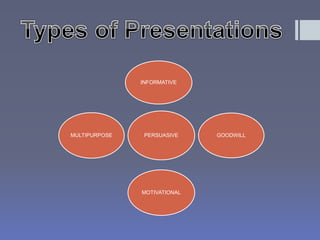
INFORMATIVE 
PERSUASIVE 
GOODWILL 
MOTIVATIONAL 
MULTIPURPOSE
Persuasive Presentations 
• These are the presentations in which you attempt to convince the 
audience to buy your product or service. 
• Persuasive presentations, which are sometimes called transactional, are 
often motivational. 
• For example 
 A college dorm proctor, during a presentation to new freshmen, may 
try to motivate the students in her care to avoid drugs, alcohol, and 
unprotected sex
Goodwill Presentations 
• Goodwill presentations, which often take the form of after-dinner speeches, 
are often designed to be entertaining--for example, by sharing video 
highlights of the football or tennis season. 
• The purpose of goodwill presentations is pretty obvious. 
• That purpose is to build goodwill, to make people feel good about 
themselves. 
Informative Presentations 
• Informational presentations include talks, seminars, the presenter or 
presenters share their expertise, and information is exchanged. 
• During the sales process, the sales person may provide information on the 
product or service to a prospective customer. 
• And in an educational setting, an informative presentation may report on 
changes in the reading curriculum.
Multipurpose Presentations 
• Presentations, however, usually have more than one purpose. 
• A presentation to employees may be announced as an informative session 
on new regulations, but in fact may also be an all out effort to persuade 
workers to buy into the new rules. 
Motivation Presentations 
• Motivation is another form of persuasion, but one that somehow takes on a 
more fervent, highly charged tone. 
• Motivational presenters must know what makes the audience tick and zero 
in on their hot buttons. 
• They also must use high-energy presenting tactics in order to capture the 
audience's attention for the entire message.
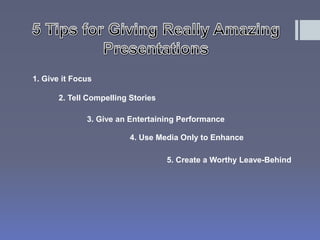
1. Give it Focus 
2. Tell Compelling Stories 
3. Give an Entertaining Performance 
4. Use Media Only to Enhance 
5. Create a Worthy Leave-Behind
• No one is impressed by a presentation that rambles. 
• Rambling happens when the speaker is both self-indulgent and 
unorganized. 
• Outline the structure of your presentation in a way that people can 
follow easily. 
• There must be a reason you are presenting to these people. Most 
likely you want them to take action of some kind. 
• You need to connect with them emotionally and inspire them to 
change behavior. 
• Not every presenter has to be an actor or comedian, but no one 
wants to listen to someone drone on in dull monotone. 
• Give them an awesome experience. 
• Make your audience knows they are worth your effort.
• PowerPoint, visuals and video are powerful presentation tools when used 
correctly. 
• But they can be disastrous distractions when misused. 
• So you just delivered the best presentation ever. 
• Now your audience heads off to the next speaker, to lunch or back to their 
desks. 
• Give them something to remember you by. 
• Be clever and appropriate so people will appreciate your thoughtfulness 
as well as your ideas.
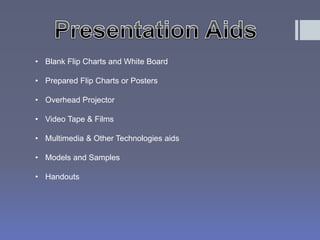
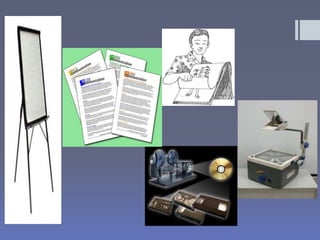
• Blank Flip Charts and White Board 
• Prepared Flip Charts or Posters 
• Overhead Projector 
• Video Tape & Films 
• Multimedia & Other Technologies aids 
• Models and Samples 
• Handouts
• Boredom is an emotional state experienced when an individual is left 
without anything in particular to do, and not interested in their 
surroundings. 
• We have all experienced boredom. 
• Sitting in a class where the teacher is droning on about a topic you don’t 
care about, you may find yourself daydreaming or staring at a clock that 
doesn’t seem to be moving. 
• Waiting for a delayed flight to take off at the airport, you may search in 
vain for something to distract you. 
• Boredom is unpleasant and physically painful. 
• It can make you angry and frustrated. 
• Boredom can also influence your actions in negative ways.
• A major cause of boredom is lack of variety. 
• Human beings appear to have a need for changes of stimulation. 
• Imagine yourself confined to a small room with no windows, no 
telephone, no television set, no books to read, no interesting pictures 
on the wall, and no visitors. 
• You probably would soon find yourself unbearably bored.
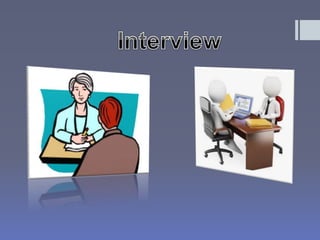
• An interview is a conversation between two or more people 
where questions are asked by the interviewer to elicit facts or 
statements from the interviewee. 
• Interviews are a standard part of journalism and media reporting, but 
are also employed in many other situations, including qualitative 
research. 
• Interviews are conducted for employee selection , appraisal , 
counseling, grievance Redressal and other purposes. 
• Interviews can be for informal or formal , structured or unstructured , 
depth, group , stress and board interview
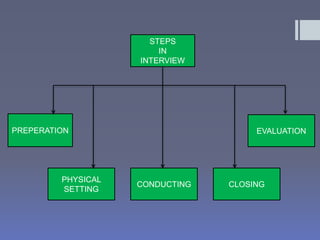
STEPS 
IN 
INTERVIEW 
PREPERATION 
PHYSICAL 
SETTING 
EVALUATION 
CONDUCTING CLOSING
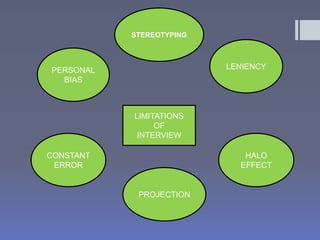
LIMITATIONS 
OF 
INTERVIEW 
HALO 
EFFECT 
PERSONAL 
BIAS 
STEREOTYPING 
PROJECTION 
LENIENCY 
CONSTANT 
ERROR
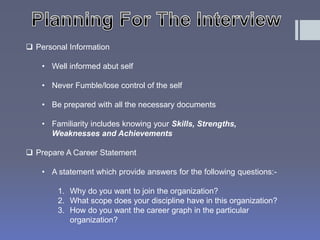
 Personal Information 
• Well informed abut self 
• Never Fumble/lose control of the self 
• Be prepared with all the necessary documents 
• Familiarity includes knowing your Skills, Strengths, 
Weaknesses and Achievements 
 Prepare A Career Statement 
• A statement which provide answers for the following questions:- 
1. Why do you want to join the organization? 
2. What scope does your discipline have in this organization? 
3. How do you want the career graph in the particular 
organization?
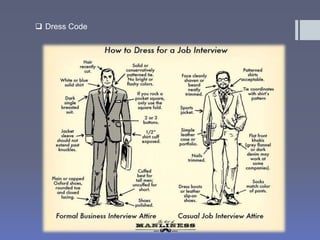
 Dress Code
 Detection Process 
• Prepare the anticipated questions well in advance 
• Most of the questions are linked to your personality 
• Be prepared to answer the likely questions 
 Practice Before The Mirror 
• Practice by speaking in front of the mirror 
• Self Analysis of the self will bring true results only 
• Change the strategies accordingly
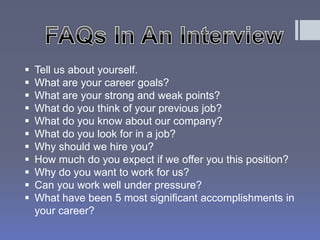
 Tell us about yourself. 
 What are your career goals? 
 What are your strong and weak points? 
 What do you think of your previous job? 
 What do you know about our company? 
 What do you look for in a job? 
 Why should we hire you? 
 How much do you expect if we offer you this position? 
 Why do you want to work for us? 
 Can you work well under pressure? 
 What have been 5 most significant accomplishments in 
your career?
Presentations and Interviews

Presentations and Interviews

  • 1.
  • 2.
    • A Presentationis the process of presenting a topic to an audience. • It is typically a demonstration, lecture or speech meant to inform, persuade, or build goodwill. • The process of offering for consideration or display. • A social introduction, as of a person at court. • A demonstration, lecture, or welcoming speech. • A manner or style of speaking, instructing or putting oneself forward. • The manner of presenting, especially the organization of visual details to create an overall impression.
  • 3.
    INFORMATIVE PERSUASIVE GOODWILL MOTIVATIONAL MULTIPURPOSE
  • 4.
    Persuasive Presentations •These are the presentations in which you attempt to convince the audience to buy your product or service. • Persuasive presentations, which are sometimes called transactional, are often motivational. • For example  A college dorm proctor, during a presentation to new freshmen, may try to motivate the students in her care to avoid drugs, alcohol, and unprotected sex
  • 5.
    Goodwill Presentations •Goodwill presentations, which often take the form of after-dinner speeches, are often designed to be entertaining--for example, by sharing video highlights of the football or tennis season. • The purpose of goodwill presentations is pretty obvious. • That purpose is to build goodwill, to make people feel good about themselves. Informative Presentations • Informational presentations include talks, seminars, the presenter or presenters share their expertise, and information is exchanged. • During the sales process, the sales person may provide information on the product or service to a prospective customer. • And in an educational setting, an informative presentation may report on changes in the reading curriculum.
  • 6.
    Multipurpose Presentations •Presentations, however, usually have more than one purpose. • A presentation to employees may be announced as an informative session on new regulations, but in fact may also be an all out effort to persuade workers to buy into the new rules. Motivation Presentations • Motivation is another form of persuasion, but one that somehow takes on a more fervent, highly charged tone. • Motivational presenters must know what makes the audience tick and zero in on their hot buttons. • They also must use high-energy presenting tactics in order to capture the audience's attention for the entire message.
  • 7.
    1. Give itFocus 2. Tell Compelling Stories 3. Give an Entertaining Performance 4. Use Media Only to Enhance 5. Create a Worthy Leave-Behind
  • 8.
    • No oneis impressed by a presentation that rambles. • Rambling happens when the speaker is both self-indulgent and unorganized. • Outline the structure of your presentation in a way that people can follow easily. • There must be a reason you are presenting to these people. Most likely you want them to take action of some kind. • You need to connect with them emotionally and inspire them to change behavior. • Not every presenter has to be an actor or comedian, but no one wants to listen to someone drone on in dull monotone. • Give them an awesome experience. • Make your audience knows they are worth your effort.
  • 9.
    • PowerPoint, visualsand video are powerful presentation tools when used correctly. • But they can be disastrous distractions when misused. • So you just delivered the best presentation ever. • Now your audience heads off to the next speaker, to lunch or back to their desks. • Give them something to remember you by. • Be clever and appropriate so people will appreciate your thoughtfulness as well as your ideas.
  • 10.
    • Blank FlipCharts and White Board • Prepared Flip Charts or Posters • Overhead Projector • Video Tape & Films • Multimedia & Other Technologies aids • Models and Samples • Handouts
  • 12.
    • Boredom isan emotional state experienced when an individual is left without anything in particular to do, and not interested in their surroundings. • We have all experienced boredom. • Sitting in a class where the teacher is droning on about a topic you don’t care about, you may find yourself daydreaming or staring at a clock that doesn’t seem to be moving. • Waiting for a delayed flight to take off at the airport, you may search in vain for something to distract you. • Boredom is unpleasant and physically painful. • It can make you angry and frustrated. • Boredom can also influence your actions in negative ways.
  • 14.
    • A majorcause of boredom is lack of variety. • Human beings appear to have a need for changes of stimulation. • Imagine yourself confined to a small room with no windows, no telephone, no television set, no books to read, no interesting pictures on the wall, and no visitors. • You probably would soon find yourself unbearably bored.
  • 16.
    • An interviewis a conversation between two or more people where questions are asked by the interviewer to elicit facts or statements from the interviewee. • Interviews are a standard part of journalism and media reporting, but are also employed in many other situations, including qualitative research. • Interviews are conducted for employee selection , appraisal , counseling, grievance Redressal and other purposes. • Interviews can be for informal or formal , structured or unstructured , depth, group , stress and board interview
  • 17.
    STEPS IN INTERVIEW PREPERATION PHYSICAL SETTING EVALUATION CONDUCTING CLOSING
  • 18.
    LIMITATIONS OF INTERVIEW HALO EFFECT PERSONAL BIAS STEREOTYPING PROJECTION LENIENCY CONSTANT ERROR
  • 19.
     Personal Information • Well informed abut self • Never Fumble/lose control of the self • Be prepared with all the necessary documents • Familiarity includes knowing your Skills, Strengths, Weaknesses and Achievements  Prepare A Career Statement • A statement which provide answers for the following questions:- 1. Why do you want to join the organization? 2. What scope does your discipline have in this organization? 3. How do you want the career graph in the particular organization?
  • 20.
  • 21.
     Detection Process • Prepare the anticipated questions well in advance • Most of the questions are linked to your personality • Be prepared to answer the likely questions  Practice Before The Mirror • Practice by speaking in front of the mirror • Self Analysis of the self will bring true results only • Change the strategies accordingly
  • 22.
     Tell usabout yourself.  What are your career goals?  What are your strong and weak points?  What do you think of your previous job?  What do you know about our company?  What do you look for in a job?  Why should we hire you?  How much do you expect if we offer you this position?  Why do you want to work for us?  Can you work well under pressure?  What have been 5 most significant accomplishments in your career?