• FATCA stands for the Foreign Account Tax Compliance Act. It 
was signed into law on March 18, 2010 and is effective 
from January 1, 2013. 
• FATCA is a United States federal law that requires United States 
persons including individuals who live outside the U.S, to report 
their Financial Accounts Held outside the U.S. 
• It further requires FFI (Foreign Financial Institutions) to report 
to the IRS (Internal Revenue Services) about their U.S clients.
• FATCA is intended to increase transparency for the Internal 
Revenue Service (IRS) with respect to U.S. persons that may be 
investing and earning income through non-U.S. institutions. 
• While the primary goal of FATCA is to gain information about 
U.S. persons. 
• FATCA imposes tax withholding where the applicable 
documentation and reporting requirements are not met. 
• While FATCA certainly affects U.S. withholding agents and U.S. 
multinational companies, the greatest impact will likely be to 
Foreign Financial Institutions (FFIs).
• An FFI is any foreign entity that : 
 Accepts deposits in the ordinary course of a banking or similar 
business 
 As a substantial portion of its business holds financial assets for 
the account of others; or 
 Is engaged (or holding itself out as being engaged) primarily in 
the business of investing, reinvesting, or trading in securities, 
partnership interests, commodities, or any interest (including a 
futures or forward contract or option) in such securities, 
partnership interests, or commodities.
• Non-Financial Foreign Entity: A foreign entity that is excluded 
from the definition of FFI. 
• TYPES : 
A. Corporation with stock traded on established securities market 
B. Affiliated group of those corporations 
C. Entity organized in U.S. Territory and owned by its residents 
D. Foreign government 
E. International organization 
F. Foreign Central Bank of Issue 
G. Any other specifically identified class, including those posing a 
low risk of tax evasion, as determined by the IRS.
• GIIN means a Global Intermediary Identification Number assigned 
to a PFFI or Registered Deemed Compliant FFI. 
• A separate GIIN will be issued to the FI to identify each jurisdiction, 
including the FI’s jurisdiction of residence, in which the FI maintains a 
branch that is not treated as a Limited Branch. 
• The GIIN may be used by an FI to identify itself to withholding agents 
and tax administrations for FATCA reporting.
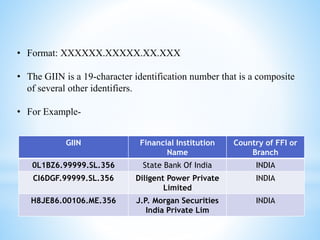
GIIN Financial Institution 
Name 
Country of FFI or 
Branch 
0L1BZ6.99999.SL.356 State Bank Of India INDIA 
CI6DGF.99999.SL.356 Diligent Power Private 
Limited 
INDIA 
H8JE86.00106.ME.356 J.P. Morgan Securities 
India Private Lim 
INDIA 
• Format: XXXXXX.XXXXX.XX.XXX 
• The GIIN is a 19-character identification number that is a composite 
of several other identifiers. 
• For Example-
• Preliminary guidance from the IRS indicates that a grandfathered obligation is 
defined as any legal agreement that produces or could produce withholdable 
payments, but does not include any instrument that is treated as equity for US 
tax purposes, or any legal agreement that lacks a definitive expiration or term 
(examples include savings, deposits, demand deposits , and other similar 
accounts). 
• A grandfathered obligation is an obligation that is outstanding on March 18, 
2012 (two years from the date that FATCA was signed into law). 
• Interest on a grandfathered obligation is exempt from FATCA withholding, and 
gross proceeds from the sale or other disposition of a grandfathered obligation 
is also exempt from FATCA withholding.
• "Due diligence" is an investigation of a business or person prior to signing a 
contract, or an act with a certain standard of care . 
• The FATCA rules impose detailed due diligence and reporting requirements for 
FFIs. 
• An FFI generally will be subject to the 30% U.S. withholding tax on 
withholdable payments unless it becomes a “participating FFI” by entering into 
an agreement with the IRS . 
• The due diligence requirements under an FFI agreement:- 
 For preexisting entity accounts, a participating FFI generally must complete 
the required diligence within 6 months of the effective date of its FFI 
agreement(generally June 30, 2014) for any account holder that is a “prima 
facie FFI . 
 For preexisting individual accounts, a participating FFI generally must 
complete the required diligence within one year of the effective date of its 
FFI agreement(generally December 31, 2014) for “high-value accounts” 
(i.e., accounts having a balance or value that exceeds $1 million).
• Any financial account held by specified U.S. Persons or U.S. Owned 
Foreign Entities. 
• Any of the following which may indicate U.S. status: 
A. U.S. citizenship or permanent residence 
B. U.S. address (resident or correspondence) 
C. U.S. place of birth 
D. U.S. telephone number 
E. Power of Attorney or signatory authority granted to person 
with U.S. address 
F. Standing instructions to transfer funds to account maintained in 
the U.S. or directions received from a U.S. address.
• Any Account with a holder who: 
 Fails to comply with FFI requests for information to confirm 
identity, or 
 Fails to provide a waiver allowing disclosure of information 
to the IRS where such disclosure is prevented by a foreign 
privacy law. 
 Fails to provide the name, address, and TIN of each 
“specified United States person” and each substantial United 
States owner of a United States owned foreign entity.
• In general, a withholding agent is required to withhold 30% on a 
withholdable payment made to a Foreign Financial Institution 
(FFI) or to a Non-Financial Foreign Entity (NFFE), unless the FFI 
or NFFE meets certain requirements. 
• In addition, an FFI must withhold 30% on any passthru payment it 
makes to a recalcitrant account holder, as well as to payments it 
makes to another FFI unless that FFI meets certain requirements
• All persons having control, receipt, custody, disposal or payment 
of any withholdable payment. 
• Any of the following: 
A. U.S. source dividends, interest and other periodic payments 
B. Gross proceeds from the sale of property that can produce 
U.S. source income 
C. Deposit interest paid by foreign branches of U.S. banks.
• Under the Model IGA, Foreign Financial institutions (FFIs) in 
partner jurisdictions will report information on U.S. account 
holders to their national tax authorities, which in turn will provide 
this information into the U.S. under an automatic exchange of 
information. 
IGA 
MODELS 
IGA 1 IGA 2
Intergovernmental Agreement Model 1 
• In July 2012, the U.S. Treasury Department issued the first model 
for an Intergovernmental Agreement (IGA) which makes it easier 
for partner countries to comply with the provisions of FATCA. 
• The IGA provides for a partnership agreement between the U.S. 
and a FATCA Partnership jurisdiction, namely France, Germany, 
Italy and Spain with the United Kingdom first to sign the IGA 
agreement. 
Intergovernmental Agreement Model 2 
• On November 15, 2012, the U.S. Treasury Department issued the 
second model of the Intergovernmental Agreement (IGA) for 
complying with the FATCA provisions. 
• The model 2 IGA reflects the framework that was described in the 
joint statements by U.S. and Switzerland and U.S. and Japan earlier 
in the year.
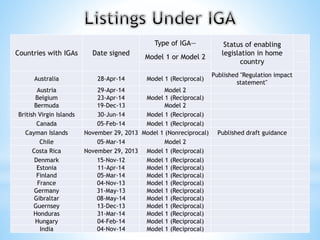
Countries with IGAs Date signed 
Type of IGA— Status of enabling 
legislation in home 
country 
Model 1 or Model 2 
Australia 28-Apr-14 Model 1 (Reciprocal) 
Published "Regulation impact 
statement" 
Austria 29-Apr-14 Model 2 
Belgium 23-Apr-14 Model 1 (Reciprocal) 
Bermuda 19-Dec-13 Model 2 
British Virgin Islands 30-Jun-14 Model 1 (Reciprocal) 
Canada 05-Feb-14 Model 1 (Reciprocal) 
Cayman Islands November 29, 2013 Model 1 (Nonreciprocal) Published draft guidance 
Chile 05-Mar-14 Model 2 
Costa Rica November 29, 2013 Model 1 (Reciprocal) 
Denmark 15-Nov-12 Model 1 (Reciprocal) 
Estonia 11-Apr-14 Model 1 (Reciprocal) 
Finland 05-Mar-14 Model 1 (Reciprocal) 
France 04-Nov-13 Model 1 (Reciprocal) 
Germany 31-May-13 Model 1 (Reciprocal) 
Gibraltar 08-May-14 Model 1 (Reciprocal) 
Guernsey 13-Dec-13 Model 1 (Reciprocal) 
Honduras 31-Mar-14 Model 1 (Reciprocal) 
Hungary 04-Feb-14 Model 1 (Reciprocal) 
India 04-Nov-14 Model 1 (Reciprocal)
Ireland 21-Dec-12 Model 1 (Reciprocal) 
Published draft of the 
"Financial Accounts 
Reporting Regulations 2012" 
Isle of Man 13-Dec-13 Model 1 (Reciprocal) 
Israel 30-Jun-14 Model 1 (Reciprocal) 
Italy 10-Jan-14 Model 1 (Reciprocal) 
Jamaica 02-May-14 Model 1 (Reciprocal) 
Japan 11-Jun-13 Model 2 
Jersey 13-Dec-13 Model 1 (Reciprocal) 
Latvia 27-Jun-14 Model 1 (Reciprocal) 
Liechtenstein 19-May-14 Model 1 (Reciprocal) 
Published draft legislation 
on July 1, 2014 
Luxembourg 28-Mar-14 Model 1 (Reciprocal) 
Malta 16-Dec-13 Model 1 (Reciprocal) 
Mauritius 27-Dec-13 Model 1 (Reciprocal) 
Mexico 19-Nov-12 Model 1 (Reciprocal) 
Netherlands 18-Dec-13 Model 1 (Reciprocal) 
New Zealand 12-Jun-14 Model 1 (Reciprocal) 
Norway 15-Apr-13 Model 1 (Reciprocal) 
Slovenia 02-Jun-14 Model 1 (Reciprocal) 
South Africa 09-Jun-14 Model 1 (Reciprocal) 
Spain 14-May-13 Model 1 (Reciprocal) 
Switzerland 14-Feb-13 Model 2 
United Kingdom 14-Sep-12 Model 1 (Reciprocal) 
Published the “International 
Tax Compliance Regulations 
2013.”
• For Individuals, accounts less than $50k is deemed out of scope 
for FATCA purposes. 
• Fund managers will also only have to manually review paper 
records where the accounts are in excess of $1 million USD. 
• Similarly for entities, it is $250k and FFI’s can use existing KYC 
processes to identify the FATCA status of their existing accounts.
Aggregate Balance: It means that an amount which is made up of 
several smaller amounts added together . It is the 
combined total of all account or loan relationships 
with the credit union. 
• An electronic search for U.S. indicia generally suffices for all accounts 
with aggregate balances up to $1 million; accounts aggregating $50,000 
or less ($250,000 or less in the case of cash value insurance or annuity 
contracts) need not be searched at all until the account balance exceeds 
$1 million.
• The Caribbean financial executives have bemoaned what they deem 
as an uneven playing field in negotiations towards compliance of the 
US Foreign Account Tax Compliance Act (FATCA). 
• The controversial law demands that foreign banks provide 
information to America's Internal Revenue Service (IRS) on any 
customer deemed a "US person" if they have more than US$50,000. 
• It aims to crack down on tax dodgers who hide hundreds of millions 
of US dollars in offshore accounts annually in an effort to avoid 
paying Washington its due. 
• Jamaica and other Caricom member states are currently negotiating 
individual inter-governmental agreements (IGAs) with the 
Americans.
• Jamaican financial institutions face a cost-crunching dilemma in the 
form of a new US tax compliance rule requiring them to release personal 
financial information of clients to American authorities. 
• It has costed banks tens of millions of dollars. 
• For they choose to comply with the Foreign Account Tax Compliance 
Act (FATCA), which became effective on January1st 2013. 
• The act required financial institutions around the world to report the 
names and tax identification numbers of "US persons" with balances 
above US$50,000 ($4.3 million) to the Internal Revenue Service (IRS). 
• Implementation costs of FATCA alone – when financial institutions 
choose to comply - was from US$100,000 to upwards of US$1 million.
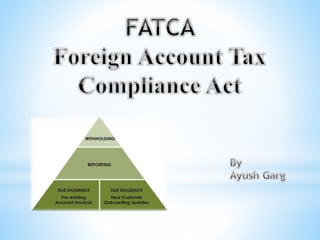
FATCA OVERVIEW

FATCA OVERVIEW

  • 2.
    • FATCA standsfor the Foreign Account Tax Compliance Act. It was signed into law on March 18, 2010 and is effective from January 1, 2013. • FATCA is a United States federal law that requires United States persons including individuals who live outside the U.S, to report their Financial Accounts Held outside the U.S. • It further requires FFI (Foreign Financial Institutions) to report to the IRS (Internal Revenue Services) about their U.S clients.
  • 3.
    • FATCA isintended to increase transparency for the Internal Revenue Service (IRS) with respect to U.S. persons that may be investing and earning income through non-U.S. institutions. • While the primary goal of FATCA is to gain information about U.S. persons. • FATCA imposes tax withholding where the applicable documentation and reporting requirements are not met. • While FATCA certainly affects U.S. withholding agents and U.S. multinational companies, the greatest impact will likely be to Foreign Financial Institutions (FFIs).
  • 4.
    • An FFIis any foreign entity that :  Accepts deposits in the ordinary course of a banking or similar business  As a substantial portion of its business holds financial assets for the account of others; or  Is engaged (or holding itself out as being engaged) primarily in the business of investing, reinvesting, or trading in securities, partnership interests, commodities, or any interest (including a futures or forward contract or option) in such securities, partnership interests, or commodities.
  • 5.
    • Non-Financial ForeignEntity: A foreign entity that is excluded from the definition of FFI. • TYPES : A. Corporation with stock traded on established securities market B. Affiliated group of those corporations C. Entity organized in U.S. Territory and owned by its residents D. Foreign government E. International organization F. Foreign Central Bank of Issue G. Any other specifically identified class, including those posing a low risk of tax evasion, as determined by the IRS.
  • 6.
    • GIIN meansa Global Intermediary Identification Number assigned to a PFFI or Registered Deemed Compliant FFI. • A separate GIIN will be issued to the FI to identify each jurisdiction, including the FI’s jurisdiction of residence, in which the FI maintains a branch that is not treated as a Limited Branch. • The GIIN may be used by an FI to identify itself to withholding agents and tax administrations for FATCA reporting.
  • 7.
    GIIN Financial Institution Name Country of FFI or Branch 0L1BZ6.99999.SL.356 State Bank Of India INDIA CI6DGF.99999.SL.356 Diligent Power Private Limited INDIA H8JE86.00106.ME.356 J.P. Morgan Securities India Private Lim INDIA • Format: XXXXXX.XXXXX.XX.XXX • The GIIN is a 19-character identification number that is a composite of several other identifiers. • For Example-
  • 8.
    • Preliminary guidancefrom the IRS indicates that a grandfathered obligation is defined as any legal agreement that produces or could produce withholdable payments, but does not include any instrument that is treated as equity for US tax purposes, or any legal agreement that lacks a definitive expiration or term (examples include savings, deposits, demand deposits , and other similar accounts). • A grandfathered obligation is an obligation that is outstanding on March 18, 2012 (two years from the date that FATCA was signed into law). • Interest on a grandfathered obligation is exempt from FATCA withholding, and gross proceeds from the sale or other disposition of a grandfathered obligation is also exempt from FATCA withholding.
  • 9.
    • "Due diligence"is an investigation of a business or person prior to signing a contract, or an act with a certain standard of care . • The FATCA rules impose detailed due diligence and reporting requirements for FFIs. • An FFI generally will be subject to the 30% U.S. withholding tax on withholdable payments unless it becomes a “participating FFI” by entering into an agreement with the IRS . • The due diligence requirements under an FFI agreement:-  For preexisting entity accounts, a participating FFI generally must complete the required diligence within 6 months of the effective date of its FFI agreement(generally June 30, 2014) for any account holder that is a “prima facie FFI .  For preexisting individual accounts, a participating FFI generally must complete the required diligence within one year of the effective date of its FFI agreement(generally December 31, 2014) for “high-value accounts” (i.e., accounts having a balance or value that exceeds $1 million).
  • 11.
    • Any financialaccount held by specified U.S. Persons or U.S. Owned Foreign Entities. • Any of the following which may indicate U.S. status: A. U.S. citizenship or permanent residence B. U.S. address (resident or correspondence) C. U.S. place of birth D. U.S. telephone number E. Power of Attorney or signatory authority granted to person with U.S. address F. Standing instructions to transfer funds to account maintained in the U.S. or directions received from a U.S. address.
  • 12.
    • Any Accountwith a holder who:  Fails to comply with FFI requests for information to confirm identity, or  Fails to provide a waiver allowing disclosure of information to the IRS where such disclosure is prevented by a foreign privacy law.  Fails to provide the name, address, and TIN of each “specified United States person” and each substantial United States owner of a United States owned foreign entity.
  • 13.
    • In general,a withholding agent is required to withhold 30% on a withholdable payment made to a Foreign Financial Institution (FFI) or to a Non-Financial Foreign Entity (NFFE), unless the FFI or NFFE meets certain requirements. • In addition, an FFI must withhold 30% on any passthru payment it makes to a recalcitrant account holder, as well as to payments it makes to another FFI unless that FFI meets certain requirements
  • 14.
    • All personshaving control, receipt, custody, disposal or payment of any withholdable payment. • Any of the following: A. U.S. source dividends, interest and other periodic payments B. Gross proceeds from the sale of property that can produce U.S. source income C. Deposit interest paid by foreign branches of U.S. banks.
  • 15.
    • Under theModel IGA, Foreign Financial institutions (FFIs) in partner jurisdictions will report information on U.S. account holders to their national tax authorities, which in turn will provide this information into the U.S. under an automatic exchange of information. IGA MODELS IGA 1 IGA 2
  • 16.
    Intergovernmental Agreement Model1 • In July 2012, the U.S. Treasury Department issued the first model for an Intergovernmental Agreement (IGA) which makes it easier for partner countries to comply with the provisions of FATCA. • The IGA provides for a partnership agreement between the U.S. and a FATCA Partnership jurisdiction, namely France, Germany, Italy and Spain with the United Kingdom first to sign the IGA agreement. Intergovernmental Agreement Model 2 • On November 15, 2012, the U.S. Treasury Department issued the second model of the Intergovernmental Agreement (IGA) for complying with the FATCA provisions. • The model 2 IGA reflects the framework that was described in the joint statements by U.S. and Switzerland and U.S. and Japan earlier in the year.
  • 18.
    Countries with IGAsDate signed Type of IGA— Status of enabling legislation in home country Model 1 or Model 2 Australia 28-Apr-14 Model 1 (Reciprocal) Published "Regulation impact statement" Austria 29-Apr-14 Model 2 Belgium 23-Apr-14 Model 1 (Reciprocal) Bermuda 19-Dec-13 Model 2 British Virgin Islands 30-Jun-14 Model 1 (Reciprocal) Canada 05-Feb-14 Model 1 (Reciprocal) Cayman Islands November 29, 2013 Model 1 (Nonreciprocal) Published draft guidance Chile 05-Mar-14 Model 2 Costa Rica November 29, 2013 Model 1 (Reciprocal) Denmark 15-Nov-12 Model 1 (Reciprocal) Estonia 11-Apr-14 Model 1 (Reciprocal) Finland 05-Mar-14 Model 1 (Reciprocal) France 04-Nov-13 Model 1 (Reciprocal) Germany 31-May-13 Model 1 (Reciprocal) Gibraltar 08-May-14 Model 1 (Reciprocal) Guernsey 13-Dec-13 Model 1 (Reciprocal) Honduras 31-Mar-14 Model 1 (Reciprocal) Hungary 04-Feb-14 Model 1 (Reciprocal) India 04-Nov-14 Model 1 (Reciprocal)
  • 19.
    Ireland 21-Dec-12 Model1 (Reciprocal) Published draft of the "Financial Accounts Reporting Regulations 2012" Isle of Man 13-Dec-13 Model 1 (Reciprocal) Israel 30-Jun-14 Model 1 (Reciprocal) Italy 10-Jan-14 Model 1 (Reciprocal) Jamaica 02-May-14 Model 1 (Reciprocal) Japan 11-Jun-13 Model 2 Jersey 13-Dec-13 Model 1 (Reciprocal) Latvia 27-Jun-14 Model 1 (Reciprocal) Liechtenstein 19-May-14 Model 1 (Reciprocal) Published draft legislation on July 1, 2014 Luxembourg 28-Mar-14 Model 1 (Reciprocal) Malta 16-Dec-13 Model 1 (Reciprocal) Mauritius 27-Dec-13 Model 1 (Reciprocal) Mexico 19-Nov-12 Model 1 (Reciprocal) Netherlands 18-Dec-13 Model 1 (Reciprocal) New Zealand 12-Jun-14 Model 1 (Reciprocal) Norway 15-Apr-13 Model 1 (Reciprocal) Slovenia 02-Jun-14 Model 1 (Reciprocal) South Africa 09-Jun-14 Model 1 (Reciprocal) Spain 14-May-13 Model 1 (Reciprocal) Switzerland 14-Feb-13 Model 2 United Kingdom 14-Sep-12 Model 1 (Reciprocal) Published the “International Tax Compliance Regulations 2013.”
  • 20.
    • For Individuals,accounts less than $50k is deemed out of scope for FATCA purposes. • Fund managers will also only have to manually review paper records where the accounts are in excess of $1 million USD. • Similarly for entities, it is $250k and FFI’s can use existing KYC processes to identify the FATCA status of their existing accounts.
  • 21.
    Aggregate Balance: Itmeans that an amount which is made up of several smaller amounts added together . It is the combined total of all account or loan relationships with the credit union. • An electronic search for U.S. indicia generally suffices for all accounts with aggregate balances up to $1 million; accounts aggregating $50,000 or less ($250,000 or less in the case of cash value insurance or annuity contracts) need not be searched at all until the account balance exceeds $1 million.
  • 22.
    • The Caribbeanfinancial executives have bemoaned what they deem as an uneven playing field in negotiations towards compliance of the US Foreign Account Tax Compliance Act (FATCA). • The controversial law demands that foreign banks provide information to America's Internal Revenue Service (IRS) on any customer deemed a "US person" if they have more than US$50,000. • It aims to crack down on tax dodgers who hide hundreds of millions of US dollars in offshore accounts annually in an effort to avoid paying Washington its due. • Jamaica and other Caricom member states are currently negotiating individual inter-governmental agreements (IGAs) with the Americans.
  • 23.
    • Jamaican financialinstitutions face a cost-crunching dilemma in the form of a new US tax compliance rule requiring them to release personal financial information of clients to American authorities. • It has costed banks tens of millions of dollars. • For they choose to comply with the Foreign Account Tax Compliance Act (FATCA), which became effective on January1st 2013. • The act required financial institutions around the world to report the names and tax identification numbers of "US persons" with balances above US$50,000 ($4.3 million) to the Internal Revenue Service (IRS). • Implementation costs of FATCA alone – when financial institutions choose to comply - was from US$100,000 to upwards of US$1 million.

Editor's Notes

  • #8 First 6 digits- FATCA ID ; Next 5 digits-Financial Institution Type ; Next 2 digits - Category Code; Last 3 digits- Country Identifier