Art of Presenting Yourself………!!! CA. Deepak Rajdev
Need- Modern day managers and professionals routinely come across the situations that demand them to speak / presenting themselves in front of large gathering of people. They might be making a presentation, explaining strategies to their business colleagues, conducting training or simply explaining any subject matter.  Thus,  presenting yourself  amongst others is an important aspect of ones personality.
Objective- By the end of the session, you will be able to know:-  Identify the key principles of preparing and delivering a presentation; and review presentations – as a part of the feedback process for continuous improvement.
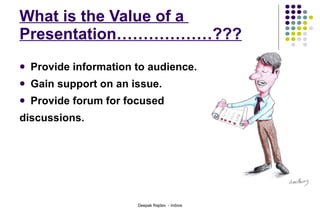
What is the Value of a  Presentation………………??? Provide information to audience. Gain support on an issue. Provide forum for focused  discussions.
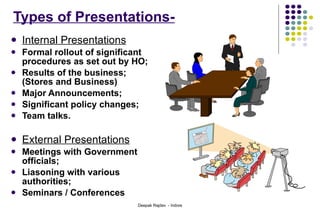
Types of Presentations- Internal Presentations Formal rollout of significant procedures as set out by HO;  Results of the business; (Stores and Business) Major Announcements; Significant policy changes; Team talks. External Presentations Meetings with Government officials; Liasoning with various authorities;  Seminars / Conferences
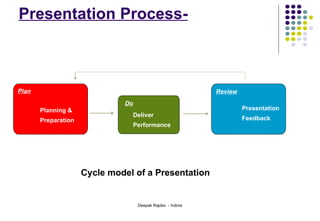
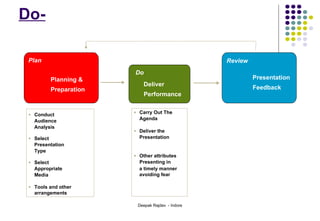
Presentation Process-  Follow - Up on Next  Planning &  Preparation Plan Deliver Performance Do Presentation Feedback Review Cycle model of a Presentation
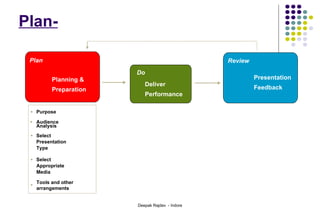
Plan- Planning &  Preparation Plan Deliver Performance Do Presentation Feedback Review  Purpose  Audience Analysis  Select Appropriate  Media  Tools and other  arrangements  Select  Presentation Type 
Purpose- Understanding the purpose is very important and on the basis of the same, one can decide the form: Informative presentation; Persuasive presentation; Entertaining presentation (Not a part of business presentation)
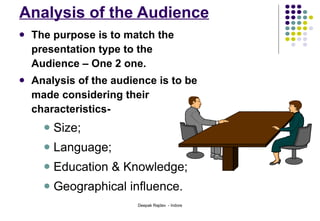
Analysis of the Audience The purpose is to match the presentation type to the Audience – One 2 one.  Analysis of the audience is to be made considering their characteristics-  Size; Language; Education & Knowledge; Geographical influence.
Selecting the suitable type- Type whatsoever is to be selected should have a definite structure or format with a view to generate the desired result. If the ideas are not well established / defined, the audience will not be able to follow the same.  Sequential arguments;  Hierarchical decomposition.
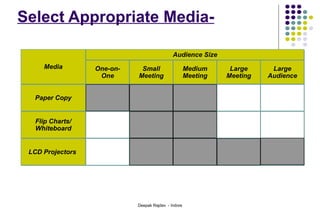
Select Appropriate Media- Media Audience Size One-on- One Small Meeting Medium Meeting Large Meeting Large Audience Paper Copy Flip Charts/ Whiteboard LCD Projectors
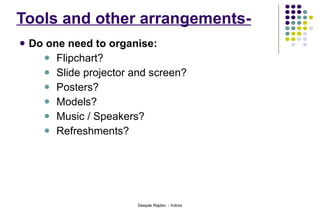
Tools and other arrangements- Do one need to organise: Flipchart? Slide projector and screen? Posters? Models? Music / Speakers? Refreshments?
Do- Planning &  Preparation Plan Deliver Performance Do Presentation Feedback Review  Carry Out The  Agenda  Deliver the Presentation  Other attributes  Presenting in  a timely manner  avoiding fear   Conduct  Audience Analysis  Select Appropriate  Media  Tools and other  arrangements  Select  Presentation Type
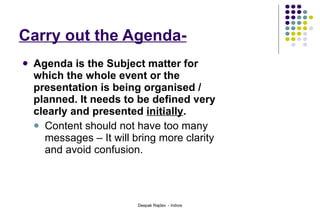
Carry out the Agenda- Agenda is the Subject matter for which the whole event or the presentation is being organised / planned. It needs to be defined very clearly and presented  initially .  Content should not have too many messages – It will bring more clarity and avoid confusion.
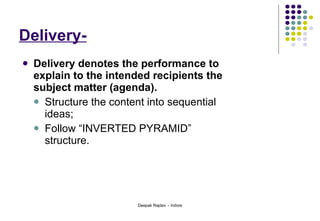
Delivery- Delivery denotes the performance to explain to the intended recipients the subject matter (agenda).  Structure the content into sequential ideas; Follow “INVERTED PYRAMID” structure.
Delivery- Influencing Rapport with the Audience. It includes considering:   Presenter’s distance with the audience;  Presenter’s dress code relative to the  environment – formal OR informal; Volume of the speaker; Pace of delivery.
Delivery- Using slides through the projectors to convey the idea. It includes considering:   Place screen at a convenient place;  Keep slides to a minimum; Don’t overload the slides with lot of information;  Background and layout.
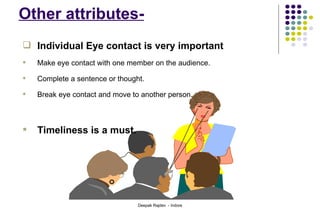
Other attributes- Individual Eye contact is very important Make eye contact with one member on the audience. Complete a sentence or thought. Break eye contact and move to another person. Timeliness is a must.
Other Attributes –  Fear………??? F  – False E  – Evidences A  – Appearing R  – Right……………..
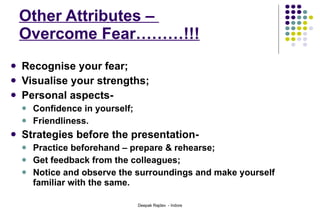
Other Attributes –  Overcome Fear………!!! Recognise your fear; Visualise your strengths; Personal aspects- Confidence in yourself; Friendliness. Strategies before the presentation- Practice beforehand – prepare & rehearse; Get feedback from the colleagues; Notice and observe the surroundings and make yourself familiar with the same.
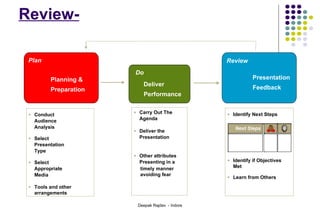
Review- Planning &  Preparation Plan Deliver Performance Do Presentation Feedback Review  Carry Out The  Agenda  Deliver the Presentation  Other attributes Presenting in a  timely manner  avoiding fear  Conduct  Audience Analysis  Select Appropriate  Media  Tools and other  arrangements  Select  Presentation Type  Debrief Immediately  Publish next steps  Follow - Up on Next  Steps  Incorporate Benefits  and Concerns in Next  Meeting Plan  Identify Next Steps  Identify if Objectives Met  Learn from Others Next Steps Next Steps Next Steps Next Steps
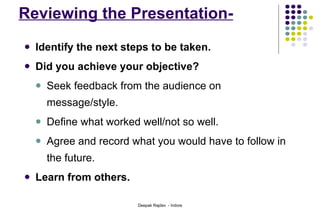
Reviewing the Presentation- Identify the next steps to be taken.  Did you achieve your objective? Seek feedback from the audience on message/style. Define what worked well/not so well. Agree and record what you would have to follow in the future. Learn from others.
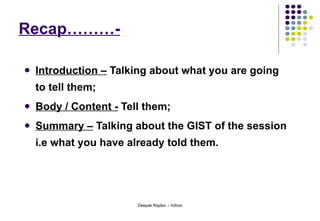
Recap………- Introduction –  Talking about what you are going to tell them; Body / Content -  Tell them; Summary –  Talking about the GIST of the session i.e what you have already told them.
Issues/Discussion? You can contact at 98276 33797 OR  mail at  rajdev [email_address]

Art of Presenting yourself

  • 1.
    Art of PresentingYourself………!!! CA. Deepak Rajdev
  • 2.
    Need- Modern daymanagers and professionals routinely come across the situations that demand them to speak / presenting themselves in front of large gathering of people. They might be making a presentation, explaining strategies to their business colleagues, conducting training or simply explaining any subject matter. Thus, presenting yourself amongst others is an important aspect of ones personality.
  • 3.
    Objective- By theend of the session, you will be able to know:- Identify the key principles of preparing and delivering a presentation; and review presentations – as a part of the feedback process for continuous improvement.
  • 4.
    What is theValue of a Presentation………………??? Provide information to audience. Gain support on an issue. Provide forum for focused discussions.
  • 5.
    Types of Presentations-Internal Presentations Formal rollout of significant procedures as set out by HO; Results of the business; (Stores and Business) Major Announcements; Significant policy changes; Team talks. External Presentations Meetings with Government officials; Liasoning with various authorities; Seminars / Conferences
  • 6.
    Presentation Process- Follow - Up on Next Planning & Preparation Plan Deliver Performance Do Presentation Feedback Review Cycle model of a Presentation
  • 7.
    Plan- Planning & Preparation Plan Deliver Performance Do Presentation Feedback Review  Purpose Audience Analysis  Select Appropriate Media  Tools and other arrangements  Select Presentation Type 
  • 8.
    Purpose- Understanding thepurpose is very important and on the basis of the same, one can decide the form: Informative presentation; Persuasive presentation; Entertaining presentation (Not a part of business presentation)
  • 9.
    Analysis of theAudience The purpose is to match the presentation type to the Audience – One 2 one. Analysis of the audience is to be made considering their characteristics- Size; Language; Education & Knowledge; Geographical influence.
  • 10.
    Selecting the suitabletype- Type whatsoever is to be selected should have a definite structure or format with a view to generate the desired result. If the ideas are not well established / defined, the audience will not be able to follow the same. Sequential arguments; Hierarchical decomposition.
  • 11.
    Select Appropriate Media-Media Audience Size One-on- One Small Meeting Medium Meeting Large Meeting Large Audience Paper Copy Flip Charts/ Whiteboard LCD Projectors
  • 12.
    Tools and otherarrangements- Do one need to organise: Flipchart? Slide projector and screen? Posters? Models? Music / Speakers? Refreshments?
  • 13.
    Do- Planning & Preparation Plan Deliver Performance Do Presentation Feedback Review  Carry Out The Agenda  Deliver the Presentation  Other attributes Presenting in a timely manner avoiding fear  Conduct Audience Analysis  Select Appropriate Media  Tools and other arrangements  Select Presentation Type
  • 14.
    Carry out theAgenda- Agenda is the Subject matter for which the whole event or the presentation is being organised / planned. It needs to be defined very clearly and presented initially . Content should not have too many messages – It will bring more clarity and avoid confusion.
  • 15.
    Delivery- Delivery denotesthe performance to explain to the intended recipients the subject matter (agenda). Structure the content into sequential ideas; Follow “INVERTED PYRAMID” structure.
  • 16.
    Delivery- Influencing Rapportwith the Audience. It includes considering: Presenter’s distance with the audience; Presenter’s dress code relative to the environment – formal OR informal; Volume of the speaker; Pace of delivery.
  • 17.
    Delivery- Using slidesthrough the projectors to convey the idea. It includes considering: Place screen at a convenient place; Keep slides to a minimum; Don’t overload the slides with lot of information; Background and layout.
  • 18.
    Other attributes- IndividualEye contact is very important Make eye contact with one member on the audience. Complete a sentence or thought. Break eye contact and move to another person. Timeliness is a must.
  • 19.
    Other Attributes – Fear………??? F – False E – Evidences A – Appearing R – Right……………..
  • 20.
    Other Attributes – Overcome Fear………!!! Recognise your fear; Visualise your strengths; Personal aspects- Confidence in yourself; Friendliness. Strategies before the presentation- Practice beforehand – prepare & rehearse; Get feedback from the colleagues; Notice and observe the surroundings and make yourself familiar with the same.
  • 21.
    Review- Planning & Preparation Plan Deliver Performance Do Presentation Feedback Review  Carry Out The Agenda  Deliver the Presentation  Other attributes Presenting in a timely manner avoiding fear  Conduct Audience Analysis  Select Appropriate Media  Tools and other arrangements  Select Presentation Type  Debrief Immediately  Publish next steps  Follow - Up on Next Steps  Incorporate Benefits and Concerns in Next Meeting Plan  Identify Next Steps  Identify if Objectives Met  Learn from Others Next Steps Next Steps Next Steps Next Steps
  • 22.
    Reviewing the Presentation-Identify the next steps to be taken. Did you achieve your objective? Seek feedback from the audience on message/style. Define what worked well/not so well. Agree and record what you would have to follow in the future. Learn from others.
  • 23.
    Recap………- Introduction – Talking about what you are going to tell them; Body / Content - Tell them; Summary – Talking about the GIST of the session i.e what you have already told them.
  • 24.
    Issues/Discussion? You cancontact at 98276 33797 OR mail at rajdev [email_address]

Editor's Notes