SOLdering Alloys
       in Reduced Gravity
Background
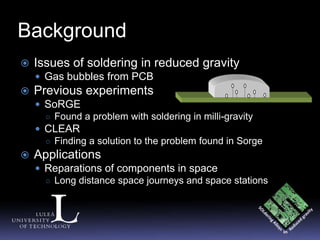
   Issues of soldering in reduced gravity
     Gas bubbles from PCB
   Previous experiments
     SoRGE
      ○ Found a problem with soldering in milli-gravity
     CLEAR
      ○ Finding a solution to the problem found in Sorge
   Applications
     Reparations of components in space
      ○ Long distance space journeys and space stations
Experiment proposal
   Our solution
     Non pressurized enviroment
      ○ Overpressure
     Gas flow
      ○ Internal flux of solder

   Need for a rocket
     Reduced gravity
   The experiment will melt and cool nine
    samples
     Atmosphere
      ○ Reference sample
     Vaccum
     Gas flow
   Additional test done on ground
     Reference sample
How it all works
        The inside
              the outside
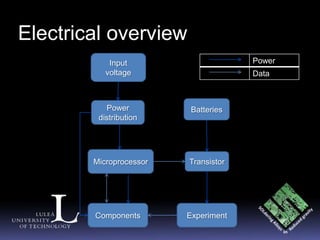
Electrical overview
            Input                     Power
           voltage                    Data


           Power          Batteries
         distribution


        Microprocessor   Transistor


        Components       Experiment
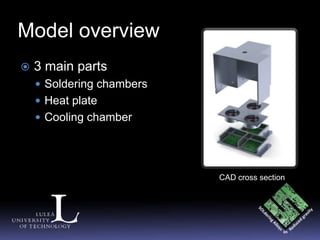
Model overview
   3 main parts
     Soldering chambers
     Heat plate
     Cooling chamber


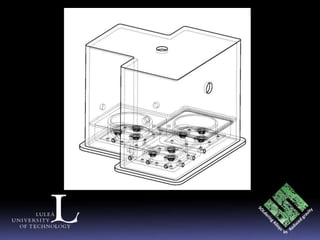
                           CAD cross section
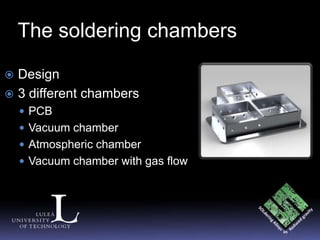
The soldering chambers

 Design
 3 different chambers
     PCB
     Vacuum chamber
     Atmospheric chamber
     Vacuum chamber with gas flow
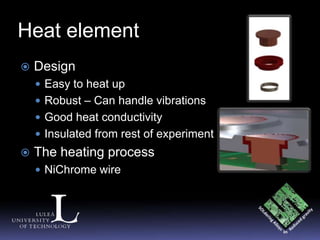
Heat element
   Design
     Easy to heat up
     Robust – Can handle vibrations
     Good heat conductivity
     Insulated from rest of experiment
   The heating process
     NiChrome wire
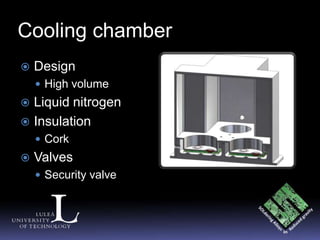
Cooling chamber
   Design
     High volume
 Liquid nitrogen
 Insulation
     Cork
   Valves
     Security valve
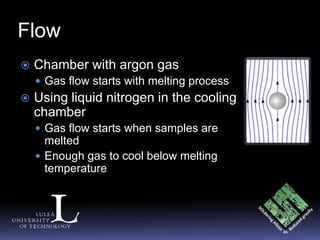
Flow
   Chamber with argon gas
     Gas flow starts with melting process
   Using liquid nitrogen in the cooling
    chamber
     Gas flow starts when samples are
      melted
     Enough gas to cool below melting
      temperature
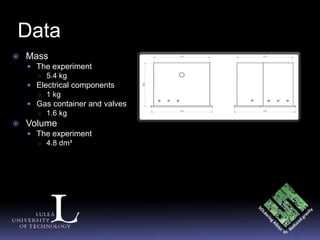
Data
   Mass
     The experiment
      ○ 5.4 kg
     Electrical components
      ○ 1 kg
     Gas container and valves
      ○ 1.6 kg
   Volume
     The experiment
      ○ 4.8 dm³
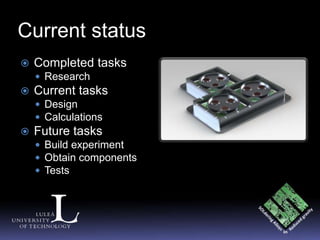
Current status
   Completed tasks
     Research
   Current tasks
     Design
     Calculations
   Future tasks
     Build experiment
     Obtain components
     Tests
Microcontroller and sensors –
                 How it all fits together
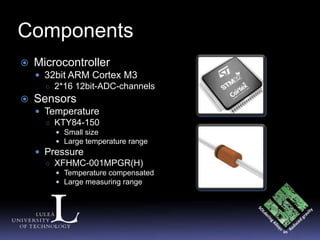
Components
   Microcontroller
     32bit ARM Cortex M3
      ○ 2*16 12bit-ADC-channels
   Sensors
     Temperature
      ○ KTY84-150
         Small size
         Large temperature range
     Pressure
      ○ XFHMC-001MPGR(H)
         Temperature compensated
         Large measuring range
   Batteries
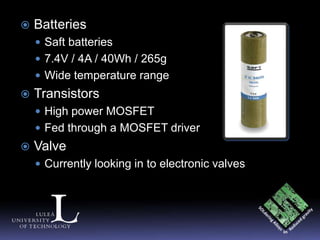
     Saft batteries
     7.4V / 4A / 40Wh / 265g
     Wide temperature range
   Transistors
     High power MOSFET
     Fed through a MOSFET driver
   Valve
     Currently looking in to electronic valves
Analysis of samples
   CT scan
     University in Finland
   Comparing samples
     From same chamber
     Between chambers
     With reference samples
   Compile test data into a report
     Report will evaluate if methods are viable
Our outreach program
               Project funding
                      and supporing professors
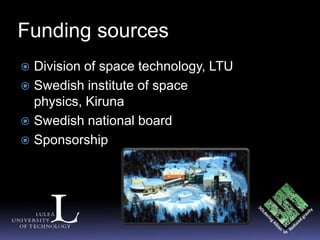
Funding sources
 Division of space technology, LTU
 Swedish institute of space
  physics, Kiruna
 Swedish national board
 Sponsorship
Facilities
   Division of space technology, Kiruna
     Computer simulation tools
     Workshop
   Swedish institute of space
    physics, Kiruna
     Tests and development
   Department of material
    engineering, Luleå
Expert advice
   Department of space science, IRV, Kiruna
     Support from experts in the field of space
      engineering
     Alf Wikström & Kjell Lundin
 Esrange, Kiruna
 Department of material engineering, Luleå
 University lecturer Esa Vuorinen, Material
  science department, Luleå
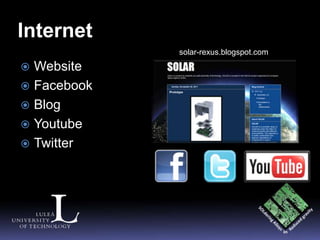
Internet
             solar-rexus.blogspot.com
 Website
 Facebook
 Blog
 Youtube
 Twitter
Media
   Publications in magazines
     Ny Teknik
     Populär astronomi
     Local newspapers
   Television/Radio
Presentations
   Seminars
     Spread intrest of space science
   Luleå university of technology
     Present project to new students
     Introduce Rexus/bexus
   High schools
     Inspire the younger audience
The SOLAR team
      and estimated time plan
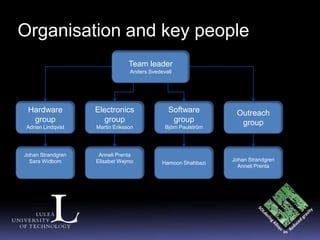
Organisation and key people
                                 Team leader
                                 Anders Svedevall


 Hardware           Electronics                Software          Outreach
  group                group                    group             group
 Adrian Lindqvist   Martin Eriksson           Björn Paulström


Johan Strandgren     Anneli Prenta
  Sara Widbom       Elisabet Wejmo                              Johan Strandgren
                                             Hamoon Shahbazi
                                                                  Anneli Prenta
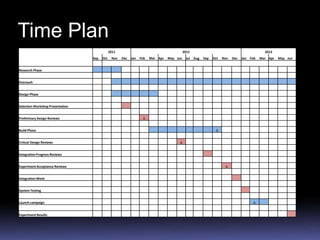
Time Plan
                                              2011                                         2012                                               2013
                                  Sep   Oct    Nov   Dec   Jan   Feb   Mar Apr   May Jun    Jul   Aug   Sep   Oct   Nov   Dec   Jan   Feb   Mar Apr   May Jun


Research Phase


Outreach


Design Phase


Selection Workshop Presentation


Preliminary Design Reviews                                        Δ


Build Phase                                                                                                    Δ


Critical Design Reviews                                                                Δ


Integration Progress Reviews


Experiment Acceptance Reviews                                                                                        Δ


Integration Week


System Testing


Launch campaign                                                                                                                        Δ


Experiment Results
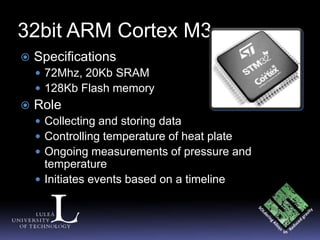
32bit ARM Cortex M3
   Specifications
     72Mhz, 20Kb SRAM
     128Kb Flash memory
   Role
     Collecting and storing data
     Controlling temperature of heat plate
     Ongoing measurements of pressure and
      temperature
     Initiates events based on a timeline
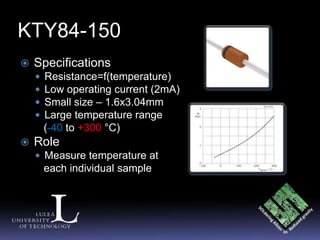
KTY84-150
   Specifications
       Resistance=f(temperature)
       Low operating current (2mA)
       Small size – 1.6x3.04mm
       Large temperature range
        (-40 to +300 °C)
   Role
     Measure temperature at
        each individual sample
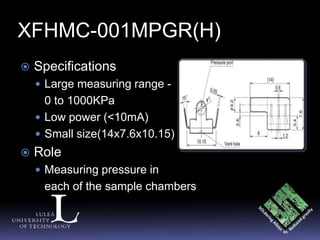
XFHMC-001MPGR(H)
   Specifications
     Large measuring range -
      0 to 1000KPa
     Low power (<10mA)
     Small size(14x7.6x10.15)
   Role
     Measuring pressure in
     each of the sample chambers
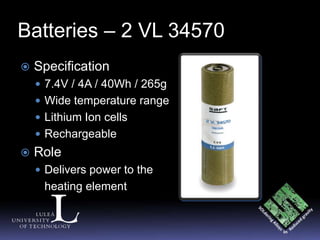
Batteries – 2 VL 34570
   Specification
     7.4V / 4A / 40Wh / 265g
     Wide temperature range
     Lithium Ion cells
     Rechargeable
   Role
     Delivers power to the
     heating element
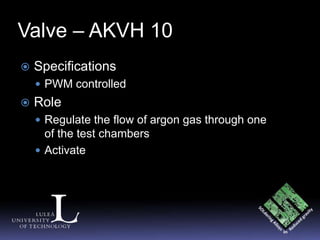
Valve – AKVH 10
   Specifications
     PWM controlled
   Role
     Regulate the flow of argon gas through one
      of the test chambers
     Activate
Transistor
   Specifications
     PWM controlled
   Role
     Regulating current through the heating
     element, which controls temperature.
Presentation2
Presentation2
Presentation2

Presentation2

  • 1.
    SOLdering Alloys in Reduced Gravity
  • 2.
    Background  Issues of soldering in reduced gravity  Gas bubbles from PCB  Previous experiments  SoRGE ○ Found a problem with soldering in milli-gravity  CLEAR ○ Finding a solution to the problem found in Sorge  Applications  Reparations of components in space ○ Long distance space journeys and space stations
  • 3.
    Experiment proposal  Our solution  Non pressurized enviroment ○ Overpressure  Gas flow ○ Internal flux of solder  Need for a rocket  Reduced gravity
  • 4.
    The experiment will melt and cool nine samples  Atmosphere ○ Reference sample  Vaccum  Gas flow  Additional test done on ground  Reference sample
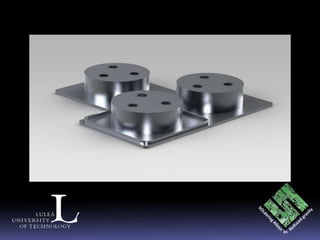
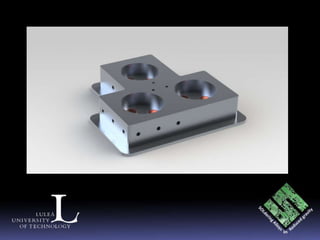
  • 5.
    How it allworks The inside the outside
  • 6.
    Electrical overview Input Power voltage Data Power Batteries distribution Microprocessor Transistor Components Experiment
  • 7.
    Model overview  3 main parts  Soldering chambers  Heat plate  Cooling chamber CAD cross section
  • 8.
    The soldering chambers Design  3 different chambers  PCB  Vacuum chamber  Atmospheric chamber  Vacuum chamber with gas flow
  • 9.
    Heat element  Design  Easy to heat up  Robust – Can handle vibrations  Good heat conductivity  Insulated from rest of experiment  The heating process  NiChrome wire
  • 10.
    Cooling chamber  Design  High volume  Liquid nitrogen  Insulation  Cork  Valves  Security valve
  • 11.
    Flow  Chamber with argon gas  Gas flow starts with melting process  Using liquid nitrogen in the cooling chamber  Gas flow starts when samples are melted  Enough gas to cool below melting temperature
  • 12.
    Data  Mass  The experiment ○ 5.4 kg  Electrical components ○ 1 kg  Gas container and valves ○ 1.6 kg  Volume  The experiment ○ 4.8 dm³
  • 13.
    Current status  Completed tasks  Research  Current tasks  Design  Calculations  Future tasks  Build experiment  Obtain components  Tests
  • 14.
    Microcontroller and sensors– How it all fits together
  • 15.
    Components  Microcontroller  32bit ARM Cortex M3 ○ 2*16 12bit-ADC-channels  Sensors  Temperature ○ KTY84-150  Small size  Large temperature range  Pressure ○ XFHMC-001MPGR(H)  Temperature compensated  Large measuring range
  • 16.
    Batteries  Saft batteries  7.4V / 4A / 40Wh / 265g  Wide temperature range  Transistors  High power MOSFET  Fed through a MOSFET driver  Valve  Currently looking in to electronic valves
  • 17.
    Analysis of samples  CT scan  University in Finland  Comparing samples  From same chamber  Between chambers  With reference samples  Compile test data into a report  Report will evaluate if methods are viable
  • 18.
    Our outreach program Project funding and supporing professors
  • 19.
    Funding sources  Divisionof space technology, LTU  Swedish institute of space physics, Kiruna  Swedish national board  Sponsorship
  • 20.
    Facilities  Division of space technology, Kiruna  Computer simulation tools  Workshop  Swedish institute of space physics, Kiruna  Tests and development  Department of material engineering, Luleå
  • 21.
    Expert advice  Department of space science, IRV, Kiruna  Support from experts in the field of space engineering  Alf Wikström & Kjell Lundin  Esrange, Kiruna  Department of material engineering, Luleå  University lecturer Esa Vuorinen, Material science department, Luleå
  • 22.
    Internet solar-rexus.blogspot.com  Website  Facebook  Blog  Youtube  Twitter
  • 23.
    Media  Publications in magazines  Ny Teknik  Populär astronomi  Local newspapers  Television/Radio
  • 24.
    Presentations  Seminars  Spread intrest of space science  Luleå university of technology  Present project to new students  Introduce Rexus/bexus  High schools  Inspire the younger audience
  • 25.
    The SOLAR team and estimated time plan
  • 26.
    Organisation and keypeople Team leader Anders Svedevall Hardware Electronics Software Outreach group group group group Adrian Lindqvist Martin Eriksson Björn Paulström Johan Strandgren Anneli Prenta Sara Widbom Elisabet Wejmo Johan Strandgren Hamoon Shahbazi Anneli Prenta
  • 27.
    Time Plan 2011 2012 2013 Sep Oct Nov Dec Jan Feb Mar Apr May Jun Jul Aug Sep Oct Nov Dec Jan Feb Mar Apr May Jun Research Phase Outreach Design Phase Selection Workshop Presentation Preliminary Design Reviews Δ Build Phase Δ Critical Design Reviews Δ Integration Progress Reviews Experiment Acceptance Reviews Δ Integration Week System Testing Launch campaign Δ Experiment Results
  • 29.
    32bit ARM CortexM3  Specifications  72Mhz, 20Kb SRAM  128Kb Flash memory  Role  Collecting and storing data  Controlling temperature of heat plate  Ongoing measurements of pressure and temperature  Initiates events based on a timeline
  • 30.
    KTY84-150  Specifications  Resistance=f(temperature)  Low operating current (2mA)  Small size – 1.6x3.04mm  Large temperature range (-40 to +300 °C)  Role  Measure temperature at each individual sample
  • 31.
    XFHMC-001MPGR(H)  Specifications  Large measuring range - 0 to 1000KPa  Low power (<10mA)  Small size(14x7.6x10.15)  Role  Measuring pressure in each of the sample chambers
  • 32.
    Batteries – 2VL 34570  Specification  7.4V / 4A / 40Wh / 265g  Wide temperature range  Lithium Ion cells  Rechargeable  Role  Delivers power to the heating element
  • 33.
    Valve – AKVH10  Specifications  PWM controlled  Role  Regulate the flow of argon gas through one of the test chambers  Activate
  • 34.
    Transistor  Specifications  PWM controlled  Role  Regulating current through the heating element, which controls temperature.

Editor's Notes

  • #3 Gas bubbles reduces the quality of the soldesSoRGE: done in pressurized enviromentCLEAR: finding a solution to the problem, simular to our projectApplications: reparing or improve space crafts, save money
  • #4 Gas flow: create a movement in the soldesNeed a rocket: This phenomena only occurs in reduced gravity
  • #5 Additional tests done for comparison
  • #20 We will seek funding from:We will also seek sponsorships for material and components.
  • #21 We will have access to:We will be able to perform tests…The project is also supported by the Depart… where we have access to there facilities.
  • #22 Alf and Kjell, with years of experinence from baloon and rocket campaigns at Esrange in Kiruna are supervising and supporting the SOLAR project In luleå we are supported by the depart….which we can consult if any problems occure. The team will have a close relation to:
  • #23 Internet is a a perfect way to reach a large audience. First of all we will create a website where u can find our contact info, learn more about our experiment and about the Rexus-project. It is also a place where our sponsors can be presented. Facebook allows us to update the audience with news and pictures about the forthcoming of the project and we can easily answer to questions. The blog is a fine way to update with pictures and information about the project. Youtube and twitter belongs to the future part of the outreach program. On youtube we can publish videos of launch and tests during the project and if there is a large audience we will use twitter as a quicker way to post updates about the project.
  • #24 These are a few examples of the magazines that we will contact to be published so that we can intrest others to space science and inspire other students to participate in projects. Television and Radio allows to do the same but reach a wider audience than by magazines.
  • #25 There is a lot of acitivities at the university where we could give a presentation about our experiment but also about the Rexus project. We would also like to give presentations at high schools so that we can inspire them to find an intrest in science but also just to inspire them to continue there studies after high school graduation.
  • #27 Anders – studying towars master in space engineering and participated in The Bexus project Marvel previous year.Adrian – Hard ware coordinator, studying towards master in aerodynamicsBjörn – soft ware coordinator, master in computer science and imbedded systems.Martin – master in spacecraft and instrumentation focusing on development of electronics. Anneli and Johan are the outreach coordinators. I have been responsible for the outreach programs in several different student groups including seeking sponsorships.
  • #29 Eurolaunch gas containerSpace or military components