Blaž Remškar
Research and development
2012 - 2015
Jozef Stefan Institute
October 2012 – February 2015
SensorLab and VESNA
SensorLab is an interdepartmental laboratory within Jozef
Stefan Institute which carries out research and development
related to the Internet of Things.
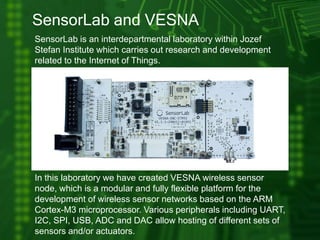
In this laboratory we have created VESNA wireless sensor
node, which is a modular and fully flexible platform for the
development of wireless sensor networks based on the ARM
Cortex-M3 microprocessor. Various peripherals including UART,
I2C, SPI, USB, ADC and DAC allow hosting of different sets of
sensors and/or actuators.
SNE-SENS multisensor board
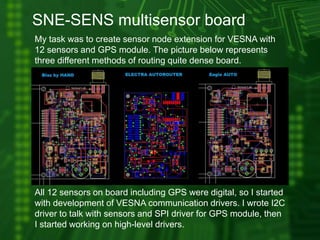
My task was to create sensor node extension for VESNA with
12 sensors and GPS module. The picture below represents
three different methods of routing quite dense board.
All 12 sensors on board including GPS were digital, so I started
with development of VESNA communication drivers. I wrote I2C
driver to talk with sensors and SPI driver for GPS module, then
I started working on high-level drivers.
Drivers for SNE-SENS
In order to use SNE-SENS in VESNA applications I needed to
create drivers for using and controlling sensors and other
devices on board. Below is the list of all my high-level drivers:
All drivers with simple to use user functions were written by
myself in C language using Eclipse IDE and STM32 32-bit ARM
Cortex M3 MCU, which is a core processor on VESNA board.
• IC1 - Temperature TMP75
• IC2 - IR temperature MLX90614
• IC3 - Pressure LPS331AP
• IC4 - Humidity SHT21
• IC5 - Light + PIR SI1143
• IC6 - Color sensor TCS3772
• IC7 - Sound ADMP521
• IC8 - Acceleration MMA8453Q
• IC9 - Compass HMC5883L
• IC10 - Gyroscope L3GD20
• IC11 - Acceleration + Compass LSM303DLHC
• IC12 - GPS module MAX6G (most complicated driver)
SNE-SENS modularity
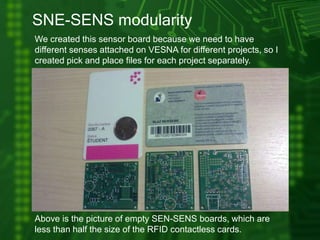
We created this sensor board because we need to have
different senses attached on VESNA for different projects, so I
created pick and place files for each project separately.
Above is the picture of empty SEN-SENS boards, which are
less than half the size of the RFID contactless cards.
CO2 and VOC sensor drivers
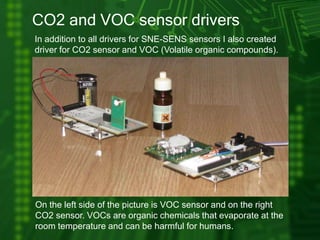
In addition to all drivers for SNE-SENS sensors I also created
driver for CO2 sensor and VOC (Volatile organic compounds).
On the left side of the picture is VOC sensor and on the right
CO2 sensor. VOCs are organic chemicals that evaporate at the
room temperature and can be harmful for humans.
Wireless M-Bus and ZigBee
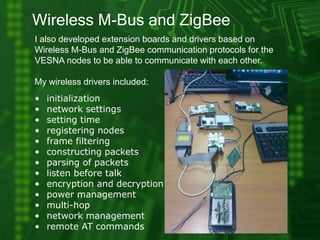
I also developed extension boards and drivers based on
Wireless M-Bus and ZigBee communication protocols for the
VESNA nodes to be able to communicate with each other.
My wireless drivers included:
• initialization
• network settings
• setting time
• registering nodes
• frame filtering
• constructing packets
• parsing of packets
• listen before talk
• encryption and decryption
• power management
• multi-hop
• network management
• remote AT commands
Testing regularly and constantly
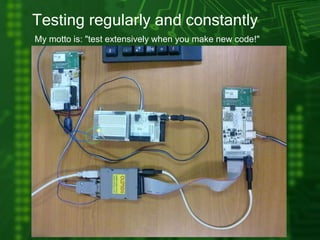
My motto is: "test extensively when you make new code!"
Smart AC power plug application
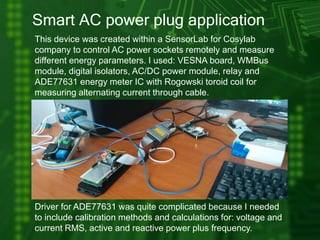
This device was created within a SensorLab for Cosylab
company to control AC power sockets remotely and measure
different energy parameters. I used: VESNA board, WMBus
module, digital isolators, AC/DC power module, relay and
ADE77631 energy meter IC with Rogowski toroid coil for
measuring alternating current through cable.
Driver for ADE77631 was quite complicated because I needed
to include calibration methods and calculations for: voltage and
current RMS, active and reactive power plus frequency.
Wireless outdoor weather station
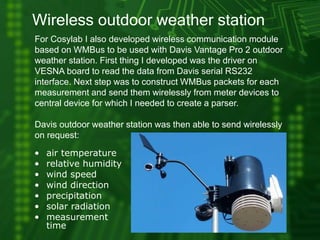
For Cosylab I also developed wireless communication module
based on WMBus to be used with Davis Vantage Pro 2 outdoor
weather station. First thing I developed was the driver on
VESNA board to read the data from Davis serial RS232
interface. Next step was to construct WMBus packets for each
measurement and send them wirelessly from meter devices to
central device for which I needed to create a parser.
Davis outdoor weather station was then able to send wirelessly
on request:
• air temperature
• relative humidity
• wind speed
• wind direction
• precipitation
• solar radiation
• measurement
time
Sensee (AirBubble) project
From January 2013
AirBubble device development
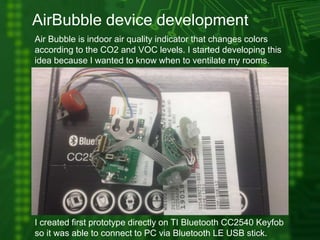
Air Bubble is indoor air quality indicator that changes colors
according to the CO2 and VOC levels. I started developing this
idea because I wanted to know when to ventilate my rooms.
I created first prototype directly on TI Bluetooth CC2540 Keyfob
so it was able to connect to PC via Bluetooth LE USB stick.
AirBubble device development
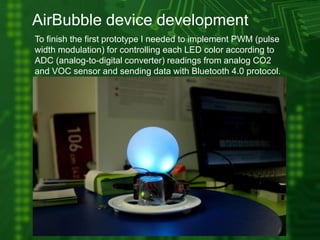
To finish the first prototype I needed to implement PWM (pulse
width modulation) for controlling each LED color according to
ADC (analog-to-digital converter) readings from analog CO2
and VOC sensor and sending data with Bluetooth 4.0 protocol.
AirBubble device development
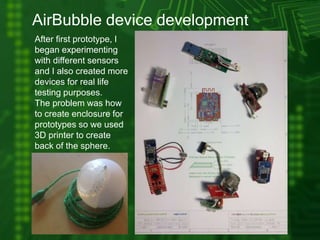
After first prototype, I
began experimenting
with different sensors
and I also created more
devices for real life
testing purposes.
The problem was how
to create enclosure for
prototypes so we used
3D printer to create
back of the sphere.
AirBubble device development
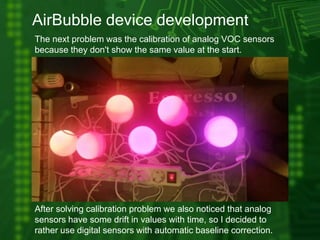
The next problem was the calibration of analog VOC sensors
because they don't show the same value at the start.
After solving calibration problem we also noticed that analog
sensors have some drift in values with time, so I decided to
rather use digital sensors with automatic baseline correction.
AirBubble device development
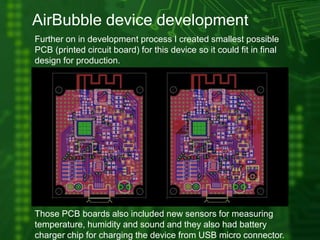
Further on in development process I created smallest possible
PCB (printed circuit board) for this device so it could fit in final
design for production.
Those PCB boards also included new sensors for measuring
temperature, humidity and sound and they also had battery
charger chip for charging the device from USB micro connector.
AirBubble device development
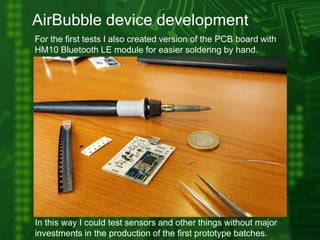
For the first tests I also created version of the PCB board with
HM10 Bluetooth LE module for easier soldering by hand.
Bluetooth LE module
In this way I could test sensors and other things without major
investments in the production of the first prototype batches.
AirBubble device development
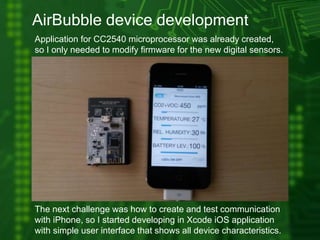
Application for CC2540 microprocessor was already created,
so I only needed to modify firmware for the new digital sensors.
The next challenge was how to create and test communication
with iPhone, so I started developing in Xcode iOS application
with simple user interface that shows all device characteristics.
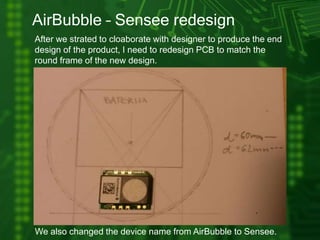
AirBubble – Sensee redesign
After we strated to cloaborate with designer to produce the end
design of the product, I need to redesign PCB to match the
round frame of the new design.
We also changed the device name from AirBubble to Sensee.
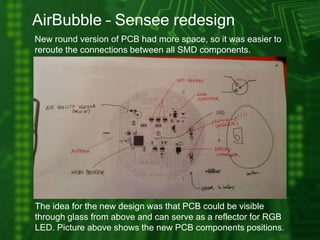
AirBubble – Sensee redesign
New round version of PCB had more space, so it was easier to
reroute the connections between all SMD components.
The idea for the new design was that PCB could be visible
through glass from above and can serve as a reflector for RGB
LED. Picture above shows the new PCB components positions.
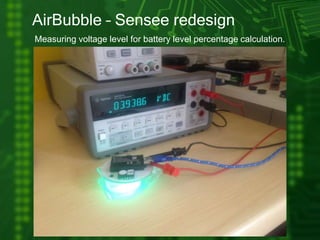
AirBubble – Sensee redesign
Measuring voltage level for battery level percentage calculation.
AirBubble – Sensee redesign
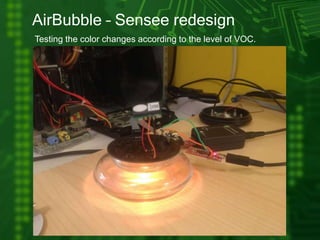
Testing the color changes according to the level of VOC.
AirBubble – Sensee redesign
We also made black version of this new round PCB.
AirBubble – Sensee redesign
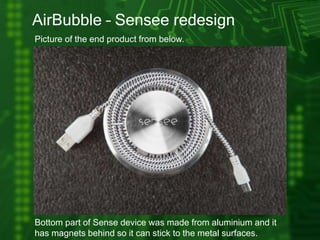
Picture of the end product from below.
Bottom part of Sense device was made from aluminium and it
has magnets behind so it can stick to the metal surfaces.
AirBubble – Sensee redesign
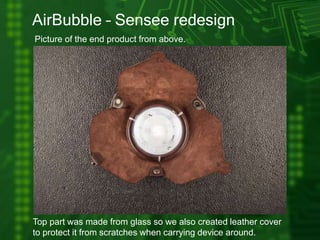
Picture of the end product from above.
Top part was made from glass so we also created leather cover
to protect it from scratches when carrying device around.
AirBubble – Sensee redesign
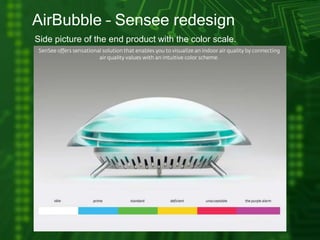
Side picture of the end product with the color scale.
AirBubble – Sensee redesign
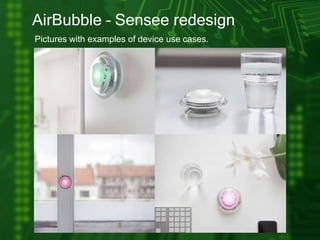
Pictures with examples of device use cases.
H2O-Pal (hydration tracker)
June 2014 – October 2014
H2O-Pal device development
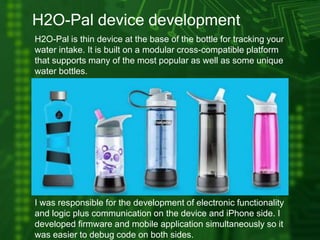
H2O-Pal is thin device at the base of the bottle for tracking your
water intake. It is built on a modular cross-compatible platform
that supports many of the most popular as well as some unique
water bottles.
I was responsible for the development of electronic functionality
and logic plus communication on the device and iPhone side. I
developed firmware and mobile application simultaneously so it
was easier to debug code on both sides.
H2O-Pal device development
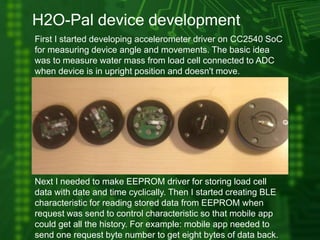
First I started developing accelerometer driver on CC2540 SoC
for measuring device angle and movements. The basic idea
was to measure water mass from load cell connected to ADC
when device is in upright position and doesn't move.
Next I needed to make EEPROM driver for storing load cell
data with date and time cyclically. Then I started creating BLE
characteristic for reading stored data from EEPROM when
request was send to control characteristic so that mobile app
could get all the history. For example: mobile app needed to
send one request byte number to get eight bytes of data back.
H2O-Pal device development
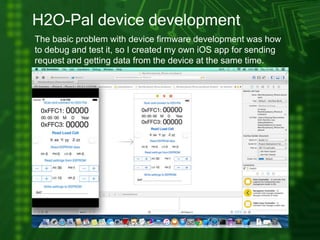
The basic problem with device firmware development was how
to debug and test it, so I created my own iOS app for sending
request and getting data from the device at the same time.
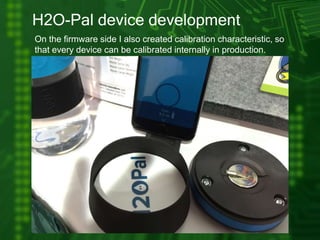
H2O-Pal device development
On the firmware side I also created calibration characteristic, so
that every device can be calibrated internally in production.
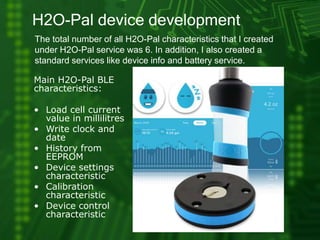
H2O-Pal device development
The total number of all H2O-Pal characteristics that I created
under H2O-Pal service was 6. In addition, I also created a
standard services like device info and battery service.
Main H2O-Pal BLE
characteristics:
• Load cell current
value in millilitres
• Write clock and
date
• History from
EEPROM
• Device settings
characteristic
• Calibration
characteristic
• Device control
characteristic
H2O-Pal device development
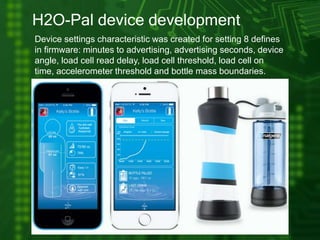
Device settings characteristic was created for setting 8 defines
in firmware: minutes to advertising, advertising seconds, device
angle, load cell read delay, load cell threshold, load cell on
time, accelerometer threshold and bottle mass boundaries.
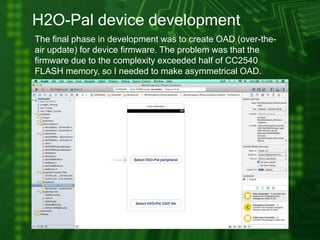
H2O-Pal device development
The final phase in development was to create OAD (over-the-
air update) for device firmware. The problem was that the
firmware due to the complexity exceeded half of CC2540
FLASH memory, so I needed to make asymmetrical OAD.
H2O-Pal device development
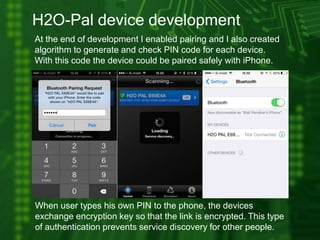
At the end of development I enabled pairing and I also created
algorithm to generate and check PIN code for each device.
With this code the device could be paired safely with iPhone.
When user types his own PIN to the phone, the devices
exchange encryption key so that the link is encrypted. This type
of authentication prevents service discovery for other people.
Coolinginno (thermal storage)
July 2014
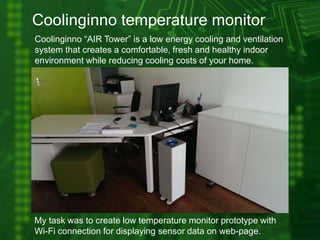
Coolinginno temperature monitor
Coolinginno “AIR Tower” is a low energy cooling and ventilation
system that creates a comfortable, fresh and healthy indoor
environment while reducing cooling costs of your home.
My task was to create low temperature monitor prototype with
Wi-Fi connection for displaying sensor data on web-page.
Coolinginno temperature monitor
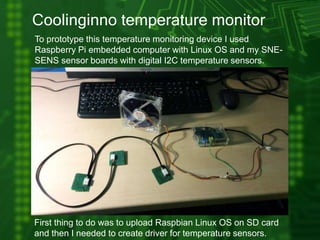
To prototype this temperature monitoring device I used
Raspberry Pi embedded computer with Linux OS and my SNE-
SENS sensor boards with digital I2C temperature sensors.
First thing to do was to upload Raspbian Linux OS on SD card
and then I needed to create driver for temperature sensors.
Coolinginno temperature monitor
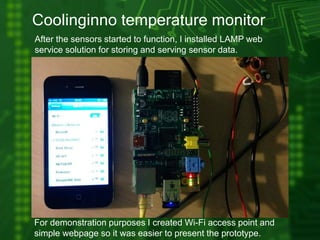
After the sensors started to function, I installed LAMP web
service solution for storing and serving sensor data.
For demonstration purposes I created Wi-Fi access point and
simple webpage so it was easier to present the prototype.
ZEVS (smart light switch)
May 2014 – September 2014
ZEVS Hekovnik project
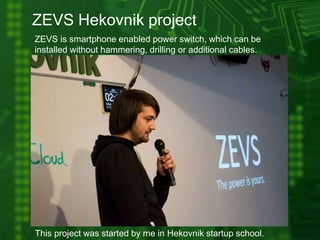
ZEVS is smartphone enabled power switch, which can be
installed without hammering, drilling or additional cables.
This project was started by me in Hekovnik startup school.
ZEVS Hekovnik project
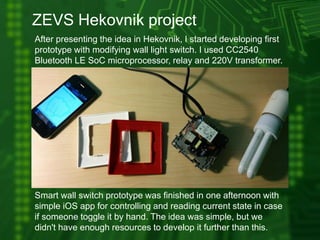
After presenting the idea in Hekovnik, I started developing first
prototype with modifying wall light switch. I used CC2540
Bluetooth LE SoC microprocessor, relay and 220V transformer.
Smart wall switch prototype was finished in one afternoon with
simple iOS app for controlling and reading current state in case
if someone toggle it by hand. The idea was simple, but we
didn't have enough resources to develop it further than this.
Chipolo (item finder)
May 2015 – September 2015
Chipolo optimisation and porting
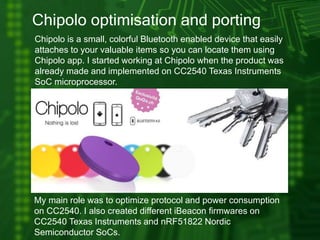
Chipolo is a small, colorful Bluetooth enabled device that easily
attaches to your valuable items so you can locate them using
Chipolo app. I started working at Chipolo when the product was
already made and implemented on CC2540 Texas Instruments
SoC microprocessor.
My main role was to optimize protocol and power consumption
on CC2540. I also created different iBeacon firmwares on
CC2540 Texas Instruments and nRF51822 Nordic
Semiconductor SoCs.
Chipolo optimisation and porting
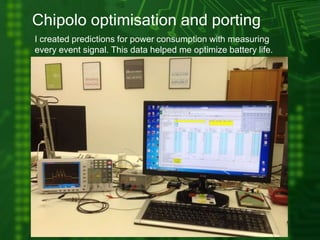
I created predictions for power consumption with measuring
every event signal. This data helped me optimize battery life.
Chipolo optimisation and porting
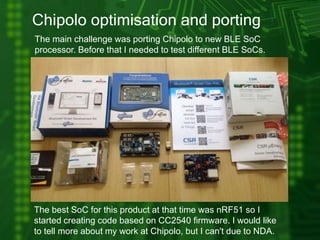
The main challenge was porting Chipolo to new BLE SoC
processor. Before that I needed to test different BLE SoCs.
The best SoC for this product at that time was nRF51 so I
started creating code based on CC2540 firmware. I would like
to tell more about my work at Chipolo, but I can't due to NDA.
REFERENCES
Companies:
CHIPOLO, d.o.o. https://chipolo.net/
OUT of GALAXY, Inc. http://www.outofgalaxy.com/
Cosylab, d.d. http://www.cosylab.com/
Spica International, d.o.o. http://www.spica.com/
Setran Plus, Ltd. http://coolinginno.com/
7sense, Ltd. http://www.sensee.io/
Laboratories:
Machine Vision Laboratory http://vision.fe.uni-lj.si/
SensorLab IJS http://sensorlab.ijs.si/
Competitions:
ITIME ideas accelerator http://www.itime.si/
Slovenian Innovation Forum http://www.slovenia-innovation.si/
Hekovnik start:Cloud bootcamp http://hekovnik.com/startcloud-bootcamp/
Live projects:
H2Opal https://www.h2opal.com/
Sensee http://www.sensee.io/
Cooling Inno http://coolinginno.com/
VESNA http://sensorlab.ijs.si/hardware.html/
All Hours Clock http://allhours.com/time-clock-systems/
Presentations:
ZEVS Hekovnik homework presentation http://video.hekovnik.com/pp_zevs_smart_switch/
My work 1998 - 2012 http://www.slideshare.net/blazetech/2012-sep-28-blaz-remskar-intro/

Blaz_Remskar_2012-2015

  • 1.
    Blaž Remškar Research anddevelopment 2012 - 2015
  • 2.
    Jozef Stefan Institute October2012 – February 2015
  • 3.
    SensorLab and VESNA SensorLabis an interdepartmental laboratory within Jozef Stefan Institute which carries out research and development related to the Internet of Things. In this laboratory we have created VESNA wireless sensor node, which is a modular and fully flexible platform for the development of wireless sensor networks based on the ARM Cortex-M3 microprocessor. Various peripherals including UART, I2C, SPI, USB, ADC and DAC allow hosting of different sets of sensors and/or actuators.
  • 4.
    SNE-SENS multisensor board Mytask was to create sensor node extension for VESNA with 12 sensors and GPS module. The picture below represents three different methods of routing quite dense board. All 12 sensors on board including GPS were digital, so I started with development of VESNA communication drivers. I wrote I2C driver to talk with sensors and SPI driver for GPS module, then I started working on high-level drivers.
  • 5.
    Drivers for SNE-SENS Inorder to use SNE-SENS in VESNA applications I needed to create drivers for using and controlling sensors and other devices on board. Below is the list of all my high-level drivers: All drivers with simple to use user functions were written by myself in C language using Eclipse IDE and STM32 32-bit ARM Cortex M3 MCU, which is a core processor on VESNA board. • IC1 - Temperature TMP75 • IC2 - IR temperature MLX90614 • IC3 - Pressure LPS331AP • IC4 - Humidity SHT21 • IC5 - Light + PIR SI1143 • IC6 - Color sensor TCS3772 • IC7 - Sound ADMP521 • IC8 - Acceleration MMA8453Q • IC9 - Compass HMC5883L • IC10 - Gyroscope L3GD20 • IC11 - Acceleration + Compass LSM303DLHC • IC12 - GPS module MAX6G (most complicated driver)
  • 6.
    SNE-SENS modularity We createdthis sensor board because we need to have different senses attached on VESNA for different projects, so I created pick and place files for each project separately. Above is the picture of empty SEN-SENS boards, which are less than half the size of the RFID contactless cards.
  • 7.
    CO2 and VOCsensor drivers In addition to all drivers for SNE-SENS sensors I also created driver for CO2 sensor and VOC (Volatile organic compounds). On the left side of the picture is VOC sensor and on the right CO2 sensor. VOCs are organic chemicals that evaporate at the room temperature and can be harmful for humans.
  • 8.
    Wireless M-Bus andZigBee I also developed extension boards and drivers based on Wireless M-Bus and ZigBee communication protocols for the VESNA nodes to be able to communicate with each other. My wireless drivers included: • initialization • network settings • setting time • registering nodes • frame filtering • constructing packets • parsing of packets • listen before talk • encryption and decryption • power management • multi-hop • network management • remote AT commands
  • 9.
    Testing regularly andconstantly My motto is: "test extensively when you make new code!"
  • 10.
    Smart AC powerplug application This device was created within a SensorLab for Cosylab company to control AC power sockets remotely and measure different energy parameters. I used: VESNA board, WMBus module, digital isolators, AC/DC power module, relay and ADE77631 energy meter IC with Rogowski toroid coil for measuring alternating current through cable. Driver for ADE77631 was quite complicated because I needed to include calibration methods and calculations for: voltage and current RMS, active and reactive power plus frequency.
  • 11.
    Wireless outdoor weatherstation For Cosylab I also developed wireless communication module based on WMBus to be used with Davis Vantage Pro 2 outdoor weather station. First thing I developed was the driver on VESNA board to read the data from Davis serial RS232 interface. Next step was to construct WMBus packets for each measurement and send them wirelessly from meter devices to central device for which I needed to create a parser. Davis outdoor weather station was then able to send wirelessly on request: • air temperature • relative humidity • wind speed • wind direction • precipitation • solar radiation • measurement time
  • 12.
  • 13.
    AirBubble device development AirBubble is indoor air quality indicator that changes colors according to the CO2 and VOC levels. I started developing this idea because I wanted to know when to ventilate my rooms. I created first prototype directly on TI Bluetooth CC2540 Keyfob so it was able to connect to PC via Bluetooth LE USB stick.
  • 14.
    AirBubble device development Tofinish the first prototype I needed to implement PWM (pulse width modulation) for controlling each LED color according to ADC (analog-to-digital converter) readings from analog CO2 and VOC sensor and sending data with Bluetooth 4.0 protocol.
  • 15.
    AirBubble device development Afterfirst prototype, I began experimenting with different sensors and I also created more devices for real life testing purposes. The problem was how to create enclosure for prototypes so we used 3D printer to create back of the sphere.
  • 16.
    AirBubble device development Thenext problem was the calibration of analog VOC sensors because they don't show the same value at the start. After solving calibration problem we also noticed that analog sensors have some drift in values with time, so I decided to rather use digital sensors with automatic baseline correction.
  • 17.
    AirBubble device development Furtheron in development process I created smallest possible PCB (printed circuit board) for this device so it could fit in final design for production. Those PCB boards also included new sensors for measuring temperature, humidity and sound and they also had battery charger chip for charging the device from USB micro connector.
  • 18.
    AirBubble device development Forthe first tests I also created version of the PCB board with HM10 Bluetooth LE module for easier soldering by hand. Bluetooth LE module In this way I could test sensors and other things without major investments in the production of the first prototype batches.
  • 19.
    AirBubble device development Applicationfor CC2540 microprocessor was already created, so I only needed to modify firmware for the new digital sensors. The next challenge was how to create and test communication with iPhone, so I started developing in Xcode iOS application with simple user interface that shows all device characteristics.
  • 20.
    AirBubble – Senseeredesign After we strated to cloaborate with designer to produce the end design of the product, I need to redesign PCB to match the round frame of the new design. We also changed the device name from AirBubble to Sensee.
  • 21.
    AirBubble – Senseeredesign New round version of PCB had more space, so it was easier to reroute the connections between all SMD components. The idea for the new design was that PCB could be visible through glass from above and can serve as a reflector for RGB LED. Picture above shows the new PCB components positions.
  • 22.
    AirBubble – Senseeredesign Measuring voltage level for battery level percentage calculation.
  • 23.
    AirBubble – Senseeredesign Testing the color changes according to the level of VOC.
  • 24.
    AirBubble – Senseeredesign We also made black version of this new round PCB.
  • 25.
    AirBubble – Senseeredesign Picture of the end product from below. Bottom part of Sense device was made from aluminium and it has magnets behind so it can stick to the metal surfaces.
  • 26.
    AirBubble – Senseeredesign Picture of the end product from above. Top part was made from glass so we also created leather cover to protect it from scratches when carrying device around.
  • 27.
    AirBubble – Senseeredesign Side picture of the end product with the color scale.
  • 28.
    AirBubble – Senseeredesign Pictures with examples of device use cases.
  • 29.
    H2O-Pal (hydration tracker) June2014 – October 2014
  • 30.
    H2O-Pal device development H2O-Palis thin device at the base of the bottle for tracking your water intake. It is built on a modular cross-compatible platform that supports many of the most popular as well as some unique water bottles. I was responsible for the development of electronic functionality and logic plus communication on the device and iPhone side. I developed firmware and mobile application simultaneously so it was easier to debug code on both sides.
  • 31.
    H2O-Pal device development FirstI started developing accelerometer driver on CC2540 SoC for measuring device angle and movements. The basic idea was to measure water mass from load cell connected to ADC when device is in upright position and doesn't move. Next I needed to make EEPROM driver for storing load cell data with date and time cyclically. Then I started creating BLE characteristic for reading stored data from EEPROM when request was send to control characteristic so that mobile app could get all the history. For example: mobile app needed to send one request byte number to get eight bytes of data back.
  • 32.
    H2O-Pal device development Thebasic problem with device firmware development was how to debug and test it, so I created my own iOS app for sending request and getting data from the device at the same time.
  • 33.
    H2O-Pal device development Onthe firmware side I also created calibration characteristic, so that every device can be calibrated internally in production.
  • 34.
    H2O-Pal device development Thetotal number of all H2O-Pal characteristics that I created under H2O-Pal service was 6. In addition, I also created a standard services like device info and battery service. Main H2O-Pal BLE characteristics: • Load cell current value in millilitres • Write clock and date • History from EEPROM • Device settings characteristic • Calibration characteristic • Device control characteristic
  • 35.
    H2O-Pal device development Devicesettings characteristic was created for setting 8 defines in firmware: minutes to advertising, advertising seconds, device angle, load cell read delay, load cell threshold, load cell on time, accelerometer threshold and bottle mass boundaries.
  • 36.
    H2O-Pal device development Thefinal phase in development was to create OAD (over-the- air update) for device firmware. The problem was that the firmware due to the complexity exceeded half of CC2540 FLASH memory, so I needed to make asymmetrical OAD.
  • 37.
    H2O-Pal device development Atthe end of development I enabled pairing and I also created algorithm to generate and check PIN code for each device. With this code the device could be paired safely with iPhone. When user types his own PIN to the phone, the devices exchange encryption key so that the link is encrypted. This type of authentication prevents service discovery for other people.
  • 38.
  • 39.
    Coolinginno temperature monitor Coolinginno“AIR Tower” is a low energy cooling and ventilation system that creates a comfortable, fresh and healthy indoor environment while reducing cooling costs of your home. My task was to create low temperature monitor prototype with Wi-Fi connection for displaying sensor data on web-page.
  • 40.
    Coolinginno temperature monitor Toprototype this temperature monitoring device I used Raspberry Pi embedded computer with Linux OS and my SNE- SENS sensor boards with digital I2C temperature sensors. First thing to do was to upload Raspbian Linux OS on SD card and then I needed to create driver for temperature sensors.
  • 41.
    Coolinginno temperature monitor Afterthe sensors started to function, I installed LAMP web service solution for storing and serving sensor data. For demonstration purposes I created Wi-Fi access point and simple webpage so it was easier to present the prototype.
  • 42.
    ZEVS (smart lightswitch) May 2014 – September 2014
  • 43.
    ZEVS Hekovnik project ZEVSis smartphone enabled power switch, which can be installed without hammering, drilling or additional cables. This project was started by me in Hekovnik startup school.
  • 44.
    ZEVS Hekovnik project Afterpresenting the idea in Hekovnik, I started developing first prototype with modifying wall light switch. I used CC2540 Bluetooth LE SoC microprocessor, relay and 220V transformer. Smart wall switch prototype was finished in one afternoon with simple iOS app for controlling and reading current state in case if someone toggle it by hand. The idea was simple, but we didn't have enough resources to develop it further than this.
  • 45.
    Chipolo (item finder) May2015 – September 2015
  • 46.
    Chipolo optimisation andporting Chipolo is a small, colorful Bluetooth enabled device that easily attaches to your valuable items so you can locate them using Chipolo app. I started working at Chipolo when the product was already made and implemented on CC2540 Texas Instruments SoC microprocessor. My main role was to optimize protocol and power consumption on CC2540. I also created different iBeacon firmwares on CC2540 Texas Instruments and nRF51822 Nordic Semiconductor SoCs.
  • 47.
    Chipolo optimisation andporting I created predictions for power consumption with measuring every event signal. This data helped me optimize battery life.
  • 48.
    Chipolo optimisation andporting The main challenge was porting Chipolo to new BLE SoC processor. Before that I needed to test different BLE SoCs. The best SoC for this product at that time was nRF51 so I started creating code based on CC2540 firmware. I would like to tell more about my work at Chipolo, but I can't due to NDA.
  • 49.
    REFERENCES Companies: CHIPOLO, d.o.o. https://chipolo.net/ OUTof GALAXY, Inc. http://www.outofgalaxy.com/ Cosylab, d.d. http://www.cosylab.com/ Spica International, d.o.o. http://www.spica.com/ Setran Plus, Ltd. http://coolinginno.com/ 7sense, Ltd. http://www.sensee.io/ Laboratories: Machine Vision Laboratory http://vision.fe.uni-lj.si/ SensorLab IJS http://sensorlab.ijs.si/ Competitions: ITIME ideas accelerator http://www.itime.si/ Slovenian Innovation Forum http://www.slovenia-innovation.si/ Hekovnik start:Cloud bootcamp http://hekovnik.com/startcloud-bootcamp/ Live projects: H2Opal https://www.h2opal.com/ Sensee http://www.sensee.io/ Cooling Inno http://coolinginno.com/ VESNA http://sensorlab.ijs.si/hardware.html/ All Hours Clock http://allhours.com/time-clock-systems/ Presentations: ZEVS Hekovnik homework presentation http://video.hekovnik.com/pp_zevs_smart_switch/ My work 1998 - 2012 http://www.slideshare.net/blazetech/2012-sep-28-blaz-remskar-intro/