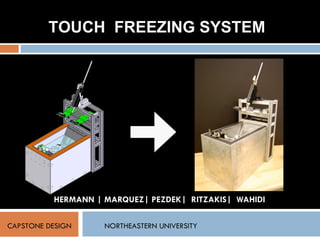
HERMANN | MARQUEZ| PEZDEK|  RITZAKIS|  WAHIDI CAPSTONE DESIGN NORTHEASTERN UNIVERSITY TOUCH  FREEZING SYSTEM
What is Slam Freezing? Slam freezing systems allow tissue samples to be vitrified and structurally preserved at cryogenic temperatures through a process of quickly impacting the sample onto a cooled metal mirror.  Vitrify : A process of converting a material into a glass like  amorphous solid that is free from any crystalline  structure, either by the quick removal or addition of heat.
Why Slam Freeze? There are currently several main methods for sample cryopreservation for electron microscopy.  Among these methods are: plunge, spray, jet, and slam. However, slam freezing is particularly effective. High cooling rates at the sample surface can reach 80,000-100,000 K/s This extremely high cooling rate at the surface creates a vitrified surface with a freezing depth of 15-25μm
Current Models MM80 Leica Microsystems $8,000 Cryogun Delaware Diamond Knives $4,000 Cryopress Medvac / Heuserlab $28,000 +
Problem Statement Current slam freezing method: Causes mechanical sample deformation from impact. Difficult to achieve reproducible results  Has limited control over the freezing process Does not accommodate varying sample sizes Expensive
Design Goals Design a  touch  freezing system that can vitrify multiple samples without causing deformation from freezing and mechanical injury. Control motor to prevent mechanical deformation of sample Maximize cooling rate Test effectiveness of system by touch freezing a water droplet without deformation
Design Requirements Minimize Deformation Precise motor control and sample position No Recoil Cooling Maximize cooling rate: 10,000K/s + Monitor temperature of mirror and working zone Ergonomics 4 Mirror cycle capacity Incorporate sample stack Sample storage Cost Minimize LN 2  boil off Cost <  $5,000 Sample speed of 4m/s Keep copper mirrors cool Unit stability Minimize heat transfer Leak proof Low maintenance  High life cycle Low fatigue
Touch Freezing System Linear Motor Basin Mirror Module  with Copper Mirrors  in LN 2 Ribbon Laser Motor and Sensor Stand Sample Stack
Design Requirements: Mirror Module Rotate between 4 copper mirrors Minimize heat transfer to handle Monitor temperature of the mirrors Ease of use Minimize LN 2  needed to cool Prevent film of LN 2  on mirrors Manufacturability
Mirror Module: Material Selection Cooling Rates of Various Liquid Cryogen Echlin, Patrick.  Low-Temp Microscopy and Analysis . New York: Plenum Press, 1992. Thermal Conductivity and Inertia of Various Materials Material Temperature [K] Specific Heat [J/(g∙K)] Thermal Conductivity [ J/(m∙s∙K)] Thermal Inertia [ Jm 2 /√K ] Aluminum 77 3.7 x 10 -1 410 1.9 20 8.4 x 10 -3 - 1.6 4 2.6 x 10 -4 15,000 0.3 Copper 77 2.1 x 10 -1 570 3.2 20 8.0 x 10 -3 10,500 2.6 4 9.1 x 10 -5 11,300 0.3 Gold 77 9.6 x 10 -2 252 2.6 20 1.6 x 10 -2 1,500 2.4 4 1.6 x 10 -4 1,710 2.3 Sapphire 77 6.3 x 10 -2 960 1.6 20 2.0 x 10 -2 15,700 0.6 4 8.0 x 10 -6 410 0.1 Silver 77 1.5 x 10 -1 471 2.9 20 1.3 x 10 -2 5,100 2.7 4 1.3 x 10 -4 14,700 0.4 Cryogen Temperature Mean Cooling Rate ( ° K) (10 3   ° K/s) Ethane 90 13-15 Liquid Helium 4.3 0.1 Liquid Nitrogen 77 0.5 Propane 88 10-12
Mirror Module: Design Iterations Revision 1 Manufacturability Locking & Thermal Mass  Reduction  FINAL DESIGN
Mirror Module: Components Base Unit Female Thermocouple Connector (4) Male Thermocouple   Connector (4) Copper Mirror Ceramic Standoff Handle Shaft Gearing Teeth (4) Thermocouple Cover
Mirror Module: Thermocouple T-Type Thermocouple -270 - 400°C Ceramic Connectors Recommended for cryogenic applications Copper Mirror Thermocouple Connectors  (Male & Female) Thermocouple Connector LN 2 LN 2 M F Working Zone Mirror Module Thermocouple Sensor
Design Requirements: Basin House mirror module Sample storage Monitor working zone temperature Minimize heat transfer from surroundings to LN 2   Prevent LN 2  leakage
Basin: Inner Basin  Working Zone T-Type Thermocouple Mirror Module Sample Storage Inner Basin Handle Stand Working Zone Thermocouple Placement Stationary Support Exposed  Copper Mirror Screws
Basin: Heat Transfer Analysis Energy Balance: Liters of LN 2  Required = 12.8654L Heat transfer rate per unit area through basin: q”= 181 [W/m 2 ] with EPS @ 1.5” AIR EXT BOX INNER BASIN INSULATION LIQUID NITROGEN
Basin: Insulation LN 2 FOAM FOAM Ceramic Standoffs Sample Storage Exposed  Copper Mirror Handle Stand
Basin: Exterior Box Exterior Box LN 2 FOAM Sample Storage Exposed  Copper Mirror Handle Stand
Basin: Motor and Sensor Stand 80/20 T-slotted extrusions  Provides rigidity Holds linear motor and ribbon  laser Motor and  Sensor Stand
Design Requirements: Linear Motor Accelerates sample to copper mirror at 4m/s Precise position control to touch sample to copper mirror No recoil Minimize pre-cooling Incorporates sample stack to hold and protect sample
Linear Motor: Selection Slider Stator Connector LinMot  Nippon Linear Motor
Linear Motor: Motion Profiles  5 m/s 4 m/s
Linear Motor: Controlling Motor Ribbon Laser Sample Stack Attached at End of Slider Mirror Module LN 2   Ribbon Laser Sensor Copper Mirror LN 2   Sample Stack X s X r X m Linear Motor Sample
Touch Freezing System Process
System Cost Analysis COST ANALYSIS           ITEM MANUFACTURER MODEL # SIZE QUANTITY COST ($) Linear Motor (stator/slider/power/controller/etc.) Linmot PS01-23x160F-HP-R PL01-12x480/440-HP E1100-GP-HC  S01-72/300 * 1 2688.65 Ribbon Laser Keyence LV-H300 * 1 299 Laser Amplifier Keyence LV-51MP * 1 299 Mounting Brackets for LV-H300 Keyence LV-B302 * 1 13 Rod End Bearing, Male/Female Cooper Bearing Set * 1 55 Thermocouple T-Type Connector (male) Omega NHX-T-M * 4 36 Thermocouple T-Type Connector (female) Omega NHX-T-F * 1 7 Thermocouple T-Type for Working Zone Omega 5TC-TT-T24-36 * 1  33 Epoxy (Cryo-Bond) Valpac 877 * * * Polystyrene Insulation Foam ICA   *   * 35 Aluminum Alloy 6061 McMaster-Carr 1610T44 4-1/2&quot;D X 6&quot; 1 65.11 Aluminum Plates Admiral Metals *    *   * 250 Screws McMaster-Carr 6-32 Screws   * 300 38 Brackets McMaster-Carr L-Brackets   * 20 38 Machining for Mirror Module Nova Machine   *   * 1 1100 TOTAL COST 4956.76
Future Work Testing LN2 boil off test  Fatigue analysis of mirror module  Water droplet test Obtain data from initial user interactions with the  apparatus to address shortcomings and user requirements. Reduce human error by automation Obtain images using TEM
Acknowledgments Professor Jeff Ruberti (Sponsor & Advisor) Nima Saeidi (Research Assistant) Professor Yiannis Levendis (Capstone Advisor) Professor Uichiro Narusawa (Heat Transfer Consultant) Professor Jeff Doughty (Laboratory Director) Professor Rifat Sipahi (Controls Consultant) John Doughty (MIE Machine Shop Manager) Kevin McCue (Laboratory Consultant) Bob McLeean (Nova Machine)
Design Team Nicholas Hermann Gabriel Marquez Afjal Wahidi Jamison Pezdek Nector Ritzakis
FEA  Analysis
Sample Stack
Material Selection: Aluminum T-6061 http://cryogenics.nist.gov/MPropsMAY/6061%20Aluminum/6061_T6Aluminum_rev.htm
Motor Selection Linear Motor Selection Brushless Linear Motor Selection Attribute Weight Factor Brushed Brushless Step Low Maintenance 1.5 1.5 7.5 4.5 High Velocity 1.9 5.7 9.5 5.7 High Acceleration 1.9 5.7 9.5 5.7 High Travel Length 1.1 5.5 1.1 5.5 Precise Position 1.9 9.5 9.5 5.7 Low Cost 1.7 8.5 5.1 5.1 TOTAL   36.4 42.2 32.2 Attribute Weight Factor Iron Core Ironless Slotless Direct Drive No Cogging 1.9 1.9 9.5 5.7 9.5 No Attractive Force 1.5 1.5 7.5 4.5 7.5 Force/Size 1.4 7 1.4 4.2 1.4 Thermal Characteristics 1.1 5.5 1.1 3.3 3.3 Least Forcer Weight 1.1 1.1 3.3 3.3 5.5 Forcer Strength 1.3 6.5 1.3 3.9 3.9 TOTAL   23.5 24.1 24.9 31.1
Mirror Module: Rotating

Slam Freezing For Electron Microscopy

  • 1.
    HERMANN | MARQUEZ|PEZDEK| RITZAKIS| WAHIDI CAPSTONE DESIGN NORTHEASTERN UNIVERSITY TOUCH FREEZING SYSTEM
  • 2.
    What is SlamFreezing? Slam freezing systems allow tissue samples to be vitrified and structurally preserved at cryogenic temperatures through a process of quickly impacting the sample onto a cooled metal mirror. Vitrify : A process of converting a material into a glass like amorphous solid that is free from any crystalline structure, either by the quick removal or addition of heat.
  • 3.
    Why Slam Freeze?There are currently several main methods for sample cryopreservation for electron microscopy. Among these methods are: plunge, spray, jet, and slam. However, slam freezing is particularly effective. High cooling rates at the sample surface can reach 80,000-100,000 K/s This extremely high cooling rate at the surface creates a vitrified surface with a freezing depth of 15-25μm
  • 4.
    Current Models MM80Leica Microsystems $8,000 Cryogun Delaware Diamond Knives $4,000 Cryopress Medvac / Heuserlab $28,000 +
  • 5.
    Problem Statement Currentslam freezing method: Causes mechanical sample deformation from impact. Difficult to achieve reproducible results Has limited control over the freezing process Does not accommodate varying sample sizes Expensive
  • 6.
    Design Goals Designa touch freezing system that can vitrify multiple samples without causing deformation from freezing and mechanical injury. Control motor to prevent mechanical deformation of sample Maximize cooling rate Test effectiveness of system by touch freezing a water droplet without deformation
  • 7.
    Design Requirements MinimizeDeformation Precise motor control and sample position No Recoil Cooling Maximize cooling rate: 10,000K/s + Monitor temperature of mirror and working zone Ergonomics 4 Mirror cycle capacity Incorporate sample stack Sample storage Cost Minimize LN 2 boil off Cost < $5,000 Sample speed of 4m/s Keep copper mirrors cool Unit stability Minimize heat transfer Leak proof Low maintenance High life cycle Low fatigue
  • 8.
    Touch Freezing SystemLinear Motor Basin Mirror Module with Copper Mirrors in LN 2 Ribbon Laser Motor and Sensor Stand Sample Stack
  • 9.
    Design Requirements: MirrorModule Rotate between 4 copper mirrors Minimize heat transfer to handle Monitor temperature of the mirrors Ease of use Minimize LN 2 needed to cool Prevent film of LN 2 on mirrors Manufacturability
  • 10.
    Mirror Module: MaterialSelection Cooling Rates of Various Liquid Cryogen Echlin, Patrick. Low-Temp Microscopy and Analysis . New York: Plenum Press, 1992. Thermal Conductivity and Inertia of Various Materials Material Temperature [K] Specific Heat [J/(g∙K)] Thermal Conductivity [ J/(m∙s∙K)] Thermal Inertia [ Jm 2 /√K ] Aluminum 77 3.7 x 10 -1 410 1.9 20 8.4 x 10 -3 - 1.6 4 2.6 x 10 -4 15,000 0.3 Copper 77 2.1 x 10 -1 570 3.2 20 8.0 x 10 -3 10,500 2.6 4 9.1 x 10 -5 11,300 0.3 Gold 77 9.6 x 10 -2 252 2.6 20 1.6 x 10 -2 1,500 2.4 4 1.6 x 10 -4 1,710 2.3 Sapphire 77 6.3 x 10 -2 960 1.6 20 2.0 x 10 -2 15,700 0.6 4 8.0 x 10 -6 410 0.1 Silver 77 1.5 x 10 -1 471 2.9 20 1.3 x 10 -2 5,100 2.7 4 1.3 x 10 -4 14,700 0.4 Cryogen Temperature Mean Cooling Rate ( ° K) (10 3 ° K/s) Ethane 90 13-15 Liquid Helium 4.3 0.1 Liquid Nitrogen 77 0.5 Propane 88 10-12
  • 11.
    Mirror Module: DesignIterations Revision 1 Manufacturability Locking & Thermal Mass Reduction FINAL DESIGN
  • 12.
    Mirror Module: ComponentsBase Unit Female Thermocouple Connector (4) Male Thermocouple Connector (4) Copper Mirror Ceramic Standoff Handle Shaft Gearing Teeth (4) Thermocouple Cover
  • 13.
    Mirror Module: ThermocoupleT-Type Thermocouple -270 - 400°C Ceramic Connectors Recommended for cryogenic applications Copper Mirror Thermocouple Connectors (Male & Female) Thermocouple Connector LN 2 LN 2 M F Working Zone Mirror Module Thermocouple Sensor
  • 14.
    Design Requirements: BasinHouse mirror module Sample storage Monitor working zone temperature Minimize heat transfer from surroundings to LN 2 Prevent LN 2 leakage
  • 15.
    Basin: Inner Basin Working Zone T-Type Thermocouple Mirror Module Sample Storage Inner Basin Handle Stand Working Zone Thermocouple Placement Stationary Support Exposed Copper Mirror Screws
  • 16.
    Basin: Heat TransferAnalysis Energy Balance: Liters of LN 2 Required = 12.8654L Heat transfer rate per unit area through basin: q”= 181 [W/m 2 ] with EPS @ 1.5” AIR EXT BOX INNER BASIN INSULATION LIQUID NITROGEN
  • 17.
    Basin: Insulation LN2 FOAM FOAM Ceramic Standoffs Sample Storage Exposed Copper Mirror Handle Stand
  • 18.
    Basin: Exterior BoxExterior Box LN 2 FOAM Sample Storage Exposed Copper Mirror Handle Stand
  • 19.
    Basin: Motor andSensor Stand 80/20 T-slotted extrusions Provides rigidity Holds linear motor and ribbon laser Motor and Sensor Stand
  • 20.
    Design Requirements: LinearMotor Accelerates sample to copper mirror at 4m/s Precise position control to touch sample to copper mirror No recoil Minimize pre-cooling Incorporates sample stack to hold and protect sample
  • 21.
    Linear Motor: SelectionSlider Stator Connector LinMot Nippon Linear Motor
  • 22.
    Linear Motor: MotionProfiles 5 m/s 4 m/s
  • 23.
    Linear Motor: MotionProfiles 5 m/s 4 m/s
  • 24.
    Linear Motor: ControllingMotor Ribbon Laser Sample Stack Attached at End of Slider Mirror Module LN 2 Ribbon Laser Sensor Copper Mirror LN 2 Sample Stack X s X r X m Linear Motor Sample
  • 25.
  • 26.
    System Cost AnalysisCOST ANALYSIS           ITEM MANUFACTURER MODEL # SIZE QUANTITY COST ($) Linear Motor (stator/slider/power/controller/etc.) Linmot PS01-23x160F-HP-R PL01-12x480/440-HP E1100-GP-HC S01-72/300 * 1 2688.65 Ribbon Laser Keyence LV-H300 * 1 299 Laser Amplifier Keyence LV-51MP * 1 299 Mounting Brackets for LV-H300 Keyence LV-B302 * 1 13 Rod End Bearing, Male/Female Cooper Bearing Set * 1 55 Thermocouple T-Type Connector (male) Omega NHX-T-M * 4 36 Thermocouple T-Type Connector (female) Omega NHX-T-F * 1 7 Thermocouple T-Type for Working Zone Omega 5TC-TT-T24-36 * 1 33 Epoxy (Cryo-Bond) Valpac 877 * * * Polystyrene Insulation Foam ICA   *   * 35 Aluminum Alloy 6061 McMaster-Carr 1610T44 4-1/2&quot;D X 6&quot; 1 65.11 Aluminum Plates Admiral Metals *    *   * 250 Screws McMaster-Carr 6-32 Screws   * 300 38 Brackets McMaster-Carr L-Brackets   * 20 38 Machining for Mirror Module Nova Machine   *   * 1 1100 TOTAL COST 4956.76
  • 27.
    Future Work TestingLN2 boil off test Fatigue analysis of mirror module Water droplet test Obtain data from initial user interactions with the apparatus to address shortcomings and user requirements. Reduce human error by automation Obtain images using TEM
  • 28.
    Acknowledgments Professor JeffRuberti (Sponsor & Advisor) Nima Saeidi (Research Assistant) Professor Yiannis Levendis (Capstone Advisor) Professor Uichiro Narusawa (Heat Transfer Consultant) Professor Jeff Doughty (Laboratory Director) Professor Rifat Sipahi (Controls Consultant) John Doughty (MIE Machine Shop Manager) Kevin McCue (Laboratory Consultant) Bob McLeean (Nova Machine)
  • 29.
    Design Team NicholasHermann Gabriel Marquez Afjal Wahidi Jamison Pezdek Nector Ritzakis
  • 30.
  • 31.
  • 32.
    Material Selection: AluminumT-6061 http://cryogenics.nist.gov/MPropsMAY/6061%20Aluminum/6061_T6Aluminum_rev.htm
  • 33.
    Motor Selection LinearMotor Selection Brushless Linear Motor Selection Attribute Weight Factor Brushed Brushless Step Low Maintenance 1.5 1.5 7.5 4.5 High Velocity 1.9 5.7 9.5 5.7 High Acceleration 1.9 5.7 9.5 5.7 High Travel Length 1.1 5.5 1.1 5.5 Precise Position 1.9 9.5 9.5 5.7 Low Cost 1.7 8.5 5.1 5.1 TOTAL   36.4 42.2 32.2 Attribute Weight Factor Iron Core Ironless Slotless Direct Drive No Cogging 1.9 1.9 9.5 5.7 9.5 No Attractive Force 1.5 1.5 7.5 4.5 7.5 Force/Size 1.4 7 1.4 4.2 1.4 Thermal Characteristics 1.1 5.5 1.1 3.3 3.3 Least Forcer Weight 1.1 1.1 3.3 3.3 5.5 Forcer Strength 1.3 6.5 1.3 3.9 3.9 TOTAL   23.5 24.1 24.9 31.1
  • 34.