Tim UB
Interaksi
Antar Planet
Seri : Smart learning in digital era
LOGOEsplorasi Ruang Angkasa
Pesawat ulang alik
Stasiun antariksa
Wahana diluar orbit
Kembali ke bulan
Menjadikan bulan sebagai batu
loncatan untuk penjelajahan ke planet
lain
www.themegallery.com Company Logo
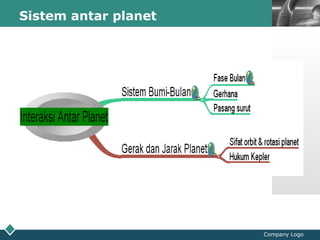
LOGOSistem antar planet
Company Logo
LOGO
Seri : Smart learning in digital era Tim UB
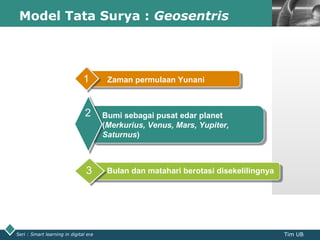
Model Tata Surya : Geosentris
Zaman permulaan Yunani1
Bumi sebagai pusat edar planet
(Merkurius, Venus, Mars, Yupiter,
Saturnus)
2
Bulan dan matahari berotasi disekelilingnya3
LOGO
www.themegallery.com Company Logo
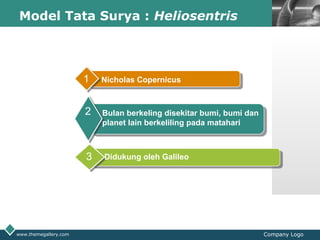
Model Tata Surya : Heliosentris
Nicholas Copernicus1
Bulan berkeling disekitar bumi, bumi dan
planet lain berkeliling pada matahari
2
Didukung oleh Galileo3
LOGO
www.themegallery.com Company Logo
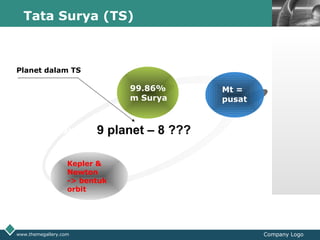
Tata Surya (TS)
Text
99.86%
m Surya
Mt =
pusat
Kepler &
Newton
-> bentuk
orbit
9 planet – 8 ???
Planet dalam TS
LOGO
www.themegallery.com Company Logo
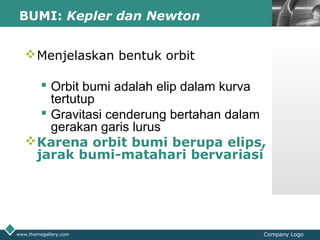
BUMI: Kepler dan Newton
Menjelaskan bentuk orbit
 Orbit bumi adalah elip dalam kurva
tertutup
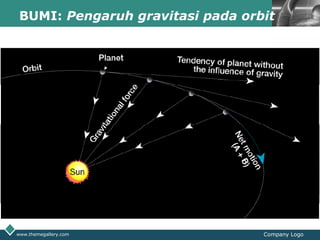
 Gravitasi cenderung bertahan dalam
gerakan garis lurus
Karena orbit bumi berupa elips,
jarak bumi-matahari bervariasi
LOGOBUMI: Pengaruh gravitasi pada orbit
www.themegallery.com Company Logo
LOGO
www.themegallery.com Company Logo
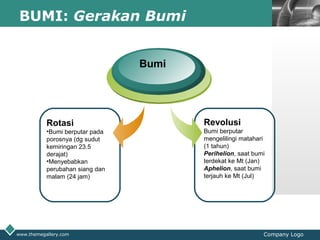
BUMI: Gerakan Bumi
Rotasi
•Bumi berputar pada
porosnya (dg sudut
kemiringan 23.5
derajat)
•Menyebabkan
perubahan siang dan
malam (24 jam)
Bumi
Revolusi
Bumi berputar
mengelilingi matahari
(1 tahun)
Perihelion, saat bumi
terdekat ke Mt (Jan)
Aphelion, saat bumi
terjauh ke Mt (Jul)
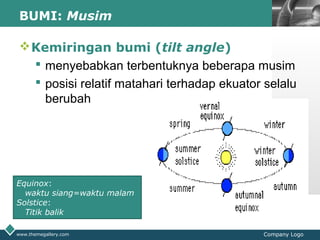
LOGOBUMI: Musim
Kemiringan bumi (tilt angle)
 menyebabkan terbentuknya beberapa musim
 posisi relatif matahari terhadap ekuator selalu
berubah
www.themegallery.com Company Logo
Equinox:
waktu siang=waktu malam
Solstice:
Titik balik
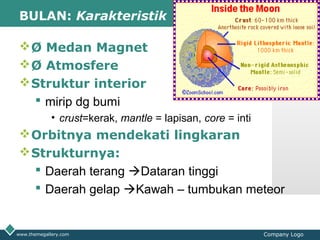
LOGOBULAN: Karakteristik
Ø Medan Magnet
Ø Atmosfere
Struktur interior
 mirip dg bumi
• crust=kerak, mantle = lapisan, core = inti
Orbitnya mendekati lingkaran
Strukturnya:
 Daerah terang Dataran tinggi
 Daerah gelap Kawah – tumbukan meteor
www.themegallery.com Company Logo
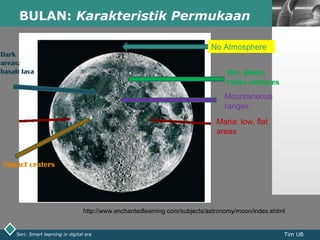
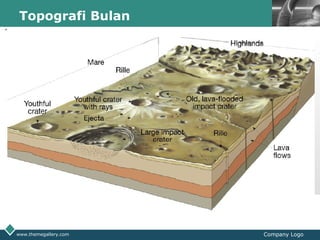
LOGOBULAN: Karakteristik Permukaan
Seri: Smart learning in digital era Tim UB
http://www.enchantedlearning.com/subjects/astronomy/moon/index.shtml
No Atmosphere
Mountaneous
ranges
Maria: low, flat
areas
Dry, dusty,
rocky surfaces
Impact craters
Dark
areas:
basalt lava
LOGOTopografi Bulan
www.themegallery.com Company Logo
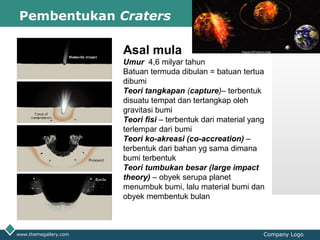
LOGOPembentukan Craters
www.themegallery.com Company Logo
Asal mula
Umur 4,6 milyar tahun
Batuan termuda dibulan = batuan tertua
dibumi
Teori tangkapan (capture)– terbentuk
disuatu tempat dan tertangkap oleh
gravitasi bumi
Teori fisi – terbentuk dari material yang
terlempar dari bumi
Teori ko-akreasi (co-accreation) –
terbentuk dari bahan yg sama dimana
bumi terbentuk
Teori tumbukan besar (large impact
theory) – obyek serupa planet
menumbuk bumi, lalu material bumi dan
obyek membentuk bulan
LOGO
www.themegallery.com Company Logo
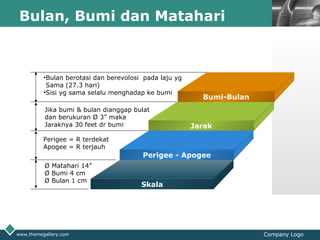
Bulan, Bumi dan Matahari
Jika bumi & bulan dianggap bulat
dan berukuran Ø 3” maka
Jaraknya 30 feet dr bumi
•Bulan berotasi dan berevolosi pada laju yg
Sama (27.3 hari)
•Sisi yg sama selalu menghadap ke bumi
Ø Matahari 14”
Ø Bumi 4 cm
Ø Bulan 1 cm
Bumi-Bulan
Jarak
Perigee - Apogee
Skala
Perigee = R terdekat
Apogee = R terjauh
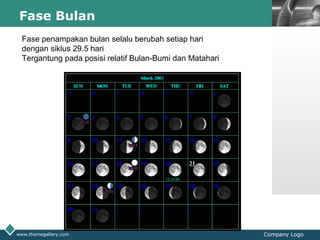
LOGOFase Bulan
www.themegallery.com Company Logo
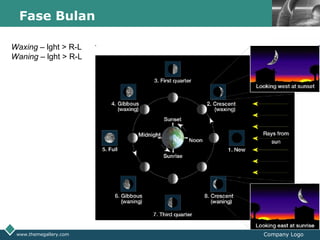
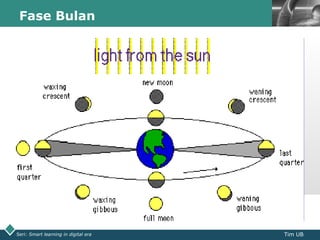
Fase penampakan bulan selalu berubah setiap hari
dengan siklus 29.5 hari
Tergantung pada posisi relatif Bulan-Bumi dan Matahari
LOGOFase Bulan
www.themegallery.com Company Logo
Waxing – lght > R-L
Waning – lght > R-L
LOGOFase Bulan
Seri: Smart learning in digital era Tim UB
LOGOGerhana
Seri: Smart learning in digital era Tim UB
Terjadi jika salah bumi atau bulan
mengalangi cahaya matahari
LOGOGerhana Matahari
Seri: Smart learning in digital era Tim UB
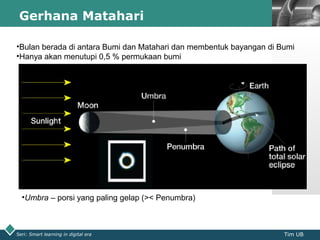
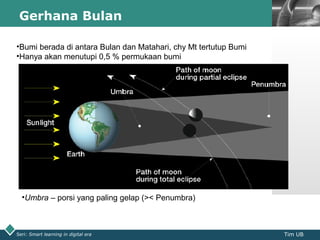
•Bulan berada di antara Bumi dan Matahari dan membentuk bayangan di Bumi
•Hanya akan menutupi 0,5 % permukaan bumi
•Umbra – porsi yang paling gelap (>< Penumbra)
LOGOGerhana Bulan
Seri: Smart learning in digital era Tim UB
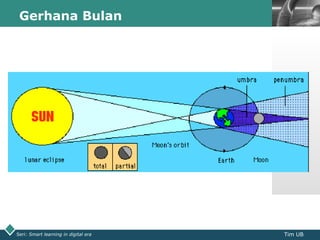
•Bumi berada di antara Bulan dan Matahari, chy Mt tertutup Bumi
•Hanya akan menutupi 0,5 % permukaan bumi
•Umbra – porsi yang paling gelap (>< Penumbra)
LOGOGerhana Bulan
Seri: Smart learning in digital era Tim UB
LOGO
www.themegallery.com
Company Logo
•Tinggi gelombang
dipengaruhi oleh gaya
gravitasi Bumi, Bulan
dan Matahari
•Gelombang panjang
terjadi secara periodik
•Beberapa daerah
mengalami 2 pasang
naik dan 2 pasang surut
Tinggi gelombang
dipengaruhi oleh:
Kecepatan, Jarak, Panjang
Tiupan angin
Gelombang Laut
Angin Pasang
LOGOTonjolan Pasang (Tide Bulges)
Seri: Smart learning in digital era Tim UB
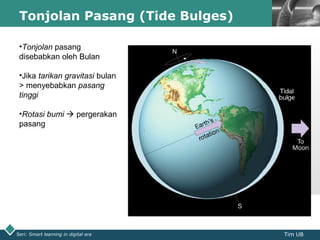
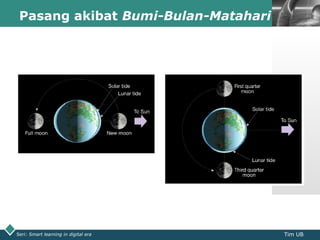
•Tonjolan pasang
disebabkan oleh Bulan
•Jika tarikan gravitasi bulan
> menyebabkan pasang
tinggi
•Rotasi bumi  pergerakan
pasang
LOGOPasang akibat Bumi-Bulan-Matahari
Seri: Smart learning in digital era Tim UB
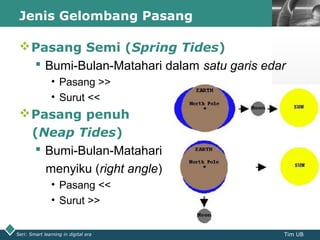
LOGOJenis Gelombang Pasang
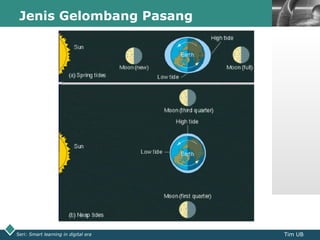
Pasang Semi (Spring Tides)
 Bumi-Bulan-Matahari dalam satu garis edar
• Pasang >>
• Surut <<
Pasang penuh
(Neap Tides)
 Bumi-Bulan-Matahari
menyiku (right angle)
• Pasang <<
• Surut >>
Seri: Smart learning in digital era Tim UB
LOGOJenis Gelombang Pasang
Seri: Smart learning in digital era Tim UB
Tim UB
LOGO
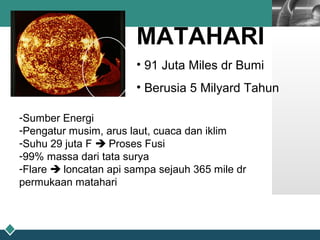
MATAHARI
• 91 Juta Miles dr Bumi
• Berusia 5 Milyard Tahun
-Sumber Energi
-Pengatur musim, arus laut, cuaca dan iklim
-Suhu 29 juta F  Proses Fusi
-99% massa dari tata surya
-Flare  loncatan api sampa sejauh 365 mile dr
permukaan matahari
LOGO
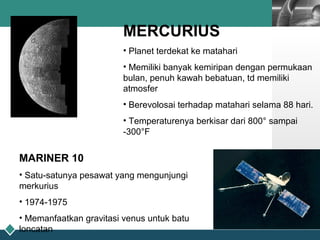
MERCURIUS
• Planet terdekat ke matahari
• Memiliki banyak kemiripan dengan permukaan
bulan, penuh kawah bebatuan, td memiliki
atmosfer
• Berevolosai terhadap matahari selama 88 hari.
• Temperaturenya berkisar dari 800° sampai
-300°F
MARINER 10
• Satu-satunya pesawat yang mengunjungi
merkurius
• 1974-1975
• Memanfaatkan gravitasi venus untuk batu
loncatan
LOGO
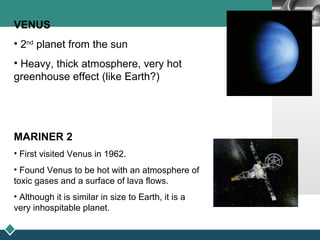
VENUS
• 2nd
planet from the sun
• Heavy, thick atmosphere, very hot
greenhouse effect (like Earth?)
MARINER 2
• First visited Venus in 1962.
• Found Venus to be hot with an atmosphere of
toxic gases and a surface of lava flows.
• Although it is similar in size to Earth, it is a
very inhospitable planet.
LOGO
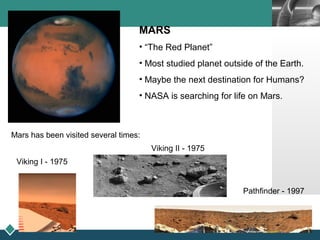
MARS
• “The Red Planet”
• Most studied planet outside of the Earth.
• Maybe the next destination for Humans?
• NASA is searching for life on Mars.
Mars has been visited several times:
Viking I - 1975
Viking II - 1975
Pathfinder - 1997
LOGOMARS (CON’T)
Additionally, we have 2 spacecraft orbiting the planet:
The Mars Global Surveyer The Mars Odyssey
Mission: To Map the surface Mission: To determine the
of Mars composition of the
soil and to find water
LOGO
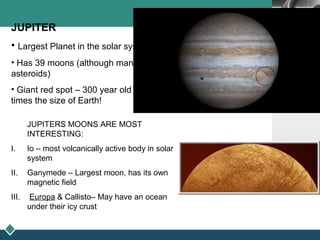
JUPITER
• Largest Planet in the solar system
• Has 39 moons (although many may be
asteroids)
• Giant red spot – 300 year old storm 3
times the size of Earth!
JUPITERS MOONS ARE MOST
INTERESTING:
I. Io – most volcanically active body in solar
system
II. Ganymede – Largest moon, has its own
magnetic field
III. Europa & Callisto– May have an ocean
under their icy crust
LOGO
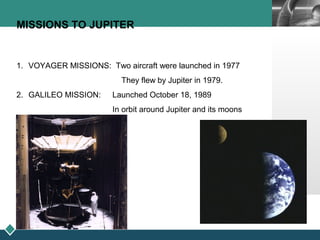
MISSIONS TO JUPITER
1. VOYAGER MISSIONS: Two aircraft were launched in 1977
They flew by Jupiter in 1979.
2. GALILEO MISSION: Launched October 18, 1989
In orbit around Jupiter and its moons
LOGO
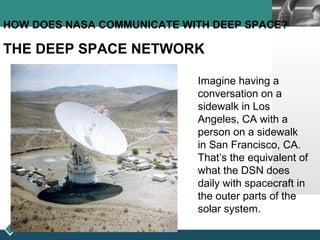
HOW DOES NASA COMMUNICATE WITH DEEP SPACE?
THE DEEP SPACE NETWORK
Imagine having a
conversation on a
sidewalk in Los
Angeles, CA with a
person on a sidewalk
in San Francisco, CA.
That’s the equivalent of
what the DSN does
daily with spacecraft in
the outer parts of the
solar system.
LOGO
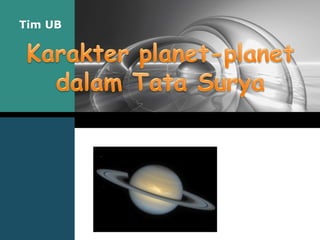
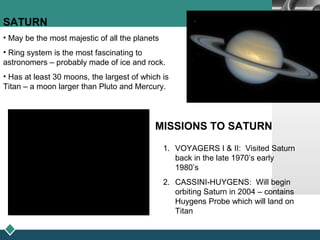
SATURN
• May be the most majestic of all the planets
• Ring system is the most fascinating to
astronomers – probably made of ice and rock.
• Has at least 30 moons, the largest of which is
Titan – a moon larger than Pluto and Mercury.
MISSIONS TO SATURN
1. VOYAGERS I & II: Visited Saturn
back in the late 1970’s early
1980’s
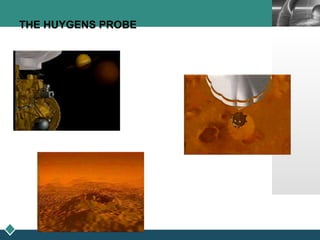
2. CASSINI-HUYGENS: Will begin
orbiting Saturn in 2004 – contains
Huygens Probe which will land on
Titan
LOGO
THE HUYGENS PROBE
LOGO
THE VOYAGER MISSIONS
http://voyager.jpl.nasa.gov/
LOGO
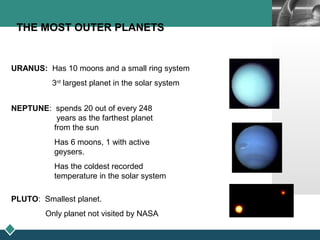
THE MOST OUTER PLANETS
URANUS: Has 10 moons and a small ring system
3rd
largest planet in the solar system
NEPTUNE: spends 20 out of every 248
years as the farthest planet
from the sun
Has 6 moons, 1 with active
geysers.
Has the coldest recorded
temperature in the solar system
PLUTO: Smallest planet.
Only planet not visited by NASA
Tim UB
Click to edit company slogan .

Tatasurya

  • 1.
    Tim UB Interaksi Antar Planet Seri: Smart learning in digital era
  • 2.
    LOGOEsplorasi Ruang Angkasa Pesawatulang alik Stasiun antariksa Wahana diluar orbit Kembali ke bulan Menjadikan bulan sebagai batu loncatan untuk penjelajahan ke planet lain www.themegallery.com Company Logo
  • 3.
  • 4.
    LOGO Seri : Smartlearning in digital era Tim UB Model Tata Surya : Geosentris Zaman permulaan Yunani1 Bumi sebagai pusat edar planet (Merkurius, Venus, Mars, Yupiter, Saturnus) 2 Bulan dan matahari berotasi disekelilingnya3
  • 5.
    LOGO www.themegallery.com Company Logo ModelTata Surya : Heliosentris Nicholas Copernicus1 Bulan berkeling disekitar bumi, bumi dan planet lain berkeliling pada matahari 2 Didukung oleh Galileo3
  • 6.
    LOGO www.themegallery.com Company Logo TataSurya (TS) Text 99.86% m Surya Mt = pusat Kepler & Newton -> bentuk orbit 9 planet – 8 ??? Planet dalam TS
  • 7.
    LOGO www.themegallery.com Company Logo BUMI:Kepler dan Newton Menjelaskan bentuk orbit  Orbit bumi adalah elip dalam kurva tertutup  Gravitasi cenderung bertahan dalam gerakan garis lurus Karena orbit bumi berupa elips, jarak bumi-matahari bervariasi
  • 8.
    LOGOBUMI: Pengaruh gravitasipada orbit www.themegallery.com Company Logo
  • 9.
    LOGO www.themegallery.com Company Logo BUMI:Gerakan Bumi Rotasi •Bumi berputar pada porosnya (dg sudut kemiringan 23.5 derajat) •Menyebabkan perubahan siang dan malam (24 jam) Bumi Revolusi Bumi berputar mengelilingi matahari (1 tahun) Perihelion, saat bumi terdekat ke Mt (Jan) Aphelion, saat bumi terjauh ke Mt (Jul)
  • 10.
    LOGOBUMI: Musim Kemiringan bumi(tilt angle)  menyebabkan terbentuknya beberapa musim  posisi relatif matahari terhadap ekuator selalu berubah www.themegallery.com Company Logo Equinox: waktu siang=waktu malam Solstice: Titik balik
  • 11.
    LOGOBULAN: Karakteristik Ø MedanMagnet Ø Atmosfere Struktur interior  mirip dg bumi • crust=kerak, mantle = lapisan, core = inti Orbitnya mendekati lingkaran Strukturnya:  Daerah terang Dataran tinggi  Daerah gelap Kawah – tumbukan meteor www.themegallery.com Company Logo
  • 12.
    LOGOBULAN: Karakteristik Permukaan Seri:Smart learning in digital era Tim UB http://www.enchantedlearning.com/subjects/astronomy/moon/index.shtml No Atmosphere Mountaneous ranges Maria: low, flat areas Dry, dusty, rocky surfaces Impact craters Dark areas: basalt lava
  • 13.
  • 14.
    LOGOPembentukan Craters www.themegallery.com CompanyLogo Asal mula Umur 4,6 milyar tahun Batuan termuda dibulan = batuan tertua dibumi Teori tangkapan (capture)– terbentuk disuatu tempat dan tertangkap oleh gravitasi bumi Teori fisi – terbentuk dari material yang terlempar dari bumi Teori ko-akreasi (co-accreation) – terbentuk dari bahan yg sama dimana bumi terbentuk Teori tumbukan besar (large impact theory) – obyek serupa planet menumbuk bumi, lalu material bumi dan obyek membentuk bulan
  • 15.
    LOGO www.themegallery.com Company Logo Bulan,Bumi dan Matahari Jika bumi & bulan dianggap bulat dan berukuran Ø 3” maka Jaraknya 30 feet dr bumi •Bulan berotasi dan berevolosi pada laju yg Sama (27.3 hari) •Sisi yg sama selalu menghadap ke bumi Ø Matahari 14” Ø Bumi 4 cm Ø Bulan 1 cm Bumi-Bulan Jarak Perigee - Apogee Skala Perigee = R terdekat Apogee = R terjauh
  • 16.
    LOGOFase Bulan www.themegallery.com CompanyLogo Fase penampakan bulan selalu berubah setiap hari dengan siklus 29.5 hari Tergantung pada posisi relatif Bulan-Bumi dan Matahari
  • 17.
    LOGOFase Bulan www.themegallery.com CompanyLogo Waxing – lght > R-L Waning – lght > R-L
  • 18.
    LOGOFase Bulan Seri: Smartlearning in digital era Tim UB
  • 19.
    LOGOGerhana Seri: Smart learningin digital era Tim UB Terjadi jika salah bumi atau bulan mengalangi cahaya matahari
  • 20.
    LOGOGerhana Matahari Seri: Smartlearning in digital era Tim UB •Bulan berada di antara Bumi dan Matahari dan membentuk bayangan di Bumi •Hanya akan menutupi 0,5 % permukaan bumi •Umbra – porsi yang paling gelap (>< Penumbra)
  • 21.
    LOGOGerhana Bulan Seri: Smartlearning in digital era Tim UB •Bumi berada di antara Bulan dan Matahari, chy Mt tertutup Bumi •Hanya akan menutupi 0,5 % permukaan bumi •Umbra – porsi yang paling gelap (>< Penumbra)
  • 22.
    LOGOGerhana Bulan Seri: Smartlearning in digital era Tim UB
  • 23.
    LOGO www.themegallery.com Company Logo •Tinggi gelombang dipengaruhioleh gaya gravitasi Bumi, Bulan dan Matahari •Gelombang panjang terjadi secara periodik •Beberapa daerah mengalami 2 pasang naik dan 2 pasang surut Tinggi gelombang dipengaruhi oleh: Kecepatan, Jarak, Panjang Tiupan angin Gelombang Laut Angin Pasang
  • 24.
    LOGOTonjolan Pasang (TideBulges) Seri: Smart learning in digital era Tim UB •Tonjolan pasang disebabkan oleh Bulan •Jika tarikan gravitasi bulan > menyebabkan pasang tinggi •Rotasi bumi  pergerakan pasang
  • 25.
    LOGOPasang akibat Bumi-Bulan-Matahari Seri:Smart learning in digital era Tim UB
  • 26.
    LOGOJenis Gelombang Pasang PasangSemi (Spring Tides)  Bumi-Bulan-Matahari dalam satu garis edar • Pasang >> • Surut << Pasang penuh (Neap Tides)  Bumi-Bulan-Matahari menyiku (right angle) • Pasang << • Surut >> Seri: Smart learning in digital era Tim UB
  • 27.
    LOGOJenis Gelombang Pasang Seri:Smart learning in digital era Tim UB
  • 28.
  • 29.
    LOGO MATAHARI • 91 JutaMiles dr Bumi • Berusia 5 Milyard Tahun -Sumber Energi -Pengatur musim, arus laut, cuaca dan iklim -Suhu 29 juta F  Proses Fusi -99% massa dari tata surya -Flare  loncatan api sampa sejauh 365 mile dr permukaan matahari
  • 30.
    LOGO MERCURIUS • Planet terdekatke matahari • Memiliki banyak kemiripan dengan permukaan bulan, penuh kawah bebatuan, td memiliki atmosfer • Berevolosai terhadap matahari selama 88 hari. • Temperaturenya berkisar dari 800° sampai -300°F MARINER 10 • Satu-satunya pesawat yang mengunjungi merkurius • 1974-1975 • Memanfaatkan gravitasi venus untuk batu loncatan
  • 31.
    LOGO VENUS • 2nd planet fromthe sun • Heavy, thick atmosphere, very hot greenhouse effect (like Earth?) MARINER 2 • First visited Venus in 1962. • Found Venus to be hot with an atmosphere of toxic gases and a surface of lava flows. • Although it is similar in size to Earth, it is a very inhospitable planet.
  • 32.
    LOGO MARS • “The RedPlanet” • Most studied planet outside of the Earth. • Maybe the next destination for Humans? • NASA is searching for life on Mars. Mars has been visited several times: Viking I - 1975 Viking II - 1975 Pathfinder - 1997
  • 33.
    LOGOMARS (CON’T) Additionally, wehave 2 spacecraft orbiting the planet: The Mars Global Surveyer The Mars Odyssey Mission: To Map the surface Mission: To determine the of Mars composition of the soil and to find water
  • 34.
    LOGO JUPITER • Largest Planetin the solar system • Has 39 moons (although many may be asteroids) • Giant red spot – 300 year old storm 3 times the size of Earth! JUPITERS MOONS ARE MOST INTERESTING: I. Io – most volcanically active body in solar system II. Ganymede – Largest moon, has its own magnetic field III. Europa & Callisto– May have an ocean under their icy crust
  • 35.
    LOGO MISSIONS TO JUPITER 1.VOYAGER MISSIONS: Two aircraft were launched in 1977 They flew by Jupiter in 1979. 2. GALILEO MISSION: Launched October 18, 1989 In orbit around Jupiter and its moons
  • 36.
    LOGO HOW DOES NASACOMMUNICATE WITH DEEP SPACE? THE DEEP SPACE NETWORK Imagine having a conversation on a sidewalk in Los Angeles, CA with a person on a sidewalk in San Francisco, CA. That’s the equivalent of what the DSN does daily with spacecraft in the outer parts of the solar system.
  • 37.
    LOGO SATURN • May bethe most majestic of all the planets • Ring system is the most fascinating to astronomers – probably made of ice and rock. • Has at least 30 moons, the largest of which is Titan – a moon larger than Pluto and Mercury. MISSIONS TO SATURN 1. VOYAGERS I & II: Visited Saturn back in the late 1970’s early 1980’s 2. CASSINI-HUYGENS: Will begin orbiting Saturn in 2004 – contains Huygens Probe which will land on Titan
  • 38.
  • 39.
  • 40.
    LOGO THE MOST OUTERPLANETS URANUS: Has 10 moons and a small ring system 3rd largest planet in the solar system NEPTUNE: spends 20 out of every 248 years as the farthest planet from the sun Has 6 moons, 1 with active geysers. Has the coldest recorded temperature in the solar system PLUTO: Smallest planet. Only planet not visited by NASA
  • 41.
    Tim UB Click toedit company slogan .

Editor's Notes

  • #30 The Source of all Energy (food) here on Earth Drives the seasons, currents in the ocean, weather, and climate Burns at 29 million degrees Fahrenheit – Process called FUSION Makes up 99% of the mass of the solar system In the picture up above you can see a “solar flare” that stretches 365,000 miles off the surface of the sun.
  • #31 Closest planet to the sun Much like our moon, rocky full of craters, no atmosphere Circles the sun every 88 days. Temperature range 800° to -300°F Only spacecraft to visit Mercury 1974-1975 Used the gravity of Venus to slingshot to Mercury (first gravity assist)