International Research Journal of Engineering and Technology (IRJET) e-ISSN: 2395-0056
Volume: 06 Issue: 02 | Feb 2019 www.irjet.net p-ISSN: 2395-0072
© 2019, IRJET | Impact Factor value: 7.211 | ISO 9001:2008 Certified Journal | Page 4638
Testing and Analysis of Shell and Tube Heat Exchanger by Using
Nanofluid Al2O3
Mr. Harshavardhan Yadav1, Mr.Jagdish shinde2, Ms. Rohini Sarawade3 , Mr.Akshay Patil4,
5
1234 Student, Dept. of Mech. Engineering, Zeal college of Engg. and Reasearch Pune , India
5 Professor, Dept. of Mech. Engineering, Zeal college of Engg. and Reasearch Pune ,India
---------------------------------------------------------------------***---------------------------------------------------------------------
Abstract - Cooling is indispensable for maintaining the
specified performance and responsibility terribly huge type of
product like automotive, computer, high power optical device
system. Whenever there is a increase the warmth load and
warmth fluxes caused by a lot of power and smaller size for
these product cooling is one of the technicalchallengefacedby
the industries like as microelectronics, transportation,
manufacturing. There are many single-phase liquid cooling
techniques such as micro channel heat sink and two-phase
liquid cooling technology like heat pipes, thermosyphones,
direct immersion cooling and spray cooling. Development of
the nano materials technology has made it possible to
structure a new type of heat transfer fluid formed by
suspending nanoparticles ( dia. < one hundred nm ).In
conventional base fluid like water and ethylene glycol choi
coined the term NANO FLUID to refer the thermal properties
superior to those of their base fluids. Due to rapid fluid mixing
effects strengthens the energy transport inside the nanofluids
by modifying the temperature profiles. Experimental
knowledge indicates that particle size, volume fraction and
properties of the nanoparticles influence the heat transfer
characteristics of nano fluids. This paper shows the analysis
work on mini Heat Exchanger Al2O3- Water based mostly
nano fluid.
Key Words: Nanofluid, Shell and Tube Heat Exchanger,
Thermal Conductivity, Al2O3, Nano Particles.
1.INTRODUCTION
Heat exchanger mistreatment nano fluid may be a device
during which the warmth transfer takes place by using nano
fluid. In this the working fluid is nano fluid. Nano fluid is
made by the suspending nano particles within the fluid like
water, antifreeze and oil, hydrocarbons, fluorocarbons etc.
1.1 Introduction to Nano Fluids
Nano fluid, first suggested by S.U.S. Choi of Argonne National
Lab in 1995, innovative operating fluid for warmth transfer
created by dispersing extremely thermal conducting solid
particles smaller than fifty nanometers in diameter in
ancient low thermal conducting heat transfer fluids like
water, engine oil, and ethanediol.
1.2 Introduction of Heat Exchanger
It is associate instrumentation that transfer the energy from
a hot fluid to a cold fluid, with maximum rate and minimum
investment and running costs. The heat transfer in a heat
exchanger typically involves convection on all sides of fluid
and conductivity through the wall separating the two fluids.
1.3 Why we use Nanofluid
The main goal or plan of mistreatment nano fluids is to
achieve highest attainable thermal propertiesatthesmallest
possible concentrations (preferably. <1% by volume) by
uniform dispersion and stable suspension of nano particles
(preferably<10 nm) in hot fluids. A nano fluid is a mixture of
water and suspended metallic nano particles. Since the
thermal conductivity of aluminous solids square measure
usually orders of magnitude beyond that of fluids it's
expected that a solid/fluid mixture can have higher effective
thermal conduction compared to the base fluid.
2. Project Work
2.1 Principal of Operation
Heat exchangers work as a result ofheatnaturallyflowsfrom
higher temperatureto lowertemperatures.Thus ifahotfluid
and a chilly fluid ar separated by a heat conducting surface
heat is transferred from the new fluid to the cold fluid.
Where, Nanofluids ar a brand new category of fluids built by
dispersing metric linear unit sized materials (nanoparticles,
nanofibers, nanotubes, nanowires,ordroplets)inbasefluids.
2.2 Analysis of Heat Exchanger
The thermal analysis of warmth money dealer is formed by
taking outlet temperature of fluid and it's then associated
with freelance parameters as follows,
Prof. Gadpayale U. k.
International Research Journal of Engineering and Technology (IRJET) e-ISSN: 2395-0056
Volume: 06 Issue: 02 | Feb 2019 www.irjet.net p-ISSN: 2395-0072
© 2019, IRJET | Impact Factor value: 7.211 | ISO 9001:2008 Certified Journal | Page 4639
Six independent and one variable which may be Th,o ,
Tc,o,or q dependent variable as given withintheontop
of equation for a given flow arrangement transferred
into 2 freelance and one dependent groups which are
dimensionless. By combining Differential energy
conservation equations for the control volume we get
Where, sign depends upon whether or not dTc is increasing or
decreasing with increasing prosecuting officer or Dx (i.e cross
sectional surface area and length). The overall rate of warmth
transfer equation on a differential base for the extent prosecuting
officer
is
Integrating the 2 higher than equations across the warmth money
dealerarea,weget
parameter is the actual mean temperature difference that
depends upon the money dealer flow arrangement and degree of
fluid mixture among every fluid stream.
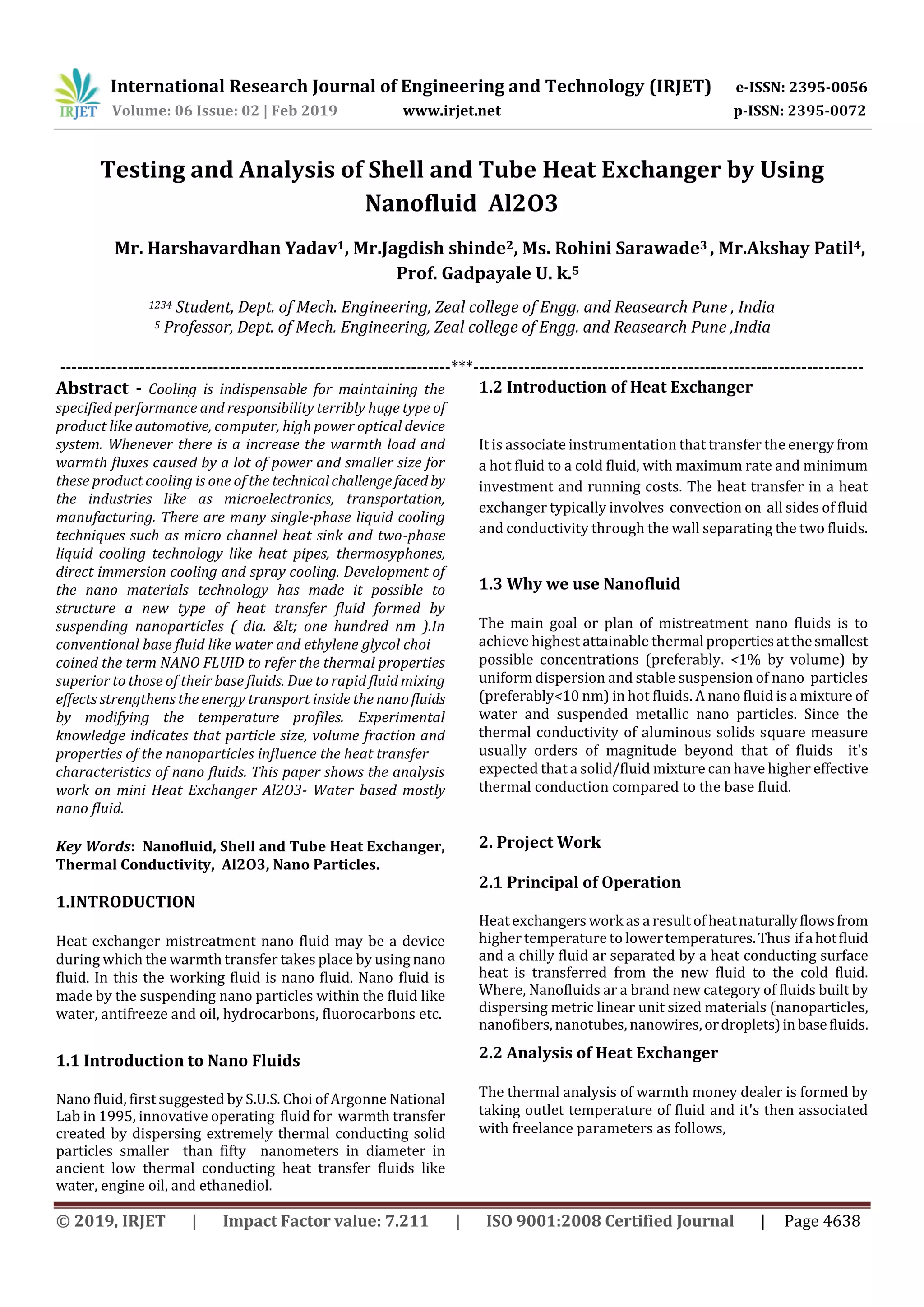
Fig -1: Shell and Tube Heat Exchanger
2.2 Mechanisms of Heat Conduction of Nano Fluid
Nano fluid is nothing but fluid particles which are less than
even a micron(nearly 10-9 times smaller) in diameter and
highly reactive and efficient material which can be used to
increase issue like rate of reaction, thermal conductivity of
any metal or material, theyarethatmuchreactiveandstrong.
Keblinski bestowed four doable ways in nano fluids which
can contribute to thermal conductivity.
(a) Brownian motion of nano particles.
(b) Liquid layering at the liquid/particle interface.
(c) flight nature of warmth transport in nano particles.
(d) Nano particle clustering in nano fluids.
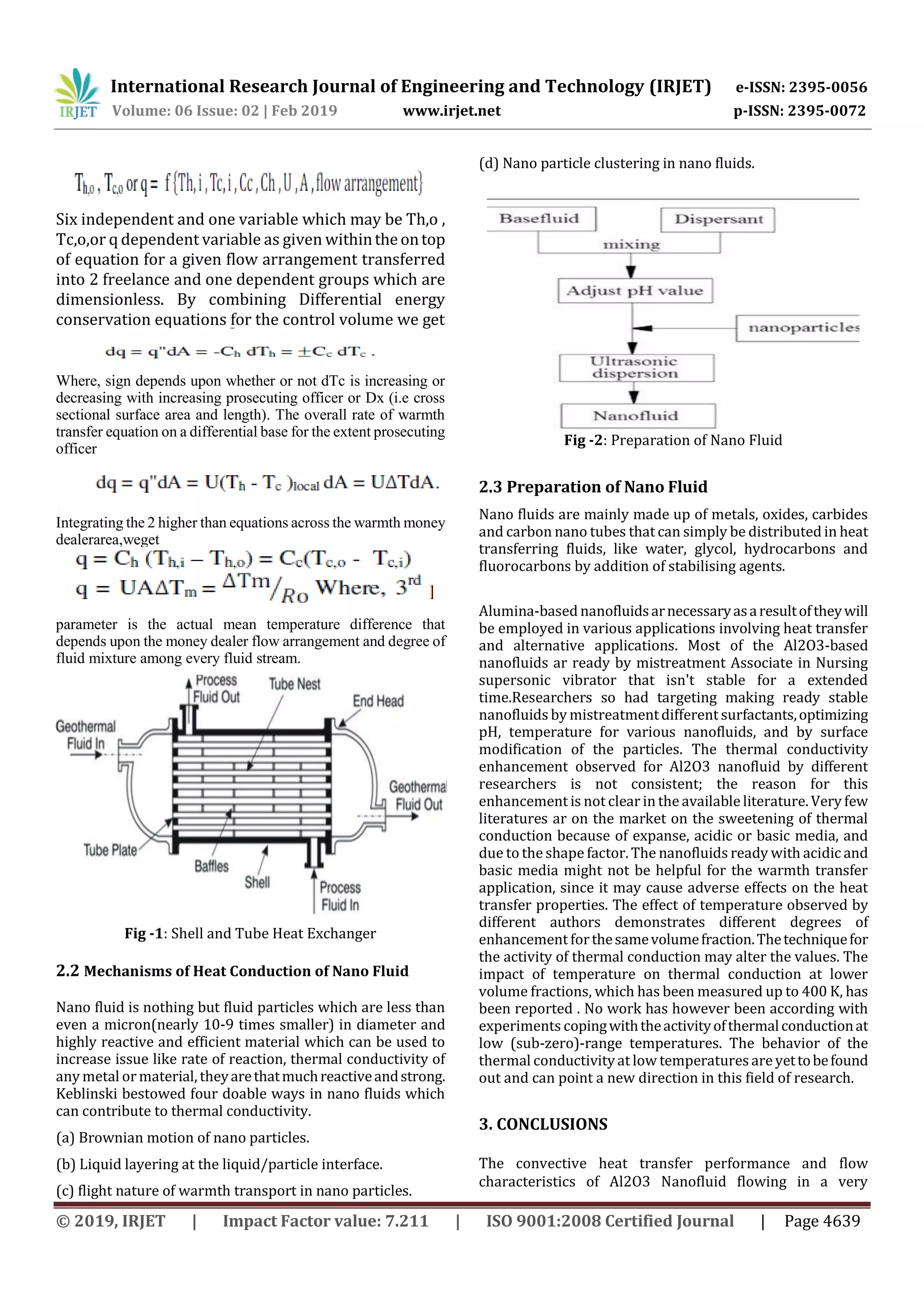
Fig -2: Preparation of Nano Fluid
2.3 Preparation of Nano Fluid
Nano fluids are mainly made up of metals, oxides, carbides
and carbon nano tubes that can simply be distributed in heat
transferring fluids, like water, glycol, hydrocarbons and
fluorocarbons by addition of stabilising agents.
Alumina-based nanofluidsarnecessaryasaresultoftheywill
be employed in various applications involving heat transfer
and alternative applications. Most of the Al2O3-based
nanofluids ar ready by mistreatment Associate in Nursing
supersonic vibrator that isn't stable for a extended
time.Researchers so had targeting making ready stable
nanofluids by mistreatmentdifferent surfactants,optimizing
pH, temperature for various nanofluids, and by surface
modification of the particles. The thermal conductivity
enhancement observed for Al2O3 nanofluid by different
researchers is not consistent; the reason for this
enhancement is not clear in the available literature. Very few
literatures ar on the market on the sweetening of thermal
conduction because of expanse, acidic or basic media, and
due to the shape factor. The nanofluids ready with acidic and
basic media might not be helpful for the warmth transfer
application, since it may cause adverse effects on the heat
transfer properties. The effect of temperature observed by
different authors demonstrates different degrees of
enhancement forthesamevolumefraction.Thetechniquefor
the activity of thermal conduction may alter the values. The
impact of temperature on thermal conduction at lower
volume fractions, which has been measured up to 400 K, has
been reported . No work has however been according with
experiments copingwiththeactivityofthermalconductionat
low (sub-zero)-range temperatures. The behavior of the
thermal conductivityat low temperaturesare yettobefound
out and can point a new direction in this field of research.
3. CONCLUSIONS
The convective heat transfer performance and flow
characteristics of Al2O3 Nanofluid flowing in a very
International Research Journal of Engineering and Technology (IRJET) e-ISSN: 2395-0056
Volume: 06 Issue: 02 | Feb 2019 www.irjet.net p-ISSN: 2395-0072
© 2019, IRJET | Impact Factor value: 7.211 | ISO 9001:2008 Certified Journal | Page 4640
horizontal shell and tube heat exchanger has been
experimentally investigated. Experimentshavebeencarried
out under turbulent conditions. The result of particle
concentration and therefore the painter variety on the
warmth transfer performance and flow behavior of the
Nanofluid has been determined. Importantconclusionshave
been obtained and are summarized as following:
1. Dispersion of the nanoparticles into the distilled water
increases the thermal conductivity and viscosity of the
Nanofluid,
this augmentation will increase with the rise in particle
concentrations.
2. At a particle volume concentration of 2% the use of
Al2O3/water Nanofluid gives significantly higher heat
transfer characteristics.
For example at the particle volume concentration of 2% the
overall heat transfer coefficient is 700.242 W/m2 K and for
the water it is 399.15 W/m2 K for a mass flow rate of 0.0125
L/s so the enhancement ratio of the overall heat transfer
coefficient is 1.754, this means the number of the general
heat transfer constant of the Nanofluid is fifty seven larger
than that of water. As for Nusselt variety, the value of
Nusselt number for 2% volume concentration is 587 and for
the distilled water it is 367.759 so the maximum
improvement quantitative relationatzero.0125L/sis1.596,
this means that Nusselt number of the nanofluid is 62.6%
greater than that of distilled water.
3. Friction issue will increase with the riseinparticlevolume
concentration. This is because of the increaseintheviscosity
of the nanofluid and it implies that the nanofluid incur very
little penalty in pressure drop.
ACKNOWLEDGEMENT
I would like to special thanks of gratitude to our Professor
Mr. Gadpayale U.K. who gave the golden opportunitytothise
wonderful project topic “ Testing And Analysis of Heat
Exchanger by Using NanoFluid Al2O3”, which also helped in
lot of research and we came to know about so many new
things I am really thankful to them.
REFERENCES
[1] Taylor, R.A.; et al. "Small particles, big impacts: Areview
of the diverse applications of nanofluids". Journal of
Applied Physics. 113 (1): 011301-011301-19.
doi:10.1063/1.4754271.
[2] S. Witharana, H. Chen, Y. Ding, “Stability of nanofluids in
quiescent and shear flow fields,” Nanoscale Research
Letters 2011.
[3] Forrester, D. M.; et al. (2016). "Experimental verification
of nanofluid shear-wave reconversion in ultrasonic
fields". Nanoscale. doi:10.1039/C5NR07396K.
[4] Kuznetsov, A.V.; Nield, D.A. "Natural convective
boundary-layer flow of a nanofluid past a vertical
plate". International Journal of Thermal Sciences.
[5] Chen H.; Witharana, S.; et al. (2009). "; Predicting
thermal physical phenomenon of liquid suspensions of
nanoparticles (nanofluids) supported Rheology".
Particuology.
[6] Malvandi, Amir (2016-06-01). "Anisotropic behavior of
magnetic nanofluids (MNFs) at film boiling over a
vertical cylinder within the presence of an identical
variable-directional magnetic field". Powder
Technology.
[7] Kakaç, Sadik; Anchasa Pramuanjaroenkij
(2009). "Review of convective heat transfer
enhancement with nanofluids". International Journal of
Heat and Mass Transfer.
BIOGRAPHIES
Mr. Harshavardhan Yadav , a B.E
Graduation studentinMeachanical
Engineering from Zeal College Of
Engineering And Reasearch , Pune
, Maharashtra , India .
Mr. Jagdish Shinde , a B.E
Graduation student in Mechanical
Engineering from Zeal College Of
Engineering And Reasearch,Pune,
Maharashtra , India .
Mr. Akshay Patil , a B.E Graduation
student in Mechanical Engineering
from Zeal College Of Engineering
And Reasearch , Pune , Mharashtra
, India
Ms. Rohini Sarawade , a B.E
Graduation student in Mechanical
Engineering from Zeal College Of
Engineering And Research, Pune ,
Maharashtra ,India.
Mr. Gadpayale U. K. , an Assistant
Professor in Mechanical
Engineering DepartmentfromZeal
College Of Engineering And
Reasearch ,Pune, Maharashtra,
India

IRJET- Testing and Analysis of Shell and Tube Heat Exchanger by using Nanofluid Al2O3

  • 1.
    International Research Journalof Engineering and Technology (IRJET) e-ISSN: 2395-0056 Volume: 06 Issue: 02 | Feb 2019 www.irjet.net p-ISSN: 2395-0072 © 2019, IRJET | Impact Factor value: 7.211 | ISO 9001:2008 Certified Journal | Page 4638 Testing and Analysis of Shell and Tube Heat Exchanger by Using Nanofluid Al2O3 Mr. Harshavardhan Yadav1, Mr.Jagdish shinde2, Ms. Rohini Sarawade3 , Mr.Akshay Patil4, 5 1234 Student, Dept. of Mech. Engineering, Zeal college of Engg. and Reasearch Pune , India 5 Professor, Dept. of Mech. Engineering, Zeal college of Engg. and Reasearch Pune ,India ---------------------------------------------------------------------***--------------------------------------------------------------------- Abstract - Cooling is indispensable for maintaining the specified performance and responsibility terribly huge type of product like automotive, computer, high power optical device system. Whenever there is a increase the warmth load and warmth fluxes caused by a lot of power and smaller size for these product cooling is one of the technicalchallengefacedby the industries like as microelectronics, transportation, manufacturing. There are many single-phase liquid cooling techniques such as micro channel heat sink and two-phase liquid cooling technology like heat pipes, thermosyphones, direct immersion cooling and spray cooling. Development of the nano materials technology has made it possible to structure a new type of heat transfer fluid formed by suspending nanoparticles ( dia. &lt; one hundred nm ).In conventional base fluid like water and ethylene glycol choi coined the term NANO FLUID to refer the thermal properties superior to those of their base fluids. Due to rapid fluid mixing effects strengthens the energy transport inside the nanofluids by modifying the temperature profiles. Experimental knowledge indicates that particle size, volume fraction and properties of the nanoparticles influence the heat transfer characteristics of nano fluids. This paper shows the analysis work on mini Heat Exchanger Al2O3- Water based mostly nano fluid. Key Words: Nanofluid, Shell and Tube Heat Exchanger, Thermal Conductivity, Al2O3, Nano Particles. 1.INTRODUCTION Heat exchanger mistreatment nano fluid may be a device during which the warmth transfer takes place by using nano fluid. In this the working fluid is nano fluid. Nano fluid is made by the suspending nano particles within the fluid like water, antifreeze and oil, hydrocarbons, fluorocarbons etc. 1.1 Introduction to Nano Fluids Nano fluid, first suggested by S.U.S. Choi of Argonne National Lab in 1995, innovative operating fluid for warmth transfer created by dispersing extremely thermal conducting solid particles smaller than fifty nanometers in diameter in ancient low thermal conducting heat transfer fluids like water, engine oil, and ethanediol. 1.2 Introduction of Heat Exchanger It is associate instrumentation that transfer the energy from a hot fluid to a cold fluid, with maximum rate and minimum investment and running costs. The heat transfer in a heat exchanger typically involves convection on all sides of fluid and conductivity through the wall separating the two fluids. 1.3 Why we use Nanofluid The main goal or plan of mistreatment nano fluids is to achieve highest attainable thermal propertiesatthesmallest possible concentrations (preferably. <1% by volume) by uniform dispersion and stable suspension of nano particles (preferably<10 nm) in hot fluids. A nano fluid is a mixture of water and suspended metallic nano particles. Since the thermal conductivity of aluminous solids square measure usually orders of magnitude beyond that of fluids it's expected that a solid/fluid mixture can have higher effective thermal conduction compared to the base fluid. 2. Project Work 2.1 Principal of Operation Heat exchangers work as a result ofheatnaturallyflowsfrom higher temperatureto lowertemperatures.Thus ifahotfluid and a chilly fluid ar separated by a heat conducting surface heat is transferred from the new fluid to the cold fluid. Where, Nanofluids ar a brand new category of fluids built by dispersing metric linear unit sized materials (nanoparticles, nanofibers, nanotubes, nanowires,ordroplets)inbasefluids. 2.2 Analysis of Heat Exchanger The thermal analysis of warmth money dealer is formed by taking outlet temperature of fluid and it's then associated with freelance parameters as follows, Prof. Gadpayale U. k.
  • 2.
    International Research Journalof Engineering and Technology (IRJET) e-ISSN: 2395-0056 Volume: 06 Issue: 02 | Feb 2019 www.irjet.net p-ISSN: 2395-0072 © 2019, IRJET | Impact Factor value: 7.211 | ISO 9001:2008 Certified Journal | Page 4639 Six independent and one variable which may be Th,o , Tc,o,or q dependent variable as given withintheontop of equation for a given flow arrangement transferred into 2 freelance and one dependent groups which are dimensionless. By combining Differential energy conservation equations for the control volume we get Where, sign depends upon whether or not dTc is increasing or decreasing with increasing prosecuting officer or Dx (i.e cross sectional surface area and length). The overall rate of warmth transfer equation on a differential base for the extent prosecuting officer is Integrating the 2 higher than equations across the warmth money dealerarea,weget parameter is the actual mean temperature difference that depends upon the money dealer flow arrangement and degree of fluid mixture among every fluid stream. Fig -1: Shell and Tube Heat Exchanger 2.2 Mechanisms of Heat Conduction of Nano Fluid Nano fluid is nothing but fluid particles which are less than even a micron(nearly 10-9 times smaller) in diameter and highly reactive and efficient material which can be used to increase issue like rate of reaction, thermal conductivity of any metal or material, theyarethatmuchreactiveandstrong. Keblinski bestowed four doable ways in nano fluids which can contribute to thermal conductivity. (a) Brownian motion of nano particles. (b) Liquid layering at the liquid/particle interface. (c) flight nature of warmth transport in nano particles. (d) Nano particle clustering in nano fluids. Fig -2: Preparation of Nano Fluid 2.3 Preparation of Nano Fluid Nano fluids are mainly made up of metals, oxides, carbides and carbon nano tubes that can simply be distributed in heat transferring fluids, like water, glycol, hydrocarbons and fluorocarbons by addition of stabilising agents. Alumina-based nanofluidsarnecessaryasaresultoftheywill be employed in various applications involving heat transfer and alternative applications. Most of the Al2O3-based nanofluids ar ready by mistreatment Associate in Nursing supersonic vibrator that isn't stable for a extended time.Researchers so had targeting making ready stable nanofluids by mistreatmentdifferent surfactants,optimizing pH, temperature for various nanofluids, and by surface modification of the particles. The thermal conductivity enhancement observed for Al2O3 nanofluid by different researchers is not consistent; the reason for this enhancement is not clear in the available literature. Very few literatures ar on the market on the sweetening of thermal conduction because of expanse, acidic or basic media, and due to the shape factor. The nanofluids ready with acidic and basic media might not be helpful for the warmth transfer application, since it may cause adverse effects on the heat transfer properties. The effect of temperature observed by different authors demonstrates different degrees of enhancement forthesamevolumefraction.Thetechniquefor the activity of thermal conduction may alter the values. The impact of temperature on thermal conduction at lower volume fractions, which has been measured up to 400 K, has been reported . No work has however been according with experiments copingwiththeactivityofthermalconductionat low (sub-zero)-range temperatures. The behavior of the thermal conductivityat low temperaturesare yettobefound out and can point a new direction in this field of research. 3. CONCLUSIONS The convective heat transfer performance and flow characteristics of Al2O3 Nanofluid flowing in a very
  • 3.
    International Research Journalof Engineering and Technology (IRJET) e-ISSN: 2395-0056 Volume: 06 Issue: 02 | Feb 2019 www.irjet.net p-ISSN: 2395-0072 © 2019, IRJET | Impact Factor value: 7.211 | ISO 9001:2008 Certified Journal | Page 4640 horizontal shell and tube heat exchanger has been experimentally investigated. Experimentshavebeencarried out under turbulent conditions. The result of particle concentration and therefore the painter variety on the warmth transfer performance and flow behavior of the Nanofluid has been determined. Importantconclusionshave been obtained and are summarized as following: 1. Dispersion of the nanoparticles into the distilled water increases the thermal conductivity and viscosity of the Nanofluid, this augmentation will increase with the rise in particle concentrations. 2. At a particle volume concentration of 2% the use of Al2O3/water Nanofluid gives significantly higher heat transfer characteristics. For example at the particle volume concentration of 2% the overall heat transfer coefficient is 700.242 W/m2 K and for the water it is 399.15 W/m2 K for a mass flow rate of 0.0125 L/s so the enhancement ratio of the overall heat transfer coefficient is 1.754, this means the number of the general heat transfer constant of the Nanofluid is fifty seven larger than that of water. As for Nusselt variety, the value of Nusselt number for 2% volume concentration is 587 and for the distilled water it is 367.759 so the maximum improvement quantitative relationatzero.0125L/sis1.596, this means that Nusselt number of the nanofluid is 62.6% greater than that of distilled water. 3. Friction issue will increase with the riseinparticlevolume concentration. This is because of the increaseintheviscosity of the nanofluid and it implies that the nanofluid incur very little penalty in pressure drop. ACKNOWLEDGEMENT I would like to special thanks of gratitude to our Professor Mr. Gadpayale U.K. who gave the golden opportunitytothise wonderful project topic “ Testing And Analysis of Heat Exchanger by Using NanoFluid Al2O3”, which also helped in lot of research and we came to know about so many new things I am really thankful to them. REFERENCES [1] Taylor, R.A.; et al. "Small particles, big impacts: Areview of the diverse applications of nanofluids". Journal of Applied Physics. 113 (1): 011301-011301-19. doi:10.1063/1.4754271. [2] S. Witharana, H. Chen, Y. Ding, “Stability of nanofluids in quiescent and shear flow fields,” Nanoscale Research Letters 2011. [3] Forrester, D. M.; et al. (2016). "Experimental verification of nanofluid shear-wave reconversion in ultrasonic fields". Nanoscale. doi:10.1039/C5NR07396K. [4] Kuznetsov, A.V.; Nield, D.A. "Natural convective boundary-layer flow of a nanofluid past a vertical plate". International Journal of Thermal Sciences. [5] Chen H.; Witharana, S.; et al. (2009). "; Predicting thermal physical phenomenon of liquid suspensions of nanoparticles (nanofluids) supported Rheology". Particuology. [6] Malvandi, Amir (2016-06-01). "Anisotropic behavior of magnetic nanofluids (MNFs) at film boiling over a vertical cylinder within the presence of an identical variable-directional magnetic field". Powder Technology. [7] Kakaç, Sadik; Anchasa Pramuanjaroenkij (2009). "Review of convective heat transfer enhancement with nanofluids". International Journal of Heat and Mass Transfer. BIOGRAPHIES Mr. Harshavardhan Yadav , a B.E Graduation studentinMeachanical Engineering from Zeal College Of Engineering And Reasearch , Pune , Maharashtra , India . Mr. Jagdish Shinde , a B.E Graduation student in Mechanical Engineering from Zeal College Of Engineering And Reasearch,Pune, Maharashtra , India . Mr. Akshay Patil , a B.E Graduation student in Mechanical Engineering from Zeal College Of Engineering And Reasearch , Pune , Mharashtra , India Ms. Rohini Sarawade , a B.E Graduation student in Mechanical Engineering from Zeal College Of Engineering And Research, Pune , Maharashtra ,India. Mr. Gadpayale U. K. , an Assistant Professor in Mechanical Engineering DepartmentfromZeal College Of Engineering And Reasearch ,Pune, Maharashtra, India